Fuzzy Controller Based 3Phase 4Wire Shunt Active Filter
for Mitigation of Current Harmonics with Combined p-q
and I
d
-I
q
Control Strategies
Mikkili Suresh, Anup Kumar Panda, Y. Suresh
Department of Electrical Engineering, National Institute of Technology, Rourkela, India
E-mail: [email protected], [email protected], [email protected]
Received November 14, 2010; revised December 15, 2010; accepted December 16, 2010
Abstract
As more and more variable frequency drives (VFDs), electronic ballasts, battery chargers, and static Var compensators are installed in facilities, the problems related to harmonics are expected to get worse. As a result Active power filter (APF) gains much more attention due to excellent harmonic compensation. But still the performance of the active filter seems to be in contradictions with different control strategies. This paper presents detailed analysis to compare and elevate the performance of two control strategies for ex-tracting reference currents of shunt active filters under balanced, un-balanced and non-sinusoidal conditions by using Fuzzy controller. The well known methods, instantaneous real active and reactive power method (p-q) and active and reactive current method (id-iq) are two control methods which are extensively used in active filters. Extensive Simulations are carried out with fuzzy controller for both p-q and Id-Iq methods for different voltage conditions and adequate results were presented. Simulation results validate the superior per-formance of active and reactive current control strategy (id-iq) with fuzzy controller over active and reactive power control strategy (p-q) with fuzzy controller.
Keywords:Harmonic Compensation, Shunt Active Power Filter, p-q Control Strategy, id-iq Control Strategy, Fuzzy Controller
1. Introduction
Highly automatic electric equipments, in particular, cause enormous economic loss every year. Owing both power suppliers and power consumers are concerned about the power quality problems and compensation techniques. In recent years, single-phase electronic equipments have been widely used in domestic, educational and commer-cial appliances. These equipments include computers, communication equipments, electronic lighting ballasts etc. Also, a large number of computers are turned on at the same time. Each computer and its related devices have a diode rectifier to convert AC electricity to DC one. In other words, those equipments draw non- sinusoidal currents which pollute the utility line due to the current harmonics generated by the nonlinear loads [1]. It is noted that non-sinusoidal current results in many prob-lems for the utility power supply company, such as: low power factor, low energy efficiency, electromagnetic
interference (EMI), distortion of line voltage etc. and it is noted that, in three-phase four-wire system, zero line may be overheated or causes fire disaster as a result of excessive harmonic current going through the zero line three times or times that of three. Thus a perfect com-pensator is necessary to avoid the consequences due to harmonics [2]. Though several control strategies have been developed but still two control theories, instanta-neous active and reactive currents (id-iq) method and
in-stantaneous active and reactive power (p-q) methods are always dominant. Present paper mainly focused on two control strategies (p-q and Id-Iq) with fuzzy controller [3].
To validate current observations, Extensive Simulations are carried out with fuzzy controller for both p-q and Id-Iq
methods for different voltage conditions like sinusoidal, non-sinusoidal, and un-balanced conditions and adequate results were presented. On observing the performance of
id-iq control strategy with fuzzy controller is quite good
M. SURESH ET AL. 44
2.
Control Strategy
In this section two control strategies are discussed in detail. Ideal analysis has done in steady state conditions of the active power filter. Steady state analysis using Fast Fourier Transform (FFT) for the two control methods that are presented are now briefly enlightened.
2.1. Instantaneous Real and Reactive Power Method (p-q)
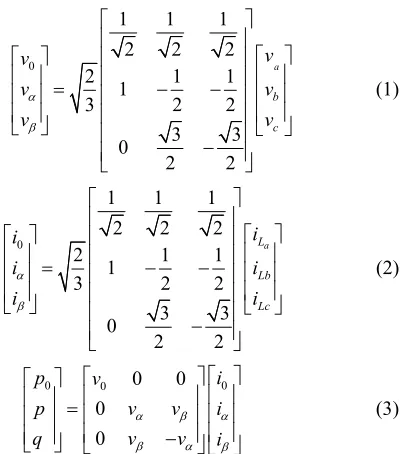
The active filter currents are achieved from the instanta-neous active and reactive powers p and q of the non-linear load. Figure 1 shows the block diagram to attain reference currents from load. Transformation of the phase voltages va, vb, and vc and the load currents iLa, iLb, and iLcinto the α - β orthogonal coordinates are given
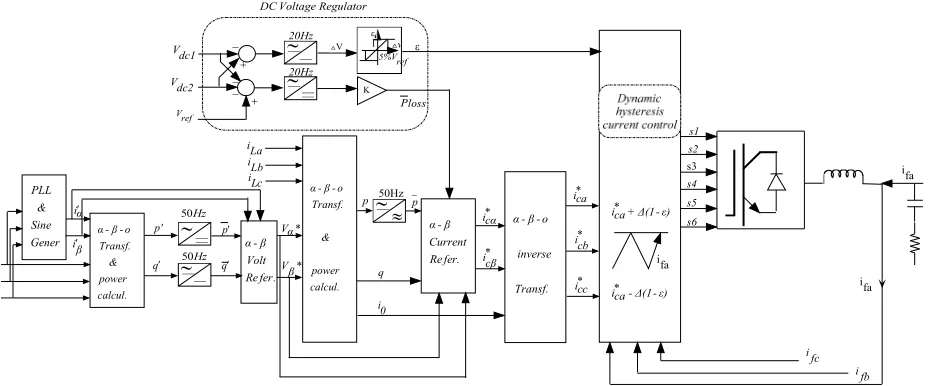
in Equation (1-2). The compensation objectives of active power filters [4,5] are the harmonics present in the input currents. Present architecture represents three phase four wire and it is realized with constant power controls strategy [6]. Figure 2 illustrates control block diagram and Inputs to the system are phase voltages and line cur-rents of the load. It was recognized that resonance at relatively high frequency might appear between the source impedance. So a small high pass filter is incorpo-rated in the system. The power calculation is given in detail form in Equation (3).
0
1 1 1
2 2 2
2 1 1
1
3 2 2
3 3 0 2 2 a b c v v v v v v
(1)
0
1 1 1
2 2 2
2 1 1
1
3 2 2
3 3 0 2 2 a L Lb Lc i i i i i i i (2)
0 0 0 0 0
0 0
p v i
p v v
q v v i
(3)
From Figure 2 we can observe a high pass filter with cut off frequency 50 Hz separates the powers p from
and a low – p
Pass filter separates p0 from 0. The powers current and 0 of the load, together with q, should be com-pensated to provide optimal power flow to the source. It is Important to note that system used is three phase four wire, so additional neutral currents has to be supplied by the shunt active power filter thus Ploss is incorporated to
[image:2.595.339.541.77.304.2]p p p
[image:2.595.111.493.434.700.2]K
V
* ica+Δ(1-ε)
* ica-Δ(1-ε)
α-β-ο Transf. & power calcul.
α-β-ο Transf. & power calcul. α-β Volt Re fer. PLL & Sine Gener iLa iLb iLc 50Hz 50Hz p' q p' q α-β Current Re fer. * icα * icβ
α-β-ο
inverse Transf. * ica * icb * icc Va Vb Vc
iβ iα
Vdc1
Vdc2
DC Voltage Regulator
Vref
50Hz
V *α
[image:3.595.70.534.83.276.2]V *β p q i0 20Hz 20Hz Ploss p v 5%Vref 1 ifa s1 s2 s3 s4 s5 s6 ifa i fc i fb ifa
Figure 2. Control block diagram of shunt active power filter.
correct compensation error due to feed forward network unable to suppress the zero sequence power. Since active filter compensates the whole neutral current of the load in the presence of zero-sequence voltages, the shunt ac-tive filter eventually supplies po. Consequently if active
filter supplies po to the load, this make changes in dc
voltage regulator, hence additional amount of active power is added automatically to Ploss which mainly
pro-vide energy to cover all the losses in the power circuit in the active filter. Thus, with this control strategy shunt active filter gains additional capability to reduce neutral currents and there-by supply necessary compensation when it is most required in the system. Thus the αβ ref-erence currents can be found with following equation [7].
2 2
* 1
*
c c
i v v p p
v v
i v v q
(4)
0 Loss
p p p
where p is the ac component / oscillating value of p 0
p is the dc component of p0
loss
P is the losses in the active filter
loss
P is the average value of Ploss
Δp Provides energy balance inside the active power filter and using Equation (5) inverse transformation can be done. 0 1 1 0 2 *
2 1 1 3
*
3 2 2 2 *
*
1 1 3
2 2 2 ca cb c c cc i i i i i
where ica*, icb*, icc* are the instantaneous three-phase
current references
In addition PLL (Phase locked loop) employed in shunt filter tracks automatically, the system frequency and fundamental positive–sequence component of three phase generic input signal [8]. Appropriate design of PLL allows proper operation under distorted and unbal-anced voltage conditions. Controller includes small changes in positive sequence detector as harmonic com-pensation is mainly concentrated on three phase four wire. As we know in three- phase three wire, va′, vb′, vc′
are used in transformations which resemble absence of zero sequence component and it is given in Equation (6). Thus in three phase four wire it was modified as vα′, vβ′
and it is given in Equation (7).
1 0
2 1 3
3 2 2
1 3 2 2 a b c v v v v v (6) 2 2 1
v i i p
v i i i i q
(7)
DC voltage regulator (p-q):
* i
(5)
The dc capacitor voltages Vdc1 and Vdc2 may be
con-trolled by a dc voltage regulator. A low-pass filter with cut-off frequency 20 Hz is used to render it insensitive to the fundamental frequency (50 Hz) voltage variations.
The filtered voltage difference ∆V = Vdc2 − Vdc1
M. SURESH ET AL. 46
1; 0.05
; 0.05 0.05
0.05
1; 0.05
ref
ref ref
ref
ref
V V
V
V V V
V
V V
where Vref is a pre-defined dc voltage reference and 0.05 Vref was arbitrarily chosen as an acceptable tolerance
margin for voltage variations.
If (Vdc1 + Vdc2) < Vref, the PWM inverter should absorb
energy from the ac network to charge the dc capacitor. The inverse occur if (Vdc1 + Vdc2) > Vref.
The signal Ploss generated in the dc voltage regulator
is useful for correcting voltage variations due to com-pensation errors that may occur during the transient re-sponse of shunt active filter.
2.2. Instantaneous Active and Reactive Current Method (id – iq)
In this method reference currents are obtained through instantaneous active and reactive currents id and iq of the
non linear load. Calculations follows Similar to the in-stantaneous power theory, however dq load currents can be obtained from Equation (8). Two stage transforma-tions give away relation between the stationary and ro-tating reference frame with active and reactive current method [9-11]. Figure 4 shows voltage and current vec-tors in stationary and rotating reference frames. The transformation angle ‘θ’ is sensible to all voltage har-monics and unbalanced voltages; as a result dθ/dt may not be constant. Arithmetical relations are given in Equa-tions (8) and (9); finally reference currents can be ob-tained from Equation (10).
2 2
1 d
q
i v v i
i v v v v i
(8)
where iα, iβare the instantaneousα-βaxis current
refer-ences
cos sin
sin cos
d q
i i
i i
(9)
2 2
1 d
q
ic
ic v v
ic
ic v v v v
(10)
where icd, icq are compensation currents.
One of the advantages of this method is that angle θ is calculated directly from main voltages and thus makes this method frequency independent by avoiding the PLL in the control circuit. Consequently synchronizing prob-lems with unbalanced and distorted conditions of main voltages are also evaded. Thus id – iq achieves large
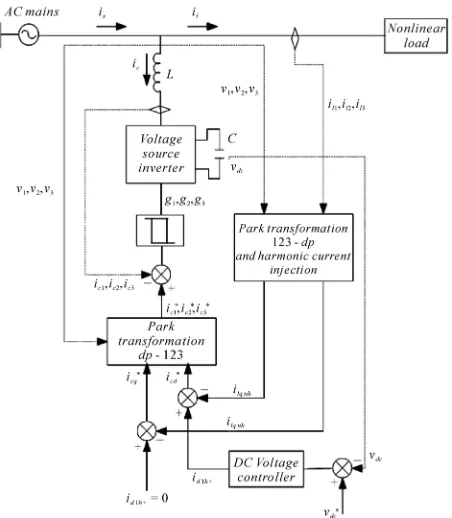
quency operating limit essentially by the cut-off fre-quency of voltage source inverter (VSI) [12]. Figures 3 and 5 show the control diagram for shunt active filter and harmonic injection circuit. On owing load currents id and iqare obtained from park transformation then they are
[image:4.595.92.262.80.138.2]allowed to pass through the high pass filter to eliminate dc components in the nonlinear load currents. Filters used in the circuit are Butterworth type and to reduce the influence of high pass filter an alternative high pass filter (AHPF) can be used in the circuit. It can be obtained through the low pass filter (LPF) of same order and cut-off frequency simply difference between the input signal and the filtered one, which is clearly shown in
[image:4.595.311.537.246.505.2]Figure 3. Active powers filter control circuit.
[image:4.595.316.524.541.701.2]
Figure 5. Park transformation and harmonic current injection circuit.
Figure 5. Butterworth filters used in harmonic injecting circuit have cut-off frequency equal to one half of the main frequency (fc = f/2), with this a small phase shift in
harmonics and sufficiently high transient response can be obtained.
DC Voltage regulator (Id-Iq)
The function of voltage regulator on dc side is per-formed by proportional — integral (PI) controller, inputs to the PI controller are, change in dc link voltage (Vdc)
and reference voltage (Vdc*), on regulation of first
har-monic active current of positive sequence id1h+it is
pos-sible to control the active power flow in the VSI and thus the capacitor voltage Vdc.
In similar fashion reactive power flow is controlled by first harmonic reactive current of positive sequence iq1h+.
On the contrary the primary end of the active power fil-ters is just the exclusion of the harmonics caused by nonlinear loads hence the current iq1h+ is always set to
zero.
3. Construction of Fuzzy Logic Controller
The concept of Fuzzy Logic (FL) was proposed by Pro-fessor Lotfi Zadeh in 1965, at first as a way of process-ing data by allowprocess-ing partial set membership rather than crisp membership. Soon after, it was proven to be an excellent choice for many control system applications since it mimics human control logic.
Figure 6 shows the internal structure of the control circuit. The control scheme consists of Fuzzy controller, limiter, and three phase sine wave generator for reference current generation and generation of switching signals [13]. The peak value of reference currents is estimated by regulating the DC link voltage. The actual capacitor
signal is then processed through a Fuzzy controller, which contributes to zero steady error in tracking the reference current signal.
A fuzzy controller conv
voltage is compared with a set reference value. The error
erts a linguistic control strat-eg
lows:
of dis-co
ication using Mamdani's ‘min’ operator.
s of this rule base table are determined ba
a numerical va
generate required output in a linguistic variable (Fuzzy Number), accord- y into an automatic control strategy, and fuzzy rules are constructed by expert experience or knowledge data-base. Firstly, input voltage Vdc and the input reference
voltage Vdc-ref have been placed of the angular velocity to
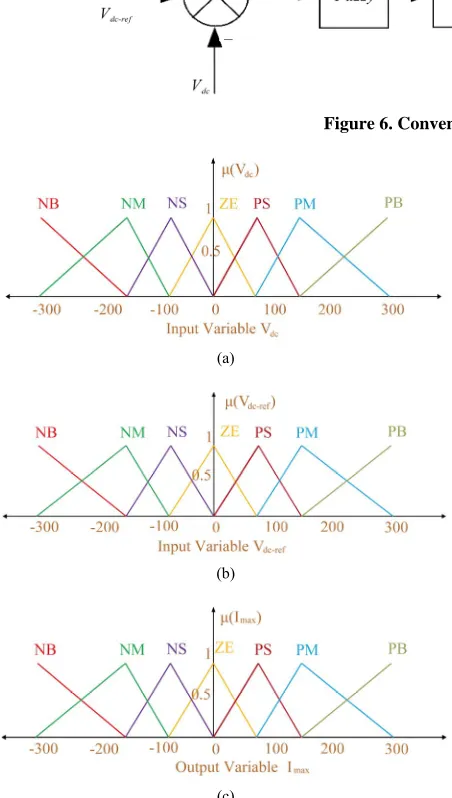
be the input variables of the fuzzy logic controller [14]. Then the output variable of the fuzzy logic controller is presented by the control Current Imax. To convert these
numerical variables into linguistic variables, the follow-ing seven fuzzy levels or sets are chosen as: NB (nega-tive big), NM (nega(nega-tive medium), NS (nega(nega-tive small), ZE (zero), PS (positive small), PM (positive medium), and PB (positive big) as shown in Figure 7.
The fuzzy controller is characterized as fol 1) Seven fuzzy sets for each input and output. 2) Fuzzification using continuous universe urse.
3) Impl
4) De-fuzzification using the 'centroid' method. Rule Base:
The element
sed on the theory that in the transient state, large errors need coarse control, which requires coarse input/output variables; in the steady state, small errors need fine con-trol, which requires fine input/output variables. Based on this the elements of the rule table are obtained as shown in Table 1, with ‘Vdc’ and ‘Vdc-ref’ as inputs.
Fuzzification: The process of converting
riable (real number) convert to a linguistic variable (fuzzy number) is called fuzzification.
M. SURESH ET AL. 48
Figure 6. Conventional fuzzy controller.
(a)
(b)
(c)
Figure 7. (a) Input Vdc normalized membership function; (b)
input Vdc-ref normalized me rship function; (c) output
istic variables have be transformed to crisp output (Real number).
fuzzi-fie
Table 1. Rule base.
mbe Imax normalized membership function.
ing to real world requirements, lingu to
Database: The Database stores the definition of the membership Function required by fuzzifier and de
r.
Vde-ref
Vde NB NM NS Z PS PM PB
NB NB NB NB NB NM NS Z
NM NB NB NB NM NS Z PS
NS NB NB NM NS Z PS PM
Z NB NM NS Z PS PM PB
PS NM NS Z PS PM PB PB
PM NS Z PS PM PB PB PB
PB Z PS PM PB PB PB PB
4. System Performance
on 3 phase 4 wire shunt active power and steady state con-on AHPF (alternative high ass filter) were used in Butterworth filter with cut-off
or i -i method with Fuzzy Controller is 1.
In th re
is secti filter
sponses are presented in transient ditions. In the present simulati p
frequency fc=f/2. Simulation shown here are for
differ-ent voltage conditions like sinusoidal, non-sinusoidal, unbalanced, and with different main frequencies. Simu-lation is carried out for both instantaneous power theory (p-q) and instantaneous active and reactive current theory (id- iq) with Fuzzy controller.
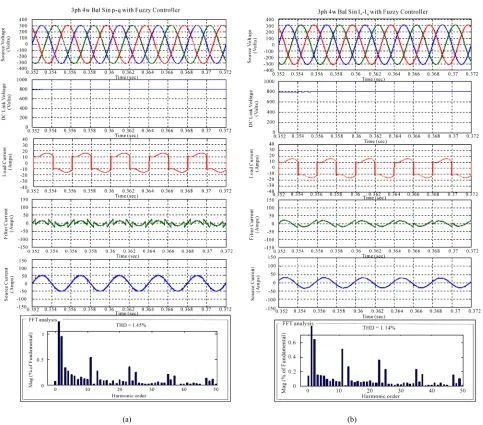
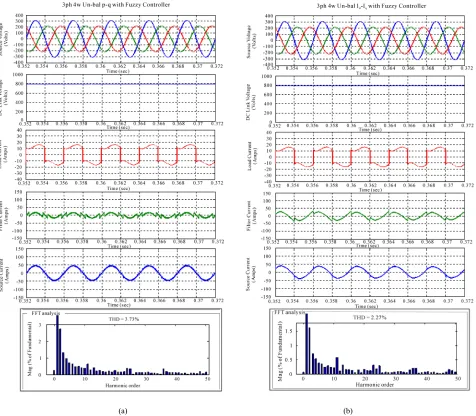
Figures 8-10 illustrate the performance of shunt active power filter under different main voltages, as load is highly inductive, current draw by load is integrated with rich harmonics.
Figure 8 illustrates the performance of Shunt active power filter under balanced sinusoidal voltage condition. THD for p-q method with Fuzzy controller is about 1.45% and THD f d q
14%.
(a) (b)
Figure 8. 3ph 4wire Shunt ative filter response with fuzzy controller under balanced sinusoidal (a) using p-q control strategy (b) using Id-Iq control strategy.
Fuzzy controller is 3.73% nd THD for id-iq method with Fuzzy Controller is
D for p-q method with Fuzzy controller is 5.
ditions. So harmonic content seems to very hi
tion.
Fuzzy controller is finest controller in all the
control-ds with fuzzy controller; on over all with combina-tio
power filter under un-balanced sinusoidal voltage condi-tion. THD for p-q method with
id-iq control strategy one can attain perfect
compensa-a
2.27%.
Figure 10 illustrates the performance of Shunt active power filter under balanced non-sinusoidal voltage con-dition. TH
11% and THD for id-iqmethod with Fuzzy Controller is
4.09%.
On observing p-q control strategy fails to deliver ref-erence currents properly under unbalance and non-sinu-soidal con
gh in p-q control strategy under these conditions. On owing id-iq control strategy delivers exact reference
cur-rents under any voltage conditions. As a result with the
lers, but it too has some drawbacks like redundancy and iteration problems. So one has to choose the membership function on the bases system complexity Extensive simulation is carried out to validate both p-q and Id-Iq
metho
n of Id-Iq strategy and fuzzy controller, there is
possi-bility of building novel shunt active filter for 3-phase 4-wire system.
Numerical simulations:
Above simulation is carried out with only AHPF (al-ternative high pass filter) of 2nd order with cut-off
M. SURESH ET AL. 50
[image:8.595.62.538.82.498.2](a) (b)
Figure 9. 3ph 4wire Shunt ative filter response with fuzzy controller under un-balanced sinusoidal (a) using p-q control strategy (b) using Id-Iq control strategy.
dependent of main voltages an
onditions. In addi-on simulatiaddi-on is also extended to different kinds of
fil-erformance same. Generally
under any voltage conditions.
e and reactive current id-iq
ntroller lead always better result and non-sinusoidal voltage conditions ver the instantaneous active and reactive power p-q
method. On contrast p-q theory needs additional PLL d there is no ripple on the der sinusoidal conditions p
rectifier dc current. Active power filter performance is analysed under several main voltage c
speaking in all the filters, HPF gives best filtering action
ti
ters like HPF (high pass filter) with 2nd order, AHPF with
4th order and HPF with 4th order. In all those, Alternative
high pass filter shows good performance and it is easy to obtain with LPF (low pass filter) of same order and cut-off frequency, simply by difference between the in-put and filter signal which is shown in Figure 4. Graphs shown in Figure 11 and Figure 12 summarize the total performance of the shunt active filter with different fil-ters. Results presented confirm superior performance of Id-Iq method with Fuzzy controller. But performance of
shunt active filters with both methods (p-q and Id-Iq)
un-5. Conclusion
In the present paper two control strategies are developed and verified with three phase four wire system. Though the two strategies are capable to compensate current harmonics in the 3 phase 4-wire system, but it is ob-served that instantaneous activ
(a) (b)
[image:9.595.59.540.74.543.2]Figure 10. 3ph 4wire shunt ative filter response with fuzzy controller under balanced non-sinusoidal (a) using p-q control strategy (b) using Id-Iq control strategy.
[image:9.595.312.537.590.701.2]M. SURESH ET AL. 52
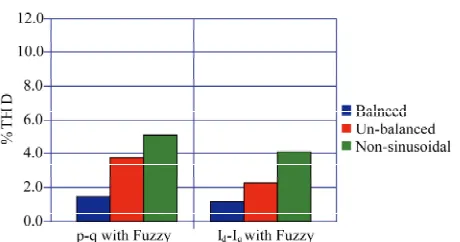
Figure 13. THD for p-q and id-iq methods with fuzzy con
troll
circuit for synchronization so p-q method is frequ variant, where as in id-iq method angle
‘θ’ is calculated directly from main voltages and enables the method to be frequency independent. T large numbers of synchronization problems with un- balanced and non-sinusoidal voltages are also avoided. Addition to that DC voltage regulation system valid to be a stable and steady-state error free system was obtained. Over all, performance of id-iq theory with fuzzy
control-ler is quite good over p-q theory with fuzzy controller.
6. References
[1] H. Akagi, “New Trends in Active Filters for Power Con-ditioning,” IEEE Transactions on Industry Applications
Vol. 32, No. 6, November-December 1996, pp. 1312- 1322. doi.:10.1109/28.556633
[2] Z. Peng, G. W. Ott and D. J. Adams, “Harmonic and Reactive Power Compensation Based on the General Instantaneous Reactive Power Theory for Three-P Four-Wire Systems,” IEEE Transactions on Power Elec tronics,Vol. 13, No. 5, November 1998, pp. 1174-1181.
K. Jain, P. Agrawal and H. O. Gupta, “Fuzzy Logic Controlled Shunt Active Power Filter for Power Quali
Power Filters in Three-Phase Four-Wire Systems,” IEEE Transactions on Power Electronics,Vol. 22, No. 1,
Janu-. Aredes, “Instantaneous
o. 5, May 2009, pp. 1350-1363.
0.1109/63.558748
armonics
Can
-er.
ency [9] P. Rodriguez,J. I. Candela,A. Luna, L. Asiminoaei,R. Teodorescu and F. Blaabjerg, “Current H
thus
hus cellation in Three-Phase Four-Wire Systems by Using a Four-Branch Star Filtering Topology,” IEEE Transac-tions on Power Electronics,Vol. 24, No. 8, August 2009, pp. 1939-1950.
[10] P. Salmeron and R. S. Herrera, “Distorted and Unbal
, id
ized hase
tronics Specialists Conference, Vol. 2, 1997, pp. 1096- 1101.
[13] P. Kirawanich and R. M. O’Connell, “Fuzzy Logic Con-trol of an Active Power Line Conditioner,” IEEE Trans-actions on Power Electronics, Vol. 19, No. 6, November 2004, pp. 1574-1585. doi:10.1109/TPEL.2004.836631
-doi:10.1109/63.728344 [3] S.
ty [1 Improvement,” IEE Proceedings of Electric Power Ap-plication,Vol. 149, No. 5, September 2002, pp. 317-328. doi:10.1049/ip-epa:20020511
[4] L. Gyugyi and E. C. Strycula, “Active AC Power Filters,”
IEEE IIAS Annual Meeting,1976, p.529.
[5] M. I. M. Montero, E. R. Cadaval and F. B. González, “Comparison of Control Strategies for Shunt Active
ary2007, pp. 229-236. doi:10.1109/TPEL.2006.886616 [6] H. Akagi, E. H. Watanabe and M
Power Theory and Applications to Power Conditioning,” IEEE Press/Wiley-Inter-Science, New Jersey, 2007. [7] O. Vodyakho and C. C. Mi, “Three-Level Inverter-Based
Shunt Active Power Filter in Three-Phase Three-Wire and Four-Wire Systems,” IEEE Transactions on Power Electronics, Vol. 24, N
doi:10.1109/TPEL.2009.2016663
[8] M. Aredes, J. Hafner and K. Heumann,“Three-Phase Four-Wire ShuntActive Filter Control Strategies,” IEEE Transactions on Power Electronics, Vol. 12, No. 2, March 1997, pp. 311-318. doi:1
anced Systems Compensation within Instantaneous Reac-tive Power Framework,” IEEE Transactions on Power Delivery, Vol. 21, No. 3, July 2006, pp. 1655-1662. doi: 10.1109/TPWRD.2006.874115
[11] N. G. Jayanti, M. Basu, I. Axente, K. Gaughan and. F. Conlon, “Development of Laboratory Prototype of a 12 kVA Digital Shunt Active Filter,” Proceedings of 34th IEEE Industrial Electronics Conference (IECON),
Flor-a,10th-13th November2008,pp. 3129-3134.
[12] V. Soares, P. Verdelho and G. Marques, “Active Power Filter Control Circuit Based on the Instantaneous Active and Reactive Current id-iq Method,” IEEE Power
Elec-4] C. S. Perumalla, P. C. Panda and S. Mishra, “Fuzzy Con-trolled Harmonic Suppressor and Reactive Volt Ampere Compensator for Enhancing Power Quality,” 2009 World Congress on Nature & Biologically Inspired Computing