COCONUT LEFTOVERS RESOURCE UTILIZATION FOR CONCRETE PRODUCTION
Jose Rizal Memorial State University
ARTICLE INFO ABSTRACT
Coconut shells and fibers are valuable aggregates as
concrete production. Fibers control cracking due to shrinkage while shells are hard sto
lightweight. Tests of sieve analysis, specific gravity, moisture content, mechanical property and the comprehensive test in accordance with the ASTM (Standard Test Method for Sieve Analysis of Coarse Aggregate, 2011) were employed to the ho
curing age of 28days, HBsf is much darker than the (CHB) concrete hollow block. Both textures are rough and have the same dimension of 100mm x 400mm x 800mm. HBsf has a density of 1213.59 kg/m3 while CHB
stress capacity of 0.57 MPa to 0.8 MPa while HBsf has reached a load of 34.42 KN to 43.5 KN and a stress of 1.82 MPa to 2.11 MPa .It implies that the thermal conductivity of HB
temperature resist freezing and heating. The average modulus of elasticity of CHB is 525 MPa, while HBsf is 1400 MPa. HBsf has greater modulus of elasticity than CHB.
resistant thus
mechanically separate the strands into individual fibers and grinder for coconut shells to have uniform sizes of particles (pea size). The mass production of HBsf is recommended to test the
properties.
Copyright © 2018, Jane T. Aquino. This is an open access distribution, and reproduction in any medium, provided
INTRODUCTION
Growing demand of houses, buildings and infrastructures have led to the scarcity of the sand as fine aggregates and pea gravel as course aggregates. The growing interest in utilizing recyclable materials and other alternative aggregates is a task that is worth studying because the quarrying of sand and gravel from rivers and mountains degrades the environment. The utilization of waste products such as coconut shells as a coarse aggregate in construction will also reduce the amount of waste and thus will prevent pollution (iosrjournal.org/iosr 2008). Traditionally, coconut farmers dispose the husks, spate petioles, and leaves by burning or allowing these farm wastes to rot in the field. However, worldwide interest in using farm residues can be a source of value-added products so then farmers can generate additional income. Studies have shown that burning of agricultural waste cause pollution, soil erosion, and even a decrease in soil biological activity that can eventually lead to decreased soil fertility. Allowing farm residues to rot in the field may improve the productivity of the soil but the process of decomposition is very slow leading to
*Corresponding author: Jane T. Aquino,
Jose Rizal Memorial State University- Katipunan Campus, Katipunan, Zamboanga Del Norte, Philippines.
ISSN: 0975-833X
Article History:
Received 13th January, 2018
Received in revised form 24th February, 2018
Accepted 28th March, 2018
Published online 30th April, 2018
Citation: Jane T. Aquino, 2018. “Coconut leftovers resource utilization for concrete production 67889-67893. Key words: Coconut shells, Coconutfibers, Hollowblock, Fine aggregates, Elasticity.
RESEARCH ARTICLE
COCONUT LEFTOVERS RESOURCE UTILIZATION FOR CONCRETE PRODUCTION
*Jane T. Aquino
Jose Rizal Memorial State University- Katipunan Campus, Katipunan, Zamboanga Del Norte,
ABSTRACT
Coconut shells and fibers are valuable aggregates as potential alternative for commercialization in concrete production. Fibers control cracking due to shrinkage while shells are hard sto
lightweight. Tests of sieve analysis, specific gravity, moisture content, mechanical property and the comprehensive test in accordance with the ASTM (Standard Test Method for Sieve Analysis of Coarse Aggregate, 2011) were employed to the hollow block-coco
curing age of 28days, HBsf is much darker than the (CHB) concrete hollow block. Both textures are rough and have the same dimension of 100mm x 400mm x 800mm. HBsf has a density of 1213.59 kg/m3 while CHB has a density of 1529 kg/m3. CHB reached a load of 11.65 KN to 17.58 KN and stress capacity of 0.57 MPa to 0.8 MPa while HBsf has reached a load of 34.42 KN to 43.5 KN and a stress of 1.82 MPa to 2.11 MPa .It implies that the thermal conductivity of HB
temperature resist freezing and heating. The average modulus of elasticity of CHB is 525 MPa, while HBsf is 1400 MPa. HBsf has greater modulus of elasticity than CHB.
resistant thus sturdy to crushing, absorption and surface moisture. It suggests fabricating shredder to mechanically separate the strands into individual fibers and grinder for coconut shells to have uniform sizes of particles (pea size). The mass production of HBsf is recommended to test the
properties.
access article distributed under the Creative Commons Attribution License, the original work is properly cited.
Growing demand of houses, buildings and infrastructures have led to the scarcity of the sand as fine aggregates and pea gravel as course aggregates. The growing interest in utilizing recyclable materials and other alternative aggregates is a task worth studying because the quarrying of sand and gravel from rivers and mountains degrades the environment. The utilization of waste products such as coconut shells as a coarse aggregate in construction will also reduce the amount of waste event pollution (iosrjournal.org/iosr-jmce, Traditionally, coconut farmers dispose the husks, spate petioles, and leaves by burning or allowing these farm wastes to rot in the field. However, worldwide interest in using farm added products so then farmers can generate additional income. Studies have shown that burning of agricultural waste cause pollution, soil erosion, and even a decrease in soil biological activity that can ty. Allowing farm residues to rot in the field may improve the productivity of the soil but the process of decomposition is very slow leading to
Katipunan Campus, Katipunan,
accumulation of piles of agricultural waste that can cause phytosanitary problem to the coconut plantation since decaying debris is ideal breeding place for coconut pest like the rhinoceros beetle (Vilas, 2007).
the most widely known and used building material in construction and are the most important of all building material. According to Middendorf
the use of fibers with earth bricks dates back to Mesopot and the banks of Nile river in Egypt in 8000 BC.
famous as multi-function plants can be used for various activities (Fortes, 2008). Industrialists in most producing countries hail the economic, environmental and the technological benefits of utilizing coconut wastes (www. Internationalcoconut.com) the use of coconut fiber and shell can be a valuable substitute in the formation of composite material that can be used in housing construction (Rahman, 2006). Coconut fiber serves as a substitute
coarse aggregate in concrete production. The coconut fibers are more suitable as low strength
when used to replace common coarse aggregate in concrete production. Philippines is one of the world’s largest p
of coconut oil, copra, and desiccated coconut and farmers in Bicol and the Eastern Visayas are dependent on coconuts as their livelihood. Large amount of agricultural waste was disposed due to poor disposal management which causes social
International Journal of Current Research
Vol. 10, Issue, 04, pp.67889-67893, April, 2018
Coconut leftovers resource utilization for concrete production”, International Journal of Current Research
COCONUT LEFTOVERS RESOURCE UTILIZATION FOR CONCRETE PRODUCTION
Katipunan Campus, Katipunan, Zamboanga Del Norte, Philippines
potential alternative for commercialization in concrete production. Fibers control cracking due to shrinkage while shells are hard stony endocarp but lightweight. Tests of sieve analysis, specific gravity, moisture content, mechanical property and the comprehensive test in accordance with the ASTM (Standard Test Method for Sieve Analysis of coco shell /fiber (HBsf).With the same curing age of 28days, HBsf is much darker than the (CHB) concrete hollow block. Both textures are rough and have the same dimension of 100mm x 400mm x 800mm. HBsf has a density of 1213.59 has a density of 1529 kg/m3. CHB reached a load of 11.65 KN to 17.58 KN and stress capacity of 0.57 MPa to 0.8 MPa while HBsf has reached a load of 34.42 KN to 43.5 KN and a stress of 1.82 MPa to 2.11 MPa .It implies that the thermal conductivity of HBsf for cold and warm temperature resist freezing and heating. The average modulus of elasticity of CHB is 525 MPa, while HBsf is 1400 MPa. HBsf has greater modulus of elasticity than CHB. It is a good indicator as fire sorption and surface moisture. It suggests fabricating shredder to mechanically separate the strands into individual fibers and grinder for coconut shells to have uniform sizes of particles (pea size). The mass production of HBsf is recommended to test the mechanical
License, which permits unrestricted use,
accumulation of piles of agricultural waste that can cause phytosanitary problem to the coconut plantation since decaying debris is ideal breeding place for coconut pest like the rhinoceros beetle (Vilas, 2007). Historically, fibers have been the most widely known and used building material in construction and are the most important of all building According to Middendorf (2001) recorded cases of the use of fibers with earth bricks dates back to Mesopotamia and the banks of Nile river in Egypt in 8000 BC. Coconut is function plants can be used for various activities (Fortes, 2008). Industrialists in most producing countries hail the economic, environmental and the of utilizing coconut wastes (www. the use of coconut fiber and shell can be a valuable substitute in the formation of composite material that can be used in housing construction (Rahman, Coconut fiber serves as a substitute for either fine or coarse aggregate in concrete production. The coconut fibers are more suitable as low strength-giving lightweight aggregate when used to replace common coarse aggregate in concrete Philippines is one of the world’s largest producers of coconut oil, copra, and desiccated coconut and farmers in Bicol and the Eastern Visayas are dependent on coconuts as their livelihood. Large amount of agricultural waste was disposed due to poor disposal management which causes social
OF CURRENT RESEARCH
and economic problems. In Zamboanga del Norte, coconuts are abundant and copra is one of the major sources of income. Leftovers of coconuts after the copra curing activity are unused. The fibers from the coconut husk and shells can be used as organic aggregates and this innovation is designed for the desired strength, elasticity, and compactness of hollow block. This study seeks to fabricate hollow blocks from coconut shells and fibers as aggregates. Specifically, it intends to determine the basic physical properties in terms of color, texture, size and density. It is also geared to determine the mechanical properties of fabricated hollow blocks as compared to commercial hollow blocks in terms of strength, workability and durability. It further determines the technical specifications of fabricated hollow block using coconut shell and fibers (Fig. 1)
Figure 1. Technical Specification of hollow block-cocoshell/fiber (HBsf)
Figure 2. Selection of Coconut Shells
Theoretical Framework
This study is anchored to the concept of ‘’ Green Concrete using waste as Alternate Aggregate’’ which states that the reuse of waste materials and the utilization of waste product in the manufacturing of new product is a good solution to the problem of depleting natural resources and the increase of waste materials disposed globally (Vyas et al, 2013). Aggregates played an important rolein the use of waste materials particularly on the coconut fibers and shells as a substitute for the coarse and the fine aggregate in hollow blocks used in construction. Recycled aggregate is obtained from coconut shells and husk which can be reused in building industry instead of being burned. The utilization of 40% of the total raw materials used in fabricating a hollow block with the use of coconut waste will give a workable, strong, environment friendly and a green concrete (Deshpande, 2011).
MATERIALS AND METHODS
The study employed the series of physical property test namely the sieve analysis, specific gravity, moisture content, mechanical property test and the comprehensive test, that were accordance with the ASTM (ASTM C 136 Standard Test Method for Sieve Analysis of Coarse Aggregate, 2011).
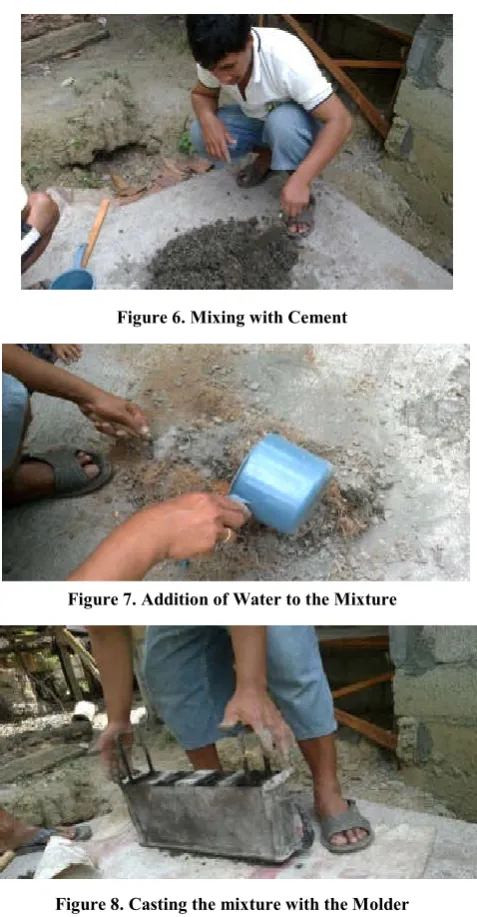
[image:2.595.326.550.264.403.2] [image:2.595.57.271.415.579.2]The coconut fibers and shells were taken along the municipality of Katipunan. The materials were gathered, screened and discarded foreign materials then placed in a container and sealed so as to preserve and retain its natural conditions. As the production starts, the required amounts of sand, coconut shell, fiber and cement are measured to obtain the proper amounts of each material. After the dry materials were blended, a small amount of water was added (Figures 3, 4, 5, 6, 7, 8, 9 and 10).
[image:2.595.321.553.426.574.2]Figure 3. Segregation of Coconut fibers
[image:2.595.323.550.593.747.2]Figure 4. Crushing Method of Coconut Shells
Figure 5. Drying of Coconut Fibers
Theconcrete was then mixed for six to eight minutes. Once the load of concrete was thoroughly mixed, it was dumped into the molder and forced downwards.
PHYSICAL PROPERTIES
COLOR TEXTURE SIZE DENSITY
MECHANICAL PROPERTIES
COLOR TEXTURE SIZE DENSITY
TECHNICAL SPECIFICATION OF CONCRETE HOLLOW BLOCK WITH COCONUT SHELL AND FIBER
Fig.4
Figure 6. Mixing with Cement
Figure 7. Addition of Water to the Mixture
[image:3.595.55.277.59.249.2]Figure 8. Casting the mixture with the Molder
Figure 9. Releasing the Molder
The molds consist of outer molds containing several mold liners. The liners determine the outer shape of the block and the inner shape of the block cavities. When the molds are full, the concrete is compacted by the weight of the upper mold head coming down on the mold cavities. The compacted blocks are pushed down and out of the molds onto a flat steel pallet or wood as a curing rack and curing period of 28 days.
RESULTS AND DISCUSSION
A. Physical Properties of Concrete Hollow Block (CHB) and HB with Coconut Shell and fiber Table 1 shows the physical
properties of CHB (Fig. 2b) and HB with coconut shell and fiber. The color is simply observed through visual inspection. HB with coconut and fiber is much darker than the CHB (Fig. 2a). The texture of both specimens are absolutely rough, they are the same with the property. Both Hollow Blocks have the dimension of 100mm x 400mm x 800mm. It is commonly used material for the construction purposes such as wall panels and partitions. Moreover, HB with coconut shell and fiber has a density of 1213.59 kg/m3, while the CHB has a density of 1529 kg/m3.
Table 1. Physical properties of CHB
Property Commercial CHB HB with coconut shell and fiber
Color Gray Dark Gray
Texture Rough Rough
Size 100x 400x 800mm 100x 400x 800mm
Density of 1529 kg./m3 1213.59 kg/m3
[image:3.595.322.543.190.242.2]B. Mechanical Properties of Concrete Hollow Block (CHB) and HB with Coconut Shell and fiber As shown in Table 2, the commercial CHB in 28 days of age reached a load of 11.65 KN to 17.58 KN, and stress of capacity of 0.57 MPa to 0.8 MPa. On the other hand, the HB with coconut shell and fiber with the same curing age has reached a load of 34.42 KN to 43.5 KN, and a stress of 1.82 MPa to 2.11 MPa respectively, which signifies that the number it reaches the curing age requirements for the 28-day curing age of concrete per ASTM standards.
Table 2. Comprehensive strength test of commercial CHB and HB with Coconut Shell and fiber
CHB HB with Coconut Shell and fiber
Time ( Days)
Speci men
Load (KN)
Stress (MPa)
Specimen Load
(KN)
Stress (MPa)
28 1 17.58 0.8 1 43.5 2.11
2 11.65 0.57 2 34.42 1.67
3 15.07 0.73 3 37.56 1.82
As shown in Table 3, the average modulus of elasticity of CHB for the full curing age of 28 days is 525 MPa, while HB with Coconut shell and fiber has an average of 1400 MPa. Using modulus of elasticity for concrete unit masonry, Êm= 750 ƒ’m
and must not be greater than 20.5 GPa.( National Structural Code of the Philippines, S 706.2.12.1 Modulus Elasticity of Masonry, 1192). Based from the results, HB with coconut shell and fiber has greater modulus of elasticity rather than CHB.
Table 3. Modulus Elasticity test of commercial CHB and HB with Coconut Shell and fiber
Time ( Days) Modulus of Elasticity (MPa) Specimen Commercial CHB Speci
men
HB with Coconut Shell and fiber
28 1 600 1 1582.5
2 427.5 2 1252.5
3 547.5 3 1365.5
[image:3.595.312.553.407.466.2]Table 4 shows the average modulus of rupture of HB with Coconut shell and fiber for the full curing period of 28 days is 0.391 MPa.
Table 4. Modulus of Rupture test of HB with Coconut Shell and fiber
Time ( Days) Specimen CHB with Coconut shell and Fiber
28 1 0.441
2 0.350
3 0.382
Fig.7
Fig.8
[image:3.595.49.281.506.652.2] [image:3.595.321.545.752.794.2]Table 5 shows that HB with coconut shell and fiber has lesser moisture content and water absorption than the CHB.
Table 5. Moisture content of CHB and HB with Coconut Shell and fiber
Specimen CHB HB with Coconut shell and fiber
Weight (kg) 5.2 7.8
Dry weight (kg) 5.0 7.6
Saturated weight (kg) 5.4 7.8
% Water absorption 4.0 2.63
Table 6 shows that HB with coconut shell and fiber can resist freezing gained a large value of load. In cold temperature, HB with coconut shell and fiber has a load capacity of 96.69 KN and stress capacity of 4.69 MPa.
Table 7 shows that even in higher temperature condition, HB with coconut shell and fiber can resist. It was subjected to compressive test to determine if the strength will change.
(ASTM C 136 Standard Test Method for Sieve Analysis of Coarse Aggregate, 2011). In warm temperature, it has an average load of 55.225 KN and stress capacity of 2.97 MPa. Table 8 shows that the specimens are subjected to a high degree of temperature for a certain period of time. It was subjected to compressive test to determine if the strength will change. Data’s gathered shows that the HB with coconut shell and fiber can resist the fire. This means that that it can resist a high degree of temperature (Rahman, IE, 2003). The result at the full curing age of 28 days attained an average load capacity of 64.15 and 3.175 MPa for average stress.
FINDINGS
The physical properties of HB with coconut shell and fiber affects the quantity in terms of production.
The comprehensive strength of HB with coconut shell and fiber attained the highest average loads and stress compared to Commercial Hollow Blocks (CHB). Table 6. Thermal Conductivity at cold temperature
Specimen CHB HB with Coconut shell and fiber
Weight (Kg) 12.4 10.6
Load (KN) 12.87 96.69
Stress (MPa) 0.62 4.69
Table 7. Thermal Conductivity at hot temperature
Specimen Weight (Kg) Load (Kg) Stress (MPa)
1 9.8 50.47 2.97
2 9.4 59.98 2.97
Table 8. Fire resistance of HB with coconut shell and fiber)
Specimen Weight (Kg) Load (Kg) Stress (MPa)
1 9.8 68.32 3.38
2 9.4 59.98 2.97
Table 9. Good indicators of coconut shell and fiber as aggregates
Good indicators Significance
1. Particles shape and texture Affects workability of fresh concrete.
2. Resistance to crushing In high strength concrete, aggregate is low in crushing value. This will not give high strength even though
cement strength is higher.
3. Absorption and surface moisture Affects the mix proportions and control of water content to maintain water-cement ratio.
4. Grading Economizes cement content and improves workability.
5. Resistance to freezing and heating Significant to cold countries where frost action deteriorates concrete due to alternate freezing and heating.
6. Lightweight Reduces weight of structures.
Table 10. Laboratory test of HB with coconut shell and fiber
Properties HB with coconut shell and fiber
Texture Rough
Size 100mmx 400mmx 800mm
Color Dark Gray
Density 1213.56 kg./m3
Weight 10.6 kg.
Mix Proportion 1:3:3
Comprehensive Strength (28 days) 75.21 KN
Modulus of Elasticity (28 days) 2740 MPa
Modulus of Rupture (28 days) 0.401 MPa
Moisture Content 5.41%
Water absorption 2.63%
Table 11. Cost and Return Analysis
Labor Cost Total Cost Profit Price per Block
Commercial Hollow Block(CHB)(1bag cement:11 sacks mixed aggregates)(1bag cement/70 blocks)
Php 1.00/ block Php5.78/block Php 5.22/block Php 11.00
CoCo Hollowblock (HBsf)
(1bag cement:6sacks cocoshell/fibers))(1bag cement/70 blocks)
The thermal conductivity of HB with coconut shell and fiber for cold and warm temperature resist freezing and heating gained a large value of load.
The fire resistance of HB with coconut shell and fiber affects its mechanical properties in terms of compressive strength.
The HB with coconut shell and fiber exceeds the minimum strength of Commercial Hollow Blocks (CHB).
The good indicators of HB with coconut shell and fiber are particles shape, and texture, resistance to crushing, absorption and surface moisture, grading, resistance to freezing and heating, and lightweight.
The HB with coconut shell and fiber is used as an alternative aggregate for Commercial Hollow Block (CHB).
Conclusion
The concrete hollow block with coco shell and fiber (HBsf) as aggregates is a technology innovation that is valuable for building construction as non-load bearing materials especially for wall panels and partitions .The utilized aggregates passed the quality attribute tests conducted as to sieve analysis, moisture content, mechanical property and the comprehensive test in accordance with the ASTM (Standard Test Method for Sieve Analysis of Coarse Aggregate, 2011). With the same curing age of 28days, HBsf is much darker and a good indicator as fire resistant for it exceeds the minimum strength as compared to the CHB. The good indicators of HBsf as to particles of aggregates, shape, and texture implies to resist crushing, absorption and surface moisture. The HBsf is potential alternative for commercialization. The prevailing price of local commercial concrete hollow block is Php 11.00 per block. The HBsf found to be most economical and durable with desired strength, elasticity, and compactness is comparable with Php 11.00 per block with profit of Php 1.50/ block or Php 105/ 70 blocks in one bag of cement. For quality choice, the HBsf is valuable for commercialization.
Recommendations
The findings of the study would further be enhanced by fabricating shredder to mechanically separate the strands into individual fibers.
It further recommends by fabricating innovatively grinder for coconut shells so as to have uniform sizes of particles (pea size) as course aggregates.
To undertake mass production of HB with aggregates of coco shells and fibers in order to test the physical and mechanical properties in actual setting as model or mock up structure.
REFERENCES
Laine, Jorge and Simon Yunes, 2002. Effects of the Preparation Method on the Pore size Distribution of activated Carbon from Coconut Shell.
Mamlouk, MS. and Zaniewski, JP. 2006. Materials for Civil and Construction Engineers, pp. 305-311.
Meyer, C. 2001. Recycled Glass: Waste Material to Valuable Resource, Construction Materials and Technology, Vol.1 Jan.
National Solid Waste Management Commission, Alter-native Technologies part 2: Recycled Materials, 2003
National Structural Code of the Philippines section 708.2.4.6.6 Modulus of rupture for partially Grouted Hollow Unit Masonry, 1992