© 2017 IJSRST | Volume 3 | Issue 7 | Print ISSN: 2395-6011 | Online ISSN: 2395-602X Themed Section: Scienceand Technology
Isolation of Different Types of Fungi from Diverse Soils
Pritha Ghosh*1, K. Sneha Mani Priya2, Md.Tahaniyath Unissa3, K.Vaishali4, Shahzad Begum5
*1Lecturer, Department of Microbiology, St. Pious X Degree & PG College for Women, Hyderabad, Telangana,
India
2,3,4,5III MZC, Department of Microbiology, St. Pious X Degree & PG College for Women, Hyderabad,
Telangana, India ABSTRACT
Soils are excellent cultural media for the growth of many types of organisms. Microorganisms play an important function in biodegradation of solid agriculture waste and also help in the crop production. This includes bacteria, fungi, algae, protozoa and viruses. Different soil samples were collected from agriculture soil, construction area, scrap area, pavement soil and college garden soil. The present work deals with the isolation of fungi from different soils. Isolation of fungi was carried out by culturing on potato dextrose agar media and Identification of fungi by lacto phenol cotton blue staining and microscopic method.
Keywords : Microorganisms, Fungi, Agriculture Soil, Construction Area, Scrap Area, College Garden Soil Pavement Soil, Potato Dextrose Agar Media, Lacto Phenol Cotton Blue Staining.
I. INTRODUCTION
Soil is the upper layer of most of the earth’s surface and varies in depth from inches to over twenty feet. It is a product of weathered rock, but quite distinct in its characteristic. Soils are excellent cultural media for the growth of many types of organisms. This includes bacteria, fungi, algae, protozoa and viruses. Microorganism are frequently present in soil manure and decaying plant tissues which are able to degrade wastes that are correlated with the substrate organic matter. Microorganisms play an important function in biodegradation of solid agriculture waste and also help in crop production .The number and kinds of organisms found in soil depend upon the nature of soil, depth, season of the year, state of the cultivation, reaction, organic matter, temperature, moisture, aeration, etc. (Md. MehediHasan Magnet 2013) Soil is a natural habitat for the growth of wide variety of microorganisms foe example bacteria, fungi, yeasts, algae, protozoa and viruses. Soil microflora plays a pivotal role in evaluation of soil conditions and in
stimulating plant growth (Kiran Singh et.al 1999). Microorganisms are beneficial in increasing the soil fertility and plant growth as they are involved in several biochemical transformation and mineralization activities in soils. Type of cultivation and crop management practices found to have greater influence on the activity of soil microflora(Mc. Gill, W.B. et.al 1980). Soil mycoflora plays a pivotal role in evaluation of soil conditions and in stimulating plant growth by biochemical transformation and mineralization activities in soils. Type of cultivation and crop management practices found to have greater influence on the activity of soil mycoflora. Continuous use of chemical fertilizers over a long period may cause imbalance in soil mycoflora and thereby indirectly affect biological properties of soil leading to soil degradation. Fungi are an important component of the soil micro biota. Micro fungi play a focal role in nutrient cycling by regulating soil biological activity.(Vinay K, Udit Y, Ankit K.2015). Fungi are fundamental for soil ecosystem functioning (Warcup JH 1951). Especially in forest and
agricultural soils, they play a key role in many essential processes such as organic matter decomposition and elemental release by mineralization (Christensen, M, 1989).Micro fungi play a focal role in nutrient cycling by regulating soil biological activity (Arunachalam, et.al K.M et.al 1997). Fungi grow on diverse habitats in nature and are cosmopolitan in distribute ion requiring several specific elements for growth and reproduction. In laboratory, these are isolated on specific culture medium for cultivation, preservation, microscopical examinations and biochemical and physiological characterization (Aina VO et.al 2011). Fungi are an important component of the soil micro biota (Ainsworth, G.C and G.R. Bisby 1995).Fungi, bacteria and actinomycetes colonize different habitats and substrates and play substantial role in plant health and productivity besides producing diseases. The role of fungi in the soil is an extremelycomplex one and is fundamental to the soil ecosystem. They are geographically widely distributed and have been observed in a broad range of habitats principally in soils and decaying vegetation (Ratna Kumar P.K et.al 2015). Fungi are a member of large group of eukaryotic organism that include microorganism such as yeast and mould as well as several mushrooms. The fungi species can be used a biocontrol agent where they act as antagonists by developing the condition of generating competition for nutrient and space with pathogens to be killed. Certain fungi, particularly white rot fungi can degrade toxic compounds such as uranium oxides and azo dyes by the secretion of extracellular enzymes thus enabling in the process of bioremediation. The impact of fungi is considerable. Chemical changes occur as a result of humification of organic matter. The resultant mineralization of various organic compounds (phosphorous, sulphur, and nitrogen, for example) provides plants with forms of nutrition that are readily available for uptake. The turnover of microbial populations also results in the release of nutrients. (Jeyanthi Rebecca. L et.al 2012). The traditional assessment of soil contamination is
based on the regular routine of comparison of allowable threshold values with the results of monitoring. This approach is even a required action in environmental agencies, agricultural administration, and managing organization. Very often, solving a particular problem concerning the soil contamination or respective decision making is based solely on single results and not on a more generalized model about the state of the soil contamination in a certain region. This environmetric strategy makes it possible to detect relationships between the chemical pollutants and specific soil parameters, between sampling sites and, therefore, to achieve a stratification of the pollution. (Md. MehediHasan Magnet 2013). The present investigation was conducted to find out the fungal diversity in various soils.
II. METHODS AND MATERIAL
Collection of soil samples and locations for study Different locations of city have been selected for collection sites of soil samples. Soil samples were collected from site such as agriculture soil, construction area, scrap area, fruit market area and college garden soil. Agricultural soil sample were collected from Dammaiguda, Secunderabad, Telangana . Scrap soil sample were collected from Narapally, Secunderabad, Telangana .Soil samples were taken with the help of sterile spatula, in sterile plastic bags. The samples were brought to the microbiology laboratory and stored at 4oc for further
use.
Isolation of Fungi
The technique, Soil dilution plate method (Waksman SA, 1922) was used to isolate the fungal organisms from soil samples.1 gram of soil sample was suspended in 10 ml of distilled water to make microbial suspensions (10-1 to 10-5). Dilution of 10-3, 10-4 and 10 -5 were used and 0.1 ml ofmicrobial suspension of each
(triplicate of each dilution) containing 20 ml of sterile potato dextrose agar and sabouraud’s agar were used. Preparation of Lacto-phenol Cotton Blue Slide Mounts
The lacto-phenol cotton blue (LPBS) wet mount preparation is the most widely used method of staining and observing fungi and is simple to prepare. The preparation has three components: phenol, which will kill any live organisms; lactic acid which preserves fungal structures, and cotton blue which stains the chitin in the fungal cellwalls. The samples were immersed in a drop of alcohol and it was viewed under the microscope after the addition of two drops of the lacto-phenol/cotton blue mount/stain.(Jeyanthi Rebecca. L et al 2012)
III. RESULTS AND DISCUSSION
Results
Collection of soil samples and locations for study Different locations of city have been selected for collection sites of soil samples. Soil samples were collected from site such as agriculture soil, construction area, scrap area, fruit market area and college garden soil. (Table - 1)Soil samples were taken with the help of sterile spatula, in sterile plastic bags. The samples were brought to the microbiology laboratory and stored at 4oc for further use.
Isolation of Fungi
Soil dilution plate method (Wasksman SA, 1922) was used to isolate the fungal organisms from soil samples.PDA medium is the most commonly used culture growth by several workers worked with it earlier due to its simple formulation and potential to support wide range of fungal growth. A total of
260colonies were enumarated. (Table 1).7 genera of fungi were identified. Maximum number of fungal colonies belonged to ascomycetes, deuteromycetes and phycomycetes.
Lacto-phenol Cotton Blue Slide Mounts
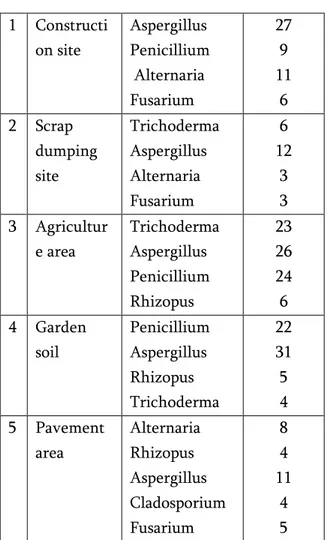
The lacto-phenol cotton blue (LPBS) wet mount preparation is the most widely used method of staining and observing fungi and is simple to prepare. The preparation has three components: phenol, which will kill any live organisms; lactic acid which preserves fungal structures, and cotton blue which stains the chitin in the fungalcellwalls. Identification was done by preparing the LPCB mounts. In the present study Aspergillus sp, Penicillium sp. Fusrium sp, Alternaria sp, Trichoderma sp Rhizopus sp. Cladosporium sp were observed. (Table - 2)
Discussion
Soil is the complex system containing flora of various microorganisms including bacteria, algae, moulds and mushrooms. Fungi are one of them, it is estimated to have 1.5 million species of fungi in the world at different surroundings with about 5% of these identified formally (Jeyanthi Rebecca. L et.al 2012).
Table 1 : Total number of fungal colonies at different locations
S.No Location Total number of fungal
colonies
1. Construction site 53
2. Scrap dumping site 24
3. Agriculture area 79
Table 2: Number of fungal colonies at different locations
There is a vast microbial flora inheriting the earth and they are found in all types of soils. These microbes may interact with the plants resulting sometimes in useful effect and other times in harmful consequences. Fungi are an important component of the soil microbiota1 and are present as mycelia bits, rhizomorphs or as spores. They play significant role in soils and plant nutrition.(Ratna Kumar P.K et.al 2015).The number and kinds of organisms found in soil depend upon the nature of soil, depth, season of the year, state of cultivation, reaction, organize matter, temperature, moisture, aeration, etc. (HaqeeqatAfreenArshi, Dr.SaheraNasreen 2016). Fungi are fundamental for soil ecosystem functioning. Especially in forest and agricultural soils, they play a key role in many essential processes such as organic matter decomposition and elemental release by
mineralization. The quantities of organic and inorganic materials present in the soilhave a direct effect on the fungal population of the soil. The members and kinds of micro organisms present in soil depend on many environmental factors such as the amount and type of nutrients, moisture, degree of aeration, pH and temperature etc. (Gaddeyya. G et.al 2012). Micro fungi play a focal role in nutrient cycling by regulating soil biological activity.(Gaddeyya.G et.al 2012).(Vinay K, Udit Y, Ankit K.2015).
The soil samples were analyzed for the presence of different types of fungi. The most common fungi,.Aspergillus, Penicillium, Alternaria, Fusariumsp. were found in (construction site soil). Trichodermasp, Aspergillus sp, Alternaria sp, Fusariums sp was observed in (scrap dumping site soil). Trichodermasp, Penicillium sp, Aspergillus sp, Rhizopus sp were found in (agricultural area soil) Penicilliumsp, Aspergillussp, Rhizopus sp Trichoderma sp were observed in (garden soil). Alternaria sp, Rhizopus sp, Aspergillus sp, Cladosporium sp, Fusarium sp was found in (pavement side soil).
Alternarisp, Fusariumspwere found in construction site soil, scrap dumping site soil and pavement side soil. Aspergillusspwas found to be present in almost all the five soil samples taken for experimental study. Trichodermasp was observed in scrap dumping site soil, agricultural area soil and garden soil. Penicilliumsp was observed in construction site soil, agricultural area soil and garden soil.
In our present study fungal isolates of genera Aspergillussp,Trichodermasp and Penicilliumspwere dominant, found in large numbers and showed profuse growth . The results of our study correlate with the literature available. (Rakesh Kumar Soni, Kavita Sharma, 2014), (Ratna Kumar P.K et.al 2015), (Md. MehediHasan Magnet 2013), (Vinay K, Udit Y, Ankit K.2015). The fungal isolates belonged to Ascomycetes, Deuteromycetes and Zygomycetes. 1 Constructi on site Aspergillus Penicillium Alternaria Fusarium 27 9 11 6 2 Scrap dumping site Trichoderma Aspergillus Alternaria Fusarium 6 12 3 3 3 Agricultur e area Trichoderma Aspergillus Penicillium Rhizopus 23 26 24 6 4 Garden soil Penicillium Aspergillus Rhizopus Trichoderma 22 31 5 4 5 Pavement area Alternaria Rhizopus Aspergillus Cladosporium Fusarium 8 4 11 4 5
The conservation of diversity of mycoflora in agricultural fields becomes very essential for the development of sustainable agriculture. The studies on fungal diversity and percentile contribution and periodic occurrence of soil mycoflora are useful for farmers, agronomists, researchers and microbiologists for future activities in the view of conservation of soil ecosystem, conservation of soil microbial diversity and sustainable agriculture. (Ratna Kumar P.K et.al 2015). The quantities of organic and inorganic materials present in the soil have a direct effect on the fungal population of the soil. In addition to chemical fertilizers and wide range of pesticides shows adverse effect on mycoflora the members and kinds of micro organisms present in soil depend on many environmental factors such as the amount and type of nutrients, moisture, degree ofaeration, pH and temperature etc.The soil pH, organic content and water are the main factors affecting the fungal population and diversity. The organic carbon, nitrogen, phosphorus, potassium are important for fungi. In the absence of any ofthese the growth and sporulation of moulds as well as other microorganisms are hampered a lot. Fungal diversity of any soil depends on a large number of factors of the soil such as pH, organiccontent, and moisture. (Vinay K, Udit Y, Ankit K.2015).
Aspergillus species are one the most fast growing fungal organisms which can grow in varied environments irrespective of various factors governing the growth of organisms . In the present context it was found that these species outnumbered the other fungal organisms in terms of growth and number too in all the five soil samples taken for experimental study. This feature can be attributed to the increasing anthropogenic activities and presence of complex carbon sources which may serve as one of the contributing factor for its luxirient growth.
Construction site soil sampleis exposed to dusty environments, constant human and mechanized activy with temperature fluctuations and heterogenous nutrient source there by favouring the growth of different types of fungal orgasnisms.
The possible reason for decrease colony count in scrap dump soil sample may be due to the presence of the mixed up complex waste in the form of metallic or nonmetallic counterparts which there by restricted their growth.
The cultivated, fertile soil comprises of diverse community of organisms. From agriculture point of view, fungal organisms contribute to elevate soil properties, plant growth and nutrition.
The garden soil primarily consists of saprophytic fungi and other microorganisms. The soil is enriched with nutrients which there by supports the growth of different types of microorganisms. The major factor governing the growth of fungal organisms in the pavement side soil is nutrient availability. The soil is exposed to traffic dusts and pollution which there by limit the nutrient source required for the growth of fungal organisms thereby decreasing their number. During the course of study, the possible reason for the diversity of mycoflora in different soils may be attributed to the various biotic and abiotic components like nutrient availability, seasonal variations and temperature had direct impact on the growth of fungal organisms.
From the above discussion it can be concluded that various physical and chemical parameters dictate the diversity of fungal mycoflora in different regions.
IV. REFERENCES
[1]. Aina VO, Adewuni AAJ, Hauwa Haruna and Amina Zaraki. Isolation and identification of fungi associated with the deterioration of painted wall surfaces within Kadunapolytechnic. Asian Journal of Medical Sciences, 2011; 3 (6): 250-253.
[2]. Ainsworth,G.C and G.R. Bisby., Dictionary of the fungi, Commonwealth Mycological Institute Kew, Surrey,1995, pp 445.
[3]. Arunachalam ,K.M., Arunachalam, R.S., Tripathi and Pandey, H.N., Trop.Ecol.,1997, 38:333-341.
[4]. Christensen, M., A view of fungal ecology. Mycologia., 1989, 81:1-19.
[5]. Gaddeyya. G, P. Shiny Niharika, P. Bharathi and P. K. Ratna Kumar, Isolation and identification of soil mycoflora in different crop fields at Salur Mandal, Pelagia Research Library, Advances in Applied Science Research, 2012, 3 (4):2020-2026, ISSN: 0976-8610
[6]. Haqeeqat Afreen Arshi, Dr. Sahera Nasreen. Isolation and Identification of Fungi From Soil Samples of Different sites In Aurangabad City, India, International Journal Of Scientific Research, Volume : 5 Issue : 3 March 2016. ISSN No 2277 - 8179.
[7]. Kiran Singh, Jaishree Borana and Sobha Srivastava, VA., Journal of Soil Biology and Ecology., 1999, 19 :11-14.
[8]. Jeyanthi Rebecca L, V. Dhanalakshmi1, S. Sharmila,G. Susithra, Santosh Kumar and Sashi Bala. Isolation, Identification and Characterization of Fungi from Rhizosphere Soil of Barleria Cristata. International Journal of Horticultural & Crop Science Research. ISSN 2249-4243 Volume 2, Number 1 2012, pp. 1-6 [9]. Mc.Gill,W.B., Cannon, K.R., Robertson, J.A and
Cook, F.D., Canadian Journal of Soil Science, 1980, 66:1-19.
[10]. Md. Mehedi Hasan Magnet, Dayanidhi Sarkar, Zakaria Ahmed, Isolation And Identification Of Bacteria And Fungi From Soil Samples Of Different Industry Side In Dhaka City, Bangladesh, International Journal Of Innovative Research & Development, 2013,Vol 2 Issue 8, ISSN: 2278 - 0211 (Online)
[11]. Rakesh Kumar Soni, Kavita Sharma Isolation, Screening and Identification of Fungi From Soil, International Journal Of Scientific Research, Volume: 3 Issue : 7 July 2014. ISSN No 2277 - 8179
[12]. Ratna Kumar P.K, Hemanth.G, P.Shiny Niharika and Samuel k kolli. Isolation and identification of soil mycoflora inagricultural fields at Tekkali Mandal in Srikakulam District. International journal of advances in Pharmacy, biology and chemistry- Vol. 4(2), Apr - Jun, 2015 ISSN: 2277 - 4688
[13]. Vinay K, Udit Y, Ankit K. Isolation and Identification of Soil Mycoflora from Different Populated Area of Bareilly City. Bull. Env. Pharmacol. Life Sci., Vol 4 [7] June 2015: 151-156
[14]. Waksman SA. A method for counting the number of fungi in the soil. J. Bact., 1922; 7 (3):339-341.
[15]. Warcup JH., Trans Br Mycol Soc., 1951, 34:376-399.