Aging Effect on Adhesion Strength between Electroless Copper
and Polyimide Films
Ho-Nyun Lee
1, Yoonsung Han
1, Jang-hun Lee
1,2, Jin-Young Hur
1and Hong Kee Lee
1,+ 1Heat Treatment and Plating Technology Center, Incheon Regional Division, Korea Institute of Industrial Technology,7-47, Songdo-Dong, Yeonsu-gu, Incheon 406-840, Korea
2Department of Materials Science and Engineering, Korea University, 145, Anam-ro, Seongbuk-gu, Seoul 136-701, Korea
The effect of atmospheric aging on the adhesion strength between electroless copper and polyimidefilms was investigated. 100 nm thick electroless copper was plated on polyimidefilm and 10 µm of copper electroplating was performed successively. Aging was allowed to occur at room temperature in atmosphere for designated times: either between electroless deposition and electroplating or between electroplating and the peel test. The adhesion strength between copper and polyimidefilm increased and then saturated as aging progressed for about 1 d, with rapid increase from 0.2 to 0.5 d. Among the samples with equivalent total aging time, samples that were electroplated later showed higher adhesion strength. Inter-diffusion and chemical bonding between copper and polyimide were observed after aging and additionally applied electrical current increased the adhesion strength. It could be suggested that the atmospheric aging and additionally applied current enhance the inter-diffusion and the chemical bonding between electroless copper and polyimidefilm. [doi:10.2320/matertrans.M2013044]
(Received January 31, 2013; Accepted March 19, 2013; Published April 26, 2013)
Keywords: aging, plating, chemical bonding, inter-diffusion, adhesion strength
1. Introduction
Polymer metallization has drawn much attention for applications in mobile device, flexible display and flexible printed circuit boards (FPCB).1) Among the polymers
suitable for those applications, polyimide is one of the promising candidates because of their excellent thermal stability, good mechanical strength, high chemical resistance, and low dielectric permittivity.1,2) However, low reactivity
of polyimide with other substances due to the stable characteristics of imide rings, has resulted in low adhesion strength between coated metal and polyimidefilms.1,2)
In order to improve the adhesion strength between metal and polyimide films, surface modifications of polyimide have been widely investigated: dry processes such as plasma treatment,3,4) or ion beam treatment,5) as well as wet processes using potassium hydroxide6) or aqueous amine solution.7)Post processes such as annealing at high temper-ature and aging in humid environment have also been reported.810) However, the chemical bonding mechanism
between metal and polyimide and the relationship between the interface reaction and adhesion strength have not been clearly understood yet. Moreover, the effect of atmospheric aging at room temperature on the adhesion strength has not been reported.
In this study, electrolessly- and electro-plated copper on polyimidefilm was prepared and the effects of aging at room temperature in atmosphere on adhesion strength have been investigated. In order to analyze the cause for adhesion strength changes during aging, physical property of copper
films, inter-diffusion, and additional electrical current effect were examined.
2. Experimental Procedure
2.1 Sample preparation
Pyromellitic dianhydride-oxydianiline (PMDA-ODA) based 50 µm Kaptonμ HN from DuPont· was pre-treated with following steps: etching, cleansing, protonation, cleans-ing, sensitization, cleanscleans-ing, activation, and then, cleansing once again. After the final step of the surface treatment, electroless copper deposition was performed. For the etching step, polyimidefilm was submerged in potassium hydroxide solution for 5 min, which was heated up to 323 K. For the protonation step, samples were dipped in hydrogen chloride solution for 5 min, then subsequent sensitization and activation steps using tin (II) chloride and palladium (II) chloride, were performed for 4 and 2 min, respectively. Surface modified polyimide film was then immersed in a copper sulfate solution, containing formaldehyde as a reducing agent, Rochelle salt as a complexing agent, and sodium hydroxide as a pH controlling agent. 100 nm of copper was electrolessly deposited on the film at pH 12.5. Electroplating of copper was performed to increase the thickness of deposition layer up to 10 µm using copper (II) sulfate based electrolyte.
2.2 Aging and applying additional electrical current
Aging was allowed to occur either between electroless-and electro-plating or between electro-plating electroless-and the peel test from 0 to 10 d at room temperature in atmosphere. Adhesion strength between the deposited copper and polyimide film was evaluated by T-Peel (180° Peel) test method using universal testing machine with 50.8 mm/min of crosshead speed. Peel tests were performed for three samples with the same aging condition, and the average value was calculated. 1 kW pulse source meter was used to observe the change of adhesion strength before and after additional electrical current was applied, providing 1 mA of current for designated periods.
+Corresponding author, E-mail: schwein@kitech.re.kr
2.3 Chemical and physical characterization
X-Ray diffraction (XRD) system was used to observe how aging affects the crystal orientation, grain size, and residual stress of electrolessly deposited and electroplated copper. The grain size was obtained using Scherrer’s Equation. Focused ion beamscanning electron microscopy (FIBSEM) was used to observe the interface between copper and polyimide. X-Ray photoelectron spectroscopy (XPS) was used to investigate the compositional change and chemical bonding states of copper and constituent elements in polyimidefilm. Depth profiling was performed by alternating Ar-sputter and XPS-measure cycles, using a 3 keV Ar-ion beam, providing a sample current of 1.8 mA on a 2©2 mm2 surface area.
Calculated sputtering etching rate was 0.17 nm/s.
3. Results and Discussions
3.1 Aging effect on adhesion strength
In order to investigate the change in the adhesion strength with the variation of time and initiation point of aging, samples of 10 µm thick copper were prepared by electroless-and electro-deposition on polyimidefilm. Aging was allowed to occur at room temperature in atmosphere for 0, 0.2, 0.5, 1, 2, 6 and 10 d: either between electroless deposition and electroplating or between electroplating and the peel test. Peel tests were performed to measure the adhesion strength between copper and the polyimidefilm, and the obtained data are plotted in Fig. 1. The samples with xd of aging after electroless deposition and immediate electro-deposition are indicated as ELxED0, and the samples with 100 nm electro-less deposition followed by immediate electro-deposition and then aged for xd are indicated as EL0EDx. From Fig. 1, adhesion strengths of both EL0EDxand ELxED0 were lower than 30 mN/mm until 0.2 d of aging and increased sharply between 0.2 and 0.5 d of aging. After 1 d of aging occurred, the adhesion strengths of the EL0EDx and the ELxED0 samples reached a saturation value about 410 and 470 mN/mm, respectively. ELxED0 samples showed about 30 80 mN/mm higher adhesions than those of EL0EDxsamples. Moreover, EL1ED1 sample showed 413 mN/mm of adhesion
strength, between 390 mN/mm of EL0ED2 and 432 mN/mm of EL2ED0 (not shown). It was verified that aging after electroless deposition was more effective than aging after electro-deposition for increasing adhesion strength.
The significant increase during initial periods of aging and the gap after aging with different initiation point in adhesion strength, are possibly caused by the change of physical property11) such as crystal orientation, grain size and residual stress, inter-diffusion12,13) between electroless copper and polyimide, or enhancement of density in chemical bonding1416) during aging. Following experiments and analyses were performed to verify which of them have affected the adhesion strength the most.
3.2 Physical property changes of the copper deposition layer
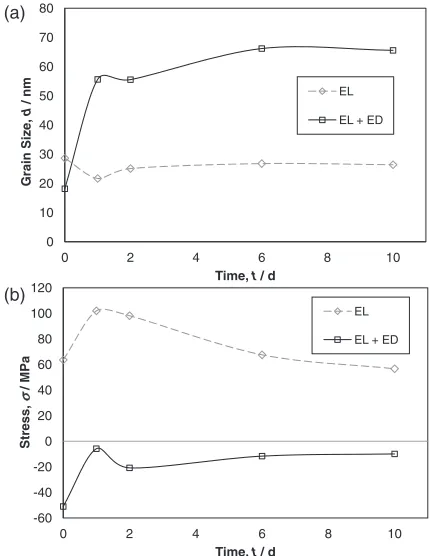
In order to evaluate the influence of physical property change on adhesion strength after aging, the changes in the crystal orientation, grain size, and residual stress of two sample sets were observed using XRD. One with 100 nm thick copper was electrolessly deposited, and the other with additional 10 µm copper was deposited by successive electroless- and electro-deposition. Figure 2 indicates the changes of the grain size and residual stress in the samples that are aged for 0, 1, 2, 6 and 10 d, respectively. Electrolessly deposited copper exhibited no change in grain size during aging period, while electro-deposited copper showed rapid growth in grain size until 1 d and reached saturation value afterwards. Electrolessly deposited copper showed tensile stress and electro-deposited copper showed compressive stress. The absolute residual stress of electrolessly deposited copper increased slightly and decreased back to initial
0 100 200 300 400 500 600
0 2 4 6 8 10
Peel Strength,
σ⋅
d
/ mN
⋅
mm
-1
Time, t/ d
ELxED0
EL0EDx
Fig. 1 Average adhesion strength as a function of aging time either between electroless deposition and electroplating (ELxED0) or between electroplating and the peel test (EL0EDx). Electroless- and electro-deposition are denoted by EL and ED, respectively, andxand 0 mean aging time. Maximum and minimum adhesion strengths are denoted as error bar.
0 10 20 30 40 50 60 70 80
0 2 4 6 8 10
Grain Size,
d
/ nm
Time, t/ d
EL
EL + ED
-60 -40 -20 0 20 40 60 80 100 120
0 2 4 6 8 10
Stress,
σ
/ MPa
Time, t/ d
EL
EL + ED (a)
(b)
[image:2.595.319.534.481.759.2] [image:2.595.63.277.573.720.2]residual stress. The absolute residual stress of electro-deposited copper decreased until 1 d and saturated afterwards. Since adhesion strength of both EL0EDx and ELxED0 samples increased during 1 d of aging and saturated afterward as shown in Fig. 1, the changes of the grain size and residual stress in the electroplated copper during aging are not the main cause of the initial rapid increase in adhesion strength. The almost equivalent gaps 3080 mN/mm in adhesion strength after 1 d of aging between EL0EDx and ELxED0 samples, also indicate that the changes of the grain size and residual stress do not cause the difference in adhesion strength. At each aging period, ratios of peak intensity (I111/
I002) for electrolessly deposited copper were 1.8, 1.8, 1.9, 2.0
and 2.0, and those for electroplated copper were 3.5, 3.0, 3.3, 3.4 and 3.3; both electroless copper and electroplated copper showed similar intensity ratio regardless of different aging periods. Therefore, the change in crystal orientation does not affect the initial rapid growth and the difference of the adhesion strength between EL0EDxand ELxED0, either.
3.3 Inter-diffusion between electroless copper and poly-imidefilm
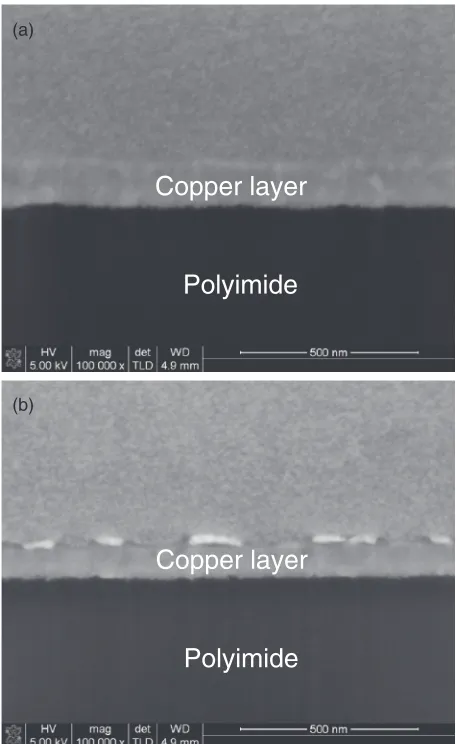
To investigate the inter-diffusion as aging progresses, cross-section of the interface between electroless copper and polyimide has been observed using the FIBSEM, as shown in Fig. 3. Figure 3(a) is the cross-section of the interface between copper and polyimide right after the electroless deposition (0 d), while Fig. 3(b) is that of the interface after 10 d of aging at room temperature in atmosphere. Figure 3(a) shows subtle roughness in interface and this is considered to be caused by the surface modification processes before the copper electroless deposition. However, the roughness change of interface between two layers was not optically observable right after the electroless deposition (0 d) and after 10 d of aging as shown in Fig. 3.
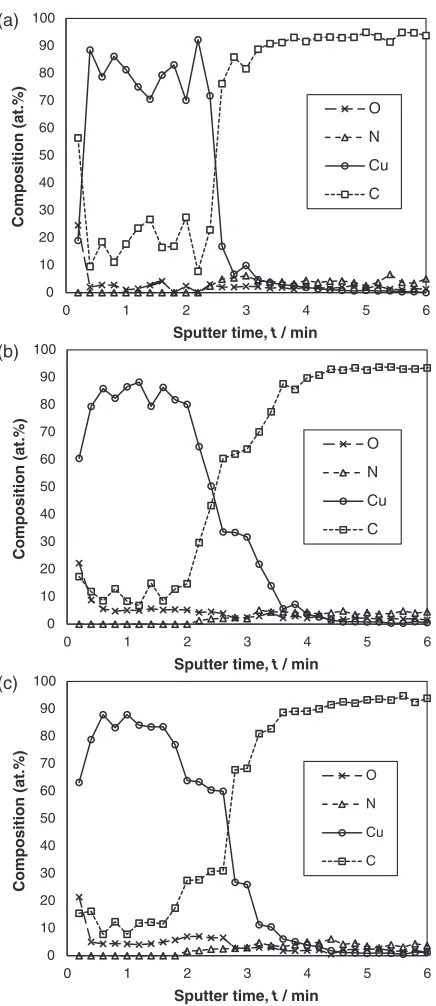
Thus, depth profiling study using XPS was performed as shown in Fig. 4. Depth profiling was conducted and completed within four hours including pumping time of XPS chamber for observing the initial state of interface. Moreover, to minimize the sputtering effects during etching such as ion mixing, only 20 nm of electroless copper on polyimidefilm was used in this case. Comparing Figs. 4(a), 4(b), 4(c), a sample with 1 and 10 d of aging showed that copper has penetrated into the polyimide film, and carbon, nitrogen, and oxygen have diffused into electroless copper. Though aging was performed at room temperature, inter-diffusion between two layers has occurred, which is consistent with the previous results12,13) and the length of
inter-diffusion was about 10 to 15 nm. However, there was no remarkable compositional change near interface between samples with 1 and 10 d of aging as shown in Fig. 4. Once copper was electrolessly deposited, inter-diffusion between copper and polyimide can occur regardless of copper electroplating. Therefore, increased interfacial area caused by inter-diffusion between electroless copper and polyimide can be responsible for initial sharp increase in adhesion strength during aging. Moreover, the increased interfacial area may promote the chemical bonding between electroless copper and the dangling bonds in the modified polyimide surface, such as CuNO, CuN and CuOC.1416)
How-ever, the movement of copper and the formation of new chemical bonding are more difficult as the density of chemical bonding between copper and polyimide increases13) as shown in Figs. 4(b), 4(c). So, the adhesion strength of the samples reached a saturation value after 1 d of aging. On the other hand, 3080 mN/mm of difference in adhesion strength between EL0EDxand ELxED0 cannot be explained by diffusion since two sample sets experienced same inter-diffusion between electroless copper and polyimide.
3.4 Additional electrical current effect on adhesion strength
The differences in experimental conditions between EL0EDxand ELxED0 samples with different initiation point of aging were: when the samples were exposed to the copper sulfate electrolyte for electro-deposition, causing different water concentration within the sample during peel test, and different initiation points of electrical current for electro-deposition. Leeet al.8)has reported that humid environment lowered the adhesion strength between copper and poly-imide. Furman et al.9) has reported that no degradation of
adhesion strength was observed in the chromium film on polyimide which was simply exposed to water and not successively exposed to high temperature. In this study, ELxED0 samples with higher water concentration during peel
(a)
(b)
Polyimide
Copper layer
Polyimide
Copper layer
[image:3.595.313.541.69.441.2]tests showed higher adhesions than those of EL0EDxsamples as mentioned in 3.1. Thus, it is considered that initiation point of applied electrical current is more important factor on adhesion strength change and following experiments were performed to verify it.
For one EL0ED2 sample, 1 mA of electrical current for 1 s was additionally applied for three times. For the other EL0ED2 sample, 1 mA of constant electrical current was applied for 20 min, the same time for copper electro-deposition. Their adhesion strengths are plotted in Fig. 5, and the adhesion strength of EL0ED2 are plotted for comparison. Adhesion strength for EL0ED2 samples that received no additional electrical current, received electrical
current for three times of 1 s, and received for 20 min were 390, 445 and 462 mN/mm, respectively. Adhesion strengths of the two samples with additional electrical current were 55 72 mN/mm greater than that of sample without additional current and this difference in adhesion strength is almost the same with the gap in adhesion strength between EL0EDx
and ELxED0 samples. Moreover, there is little difference in adhesion strength between samples with additional electrical current. Thus, it seems that whether electrical current is applied or not is more important on adhesion strength change than the length of applied time of electrical current in samples with the same initiation point of electrical current.
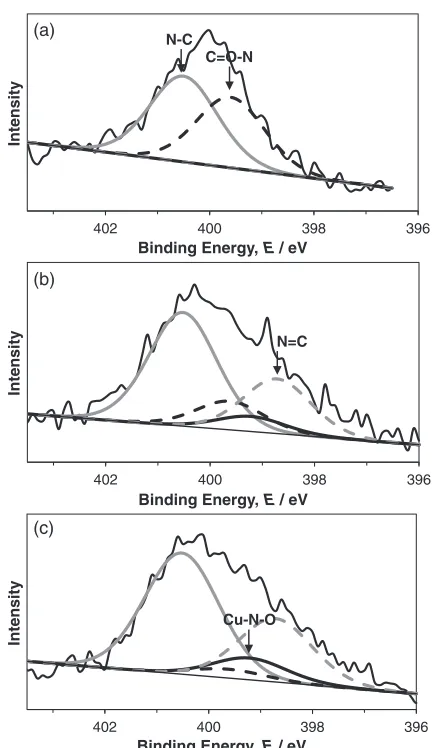
XPS analyses were performed to investigate the change of chemical bondings with the variation of time and initiation point of aging. Figure 6 shows the N 1s core-level photo-emission spectra of peeled copper surface for EL0ED0, EL0ED2 and EL2ED0 samples after peel tests. Generally, the N 1s core-level spectrum of pristine polyimide consists of a single peak from the imide species (NC) at 400.6 eV. However, other peaks appeared at 399.7, 399.3 and 398.8 eV, which were assigned to C=ON, CuN and N=C species,1417) respectively. The peak of C=ON bonding
originated from the surface modification of polyimide by potassium hydroxide solution,17) and the peak for N=C
bonding formed as a result of CuOC bonding formation.16)
EL0ED0 sample without aging showed only NC and C=O N spectra (Fig. 6(a)), while EL0ED2 and EL2ED0 samples with 2 d of aging showed additional peaks of N=C and CuN spectra (Figs. 6(b), 6(c)). 2 d of aging makes the peaks of N=C and CuN increase and the peak of C=ON decrease as shown in Fig. 6. As a results, the density of CuOC and CuN bondings increases through aging. Moreover, the N=C and CuN peaks of EL2ED0 were slightly higher than those of EL0ED2. Therefore, applying electrical current to electroless copper during electroplating with proper inter-diffusion between copper and polyimide, is more effective in increasing the density of chemical bonding because enlarged interfacial area caused by inter-diffusion increases the probability of chemical bonding formation between copper and polyimide as shown in Figs. 6(b), 6(c) and mentioned in 3.3.
300 320 340 360 380 400 420 440 460 480 500
EL0ED2 1 mA for 1 s
(Three times)
1 mA for 20 min
Peel Strength,
σ⋅
d
/ mN
⋅
mm
-1
Sample #1
Sample #2
Sample #3
390
445
462
Fig. 5 Adhesion strength with additional electrical current after 2 d of aging.
(a)
(b)
(c) 0 10 20 30 40 50 60 70 80 90 100
0 1 2 3 4 5 6
Composition (at.%)
Sputter time, t / min O
N
Cu
C
0 10 20 30 40 50 60 70 80 90 100
0 1 2 3 4 5 6
Composition (at.%)
Sputter time, t / min O
N
Cu
C
0 10 20 30 40 50 60 70 80 90 100
0 1 2 3 4 5 6
Composition (at.%)
Sputter time, t / min O N Cu C
[image:4.595.62.280.66.569.2] [image:4.595.318.535.71.244.2]Liet al.18)has reported that electrical current can influence the activation energy of atoms due to the collision between electron and metal atom. Thus, it can be suggested that the collisions between electron and copper atoms induced by the applied electrical current, provide activation energy to enhance chemical bonding between copper and polyimide, such as CuN and CuOC.1416)Therefore, after 2 d of aging
with proper inter-diffusion between copper and polyimide, applied electrical current could increase additionally adhesion strength (Fig. 5). From these results, the difference in adhesion strength between EL0EDx and ELxED0 samples can be explained. However, further investigation is necessary to clarify the exact chemical bonding mechanism between copper and polyimide during inter-diffusion and applying electrical current.
4. Conclusion
It is found that the adhesion strength between copper and polyimide increased sharply and then saturated as aging progressed. With the same total aging time, samples that were
electroplated later showed greater adhesion strength. Accord-ing to the XPS analysis, the increase of adhesion strength during initial aging period was mostly affected by inter-diffusion that increases the interfacial area and the density of chemical bonding between copper and polyimide. Moreover, it is considered that collisions between copper and electrons promote the chemical bonding between copper and the polyimide film while additional electrical current was applied. Therefore, aging and applying additional electrical current increased the density of chemical bonding, and has resulted in enhancement of the adhesion strength between copper and the polyimide film. This phenomenon can be effectively applied to many other processes requiring high adhesion strength between metal and polymerfilm, such as
flexible printed circuit board (FPCB) and ultrafine pattern forming inflexible display.
Acknowledgments
This work was supported by the Industrial Strategic Technology Development Program (10039210, Development of materials and process for 40 µm pitch flexible PCB for high data rate) funded by the Ministry of Knowledge Economy (MKE, Korea).
REFERENCES
1) G. Rabilloud:High Performance Polymers, Polyimides in Electronics, (Editions Technip, Paris, 2000) pp. 89164.
2) M. K. Ghosh and K. L. Mittal: Polyimides, Fundamentals and Applications, (Marcel Dekker, New York, 1996) pp. 759814. 3) Y.-S. Lin, H.-M. Liu and C.-L. Chen:Surf. Coat. Technol.200(2006)
37753785.
4) S. H. Kim, S. W. Na, N.-E. Lee, Y. W. Nam and Y.-H. Kim:Surf. Coat. Technol.200(2005) 20722079.
5) A. Ebe, E. Takahashi, Y. Iwamoto, N. Kuratani, S. Nishiyama, O. Imai, K. Ogata, Y. Setsuhara and S. Miyake: Thin Solid Films281282 (1996) 356359.
6) S. Ikeda, H. Yanagimoto, K. Akamatsu and H. Nawafune:Adv. Funct. Mater.17(2007) 889897.
7) H. K. Yun, K. Cho, J. K. Kim, C. E. Park, S. M. Sim, S. Y. Oh and M. Park:Polymer38(1997) 827834.
8) H. J. Lee and J. Yu:J. Electron. Mater.37(2008) 11021110. 9) B. K. Furman, K. D. Childs, H. Clearfield, R. Davis and S.
Purushothaman:J. Vac. Sci. Technol. A10(1992) 29132920. 10) S. A. Chambers, V. A. Loebs and K. K. Chakravorty: J. Vac. Sci.
Technol. A8(1990) 875884.
11) W. Jang, M. Seo, J. Seo, S. Park and H. Han:Polym. Int.57(2008) 350358.
12) R. M. Tromp, F. Legoues and P. S. Ho:J. Vac. Sci. Technol. A3(1985) 782785.
13) A. Thran, T. Strunskus, V. Zaporojtchenko and F. Faupel:Appl. Phys. Lett.81(2002) 244246.
14) W.-J. Lee, Y.-S. Lee, S.-K. Rha, Y.-J. Lee, K.-Y. Lim, Y.-D. Chung and C.-N. Whang:Appl. Surf. Sci.205(2003) 128136.
15) J.-Y. Park, Y.-S. Jung, J. Cho and W.-K. Choi:Appl. Surf. Sci.252 (2006) 58775891.
16) D. Wolany, T. Fladung, L. Duda, J. W. Lee, T. Gantenfort, L. Wiedmann and A. Benninghoven:Surf. Interf. Anal.27(1999) 609 617.
17) G. H. Yang, E. T. Kang, K. G. Neoh, Y. Zhang and K. L. Tan:Colloid Polym. Sci.279(2001) 745753.
18) Y. Li, Y. Yang and X. Feng: J. Mater. Sci. Technol.24(2008) 410414. 396
398 400
402
Intensity
Binding Energy, E/ eV
396 398
400 402
Intensity
Binding Energy, E/ eV
396 398
400 402
Intensity
Binding Energy, E/ eV (a)
(b)
(c)
N-C C=O-N
N=C
Cu-N-O
[image:5.595.60.276.65.439.2]