A Mention-Synchronous Coreference Resolution Algorithm Based on the
Bell Tree
Xiaoqiang Luo and Abe Ittycheriah
Hongyan Jing and Nanda Kambhatla and Salim Roukos
1101 Kitchawan Road
Yorktown Heights, NY 10598, U.S.A.
{xiaoluo,abei,hjing,nanda,roukos}@us.ibm.com
Abstract
This paper proposes a new approach for coreference resolution which uses the Bell tree to represent the search space and casts the coreference resolution problem as finding the best path from the root of the Bell tree to the leaf nodes. A Maximum Entropy model is used to rank these paths. The coreference performance on the 2002 and 2003 Auto-matic Content Extraction (ACE) data will be reported. We also train a coreference system using the MUC6 data and competitive results are obtained.
1
Introduction
In this paper, we will adopt the terminologies used in the Automatic Content Extraction (ACE) task (NIST, 2003). Coreference resolution in this context is defined as partitioning mentions into entities. A mention is an instance of reference to an object, and the collection of mentions referring to the same object in a document form an entity. For example, in the following sentence, mentions are underlined:
“The American Medical Association voted yesterday to install the heir apparent as its president-elect, rejecting a strong, upstart challenge by a District doctor who argued that the nation’s largest physicians’ group needs stronger ethics and new leadership.”
“American Medical Association”, “its” and “group” belong to the same entity as they refer to the same ob-ject.
Early work of anaphora resolution focuses on find-ing antecedents of pronouns (Hobbs, 1976; Ge et al., 1998; Mitkov, 1998), while recent advances (Soon et al., 2001; Yang et al., 2003; Ng and Cardie, 2002; Itty-cheriah et al., 2003) employ statistical machine learn-ing methods and try to resolve reference among all
kinds of noun phrases (NP), be it a name, nominal, or pronominal phrase – which is the scope of this paper as well. One common strategy shared by (Soon et al., 2001; Ng and Cardie, 2002; Ittycheriah et al., 2003) is that a statistical model is trained to measure how likely a pair of mentions corefer; then a greedy procedure is followed to group mentions into entities. While this ap-proach has yielded encouraging results, the way men-tions are linked is arguably suboptimal in that an instant decision is made when considering whether two men-tions are linked or not.
In this paper, we propose to use the Bell tree to rep-resent the process of forming entities from mentions. The Bell tree represents the search space of the coref-erence resolution problem – each leaf node corresponds to a possible coreference outcome. We choose to model the process from mentions to entities represented in the Bell tree, and the problem of coreference resolution is cast as finding the “best” path from the root node to leaves. A binary maximum entropy model is trained to compute the linking probability between a partial entity and a mention.
The rest of the paper is organized as follows. In Section 2, we present how the Bell tree can be used to represent the process of creating entities from mtions and the search space. We use a maximum en-tropy model to rank paths in the Bell tree, which is dis-cussed in Section 3. After presenting the search strat-egy in Section 4, we show the experimental results on the ACE 2002 and 2003 data, and the Message Under-standing Conference (MUC) (MUC, 1995) data in Sec-tion 5. We compare our approach with some recent work in Section 6.
2
Bell Tree: From Mention to Entity
[1][2] 3*
[1][2][3] [1] [23] [13][2] [123]
[12][3] [1] 2* 3
[1]
[12]
[1] [2]
(c1)
(c5) (b1)
(c2)
(c3)
(c4)
(a) [12] 3*
[image:2.595.91.268.106.233.2](b2)
Figure 1: Bell tree representation for three mentions: numbers in [] denote a partial entity. In-focus entities are marked on the solid arrows, and active mentions are marked by *. Solid arrows signify that a mention is linked with an in-focus partial entity while dashed arrows indicate starting of a new entity.
added in the next step by either linking to the exist-ing entity, or startexist-ing a new entity. A second layer of nodes are created to represent the two possible out-comes. Subsequent mentions are added to the tree in the same manner. The process is mention-synchronous in that each layer of tree nodes are created by adding one mention at a time. Since the number of tree leaves is the number of possible coreference outcomes and it equals the Bell Number (Bell, 1934), the tree is called the Bell tree. The Bell Number
is the num-ber of ways of partitioning
distinguishable objects (i.e., mentions) into non-empty disjoint subsets (i.e., entities). The Bell Number has a “closed” formula
and it increases rapidly as
in-creases:
! #"%$&'
)(
! Clearly, an efficient search strategy is necessary, and it will be addressed in Section 4.
Figure 1 illustrates how the Bell tree is created for a document with three mentions. The initial node con-sists of the first partial entity[1](i.e., node (a) in Fig-ure 1). Next, mention2becomes active (marked by “*” in node (a)) and can either link with the partial entity
[1]and result in a new node (b1), or start a new entity and create another node (b2). The partial entity which the active mention considers linking with is said to be
in-focus. In-focus entities are highlighted on the solid
arrows in Figure 1. Similarly, mention3 will be ac-tive in the next stage and can take five possible actions, which create five possible coreference results shown in node (c1) through (c5).
Under the derivation illustrated in Figure 1, each leaf node in the Bell tree corresponds to a possible corefer-ence outcome, and there is no other way to form enti-ties. The Bell tree clearly represents the search space of the coreference resolution problem. The corefer-ence resolution can therefore be cast equivalently as finding the “best” leaf node. Since the search space is
large (even for a document with a moderate number of mentions), it is difficult to estimate a distribution over leaves directly. Instead, we choose to model the
pro-cess from mentions to entities, or in other words, score
paths from the root to leaves in the Bell tree.
A nice property of the Bell tree representation is that the number of linking or starting steps is the same for all the hypotheses. This makes it easy to rank them us-ing the “local” linkus-ing and startus-ing probabilities as the number of factors is the same. The Bell tree represen-tation is also incremental in that mentions are added sequentially. This makes it easy to design a decoder and search algorithm.
3
Coreference Model
3.1 Linking and Starting Model
We use a binary conditional model to compute the probability that an active mentionlinkswith an
in-focus partial entity. The conditions include all the partially-formed entities before, the focus entity index, and the active mention.
Formally, let *'+-,.
&0/213/465
be
mentions in a document. Mention index 1
represents the order it appears in the document. Let 78 be an entity, and
9
.
1;:<>=
be the (many-to-one) map from mention index1
to entity index=
. For an active mention index
?
)&@/
?
/A
, define
B
*CD.C
9
E1FG
for some&H/A1I/ ?KJ
&5LG
the set of indices of the partially-established entities to the left of+
(note that
B NM
), and
O
*P7Q.CIR
B
5G
the set of the partially-established entities. The link model is then
STVUXWO
G
+
GZY
C
G
(1)
the probability linking the active mention+
with the in-focus entity7 Q. The random variable
Y
takes value from the set
B
and signifies which entity is in focus;
U
takes binary value and is
&
if+
links with7'Q.
As an example, for the branch from (b2) to (c4) in Figure 1, the active mention is “3”, the set of partial entities to the left of “3” is
O
(
*\[ &]^G
[
P]5
, the ac-tive entity is the second partial entity “[2]”. Probability
STVU_`&\WO
(
GbadceeGZY
(
fb
measures how likely men-tion “3” links with the entity “[2].”
The model STVUXWO
G
+
GdY
C
only computes how likely+
links with 7 Q; It does not say anything
about the possibility that+
starts a new entity. Fortu-nately, the starting probability can be computed using link probabilities (1), as shown now.
Since starting a new entity means that+
does not link with any entities in
O
a new entity,
STVUA WO G
+
, can be computed as
STU WO
G + (2) Q STVUA #GZY C WO G + K& J Q STY C WO G +
STUA &\WO
G + GZY C " (3)
(3) indicates that the probability of starting an en-tity can be computed using the linking probabilities
STU_ & WO
G + GdY C
, provided that the marginal
STY Q C WO G +
is known. In this paper,
STY C WO G +
is approximated as:
STY C WO G + L & ifC ,
STU & WO
G + GdY 1F otherwise (4)
With the approximation (4), the starting probability (3) is
STUA WO
G + K& J Q
STUA &\WO
G + GZY C " (5)
The linking model (1) and approximated starting model (5) can be used to score paths in the Bell tree. For example, the score for the path (a)-(b2)-(c4) in Fig-ure 1 is the product of the start probability from (a) to (b2) and the linking probability from (b2) to (c4).
Since (5) is an approximation, not true probability, a constant is introduced to balance the linking
proba-bility and starting probaproba-bility and the starting probabil-ity becomes:
S VUA WO
G + L
STUA WO
G + " (6) If &
, it penalizes creating new entities; Therefore,
is called start penalty. The start penalty can be
used to balance entity miss and false alarm.
3.2 Model Training and Features The model
STU WO
G + GdY C
depends on all par-tial entities
O
, which can be very expensive. After making some modeling assumptions, we can approxi-mate it as:
STUA &\WO
G + GZY C (7) XSTUA &\W 7 Q G + (8) !
STU &\W
+ G + " (9)
From (7) to (8), entities other than the one in focus,
7 Q, are assumed to have no influence on the decision
of linking +
with 7'Q. (9) further assumes that the
entity-mention score can be obtained by the maximum mention pair score. The model (9) is very similar to
the model in (Morton, 2000; Soon et al., 2001; Ng and Cardie, 2002) while (8) has more conditions.
We use maximum entropy model (Berger et al., 1996) for both the mention-pair model (9) and the entity-mention model (8):
STVUXW + , G + 7#"$ #% '&(*) ,+- -.0/1 2 + , G + G (10) STU W 7 Q G + 7#" $ % '&(*) -
-.0/1
2 7'Q G + G (11) where9
3G4GZUI
is a feature and5
is its weight;2 !G6
is a normalizing factor to ensure that (10) or (11) is a probability. Effective training algorithm exists (Berger et al., 1996) once the set of features*
9
!G6GdUD 5
is se-lected.
The basic features used in the models are tabulated in Table 1.
Features in the lexical category are applicable to non-pronominal mentions only. Distance features char-acterize how far the two mentions are, either by the number of tokens, by the number of sentences, or by the number of mentions in-between. Syntactic fea-tures are derived from parse trees output from a maxi-mum entropy parser (Ratnaparkhi, 1997). The “Count” feature calculates how many times a mention string is seen. For pronominal mentions, attributes such as gen-der, number, possessiveness and reflexiveness are also used. Apart from basic features in Table 1, composite features can be generated by taking conjunction of ba-sic features. For example, a distance feature together with reflexiveness of a pronoun mention can help to capture that the antecedent of a reflexive pronoun is of-ten closer than that of a non-reflexive pronoun.
The same set of basic features in Table 1 is used in the entity-mention model, but feature definitions are slightly different. Lexical features, including the acronym features, and the apposition feature are com-puted by testing any mention in the entity7 Q against the
active mention+
. Editing distance for 7 Q G + is de-fined as the minimum distance over any non-pronoun mentions and the active mention. Distance features are computed by taking minimum between mentions in the entity and the active mention.
In the ACE data, mentions are annotated with three levels: NAME, NOMINAL and PRONOUN. For each ACE entity, a canonical mention is defined as the longest NAME mention if available; or if the entity does not have a NAME mention, the most recent NOM-INAL mention; if there is no NAME and NOMNOM-INAL mention, the most recent pronoun mention. In the entity-mention model, “ncd”,“spell” and “count” fea-tures are computed over the canonical mention of the in-focus entity and the active mention. Conjunction features are used in the entity-mention model too.
men-Category Features Remark
Lexical exact_strm 1 if two mentions have the same spelling; 0 otherwise left_subsm 1 if one mention is a left substring of the other; 0 otherwise right_subsm 1 if one mention is a right substring of the other; 0 otherwise acronym 1 if one mention is an acronym of the other; 0 otherwise edit_dist quantized editing distance between two mention strings spell pair of actual mention strings
ncd number of different capitalized words in two mentions Distance token_dist how many tokens two mentions are apart (quantized)
sent_dist how many sentences two mentions are apart (quantized)
gap_dist how many mentions in between the two mentions in question (quantized) Syntax POS_pair POS-pair of two mention heads
apposition 1 if two mentions are appositive; 0 otherwise
Count count pair of (quantized) numbers, each counting how many times a mention string is seen Pronoun gender pair of attributes of {female, male, neutral, unknown }
[image:4.595.87.507.104.278.2]number pair of attributes of {singular, plural, unknown} possessive 1 if a pronoun is possessive; 0 otherwise reflexive 1 if a pronoun is reflexive; 0 otherwise
Table 1: Basic features used in the maximum entropy model.
tions; its drawback is that information outside the men-tion pair is ignored. Suppose a document has three mentions “Mr. Clinton”, “Clinton” and “she”, appear-ing in that order. When considerappear-ing the mention pair “Clinton” and “she”, the model may tend to link them because of their proximity; But this mistake can be easily avoided if “Mr. Clinton” and “Clinton” have been put into the same entity and the model knows “Mr. Clinton” referring to a male while “she” is fe-male. Since gender and number information is prop-agated at the entity level, the entity-mention model is able to check the gender consistency when considering the active mention “she”.
3.3 Discussion
There is an in-focus entity in the condition of the link-ing model (1) while the startlink-ing model (2) conditions on all left entities. The disparity is intentional as the
starting action is influenced by all established entities
on the left.
(4) is not the only waySTY
C
WO
G
+
can be approximated. For example, one could use a uniform distribution overB
. We experimented several schemes of approximation, including a uniform distribution, and (4) worked the best and is adopted here. One may con-sider trainingSTY
C
WO
G
+
directly and use it to score paths in the Bell tree. The problem is that 1) the size ofB
from whichY
takes value is variable; 2) the start action depends on all entities inO
, which makes it difficult to trainSTY
C
WO
G
+
directly.
4
Search Issues
As shown in Section 2, the search space of the coref-erence problem can be represented by the Bell tree. Thus, the search problem reduces to creating the Bell tree while keeping track of path scores and picking the top-N best paths. This is exactly what is described in Algorithm 1.
In Algorithm 1, contains all the hypotheses, or paths from the root to the current layer of nodes. Vari-able
VO
stores the cumulative score for a corefer-ence resultO
. At line 1, is initialized with a single entity consisting of mention+ , which corresponds to
the root node of the Bell tree in Figure 1. Line 2 to 15 loops over the remaining mentions (+ to+ ), and for
each mention+
, the algorithm extends each result
O
in (or a path in the Bell tree) by either linking+
with an existing entity7
, (line 5 to 10), or starting an
entity[+
]
(line 11 to 14). The loop from line 2 to 12 corresponds to creating a new layer of nodes for the ac-tive mention+
in the Bell tree.
in line 4 and
in
line 6 and 11 have to do with pruning, which will be discussed shortly. The last line returns top results,
where
O
)
/ denotes the
Q
result ranked by 3
:
VO
)
/
O
)
/
66
VO
)
/
"
Algorithm 1 Search Algorithm Input: mentions
*+;,6.
&bG" ""G)65
;
Output: top entity results
1:Initialize: .
*
O
.
*[+ ]5b5
O f&
2:for
?
to
3: foreach nodeO R
4: compute
.
5: foreach1
R
B
6: if (S VUA & WOTG
+
GdY 1
) {
8: ExtendO
toO e
, by linking
+
with7P,
9:
VO e
,
.
O S UAf& WO G
+
GdY 1F
10: }
11: if(SHUA WOTG
+
) {
12: ExtendO
toO e
by starting [+
]
.
13:
O e
.
VO S VUA WOTG
+
14: } 15: .
*
O e5
*
O e
,
.
1
R
B
5
. 16:return*
O
)
/
GZO
)
/
G646GZO
)
/
The complexity of the search Algorithm 1 is the total number of nodes in the Bell tree, which is ?
, where?
is the Bell Number. Since the Bell number increases rapidly as a function of the number of men-tions, pruning is necessary. We prune the search space in the following places:
Local pruning: any children with a score below a fixed factor of the maximum score are pruned.
This is done at line 6 and 11 in Algorithm 1. The operation in line 4 is:
.
*
*
S VU WOTG
+
5
*
STVU f&\WOTG
+
GZY 1F
.
1
R
B
5"
Block 8-9 is carried out only if STU & WOTG
+
GZY 1F
and block 12-13 is
car-ried out only if
SUA WOTG
+
.
Global pruning: similar to local pruning except that this is done using the cumulative score
O
. Pruning based on the global scores is carried out at line 15 of Algorithm 1.
Limit hypotheses: we set a limit on the maxi-mum number of live paths. This is useful when a document contains many mentions, in which case excessive number of paths may survive local and global pruning.
Whenever available, we check the compatibility of entity types between the in-focus entity and the active mention. A hypothesis with incompatible entity types is discarded. In the ACE annotation, every mention has an entity type. Therefore we can eliminate hypotheses with two mentions of different types.
5
Experiments
5.1 Performance Metrics
The official performance metric for the ACE task is ACE-value. ACE-value is computed by first calculat-ing the weighted cost of entity insertions, deletions and substitutions; The cost is then normalized against the cost of a nominal coreference system which outputs no entities; The ACE-value is obtained by subtracting the normalized cost from &
. Weights are designed to emphasize NAME entities, while PRONOUN entities (i.e., an entity consisting of only pronominal mentions) carry very low weights. A perfect coreference system will get a &'b
ACE-value while a system outputs no entities will get a
ACE-value. Thus, the ACE-value can be interpreted as percentage of value a system has, relative to the perfect system.
Since the ACE-value is an entity-level metric and is weighted heavily toward NAME entities, we also mea-sure our system’s performance by an entity-constrained mention F-measure (henceforth “ECM-F”). The metric
first aligns the system entities with the reference enti-ties so that the number of common mentions is maxi-mized. Each system entity is constrained to align with at most one reference entity, and vice versa. For exam-ple, suppose that a reference document contains three entities: *\[+
]G
[+
G
+
(
]G
[+
]5
while a system out-puts four entities: * [+
G
+
]^G
[+
(
]G
[+
]G
[+
]5
, then the best alignment (from reference to system) would be
[+ ]
[+
G
+
]
,[+
G
+
(
]
[+
(
]
and other entities are not aligned. The number of common mentions of the best alignment is
(i.e.,+ and+
( ), which leads to
a mention recall
and precision
. The ECM-F
mea-sures the percentage of mentions that are in the “right” entities.
For tests on the MUC data, we report both F-measure using the official MUC score (Vilain et al., 1995) and ECM-F. The MUC score counts the common links be-tween the reference and the system output.
5.2 Results on the ACE data
The system is first developed and tested using the ACE data. The ACE coreference system is trained with
&
documents (about
&b
words) of ACE 2002 training data. A separate
b
documents ( words) is used as the development-test (Devtest) set. In 2002, NIST re-leased two test sets in February (Feb02) and September (Sep02), respectively. Statistics of the three test sets is summarized in Table 2. We will report coreference re-sults on the true mentions of the three test sets.
TestSet #-docs #-words #-mentions #-entities Devtest 90 50426 7470 2891
Feb02 97 52677 7665 3104 Sep02 186 69649 10577 4355
Table 2: Statistics of three test sets.
For the mention-pair model, training events are gen-erated for all compatible mention-pairs, which results in aboutb
events, about&'
of which are posi-tive examples. The full mention-pair model uses about
& &
features; Most are conjunction features. For the entity-mention model, events are generated by walking through the Bell tree. Only events on the true path (i.e., positive examples) and branches emitting from a node on the true path to a node not on the true path (i.e., negative examples) are generated. For example, in Fig-ure 1, suppose that the path (a)-(b2)-(c4) is the truth, then positive training examples are starting event from (a) to (b2) and linking event from (b2) to (c4); While the negative examples are linking events from (a) to (b1), (b2) to (c3), and the starting event from (b2) to (c5). This scheme generates about
c
events, out of which about &
are positive training examples. The full entity-mention model has about#"
features, due to less number of conjunction features and training ex-amples.
De-vtest, Feb02, and Sep02 test sets are tabulated in Ta-ble 3. These numbers are obtained with a fixed search beamb
and pruning threshold
"#&
(widening the search beam or using a smaller pruning threshold did not change results significantly).
The mention-pair model in most cases performs bet-ter than the mention-entity model by both ACE-value and ECM-F measure although none of the differences is statistically significant (pair-wise t-test) at p-value
#"
. Note that, however, the mention-pair model uses
times more features than the entity-pair model. We also observed that, because the score between the in-focus entity and the active mention is computed by (9) in the mention-pair model, the mention-pair sometimes mistakenly places a male pronoun and female pronoun into the same entity, while the same mistake is avoided in the entity-mention model. Using the canonical men-tions when computing some features (e.g., “spell”) in the entity-mention model is probably not optimal and it is an area that needs further research.
When the same mention-pair model is used to score the ACE 2003 evaluation data, an ACE-value
c "
is obtained on the system1mentions. After retrained with
Chinese and Arabic data (much less training data than English), the system got "
and
"
ACE-value on the system mentions of ACE 2003 evaluation data for Chinese and Arabic, respectively. The results for all three languages are among the top-tier submission systems. Details of the mention detection and corefer-ence system can be found in (Florian et al., 2004).
Since the mention-pair model is better, subsequent analyses are done with the mention pair model only.
5.2.1 Feature Impact
To see how each category of features affects the per-formance, we start with the aforementioned mention-pair model, incrementally remove each feature cate-gory, retrain the system and test it on the Devtest set. The result is summarized in Table 4. The last column lists the number of features. The second row is the full mention-pair model, the third through seventh row cor-respond to models by removing the syntactic features (i.e., POS tags and apposition features), count features, distance features, mention type and level information, and pair of mention-spelling features. If a basic fea-ture is removed, conjunction feafea-tures using that basic feature are also removed. It is striking that the small-est system consisting of only
c
features (string and substring match, acronym, edit distance and number of different capitalized words) can get as much as#"
ACE-value. Table 4 shows clearly that these lexical features and the distance features are the most impor-tant. Sometimes the ACE-value increases after remov-ing a set of features, but the ECM-F measure tracks nicely the trend that the more features there are, the bet-ter the performance is. This is because the ACE-value
1
System mentions are output from a mention detection system.
−2.5 −2 −1.5 −1 −0.5 0
0.65 0.7 0.75 0.8 0.85 0.9
log α
ACE−value or ECM−F
[image:6.595.326.506.104.245.2]ECM−F ACE−value
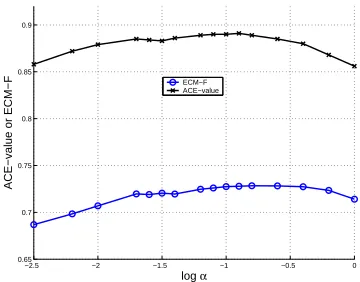
Figure 2: Performance vs. log start penalty
is a weighted metric. A small fluctuation of NAME entities will impact the ACE-value more than many NOMINAL or PRONOUN entities.
Model ACE-val(%) ECM-F(%) #-features
Full 89.8 73.20 (
2.9) 171K -syntax 89.0 72.6 (
2.5) 71K
-count 89.4 72.0 (
3.3) 70K
-dist 86.7 *66.2 (
3.9) 24K -type/level 86.8 65.7 (
2.2) 5.4K -spell 86.0 64.4 (
1.9) 39
Table 4: Impact of feature categories. Numbers after
are the standard deviations. * indicates that the result is significantly (pair-wise t-test) different from the line above at
#"
.
5.2.2 Effect of Start Penalty
As discussed in Section 3.1, the start penalty can
be used to balance the entity miss and false alarm. To see this effect, we decode the Devtest set by varying the start penalty and the result is depicted in Figure 2. The ACE-value and ECM-F track each other fairly well. Both achieve the optimal when
J #"
.
5.3 Experiments on the MUC data
[image:6.595.308.541.340.423.2]Devtest Feb02 Sep02
Model ACE-val(%) ECM-F(%) ACE-val(%) ECM-F(%) ACE-val(%) ECM-F(%)
MP 89.8 73.2 (
2.9) 90.0 73.1 (
4.0) 88.0 73.1 (
6.8)
EM 89.9 71.7 (
2.4) 88.2 70.8 (
3.9) 87.6 72.4 (
[image:7.595.96.502.105.154.2]6.2)
Table 3: Coreference results on true mentions: MP – mention-pair model; EM – entity-mention model; ACE-val: ACE-value; ECM-F: Entity-constrained Mention F-measure. MP uses & &
features while EM uses only "
features. None of the ECM-F differences between MP and EM is statistically significant at #"
.
generic type “UNKNOWN” is assigned to these men-tions. Mentions that can be found in the named-entity annotation are assumed to have the ACE mention level “NAME”; All other mentions other than English pro-nouns are assigned the level “NOMINAL.”
After the MUC data is mapped into the ACE-style, the same set of feature templates is used to train a coreference system. Two coreference systems are trained on the MUC6 data: one trained with 30 dry-run test documents (henceforth “MUC6-small”); the other trained with 191 “dryrun-train” documents that have both coreference and named-entity annotations (hence-forth “MUC6-big”) in the latest LDC release.
To use the official MUC scorer, we convert the out-put of the ACE-style coreference system back into the MUC format. Since MUC does not require entity label and level, the conversion from ACE to MUC is “loss-less.”
Table 5 tabulates the test results on the true mentions of the MUC6 formal test set. The numbers in the ta-ble represent the optimal operating point determined by ECM-F. The MUC scorer cannot be used since it inher-ently favors systems that output fewer number of enti-ties (e.g., putting all mentions of the MUC6 formal test set into one entity will yield a
&'b
recall and
"
precision of links, which gives an#"
F-measure). The MUC6-small system compares favorably with the similar experiment in Harabagiu et al. (2001) in which an &b"
F-measure is reported. When measured by the ECM-F measure, the MUC6-small system has the same level of performance as the ACE system, while the MUC6-big system performs better than the ACE system. The results show that the algorithm works well on the MUC6 data despite some information is lost in the conversion from the MUC format to the ACE for-mat.
System MUC F-measure ECM-F
MUC6-small 83.9% 72.1%
[image:7.595.86.275.636.670.2]MUC6-big 85.7% 76.8%
Table 5: Results on the MUC6 formal test set.
6
Related Work
There exists a large body of literature on the topic of coreference resolution. We will compare this study
with some relevant work using machine learning or sta-tistical methods only.
Soon et al. (2001) uses a decision tree model for coreference resolution on the MUC6 and MUC7 data. Leaves of the decision tree are labeled with “link” or “not-link” in training. At test time, the system checks a mention against all its preceding mentions, and the first one labeled with “link” is picked as the antecedent. Their work is later enhanced by (Ng and Cardie, 2002) in several aspects: first, the decision tree returns scores instead of a hard-decision of “link” or “not-link” so that Ng and Cardie (2002) is able to pick the “best” candi-date on the left, as opposed the first in (Soon et al., 2001); Second, Ng and Cardie (2002) expands the fea-ture sets of (Soon et al., 2001). The model in (Yang et al., 2003) expands the conditioning scope by including a competing candidate. Neither (Soon et al., 2001) nor (Ng and Cardie, 2002) searches for the global optimal entity in that they make locally independent decisions during search. In contrast, our decoder always searches for the best result ranked by the cumulative score (sub-ject to pruning), and subsequent decisions depend on earlier ones.
Recently, McCallum and Wellner (2003) proposed to use graphical models for computing probabilities of entities. The model is appealing in that it can poten-tially overcome the limitation of mention-pair model in which dependency among mentions other than the two in question is ignored. However, models in (McCal-lum and Wellner, 2003) compute directly the probabil-ity of an entprobabil-ity configuration conditioned on mentions, and it is not clear how the models can be factored to do the incremental search, as it is impractical to enu-merate all possible entities even for documents with a moderate number of mentions. The Bell tree represen-tation proposed in this paper, however, provides us with a naturally incremental framework for coreference res-olution.
pairs. Our entity-mention model eliminates the need to synthesize an entity-mention score from mention-pair scores. Morton (2000) also uses a maximum entropy mention-pair model, and a special “dummy” mention is used to model the event of starting a new entity. Features involving the dummy mention are essentially computed with the single (normal) mention, and there-fore the starting model is weak. In our model, the start-ing model is obtained by “complementstart-ing” the linkstart-ing scores. The advantage is that we do not need to train a starting model. To compensate the model inaccuracy, we introduce a “starting penalty” to balance the linking and starting scores.
To our knowledge, the paper is the first time the Bell tree is used to represent the search space of the coref-erence resolution problem.
7
Conclusion
We propose to use the Bell tree to represent the pro-cess of forming entities from mentions. The Bell tree represents the search space of the coreference reso-lution problem. We studied two maximum entropy models, namely the mention-pair model and the entity-mention model, both of which can be used to score entity hypotheses. A beam search algorithm is used to search the best entity result. State-of-the-art perfor-mance has been achieved on the ACE coreference data across three languages.
Acknowledgments
This work was partially supported by the Defense Ad-vanced Research Projects Agency and monitored by SPAWAR under contract No. N66001-99-2-8916. The views and findings contained in this material are those of the authors and do not necessarily reflect the position of policy of the Government and no official endorse-ment should be inferred. We also would like to thank the anonymous reviewers for suggestions of improving the paper.
References
E.T. Bell. 1934. Exponential numbers. Amer. Math.
Monthly, pages 411–419.
Adam L. Berger, Stephen A. Della Pietra, and Vincent J. Della Pietra. 1996. A maximum entropy approach to natural language processing. Computational
Lin-guistics, 22(1):39–71, March.
R Florian, H Hassan, A Ittycheriah, H Jing, N Kamb-hatla, X Luo, N Nicolov, and S Roukos. 2004. A statistical model for multilingual entity detection and tracking. In Daniel Marcu Susan Dumais and Salim Roukos, editors, HLT-NAACL 2004: Main
Proceed-ings, pages 1–8, Boston, Massachusetts, USA, May
2 - May 7. Association for Computational Linguis-tics.
Niyu Ge, John Hale, and Eugene Charniak. 1998. A statistical approach to anaphora resolution. In Proc.
of the sixth Workshop on Very Large Corpora.
Sanda M. Harabagiu, Razvan C. Bunescu, and Steven J. Maiorano. 2001. Text and knowledge mining for coreference resolution. In Proc. of NAACL.
J. Hobbs. 1976. Pronoun resolution. Technical report, Dept. of Computer Science, CUNY, Technical Re-port TR76-1.
A. Ittycheriah, L. Lita, N. Kambhatla, N. Nicolov, S. Roukos, and M. Stys. 2003. Identifying and tracking entity mentions in a maximum entropy framework. In HLT-NAACL 2003: Short Papers, May 27 - June 1.
Andrew Kehler. 1997. Probabilistic coreference in in-formation extraction. In Proc. of EMNLP.
Andrew McCallum and Ben Wellner. 2003. To-ward conditional models of identity uncertainty with application to proper noun coreference. In IJCAI
Workshop on Information Integration on the Web.
R. Mitkov. 1998. Robust pronoun resolution with lim-ited knowledge. In Procs. of the 17th Internaltional
Conference on Computational Linguistics, pages
869–875.
Thomas S. Morton. 2000. Coreference for NLP appli-cations. In In Proceedings of the 38th Annual
Meet-ing of the Association for Computational LMeet-inguistics.
MUC-6. 1995. Proceedings of the Sixth Message Understanding Conference(MUC-6), San Francisco,
CA. Morgan Kaufmann.
Vincent Ng and Claire Cardie. 2002. Improving ma-chine learning approaches to coreference resolution. In Proc. of ACL, pages 104–111.
NIST. 2003. The ACE evaluation plan. www.nist.gov/speech/tests/ace/index.htm.
Adwait Ratnaparkhi. 1997. A Linear Observed Time Statistical Parser Based on Maximum Entropy Mod-els. In Second Conference on Empirical Methods in
Natural Language Processing, pages 1 – 10.
Wee Meng Soon, Hwee Tou Ng, and Chung Yong Lim. 2001. A machine learning approach to coreference resolution of noun phrases. Computational
Linguis-tics, 27(4):521–544.
M. Vilain, J. Burger, J. Aberdeen, D. Connolly, , and L. Hirschman. 1995. A model-theoretic coreference scoring scheme. In In Proc. of MUC6, pages 45–52.
Xiaofeng Yang, Guodong Zhou, Jian Su, and Chew Lim Tan. 2003. Coreference resolution us-ing competition learnus-ing approach. In Proc. of the
&
Q
![Figure 1: Bell tree representation for three mentions:numbers in [] denote a partial entity](https://thumb-us.123doks.com/thumbv2/123dok_us/255451.524958/2.595.91.268.106.233/figure-bell-representation-mentions-numbers-denote-partial-entity.webp)