Relation Extraction Using Label Propagation Based Semi-supervised
Learning
Jinxiu Chen1 Donghong Ji1 Chew Lim Tan2 Zhengyu Niu1
1Institute for Infocomm Research 2Department of Computer Science
21 Heng Mui Keng Terrace National University of Singapore
119613 Singapore 117543 Singapore
{jinxiu,dhji,zniu}@i2r.a-star.edu.sg [email protected]
Abstract
Shortage of manually labeled data is an obstacle to supervised relation extraction methods. In this paper we investigate a graph based semi-supervised learning al-gorithm, a label propagation (LP) algo-rithm, for relation extraction. It represents labeled and unlabeled examples and their distances as the nodes and the weights of edges of a graph, and tries to obtain a la-beling function to satisfy two constraints: 1) it should be fixed on the labeled nodes, 2) it should be smooth on the whole graph. Experiment results on the ACE corpus showed that this LP algorithm achieves better performance than SVM when only very few labeled examples are available, and it also performs better than bootstrap-ping for the relation extraction task.
1 Introduction
Relation extraction is the task of detecting and classifying relationships between two entities from text. Many machine learning methods have been proposed to address this problem, e.g., supervised learning algorithms (Miller et al., 2000; Zelenko et al., 2002; Culotta and Soresen, 2004; Kambhatla, 2004; Zhou et al., 2005), semi-supervised learn-ing algorithms (Brin, 1998; Agichtein and Gravano, 2000; Zhang, 2004), and unsupervised learning al-gorithms (Hasegawa et al., 2004).
Supervised methods for relation extraction per-form well on the ACE Data, but they require a large
amount of manually labeled relation instances. Un-supervised methods do not need the definition of relation types and manually labeled data, but they cannot detect relations between entity pairs and its result cannot be directly used in many NLP tasks since there is no relation type label attached to each instance in clustering result. Considering both the availability of a large amount of untagged cor-pora and direct usage of extracted relations, semi-supervised learning methods has received great at-tention.
DIPRE (Dual Iterative Pattern Relation Expan-sion) (Brin, 1998) is a bootstrapping-based sys-tem that used a pattern matching syssys-tem as clas-sifier to exploit the duality between sets of pat-terns and relations. Snowball (Agichtein and Gra-vano, 2000) is another system that used bootstrap-ping techniques for extracting relations from un-structured text. Snowball shares much in common with DIPRE, including the employment of the boot-strapping framework as well as the use of pattern matching to extract new candidate relations. The third system approaches relation classification prob-lem with bootstrapping on top of SVM, proposed by Zhang (2004). This system focuses on the ACE sub-problem, RDC, and extracts various lexical and syn-tactic features for the classification task. However, Zhang (2004)’s method doesn’t actually “detect” re-laitons but only performs relation classification be-tween two entities given that they are known to be related.
can be found that the affinity information among un-labeled examples is not fully explored in this boot-strapping process.
Recently a promising family of semi-supervised learning algorithm is introduced, which can effec-tively combine unlabeled data with labeled data in learning process by exploiting manifold structure (cluster structure) in data (Belkin and Niyogi, 2002; Blum and Chawla, 2001; Blum et al., 2004; Zhu and Ghahramani, 2002; Zhu et al., 2003). These graph-based semi-supervised methods usually de-fine a graph where the nodes represent labeled and unlabeled examples in a dataset, and edges (may be weighted) reflect the similarity of examples. Then one wants a labeling function to satisfy two con-straints at the same time: 1) it should be close to the given labels on the labeled nodes, and 2) it should be smooth on the whole graph. This can be expressed in a regularization framework where the first term is a loss function, and the second term is a regu-larizer. These methods differ from traditional semi-supervised learning methods in that they use graph structure to smooth the labeling function.
To the best of our knowledge, no work has been done on using graph based semi-supervised learning algorithms for relation extraction. Here we inves-tigate a label propagation algorithm (LP) (Zhu and Ghahramani, 2002) for relation extraction task. This algorithm works by representing labeled and unla-beled examples as vertices in a connected graph, then propagating the label information from any ver-tex to nearby vertices through weighted edges itera-tively, finally inferring the labels of unlabeled exam-ples after the propagation process converges. In this paper we focus on the ACE RDC task1.
The rest of this paper is organized as follows. Sec-tion 2 presents related work. SecSec-tion 3 formulates relation extraction problem in the context of semi-supervised learning and describes our proposed ap-proach. Then we provide experimental results of our proposed method and compare with a popular su-pervised learning algorithm (SVM) and bootstrap-ping algorithm in Section 4. Finally we conclude our work in section 5.
1 http://www.ldc.upenn.edu/Projects/ACE/, Three tasks of
ACE program: Entity Detection and Tracking (EDT), Rela-tion DetecRela-tion and CharacterizaRela-tion (RDC), and Event Detec-tion and CharacterizaDetec-tion (EDC)
2 The Proposed Method
2.1 Problem Definition
The problem of relation extraction is to assign an ap-propriate relation type to an occurrence of two entity pairs in a given context. It can be represented as fol-lows:
R→(Cpre, e1, Cmid, e2, Cpost) (1)
where e1 and e2 denote the entity mentions, and
Cpre,Cmid,and Cpost are the contexts before, be-tween and after the entity mention pairs. In this pa-per, we set the mid-context window as the words be-tween the two entity mentions and the pre- and post-context as up to two words before and after the cor-responding entity mention.
Let X = {xi}ni=1 be a set of contexts of occur-rences of all the entity mention pairs, wherexi rep-resents the contexts of thei-th occurrence, andnis the total number of occurrences. The first l exam-ples (or contexts) are labeled asyg (yg ∈ {rj}Rj=1,
rj denotes relation type andRis the total number of relation types). The remainingu(u=n−l) exam-ples are unlabeled.
Intuitively, if two occurrences of entity mention pairs have the similarity context, they tend to hold the same relation type. Based on the assumption, we define a graph where the vertices represent the con-texts of labeled and unlabeled occurrences of entity mention pairs, and the edge between any two ver-ticesxiandxjis weighted so that the closer the ver-tices in some distance measure, the larger the weight associated with this edge. Hence, the weights are de-fined as follows:
Wij =exp(−
s2 ij
α2) (2)
wheresij is the similarity betweenxi andxj calcu-lated by some similarity measures, e.g., cosine sim-ilarity, and α is used to scale the weights. In this paper, we setαas the average similarity between la-beled examples from different classes.
2.2 A Label Propagation Algorithm
through easier. Thus the closer the examples are, the more likely they have similar labels.
We define soft label as a vector that is a proba-bilistic distribution over all the classes. In the la-bel propagation process, the soft lala-bel of each initial labeled example is clamped in each iteration to re-plenish label sources from these labeled data. Thus the labeled data act like sources to push out labels through unlabeled data. With this push from la-beled examples, the class boundaries will be pushed through edges with large weights and settle in gaps along edges with small weights. Hopefully, the val-ues ofWijacross different classes would be as small as possible and the values of Wij within the same class would be as large as possible. This will make label propagation to stay within the same class. This label propagation process will make the labeling function smooth on the graph.
Define ann×nprobabilistic transition matrixT
Tij =P(j→i) = Pnwij
k=1wkj (3)
whereTij is the probability to jump from vertexxj to vertex xi. We define a n×R label matrix Y, whereYij representing the probabilities of vertexyi to have the labelrj.
Then the label propagation algorithm consists the following main steps:
Step1 : Initialization
• Set the iteration indext= 0;
• LetY0be the initial soft labels attached to each vertex, whereYij0= 1ifyiis labelrj and0otherwise.
• Let YL0 be the top l rows of Y0 and YU0 be the remainingurows.YL0 is consistent with the labeling in labeled data and the initialization ofYU0 can be arbitrary.
Step 2 : Propagate the labels of any vertex to nearby vertices by Yt+1 = T Yt , where
T is the row-normalized matrix of T, i.e.
Tij = Tij/PkTik, which can maintain the class probability interpretation.
Step 3 : Clamp the labeled data, that is, replace the
toplrow ofYt+1withYL0.
Step 4 : Repeat from step 2 untilY converges.
Step 5 : Assign xh(l+ 1 ≤ h ≤ n) with a label:
yh=argmaxjYhj.
The above algorithm can ensure that the labeled dataYLnever changes since it is clamped in Step 3. Actually we are interested in only YU. This algo-rithm has been shown to converge to a unique solu-tionYˆU = limt→∞YUt = (I −T¯uu)−1T¯ulYL0 (Zhu and Ghahramani, 2002). Here,T¯uuandT¯ul are ac-quired by splitting matrix T¯ after the l-th row and thel-th column into4sub-matrices. AndI isu×u
identity matrix. We can see that the initialization of
Y0
U in this solution is not important, since YU0 does not affect the estimation ofYˆU.
3 Experiments and Results
3.1 Feature Set
Following (Zhang, 2004), we used lexical and syn-tactic features in the contexts of entity pairs, which are extracted and computed from the parse trees de-rived from Charniak Parser (Charniak, 1999) and the Chunklink script2written by Sabine Buchholz from Tilburg University.
Words: Surface tokens of the two entities and
words in the three contexts.
Entity Type: the entity type of both entity
men-tions, which can be PERSON, ORGANIZA-TION, FACILITY, LOCATION and GPE.
POS features: Part-Of-Speech tags corresponding
to all tokens in the two entities and words in the three contexts.
Chunking features: This category of features are
extracted from the chunklink representation, which includes:
• Chunk tag information of the two
enti-ties and words in the three contexts. The “0” tag means that the word is not in any chunk. The “I-XP” tag means that this word is inside an XP chunk. The “B-XP” by default means that the word is at the beginning of an XP chunk.
• Grammatical function of the two
enti-ties and words in the three contexts. The
2
last word in each chunk is its head, and the function of the head is the function of the whole chunk. “NP-SBJ” means a NP chunk as the subject of the sentence. The other words in a chunk that are not the head have “NOFUNC” as their function.
• IOB-chains of the heads of the two
enti-ties. So-called IOB-chain, noting the syn-tactic categories of all the constituents on the path from the root node to this leaf node of tree.
The position information is also specified in the description of each feature above. For example, word features with position information include:
1) WE1 (WE2): all words ine1(e2) 2) WHE1 (WHE2): head word ofe1(e2) 3) WMNULL: no words inCmid
4) WMFL: the only word inCmid
5) WMF, WML, WM2, WM3, ...: first word, last word, second word, third word, ...in Cmid when at least two words inCmid
6) WEL1, WEL2, ...: first word, second word, ... beforee1
7) WER1, WER2, ...: first word, second word, ... aftere2
We combine the above lexical and syntactic features with their position information in the contexts to form context vectors. Before that, we filter out low frequency features which appeared only once in the dataset.
3.2 Similarity Measures
[image:4.595.328.538.95.486.2]The similaritysij between two occurrences of entity pairs is important to the performance of the LP al-gorithm. In this paper, we investigated two similar-ity measures, cosine similarsimilar-ity measure and Jensen-Shannon (JS) divergence (Lin, 1991). Cosine sim-ilarity is commonly used semantic distance, which measures the angle between two feature vectors. JS divergence has ever been used as distance measure for document clustering, which outperforms cosine similarity based document clustering (Slonim et al., 2002). JS divergence measures the distance between two probability distributions if feature vector is con-sidered as probability distribution over features. JS divergence is defined as follows:
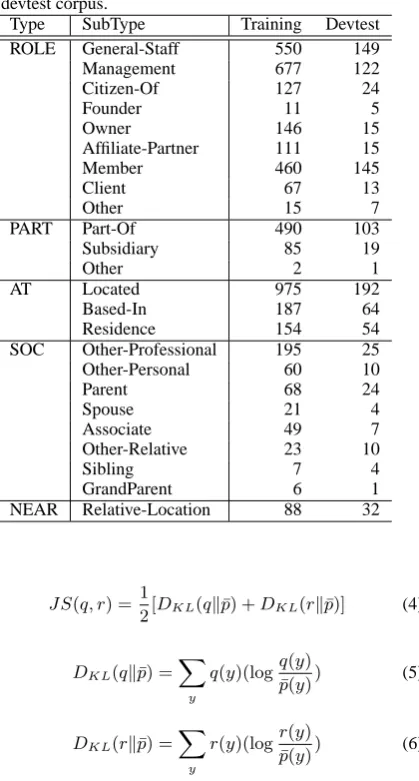
Table 1:Frequency of Relation SubTypes in the ACE training and devtest corpus.
Type SubType Training Devtest
ROLE General-Staff 550 149
Management 677 122
Citizen-Of 127 24
Founder 11 5
Owner 146 15
Affiliate-Partner 111 15
Member 460 145
Client 67 13
Other 15 7
PART Part-Of 490 103
Subsidiary 85 19
Other 2 1
AT Located 975 192
Based-In 187 64
Residence 154 54
SOC Other-Professional 195 25
Other-Personal 60 10
Parent 68 24
Spouse 21 4
Associate 49 7
Other-Relative 23 10
Sibling 7 4
GrandParent 6 1
NEAR Relative-Location 88 32
JS(q, r) = 1
2[DKL(qk¯p) +DKL(rk¯p)] (4)
DKL(qk¯p) = X
y
q(y)(logq(y)
¯
p(y)) (5)
DKL(rk¯p) = X
y
r(y)(logr(y)
¯
p(y)) (6)
where p¯ = 12(q +r) andJS(q, r) represents JS divergence between probability distribution q(y) and r(y) (y is a random variable), which is defined in terms of KL-divergence.
3.3 Experimental Evaluation
3.3.1 Experiment Setup
Table 2:The Performance of SVM and LP algorithm with different sizes of labeled data for relation detection on relation subtypes. The LP algorithm is run with two similarity measures: cosine similarity and JS divergence.
SVM LPCosine LPJS
Percentage P R F P R F P R F
1% 35.9 32.6 34.4 58.3 56.1 57.1 58.5 58.7 58.5
10% 51.3 41.5 45.9 64.5 57.5 60.7 64.6 62.0 63.2
25% 67.1 52.9 59.1 68.7 59.0 63.4 68.9 63.7 66.1
50% 74.0 57.8 64.9 69.9 61.8 65.6 70.1 64.1 66.9
75% 77.6 59.4 67.2 71.8 63.4 67.3 72.4 64.8 68.3
[image:5.595.95.516.230.314.2]100% 79.8 62.9 70.3 73.9 66.9 70.2 74.2 68.2 71.1
Table 3: The performance of SVM and LP algorithm with different sizes of labeled data for relation detection and classification on relation subtypes. The LP algorithm is run with two similarity measures: cosine similarity and JS divergence.
SVM LPCosine LPJS
Percentage P R F P R F P R F
1% 31.6 26.1 28.6 39.6 37.5 38.5 40.1 38.0 39.0
10% 39.1 32.7 35.6 45.9 39.6 42.5 46.2 41.6 43.7
25% 49.8 35.0 41.1 51.0 44.5 47.3 52.3 46.0 48.9
50% 52.5 41.3 46.2 54.1 48.6 51.2 54.9 50.8 52.7
75% 58.7 46.7 52.0 56.0 52.0 53.9 56.1 52.6 54.3
100% 60.8 48.9 54.2 56.2 52.3 54.1 56.3 52.9 54.6
frequency of occurrence in the ACE training set and test set. We constructed labeled data by randomly sampling some examples from ACE training data and additionally sampling examples with the same size from the pool of unrelated entity pairs for the “NONE” class. We used the remaining examples in the ACE training set and the whole ACE test set as unlabeled data. The testing set was used for final evaluation.
3.3.2 LP vs. SVM
Support Vector Machine (SVM) is a state of the art technique for relation extraction task. In this ex-periment, we use LIBSVM tool3with linear kernel function.
For comparison between SVM and LP, we ran SVM and LP with different sizes of labeled data and evaluate their performance on unlabeled data using precision, recall and F-measure. Firstly, we ran SVM or LP algorithm to detect possible rela-tions from unlabeled data. If an entity mention pair is classified not to the “NONE” class but to the other 24 subtype classes, then it has a relation. Then con-struct labeled datasets with different sampling set sizel, including1%×Ntrain,10%×Ntrain,25%×
Ntrain,50%×Ntrain,75%×Ntrain,100%×Ntrain (Ntrainis the number of examples in the ACE
train-3LIBSV M
: a library for support vector machines. Soft-ware available at http://www.csie.ntu.edu.tw/∼cjlin/libsvm.
ing set). If any relation subtype was absent from the sampled labeled set, we redid the sampling. For each size, we performed 20 trials and calculated average scores on test set over these 20 random trials.
Table 2 reports the performance of SVM and LP with different sizes of labled data for relation detec-tion task. We used the same sampled labeled data in LP as the training data for SVM model.
From Table 2, we see that both LPCosine and LPJSachieve higher Recall than SVM. Specifically, with small labeled dataset (percentage of labeled data≤ 25%), the performance improvement by LP is significant. When the percentage of labeled data increases from50%to100%, LPCosineis still com-parable to SVM in F-measure while LPJS achieves slightly better F-measure than SVM. On the other hand, LPJSconsistently outperforms LPCosine.
Table 3 reports the performance of relation clas-sification by using SVM and LP with different sizes of labled data. And the performance describes the average values of Precision, Recall and F-measure over major relation subtypes.
in-0.25 0.3 0.35 0.4 0.45 0.5 0.55 0.6
1% 10% 25% 50% 75% 100%
Percentage of Labeled Examples
F
-m
e
a
s
u
re SVM
[image:6.595.311.548.71.266.2]LP_Cosine LP_JS
Figure 1: Comparison of the performance of SVM and LP with different sizes of labeled data
creases from75%to100%, the performance of LP algorithm is still comparable to SVM. On the other hand, the LP algorithm based on JS divergence con-sistently outperforms the LP algorithm based on Co-sine similarity. Figure 1 visualizes the accuracy of three algorithms.
As shown in Figure 1, the gap between SVM curve and LPJScurves is large when the percentage of labeled data is relatively low.
3.3.3 An Example
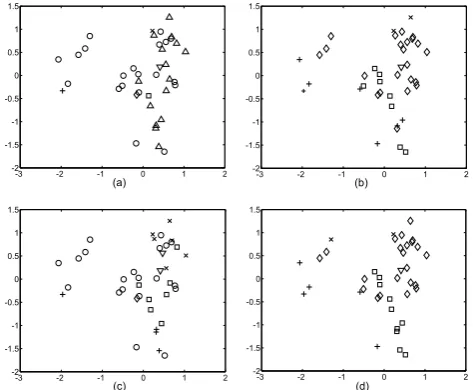
In Figure 2, we selected 25 instances in train-ing set and 15 instances in test set from the ACE corpus,which covered five relation types. Using
Isomaptool4, the 40 instances with 229 feature di-mensions are visualized in a two-dimensional space as the figure. We randomly sampled only one la-beled example for each relation type from the 25 training examples as labeled data. Figure 2(a) and 2(b) show the initial state and ground truth result spectively. Figure 2(c) reports the classification re-sult on test set by SVM (accuracy= 154 = 26.7%), and Figure 2(d) gives the classification result on both training set and test set by LP (accuracy = 1115 = 73.3%).
Comparing Figure 2(b) and Figure 2(c), we find that many examples are misclassified from class ¦ to other class symbols. This may be caused that SVMs method ignores the intrinsic structure in data. For Figure 2(d), the labels of unlabeled examples are determined not only by nearby labeled examples, but also by nearby unlabeled examples, so using LP
4
[image:6.595.71.305.73.211.2]The tool is available at http://isomap.stanford.edu/.
Figure 2: An example: comparison of SVM and LP algorithm on a data set from ACE corpus. ◦ and
4denote the unlabeled examples in training set and test set respectively, and other symbols (¦,×,2,+ and5) represent the labeled examples with respec-tive relation type sampled from training set.
strategy achieves better performance than the local consistency based SVM strategy when the size of labeled data is quite small.
3.3.4 LP vs. Bootstrapping
In (Zhang, 2004), they perform relation classifi-cation on ACE corpus with bootstrapping on top of SVM. To compare with their proposed Bootstrapped SVM algorithm, we use the same feature stream set-ting and randomly selected 100 instances from the training data as the size of initial labeled data.
Table 4 lists the performance of the bootstrapped SVM method from (Zhang, 2004) and LP method with 100 seed labeled examples for relation type classification task. We can see that LP algorithm outperforms the bootstrapped SVM algorithm on four relation type classification tasks, and perform comparably on the relation ”SOC” classification task.
4 Discussion
Table 4: Comparison of the performance of the bootstrapped SVM method from (Zhang, 2004) and LP method with 100 seed labeled examples for relation type classification task.
Bootstrapping LPJS
Relation type P R F P R F
ROLE 78.5 69.7 73.8 81.0 74.7 77.7
PART 65.6 34.1 44.9 70.1 41.6 52.2
AT 61.0 84.8 70.9 74.2 79.1 76.6
SOC 47.0 57.4 51.7 45.0 59.1 51.0
NEAR − − − 13.7 12.5 13.0
Table 5:Comparison of the performance of previous methods on ACE RDC task.
Relation Dectection Relation Detection and Classification
on Types on Subtypes
Method P R F P R F P R F
Culotta and Soresen (2004) Tree kernel based 81.2 51.8 63.2 67.1 35.0 45.8 - - -Kambhatla (2004) Feature based,
Maxi-mum Entropy
- - - 63.5 45.2 52.8
Zhou et al. (2005) Feature based,SVM 84.8 66.7 74.7 77.2 60.7 68.0 63.1 49.5 55.5
bootstrapping. We have some findings from these results:
The LP based relation extraction method can use the graph structure to smooth the labels of unlabeled examples. Therefore, the labels of unlabeled exam-ples are determined not only by the nearby labeled examples, but also by nearby unlabeled examples. For supervised methods, e.g., SVM, very few la-beled examples are not enough to reveal the struc-ture of each class. Therefore they can not perform well, since the classification hyperplane was learned only from few labeled data and the coherent struc-ture in unlabeled data was not explored when in-ferring class boundary. Hence, our LP-based semi-supervised method achieves better performance on both relation detection and classification when only few labeled data is available. Bootstrapping
Currently most of works on the RDC task of ACE focused on supervised learning methods Cu-lotta and Soresen (2004; Kambhatla (2004; Zhou et al. (2005). Table 5 lists a comparison on re-lation detection and classification of these meth-ods. Zhou et al. (2005) reported the best result as 63.1%/49.5%/55.5% in Precision/Recall/F-measure on the relation subtype classification using feature based method, which outperforms tree kernel based method by Culotta and Soresen (2004). Compared with Zhou et al.’s method, the performance of LP al-gorithm is slightly lower. It may be due to that we used a much simpler feature set. Our work in this
paper focuses on the investigation of a graph based semi-supervised learning algorithm for relation ex-traction. In the future, we would like to use more ef-fective feature sets Zhou et al. (2005) or kernel based similarity measure with LP for relation extraction.
5 Conclusion and Future Work
This paper approaches the problem of semi-supervised relation extraction using a label propaga-tion algorithm. It represents labeled and unlabeled examples and their distances as the nodes and the weights of edges of a graph, and tries to obtain a labeling function to satisfy two constraints: 1) it should be fixed on the labeled nodes, 2) it should be smooth on the whole graph. In the classifica-tion process, the labels of unlabeled examples are determined not only by nearby labeled examples, but also by nearby unlabeled examples. Our exper-imental results demonstrated that this graph based algorithm can achieve better performance than SVM when only very few labeled examples are available, and also outperforms the bootstrapping method for relation extraction task.
References
Agichtein E. and Gravano L.. 2000. Snowball: Ex-tracting Relations from large Plain-Text Collections, In Proceedings of the5thACM International
Confer-ence on Digital Libraries (ACMDL’00).
Belkin M. and Niyogi P.. 2002. Using Manifold
Struc-ture for Partially Labeled Classification. Advances in Neural Infomation Processing Systems 15.
Blum A. and Chawla S. 2001. Learning from Labeled
and Unlabeled Data Using Graph Mincuts. In Pro-ceedings of the 18th International Conference on Ma-chine Learning.
Blum A., Lafferty J., Rwebangira R. and Reddy R. 2004.
Semi-Supervised Learning Using Randomized Min-cuts. In Proceedings of the 21th International Confer-ence on Machine Learning..
Brin Sergey. 1998. Extracting patterns and relations
from world wide web. In Proceedings of WebDB Work-shop at 6th International Conference on Extending Database Technology (WebDB’98). pages 172-183.
Charniak E. 1999. A Maximum-entropy-inspired parser.
Technical Report CS-99-12. Computer Science
De-partment, Brown University.
Culotta A. and Soresen J. 2004. Dependency tree kernels
for relation extraction, In Proceedings of 42th Annual Meeting of the Association for Computational Linguis-tics. 21-26 July 2004. Barcelona, Spain.
Hasegawa T., Sekine S. and Grishman R. 2004.
Dis-covering Relations among Named Entities from Large Corpora, In Proceeding of Conference ACL2004.
Barcelona, Spain.
Kambhatla N. 2004. Combining lexical, syntactic and
semantic features with Maximum Entropy Models for extracting relations, In Proceedings of 42th Annual Meeting of the Association for Computational Linguis-tics.. 21-26 July 2004. Barcelona, Spain.
Lin J. 1991. Divergence Measures Based on the
Shan-non Entropy. IEEE Transactions on Information The-ory. Vol 37, No.1, 145-150.
Miller S.,Fox H.,Ramshaw L. and Weischedel R. 2000.
A novel use of statistical parsing to extract information from text. In Proceedings of 6th Applied Natural Lan-guage Processing Conference 29 April-4 may 2000,
Seattle USA.
Slonim, N., Friedman, N., and Tishby, N. 2002.
Un-supervised Document Classification Using Sequential Information Maximization. In Proceedings of the 25th Annual International ACM SIGIR Conference on Re-search and Development in Information Retrieval.
Yarowsky D. 1995. Unsupervised Word Sense
Disam-biguation Rivaling Supervised Methods. In Proceed-ings of the 33rd Annual Meeting of the Association for Computational Linguistics. pp.189-196.
Zelenko D., Aone C. and Richardella A. 2002.
Ker-nel Methods for Relation Extraction, Proceedings of the Conference on Empirical Methods in Natural Lan-guage Processing (EMNLP). Philadelphia.
Zhang Zhu. 2004. Weakly-supervised relation
classifi-cation for Information Extraction, In Proceedings of ACM 13th conference on Information and Knowledge Management (CIKM’2004). 8-13 Nov 2004.
Wash-ington D.C.,USA.
Zhou GuoDong, Su Jian, Zhang Jie and Zhang min. 2005. Exploring Various Knowledge in Relation
Ex-traction. In Proceedings of 43th Annual Meeting of the Association for Computational Linguistics. USA.
Zhu Xiaojin and Ghahramani Zoubin. 2002. Learning
from Labeled and Unlabeled Data with Label Propa-gation. CMU CALD tech report CMU-CALD-02-107.
Zhu Xiaojin, Ghahramani Zoubin, and Lafferty J. 2003.