Proceedings of the 45th Annual Meeting of the Association of Computational Linguistics, pages 848–855,
Unsupervised Coreference Resolution in a Nonparametric Bayesian Model
Aria Haghighi and Dan Klein Computer Science Division
UC Berkeley
{aria42, klein}@cs.berkeley.edu
Abstract
We present an unsupervised, nonparamet-ric Bayesian approach to coreference reso-lution which models both global entity iden-tity across a corpus as well as the sequen-tial anaphoric structure within each docu-ment. While most existing coreference work is driven by pairwise decisions, our model is fully generative, producing each mention from a combination of global entity proper-ties and local attentional state. Despite be-ing unsupervised, our system achieves a 70.3 MUC F1 measure on the MUC-6 test set, broadly in the range of some recent super-vised results.
1 Introduction
Referring to an entity in natural language can broadly be decomposed into two processes. First, speakers directly introduce new entities into course, entities which may be shared across dis-courses. This initial reference is typically accom-plished with proper or nominal expressions. Second, speakers refer back to entities already introduced. This anaphoric reference is canonically, though of course not always, accomplished with pronouns, and is governed by linguistic and cognitive constraints. In this paper, we present a nonparametric generative model of a document corpus which naturally con-nects these two processes.
Most recent coreference resolution work has fo-cused on the task of deciding whichmentions(noun phrases) in a document are coreferent. The domi-nant approach is to decompose the task into a col-lection of pairwise coreference decisions. One then
applies discriminative learning methods to pairs of mentions, using features which encode properties such as distance, syntactic environment, and so on (Soon et al., 2001; Ng and Cardie, 2002). Although such approaches have been successful, they have several liabilities. First, rich features require plen-tiful labeled data, which we do not have for corefer-ence tasks in most domains and languages. Second, coreference is inherently a clustering or partitioning task. Naive pairwise methods can and do fail to pro-duce coherent partitions. One classic solution is to make greedy left-to-right linkage decisions. Recent work has addressed this issue in more global ways. McCallum and Wellner (2004) use graph partion-ing in order to reconcile pairwise scores into a final coherent clustering. Nonetheless, all these systems crucially rely on pairwise models because cluster-level models are much harder to work with, combi-natorially, in discriminative approaches.
Another thread of coreference work has focused on the problem of identifying matches between documents (Milch et al., 2005; Bhattacharya and Getoor, 2006; Daume and Marcu, 2005). These methods ignore the sequential anaphoric structure inside documents, but construct models of how and when entities are shared between them.1 These models, as ours, are generative ones, since the fo-cus is on cluster discovery and the data is generally unlabeled.
In this paper, we present a novel, fully genera-tive, nonparametric Bayesian model of mentions in a document corpus. Our model captures both within-and cross-document coreference. At the top, a hi-erarchical Dirichlet process (Teh et al., 2006)
cap-1
tures cross-document entity (and parameter) shar-ing, while, at the bottom, a sequential model of salience captures within-document sequential struc-ture. As a joint model of several kinds of discourse variables, it can be used to make predictions about either kind of coreference, though we focus experi-mentally on within-document measures. To the best of our ability to compare, our model achieves the best unsupervised coreference performance.
2 Experimental Setup
We adopt the terminology of the Automatic Context Extraction (ACE) task (NIST, 2004). For this paper, we assume that each document in a corpus consists of a set of mentions, typically noun phrases. Each mention is areferenceto some entity in the domain of discourse. The coreference resolution task is to partition the mentions according to referent. Men-tions can be divided into three categories, proper
mentions (names),nominalmentions (descriptions), andpronominalmentions (pronouns).
In section 3, we present a sequence of increas-ingly enriched models, motivating each from short-comings of the previous. As we go, we will indicate the performance of each model on data from ACE 2004 (NIST, 2004). In particular, we used as our development corpus the English translations of the Arabic and Chinese treebanks, comprising 95 docu-ments and about 3,905 mentions. This data was used heavily for model design and hyperparameter selec-tion. In section 5, we present final results for new test data from MUC-6 on which no tuning or devel-opment was performed. This test data will form our basis for comparison to previous work.
In all experiments, as is common, we will assume that we have been given as part of our input the true mention boundaries, the head word of each mention and the mention type (proper, nominal, or pronom-inal). For the ACE data sets, the head and mention type are given as part of the mention annotation. For the MUC data, the head was crudely chosen to be the rightmost mention token, and the mention type was automatically detected. We will not assume any other information to be present in the data be-yond the text itself. In particular, unlike much re-lated work, we do not assume gold named entity recognition (NER) labels; indeed we do not assume observed NER labels or POS tags at all. Our
pri-α
β
K φ K
Zi
Hi
J
I
α
β
∞ φ ∞
Zi
Hi
I J
[image:2.612.335.519.72.192.2](a) (b)
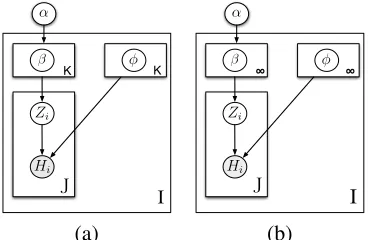
Figure 1: Graphical model depiction of document level en-tity models described in sections 3.1 and 3.2 respectively. The shaded nodes indicate observed variables.
mary performance metric will be the MUC F1 mea-sure (Vilain et al., 1995), commonly used to evalu-ate coreference systems on a within-document basis. Since our system relies on sampling, all results are averaged over five random runs.
3 Coreference Resolution Models
In this section, we present a sequence of gener-ative coreference resolution models for document corpora. All are essentially mixture models, where the mixture components correspond to entities. As far as notation, we assume a collection ofI docu-ments, each withJi mentions. We use random
vari-ablesZ to refer to (indices of) entities. We will use
φz to denote the parameters for an entity z, andφ
to refer to the concatenation of all suchφz. X will
refer somewhat loosely to the collection of variables associated with a mention in our model (such as the head or gender). We will be explicit aboutXandφz
shortly.
Our goal will be to find the setting of the entity indices which maximize the posterior probability:
Z∗ = arg max
Z P(Z|X) = arg maxZ P(Z,X)
= arg max
Z
Z
P(Z,X,φ)dP(φ)
(a)
(b)
(c)
The Weir Group1, whose2 headquarters3 is in the US4, is a large, specialized corporation5 investing in the area of electricity
generation. This power plant6, which7 will be situated in Rudong8, Jiangsu9, has an annual generation capacity of 2.4 million kilowatts.
The Weir Group1, whose1 headquarters2 is in the US3, is a large, specialized corporation4 investing in the area of electricity
generation. This power plant5, which1 will be situated in Rudong6, Jiangsu7, has an annual generation capacity of 2.4 million kilowatts.
The Weir Group1, whose1 headquarters2 is in the US3, is a large, specialized corporation4 investing in the area of electricity
generation. This power plant5, which5 will be situated in Rudong6, Jiangsu7, has an annual generation capacity of 2.4 million kilowatts.
Figure 2: Example output from various models. The output from (a) is from the infinite mixture model of section 3.2. It incorrectly labels both boxed cases of anaphora. The output from (b) uses the pronoun head model of section 3.3. It correctly labels the first case of anaphora but incorrectly labels the second pronominal as being coreferent with the dominant document entityThe Weir Group. This error is fixed by adding the salience feature component from section 3.4 as can be seen in (c).
3.1 A Finite Mixture Model
Our first, overly simplistic, corpus model is the stan-dard finite mixture of multinomials shown in fig-ure 1(a). In this model, each document is indepen-dent save for some global hyperparameters. Inside each document, there is a finite mixture model with a fixed numberKof components. The distributionβ
over components (entities) is a draw from a symmet-ric Disymmet-richlet distribution with concentrationα. For each mention in the document, we choose a compo-nent (an entity index)zfromβ. Entityzis then asso-ciated with a multinomial emission distribution over head words with parameters φhZ, which are drawn from a symmetric Dirichlet over possible mention heads with concentrationλH.2 Note that here theX
for a mention consists only of the mention headH. As we enrich our models, we simultaneously de-velop an accompanying Gibbs sampling procedure to obtain samples fromP(Z|X).3For now, all heads
Hare observed and all parameters (βandφ) can be integrated out analytically: for details see Teh et al. (2006). The only sampling is for the values ofZi,j,
the entity index of mention j in document i. The relevant conditional distribution is:4
P(Zi,j|Z−i,j,H)∝P(Zi,j|Z−i,j)P(Hi,j|Z,H−i,j)
whereHi,j is the head of mentionj in documenti.
Expanding each term, we have the contribution of the prior:
P(Zi,j =z|Z−i,j)∝nz+α
2In general, we will use a subscriptedλto indicate
concen-tration for finite Dirichlet distributions. Unless otherwise spec-ified,λconcentration parameters will be set toe−4and omitted from diagrams.
3
One could use the EM algorithm with this model, but EM will not extend effectively to the subsequent models.
4
Here,Z−i,jdenotesZ− {Zi,j}
where nz is the number of elements of Z−i,j with
entity indexz. Similarly we have for the contribu-tion of the emissions:
P(Hi,j =h|Z,H−i,j)∝nh,z+λH
wherenh,zis the number of times we have seen head
hassociated with entity indexzin(Z,H−i,j).
3.2 An Infinite Mixture Model
A clear drawback of the finite mixture model is the requirement that we specify a priori a number of en-titiesK for a document. We would like our model to selectKin an effective, principled way. A mech-anism for doing so is to replace the finite Dirichlet prior onβwith the non-parametric Dirichlet process (DP) prior (Ferguson, 1973).5 Doing so gives the model in figure 1(b). Note that we now list an in-finite number of mixture components in this model since there can be an unbounded number of entities. Rather than a finite β with a symmetric Dirichlet distribution, in which draws tend to have balanced clusters, we now have an infiniteβ. However, most draws will have weights which decay exponentially quickly in the prior (though not necessarily in the posterior). Therefore, there is a natural penalty for each cluster which is actually used.
With Z observed during sampling, we can inte-grate outβand calculateP(Zi,j|Z−i,j)analytically,
using the Chinese restaurant process representation:
P(Zi,j=z|Z−i,j)∝ (
α, ifz=znew
nz, otherwise
(1)
whereznew is a new entity index not used inZ−i,j
andnzis the number of mentions that have entity
in-dexz. Aside from this change, sampling is identical
5
PERS : 0.97, LOC : 0.01, ORG: 0.01, MISC: 0.01
Entity Type
SING: 0.99, PLURAL: 0.01
Number
MALE: 0.98, FEM: 0.01, NEUTER: 0.01
Gender
Bush : 0.90, President : 0.06, ...
Head
φt
φh
φn φg
X =
Z Z
M T N G
H
φ θ
∞
(a) (b)
Figure 3: (a) An entity and its parameters. (b)The head model described in section 3.3. The shaded nodes indicate observed variables. The mention type determines which set of parents are used. The dependence of mention variable on entity parameters
φand pronoun head modelθis omitted.
to the finite mixture case, though with the number of clusters actually occupied in each sample drifting upwards or downwards.
This model yielded a 54.5 F1 on our develop-ment data.6 This model is, however, hopelessly crude, capturing nothing of the structure of coref-erence. Its largest empirical problem is that, un-surprisingly, pronoun mentions such asheare given their own clusters, not labeled as coreferent with any non-pronominal mention (see figure 2(a)).
3.3 Pronoun Head Model
While an entity-specific multinomial distribution over heads makes sense for proper, and some nom-inal, mention heads, it does not make sense to gen-erate pronominal mentions this same way. I.e., all entities can be referred to by generic pronouns, the choice of which depends on entity properties such as gender, not the specific entity.
We therefore enrich an entity’s parameters φ to contain not only a distribution over lexical heads
φh, but also distributions(φt, φg, φn) over proper-ties, where φt parametrizes a distribution over
en-tity types (PER,LOC,ORG,MISC), and φg for gen-der (MALE,FEMALE,NEUTER), andφnfor number (SG,PL).7 We assume each of these property butions is drawn from a symmetric Dirichlet distri-bution with small concentration parameter in order to encourage a peaked posterior distribution.
6
See section 4 for inference details.
7It might seem that entities should simply have, for
exam-ple, a gendergrather than a distribution over gendersφg. There are two reasons to adopt the softer approach. First, one can rationalize it in principle, for entities like cars or ships whose grammatical gender is not deterministic. However, the real rea-son is that inference is simplified. In any event, we found these property distributions to be highly determinized in the posterior.
α
β
∞ φ ∞
Z1 Z3
L1
S1
T1 N1 G1
M1 = NAM
Z2
L2
S2
N2 G2
M2 = NOM T2
H2 = "president" H1 =
"Bush"
H3 = "he" N2 =
SG G2 = MALE M3 =
PRO T2 L3
S3
θ
[image:4.612.314.544.72.217.2]I
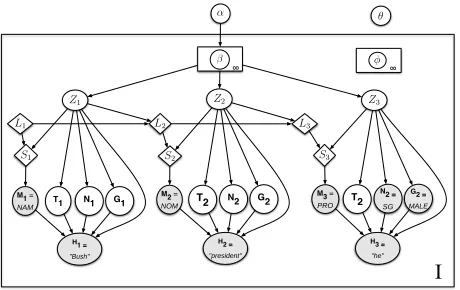
Figure 4: Coreference model at the document level with entity properties as well salience lists used for mention type distri-butions. The diamond nodes indicate deterministic functions. Shaded nodes indicate observed variables. Although it appears that each mention head node has many parents, for a given men-tion type, the menmen-tion head depends on only a small subset. De-pendencies involving parametersφandθare omitted.
Previously, when an entityzgenerated a mention, it drew a head word from φhz. It now undergoes a more complex and structured process. It first draws an entity typeT, a genderG, a numberN from the distributionsφt,φg, andφn, respectively. Once the properties are fetched, a mention typeM is chosen (proper, nominal, pronoun), according to a global multinomial (again with a symmetric Dirichlet prior and parameter λM). This corresponds to the
(tem-porary) assumption that the speaker makes a random i.i.d. choice for the type of each mention.
Our head model will then generate a head, con-ditioning on the entity, its properties, and the men-tion type, as shown in figure 3(b). If M is not a pronoun, the head is drawn directly from the en-tity head multinomial with parameters φhz. Other-wise, it is drawn based on a global pronoun head dis-tribution, conditioning on the entity properties and parametrized byθ. Formally, it is given by:
P(H|Z, T, G, N, M,φ,θ) =
(
P(H|T, G, N,θ), ifM =PRO
P(H|φhZ), otherwise
[image:4.612.78.296.74.172.2]Salience Feature Pronoun Proper Nominal
TOP 0.75 0.17 0.08
HIGH 0.55 0.28 0.17
MID 0.39 0.40 0.21
LOW 0.20 0.45 0.35
[image:5.612.73.301.71.155.2]NONE 0.00 0.88 0.12
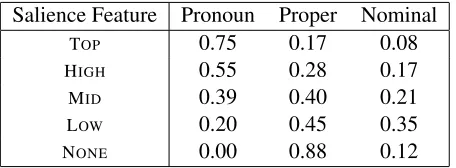
Table 1: Posterior distribution of mention type given salience by bucketing entity activation rank. Pronouns are preferred for entities which have high salience and non-pronominal mentions are preferred for inactive entities.
Ti,j, the entity type of pronominal mention j in
document i, using, P(Ti,j|Z,N,G,H,T−i,j) ∝
P(Ti,j|Z)P(Hi,j|T,N,G,H), where the posterior
distributions on the right hand side are straight-forward because the parameter priors are all finite Dirichlet. SamplingGandN are identical.
Of course we have prior knowledge about the re-lationship between entity type and pronoun head choice. For example, we expect thathe is used for mentions withT =PERSON. In general, we assume that for each pronominal head we have a list of com-patible entity types, which we encode via the prior onθ. We assumeθis drawn from a Dirichlet distri-bution where each pronoun head is given a synthetic count of(1 +λP)for each(t, g, n)wheretis
com-patible with the pronoun and given λP otherwise.
So, while it will be possible in the posterior to use
heto refer to a non-person, it will be biased towards being used with persons.
This model gives substantially improved predic-tions: 64.1 F1 on our development data. As can be seen in figure 2(b), this model does correct the sys-tematic problem of pronouns being considered their own entities. However, it still does not have a pref-erence for associating pronominal refpref-erences to en-tities which are in any way local.
3.4 Adding Salience
We would like our model to capture how mention types are generated for a given entity in a robust and somewhat language independent way. The choice of entities may reasonably be considered to be indepen-dent given the mixing weightsβ, but how werealize
an entity is strongly dependent on context (Ge et al., 1998).
In order to capture this in our model, we enrich it as shown in figure 4. As we proceed through a
document, generating entities and their mentions, we maintain a list of the active entities and their
saliences, or activity scores. Every time an entity is mentioned, we increment its activity score by1, and every time we move to generate the next mention, all activity scores decay by a constant factor of0.5. This gives rise to an ordered list of entity activations,
L, where the rank of an entity decays exponentially as new mentions are generated. We call this list a
salience list. Given a salience list,L, each possible entity z has some rank on this list. We discretize these ranks into five buckets S: TOP (1), HIGH
(2-3),MID(4-6),LOW(7+), andNONE. Given the entity
choicesZ, both the listL and buckets S are deter-ministic (see figure 4). We assume that the mention typeM is conditioned onSas shown in figure 4.
We note that correctly sampling an entity now re-quires that we incorporate terms for how a change will affect all future salience values. This changes our sampling equation for existing entities:
P(Zi,j =z|Z−i,j)∝nz Y
j0≥j
P(Mi,j0|Si,j0,Z) (2)
where the product ranges over future mentions in the document and Si,j0 is the value of future salience
feature given the setting of all entities, including set-ting the current entityZi,j toz. A similar equation
holds for sampling a new entity. Note that, as dis-cussed below, this full product can be truncated as an approximation.
This model gives a 71.5 F1 on our development data. Table 1 shows the posterior distribution of the mention type given the salience feature. This model fixes many anaphora errors and in particular fixes the second anaphora error in figure 2(c).
3.5 Cross Document Coreference
One advantage of a fully generative approach is that we can allow entities to be shared between docu-ments in a principled way, giving us the capacity to do cross-document coreference. Moreover, sharing across documents pools information about the prop-erties of an entity across documents.
α
β ∞
φ
∞
Z1 Z3
L1
S1
T1 N1 G1 M1 =
NAM
Z2
L2
S2
N2 G2 M2 =
NOM T2
H2 =
"president"
H1 =
"Bush"
H3 =
"he" N2 = SG
G2 =
MALE
M3 =
PRO T2
L3
S3
β0
∞
γ
θ
[image:6.612.79.293.72.232.2]I
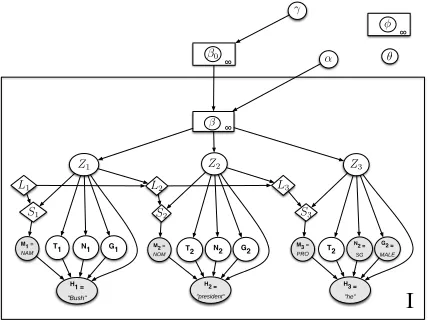
Figure 5: Graphical depiction of the HDP coreference model described in section 3.5. The dependencies between the global entity parametersφand pronoun head parametersθon the men-tion observamen-tions are not depicted.
the same global entities, but each has a document-specific distributionβidrawn from a DP centered on
β0 with concentration parameterα. Up to the point where entities are chosen, this formulation follows the basic hierarchical Dirichlet process prior of Teh et al. (2006). Once the entities are chosen, our model for the realization of the mentions is as before. This model is depicted graphically in figure 5.
Although it is possible to integrate outβ0 as we did the individual βi, we instead choose for
ef-ficiency and simplicity to sample the global mix-ture distribution β0 from the posterior distribution
P(β0|Z).8 The mention generation terms in the model and sampler are unchanged.
In the full hierarchical model, our equation (1) for sampling entities, ignoring the salience component of section 3.4, becomes:
P(Zi,j =z|Z−i,j, β0)∝ (
αβu
0, ifz=znew
nz+αβ0z, otherwise
whereβz0 is the probability of the entityzunder the sampled global entity distribution andβ0u is the un-known component mass of this distribution.
The HDP layer of sharing improves the model’s predictions to 72.5 F1on our development data. We should emphasize that our evaluation is of course per-document and does not reflect cross-document coreference decisions, only the gains through cross-document sharing (see section 6.2).
8
We do not give the details here; see Teh et al. (2006) for de-tails on how to implement this component of the sampler (called “direct assignment” in that reference).
4 Inference Details
Up until now, we’ve discussed Gibbs sampling, but we are not interested in sampling from the poste-rior P(Z|X), but in finding its mode. Instead of sampling directly from the posterior distribution, we instead sample entities proportionally to exponen-tiated entity posteriors. The exponent is given by expkci−1, whereiis the current round number (start-ing ati= 0),c = 1.5andk = 20is the total num-ber of sampling epochs. This slowly raises the pos-terior exponent from1.0 toec. In our experiments, we found this procedure to outperform simulated an-nealing. We also found sampling theT, G, andN
variables to be particularly inefficient, so instead we maintain soft counts over each of these variables and use these in place of a hard sampling scheme. We also found that correctly accounting for the future impact of salience changes to be particularly ineffi-cient. However, ignoring those terms entirely made negligible difference in final accuracy.9
5 Final Experiments
We present our final experiments using the full model developed in section 3. As in section 3, we use true mention boundaries and evaluate using the MUC F1 measure (Vilain et al., 1995). All hyper-parameters were tuned on the development set only. The document concentration parameterαwas set by taking a constant proportion of the average number ofmentionsin a document across the corpus. This number was chosen to minimize the squared error between the number of proposed entities and true entities in a document. It was not tuned to maximize the F1 measure. A coefficient of 0.4 was chosen. The global concentration coefficient γ was chosen to be a constant proportion ofαM, whereM is the number ofdocumentsin the corpus. We found0.15 to be a good value using the same least-square pro-cedure. The values for these coefficients were not changed for the experiments on the test sets.
5.1 MUC-6
Our main evaluation is on the standard MUC-6 for-mal test set.10 The standard experimental setup for
9
This corresponds to truncating equation (2) atj0=j.
10
Dataset Num Docs. Prec. Recall F1
MUC-6 60 80.8 52.8 63.9
+DRYRUN-TRAIN 251 79.1 59.7 68.0
+ENGLISH-NWIRE 381 80.4 62.4 70.3
Dataset Prec. Recall F1
ENGLISH-NWIRE 66.7 62.3 64.2
ENGLISH-BNEWS 63.2 61.3 62.3
CHINESE-NWIRE 71.6 63.3 67.2
CHINESE-BNEWS 71.2 61.8 66.2
[image:7.612.78.532.74.140.2](a) (b)
Table 2: Formal Results: Our system evaluated using the MUC model theoretic measure Vilain et al. (1995). The table in (a) is our performance on the thirty document MUC-6 formal test set with increasing amounts of training data. In all cases for the table, we are evaluating on the same thirty document test set which is included in our training set, since our system in unsupervised. The table in (b) is our performance on the ACE 2004 training sets.
this data is a 30/30 document train/test split. Train-ing our system on all 60 documents of the trainTrain-ing and test set (as this is in an unsupervised system, the unlabeled test documents are present at train-ing time), but evaluattrain-ing only on the test documents, gave 63.9 F1and is labeledMUC-6in table 2(a).
One advantage of an unsupervised approach is that we can easily utilize more data when learning a model. We demonstrate the effectiveness of this fact by evaluating on the MUC-6 test documents with in-creasing amounts of unannotated training data. We first added the 191 documents from the MUC-6 dryrun training set (which were not part of the train-ing data for official MUC-6 evaluation). This model gave 68.0 F1 and is labeled+DRYRUN-TRAINin ta-ble 2(a). We then added the ACEENGLISH-NWIRE training data, which is from a different corpora than the MUC-6 test set and from a different time period. This model gave 70.3 F1 and is labeled +ENGLISH-NWIREin table 2(a).
Our results on this test set are surprisingly com-parable to, though slightly lower than, some recent supervised systems. McCallum and Wellner (2004) report 73.4 F1on the formal MUC-6 test set, which is reasonably close to our best MUC-6 number of 70.3 F1. McCallum and Wellner (2004) also report a much lower 91.6 F1 on only proper nouns men-tions. Our system achieves a 89.8 F1 when evalu-ation is restricted to only proper mentions.11 The
et al. (2004). A mention is proper if it is annotated with NER information. It is a pronoun if the head is on the list of En-glish pronouns. Otherwise, it is a nominal mention. Note we do not use the NER information for any purpose but determining whether the mention is proper.
11The best results we know on the MUC-6 test set using the
standard setting are due to Luo et al. (2004) who report a 81.3 F1 (much higher than others). However, it is not clear this is a comparable number, due to the apparent use of gold NER fea-tures, which provide a strong clue to coreference. Regardless, it is unsurprising that their system, which has many rich features, would outperform ours.
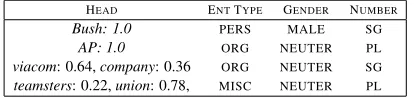
HEAD ENTTYPE GENDER NUMBER
Bush: 1.0 PERS MALE SG
AP: 1.0 ORG NEUTER PL
viacom: 0.64,company: 0.36 ORG NEUTER SG
teamsters: 0.22,union: 0.78, MISC NEUTER PL
Table 3: Frequent entities occurring across documents along with head distribution and mode of property distributions.
closest comparable unsupervised system is Cardie and Wagstaff (1999) who use pairwise NP distances to cluster document mentions. They report a 53.6 F1 on MUC6 when tuning distance metric weights to maximize F1on the development set.
5.2 ACE 2004
We also performed experiments on ACE 2004 data. Due to licensing restrictions, we did not have access to the ACE 2004 formal development and test sets, and so the results presented are on the training sets.
We report results on the newswire section (NWIRE in table 2b) and the broadcast news section (BNEWS in table 2b). These datasets include the prenomi-nalmention type, which is not present in the MUC-6 data. We treated prenominals analogously to the treatment of proper and nominal mentions.
We also tested our system on the Chinese newswire and broadcast news sections of the ACE 2004 training sets. Our relatively higher perfor-mance on Chinese compared to English is perhaps due to the lack of prenominal mentions in the Chi-nese data, as well as the presence of fewer pronouns compared to English.
[image:7.612.324.531.198.247.2]re-port 67.1 F1and 69.2 F1 on the EnglishNWIREand BNEWSrespectively using true mention boundaries. While our system underperforms the supervised sys-tems, its accuracy is nonetheless promising.
6 Discussion
6.1 Error Analysis
The largest source of error in our system is between coreferent proper and nominal mentions. The most common examples of this kind of error are appos-itive usages e.g. George W. Bush, president of the US, visited Idaho. Another error of this sort can be seen in figure 2, where thecorporation mention is not labeled coreferent with theThe Weir Group men-tion. Examples such as these illustrate the regular (at least in newswire) phenomenon that nominal men-tions are used with informative intent, even when the entity is salient and a pronoun could have been used unambiguously. This aspect of nominal mentions is entirely unmodeled in our system.
6.2 Global Coreference
Since we do not have labeled cross-document coref-erence data, we cannot evaluate our system’s cross-document performance quantitatively. However, in addition to observing the within-document gains from sharing shown in section 3, we can manually inspect the most frequently occurring entities in our corpora. Table 3 shows some of the most frequently occurring entities across the English ACE NWIRE corpus. Note thatBushis the most frequent entity, though his (and others’) nominal cluster president
is mistakenly its own entity. Merging of proper and nominal clusters does occur as can be seen in table 3.
6.3 Unsupervised NER
We can use our model to for unsupervised NER tagging: for each proper mention, assign the mode of the generating entity’s distribution over entity types. Note that in our model the only way an en-tity becomes associated with an enen-tity type is by the pronouns used to refer to it.12 If we evaluate our system as an unsupervised NER tagger for the proper mentions in the MUC-6 test set, it yields a
12
Ge et al. (1998) exploit a similar idea to assign gender to proper mentions.
per-label accuracy of 61.2% (on MUC labels). Al-though nowhere near the performance of state-of-the-art systems, this result beats a simple baseline of always guessing PERSON(the most common entity type), which yields 46.4%. This result is interest-ing given that the model was not developed for the purpose of inferring entity types whatsoever.
7 Conclusion
We have presented a novel, unsupervised approach to coreference resolution: global entities are shared across documents, the number of entities is deter-mined by the model, and mentions are generated by a sequential salience model and a model of pronoun-entity association. Although our system does not perform quite as well as state-of-the-art supervised systems, its performance is in the same general range, despite the system being unsupervised.
References
I. Bhattacharya and L. Getoor. 2006. A latent dirichlet model for unsupervised entity resolution. SIAM conference on data mining.
Claire Cardie and Kiri Wagstaff. 1999. Noun phrase corefer-ence as clustering.EMNLP.
Hal Daume and Daniel Marcu. 2005. A Bayesian model for su-pervised clustering with the Dirichlet process prior.JMLR. Pascal Denis and Jason Baldridge. 2007. Global, joint
determi-nation of anaphoricity and coreference resolution using inte-ger programming.HLT-NAACL.
Thomas Ferguson. 1973. A bayesian analysis of some non-parametric problems.Annals of Statistics.
Niyu Ge, John Hale, and Eugene Charniak. 1998. A statistical approach to anaphora resolution. Sixth Workshop on Very Large Corpora.
Xiaoqiang Luo, Abe Ittycheriah, Hongyan Jing, Nanda Kamb-hatla, and Salim Roukos. 2004. A mention-synchronous coreference resolution algorithm based on the bell tree.ACL. Andrew McCallum and Ben Wellner. 2004. Conditional mod-els of identity uncertainty with application to noun corefer-ence.NIPS.
Brian Milch, Bhaskara Marthi, Stuart Russell, David Sontag, Daniel L. Ong, and Andrey Kolobov. 2005. Blog: Proba-bilistic models with unknown objects.IJCAI.
Vincent Ng and Claire Cardie. 2002. Improving machine learn-ing approaches to coreference resolution.ACL.
NIST. 2004. The ACE evaluation plan.
W. Soon, H. Ng, and D. Lim. 2001. A machine learning ap-proach to coreference resolution of noun phrases. Computa-tional Linguistics.
Yee Whye Teh, Michael Jordan, Matthew Beal, and David Blei. 2006. Hierarchical dirichlet processes.Journal of the Amer-ican Statistical Association, 101.