organic papers
o962
J. Caleb Clarket al. C20H20O4 DOI: 10.1107/S1600536803012315 Acta Cryst.(2003). E59, o962±o963 Acta Crystallographica Section EStructure Reports Online
ISSN 1600-5368
(
E
)-3-Hexene-1,6-diyl dibenzoate
J. Caleb Clark, Tanaji Talele, Mark L. McLaughlin and Frank R. Fronczek*
Department of Chemistry, Louisiana State University, Baton Rouge, LA 70803-1804, USA
Correspondence e-mail: [email protected]
Key indicators
Single-crystal X-ray study T= 100 K
Mean(C±C) = 0.002 AÊ Rfactor = 0.042 wRfactor = 0.113
Data-to-parameter ratio = 22.8
For details of how these key indicators were automatically derived from the article, see http://journals.iucr.org/e.
#2003 International Union of Crystallography Printed in Great Britain ± all rights reserved
The title molecule, C20H20O4, lies on an inversion center. The
central alkene moiety is not coplanar with the remainder of the molecule, forming a dihedral angle of 61.61 (12)with the OÐCH2ÐCH2ÐC plane and a dihedral angle of 58.70 (11)
with the phenyl plane. The central C C length is 1.326 (2) AÊ.
Comment
During an attempted cross metathesis reaction, the title compound, (I), was produced in an interesting side reaction. Such cross metathesis reactions, which tend to be unpredict-able, occur between two ole®ns in the presence of an Ru catalyst known as Hoyveda's catalyst (Garberet al., 2000). In the reaction, an ole®n ®rst reacts with the Ru catalyst, and then the highly reactive intermediate reacts with a different ole®n. In this case, the second step was reaction of another molecule of the ®rst ole®n, but-3-enyl benzoate, to form the title dimer. The crystal structure determination was carried out in order to identify the unexpected product.
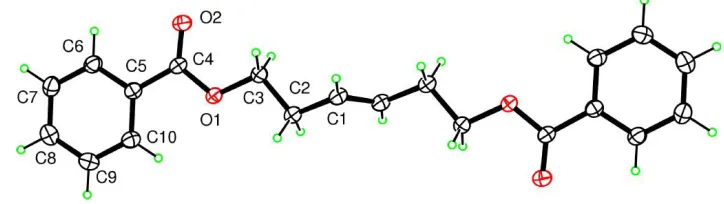
The molecule, which lies on a crystallographic inversion center, is illustrated in Fig. 1. The central 3-hexene moiety is
nonplanar, with torsion angle C3ÐC2ÐC1ÐC1i of
ÿ121.21 (14), yielding the dihedral angles given in the abstract [symmetry code: (i) 1ÿx, 1ÿy, 1ÿz].
The title compound has been previously reported as an intermediate in the synthesis of the corresponding 3,4-diol (Torneiro & Still, 1997).
Experimental
To 15 ml tetrahydrofuran were added but-3-enyl benzoate (0.10 g, 0.56 mmol, 1 eq.) and methyl vinyl ketone (0.85 g, 11.2 mmol, 20 eq.). Hoyveda's catalyst (0.018 g, 0.028 mmol, 0.05 eq) (Garberet al., 2000) was added to the ¯ask in 5 ml dichloromethane. The reaction mixture was stirred until the reaction was complete by TLC. The reaction mixture was puri®ed by column chromatography, to obtain the title compound after removal of solvent.
Crystal data
C20H20O4
Mr= 324.36
Triclinic,P1
a= 6.829 (3) AÊ
b= 7.508 (2) AÊ
c= 9.460 (4) AÊ = 67.424 (17) = 81.663 (15) = 71.322 (16)
V= 424.1 (3) AÊ3
Z= 1
Dx= 1.270 Mg mÿ3
MoKradiation Cell parameters from 2385
re¯ections = 2.5±30.0 = 0.09 mmÿ1
T= 100 K Plate, colorless 0.420.370.07 mm
Data collection
KappaCCD diffractometer (with Oxford Cryostream) !scans withoffsets 9345 measured re¯ections 2480 independent re¯ections 1979 re¯ections withI> 2(I)
Rint= 0.021
max= 30.0
h=ÿ9!9
k=ÿ10!10
l=ÿ13!13
Re®nement
Re®nement onF2
R[F2> 2(F2)] = 0.042
wR(F2) = 0.113
S= 1.05 2480 re¯ections 109 parameters
H-atom parameters constrained
w= 1/[2(F
o2) + (0.0517P)2
+ 0.0772P]
whereP= (Fo2+ 2Fc2)/3
(/)max< 0.001
max= 0.30 e AÊÿ3
min=ÿ0.20 e AÊÿ3
Table 1
Selected geometric parameters (AÊ,).
O1ÐC4 1.3405 (13)
O1ÐC3 1.4479 (13) O2ÐC4C1ÐC1i 1.2104 (12)1.326 (2)
C4ÐO1ÐC3 115.89 (7) C1iÐC1ÐC2 124.60 (12)
C1iÐC1ÐC2ÐC3 ÿ121.21 (14)
C4ÐO1ÐC3ÐC2 171.48 (8)
C1ÐC2ÐC3ÐO1 ÿ167.53 (7)
C3ÐO1ÐC4ÐC5 ÿ175.94 (7)
O1ÐC4ÐC5ÐC10 0.60 (13)
Symmetry code: (i) 1ÿx;1ÿy;1ÿz.
H atoms were placed in idealized positions, with CÐH bond distances 0.95±0.99 AÊ, and thereafter treated as riding. Displacement parameters for H were assigned asUiso= 1.2Ueqof the attached atom.
Data collection: COLLECT (Nonius, 2000); cell re®nement:
DENZO and SCALEPACK (Otwinowski & Minor, 1997); data reduction:DENZO and SCALEPACK; program(s) used to solve structure:SIR97 (Altomareet al., 1999); program(s) used to re®ne structure: SHELXL97 (Sheldrick, 1997); molecular graphics:
ORTEP-3 (Farrugia, 1997); software used to prepare material for publication:SHELXL97.
The purchase of the diffractometer was made possible by Grant No. LEQSF(1999±2000)-ESH-TR-13, administered by the Louisiana Board of Regents.
References
Altomare, A., Burla, M. C., Camalli, M., Cascarano, G. L., Giacovazzo, C., Guagliardi, A., Moliterni, A. G. G., Polidori, G. & Spagna, R. (1999).J. Appl. Cryst.32, 115±119.
Farrugia, L. J. (1997).J. Appl. Cryst.30, 565.
Garber, S. B., Kingsbury, J. S., Gray, B. L. & Hoyveda, A. H. (2000).J. Am. Chem. Soc.122, 8168±8179.
Nonius (2000).COLLECT. Nonius BV, Delft, The Netherlands.
Otwinowski, Z. & Minor, W. (1997). Methods in Enzymology, Vol. 276,
Macromolecular Crystallography, Part A, edited by C. W. Carter Jr and R. M. Sweet, pp. 307±326. New York: Academic Press.
Sheldrick, G. (1997).SHELXL97. University of GoÈttingen, Germany. Torneiro, M. & Still, W. C. (1997).Tetrahedron53, 8739±8750. Figure 1
supporting information
sup-1
Acta Cryst. (2003). E59, o962–o963
supporting information
Acta Cryst. (2003). E59, o962–o963 [doi:10.1107/S1600536803012315]
(
E
)-3-Hexene-1,6-diyl dibenzoate
J. Caleb Clark, Tanaji Talele, Mark L. McLaughlin and Frank R. Fronczek
S1. Comment
During an attempted cross metathesis reaction, the title compound, (I), was produced in an interesting side reaction. Such
cross metathesis reactions, which tend to be unpredictable, occur between two olefins in the presence of a Ru catalyst
known as Hoyveda's catalyst (Garber et al., 2000). In the reaction, an olefin first reacts with the Ru catalyst, and then the
highly reactive intermediate reacts with a different olefin. In this case, the second step was reaction of another molecule
of the first olefin, but-3-enyl benzoate, to form the title dimer. The crystal structure determination was carried out in order
to identify the unexpected product.
The molecule, which lies on a crystallographic inversion center, is illustrated in Fig. 1. The central 3-hexene moiety is
nonplanar, with torsion angle C3—C2—C1—C1i [symmetry code: (i) = 1 − x, 1 − y, 1 − z] of −121.21 (14)°, yielding the
dihedral angles given in the abstract.
The title compound has been previously reported as an intermediate in the synthesis of the corresponding 3,4-diol
(Torneiro & Still, 1997).
S2. Experimental
To 15 ml tetrahydrofuran were added but-3-enyl benzoate (0.10 g., 0.56 mmol, 1 eq.), and methyl vinyl ketone (0.85 g,
11.2 mmol, 20 eq.). Hoyveda's catalyst (0.018 g, 0.028 mmol, 0.05 eq) (Garber et al., 2000) was added to the flask in 5
ml dichloromethane. The reaction mixture was stirred until complete by TLC. The reaction mixture was purified by
column chromatography to obtain the title compound after removal of solvent.
S3. Refinement
Hydrogen atoms were placed in idealized positions, with C—H bond distances 0.95–0.99 Å, and thereafter treated as
[image:3.610.121.483.544.646.2]riding. Displacement parameters for H were assigned as Uiso = 1.2Ueq of the attached atom.
Figure 1
(I)
Crystal data C20H20O4 Mr = 324.36 Triclinic, P1 Hall symbol: -P 1 a = 6.829 (3) Å b = 7.508 (2) Å c = 9.460 (4) Å α = 67.424 (17)° β = 81.663 (15)° γ = 71.322 (16)° V = 424.1 (3) Å3
Z = 1 F(000) = 172 Dx = 1.270 Mg m−3
Mo Kα radiation, λ = 0.71073 Å Cell parameters from 2385 reflections θ = 2.5–30.0°
µ = 0.09 mm−1 T = 100 K Plate, colorless 0.42 × 0.37 × 0.07 mm
Data collection KappaCCD
diffractometer (with Oxford Cryostream) Radiation source: fine-focus sealed tube Graphite monochromator
ω scans with κ offsets 9345 measured reflections 2480 independent reflections
1979 reflections with I > 2σ(I) Rint = 0.021
θmax = 30.0°, θmin = 3.1° h = −9→9
k = −10→10 l = −13→13
Refinement Refinement on F2 Least-squares matrix: full R[F2 > 2σ(F2)] = 0.042 wR(F2) = 0.113 S = 1.05 2480 reflections 109 parameters 0 restraints
Primary atom site location: structure-invariant direct methods
Secondary atom site location: difference Fourier map
Hydrogen site location: inferred from neighbouring sites
H-atom parameters constrained w = 1/[σ2(F
o2) + (0.0517P)2 + 0.0772P] where P = (Fo2 + 2Fc2)/3
(Δ/σ)max < 0.001 Δρmax = 0.30 e Å−3 Δρmin = −0.20 e Å−3
Special details
Geometry. All e.s.d.'s (except the e.s.d. in the dihedral angle between two l.s. planes) are estimated using the full covariance matrix. The cell e.s.d.'s are taken into account individually in the estimation of e.s.d.'s in distances, angles and torsion angles; correlations between e.s.d.'s in cell parameters are only used when they are defined by crystal symmetry. An approximate (isotropic) treatment of cell e.s.d.'s is used for estimating e.s.d.'s involving l.s. planes.
Refinement. Refinement of F2 against ALL reflections. The weighted R-factor wR and goodness of fit S are based on F2, conventional R-factors R are based on F, with F set to zero for negative F2. The threshold expression of F2 > σ(F2) is used only for calculating R-factors(gt) etc. and is not relevant to the choice of reflections for refinement. R-factors based on F2 are statistically about twice as large as those based on F, and R- factors based on ALL data will be even larger.
Fractional atomic coordinates and isotropic or equivalent isotropic displacement parameters (Å2)
x y z Uiso*/Ueq
O1 0.11730 (10) 0.70498 (11) 0.12298 (8) 0.02549 (17)
O2 −0.22346 (11) 0.81072 (11) 0.17281 (8) 0.02958 (19)
C1 0.43531 (15) 0.47590 (14) 0.46947 (11) 0.0250 (2)
supporting information
sup-3
Acta Cryst. (2003). E59, o962–o963
C2 0.38650 (15) 0.56267 (15) 0.30258 (11) 0.0253 (2)
H2A 0.4299 0.4536 0.2603 0.030*
H2B 0.4647 0.6609 0.2465 0.030*
C3 0.15700 (14) 0.66633 (15) 0.27988 (11) 0.0241 (2)
H3A 0.0760 0.5787 0.3515 0.029*
H3B 0.1178 0.7943 0.2987 0.029*
C4 −0.08221 (14) 0.77226 (14) 0.08580 (11) 0.0226 (2)
C5 −0.10756 (14) 0.79355 (13) −0.07446 (11) 0.0227 (2)
C6 −0.30669 (15) 0.86558 (15) −0.13057 (12) 0.0263 (2)
H6 −0.4226 0.8959 −0.0660 0.032*
C7 −0.33613 (17) 0.89324 (15) −0.28083 (12) 0.0291 (2)
H7 −0.4718 0.9449 −0.3196 0.035*
C8 −0.16690 (17) 0.84526 (15) −0.37391 (12) 0.0302 (2)
H8 −0.1869 0.8639 −0.4765 0.036*
C9 0.03194 (17) 0.77001 (16) −0.31778 (12) 0.0297 (2)
H9 0.1473 0.7358 −0.3816 0.036*
C10 0.06215 (15) 0.74486 (15) −0.16834 (12) 0.0262 (2)
H10 0.1981 0.6946 −0.1302 0.031*
Atomic displacement parameters (Å2)
U11 U22 U33 U12 U13 U23
O1 0.0179 (3) 0.0336 (4) 0.0233 (3) −0.0050 (3) −0.0009 (2) −0.0104 (3)
O2 0.0215 (4) 0.0377 (4) 0.0268 (4) −0.0053 (3) 0.0022 (3) −0.0124 (3)
C1 0.0202 (4) 0.0246 (4) 0.0279 (5) −0.0047 (3) −0.0003 (3) −0.0085 (4)
C2 0.0202 (4) 0.0283 (5) 0.0269 (5) −0.0061 (4) −0.0005 (3) −0.0101 (4)
C3 0.0208 (4) 0.0276 (5) 0.0224 (5) −0.0053 (3) −0.0011 (3) −0.0087 (4)
C4 0.0183 (4) 0.0222 (4) 0.0256 (5) −0.0054 (3) −0.0003 (3) −0.0072 (3)
C5 0.0218 (4) 0.0202 (4) 0.0247 (5) −0.0053 (3) −0.0007 (3) −0.0071 (3)
C6 0.0220 (5) 0.0257 (5) 0.0304 (5) −0.0044 (4) −0.0013 (4) −0.0111 (4)
C7 0.0277 (5) 0.0271 (5) 0.0328 (5) −0.0053 (4) −0.0072 (4) −0.0109 (4)
C8 0.0381 (6) 0.0270 (5) 0.0262 (5) −0.0093 (4) −0.0037 (4) −0.0094 (4)
C9 0.0305 (5) 0.0300 (5) 0.0280 (5) −0.0073 (4) 0.0037 (4) −0.0125 (4)
C10 0.0226 (5) 0.0254 (5) 0.0280 (5) −0.0048 (4) 0.0003 (4) −0.0090 (4)
Geometric parameters (Å, º)
O1—C4 1.3405 (13) C5—C6 1.3933 (14)
O1—C3 1.4479 (13) C5—C10 1.3946 (14)
O2—C4 1.2104 (12) C6—C7 1.3905 (15)
C1—C1i 1.326 (2) C6—H6 0.95
C1—C2 1.5006 (15) C7—C8 1.3865 (16)
C1—H1 0.95 C7—H7 0.95
C2—C3 1.5153 (15) C8—C9 1.3901 (16)
C2—H2A 0.99 C8—H8 0.95
C2—H2B 0.99 C9—C10 1.3898 (15)
C3—H3A 0.99 C9—H9 0.95
C4—C5 1.4920 (15)
C4—O1—C3 115.89 (7) C6—C5—C10 119.82 (10)
C1i—C1—C2 124.60 (12) C6—C5—C4 118.50 (9)
C1i—C1—H1 117.7 C10—C5—C4 121.68 (9)
C2—C1—H1 117.7 C7—C6—C5 120.16 (9)
C1—C2—C3 110.66 (8) C7—C6—H6 119.9
C1—C2—H2A 109.5 C5—C6—H6 119.9
C3—C2—H2A 109.5 C8—C7—C6 119.80 (10)
C1—C2—H2B 109.5 C8—C7—H7 120.1
C3—C2—H2B 109.5 C6—C7—H7 120.1
H2A—C2—H2B 108.1 C7—C8—C9 120.31 (10)
O1—C3—C2 106.81 (8) C7—C8—H8 119.8
O1—C3—H3A 110.4 C9—C8—H8 119.8
C2—C3—H3A 110.4 C10—C9—C8 120.04 (10)
O1—C3—H3B 110.4 C10—C9—H9 120.0
C2—C3—H3B 110.4 C8—C9—H9 120.0
H3A—C3—H3B 108.6 C9—C10—C5 119.85 (10)
O2—C4—O1 123.51 (9) C9—C10—H10 120.1
O2—C4—C5 124.63 (9) C5—C10—H10 120.1
O1—C4—C5 111.86 (8)
C1i—C1—C2—C3 −121.21 (14) C10—C5—C6—C7 −1.46 (14)
C4—O1—C3—C2 171.48 (8) C4—C5—C6—C7 178.05 (8)
C1—C2—C3—O1 −167.53 (7) C5—C6—C7—C8 1.24 (15)
C3—O1—C4—O2 4.11 (14) C6—C7—C8—C9 −0.11 (15)
C3—O1—C4—C5 −175.94 (7) C7—C8—C9—C10 −0.80 (16)
O2—C4—C5—C6 1.05 (14) C8—C9—C10—C5 0.58 (15)
O1—C4—C5—C6 −178.90 (8) C6—C5—C10—C9 0.54 (15)
O2—C4—C5—C10 −179.45 (9) C4—C5—C10—C9 −178.95 (9)
O1—C4—C5—C10 0.60 (13)