AUTHOR Arsham Yousif s1026690
UNIVERSITY University of Twente
FACULTY
School of Management and Governance
STUDY PROGRAM Business Administration
TRACK SPECIALIZATION Innovation & Entrepreneurship
COMMITTEE MEMBERS
Efthymios Constantinides (1st supervisor) Sjoerd de Vries (2nd supervisor)
PLACE
Enschede, the Netherlands
DATE
November 28, 2012
Management summary
Driven by factors, such as more empowered customers and a global financial crisis, many firms are searching for new ways to gain competitive advantage. For decades, C-suite officials have focused on internal sources of competitive advantage. Since recently, however, management executives have turned their attention outward to external factors, and have started to compete on creating and delivering superior value to customers. In order to create superior customer value, companies need to devise and implement effective strategies that are aimed at building enduring and mutually beneficial relationships with customers. As a relatively new business strategy, Social CRM can lead organizations to bolster competitive advantage. At the same time, the Social CRM field has remained largely unexplored and too little direction is provided to decide a roadmap for establishing an
environment where social media and CRM are completely integrated. This study aims to gain a better understanding of Social CRM, and to present an integrated framework for understanding the added value of Social CRM. To address these research objectives, the following research problem was formulated: What is the added value of social media combined with CRM?
In order to address the research problem, a systematic literature review was conducted. The review includes analysis of the aspects that underpin Social CRM (i.e., CRM, Web 2.0 and social media), and the fundamentals of Social CRM (i.e., customer life cycle, relationship evaluation, customer knowledge management, and Social CRM practice). The review resulted in a preliminary definition of Social CRM, and a preliminary framework for understanding the added value of Social CRM. To further our understanding of Social CRM, and in order to validate the preliminary Social CRM
framework, in-depth interviews were held with 17 experts, 3 users/customers and 5 software vendors from four different countries. Constant comparative analysis was used on the qualitative data.
This study provides a broad range of findings that contribute to the research problem. The most important results are summarized below:
⎯ Social CRM is believed to be an extension of CRM, rather than a replacement. It includes traditional as well as social channels. Social CRM is related with three business objectives: (1) improving customer involvement, (2) enhancing customer interactions, and (3) creating mutually beneficial value. Although Social CRM is sometimes linked with operational phrases and tools, it is most frequently associated with strategy.
⎯ Organizations that have the intention to adopt a Social CRM strategy need to be aware of three types of issues in Social CRM. First, organizational issues include issues with culture, structure, systems, staff and strategy. Secondly, technological issues include poor/no integrations due to incomplete technology; poor integration of social with traditional channels; and no systems that support all channels whereupon people interact. Finally, miscellaneous issues include dropping prices of Social CRM systems; more empowered customers; the speed of development of theory; and information overload.
⎯ Businesses that are already harnessing the power of Social CRM must be aware of several opportunities and challenges. Main opportunities include advancing Social CRM technology; dropping prices of Social CRM systems; and the increasing availability of big data. Key challenges include the classical mindset of organizations; the rise of freeware; information sensitivity, quality and legitimacy; and changing customers’ behavior.
⎯ Companies that understand and have adopted Social CRM are currently in an exploratory phase. These companies perform some basic activities, such as monitoring Twitter. However, it is not part of an integrated strategy or plan. In 2017, the broad population of companies is expected to be in a functional phase and near to a scaling phase. In this rather mature phase, there is interaction between several departments in the organization, and firms are quite ready to establish a strategy, assign budget, involve employees, set up a policy, and implement tools.
⎯ The integrated framework for understanding the added value of Social CRM has several strengths and weaknesses. Important strengths include the framework is a good starting base for developing a more elaborate framework; the framework could potentially be used by organizations for strategic decision-making or as an awareness model; the framework covers the right ground; the customer life cycle is clear and logical; customer knowledge
channel touchpoints, a customer journey, the role of non-customers, a service component, and concrete points of action; the framework is focused inside-out, rather than outside-in; the framework is too traditional; relationship evaluation is hard to understand; the sequence of the customer life cycle is too strict; the labels in customer knowledge management are not accessible; the Social CRM practice layer is too broad and universal; and proactive and reactive are broad and unclear terms.
⎯ The most important suggestions for improving the Social CRM framework include focus on customer experiences; put the customer first in the framework; replace the framework with a customer journey map; disaggregate the phases in the customer life cycle; use simple terms and labels; focus on existing customers; use round shapes and arrows; turn around the customer knowledge management layer and Social CRM practice layer; add differentiation in the cells of Social CRM practice; and describe the Social CRM practices in detail and how they could add value in practice.
Based on the results, this study proposed an updated definition of Social CRM, and a revised framework for understanding the added value of Social CRM, which is referred to as a Customer Value Map. The Customer Value Map captures four basic activities (i.e., monitoring, reacting,
activating and engaging) that allow businesses to add value to a customer’s journey, via touchpoints and based on the customer information flows that appear as a result of a customer interacting with an interface of a brand, product or service. Furthermore, the added value of Social CRM is twofold. First, Social CRM has the ability to integrate new and traditional customer information, found on both conventional and social media, and allows businesses to capture, store, extract, process, interpret, distribute and report that information for developing a better view of customers, enhancing customer experiences, getting closer to customers and engaging them in the organization, providing them with personalized products and services, and ultimately creating mutually beneficial value. Secondly, the transparency that Social CRM brings along possibly allows businesses to look outside their
boundaries for bringing in ideas and intellectual property in order to develop pioneering products, services and experiences for their customers.
The findings have many implications for theory. The main implications are summarized below: ⎯ The results confirm that Social CRM is mainly associated with business strategy, rather than
a technology, tools or processes. Also, the results illustrate that Social CRM involves creation of value for the customer and organization, as well as creation of value for the society at large and for all shareholders.
⎯ The findings lean towards Payne and Frow’s (2005) argument for positioning CRM in a more strategic and holistic context that emphasizes the management of customer relationships to create value. Moreover, unlike current CRM practice and literature, the results posit that CRM should focus on customer value and corporate profitability, rather than corporate profitability alone.
⎯ This study offers evidence for social media as a techno-social system, associating social media on one hand with social values, and on the other hand with applications and
technologies. Furthermore, This study advanced the social media literature and attempted to address the challenges in classifying social media, by developing a classification scheme that draws upon concepts from the specialized field of economics and social sciences. ⎯ The Customer Value Map demonstrates that innovative service design tools like the customer
journey can serve as an excellent basis for trying to understand and provide value to a group of customers, without falling into the pitfall of treating markets and segments as homogenous groups or treating customers as stand-alone entities. Furthermore, the findings contrast marketing literature and hint at blurring lines between industrial and consumer marketing. ⎯ The results expose that co-creation has a much broader scope than products and services alone. Customers can also collaborate with an organization to create concepts or marketing programs. Furthermore, the findings in this study confirm that co-creation can serve as an effective tool to engage customers.
This study adds to modern business practice in several ways. First, this study provides a workable definition of Social CRM that firms can use to guide their Social CRM strategy and initiatives. Secondly, this study offers a taxonomy that provides new insights into the use of social media, and gives new opportunities to practitioners and professionals in a variety of fields. Third, this study offers a toolkit to CRM managers, which contains four fundamental means (i.e., monitoring, listening, activating and engaging) for combining social media with CRM efforts. Fourth, this study makes businesses that have the intention to adopt a Social CRM strategy aware of three types of issues in Social CRM (i.e., organizational, technological and miscellaneous). Fifth, this study provides
organizations that are already harnessing the power of Social CRM with insights into future opportunities and threats, so they can timely redefine their future direction or can appropriately respond to threats. Sixth, this study hands out a practical guideline to organizations that have already adopted a Social CRM strategy and wish to become truly customer-centric. Finally, this study
provides CRM managers and consultants with a Customer Value Map, which allows them to better understand and serve their customers, to have boardroom discussion on Social CRM, and to address their Social CRM strategy and initiatives.
Research limitations include the use of perceived measures, moderate transferability of the results and conclusions, investigator bias in the selection of participants and in publishing the results, and ill-treated accuracy of the captured data.
This study identified several opportunities for further research. The five most important avenues for future research are summarized below:
1. The social media classification scheme is potentially a very powerful tool that allows scholars and practitioners to identify social media applications and group them according to the role of users and the spaces where they operate. Nevertheless, to enhance the usefulness of the scheme, further research is required to test the taxonomy in practice.
2. In a similar vein, the Customer Value Map is an exquisite framework that possibly allows businesses to devise strategies for engaging their customer and to provide them with superior value. Unlike the social media classification scheme, the Customer Value Map is supported with empirical proof, yet future research is needed to test the map in practice. 3. This study demonstrated that Social CRM has the potential to be helpful to businesses in
gaining competitive advantage. However, further research is needed to measure the effects of Social CRM on achieving competitive advantage.
4. Moreover, this study exposed that in order to become truly customer-centric, businesses should adapt their culture, structure, systems, staff, strategy and technology. To extend this study, it would be interesting to investigate the alignment between Social CRM strategy, organizational elements, and the impact on organizational performance.
Contents
What is this study
about? 1.
Introduction 10
1.1 Research background and objectives 10
1.2 Research problem 12
1.3 Research justification 13
1.4 Research strategy 14
1.5 Thesis outline 14
What does theory
tell? 2.
Theoretical framework 15
2.1 Business relationship 15
2.1.1 The business relationship domain 15
2.1.2 Defining business relationship 15
2.1.3 Features of business relationships 16
2.2 Social CRM 16
2.2.1 Defining strategy 16
2.2.2 Social CRM underlying aspects 16
2.2.3 Social CRM fundamentals 21
2.3 An integrated framework for understanding the added value
of Social CRM 23
How can we test
theory? 3.
Methodology 25
3.1 Research philosophy, approach and purpose 25
3.2 Participants 25
3.3 Data collection 26
3.4 Data analysis 26
What does practice
tell? 4.
Results (confidential) 28
So, what’s our story? 5. Conclusions and discussions 29
5.1 Conclusions 29
5.1.1 Research objective I – Creating a better conceptual and
pragmatic understanding of Social CRM 29 5.1.2 Research objective I – Presenting an integrated framework for
understanding the added value of Social CRM (confidential) 30
5.1.3 Conclusion 31
5.2 Discussions 31
5.2.1 Implications for theory 31
5.2.2 Implications for practice 35
5.2.3 Research limitations 36
5.2.4 Future research 37
References
38
Tables and figures
What is this study
about? Table 1-1
Definitions of the key concepts 12
Table 1-2 Research questions 13
Figure 1-1 Research strategy 14
What does theory
tell? Table 2-1
Challenges in classifying social media 18 Table 2-2 Factors for evaluating business relationships 22
Figure 2-1 Social media classification scheme 20 Figure 2-2 An integrated framework for understanding the added
value Social CRM 24
How can we test theory?
Table 3-1 Characteristics of the research participants (confidential) 26 Table 3-2 Quality items for validating the integrated Social CRM
framework 26
So, what’s our
story? Figure 5-1
Social CRM – Customer Value Map (confidential) 30
INTERVIEWEES
letting me work with them —and then write about it
PEOPLE AT SIR providing me the opportunity to flourish and let the thesis happen
SUPERVISORS
providing me knowledge and direction
FRIENDS wasting my time
PARENTS AND BROTHERS loving and supporting me
GOD/JESUS
What is this study about?
1.
Introduction
This chapter introduces the research problem and is organized as follows. First, the background and main objectives of this study will be outlined (1.1). Then, the research problem will be formulated (1.2), followed by a discussion on the relevance of this study (1.3). In section 1.4, the research strategy will be discussed. Finally, in section 1.5, the structure of this report will be described. The next chapter presents the theoretical framework of this study.
1.1
Research background and objectives
An amazing transformation is happening in organizations (Woodruff, 1997). Driven by increased competition, changing regulation, technological advances, and more demanding customers, combined with a global financial crisis, many firms are searching for new ways to gain competitive advantage (Devlin, 2012; Woodruff, 1997). Understanding sources of competitive advantage for firms has become a main area of research in the field of strategic management (Barney, 1991). For
instance, Porter (1985) argues that a firm can build competitive advantage by either lowering costs or increasing product attributes. Quite differently, Dyer and Singh (1998) identified four sources of competitive advantage, which are embedded in inter-firm relationships: (1) relation-specific assets, (2) knowledge-sharing routines, (3) complementary resources, and (4) effective governance.
Furthermore, Jackson and Schuler (1995) argue that human resource policies and practices may be an especially important source of competitive advantage. Although necessary in contemporary markets and industries, most of the conventional sources may no longer work to provide competitive advantage (Hoskisson, Hitt, Ireland & Harrison, 2008). According to Woodruff (1997), executive managers should turn more of their attention outward to markets and customers, and compete on creating and delivering superior value to their customers. Indeed, creating superior customer value has been regarded as fundamental to building competitive advantage (e.g., Huber & Herrmann, 2000; Parasuraman, 1997). However, to create superior customer value, organizations need to devise and implement effective customer strategies that are aimed at building long-lasting and mutually rewarding relationships with customers (Treacy & Wiersema, 1993).
For decades, firms have used relationship marketing (RM) principles, such as one-to-one marketing and personalized services, to attract, grow and maintain customer relationships (Grönroos, 1994). The key objective of RM has always been creating customer value and customer delight (Oliver, Rust & Varki, 1997). The emphasis of RM is diverted on building and maintaining customer relationships, then attracting new ones each time (Buttle, 1996). Nevertheless, due to technological advances in the 1990s, management executives shifted their focus away from RM to customer relationship
management (CRM). More than relationship marketing, CRM changed the customer strategy from
customer acquisition to customer retention (Faase, Helms & Spruit, 2011). In the past years, many scholars have studied CRM (e.g., Bolton & Tarasi, 2006; Chen & Popovich, 2003; Payne & Frow, 2005). The ultimate objective of CRM is to transform customer relationships into greater profitability by increasing repeat purchases and reducing customer acquisition costs (Faase et al., 2011). Bolton and Tarasi (2006) state that CRM explicitly recognizes the long-run value of potential and current customers, and seeks to increase revenues, profits and shareholder value via targeted marketing activities directed toward building, growing and maintaining successful customer relationships. Moreover, CRM applies tools, processes and systems to both understand the customer and
concurrently provides the organization with ways of identifying the life cycle of customers (Greenberg, 2010). CRM focuses on so-called “customer-facing” departments––sales, marketing and support (Buttle, 2008). However, the success driver for CRM was and is sales (Greenberg, 2010). Much of its value to sales is based on account information, opportunity management, and pipeline management (Greenberg, 2010). Since CRM is largely driven by sales strategies, processes and applications, CRM initiatives initially had a relatively high rate of failure (Bolton & Tarasi, 2006). Yet, as companies scaled their expectations appropriately and CRM began to mature, comfort levels with CRM systems
enhanced and the programs for success were crafted more around a proven set of practices, success rates enhanced proportionately (Greenberg, 2010). Nevertheless, CRM was originally meant to create a more personal interaction with the customer (Bose, 2002). This interaction, however, was only unidirectional (company-to-customer) and the “personal touch” came from the selling
What is this study about?
media in particular has given rise to a new type of customer who now has the means to create and share reviews and opinions about virtually every kind of product or service (Acker, Gröne, Yazbek & Akkad, 2010), and to interact with peers and organizations in a more collaborative fashion. Social media can enrich the current CRM environment, however, until recently scholars omitted the
integration of social media in CRM initiatives (Faase et al., 2011). For this reason, a need is identified to conduct a study in determining a roadmap for integrating social media with CRM.
Internet pioneers and members in the CRM vendor community have already started to pick up on this new idea, and discuss concepts, developments and novel services made available by social media (Faase et al., 2011). Social media refers to Internet-based applications, tools and services that
facilitate two-way interactions, and allow customers, non-customers and others to (co)create, modify, publish and exchange texts, images, audio files, videos and virtual content (Anderson, 2007;
Childress, 2012; Evans, 2008; Wong, 2011). It offers a playground for firms to create, test and refine business models, and is supported by a technology platform and a set of social features
(Constantinides & Zinck-Stagno, 2011; Gouseti, 2010; Osterwalder, 2010; Weinberg & Pehlivan, 2011). There are a number of strong appearances of social media usage in the CRM space already (Faase et al., 2011). A clarifying example is Best Buy, a multinational retailer of technology and entertainment products and services (Lithium, 2011). In early 2008, the company took the initial step to start engaging customers publicly and transparently, outside of conventional channels of retail stores and customer support. A Best Buy team was established to monitor Weblogs (blogs) for customers in need of either customer service or technical assistance and then helped solve their problems. Then, the team launched a Best Buy Community that allowed customers to engage in conversations with Best Buy advocates, and to ask questions, rate solutions and mark the best replies. Due to the overall success, a new social media “Twelpforce” initiative was launched in 2009. Best Buy integrated Twitter with its CRM system and allowed Best Buy team members to respond to questions directly from Twitter. The Twelpforce initiative provided around a five million dollar benefit to the organization (Lithium, 2011). Another popular example of social media usage in the CRM
domain is the Dutch airliner KLM. In early 2010, KLM launched a pilot campaign called “KLM Surprise” to delight their customers who checked in on Foursquare at one of KLM’s venues at Amsterdam Schiphol Airport with a customized gift (Kotadia, 2010a). KLM employees browsed Twitter and Foursquare, searching for people who mentioned that they were taking a KLM flight. Then, using the information the customer provided about him/herself on social media, KLM employees purchased a suitable gift and presented it to the passenger upon his/her arrival at the airport. News of these surprises spread like wildfire via mentions, tweets, re-tweets and word-of-mouth (WOM), and in November 2010 the KLM Twitter feed was viewed more than one million times (Peveto, 2011).
What is this study about?
usage and readiness to embark in this field. Sigala (2011) reports two major findings. First, Greek tourism firms only use social media to create and retain customer relationships. Second, Greek tourism firms need to address three issues to increase their current use levels of social media: (1) improve the technological skills and competencies of their staff and/or outsource such skills to third parties, and incorporate social media responsibilities into marketers’ job descriptions; (2) map and exert more appropriate CRM metrics that can be used for customer segmentation, targeting and reward strategies; (3) and exploit mechanisms to identify and eliminate the malicious usage of social media in order to ensure the reliability of user-generated content (UGC). Moreover, Pavičić, Alfirević
and Žnidar (2011) appeal for an integration of Social CRM with another concept––customer information management. They argue that customers matter more than ever before, however, in order to delight them, firms need not only collect and analyze all existing forms of related knowledge in current CRM system, but also gather and use data found on social media. Finally, Faase et al. (2011) provide a working definition of Social CRM and present a new model that depicts the fundamentals of Social CRM in four layers. However, their study takes a rather conventional approach to Social CRM. Next to these academic attempts, a number of white papers (e.g.,
Greenfield, 2008; Leary, 2008; Lei & Yang, 2010; Morgan, Chan & Lieberman, 2010; Vinas, 2003) and books (e.g., Greenberg, 2009; Metz, 2011) have appeared on the application of social media in CRM. However, despite all these efforts of both academics and practitioners, the Social CRM field has remained largely unexplored and too little direction is provided to determining a roadmap for
establishing an environment where social media and CRM are integrated. The objective of this study is twofold:
1. to systematically analyze the Social CRM field in order to create a better conceptual and pragmatic understanding of Social CRM, and
2. to present an integrated framework for understanding the added value of Social CRM.
1.2
Research problem
Considering the aforementioned, the resulting research problem is:
What is the added value of social media combined with CRM?
The definitions of the key concepts that will be used in this study are presented in Table 1-1.
Table 1-1 Definitions of the key concepts Concept Definition
CRM A strategic approach for managing customer relationships to create business value
Social media
Internet-based applications, tools and services that facilitate two-way interactions and the (co)creation, modification, publication and exchange of user-generated content; social media offers a playground for firms to create, test and refine business models, and is supported by a technology platform and a set of social features; it is the ongoing manifestation of the Web 2.0 phenomenon
Social CRM
A business strategy for managing customer relationships through social media with the goal of improving business value
To address the research problem, several research questions have to be answered. Social CRM aims to manage customer relationships. A customer, though, can refer to both a consumer and a business user, and Social CRM may deal with each of them differently. This study focuses on business
relationships, because combined with CRM business relationships are seen as essential to the success of modern business (Zeng, Wen & Yen, 2003). To have a better understanding of business relationships, the first research question (RQ) is formulated as follows:
What is this study about?
In answering RQ1, this study will discuss the business relationship context, provide a definition of business relationship, and discuss its advantages. After the domain of business relationships has been reviewed, the Social CRM space will be explored. Hence, the second research question is formulated as follows:
RQ2: What is Social CRM?
As Social CRM covers a broad domain, RQ2 has been parsed into several other questions. As illustrated in Table 1-1, Social CRM is a business strategy. Thus, to better understand Social CRM, it is necessary to have a deeper look into strategy as a general concept. Therefore, the first question is formulated as follows:
RQ2-1: What is strategy?
The aim of RQ2-1 is to define strategy and describe the level of strategy at which Social CRM occurs. After this question has been addressed, the next step is to review the underlying aspects of Social CRM, which are CRM, Web 2.0 and social media, resulting in the following research question:
RQ2-2: What are CRM, Web 2.0 and social media?
After Social CRM and its underlying aspects have been reviewed, the fundamentals of Social CRM will be determined. Hence, the next question is formulated as follows:
RQ2-3: What are the fundamentals of Social CRM?
This study identifies four fundamentals of Social CRM. Each of them is discussed separately in section 2.2.3. The next step is to visualize and integrate the fundamentals of Social CRM in a framework. Hence, the next research question is framed as following:
RQ3: How can the fundamentals of Social CRM be visualized and integrated in a framework?
Table 1-2 contains an overview of the research questions and the section(s) where each question is addressed.
Table 1-2 Research questions
# Research question Section
RQ1 What is business relationship? 2.1
RQ2 What is Social CRM? 2.2
RQ2-1 What is strategy? 2.2.1
RQ2-2 What are CRM, Web 2.0 and social media? 2.2.2 RQ2-3 What are the fundamentals of Social CRM? 2.2.3 RQ3 How can the fundamentals of Social CRM be visualized and
integrated in a framework?
2.3
1.3
Research justification
What is this study about?
deepen relationships” (Kho, 2008, p. 26). These factors are important, because they tend to have a higher monetary value and longer-term impact than consumer sales (Kho, 2008). Concurrently, firms’ adoption of social media in the business space is still in early stages, as organizations contend with issues of productivity, security, privacy, and perceived irrelevancy to their field (White Horse, 2010). Hence, further research would be useful for a deeper understanding of how social media tools can be used in combination with CRM by firms in the business landscape. From a more practical
perspective, an exploration of the field of Social CRM may lead firms to have an improved
understanding into “social” business opportunities, and even provide firms in the business space the rationale for engaging in and adopting social as a way of doing business. As discussed above, customer value is the next source for competitive advantage, and social may be an important lever for creating customer value. Furthermore, a framework that visualizes the fundamentals of Social CRM may present CRM professionals a viable plan of action for acquiring, growing and retaining customers through a variety of social practices and based upon different customer information strategies, and help broaden the understanding of Social CRM and its role in improving customer value and corporate profitability. Customers may benefit of this research as well, because if firms increase their understanding of Social CRM as a customer-centric strategy, they may be more likely to engage their customers as co-creators of products and services, and customers, in turn, may receive products and services more aligned with their wishes and needs. The result may be an increased overall customer experience and enhanced customer satisfaction.
1.4
Research strategy
The main objective of this study is to understand the added value of social media combined with CRM. As Social CRM is a rather uncharted domain, it was decided to apply a qualitative research approach, because qualitative research is generally used to create a better understanding of a particular phenomenon about which little is yet known (Strauss & Corbin, in Hoepfl, 1997). Figure 1-1 presents the most important phases in the research project, including inputs and outputs that will provide access to a next phase. In the first phase, relevant literature will be explored and reviewed. After having explored and described literature, the most important concepts will be combined, resulting in the definition and a creation of an integrated framework for understanding the added value of Social CRM. In the third step, in-depth interviews will be applied to gain a better
understanding of Social CRM, both conceptually and pragmatically, and to validate the integrated Social CRM framework. Interviews will be held with experts, users and vendors that are
knowledgeable and/or experienced with Social CRM. In the next step, data analysis will be conducted based on constant comparative analysis, which involves taking one piece of data and comparing it with all others that may be similar or different in order to develop conceptualizations of the possible relations between various pieces of data (Thorne, 2000). Finally, in step five, conclusions will be drawn and the research findings will be discussed, which will contribute to a better
understanding of Social CRM.
Figure 1-1 Research strategy
1.5
Thesis outline
What does theory tell?
2.
Theoretical framework
The previous chapter introduced the research problem. This chapter aims to build a theoretical foundation whereupon this research is based, by reviewing relevant literature. This chapter is organized as follows. In section 2.1, the business relationship literature will be discussed in order to address the following research question: What is business relationship? Furthermore, in section 2.1, a description of the business relationship domain will be provided, the business relationship concept will be defined, and the reasons for entering into business relationships will be discussed. Then, section 2.2 will discuss the phenomenon of Social CRM and thereupon address several research questions at once––What is Social CRM? What is strategy? What are CRM, Web 2.0 and social media? What are the fundamentals of Social CRM? First, the strategy concept will be explained. Then, a discussion will follow on the aspects that underpin Social CRM, which are CRM, Web 2.0 and social media. In the last part of section 2.2, the four fundamentals of Social CRM will be discussed, which are the customer life cycle (CLC), relationship evaluation, customer knowledge
management (CKM), and Social CRM practice. Finally, section 2.3 will present a preliminary
framework that integrates and features these four fundamentals in order to address the following research question: How can the fundamentals of Social CRM be visualized and integrated in a framework? The next chapter will describe the research philosophy, outline the sampling procedure, discuss the method for data collection, and address the data analysis procedures.
2.1
Business relationship
2.1.1
The business relationship domain
For decades the main emphasis of marketing has been on the exchange paradigm, which focuses on discrete transactions between two organizations, while the relationship paradigm has been largely neglected (Järvelin, 2001). However, in the 1980s a revolution took place. The thinking in marketing shifted away from the exchange paradigm to the relationship paradigm, as firms started to
understand the value of long-term customer relationships (Järvelin, 2001). Technologies that allowed customized communications bolstered this as well by allowing one-to-one communications over time (Villarica, 2012). Relationship-rich concepts took center stage (Villarica, 2012). Nevertheless, the exchange and relationship paradigm are not opposites, because the exchange of products, services, and information, together with social exchange occurs within relationships (Järvelin, 2001). Business relationships can be considered as relational exchange relationships (e.g., Håkansson & Snehota, 1995). However, service marketing literature has a rather different view on relationships, because it considers relationships as repeated episodes (Järvelin, 2001). The differences in these two views stem from the nature of parties in a business relationship (Järvelin, 2001). The IMP-approach describes the parties in a relationship as organizations, not individuals (Håkansson & Ford, 2002). In consumer markets, the relationship exists between the firm and individual consumer. In business markets, on the contrary, a relationship exists between two firms (Järvelin, 2001).
2.1.2
Defining business relationship
Despite the growing interest in relationships in marketing, there exists no universal definition of the term “business relationship”. For instance, Plinke (1989, p. 307) defines business relationship as “a series of market transactions and business-related interactions between a buyer and seller which are not accidental”. Quite differently, Anderson and Narus (1990, p. 98) refer to business relationship as “similar or complementary actions taken by firms in interdependent relationships to achieve mutual outcomes or singular outcomes with expected reciprocation over time”. Håkansson and Snehota (1995, p. 25) seem to agree with this definition, describing business relationship as “a mutually oriented interaction between two reciprocally committed companies”. Halinen (1997), however, states that business relationships involve at least two parties, have a long-term perspective with a common history, and at least to some extent shared expectations of future exchange. Finally, Salo, Tähtinen and Ulkuniemi (2009, p. 618) define business relationship as “dynamic entities formed by at least two active parties”. For the purpose of this study, business relationship is defined as an interdependent process of continuous interaction and exchange between at least two actors in a business context
What does theory tell?
2.1.3
Features of business relationships
Firms may have various reasons for entering into relationships with one another. Castro, Alves and Proenca (2005) state that business relationships are established, because they appear as a valuable resource essential for the economic performance. Oliver, in Halinen (1997) points out six reasons for establishing business relationships: (1) necessity based on some authority, (2) potential to exercise power, (3) reciprocity of benefits, (4) efficiency of operations, (5) increase of stability and predictability in an uncertain environment, and (6) improvement of organizational legitimacy. According to Buttle (2008), firms have five reasons for entering into relationships with one another: (1) product complexity, (2) product strategic significance, (3) service requirements, (4) financial risk, and (5) reciprocity.
Furthermore, Dyer and Singh (1998) suggest that the development and creation of business
relationships can result into sustained competitive advantage. Finally, via partnerships, a supplier can leverage its limited resources through joint efforts with customers, gain the benefits of customer’s ideas and experiences, and garner higher profit margin from value-added services (Anderson & Narus, 1991).
2.2
Social CRM
2.2.1
Defining strategy
There is no universal definition of the term “strategy”. Strategy applies to a wide variety of fields, such as military strategy, marketing strategy and investment strategy (University of Sunderland, 2004). Broadly speaking, there are two opposing views on strategy––intended or realized strategy
(Mintzberg, 1978). Intended strategy is as conceived by the strategy-maker (Mintzberg, 1978), and is the result of a conscious process of negotiation, bargaining, compromise and planning, involving many people and departments within the organization (Grant, 1998). On the other hand, realized strategy emerges over time as intentions collide with and conform a changing reality (Mintzberg, 1978). In this study, strategy is defined as a long-term plan of action intentionally designed to achieve an organization’s goals.
Strategy can be distinguished by the level at which it occurs (de Wit & Meyer, 2004; Tamošiūniene & Jasilioniene, 2007). Network level strategy deals with the question “How should I interact with other organizations?” and involves collaborative arrangements, a web of relational actors, and relative power positions in inter-firm relationships (de Wit & Meyer, 2004). Corporate level strategy defines the strategy for the organization as a whole, and is cascaded to business units below (University of Sunderland, 2004). It deals with the question “What business should I be in?” (Tamošiūniene & Jasilioniene, 2007). Once an organization understands in what businesses it wants to partake, it must address the business strategy (Tamošiūniene & Jasilioniene, 2007), which can be further separated into two interrelated parts: “How do I beat the competition?” and “How do I win the customer?” (Tamošiūniene & Jasilioniene, 2007). Once an organization or business unit determines its industry position, it must answer the question “How do I operate?” in order to achieve the business strategy? The functional strategy involves all the complex decisions on people, processes and technologies that will render the business strategy (Tamošiūniene & Jasilioniene, 2007). (Tamošiūniene &
Jasilioniene, 2007). Social CRM is generally thought of as a form of business and operational strategy (e.g., Greenberg, 2010; Lei & Yang, 2010; Woodcock et al., 2011).
2.2.2
Social CRM underlying aspects
2.2.2.1 Defining CRM
What does theory tell?
and practitioners. Nevertheless, despite the increased attention, a consensus has not yet emerged about what counts as CRM (Buttle, 2008). Many scholars (e.g., Kale, 2004; Khanna, 2001) as well as practitioners consider CRM as a technology solution that extends separate databases and sales tools to bridge sales and marketing functions in order to enhance targeting efforts. CRM is also regarded as a tool specifically developed for one-to-one customer communications, a sole responsibility of sales/service, call centers or marketing departments (Chen & Popovich, 2003). However, Greenberg (2004), and several other CRM notables (e.g., Kotorov, 2003; Pan & Lee, 2003; Payne & Frow, 2005) regard CRM as a holistic approach to managing customer relationships in order to create shareholder value. This study defines CRM as a strategic approach for managing customer relationships to create business value.
In order to have a better understanding of CRM, it is necessary to briefly consider its four dimensions. First, strategic CRM aims at developing a customer-centric business culture, which is dedicated to acquiring and retaining customers by creating and delivering value better than competitors (Buttle, 2008). Secondly, operational CRM comprises the business processes and technologies that can help improve the efficiency and accuracy of day-to-day customer-facing operations (Iriana & Buttle, 2006). Operational CRM can be separated into three main areas–– marketing automation (MA), sales force automation (SFA) and service automation (SA) (Buttle, 2008; Iriana & Buttle, 2006; Torggler, 2009; Tuzhilin, 2012). MA is responsible for managing and supporting all customer-related marketing activities (Torggler, 2009). SFA applies software to the management of a company’s selling activities (Buttle, 2008), and focuses on functions, such as order management (Torggler, 2009). Finally, SA allows firms to manage their service operations whether provided via call/contact center, the Internet or face-to-face (Buttle, 2008). Thirdly, collaborative CRM covers the control and integration of all communication channels between the company and its customers (Torggler, 2009). Through customer “touchpoints”, which interface directly with the customer, a continuous dialogue between the organization and customer can be established (Buttle, 2008). Finally, analytical CRM is concerned with capturing, storing, extracting, integrating, processing, interpreting, distributing, using and
reporting customer-related data to enhance both customer and company value (Buttle, 2008). Analytical CRM builds on the foundation of customer-related data (Torggler, 2009).
2.2.2.2 The evolution of CRM
CRM grew up in the age of the customer-focused corporate ecosystem, in which firms used CRM as an approach for understanding how to administer their customers’ behavior (Greenberg, 2009). As just observed, it was via automating processes, customer interface programs, and analytical methods that were tied to an often-nascent executive strategy. CRM was utilized to discover what the individual customer was thinking by gathering customer data and tracking all customer
transactions (Greenberg, 2009). The objective of using CRM was increased revenues or decreased costs (Greenberg, 2009). Furthermore, organizations used CRM for rendering customer-facing processes more effective and for business support functions tracking the customer facing activities (Greenberg, 2009). CRM was operational-focused on the firm tracing the customer and capturing valuable data about the customer (Greenberg, 2009). The thinking behind CRM was inside-out, meaning the organization produced products, and then delivered them to customers based upon the information the firm had about the customer (Morgan et al., 2010). It was a one-way push process with the aim of obtaining a transaction (Morgan et al., 2010). However, due to the emergence and widespread adoption of Web 2.0 technologies, and of social media applications in particular, the company-customer relationship ownership has moved beyond the organizational boundaries to the province of the customer (Greenberg, 2009; 2010).
2.2.2.3 Defining Web 2.0
Web 2.0 is a relatively new term. It was officially coined in 2004 by Dale Dougherty during a
discussion on a potential future conference about the Web, and later popularized by O’Reilly (2007). Since then, the topic of Web 2.0 has attracted attention of scholars, and has been adopted by many practitioners as a notion underscoring the transition of the Web to a new state of use and service development (Constantinides, 2009). However, despite the popularity, there is no general consensus as to what Web 2.0 exactly means (see Appendix A). Most definitions either mix-up different
What does theory tell?
dimensions that shape the Internet––i.e., mechanisms, applications, UGC and social values. Building upon these terms, this study defines Web 2.0 as the set of mechanisms, applications, user-generated content and social values that shape the Web.
This study defines Web 2.0 mechanisms as Web-related techniques and technologies that spur the ideas behind the Web. Examples include Asynchronous JavaScript + XML, Web Application Programming Interface, and the folksonomy structure. UGC can be seen as the sum of all ways in which people make use of Web 2.0 applications (Kaplan & Haenlein, 2010). The term UGC can be separated into two parts: “user” and “content”. Generally speaking, the moniker content is denoted as a term to describe a particular form of data that can be presented to a group of spectators (Lastowka, 2008). It is commonly synonymous with some form of creative works (Lastowka, 2008). Users are active Internet contributors who put in a certain amount of creative effort that is created outside of professional routines and platforms (van Dijck, 2009). Values refer to desirable, universal goals that vary in their importance as guiding principles in people’s lives (Schwartz, in Roccas, Sagiv, Schwartz & Knafo, 2002). Accordingly, they must be represented cognitively in ways that enable individuals to communicate about them (Roccas et al., 2002). The aggregate of personal values is referred to as social values––that is to say, important goals a collective entity, such as a social movement or community, wishes to pursue. Web 2.0 has been a natural breeding place for a large stream of social values and principles (see Appendix B). Amongst the stream of values in Appendix B, the three values most associated with Web 2.0 are participation, collaboration and openness.
2.2.2.4 Defining social media
Social media is a relatively new and yet a highly popular concept. Individuals use social media to talk with their friends, create and upload music and read about products and services. Similarly,
practitioners have rushed to embrace social media as a new way of doing business, witnessed by the tools and start-ups being announced on almost a daily basis (Anderson, 2007). Despite the interest, there is no general consensus as to what the term exactly means (Kaplan & Haenlein, 2010; Xiang & Gretzel, 2010). The phenomenon is often used along with the seemingly-interchangeable concepts of Web 2.0 (e.g., Usher, 2010), Web-based and mobile technologies (e.g., Bruns & Bahnisch, 2009), online applications (e.g., Constantinides & Zinck-Stagno, 2011), UGC (e.g., Childress, 2012), social outcomes (e.g., Anderson, 2007; Gouseti, 2010), network-based platforms (e.g., Parent, Plangger & Bal, 2011), communication tools (e.g., Evans, 2008; Wong, 2011), and business models (e.g., Gehl, 2011; Hanna, Rohm & Grittenden, 2011). Drawing upon these terms, this study defines social media as Internet-based applications, tools and services that facilitate two-way interactions and the
(co)creation, modification, publication and exchange of user-generated content; social media offers a playground for firms to create, test and refine business models, and is supported by a technology platform and a set of social features; it is the ongoing manifestation of the Web 2.0 phenomenon.
[image:18.595.62.533.650.723.2]Several studies (e.g., Bernoff & Li, 2008; Constantinides & Fountain, 2008; Xiang & Gretzel, 2010) have attempted to categorize social media in a more or less systematic manner. However, most of these studies face two main challenges in formally classifying social media (see Table 2-1). The first challenge is the transient nature of social media. The second challenge is the lack of theoretical underpinnings in developing a framework. In concert, these two challenges reveal how a social media classification should be developed: in a systematic manner, based on stable, universal dimensions, which are grounded in robust theories. To create such a classification scheme, this study draws on some concepts from the specialized field of economics and social sciences.
Table 2-1 Challenges in classifying social media Challenge Description
Transient nature of social media
Features evolve as technologies and standards improve and environmental forces act upon them. What is more, new features are added on a regular basis, which renders social media as portal plays.
Buzz-driven taxonomies
Classification schemes tend to be buzz-driven rather than theory-driven
What does theory tell?
What distinguishes these two functions is whether the value-creation activities bring about “use value” or “exchange value” (Marx, in Humphreys & Grayson, 2008). Use value tells something about the satisfaction of a social need, whereas exchange value is the relative worth of an object when placed in exchange relation with another object of a different kind (Marx, in Humphreys & Grayson, 2008). Ritzer (2010) states that a paradigm shift is advancing in our thinking about the economy, which involves a movement away from thinking about separable producers and consumers, toward more of a focus on prosumers, which refers to individuals who are simultaneously involved in both production and consumption (Ritzer & Jurgenson, 2010). A major incentive for the increasing ubiquity of
prosumption is the dawn of Web 2.0 (Ritzer, 2010). In the days of Web 1.0, content was typically produced and managed by producers and used somewhat passively by consumers (Birdsall, 2007). In contrast, Web 2.0 is defined by social media of which the contents are created by consumers (Ritzer & Jurgenson, 2010). Ritzer (2010) states that the focus in an economic system always should be on prosumption, though in some instances the role of a producer is more important than that of a consumer, while in others it is consumption that predominates. Although something of the distinction between producer and consumer remains in the latter case, it is obvious that Web 2.0 is the natural habitat of the prosumer. Applied to the context of social media, it is assumed that a first classification can be made based on the defining roles of economic actors.
As to the social dimension of social media, affordance theory states that people perceive the environment directly in terms of its potential for action (Gibson, 1977). Affordances point to the properties of the environment and the characteristics of a person that enable him/her to interact with the environment (Bradner, Kellogg & Erickson, 1999). As a special class of affordances, “social affordances” allow individuals or a group of individuals to perceive aspects of their social environment (Hogan & Quan-Haase, 2010). The concept of social affordances has long been
discussed in studies of computer-mediated communication (e.g., Bradner, 2001; Kreijns & Kirschner, 2001), and more recently in studies of social media (e.g., Hogan & Quan-Haase, 2010; Tay & Allen, 2011). A recurring thread in these studies is the social affordance “communication”. Conole and Dyke (2004) state that Web technology offers the potential to develop new forms of online communication and new means of communicating and sharing information, and Anderson, in Lee and McLoughlin (2008, p.2) argues that “the greatest affordance of the Web […] is the profound and multifaceted increase in communication and interaction capability”. According to Treolar (1994), the Web consists of communication spaces that afford communication with other users of the Web in a variety of ways. This communication can be viewed as taking place along the dimension of “cardinality”––that is, the relationship between two objects and how they are connected (Pringle & O’Keefe, 2009). The basic cardinality types are one-to-one, one-to-many/many-to-one and many-to-many. Like Hogan and Quan-Haase (2010), this study argues that social media combines features of one, one-to-many/many-to-one and many-to-many. Hence, applied to the context of social media it is believed that a second classification can be made based on the social affordances of computer-mediated communication.
Combining both dimensions leads to a classification of social media, which is visualized in Figure 2-1. On one side of the spectrum, idiosyncratic applications enable the joint production and consumption of content by two end-users. Idiosyncratic applications might be useful in business support functions, such as customer service and/or for reputation building purposes. On the other side of the spectrum, prosumption applications enable the simultaneous creation and consumption of content by many end-users. In this sense, prosumption applications are the ultimate manifestation of social media. Drawing on the concepts of Marx, in Humphreys and Grayson (2008), this study distinguishes between two types of prosumption applications: utility applications and exchange services. Utility applications enable users to create content for themselves, whereas exchange services allow people to take on activities of the value chain to create content (or value) for others. From a corporate perspective, exchange applications may work well for hiring talented “employees” who create value for free, allowing businesses to be more efficient and innovative, and as a result to be more
What does theory tell?
Figure 2-1 Social media classification scheme
2.2.2.5 Defining Social CRM
As a relatively new concept, the exact meaning of Social CRM is still subject of heavy discussion. Several scholars use Social CRM to describe a technology or set of technologies for managing customer relationships. For instance, Mohan et al. (2008, p. 241) describe Social CRM as “easy-to-use standalone applications that can be leveraged on the structured processes of existing CRM to help end-users better leverage social networks, internal and external data and news feeds, and existing sales and marketing content.” However, others focus on Social CRM as a business strategy. For instance, Kotadia (2010b) defines Social CRM as the business strategy of engaging customers through social media with goal of building trust and brand loyalty. By the same token, Greenberg (2009, p. 8) defines Social CRM as a philosophy and a business strategy […] designed to engage the customer in a collaborative conversation in order to provide mutually beneficial value in a trusted and transparent business environment […]. Faase et al. (2011) also define Social CRM as a strategy; however, unlike other scholars they argue that Social CRM is a CRM strategy that utilizes social media to encourage active customer engagement and involvement. At the same time, Faase et al. (2011) argue that Social CRM is a company-specific strategy for building stronger relationships with customers, indicating that in Social CRM customers do not define all business aspects. The firm still has to build and maintain long-term relationships with customers, and even though the mindset and tools have altered, the objective has remained the same––building or improving business value. Hence, this study defines Social CRM as a business strategy for managing customer relationships through social media with the goal of improving business value.
Social CRM differs in many ways from traditional CRM. For example, in CRM the firm managed the relationships, whereas in Social CRM the customer-firm interaction is a collaborative conversation. Also, in CRM, the organization sought to lead and shape customer opinions about products, services and customer relationships, whereas in Social CRM, the customer is a partner from the start in co-creating products, services and relationships (Greenberg, 2009). Despite the differences, Social CRM should not be seen as a replacement of CRM, rather as an extension (Acker et al., 2010). The most important change in Social CRM is the addition and inclusion of the social customer (Morgan et al., 2010). The term “social customer” refers to people who are shifting their trust away from corporate marketers and messages, and instead talking and listening to their fellow peers (Greenberg, 2009; Leary, 2008; Sigala, 2010; Woodcock et al., 2010). Their opinions about products and services are being shaped by the data they retrieve from fellow customers who offer their experiences and express their thoughts and beliefs over social media (Acker et al., 2010). According to Brito (2011), there are different types of the social customer. Venting customers are seeking attention from their peers and often make plain statements, such as “I just purchased a TV” or “I love my iPhone, but the screen is too glossy” (Brito, 2011). Passive customers, on the other hand, are in great need of help, but they do not seek actively support yet. Used-to-be customers are upset, vocal and need
What does theory tell?
The collaborative customer is happy with the company, product or service, and seeks out venues for suggesting new products or services, or improvements to existing products or services (Brito, 2011). Customer advocates hype a brand, product or service, even while the company ignores them. These customers do not get monetary incentives for their efforts (Brito, 2011). Finally, the future customer is either a new customer or a customer who is considering an upgrade to a new product or service (Brito, 2011).
2.2.3
Social CRM fundamentals
2.2.3.1 Defining customer life cycle
Although the notion of a product life cycle is well entrenched in literature, the idea of a customer life cycle is much less well established (Ang & Buttle, 2006). Several customer management authorities have attempted to develop a conceptual notion of the CLC. For instance, Kincaid (2003, p. 45) defines CLC as “the total time that the customer is engaged with your company from the customer’s experience and viewpoint”. Somewhat differently, Baesens et al. (2004, p. 508) refer to CLC as “a customer’s spending evolution over time”. This notion of the CLC seems to be supported by van Meer (2006, p. 59) who states that the CLC “reflects the fact that a customer’s financial behavior changes over time, and aids in predicting his or her future […] financial activity”. Others scholars (e.g., Ang & Buttle, 2006; Terlutter & Weinberg, 2006) have used the CLC to describe changes in customer-firm interactions over time. In this study, the CLC is defined as stages in the relationship between a customer and an organization.
In literature, many suggestions have been made for the differentiation between and characterization of the CLC (e.g., Dwyer, Schur & Oh, 1987; Grönroos, in Zineldin, 2002; Szulce & Sosnowska, 2010). These suggestions can be summarized into three core phases: acquisition, sales and retention (e.g., Park & Kim, 2003; Terlutter & Weinberg, 2006; van Meer, 2006). The acquisition phase is the first step in the customer-firm relationship (Bruhn, 2009), in which the firm attempts to acquire new customers (Terlutter & Weinberg, 2006). The firm procures information and uses different touchpoints to get in contact with the customer (Terlutter & Weinberg, 2006). During the customer acquisition phase, the customer searches for information about different providers and offers (Terlutter & Weinberg). The customer sales phase starts when both the firm and customer are satisfied with the customer acquisition phase (Strauss, 2010), and is characterized by an intensification of the customer-firm relationship (Terlutter & Weinberg, 2006). The sales phase runs over into the retention phase or into the beginning of a new acquisition phase (Terlutter & Weinberg, 2006). In the customer retention phase, the potential or actual completion of the customer-firm relationship is reached and both, one, or neither side strives to re-establish the relationship (Terlutter & Weinberg, 2006).
2.2.3.2 Defining relationship evaluation
Business relationships do not evolve just from one stage to another. Relationship partners usually go through a complex and ongoing process of evaluation, before they will proceed to a next stage (Järvelin & Mittilä, in McLoughlin & Horan, 1999). Literature distinguishes two types of evaluation––i.e., formative and summative evaluation (e.g., Bloom, 1971; Cavanagh, 1996; Murray, 1984). The former involves assessing the value of project while development activities are running, with the focus on intermediate results during the development process. On the other hand, summative evaluations appear at the end of a project with the focus on assessing long-term outcomes (Power, 2008). In this study, relationship evaluation is defined as the intermediate assessment of relationships along the customer life cycle.
What does theory tell?
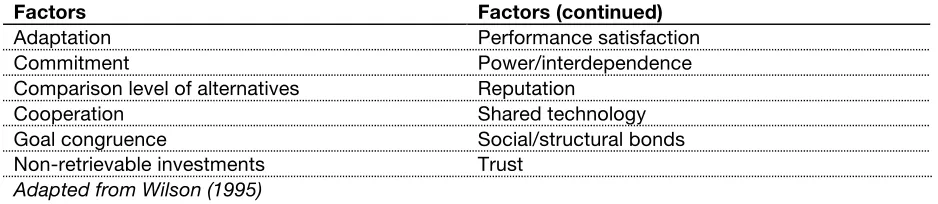
Table 2-2 Factors for evaluating business relationships
Factors Factors (continued)
Adaptation Performance satisfaction
Commitment Power/interdependence
Comparison level of alternatives Reputation
Cooperation Shared technology
Goal congruence Social/structural bonds
Non-retrievable investments Trust Adapted from Wilson (1995)
2.2.3.3 Defining customer knowledge management
CKM is a fairly new term that integrates CRM with knowledge management (KM), which is a philosophy that drives firms to optimize the use of their knowledge resources. According to García-Murillo and Annabi (2002), KM has been of interest to firms, since they realize that it can contribute to their competitive advantage. In literature, several attempts have been made to define CKM. Paquette, in Schwartz and Te’eni (2011, p. 176), for instance, defines CKM as “the processes that a firm
employs to manage the identification, acquisition, and internal utilization of customer knowledge”. Quite differently, Beerli, Falk and Diemers (2003) refer to CKM as the business-oriented gathering and organization on customers and prospects. Furthermore, Chen, in Koohang, Harman and Britz (2008) defines CKM as the application of KM tools to support the exchange of knowledge in a CRM process. In this study, CKM is defined as the management and exploitation of customer knowledge.
Dwyer et al. (1987) state that each phase of the CLC is characterized by differences in behaviors and orientations and, therefore, each phase requires different CRM approaches. Literature suggests that all CRM models are based on identifying CRM practices for managing each relational phase (e.g., Christopher, Payne & Ballantyne, 1993). These models were enriched by the CRM model proposed by Park and Kim (2003), which identifies the required and appropriate CKM strategies for managing each phase of the CLC. This study applies the latter model for developing a framework that can demonstrate how firms can exploit social media for supporting and amplifying CRM strategies. Park and Kim (2003) identified three types of knowledge that are required for managing phases of the CLC. The first is “of-the-customer knowledge”, which includes factual data about potential customers and customer segments (Daneshgar & Bosanquet, 2010), as well as personal and transaction data about individual customers (Park & Kim, 2003). Knowledge about customer is accumulated to understand customer’s needs and to address them in a personalized way (Gebert, Geib, Kolbe & Riempp, 2002). Secondly, “for-the-customer knowledge” refers to product, service and organizational information that are perceived useful by customers (Sigala, 2011). This type of knowledge is presented via diverse means of communication so that customers acquire and process it to make more informed decisions (Park & Kim, 2003). Thirdly, “by-the-customer knowledge” reflects customer feedback that can be applied to develop new products or services, or to enhance critical business processes (Gebert et al., 2002). Knowledge from customers includes the customer’s perceptions, insights and reactions, knowledge about other products or services, suppliers, markets and their environment (Daneshgar & Bosanquet, 2010). According to Smith and McKeen (2005), there is one other type of customer knowledge, which is co-created (cc) knowledge. Co-created knowledge is new knowledge that comes about as the result of collaboration between the organization and its clients and
generates value for the customers as well as the organization (Buchnowska, in Wrycza, 2011).
2.2.3.4 Defining Social CRM practice
The term “practice” implies actively working in, engaged in, or observing a particular profession or religion (The American Heritage® Dictionary of the English Language, n.d.). In a business context, a
practice refers to a method, procedure, process or rule employed by a firm in the pursuit of its objective (Business Dictionary, n.d.). In the context of CRM, practices are referred to as activities for managing business relationships (Shengdong & Xue, 2011), Hence, in this study, the term “Social CRM practice” is used to describe activities for managing customer relationships through and on social media.
What does theory tell?
proactive approach. Firms with a reactive approach are driven by customer behaviors, by
circumstances and by their environment. They might respond or “take appropriate steps of action” based on customer signals in their environment. Firms might employ a variety of reactive practices to manage each phase of the CLC. Examples include social marketing insights, social campaign tracking, market segmentation or customer profiling, and search engine optimization (see
Bounsaythip & Rinta-Runsala, 2001; Hernández, Jiménez & Martín, 2009; Owyang & Wang, 2010; Sigala, 2011). In the proactive approach, firms are still influenced by external stimuli; however, their response to the stimuli is a value-based choice or response. They are in anticipation of problems and, therefore, might take course of actions appropriate for solving a problem before they have observed a change in their environment. Again, a variety of proactive practices might be used to manage each phase of the CLC. Exemplary practices within this category include branding, co-creation,
personalization of product or services, and VIP experience (see Aaker, 1991; Hughes, 2010; Owyang & Wang, 2010; Prahalad & Ramaswamy, 2004; Sigala, 2011).
2.3
An integrated framework for understanding the added value
Social CRM
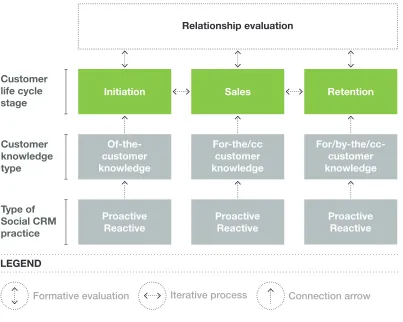
Considering the literature review, this section introduces a preliminary framework for understanding the added value of Social CRM (see Figure 2-2). This framework is preliminary, as it will serve as groundwork for developing a more elaborate framework in chapter five. The Social CRM framework integrates and features the fundamentals of Social CRM that were described in section 2.2, which are the CLC, relationship evaluation, CKM and Social CRM practice. The framework differs from
traditional CRM models (e.g., Chan, 2005; Henneberg, 2008; Parvatiyar & Seth, 2000) in two
important ways. First, the Social CRM framework contains a “social” dimension, which is embedded in the cells of both CKM type and Social CRM practice. Traditional CRM/CKM models (e.g., Bueren, Scheirholz, Kolbe & Brenner, 2004; Park & Kim, 2003) have included CKM types, however, they have focused on information solely found on or provided via conventional means of communication. The Social CRM model focuses both on traditional and social channels. Similarly, most CRM models (e.g., Bose & Sugumaran, 2003; Dawson, 2010; Winer, 2001) have focused on one-way communications with the customer. The Social CRM framework, however, centers on two-way interactions between organization and customer, and among customers themselves. Furthermore, unlike traditional CRM models, this framework contains an “evaluation” aspect. Previous CRM models (e.g., Hawkins, 2003; Park & Kim, 2003) have described relationship development as a staircase model or as a linear process. However, the Social CRM framework depicts relationship development as an iterative process of continuous interaction between the customer and firm.
The starting point of the framework is the customer life cycle. In the customer initiation phase, the firm strives to acquire new customers, making the first customer-firm contact. The firm procures factual data about prospects and customers segments, as well as personal and transactional data about individual customers. This type of information may be found on social networks, microblogs, and specialized online communities. The firm might then use proactive practices, such as branding, positive WOM, and direct marketing, or reactive practices like social marketing insights and customer profiling to add value to the CLC. Acquired customers might be valuable enough for the firm to grow the relationship. However, before the relationship can proceed to a next stage, relationship evaluation is required. In the first stage of relationship development, evaluation may either be done by the customer alone, or in conjunction with the firm. The customer might evaluate the relationship based on the quality of the outcome of products or services in comparison with other providers and whether the employees have lived up to the reputation of the organization. The customer and organization in concert may evaluate the relationship based on goal congruence, power dependence, and the strength of their bonds.
In the customer development phase, the firm strives to intensify the contact with the customers and to increase sales among existing customers. The firm presents product, service and organizational data via diverse means of communication so that customers acquire and process it to make more informed decisions about future purchases. The firm may present this type of knowledge via social networks, video sharing sites and microblogs, as well as via search engines. Knowledge for the customer may also be presented by fellow customers via review and rating sites/through
What does theory tell?
Again, the provider might use proactive practices like cross/up-selling and co-creation, or reactive practices, such as social sales insights and rapid social sales response to add value to the CLC. Growth customers might be valuable enough to maintain the relationship. However, before the relationship can advance to the last stage, assessment is imperative. In this phase, evaluation might be done jointly by the customer and provider, based on the mutual adjustment of processes, the extent of joint commitment to the relationship, the degree of cooperation, goal congruence, costs of terminating the relationship, the provision of value, shared technology, strength of bonds and the extent of communal trust.
In the customer retention phase, the potential or actual completion of the customer-provider relationship is achieved and both, one, or neither customer nor firm attempts to re-new the
relationship. If the firm attempts to re-establish the relationship, it may present data through different communication channels so that customers gather and process it for making more informed
[image:24.595.70.473.398.720.2]decisions about remaining loyal or not. If the customer strives to renew the relationship, it might provide information to the firm, which contains perceptions, insights and knowledge about other products or services, via social networks, forums, and microblogs, as well as via chats. However, if both the firm and customer strive to re-establish the relationship, they may collaborate to create new types of knowledge that is beneficial for the organization as well as the customer. In all three cases, the firm may use proactive practices, such as VIP experi