Sousa H.S., Neves L.C. (2018) Reliability based design of interventions in deteriorated timber structures, International Journal of Architectural Heritage 12(4). pp 507-515 (doi.org/10.1080/15583058.2018.1436205)
Reliability based design of interventions in
deteriorated timber structures
Hélder S. Sousaa,*,Luís C. Nevesb
a Department of Civil Engineering, ISISE, University of Minho, Portugal
b Resilience Engineering Research Centre, University of Nottingham, Nottingham, UK
* corresponding author: ISISE, University of Minho, Department of Civil Engineering, Azurém, 4800-058 Guimarães, Portugal
e-mail: [email protected]
Tel: +351 253510200; Fax: +351 253510217
Abstract
When accommodating new uses or mitigating the consequences of deterioration, the strength
increase of existing structures is significantly more onerous than a similar increase at the
design stage of new structures. The safety methods prescribed in current standards were
defined for the design of new structures and are frequently conservative for the assessment
and repair of existing structures. This work will introduce the fundamental aspects of
structural reliability and their application in the context of existing timber structures regarding
the use of target reliability indices. Firstly, the fundamental methods of structural reliability
are introduced. The use of reliability methods requires the use of more detailed information
in respect with material properties, loads and model uncertainty. The main sources of such
information are described. After overviewing the fundamental methods of structural
reliability, methods to introduce additional information, namely results of non-destructive
tests in the structural assessment are discussed. Finally, the intervention on a timber structure
will be analyzed, within a case study, by considering different repair scenarios that lead to
discussions on different suitable safety thresholds for existing and repaired structures.
Keywords:
timber structures; reliability; safety assessment; intervention; target reliability index
Running head:
1. Introduction
When accommodating new uses or mitigating the consequences of deterioration, the strength
increase of the existing structure is significantly more onerous than a similar increase at the
design stage of the new structure. Repairing (process aiming at returning a damaged structure
to its original or prior condition) or upgrading (process aiming at reaching a higher level of
performance than the existing and/or original level) existing structures are usually complex
operations, which results in higher direct costs. Besides, both require significant limitations
to the use of the structure during the intervention procedures, by leading to significant users
costs too. The safety methods prescribed in current standards were defined for the design of
new structures and are frequently conservative for the assessment and repair of existing
structures.
Consequently, it is fundamental to use a safety assessment methodology more flexible than
the traditional semi-probabilistic approach present in codes. Semi-probabilistic methods, like
the partial safety methods, take the uncertainty in structural variables into account in a
simplified manner. Each variable is described by a single value (e.g., mean, nominal or
characteristic value) while each load and strength variable is affected by a partial safety factor
dependent on its variability, on the associated probabilistic distribution and the target safety
level.
The uncertainty deriving from the safety margin can be taken into account by increasing the
partial safety factors, by resulting in a small overdesign of structures which has negligible
costs for new structures. Regarding their design, the partial safety factors are adequate, except
in some very particular cases (e.g., very high consequences of failure structures, materials or
loads not covered in codes). However, the safety assessment of the existing structure differs
from the design of the new structure in three main aspects: i) costs, ii) lifetime period, iii)
the safety of the existing structure is significantly more expensive than a similar increase at
the design stage. In fact, the main cost will typically be the rising in material costs at the design
stage, while for the existing structure it involves closure or limitation of use, more complex
retrofitting or upgrading methods, and overall greater risks. Secondly, the remaining life of
the existing structure is usually shorter than that of the new structure. This might lead to a
reduction in the representative values of loads. As last point, the uncertainty present in the
existing structure is significantly different from that expected in the new structure. On one
hand, measurements and non-destructive tests can be used in the existing structure to reduce
existing uncertainty. On the other hand, assessment of existing structures is required when
doubts on the safety of the structure exist, in particular as a result of deterioration.
Deterioration is extremely complex to predict and characterize, adding a new source of
uncertainty in the safety assessment.
Structural reliability methods use a more general approach to quantify structural safety. They
explicitly include the uncertainty in each parameter influencing the performance of the
structure, and they define safety thresholds that take into account the importance of the
structure and the cost of improving safety. Probabilistic methods are based on the computation
of the probability of failure, by taking into account the uncertainty in all structural parameters
which stand for material properties, loads, model errors, and geometry. Being compared to
semi-probabilistic methods, probabilistic methods require more information and significantly
higher computational power. However, the use of probabilistic methods overcomes the main
limitations described in the assessment of existing structures. On one hand, a target probability
of failure can be defined, based on the equilibrium between construction/repair cost and risk.
Furthermore, the differences in uncertainty in structural parameters are explicitly taken into
account. Finally, the results of new results and information on the structure including
measurements or non-destructive test results can be consistently incorporated in the safety
Considering the potential advantages of using probabilistic methods in the assessment of
existing structures, the present work will focus on the use of reliability analysis in the context
of timber structures.
2. Framework
2.1. Reliability methods
Reliability analysis of timber structures requires three main steps: definition of resistance
properties, definition of effects of actions, and computation of the probability of failure or
reliability index (Köhler, 2007; Köhler et al. 2007). Basically, structural reliability aims at
quantifying the safety of structures in terms of the probability of a limit state being violated,
denoted probability of failure, pf. The failure of a structural element is considered when the
value of its resistance R is exceeded by the value of the load effect S resultant of a determined
loading Q, on a specific element. Therefore, pf may be described as the probability that the
structural resistance R, modelled by a random variable with a known probability function fR
(r), being inferior or equal to the load effects S, equally modelled by a random variable with
a known probability function fR (s) such as defined in Eq. 1.
0f ( 0) ,
S R
RS r sdrds
f S
R P
p (1)
This integral can only be computed analytically in very simple cases. In the last decades, a
wide range of methods have been developed to compute the probability of failure of complex
problems. When both R and S are given by normal random variables, with means R and S
and variances
R2 and S2 respectively, the probability of failure according to Cornell (1969)may be stated as in Eq. 2:
1/2 1
where = M/M is defined as reliability index, with M and M being the mean and standard
deviation of the safety margin (M = R - S), and ( ) represents the standard normal distribution
function. In this case, it is visible that pf increases when either one of the variances increase
or when the difference between means of R and S decreases. Although these are the
fundamental principles for a reliability assessment, when the limit state is non-linear or the
random variables are non-normal, the procedure above cannot be applied directly. The random
variables must be approximated by normal variables whereas the limit state function must be
approximated by a linear function, within the interactive procedure known as First Order
Reliability Method (FORM).
With concern to the probabilistic safety assessment of timber structures, the key resistance
properties (or reference properties) are the bending strength (fm), the bending modulus of
elasticity (Em) and density (ρm). Probabilistic models for these parameters are proposed in the
Joint Committee for Structural Safety Model Code (JCSS, 2006). In this document, a
lognormal distribution is proposed for the bending strength and modulus of elasticity, with
coefficients of variation of 25% and 13%, respectively, whereas density is represented by a
normal distribution with coefficient of variation equal to 10%. Considering the JCSS model
code, the other resistance properties of timber can be obtained based on the key properties
through empirical expressions.
As mentioned by Faber et al. (2014), the tail behaviour of the probability distributions for
timber material characteristics plays an important role in the overall probabilistic modelling.
In this case, the parameters that define the probability distributions must be estimated with
care. To this end, Bayesian and Maximum Likelihood estimations have been applied with
success (Faber et al. 2014; Sousa et al. 2015, 2016b). Correlation analyses and statistical tests
have also been used while discussion about the applicability of interval estimation instead of
point estimation methods to determine the distribution parameters has been provided in Jenkel
2.2. Bayesian updating
Throughout their lifetime, structures change due to many aspects from natural causes to
human decisions or even by extreme or accidental actions, only to point a few. The knowledge
on the structure also changes from the design stage to the construction and the assessment
phases. In the design stage, it is assumed that structure properties are those of similar structures
whereas in the construction phase visual inspection provides further information. In addition
to these, samples of material, non-destructive tests or load tests can be carried out when
assessing the structure. Thus, the assessment of existing structures should be regarded as a
successive process of model updating and consequent evaluation regarding new information.
Bayesian methods are therefore suited to this aim because they allow the combination of new
information with pre-existing data, in a consistent manner.
The assessment of structures usually starts by analysing the structure using conservative
values (or probabilistic distributions) to all relevant parameters, based on data and experience
on similar structures. An initial analysis will indicate which variables are critical to the safety
of the structure and, consequently, for which a conservative estimate has greater impact. If
this analysis indicates that the structure is unsafe, it might be interesting to gather further
information and obtain values or probabilistic distributions of the critical parameters closer to
reality and, typically, less conservative. It must be kept in mind that the structural safety is
fundamentally dependent on the extreme values of structural parameters, which are strongly
influence by the standard deviation or by the existing uncertainty. Reducing this uncertainty
will lead to the improvement of safety estimates in most cases.
The information gathered is often limited and localized (e.g., a small timber sample only
provides localized information that must be extrapolated to the entire beam carefully), and is
associated with significant statistical uncertainty. As a result, its combination with prior
In Beconcini et al. (2016), a methodology for the probabilistic reliability assessment of
heritage buildings is presented where Bayesian updating techniques were implemented for a
rational use of the collected information. In Sousa et al. (2016a), a methodology for the holistic
assessment of timber elements was also described where information gathered in different
scales was combined by following a probabilistic framework that allows for the structural
assessment of existing timber elements with possibility of inference and updating the
mechanical properties of structural elements through Bayesian methods. Furthermore,
Bayesian methods were used, according to Sousa et al. (2013), in order to update the
information on the mechanical properties of timber through semi and non-destructive test
results.
A review on the onsite assessment of structural timber members by means of hierarchical
models and probabilistic methods is also provided in Sousa et al. (2015) where the
applicability and limitations of statistic and probabilistic methods on the prediction and
inference of timber’s reference material properties are discussed and exemplified.
2.3. Reliability targets
The decision on the need to repair the structure or on the design of upgrading solutions
requires the definition of a target safety level, by defining the acceptable minimum level of
performance. For new structures, such targets are defined in codes, either implicitly through
partial safety factors, or explicitly thought prescribed target reliability indices. In order to
design both for ultimate and serviceability limit states, diverse target reliability indices are
established for various structural situations by considering different consequences classes,
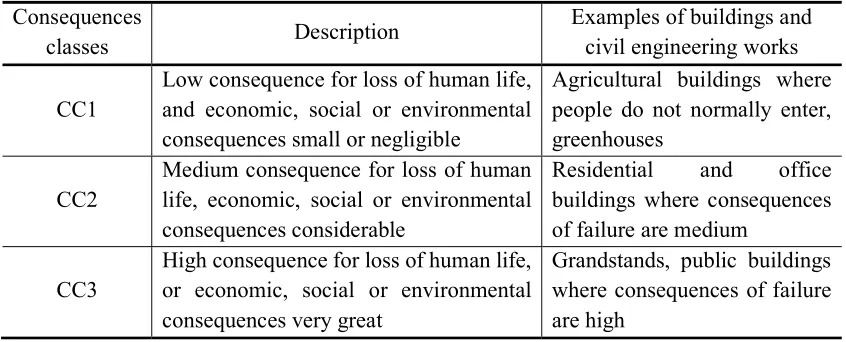
reference periods of time and relative cost of safety measures. The European standard EN
1990 (CEN, 2002), also known as Eurocode 0, refers three reliability classes RC1, RC2 and
RC3 associated with three consequences classes CC1, CC2 and CC3. The definition of the
the reliability index regarding ultimate limit states are stated in Table 2. RC is normally
[image:9.612.98.521.157.328.2]related directly to CC.
Table 1: Definition of consequence classes (adapted from CEN, 2002).
Consequences
classes Description
Examples of buildings and civil engineering works
CC1
Low consequence for loss of human life, and economic, social or environmental consequences small or negligible
Agricultural buildings where people do not normally enter, greenhouses
CC2
Medium consequence for loss of human life, economic, social or environmental consequences considerable
Residential and office buildings where consequences of failure are medium
CC3
High consequence for loss of human life, or economic, social or environmental consequences very great
Grandstands, public buildings where consequences of failure are high
Table 2: Recommended minimum values for reliability index related to ultimate limit
states (adapted from CEN, 2002).
Reliability Class 1 year reference period Minimum values for 50 year reference period
RC1 4.2 3.3
RC2 4.7 3.8
RC3 5.2 4.3
While it is valid for the design of new structures within the scope of Eurocode, this approach
is not satisfactory for the assessment of existing structures and the design of upgrading
solutions. In fact, it is uneconomical to require all existing structures to comply with safety
target levels calibrated for new structures. This would result in the need to retrofit every
structure denoting even mild signs of deterioration which is clearly impossible.
Due to the shorter design life of existing structures and the higher costs of increasing safety,
The assessment of existing structures may be considered through the procedure defined in ISO
13822 (ISO, 2010), which is based on the principles of structural reliability and consequences
of failure. This standard is applicable to the assessment of any type of existing structure that
was initially designed or analysed according to accepted engineering principles, as well as it
is valid for structures built with good workmanship and experience principles. This standard
is intended to serve as a basis for preparing national standards or codes of practice by taking
into account both the current engineering practice and also the economic conditions. It is
applicable to heritage structures if additional considerations are taken. Moreover, it may be
applied to any sort of materials, however specific adaptations may be needed depending on
the material. The assessment procedure may be considered when the anticipated change of
use or extension of design life expectancy is required or entailed by the reliability check due
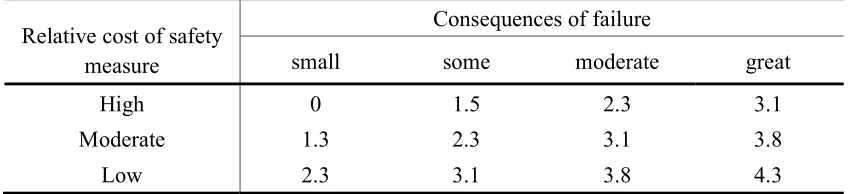
to exterior load effects. ISO 13822 (ISO, 2010) is based on ISO 2394 (ISO, 2015) principles
which propose a more detailed approach to the definition of the target reliability, considering
[image:10.612.97.522.496.593.2]both the consequences of failure and the cost of improving safety, as shown in Table 3.
Table 3: Target reliability index, target (lifetime reference period) according to ISO 2394
(2015).
Relative cost of safety measure
Consequences of failure
small some moderate great
High 0 1.5 2.3 3.1
Moderate 1.3 2.3 3.1 3.8
Low 2.3 3.1 3.8 4.3
This proposal can be used for assessing existing structures, by simply considering the cost of
safety measure as large. However, a more detailed analysis of the costs involved in the
assessment, a decision must be made as to upgrade the structure or not, and how to achieve
that improvement in case of upgrading.
On a first approach, the target reliability indices for structural design or assessment of
structures should be defined based on cost optimization, by considering the consequences and
nature of the failure, economical losses, environmental and social impacts, and the cost of
measures to reduce the probability of failure. Since construction/repair only occur once, the
equilibrium between costs and risk must consider the risk over the entire lifetime. This means
that economic constraints influence the acceptable lifetime probability of failure and
structures with different design lifetimes should have the same lifetime reliability, which
results in different annual probabilities of failure. A purely economic analysis can be used in
the cases where structural failure results in no human lives lost. Otherwise, measures of
individual risk, like the Life Quality Index, can be used to guarantee that decisions which are
optimal from an economic viewpoint do not result in unacceptable risk to users.
For existing structures, the safety cost is usually significantly higher than that for new
structures. At the design stage of new structures, safety can be increased by changing the
dimension of elements or the strength of timber or connectors, with marginal costs. For
existing structures, the costs are significantly higher, not only due to the increased complexity
of an upgrade solution, but also due to the loss of use during a period, with resulting business
losses or relocation costs. This increase in safety cost shifts the optimal point, which results
in lower optimal design parameters and lower safety levels, as long as human safety
constraints are not violated. As a consequence, the target reliability index depends on the
consequences of failure influencing the failure cost, on the cost of improving safety, and on
the project time horizon influencing the human safety constraint.
For instance, ISO 2394 (ISO, 2015) indicates that the target level of reliability should depend
The difference in cost for the safety improvement between new and existing structures is
mostly dependent on the loss of use of the structure, design, survey, mobilizing construction
crew. On the other hand, once the decision to upgrade has been taken, the difference in cost
between different alternatives only depends on the materials and application, which is higher
for existing structures. Indeed, more expensive materials are usually employed in upgrading
as a result of geometrical and weight restrictions, difficulty in access and need for faster
construction methods. For this reason, Steenbergen et al. (2015) proposed two different
reliability targets. The first, 0, defines the minimum reliability index for which not upgrading
is acceptable. The second index, up, defines the target reliability index for the design of the
upgrade. If only economic optimization is considered, the target reliability is independent of
the lifetime of the structure. Table 4 presents the proposal of Steenbergen et al. (2015) for the
target reliability index considering only economic consequences.
Table 4: Target reliability index considering only economic consequences (Steenbergen et
al., 2015).
Consequence class up 0
CC1 2.8 1.8
CC2 3.3 2.3
CC3 3.8 2.8
When the potential loss of lives is considered, not only the importance of the structure must
be considered, but also the time horizon of the structure and the expected number of fatalities.
The number of potential fatalities can be estimated based on the importance of the structure
and the expected collapsed area, Acol, by following the failure of the element.
Except for exceptional structures, the target reliability is dominated by the risk of loss of
human lives, except for very short lifetimes. For higher consequence classes, the risk grows
area. For buildings of CC1 large groups of users are not expected and, consequently, the target
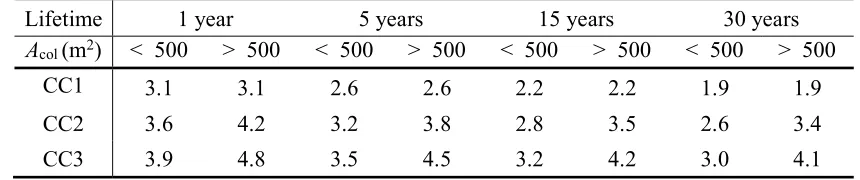
reliability is independent of the collapsed area. The proposal of Steenbergen et al. (2015) for
[image:13.612.98.520.210.299.2]both targets is presented in Tables 5 and 6.
Table 5: Target reliability index for design of upgrade actions up (Steenbergen et al., 2015)
for lifetime equal to reference period.
Lifetime 1 year 5 years 15 years 30 years
Acol (m2) < 500 > 500 < 500 > 500 < 500 > 500 < 500 > 500
CC1 3.1 3.1 2.8 2.8 2.8 2.8 2.8 2.8
CC2 3.6 4.2 3.3 3.8 3.3 3.5 3.3 3.4
CC3 3.9 4.8 3.8 4.5 3.8 4.2 3.8 4.1
Table 6: Target reliability index for defining the need to upgrade 0 (Steenbergen et al.,
2015) for lifetime equal to reference period.
Lifetime 1 year 5 years 15 years 30 years
Acol (m2) < 500 > 500 < 500 > 500 < 500 > 500 < 500 > 500
CC1 3.1 3.1 2.6 2.6 2.2 2.2 1.9 1.9
CC2 3.6 4.2 3.2 3.8 2.8 3.5 2.6 3.4
CC3 3.9 4.8 3.5 4.5 3.2 4.2 3.0 4.1
3. Application on a timber roof truss
3.1. Initial design
A timber truss pertaining to a three pitched timber roof will be considered as case study to
demonstrate the influence on using target reliability indices for the intervention design in
existing timber structures. The timber roof is composed by four collar beam trusses, spaced 3
m from each other. The disposition of elements was based on the structural configuration of
the Chimico Laboratory, a Portuguese neoclassic building from the 18th century, located in
[image:13.612.92.522.379.469.2]Z
X Y
1.5 m
3.4 m 2.9 m
14.9 m 44 °
25 °
struts (20 20 cm2)
rafter
(20 22 cm2)
collar beam (20 22 cm2)
post (20 20 cm2)
rafter
(20 22 cm2)
works regarding its inspection, geometric survey and safety analysis (Lourenço et al., 2013),
as well as full scale testing and repair interventions (Branco et al., 2017). Considering the
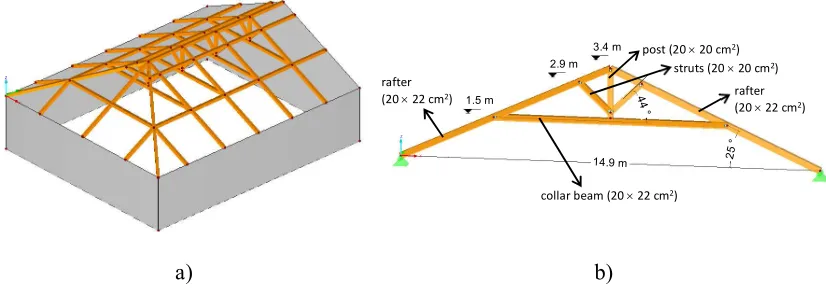
same geometry, the initial design following Eurocode 5 (CEN, 2004) was considered for one
of the central trusses (Figure 1b). The design was made as it was for new structures according
to the currently applicable design codes.
[image:14.612.104.517.208.352.2]a) b)
Figure 1: Configuration of the timber roof: a) three-dimensional perspective; b) planar collar
beam truss.
For the initial design, load combinations with permanent (i.e. weight of the trusses, roof tiles
and sheeting), imposed (i.e. live load) and wind loads (i.e. upwind and downwind) were
considered. The expected values (mean values), coefficient of variation (CoV) and
probabilistic distributions used for each load type are provided in Table 7. Strength and
stiffness variables that were used in the probabilistic assessment are also provided in the same
table. As to obtain design values according to the principles of Eurocode 5, partial safety
factors were used together with the characteristic values for resistance and load variables. In
terms of mechanical properties, the elements of the timber truss were considered to be made
of pine with strength class C24 (CEN, 2016).
During the design stage, it was found that the most conditioning limit state corresponds to the
verification of combined bending and axial compression on the rafters, while the critical load
Z
combination corresponds to the presence of permanent load together with wind load. From
the design and accounting to a homogenization of dimensions along the truss, a cross-section
of 2022 cm2 was used for the rafters and collar beam, whereas for the post and struts a
[image:15.612.98.517.211.373.2]cross-section of 2020 cm2 was used (Figure 1b).
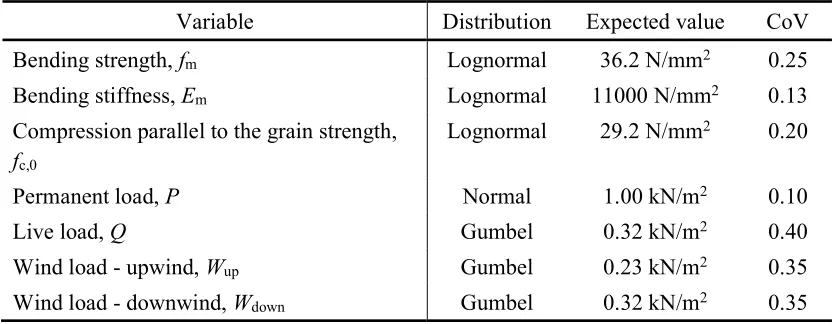
Table 7: Variables used in the design of the timber roof truss.
Variable Distribution Expected value CoV
Bending strength, fm Lognormal 36.2 N/mm2 0.25
Bending stiffness, Em Lognormal 11000 N/mm2 0.13
Compression parallel to the grain strength, fc,0
Lognormal 29.2 N/mm2 0.20
Permanent load, P Normal 1.00 kN/m2 0.10
Live load, Q Gumbel 0.32 kN/m2 0.40
Wind load - upwind, Wup Gumbel 0.23 kN/m2 0.35
Wind load - downwind, Wdown Gumbel 0.32 kN/m2 0.35
By taking into consideration these cross-section dimensions, the reliability analysis was
performed with the purpose of computing the reliability index of this truss. The analysis
considered the probability of failure for the most critical element (i.e. rafter) by accounting
the limit state equation and load combination that conditioned the initial design. Following
the definition of probability of failure provided in Eq. 1, the limit state equation, G, for the
present study case is presented in Eq. 3:
where c,0 and m are the design compressive stress along the grain and the design bending
stress respectively, which results from the load combination with permanent and wind loads.
On the other and, fc,0 and fm are the compressive strength along the grain and the bending
strength respectively. The parameter kmod is the modification factor for duration of load and
moisture content. The resistance parameters were defined according to the values given in EN
338 (CEN, 2016) for class C24, while probability distributions and variation were established
according to the Probabilistic Model Code for timber (JCSS, 2006). Geometry of the
cross-section (i.e. width and height) was considered deterministic and constant, as it is assumed that
a new construction evidences low dimensional variation along the length of the elements.
Permanent loads were modelled as a normal distribution, by providing an expected value of
1.0 kN/m2 with CoV of 10%. Wind loads were calculated through Eurocode 1 (CEN, 2005)
by resulting in a mean exterior wind pressure of 0.32 kN/m2 for downwind and 0.23 kN/m2
for upwind. Since the location and configuration of the building were known, Gumbel
distributions with CoV of 20% were considered for wind speed, by resulting in a final wind
load with a CoV of 35%.
In this work, a FORM algorithm implemented in PRADSS (Sørensen, 1987) was used to
compute the reliability index of the structure, by presupposing failure of the whole structure
if a critical element failed. After performing the reliability analysis a reliability index, = 4.85
(pf 6.310-7) was obtained. This value is consistent with the target values proposed in
Eurocode 0 (CEN, 2002).
3.2. Damaged structure
Roof structures (comprising both covering and structural components) are critical elements
on a building, as being subject to the action of the exterior environment they may be influenced
by natural and physical agents that originate different pathologies. In the case of timber roofs,
decay due to fungi or xylophages insects is often encountered, especially on the rafters
featured by direct contact to the roof cover and on the supports due to rising damp.
Probabilistic decay models for timber elements have been discussed (e.g. Leicester et al. 2009,
Sousa et al., 2014) where it is assumed that decay process may be modelled by bi-parametrical
the latter deals with the annual decay penetration rate which depends on climate, durability,
and structural conditions of the timber element.
Considering that the truss is exposed to decay along its lifetime, a safety analysis to the rafter
was made by taking into account the homogeneous decrease of size on all faces of its
cross-section. The rafter was chosen since it was determined as the most critical element on the
initial design. As previously mentioned, the rafter is the structural element which often
presents decay on existing timber roofs. The reliability analysis considered the most critical
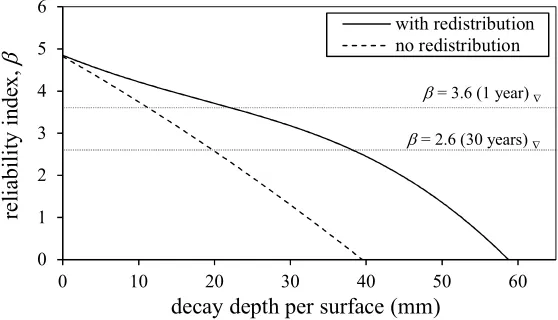
combination of loads (i.e. permanent load combined with wind load). The results are presented
in Figure 2, in terms of reliability index for each decrease of cross-section. This analysis
allows to verify what would be the decrease on the element’s cross-section needed to reach a
target reliability index for defining the need for upgrade, 0, as mentioned for example in
Steenbergen et al. (2015). Therefore, two target reliability indices are shown in Figure 2,
regarding a reference period of 1 year and 30 years. Moreover, two modelling approaches
were considered in relation to redistribution of stresses due to the loss of cross-section of one
of the rafters. In the first scenario, it is considered that no redistribution of stresses is made to
the other elements of the truss while the rafter is losing resistant cross-section. On the other
hand, the second scenario implies that stresses are redistributed along the truss during the
decay process.
It is ascertained that, by not considering a redistribution of stresses during the decay process,
lower decreases of cross-section correspond to a higher loss of structural reliability compared
to the case where it is assumed that the truss is able to redistribute the stresses from one
element to the other. In the more conservative approach (no redistribution), the value 0 = 3.6
is reached for a cross-section decrease of 11 mm on each face whereas 0 = 2.6 is reached for
a cross-section decrease of 20 mm on each face. Meanwhile, the value 0 = 3.6 is reached for
2.6 is reached for a cross-section decrease of 38 mm on each face. These results indicate that
the stress distribution approximately doubles the limit depth for cross-section decrease before
achieving a target reliability index to define the need of upgrading.
Figure 2: Reliability index of the timber truss according to different loss of cross-section
dimensions.
The results presented in Figure 2 correspond to the specific analysis of the rafter with loss of
cross-section within this specific collar beam truss but are indicative of the procedure for
determining the reduction of cross-section that leads to the need to intervene on the structure.
Therefore, it is important to obtain reliable information on the geometry of the residual
cross-section when analyzing existing timber structures. To that aim, non-destructive tests are often
used and its information may be implemented within a reliability safety analysis by
consideration of new information. As previously mentioned, this information may be
implemented through Bayesian updating approaches. The work of Sousa et al. (2013) may be
consulted for further information and examples on the use of non-destructive test data for
reliability-based assessment of existing timber structures.
0 1 2 3 4 5 6
0 10 20 30 40 50 60
re
lia
bi
li
ty
i
nd
ex
,
decay depth per surface (mm)
with redistribution no redistribution
= 3.6 (1 year)
[image:18.612.167.446.174.334.2]3.3. Interventions and target reliability indices
In the presence of old timber roofs, there is a common propensity for a full replacement by a
new structure and sometimes even to use another material. However, this is often not the most
appropriate solution, when considering both the preservation of the building's identity, and
the economic and structural optimizations. These points are critical in historical constructions,
where execution issues usually arise due to in-situ constraints, which sometimes render the
replacement option unfeasible. This situation is exemplified for the Portuguese construction
context by Rodrigues (2013) who verified through the cost analysis that the replacement of
the tie-beam and rafter from the timber truss would be approximately three times more costly
than localized repairs. Within the Portuguese context, another example is given by Ilharco et
al. (2010) where, through local repairs and reinforcement using steel screws and timber
elements, it was possible to obtain a rehabilitation cost for a timber roof structure of
approximately 20% of the value that would correspond to its full replacement.
Attending to these premises, thus taking into account that local repairs are substantially less
costly than full replacement of the elements, two types of interventions will be considered as
to exemplify the use of target reliability indices depending on relative cost of implementing a
safety measure.
In the present case study, it will be considered that intervention is required on the rafter from
the timber truss. The first intervention option is the localized repair of the rafter using timber
pieces connected by screws on each side of the rafter. This is a traditional repair solution and
details of this intervention are discussed in Branco et al. (2017) for a timber truss with the
same configuration of this case study. The second type of intervention consists in the
replacement of the rafter element by a new one. Considering the costs concerning each
implementing the safety measures, whereas the replacement of the element produces moderate
relative costs.
For the safety analysis and design of the intervention, it was considered that the rafter would
fail at the point of higher stress near the connection with the collar beam. Therefore, it was
stated that the section did not present any further contribution to the resistant
cross-section of the element. In order to obtain an analysis standing for the influence of intervention
on the new cross-section of timber elements, it was assumed that the connection between new
and old elements would be sufficiently reliable as not to influence the safety level. As a result,
the design would only be conditioned by the resistance of timber elements.
In both interventions, new timber elements were designed with height equal to the initially
existing elements. However, the width of the repaired cross-section, brep, would be determined
by the design needs.
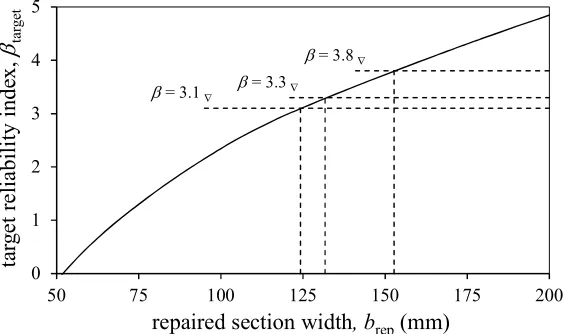
Figure 3 shows the results of the design with concern to the reliability index obtained after
intervention. For the localized intervention, the repaired section width represents the sum of
the width of each timber piece connected on each side of the rafter. Conservatively, the
intervention design was made without considering the stress redistribution between the rafter
and the other elements from the truss, as loading was not removed during repair.
By considering the target reliability indices, target, following ISO 2394 (2015) and considering
moderate consequences of failure, the value of target = 3.8 would be used for the local
intervention, while target = 3.1 would be used for the intervention which takes into account
the replacement by a new element. These target reliability indices result in a repaired section
width of 153 mm for the local intervention and of 125 mm for the replacement by a new
element. These values compared to the initial design (binitial = 200 mm corresponding to a
= 4.85) represent a decrease of 24% and 38% on the cross-section width, respectively for
also represented in Figure 3, which corresponds to the value of up proposed by Steenbergen
et al. (2015) for the lifetime reference period of 30 years and the consequence class CC2. The
consideration of the value up = 3.3 would be related to a repaired cross-section width of 132
mm (i.e. 34% decrease compared to the initial design).
Figure 3: Reliability index according to the variation of the cross-section width from the
repaired element.
4. Concluding remarks
The present work introduces key aspects of structural safety and their applicability to the
assessment of existing timber structures and the design of retrofit solutions by taking into
consideration the use of target reliability indices. The use of traditional methods, developed
for the design of new structures, frequently results in over conservative decisions, with very
high costs. Therefore the use of a more detailed methodology is clearly justified.
The definition of target reliability indices for existing timber structures, by considering both
cost optimization and risk to human lives was presented in the context of existing codes and
applied to a case study. The case study comprised of different possible interventions on a
timber truss element and their influence on design with different target reliability indices. For
0 1 2 3 4 5
50 75 100 125 150 175 200
ta
rg
et
r
el
ia
bi
li
ty
i
nd
ex
,
targ
et
repaired section width, brep(mm)
= 3.8
[image:21.612.168.450.195.362.2]considering the differences between the design of the new structure and the design of the
intervention in then existing structure. In this way, the costs of the intervention can be
optimized.
Acknowledgments
This work was partly financed by FEDER funds through the Competitivity Factors
Operational Programme - COMPETE and by national funds through FCT (Foundation for
Science and Technology) within the scope of the project POCI-01-0145-FEDER-007633. The
financial support of FCT, through national funds, within the scope of the project Protimber,
PTDC/ECM-EST/1072/2014, is acknowledged.
References
Beconcini M.L., Croce P., Marsili F., Muzzi M., Rosso E. (2016) Probabilistic reliability
assessment of a heritage structure under horizontal loads. Probabilistic Engineering
Mechanics, 45: 198-211.
Branco J.M., Sousa H.S., Tsakanika E. (2017). Non-destructive assessment, full-scale
load-carrying tests and local interventions on two historic timber collar roof trusses,
Engineering Structures 140. pp 209-224 (doi.org/10.1016/j.engstruct.2017.02.053).
CEN (2002) EN 1990:2002, Eurocode 0: Basis of Structural Design, European Committee for
Standardization, Brussels.
CEN (2004) EN 1995-1-1:2004, Eurocode 5: design of timber structures. Part 1-1: General
common rules and rules for buildings. European Committee for Standardization,
Brussels.
CEN (2005) EN 1991-1-4:2005, Eurocode 1: Actions on structures. Part 1-4: General actions:
CEN (2016) EN 338:2016., Structural timber. Strength classes. European Committee for
Standardization, Brussels.
Cornell, C.A. (1969). A probability-based structural code. Journal of the American Concrete
Institute. ACI Journal Proceedings, 66(12). ACI.
Faber M.H., Köhler J., Sørensen J.D. (2004) Probabilistic modeling of graded timber material
properties. Structural Safety, 26(3): 295-309.
Ilharco, T., Paupério, E., Costa, A., Guedes, J. (2010) Inspection, diagnosis and strengthening
of old timber roofs. The case of the Rodrigues de Freitas Secondary School. In: VI
Congresso Internacional sobre Patología y Recuperacíon de Estructuras, Córdoba,
Argentina (in Portuguese).
ISO (2010) ISO 13822:2010 Bases for design of structures - Assessment of existing structures.
International Organization for Standardization.
ISO (2015) ISO 2394:2015 General principles on reliability of structures. International
Organization for Standardization.
JCSS (2006) Probabilistic Model Code, Part III: Resistance Models – 3.5 Properties of
Timber. Probabilistic Model Code, Joint Committee for Structural safety.
Jenkel C., Leichsenring F., Graf W., Kaliske M. (2015) Stochastic modelling of uncertainty
in timber engineering. Engineering Structures, 99: 296-310.
Köhler J. (2007) Reliability of timber structures. PhD Thesis, Institute of Structural
Engineering, Swiss Federal Institute of Technology.
Köhler J., Sørensen J., Faber M. (2007) Probabilistic modelling of timber structures. Structural
Safety, 29(4): 255-267.
Lourenço P.B., Sousa H.S., Brites R.D., Neves L.C. (2013). In situ measured cross section
geometry of old timber structures and its influence on structural safety. Materials and
Rodrigues J. (2013) Strengthening and repair of timber roof structures, Pedra e Cal 55. pp
30-31 (in Portuguese).
Sørensen J.D. (1987). PRADSS: program for reliability analysis and design of structural
systems. Structural reliability theory, paper no 36. The University of Aalborg, Denmark.
Sousa H.S., Branco, J.M., Lourenço, P.B. (2014) Characterization of cross sections from old
chestnut beams weakened by decay. International Journal of Architectural Heritage
8(3). pp 436-451. (doi.org/10.1080/15583058.2013.826303)
Sousa H.S., Sørensen, J.D., Kirkegaard, P.H., Branco, J.M., Lourenço, P.B. (2013) On the use
of NDT data for reliability-based assessment of existing timber structures. Engineering
Structures 56. pp 298-311. (doi.org/10.1016/j.engstruct.2013.05.014)
Sousa H.S., Branco J.M., Lourenço P.B. (2016a) A holistic methodology for probabilistic
safety assessment of timber elements combining onsite and laboratory data.
International Journal of Architectural Heritage, 10(5): 526-538.
Sousa H.S., Branco J.M., Lourenço P.B., Neves L.C. (2016b) Inference on stiffness and
strength of existing chestnut timber elements using Hierarchical Bayesian Probability
Networks. Materials and Structures, 49(10): 4013-4028.
Sousa H.S., Machado J.S., Branco J.M., Lourenço P.B. (2015) Onsite assessment of structural
timber members by means of hierarchical models and probabilistic
methods. Construction and Building Materials, 101: 1188-1196.
Steenbergen R.D., Sýkora M., Diamantidis D., Holický M., Vrouwenvelder T. (2015)
Economic and human safety reliability levels for existing structures. Structural