
Density functional study of interactions between fluorinated
cyclohexanes and arenes†
Rodrigo A. Cormanich,a,b Alastair Durie,a Ragnar Bjornsson,c Roberto Rittner,b David O’Hagana* and Michael Bühla*
a
EastChem School of Chemistry and Centre of Magnetic Resonance, University of St Andrews, North Haugh, St Andrews, Fife, KY16 9ST, UK Fax: 01334 463800; Tel: 01334 467171;
b
Chemistry Institute, University of Campinas, Campinas, SP, 13083-970, Brazil, Tel (19) 3521 3150; Fax. (19) 3521 3023
c
MPI for Chemical Energy Conversion, Stiftstraße 34 - 36, D-45470, Mülheim an der Ruhr, Germany.
E-mail: [email protected] and [email protected]
Abstract
1
H NMR chemical shifts of all-syn-1,2,4,5-tetrafluorocyclohexane (1), all-syn -1,2,3,4-tetrafluorocyclohexane (2) and their complexes with benzene are calculated at the BHandH/6-311+G(2d,p) level. The observed shielding of certain resonances on going
from CD2Cl2 to toluene-d8 solution is qualitatively reproduced in these model
calculations, in particular when standard B3LYP/def2-TZVP optimised geometries are
employed. The results are interpreted with the quantum theory of atoms in molecules
(QTAIM) and non-covalent interactions (NCI) methods, and indicate that aromatic
molecules bind strongly (1.6 kcal mol-1) to the “positive face” of these molecules. The
level of theory is validated for the new compound all-syn -3-phenyl-1,2,4,5-tetrafluorocyclohexane (3), where a recently developed QM/MM protocol for optimisation of molecular crystals afforded excellent agreement between the
Introduction
Fluorine compounds have been widely used in many fields, with emphasis in
medicinal and material sciences. The inclusion of fluorine atoms and/or fluorinated
groups provide new and unusual molecular properties, which indeed can be used to
obtain more active and selective drugs and materials with improved efficiency.1,2 In this
sense, Durie et al. reported the synthesis of the all-syn-1,2,4,5-tetrafluorocyclohexane (1) and the all-syn-1,2,3,4-tetrafluorocyclohexane (2, Scheme 1),3,4 which were shown to have high polarity and low viscosity, and, hence, are potentially new candidates to be
used as liquid crystal materials. Some 1H NMR resonances of 1 and 2 showed unusually strong upfield shifts on going from CD2Cl2 to toluene solution, which were not fully
understood at the time.3 We now report theoretical calculations for 1 and 2 using simple solvation models in order to highlight the specific interactions with aromatic solvent
molecules which give rise to these unusual upfield shifts.
Scheme 1
A model for the interaction between the fluorinated cyclohexane moieties and
aromatic groups was provided by the recent synthesis and characterisation of all-syn -3-phenyl-1,2,4,5-tetrafluorocyclohexane (3).5 Using a suitable computational protocol, we now report on the effect of intermolecular packing on the 1H chemical shifts in 3, which is of interest in relation with the abovementioned solvent shifts in 1 (and 2).
Results and Discussion
The experimental 1H NMR chemical shifts of 1 and 2 in CD2Cl2 and toluene-d8 of
all-syn-1,2,4,5-tetrafluorocyclohexane (1) and all-syn-1,2,3,4-tetrafluorocyclohexane (2) are included in Table 1. The shielding of the 1H resonances on going from
dichloromethane to toluene is a manifestation of the well-known aromatic solvent
induced shift (ASIS),6 albeit of exceptional magnitude, as individual chemical-shift
density functional theory (DFT) calculations for 1 and 2 (Figure 1), as well as their complexes with a single benzene molecule (as a model for toluene)7 attached at the
[image:3.595.84.526.175.411.2]“positive face”, i.e., on the opposite molecular side of the axial fluorine atoms (Fig. 2).
Table 1: Experimental and theoretical [BHandH/6-311+G(2d,p)]a 1H chemical shifts (δ in ppm) for compounds 1 and 2 (atom numbering see Figure 1).
1 (experimental) 1 (theoretical) 2 (experimental) 2 (theoretical)
atom (CD2Cl2) (toluene) free 1 1.C6H6 (CD2Cl2) (toluene) free 2 2.C6H6
H7 4.94 4.06 -0.88 4.88 4.48 -0.40 5.26 4.60 -0.66 5.28 4.88 -0.40
H8 1.63 -0.06 -1.69 1.23 0.37 -0.86 4.45 2.74 -1.71 4.04 2.77 -1.27
H9 2.46 1.74 -0.72 2.63 2.17 -0.46 --- --- --- --- --- ---
H10 4.94 4.06 -0.88 4.88 4.48 -0.40 5.04 4.12 -0.92 4.95 4.46 -0.49
H11 4.53 3.22 -1.31 4.30 3.55 -0.75 4.57 3.30 -1.27 4.30 3.58 -0.72
H12 2.37 1.84 -0.53 2.28 1.89 -0.39 1.93 2.16 0.23 1.74 1.39 -0.35
H13 2.61 2.76 +0.15 2.87 2.55 -0.32 1.47 0.05 -1.42 2.47 2.16 -0.31
H14 4.53 3.22 -1.31 4.30 3.55 -0.75 2.10 1.16 -0.94 1.17 0.45 -0.72
H17 --- --- --- --- --- --- 2.28 1.32 -0.96 2.24 1.84 -0.40
a B3LYP/def2-TZVP geometries employed.
1 (µ = 4.49 D) 2 (µ = 4.71 D)
Figure 1: Optimised structures, electrostatic potentials (ESPs) and dipole moments of 1
and 2 [B3LYP/def2-TZVP]. ESPs are plotted on a color scale from -0.03 a.u. (red) to +0.03 a.u. (blue) and mapped onto an isodensity surface ( = 4.10-4 a.u.)
Both 1 and 2 have large dipole moments and highly polarised charge distributions that are very negative at the molecular face containing the fluorine atoms (“negative face”),
and positive at the opposite face (“positive face”, see ESPs in Figure 1). The
[image:3.595.86.491.460.576.2]energy of ca. 1.6 kcal mol-1 for both 1 and 2 at the B3LYP/def2-TZVP8 level). This result is confirmed by the molecular graphs obtained from the quantum theory of atoms
in molecules (QTAIM)9 and an analysis based on the recently developed non-covalent
interactions (NCI) method10 (Figure 2). The latter has been developed from the former
in order to overcome ambiguities in the classification of weak interatomic interactions
as attractive or repulsive, which is achieved by performing the topological analysis of
the reduced density gradient (RDG) instead of the electron density
() itself.
1 (QTAIM) 1 (NCI) 2 (QTAIM) 2 (NCI)
Figure 2: QTAIM and NCI molecular graphs obtained from the B3LYP/def2-TZVP electron density; green, red and blue points in the QTAIM graphs represent bond critical points (BCPs), ring critical points (RCPs) and cage critical points (CCPs), respectively. NCI surfaces are green for attractive van-der-Waals interactions and red for internal ring electron density depletion/repulsion (analogous to ring-critical points in QTAIM). NCI plots were obtained with RDG = 0.6 and blue-green-red scale ranging from -0.04 to 0.04 au.
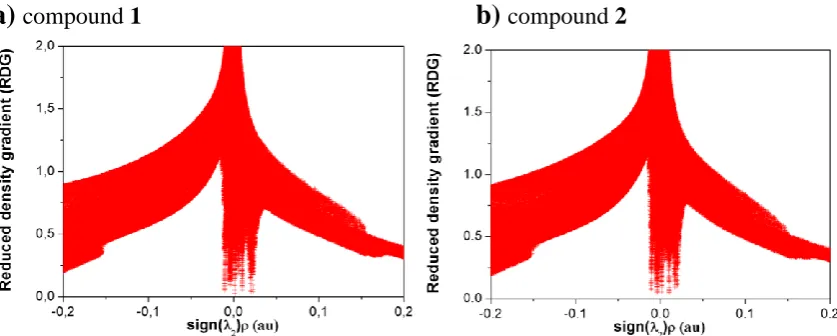
a)
compound 1b)
compound 2Figure 3: Plot of the reduced density grandient (RDG) versus sign(2) for (a)
compound 1 and (b) compound 2 [sign(2) meaning the sign (positive or negative) of
second eigenvalue 2 of the Laplacian of the electron density ]. Downward peaks at
[image:4.595.89.428.214.379.2] [image:4.595.89.508.507.675.2]between the axial F atoms, downward peaks at positive sign(2) values indicate
ring/cage critical point regions.
Both methods indicate not only formation of ...H-C intermolecular interactions
between the cyclohexane and benzene moieties (for details of their QTAIM
characterisation see Table S1 in the ESI), but also intramolecular F...F interactions
within 1 and 2 (also for the free molecules, not shown). Such interactions have attracted much interest and controversy in the literature.11,12 According to our NCI analysis (see
Figure 3) these interactions are classified as attractive.
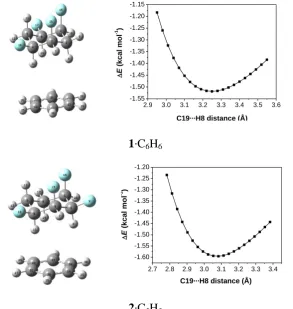
2.9 3.0 3.1 3.2 3.3 3.4 3.5 3.6 -1.55 -1.50 -1.45 -1.40 -1.35 -1.30 -1.25 -1.20 -1.15 E ( k c a l mol -1 )
C19···H8 distance (Å)
1.C6H6
2.7 2.8 2.9 3.0 3.1 3.2 3.3 3.4 -1.60 -1.55 -1.50 -1.45 -1.40 -1.35 -1.30 -1.25 -1.20 E ( k c a l mol -1 )
C19···H8 distance (Å)
2.C6H6
Figure 4: Optimised complexes of 1 and 2 with benzene and interaction energies at the B3LYP/def2-TZVP level.
Solute-solvent interaction potentials were obtained through relaxed scans of salient
distances between aliphatic H and aromatic C atoms in steps of 0.03 Å at the B3LYP
and B97-D levels (B3LYP results shown in Figure 4). The B97-D level was chosen in
addition to the popular B3LYP functional because it was suspected that dispersion
interactions would be very important. Indeed, on going from B3LYP to B97-D the
[image:5.595.152.446.259.569.2]see Figure S1) and is shifted to shorter distances (from ca. 3.1-3.2 Å to ca. 2.6-2.7 Å).
Essentially the same results are obtained when the empirical dispersion corrections13,14
are added as single points to the structures of the B3LYP scan (see B3LYP-D and
B3LYP-D3 data in Figure S1).
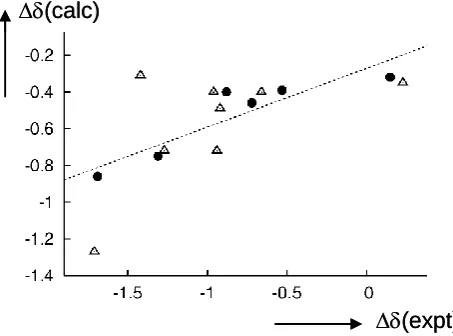
The 1H chemical shifts were calculated both for free molecules 1 and 2 and for their complexes with benzene, using B3LYP and B97-D geometries. It was expected that the
difference between the isolated molecules and the benzene complexes could be related
to the observed solvent shifts on going from CH2Cl2 to toluene. In fact the results for
both sets of structures (B3LYP and B97-D) follow the observed trends reasonably well
in a qualitative sense, in particular for compound 1, where the relative order shifts of the individual signals is well reproduced (see filled circles in the plot in Figure 5).
Interestingly the shifts calculated for the B3LYP structures afforded a slightly better
qualitative agreement with experiment (compare the values in Table 1) than those
calculated for the tighter B97-D minima (Tables S2-S5). For the latter, individual
deviations between modeled and observed solvent shifts can reach up to ca. 2 ppm (e.g.
for H8 in compound 2, Table S5).
(expt)
(calc)
(expt)
(calc)
Figure 5: Plot of calculated shifts in 1H resonances upon complex formation with benzene vs. observed shift differences on going from CH2Cl2 to toluene solutions (in
ppm); filled circles: compound 1, open triangles: compound 2.
[image:6.595.95.322.443.611.2]to the molecular plane. It is thus the hydrogen atoms lying in the positive molecular
ESP area, i.e., atoms H8, H11 and H14, which experience the highest shielding effect,
since these interact strongly with the solvent and, hence, are closer to the shielding cone
of the aromatic rings. As mentioned above, when dispersion corrections are included in
calculating the alkane-arene interaction energies (either via B3LYP-D3 single points or
at the B97-D level), the minima in Figure 4 deepen and shift to lower distances (Figure
S1). The chemical shifts are sensitive to this distance and deteriorate noticeably for such
dispersion-corrected minima. Apparently B3LYP (which describes the leading
electrostatic contributions correctly) affords reasonable models for averaged (rather than
equilibrium) structures in these cases.
For a more quantitative description, one would have to include more solvent
molecules and model their time-averaged effect on the solute shifts, e.g. by way of
molecular dynamics simulations. That our simple theoretical model can already capture
a large part of the observed effect can be taken as evidence for a predominance of
solute-solvent complexes like those in Figure 2 in the dynamic ensemble in solution.
Note that the observed pattern in the solvent shifts is due to ring-current effects in such
solute-solvent complexes, rather than to bulk solvation effects. This is demonstrated by
repeating the NMR calculations for the monomer immersed in a polarisable continuum
(PCM) modeling benzene. Relative to the gas phase results, the obtained NMR
chemical shifts are deshielded rather uniformly without distinguishing protons from
either face (by ca. 0.3 ppm and 0.2 ppm for 1 and 2, respectively, see Table S6).
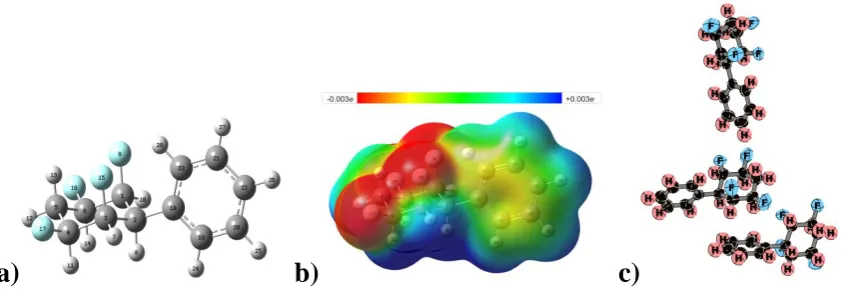
a)
b)
c)
[image:7.595.87.510.529.676.2]arrangement; note the interaction between the “negative face” of the central cyclohexane ring with another phenyl group from the upper molecule in a perpendicular arrangement.
Recently the synthesis and structure of all-syn -3-phenyl-1,2,4,5-tetrafluorocyclohexane (3) was reported.5 This compound is an analogue of 1, which was also proposed as a new structural motif for liquid crystals. This compound turns out
to be a good model to analyze the complexation of 1 with aromatic groups, since it was possible to obtain the X-ray structure for 3 and it was observed that the phenyl groups interact with the “positive face” of cyclohexane rings in neighboring molecules in
almost the same geometry we have obtained for 1 (Figure 6c).
Comparing the observed intermolecular cyclohexane-arene distance in 3 (C...H 3.46 Å) with that in 1.C6H6, the B3LYP-optimised values for the latter are closer (ca.
3.25 Å, left part of Figure 2) than the B97-D data (ca. 2.71 Å, left part in Figure S1). To
probe whether the apparent good performance of B3LYP holds for the intermolecular
interactions in 3 as well, we optimised the full molecular crystal employing the recently developed QM/MM protocol by Björnsson and Bühl (see Computational Details)16
together with a variety of standard functionals with and without explicit dispersion
corrections. Key interatomic distances obtained by each method and from experiment
are shown in Tables S7-S8 in the ESI. Compared to pristine 1.C6H6 in the gas phase,
inclusion of dispersion corrections has a much smaller effect on the intermolecular
distances in solid 3. For example, on going from B3LYP/def2-TZVP to B3LYP-D3/def2-TZVP, most intermolecular distances between the cyclohexane and the
neighboring phenyl moieties decrease slightly, by less than 0.03 Å (see C...C distances
in Table S8), i.e. by much less than for the pristine benzene complexes 1.C6H6 and
2.C6H6 discussed above. Overall, the B3LYP/def2-TZVP level performs best in
reproducing the structure in the solid, as judged by the root-mean-square deviation
(RMSD) between the optimised and observed coordinates of all C and F atoms in the
trimeric QM region (ca. 0.04 Å, Figure 7a). All other level/basis-set combinations
(including dispersion-corrected functionals) afford slightly higher RMSDs, up to ca.
The effect of the crystal environment on the relative orientation of the molecular
interactions can be probed by relaxing a section, e.g. the trimer shown in Figure 7a, in
the gas phase. As can be seen in Figure 7b, the B3LYP/def2-TZVP minimum of this
trimer in the gas phase is noticeably distorted from that in the crystal.
a)
b)
[image:9.595.86.392.182.392.2]RMSD = 0.036 RMSD = 1.207
Figure 7: Superposition of a section of the experimental crystal structure of compound
3 (grey/light blue) with (a) the same section from the QM/MM optimised crystal (black/dark blue) and (b) gas phase calculated geometries (B3LYP/def2-TZVP; black/dark blue), including root-mean-square deviation between both (RMSD, in Å).
Table 2: Theoretical [BHandH/6-311+G(2d,p)] 1H isotropic magnetic shieldings (σ) and chemical shifts (δ) in ppm for free monomeric 3 and for the central molecule in the QM trimer within the QM/MM optimised crystal of 3 (B3LYP/def2-TZVP), together with experimental data in solution (atom numbering as in Figure 6).
Hydrogen monomer) (monomer)[a] complex) (complex) [a] (CDCl3)
Experimental
H7,H10 26.04 5.58 26.44 5.18 -0.40 5.05
H8 29.00 2.62 29.16 2.46 -0.16 2.63
H11,H14 26.79 4.83 28.65 2.97 -1.86 4.62
H12 28.80 2.82 29.31 2.31 -0.51 2.81
H13 28.13 3.49 29.44 2.18 -1.31 2.51
[a]
δ = σTMS (31.62 ppm) - σH
1
[image:9.595.83.514.572.672.2](B3LYP/def2-TZVP QM/MM geometries, Table 2). The data for the trimer are in good
agreement with those of compound 1 complexed with benzene (compare values in Tables 1 and 2). Also, the computed trends upon complex formation for compound 3
are similar for that obtained for compound 1. The 1H NMR chemical shift calculations for monomeric 3 also agree with the experimental values obtained in CDCl3 (Table 2).
These findings confirm that, as expected, the intermolecular contacts seen in the crystal
are all lost upon dissolution in CDCl3 (i.e. no smaller aggregates are preserved). The
values between monomer and complex in Table 2 can serve as predictions for the
expected solution-to-solid shifts once solid-state NMR studies of compound 3 become available.
Conclusion
Overall, simple theoretical models can rationalise the experimentally observed
chemical shift values in toluene solution for the compounds 1 and 2. The leading contribution is indicated to arise from close contact between an aromatic ring from the
solvent and the "positive face" of the cyclohexane ring opposite to the fluorine
substituents. The qualitative trends are reproduced for simple complexes between 1 or 2
and a single benzene molecule at the B3LYP level, i.e. even without inclusion of
dispersion corrections. This level has also been validated using a recently developed
QM/MM protocol for the optimisation of molecular crystals, where excellent agreement
was found between the B3LYP-computed and the observed crystal structure for the new
compound 3, which is governed by such intermolecular cyclohexane...arene interactions. The attractive nature of these interactions is also apparent in a recently
proposed analysis based on the Quantum Theory of Atoms in Molecules approach,
namely the Non-Covalent Interactions (NCI) method.
Computational Details
integral equation formalism variant, IEF-PCM),18 using the parameters of benzene (dielectric constant 2.27). The QTAIM and NCI methods were carried out by using the AIMALL19 and NCIPLOT20 programs, respectively, on the B3LYP/def2-TZVP obtained electron densities.
The QM/MM protocol16 for optimising the crystal structure of 3 was carried out by using the Chemshell21 program linked to ORCA22 program and adapted as follows: A cluster with a radius of 42 Å (containing 33,880 atoms/1210 molecules) was taken from the experimental crystal structure. Atomic charges from natural population analysis (NPA) for a free molecule 3 were obtained at a variety of DFT levels (different functional were used in the present work; see below) and were assigned to all other molecules of the built cluster. Surface charges were added on the boundaries of the cluster in order to emulate the remaining, infinite periodic system. The NPA charges were then refined self-consistently in a series of QM/MM single-point calculations for a single molecule 3 electrostatically embedded in the surrounding MM point charges (cluster and the cluster boundary charges were updated in each cycle self-consistently until the charges changed by less than 0.0001 au). Assigning van der Waals parameters from the UFF force field to all atoms in the cluster (to derive 6-12 Lennard-Jones potentials for all atom pairs), the NPA charges were refined again through a series of QM/MM geometry optimizations where only the central molecule was included in the QM region, while all other MM molecules were kept frozen. Finally the QM region was enlarged to encompass the central molecule and two neighboring molecules (affording a trimer as shown in Figure 6c) and QM/MM optimisations were carried out using the self-consistent charges determined previously. These calculations used BP86, B3LYP, revPBE23 and PW6B9524 functionals with and without Grimme dispersion corrections (DFT-D3)13,14 and with the def2-SVP and def2-TZVP basis sets.8 1H NMR chemical shifts were calculated at the BHandH/6-311+G(2d,p) level for the B3LYP/def2TZVP-optimised trimer, embedded in the array of MM point charges (reported for the central molecule only). Relaxation of the QM region containing the trimer in the gas phase started from the QM/MM-optimised coordinates using ORCA.
Acknowledgements
The authors thank a Grant # 2012/03933-5, São Paulo Research Foundation (FAPESP)
for providing financial support for this research, for a scholarship [to RAC
#2011/01170-1, FAPESP). CNPq is also gratefully acknowledged for a fellowship (to RR) and a studentship (to RAC). We thank the Royal Society (Wolfson Merit Award
for DO'H) and EaStCHEM (support for MB and access to a computing facility
References
1 D. O’Hagan Chem. Soc. Rev.2008, 37, 308.
2 R. Berger, G. Resnati, P. Metrangolo, E. Weberd, J. Hulliger Chem. Soc. Rev.2011,
40, 3496.
3 A. J. Durie, A. M. Z. Alexandra, T. Lebl, P. Kirsch, D. O'Hagan Chem. Commun.
2011, 47, 8265.
4 A. J. Durie, A. M. Z. Slwein, T. Lebl, P. Kirsch, D. O'Hagan Chem. Commun.2012,
48, 9643.
5 A. J. Durie, T. Fujiwara, R. Cormanich, M. Bühl, A. M. Z. Slawin, D. O'Hagan,
Chem. Eur. J., submitted (see Supporting Information for Review). 6 See e.g.: E. M. Engler, P. Laszlo J. Am. Chem. Soc.1971, 93, 1317.
7 Benzene was used as model because it has very similar electronic properties as toluene, but lacks the conformational complexity in an adduct (i.e. relative positions of the additional Me group and the F atoms in the cyclohexane).
8 F. Weigend, R. Ahlrichs Phys. Chem. Chem. Phys. 2005, 7, 3297.
9 R. F. W. Bader, Atoms in Molecules: A Quantum Theory, Clarendon, Oxford, 1990. 10 E. Johnson, S. Keinan, P. Mori-Sánchez, J. Contreras-García, A. Cohen, W. Yang
J. Am. Chem. Soc.2010, 132, 6498.
11 T. V. Rybalova, I. Yu. Bagryanskaya J. Struct. Chem.2009, 50, 741.
12 R. M. Osuna, V. Hernández, J. T. L. Navarrete, E. D’Oria, J. J. Novoa Theor. Chem. Acc.2011, 128, 541.
13 S. Grimme, S. Ehrlich, L. Goerigk J. Comput. Chem.2011, 32, 1456.
14 S. Grimme, J. Antony, S. Ehrlich, H. Krieg J. Chem. Phys.2010, 132, 154104. 15 P. Lazzeretti, Prog. NMR Spectr. 2000, 36, 1.
16 R. Björnsson, M. Bühl J. Chem. Theory Comput.2012,8, 498.
E. Stratmann, O. Yazyev, A. J. Austin, R. Cammi, C. Pomelli, J. W. Ochterski, R. L. Martin, K. Morokuma, V. G. Zakrzewski, G. A. Voth, P. Salvador, J. J. Dannenberg, S. Dapprich, A. D. Daniels, O. Farkas, J. B. Foresman, J. V. Ortiz, J. Cioslowski, and D. J. Fox, Gaussian, Inc., Wallingford CT, 2009.
18 G. Scalmani, M. J. Frisch, J. Chem. Phys., 2010, 132, 114110. 19 A. K. Todd, AIMAll (Version 13.05.06), 2013 (aim.tkgristmill.com).
20 J. Contreras-García, E. R. Johnson, S. Keinan, R. Chaudret, J.-P. Piquemal, D. N. Beratan, W. Yang J. Chem. Theor. Comput.2011, 7,625.
21 ChemShell, a Computational Chemistry Shell, see www.chemshell.org.
22 F. Neese, ORCA; University of Bonn: Bonn, Germany, 2010. http://www.thch.uni-bonn.de/tc/orca.
23 Y. Zhang, W. Yang Phys. Rev. Lett.1998, 80, 890.
Table of Contents Graphic
F
F
F
F
C C
C C
C C
non-convalent interactions
ring-current effect on (1H)
F
F
F
F
C C
C C
C C
non-convalent interactions
![Figure 1: Optimised structures, electrostatic potentials (ESPs) and dipole moments of 1 and 2 [B3LYP/def2-TZVP]](https://thumb-us.123doks.com/thumbv2/123dok_us/8675618.377512/3.595.84.526.175.411/figure-optimised-structures-electrostatic-potentials-esps-dipole-moments.webp)
![Table 2: Theoretical [BHandH/6-311+G(2d,p)] 1H isotropic magnetic shieldings (σ) and chemical shifts (δ) in ppm for free monomeric 3 and for the central molecule in the QM trimer within the QM/MM optimised crystal of 3 (B3LYP/def2-TZVP), together with expe](https://thumb-us.123doks.com/thumbv2/123dok_us/8675618.377512/9.595.86.392.182.392/theoretical-isotropic-magnetic-shieldings-chemical-monomeric-molecule-optimised.webp)
