902
SherLIiC: A Typed Event-Focused Lexical Inference Benchmark for
Evaluating Natural Language Inference
Martin Schmitt and Hinrich Sch ¨utze
Center for Information and Language Processing (CIS) LMU Munich, Germany
Abstract
We present SherLIiC,1a testbed for lexical in-ference in context (LIiC), consisting of 3985 manually annotatedinference rule candidates
(InfCands), accompanied by (i) ~960k un-labeled InfCands, and (ii) ~190k typed tex-tual relations between Freebase entities ex-tracted from the large entity-linked corpus ClueWeb09. Each InfCand consists of one of these relations, expressed as a lemmatized de-pendency path, and two argument placehold-ers, each linked to one or more Freebase types. Due to our candidate selection process based on strong distributional evidence, SherLIiC is much harder than existing testbeds because distributional evidence is of little utility in the classification of InfCands. We also show that, due to its construction, many of SherLIiC’s correct InfCands are novel and missing from existing rule bases. We evaluate a number of strong baselines on SherLIiC, ranging from se-mantic vector space models to state of the art neural models of natural language inference (NLI). We show that SherLIiC poses a tough challenge to existing NLI systems.
1 Introduction
Lexical inference (LI) can be seen as a focused variant of natural language inference (NLI), also called recognizing textual entailment (Dagan et al.,
2013). Recently,Gururangan et al.(2018) showed that annotation artifacts in current NLI testbeds distort our impression of the performance of state of the art systems, giving rise to the need for new evaluation methods for NLI.Glockner et al.(2018) investigated LI as a way of evaluating NLI systems and found that even simple cases are challenging to current systems. In this paper, we release SherLIiC, a testbed specifically designed for evaluating a sys-tem’s ability to solve the hard problem of modeling lexical entailment in context.
1https://github.com/mnschmit/SherLIiC
(1) troponymy ORGF[A] is granting toEMPL[B]
⇒ORGF[A] is giving toEMPL[B]
(2) synonymy + ORGF[A] is supporter ofORGF[B] derivation ⇒ORGF[A] is backingORGF[B]
(3) typical AUTH[A] is president ofLOC[B] actions ⇒AUTH[A] is representingLOC[B]
(4) script PER[A] is interviewingAUTH[B] knowledge ⇒PER[A] is askingAUTH[B]
(5) common sense ORGF[A] claimsLOC[B] knowledge ⇒ORGF[A] is wantingLOC[B]
Table 1: Examples of SherLIiC InfCands and NLI challenges they cover. ORGF=organization founder, EMPL=employer, AUTH=book author, LOC=location, POL=politician,PER=person.
Levy and Dagan (2016) identified context-sensitive – as opposed to “context-free” – entail-ment as an important evaluation criterion and cre-ated a dataset for LI in context (LIiC). In their data, WordNet (Miller,1995;Fellbaum,2005) synsets serve as context for one side of a binary relation, but the other side is still instantiated with a sin-gle concrete expression. We aim to improve this setting in two ways.
First, we type our relations onboth sides, thus making them more general. Types provide a con-text that can help in disambiguation and at the same time allow generalization over contexts because ar-guments of the same type are represented abstractly. An example for the need for disambiguation is the verb “run”. “run” entails “lead” in the context of
PERSON/COMPANY(“Bezos runs Amazon”). But in the context ofCOMPUTER/SOFTWARE, “run” entails “execute”/“use” (“my mac runs macOS”). Here, types help find the right interpretation.
Second, we only consider relations between named entities(NEs). Inference mining based on non-NE types such as WordNet synsets (e.g.,ANI
on NEs makes it more likely that we will capture eventslike “Walmart closes gap with Amazon” and thus knowledge about event entailment like [“A
is closing gap withB”⇒“Bis having lead over
A”] that is substantially different from knowledge about general facts.
In more detail, we create SherLIiC as follows. First, we extract verbal relations between Freebase (Bollacker et al., 2008) entities from the entity-linked web corpus ClueWeb09 (Gabrilovich et al.,
2013).2We then divide these relations into typable subrelations based on the most frequent Freebase types found in their extensions. We then create a large set of inference rule candidates (InfCands), i.e., premise-hypothesis-pairs of verbally expressed relations. Finally, we use Amazon Mechanical Turk to classify each InfCand in a randomly sampled subset asentailmentornon-entailment.
In summary, our contributions are the follow-ing: (1) We create SherLIiC, a new resource for LIiC, consisting of 3985 manually annotated Inf-Cands. Additionally, we provide ~960k unlabeled InfCands (SherLIiC-InfCands), and the typed event graph SherLIiC-TEG, containing ~190k typed tex-tual binary relations between Freebase entities. (2) SherLIiC is harder than existing testbeds be-cause distributional evidence is of limited utility in the classification of InfCands. Thus, SherLIiC is a promising and challenging resource for devel-oping NLI systems that go beyond shallow seman-tics. (3) Human-interpretable knowledge graph types serve as context for both sides of InfCands. This makes InfCands more general and boosts the number of event-like relations in SherLIiC. (4) SherLIiC is complementary to existing collec-tions of inference rules as evidenced by the low recall these resources achieve (cf.Table 3). (5) We evaluate a large number of baselines on SherLIiC. The best-performing baseline makes use of typing. (6) We demonstrate that existing NLI systems do poorly on SherLIiC.
2 Generation of InfCands
This section describes creation (§ 2.1) and typing (§ 2.2) of the typed event graph SherLIiC-TEG and then the generation of SherLIiC-InfCands (§ 2.3).
2.1 Relation Extraction
For each sentence sin ClueWeb09 that contains at least two entity mentions, we use MaltParser
2http://lemurproject.org/clueweb09
(Nivre et al.,2007) to generate a dependency graph, where nodes are labeled with their lemmas and edges with dependency types. We take all shortest paths between all combinations of two entities ins
and represent them by alternating edge and node la-bels. As we want to focus on relations that express events, we only keep paths with a nominal subject on one end. We also apply heuristics to filter out erroneous parses. SeeAppendix Afor heuristics andTable 5for examples of relations.
Notation. Let R denote the set of extracted re-lations. A relation R ∈ R is represented as a set of pairs of Freebase entities (its extension):
R ⊆ E × E, with E the set of Freebase entities. Letπ1, π2be functions that map a pair to its first or second entry, respectively. By abuse of notation, we also apply them to sets of pairs. Finally, letT be the set of Freebase types andτ: E → 2T the function that maps an entity to the set of its types.
2.2 Typing
We define atypable subrelation of R ∈ R as a subrelation whose entities in each argument slot share at least one type, i.e., anS ⊆Rsuch that:
∀i∈ {1,2}:∃t∈ T :t∈ \
e∈πi(S)
τ(e)
We compute the setTypek2(R)of the (up to) k2 largest typable subrelations ofRand use them in-stead ofR. First, for each argument slotiof the binary relationR, thektypestij(with1≤j ≤k) are computed that occur most often in this slot:
tij := arg max
t
p∈R |t∈τji(πi(p))
with
τ1i(e) =τ(e)
τji+1(e) =τji(e)−
tij
Then, for each pair
(s, u)∈
t1j, t2l|j, l∈ {1, . . . , k}
of these types, we construct a subrelation
Rs,u:={(e1, e2)∈R|s∈τ(e1), u∈τ(e2)}
The type signature (tsg) of a typed relationTis defined as the pair of sets of types that is common to first (resp. second) entities in the extension:
tsg(T) =
\
e∈π1(T)
τ(e), \
e∈π2(T)
τ(e)
Incomplete type information. Like all large knowledge bases, Freebase suffers from incom-pleteness: Many entities have no type. To avoid losing information about relations associated with such entities, we introduce a special type>and definearg maxt|∅|:=>. We define the relations
Rs,>,R>,uandR>,>to have no type restriction on
entities in a>slot. This concerns approximately 17.6% of the relations in SherLIiC-TEG.
2.3 Entailment Discovery
Our discovery procedure is based on Sherlock (Schoenmackers et al., 2010). For the InfCand
A⇒B(A, B∈ R), we define the relevance score Relv, a metric expressing Sherlock’s stat. relevance criterionP(B|A)P(B)(cf.Salmon,1971).
Relv(A, B) := P(B|A)
P(B) =
|A∩B| |E × E| |A| |B|
Our significance scoreσ(A, B)is a scaled version of the significance testlrsused by Sherlock:
P(B |A) lrs(A, B) = |A∩B|lrs(A, B) |A|
withlrs(A, B)(likelihood ratio statistic) defined as
2|A| X
H∈{B,¬B}
P(H |A) log(Relv(A, H)).
Additionally, we introduce theentity support ratio:
esr(A, B) :=
S
i∈{1,2}πi(A∩B)
2|A∩B|
This score measures the diversity of entities in
A ∩B. We found that many InfCands involve a few frequent entities and so obtain highRelvand
σscores even though the relations of the rule are se-mantically unrelated.esrpenalizes such InfCands. We apply our three scores defined above to all possible pairs of relations(A, B) ∈ R × Rand accept a rule iff all of the following criteria are met:
1. ∀i∈ {1,2}:πi(tsg(A⇒B))6=∅
2. |A∩B| ≥rmin
Fact: location[B] is annexing location[A] .
Examples for location[B]:Russia / USA / Indonesia Examples for location[A]:Cuba / Algeria / Crimea
fact incomprehensible
Please answer the following questions:
Is it certain that location[B] is taking control of location[A]? yes no incomprehensible
Is it certain that location[B] is taking location[A]? yes no incomprehensible
Is it certain that location[B] is bordered by location[A]? yes no incomprehensible
Figure 1: Annotation Interface on Amazon MTurk
3. ∀i∈ {1,2}:|πi(A∩B)| ≥rmin
4. Relv(A, B)≥ϑrelv
5. σ(A, B)≥ϑσ
6. esr(A, B)≥ϑesr
wheretsg(A ⇒ B)is component-wise intersec-tion of tsg(A) and tsg(B) and ϑrelv = 1000,
ϑσ = 15,ϑesr = 0.6. We found these numbers by randomly sampling InfCands and inspecting their scores. Typing lets us set these thresholds higher, benefitting the quality of SherLIiC-InfCands.
Lastly, we applySchoenmackers et al.(2010)’s heuristic to only accept the 100 best-scoring premises for each hypothesis. For each hypothesis
B, we rank all possible premisesAby the product of the three scores and filter out cases whereAand
Bonly differ in their types.
3 Crowdsourced Annotation
SherLIiC-InfCands contains ~960k InfCands. We take a random sample of size 5267 and annotate it using Amazon Mechanical Turk (MTurk).
3.1 Task Formulation
We are asking our workers the same kind of ques-tions asLevy and Dagan(2016) did. We likewise form batches of sentence pairs to reduce annota-tion cost. Instead of framing the task as judging the appropriateness of answers, however, we state the premise as a fact and ask workers about its en-tailed consequences, i.e., we ask for each candidate hypothesis whether it iscertainthat it is also true.
Annotated Subset of SherLIiC-InfCands
Validated InfCands 3985
Balance yes/no 33% / 67%
Pairs with unanimous gold label 53.0% Pairs with 1 disagreeing annotation 27.4% Pairs with 2 disagreeing annotations 19.6% Individual label = gold label 86.7%
Table 2: Statistics for crowd-annotated InfCands. The gold label is the majority label.
We put premise and hypothesis in the present (progressive if suitable) based on the intuition that a pair is only to be considered an entailment if the premise makes it necessary for the hypothesis to be trueat the same time. This condition of simultane-ity follows the tradition of datasets such as SNLI (Bowman et al.,2015) – in contrast to more lenient evaluation schemes that consider a rule to be cor-rect if the hypothesis is true at any time before or after the reference time of the premise (cf.Lin and Pantel,2001;Lewis and Steedman,2013).
3.2 Annotation Quality
We imposed several qualification criteria on crowd workers: number of previous jobs on MTurk, over-all acceptance rate and a test that each worker had to pass. Some workers still had frequent low agree-ment with the majority. However, in most cases we obtained a clear majority annotation. These annotations were then used to automatically detect workers with lowtrust, wheretrustis defined as the ratio of submissions agreeing with the majority answer and a worker’s total number of submissions. We excluded workers with atrustof less than0.8 and collected replacement annotations until we had at least five annotations per InfCand.
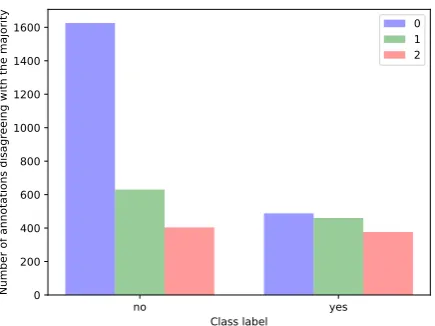
Table 2shows that workers agreed unanimously for 53% and that the maximal number of two dis-agreements only occurs for 19.6%. The high num-ber of times an individual agrees with the gold label suggests that humans can do the task reliably. Inter-estingly, the number of disagreements is not evenly distributed among the two classes entailment/non-entailment. If the majority agrees onentailment, it is comparatively much more likely that at least one of the workers disagrees (cf.Fig. 2). This suggests that our workers were strict and keen on achieving high precision in their annotations.
4 Baselines
We split our annotated data 25:75 into SherLIiC-dev and SherLIiC-test, stratifying on annotated
la-no yes
Class label 0
200 400 600 800 1000 1200 1400 1600
Number of annotations disagreeing with the majority
[image:4.595.308.526.60.223.2]0 1 2
Figure 2: Number of disagreements per class label on all annotations.
bel (yes/no) and number of disagreements with the majority (0/1/2). If unanimity of annotations marks particularly clear cases, we figure they should be evenly distributed on dev and test.
To establish the state of the art for SherLIiC, we evaluate a number of baselines. Input to these baselines are either the dependency paths or the sentences that were presented to the crowd workers. Baselines that require a threshold to be used as binary classifiers are tuned on SherLIiC-dev.
Lemma baseline. Following Levy and Dagan
(2016), this baseline classifies an InfCand as valid if the following holds true for the premisepand hypothesish after lemmatization: (1)p contains all ofh’s content words,3(2)p’s andh’s predicates are identical, and (3) the relations’ active/passive voice matches their arguments’ alignment.
Rule collection baselines. Berant I (Berant et al., 2011) and Berant II (Berant, 2012)4 are entailment graphs.PPDBis the largest collec-tion (XXXL) of PPDB 2.0 (Pavlick et al.,2015).5
Pattyis a collection of relational patterns,
con-sisting of ontological types, POS placeholders and words. We use the version extracted from Wikipedia with Freebase types (Nakashole et al.,
2012). Schoenmackers is the rule collection
released bySchoenmackers et al.(2010).Chirps is an ever-growing6predicate paraphrase database extracted via event coreference in news Tweets (Shwartz et al.,2017b).All Rulesdenotes the union of all of these rule bases. For rules with type (or POS) constraints, we ignore these constraints
3We use the stop word list ofnltk(Loper and Bird,2002). 4
We use default threshold 0.
5
We ignore stop words and punctuation for phrases.
to boost recall. We will see that even with these recall-enhancing measures, the majority of our cor-rect InfCands is not covered by existing rule bases.
Word2vec baselines. word2vec is based on
Mikolov et al. (2013b)’s pre-trained word em-beddings of size 300. We average them to ob-tain a vector representation of relations consist-ing of multiple words and use cosine similar-ity to judge a relation pair. typed rel emb (resp.untyped rel emb) is obtained by train-ing word2vec skip-gram (Mikolov et al.,2013a) with vector size 300 and otherwise default param-eters on a synthetic corpus representing the exten-sions of typed (resp. untyped) relations. The corpus is obtained by writing out one entity-relation-entity-triple per line, where each entity is prefixed with the argument slot it belongs to.w2v+typed rel (resp. w2v+untyped rel) produces its score by summing the scores of word2vec and
typed rel emb(resp.untyped rel emb).
Some type signatures (tsgs) benefit more from type-informed methods than others. For example, the correct inference [INFLUENCER
is explaining in WRITTEN WORK ⇒ INFLU
-ENCER is writing in WRITTEN WORK] is detected by w2v+typed rel, but not by
w2v+untyped rel. We therefore combine
these two methods by using, for each tsg, the method that works better for that tsg on dev. (For tsgs not occurring in dev, we take the method that works better for the individual types occurring in the tsg. We use untyped embeddings if all else fails.) We refer to this combination as w2v+tsg rel emb.
Knowledge graph embedding baselines. As SherLIiC-TEG has the structure of a knowledge graph (KG), we also evaluate the two KG embed-ding methodsTransE(Bordes et al.,2013) and
ComplEx(Trouillon et al.,2016), as provided by
the OpenKE framework (Han et al.,2018).
Asymmetric baselines. Entailment models built upon cosine similarity are symmetric whereas en-tailment is not. Therefore many asymmmetric mea-sures based on the distributional inclusion hypoth-esis have been proposed (Kotlerman et al.,2010;
Santus et al.,2014;Shwartz et al.,2017a;Roller et al.,2018). We consider WeedsPrec (Weeds et al.,2004) andinvCL(Lenci and Benotto,2012), which have strong empirical results on hypernym detection. We use cooccurrence counts with entity pairs as distributional representation of a relation.
Supervised NLI models. As LIiC is a special case of NLI, our dataset can also be used to eval-uate the generalization capabilities of supervised models trained on large NLI datasets. We pick ESIM(Chen et al.,2017), a state-of-the-art super-vised NLI model, trained on MultiNLI (Williams et al.,2018) as provided by the framework Jack the Reader (Weissenborn et al., 2018). Input to ESIMare the sentences from the annotation pro-cess with placeholders instantiated by entities ran-domly picked from the example lists that had also been shown to the crowd workers (cf.Fig. 1). As we want to measureESIM’s capacity to detect en-tailment, we map its prediction of bothneutraland contradictionto ournon-entailmentclass.
Sherlock+ESR. We also evaluate the candidate scoring method inspired bySchoenmackers et al.
(2010) that created the data in the first place. We again combine the three scores described in
§ 2 by multiplication. The low performance of
Sherlock+ESR(cf.Table 3) is evidence that the
dataset is not strongly biased in its favor and thus is promising as a general evaluation benchmark.
5 Experimental Results and Discussion
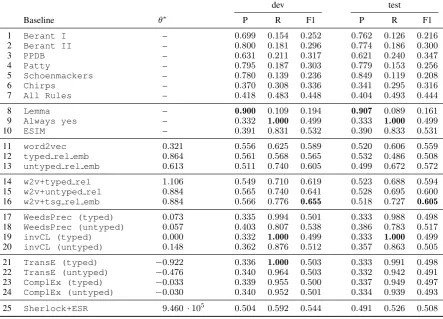
Quantitative observations. Table 3summarizes the performance of our baselines on predicting the entailmentclass for SherLIiC-dev and -test.
Rule collections (lines 1–6) have recall between 0.119 and 0.308; the recall of their union (line 7) is only 0.483 on dev and 0.493 on test, showing that we found indeed new valid inferences missing from existing rule bases.
The state-of-the-art neural modelESIMdoes not generalize well from MultiNLI (its training set) to LIiC. In fact, it hardly improves on the baseline that always predictsentailment(Always yes). Our dataset was specifically designed to only contain good InfCands based on distributional features. So it poses a challenge to models that cannot make the fine semantic distinctions necessary for LIiC.
Turning to vector space models (lines 11–24), dense relation representations (lines 12, 13) predict entailment better than sparse models (lines 17–20) although they cannot use asymmetric measures.
dev test
Baseline θ∗ P R F1 P R F1
1 Berant I – 0.699 0.154 0.252 0.762 0.126 0.216
2 Berant II – 0.800 0.181 0.296 0.774 0.186 0.300
3 PPDB – 0.631 0.211 0.317 0.621 0.240 0.347
4 Patty – 0.795 0.187 0.303 0.779 0.153 0.256
5 Schoenmackers – 0.780 0.139 0.236 0.849 0.119 0.208
6 Chirps – 0.370 0.308 0.336 0.341 0.295 0.316
7 All Rules – 0.418 0.483 0.448 0.404 0.493 0.444
8 Lemma – 0.900 0.109 0.194 0.907 0.089 0.161
9 Always yes – 0.332 1.000 0.499 0.333 1.000 0.499
10 ESIM – 0.391 0.831 0.532 0.390 0.833 0.531
11 word2vec 0.321 0.556 0.625 0.589 0.520 0.606 0.559
12 typed rel emb 0.864 0.561 0.568 0.565 0.532 0.486 0.508
13 untyped rel emb 0.613 0.511 0.740 0.605 0.499 0.672 0.572
14 w2v+typed rel 1.106 0.549 0.710 0.619 0.523 0.688 0.594
15 w2v+untyped rel 0.884 0.565 0.740 0.641 0.528 0.695 0.600
16 w2v+tsg rel emb 0.884 0.566 0.776 0.655 0.518 0.727 0.605
17 WeedsPrec (typed) 0.073 0.335 0.994 0.501 0.333 0.988 0.498
18 WeedsPrec (untyped) 0.057 0.403 0.807 0.538 0.386 0.783 0.517
19 invCL (typed) 0.000 0.332 1.000 0.499 0.333 1.000 0.499
20 invCL (untyped) 0.148 0.362 0.876 0.512 0.357 0.863 0.505
21 TransE (typed) −0.922 0.336 1.000 0.503 0.333 0.991 0.498
22 TransE (untyped) −0.476 0.340 0.964 0.503 0.332 0.942 0.491
23 ComplEx (typed) −0.033 0.339 0.955 0.500 0.337 0.949 0.497
24 ComplEx (untyped) −0.030 0.340 0.952 0.501 0.334 0.939 0.493
[image:6.595.78.522.66.385.2]25 Sherlock+ESR 9.460·105 0.504 0.592 0.544 0.491 0.526 0.508
Table 3: Precision, recall and F1 score on SherLIiC-dev and -test. All baselines run on top ofLemma. Thresholds (θ∗) are F1-optimized on dev. Best result per column is set in bold.
information for the task. These methods were not developed to compare relations; the lack of useful information is still surprising and thus is a promis-ing direction for future work on KG embeddpromis-ings.
General purpose dense representations (word2vec, line 11) perform comparatively well, showing that, in principle, they cover the information necessary for LIiC. Embeddings trained on our relation extensions SherLIiC-TEG (line 13), however, can already alone achieve better performance than word2vec embeddings alone.
In general, type-informed relation embeddings seem to have a disadvantage compared to unre-stricted ones (e.g., cf. lines 12 and 13) – presumably because type-informed baselines have training sets that are smaller (due to filtering) and sparser (since relations are split up according to type signatures). The combination of general word2vec and special-ized relation embeddings (lines 14–16), however, consistently brings gains. This indicates that distri-butional word properties are complementary to the relation extensions our method extracts. So using both sources of information is promising for future research on modeling relational semantics.
w2v+tsg rel emb is the best-performing
method. It combines typed and untyped relation embeddings as well as general-purpose word2vec embeddings. Even though one cannot rely on typed extensions only, this shows that incorporating type information is beneficial for good performance.
We usew2v+tsg rel embto provide a noisy annotation for SherLIiC-InfCands. This is a useful resource because learning from noisy labels has been well studied (Fr´enay and Verleysen, 2014;
Hendrycks et al.,2018) and is often beneficial.
Qualitative observations. Although SherLIiC’s creation is based on the same method that was used to create Schoenmackers, SherLIiC is funda-mentally different for several reasons: (1) The rule sets are complementary (cf. the low recall of0.139 and0.119inTable 3). (2) The majority of rules
inSchoenmackershas more than one premise,
be-(1) PERSON⇒ [A] isREGION[B]’s ruler
PERSON[A] is dictator ofREGION[B]
(2) LOCATION[A] is fighting withORGF[B]
⇒LOCATION[A] is allied withORGF[B]
(3) ORGF[A] is coming intoLOCATION[B]
⇒ORGF[A] is remaining inLOCATION[B]
(4) ORGF[A] is seeking fromORGF[B]
⇒ORGF[B] is giving toORGF[A]
(5) LOCATION[A] is winning war againstLOCATION[B]
[image:7.595.306.525.59.437.2]⇒LOCATION[A] is declaring war onLOCATION[B]
Table 4: False positives for each of the three best-performing baselines taken from SherLIiC-dev. ORGF=organization founder.
cause the performance ofAlways yeswould be close to 100%. (4) SherLIiC is focused on events. When linking the relations from SherLIiC-TEG back to their surface forms in the corpus, 80% of them occur at least once in the progressive, which suggests that the large majority of our relations indeed represent events.
Taking a closer look at SherLIiC, we see that the data require a large variety of lexical knowl-edge even though their creation has been entirely automatic. Table 1shows five positively labeled examples from SherLIiC-dev, each highlighting a different challenge for statistical models that is crucial for NLI. (1) is an instance oftroponymy: “granting” is a manner or kind of “giving”. This is the verbal equivalent to nominal hyponymy. (2) combines synonymy (“support”⇔ “back”) with morph. derivation. (3) can only be classified cor-rectly if one knows that it is one of the typical actions of a president to represent their country. (4) requires knowledge about the typical course of events when interviewing someone. A typical interview involves asking questions. (5) can only be detected with common sense knowledge that goes even beyond that: you generally only claim something if you want it.
An error analysis of the three best-performing baselines (lines 14–16 inTable 3) reveals that none of them was able to detect the five correct InfCands fromTable 1. Explicit modeling of one of the phe-nomena described above seems a promising direc-tion for future research to improve recall. Table 4
shows five cases where InfCands were incorrectly labeled as entailment. (1) shows the importance of modeling directionality: every “dictator” is a “ruler” but not vice versa. (2) shows a well-known problem in representation learning from
cooccur-nsubj–X–prep–of–obj ⇔ nsubj–X–poss
A is anallyof B A is B’sally
nsubj–X–prep–in–obj ⇔ nsubj–X–poss
A is thecapitalin B A is B’scapital
nsubjpass–X–prep–by–obj ⇔ obj–X–nsubj
A isfollowedby B BfollowsA
nsubj–one–prep–of–obj–X–obj ⇔ nsubj–X–obj A is one of thecountries inB A is acountry inB nsubj–capital–conj–X–obj ⇒ nsubj–X–obj A is the capital and biggestcity inB A is acity inB
nsubj–Xer–prep–of–obj ⇔ nsubj–X–obj
A is ateacher of B AteachesB
nsubj–co-Xer–prep–of–obj ⇒ nsubj–X–obj
A is a co-founder of B AfoundsB
nsubj–reX–obj ⇒ nsubj–X–obj
A rewritesB AwritesB
nsubj–overX–obj ⇒ nsubj–X–obj
A overtakesB AtakesB
nsubj–agree–xcomp–X–obj ⇒ nsubj–X–obj
A agrees tobuyB AbuysB
nsubjpass–force–xcomp–X–obj ⇒ nsubj–X–obj
A is forced toleaveB AleavesB
nsubjpass–elect–xcomp–X–obj ⇔ nsubj–X–obj A is elected to begovernorof B A isgovernorof B nsubj–go–xcomp–X–obj ⇒ nsubj–X–obj
A is going tobeatB AbeatsB
nsubj–try–xcomp–X–obj ⇒ nsubj–X–obj
A tries tocompetewith B Acompeteswith B
nsubj–decide–xcomp–X–obj ⇒ nsubj–X–obj
A decides tomove toB Amoves toB
nsubjpass–expect–xcomp–X–obj ⇒ nsubj–X–obj
A is expected tovisitB AvisitsB
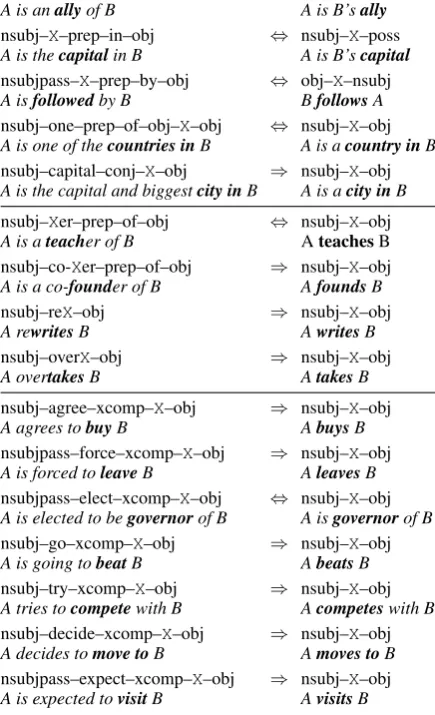
Table 5: Most frequent meta rules (top), character level meta rules (middle), and implicative verb meta rules (bottom). Bold: Words corresponding toX.
rence: antonyms tend to be close in the embed-ding space (Mohammad et al.,2008;Mrkˇsi´c et al.,
2016). The other examples show other types of correlation that models relying entirely on distri-butional information will fall for: the outcome of events like “coming into a country” or “seeking something from someone” are in general uncertain although possible outcomes like “remaining in said country” (3) or “being given the object of desire” (4) will be highly correlated with them. Finally, better models will also take into account the simul-taneity constraint: “winning a war” and “declaring a war” (5) rarely happen at the same time.
6 Meta Rules and Implicative Verbs
[image:7.595.307.525.72.430.2]to be useful for domain adaptation, representation learning and other techniques when working on LIiC. It can also be investigated on its own in a purely unsupervised fashion as we will show now. We can find easily interpretable patterns by look-ing for cases where premise and hypothesis of an InfCand have common parts. By masking these parts (X), we can abstract away from concrete in-stances and interesting meta rules emerge (Table 5). The most common patterns represent reasonable equivalent formulations, e.g., active/passive voice or “beY’sX⇔beXofY” (thein-variant coming from a lot of location-typed rule instances). The fifth most frequent pattern could still be formulated in an even more abstract way but shows already that the general principle of a conjunctionY ∧X
implying one of its componentsXcan be learned. If we search for meta rules whoseXis part of a lemma (rather than a longer dependency path), we discover cases of derivational morphology such as agent nouns (e.g.,ruler,leader) and sense preserv-ing verb prefixes (e.g.,re-write,over-react).
Finally, we observe several implicative verbs (verbs that entail their complement clauses) in their typical patternV toX⇒X. A lot of these verbs are not traditional implicatives, but are calledde facto implicativesbyPavlick and Callison-Burch
(2016) – who argue for the importance of data-driven approaches to detecting de facto implica-tives. The meta rule discovery method just de-scribed is such a data-driven approach.
7 Related Work
NLI challenge datasets.A lot of work exists that aims at uncovering weaknesses in state-of-the-art NLI models. Several approaches are based on modifications of popular datasets, such as SNLI or MultiNLI. These modifications range from sim-ple rule-based transformations (Naik et al.,2018) to rewritings generated by genetic algorithms ( Alzan-tot et al., 2018) or adversarial neural networks (Zhao et al.,2018).Lalor et al.(2016) constructed an NLI test set by judging the difficulty of the sen-tence pairs in a small SNLI subset based on crowd-sourced human responses via Item Response The-ory. These works are related as they, too, challenge existing NLI models with new data but orthogonal to ours as their goal is not to measure a model’s knowledge about lexical inference in context.
Glockner et al.(2018) modified SNLI by replac-ing one word from a given sentence by a synonym,
(co-)hyponym, hypernym or antonym to build a test set that requires NLI systems to use lexical knowledge. They rely on WordNet’s lexical taxon-omy. This, however, is difficult for verbs because their semantics depends more on context. Finally,
Glockner et al.(2018)’s dataset has a strong bias forcontradictionwhereas our dataset is specifically designed to contain cases ofentailment.
Our work is more closely related to the dataset byLevy and Dagan(2016), who frame relation en-tailment as the task of judging the appropriateness of candidate answers. Their hypothesis is that an answer is only appropriate if it entails the predi-cate of the question. This is often but by no means always true; certain questions imply additional in-formation. Consider: “Which country annexed country[B]?” The answer candidate “country[A] administers country[B]” might be considered valid, given that it is unlikely that one country annexesB
and another country administers it. The inference administer⇒annex, however, does not hold. Be-cause of these difficulties, we follow the more tra-ditional approach (Zeichner et al.,2012) of asking about consequences of a given fact (the premise).
Relation extraction. Some works ( Schoenmack-ers et al.,2010;Berant,2012;Zeichner et al.,2012) rely on the output from open information extrac-tion systems (Banko et al.,2007;Fader et al.,2011). A more flexible approach is to represent relations as lexicalized paths in dependency graphs (Lin and Pantel, 2001; Szpektor et al., 2004), some-times with semantic postprocessing (Shwartz et al.,
2017b) and/or retransforming into textual patterns (Nakashole et al.,2012). We, too, choose the latter.
Relation typing. Typing relations has become standard in inference mining because of its use-fulness for sense disambiguation (Schoenmackers et al.,2010;Nakashole et al.,2012;Yao et al.,2012;
Lewis and Steedman,2013). Still some resources only provide types for one argument slot of their bi-nary relations (Levy and Dagan,2016) or no types at all (Zeichner et al.,2012;Berant,2012;Shwartz et al.,2017b). Our InfCands are typed in both argu-ment slots, which both facilitates disambiguation and makes them more general.
Schoenmackers et al. (2010) type common nouns based on cooccurrence with class nouns identified by Hearst patterns (Hearst, 1992) and later try to filter out unreasonable typings by us-ing frequency thresholds and PMI. As KG entities are manually labeled with their correct types, we do not need this kind of heuristics. Furthermore, in contrast to this ad-hoc type system, KG types are the result of a KG design process. Notably, Freebase types function as interfaces, i.e., permit type-specific properties to be added, and are thus inherently motivated by relations between entities.
Lexical ontologies, such as WordNet (as used byLevy and Dagan,2016) likewise lack this con-nection between relations and types. Moreover, relations between real-world entities are more of-ten events than relations between common nouns. Thus, in contrast to existing resources that do not restrict relations to KG entities, SherLIiC contains more event-like relations.
Nakashole et al.(2012) also use KG types as con-text for their con-textual patterns. They simply create a new relation for each possible type combination for each entity occurring with a pattern and each possible type of this entity. It is unclear how the combinatorial explosion and the resulting sparsity affects pattern quality. Our approach of succes-sively splitting a typewise heterogenous relation into itsklargest homogenous subrelations aims at finding only the most typical types for an action and our definition of type signature as intersection of all common types avoids unnecessary redundancy.
Entailment candidate collection. Distributional features are a common choice for paraphrase detec-tion and reladetec-tion clustering (Lin and Pantel,2001;
Szpektor et al., 2004; Sekine, 2005; Yao et al.,
2012;Lewis and Steedman,2013).
The two most important alternatives are bilin-gual pivoting (Ganitkevitch et al.,2013) – which identifies identically translated phrases in bilingual corpora – and event coreference in the news (Xu et al., 2014; Zhang et al., 2015; Shwartz et al.,
2017b) – which relies on lexical variability in two articles or headlines referring to the same event. We specifically focus on distributional information for our InfCand collection because current models of lexical semantics are also mainly based on that (e.g.,Grave et al.,2017). Our goal is not to build a resource free of typical mistakes made by distri-butional approaches but to provide a benchmark to study the progress on overcoming them (cf.§ 5).
Another difference to aforementioned works is that we explicitly model unidirectional entailment as opposed to bidirectional synonymy (cf.Table 4, (1)). Here one can distinguish a learning-based approach (Berant, 2012), where an SVM classi-fier with various features is trained on lexical on-tologies like WordNet, followed by the application of global transitivity constrains to enhance consis-tency, and probabilistic models of noisy set inclu-sion in the tradition of the distributional incluinclu-sion hypothesis (Schoenmackers et al.,2010;Nakashole et al.,2012). We adapt Sherlock, an instance of the latter, for its simplicity and effectiveness.
8 Conclusion
We presented SherLIiC, a new challenging testbed for LIiC and NLI, based on typed textual relations between named entities (NEs) from a KG. The restriction to NEs (as opposed to common nouns) allowed us to harness more event-like relations than previous similar collections as these naturally occur more often with NEs. The distributional similar-ity of both positive and negative examples makes SherLIiC a promising benchmark to track future NLI models’ ability to go beyond shallow seman-tics relying primarily on distributional evidence. We showed that existing rule bases are complemen-tary to SherLIiC and that current semantic vector space models as well as SOTA neural NLI mod-els cannot achieve at the same time high precision and high recall on SherLIiC. Although SherLIiC’s creation is entirely data-driven, it shows a large variety of linguistic challenges for NLI, ranging from lexical relations like troponymy, synonymy or morph. derivation to typical actions and common sense knowledge (cf.Table 1). The large unlabeled resources, SherLIiC-InfCands and SherLIiC-TEG, are potentially useful for further linguistic analysis (as we showed in§ 6), as well as for data-driven models of lexical semantics, e.g., techniques such as representation learning and domain adaptation. We hope that SherLIiC will foster better modeling of lexical inference in context as well as progress in NLI in general.
Acknowledgments
References
Moustafa Alzantot, Yash Sharma, Ahmed Elgohary, Bo-Jhang Ho, Mani Srivastava, and Kai-Wei Chang. 2018. Generating natural language adversarial ex-amples. InProceedings of the 2018 Conference on Empirical Methods in Natural Language Processing, pages 2890–2896, Brussels, Belgium. Association for Computational Linguistics.
Michele Banko, Michael J Cafarella, Stephen Soder-land, Matthew Broadhead, and Oren Etzioni. 2007. Open information extraction from the web. InProcs. of IJCAI, volume 7, pages 2670–2676.
Jonathan Berant. 2012. Global Learning of Textual Entailment Graphs. Ph.D. thesis, The Blavatnik School of Computer Science, Raymond and Beverly Sackler Faculty of Exact Sciences, Tel Aviv Univer-sity.
Jonathan Berant, Ido Dagan, and Jacob Goldberger. 2011. Global learning of typed entailment rules. In
Proceedings of the 49th Annual Meeting of the Asso-ciation for Computational Linguistics: Human Lan-guage Technologies - Volume 1, HLT ’11, pages 610– 619, Stroudsburg, PA, USA. Association for Compu-tational Linguistics.
Kurt Bollacker, Colin Evans, Praveen Paritosh, Tim Sturge, and Jamie Taylor. 2008. Freebase: A col-laboratively created graph database for structuring human knowledge. In Proceedings of the 2008 ACM SIGMOD International Conference on Man-agement of Data, SIGMOD ’08, pages 1247–1250, New York, NY, USA.
Antoine Bordes, Nicolas Usunier, Alberto Garcia-Duran, Jason Weston, and Oksana Yakhnenko. 2013. Translating embeddings for modeling multi-relational data. In C. J. C. Burges, L. Bottou, M. Welling, Z. Ghahramani, and K. Q. Weinberger, editors,Advances in Neural Information Processing Systems 26, pages 2787–2795. Curran Associates, Inc.
Samuel R. Bowman, Gabor Angeli, Christopher Potts, and Christopher D. Manning. 2015. A large anno-tated corpus for learning natural language inference. InProceedings of the 2015 Conference on Empirical Methods in Natural Language Processing (EMNLP). Association for Computational Linguistics.
Qian Chen, Xiaodan Zhu, Zhen-Hua Ling, Si Wei, Hui Jiang, and Diana Inkpen. 2017. Enhanced lstm for natural language inference. In Proceedings of the 55th Annual Meeting of the Association for Compu-tational Linguistics (Volume 1: Long Papers), pages 1657–1668. Association for Computational Linguis-tics.
Ido Dagan, Dan Roth, Mark Sammons, and Fabio Mas-simo Zanzotto. 2013. Recognizing textual entail-ment: Models and applications. Morgan & Clay-pool Publishers.
Anthony Fader, Stephen Soderland, and Oren Etzioni. 2011. Identifying relations for open information ex-traction. InProceedings of the 2011 Conference on Empirical Methods in Natural Language Processing, pages 1535–1545, Edinburgh, Scotland, UK. Associ-ation for ComputAssoci-ational Linguistics.
Christiane Fellbaum. 2005. Wordnet and wordnets. In Keith Brown et al., editor, Encyclopedia of Lan-guage and Linguistics, second edition, pages 665– 670. Elsevier, Oxford.
Benoˆıt Fr´enay and Michel Verleysen. 2014. Classifi-cation in the Presence of Label Noise: A Survey.
IEEE TRANSACTIONS ON NEURAL NETWORKS AND LEARNING SYSTEMS, 25(5):845–869.
Evgeniy Gabrilovich, Michael Ringgaard, and Amar-nag Subramanya. 2013. FACC1: Freebase annota-tion of ClueWeb corpora, Version 1 (Release date 2013-06-26, Format version 1, Correction level 0).
Juri Ganitkevitch, Benjamin Van Durme, and Chris Callison-Burch. 2013. PPDB: The paraphrase database. InProceedings of the 2013 Conference of the North American Chapter of the Association for Computational Linguistics: Human Language Tech-nologies, pages 758–764, Atlanta, Georgia. Associa-tion for ComputaAssocia-tional Linguistics.
Max Glockner, Vered Shwartz, and Yoav Goldberg. 2018. Breaking NLI systems with sentences that re-quire simple lexical inferences. InThe 56th Annual Meeting of the Association for Computational Lin-guistics (ACL), Melbourne, Australia.
Edouard Grave, Tomas Mikolov, Armand Joulin, and Piotr Bojanowski. 2017. Bag of tricks for efficient text classification. InEACL (2), pages 427–431. As-sociation for Computational Linguistics.
Suchin Gururangan, Swabha Swayamdipta, Omer Levy, Roy Schwartz, Samuel Bowman, and Noah A. Smith. 2018. Annotation artifacts in natural lan-guage inference data. InProceedings of the 2018 Conference of the North American Chapter of the Association for Computational Linguistics: Human Language Technologies, Volume 2 (Short Papers), pages 107–112. Association for Computational Lin-guistics.
Xu Han, Shulin Cao, Lv Xin, Yankai Lin, Zhiyuan Liu, Maosong Sun, and Juanzi Li. 2018. Openke: An open toolkit for knowledge embedding. In Proceed-ings of EMNLP.
Marti A. Hearst. 1992. Automatic acquisition of hy-ponyms from large text corpora. InProceedings of the 14th Conference on Computational Linguistics - Volume 2, COLING ’92, pages 539–545,
Strouds-burg, PA, USA. Association for Computational Lin-guistics.
In S. Bengio, H. Wallach, H. Larochelle, K. Grau-man, N. Cesa-Bianchi, and R. Garnett, editors, Ad-vances in Neural Information Processing Systems 31, pages 10477–10486. Curran Associates, Inc.
Lili Kotlerman, Ido Dagan, Idan Szpektor, and Maayan Zhitomirsky-geffet. 2010. Directional distributional similarity for lexical inference. Nat. Lang. Eng., 16(4):359–389.
John Lalor, Hao Wu, and hong yu. 2016. Building an evaluation scale using item response theory. In Pro-ceedings of the 2016 Conference on Empirical Meth-ods in Natural Language Processing, pages 648– 657, Austin, Texas. Association for Computational Linguistics.
Alessandro Lenci and Giulia Benotto. 2012. Identi-fying hypernyms in distributional semantic spaces. In*SEM 2012: The First Joint Conference on Lexi-cal and Computational Semantics – Volume 1: Pro-ceedings of the main conference and the shared task, and Volume 2: Proceedings of the Sixth Interna-tional Workshop on Semantic Evaluation (SemEval 2012), pages 75–79, Montr´eal, Canada. Association for Computational Linguistics.
Omer Levy and Ido Dagan. 2016. Annotating relation inference in context via question answering. In Pro-ceedings of the 54th Annual Meeting of the Associ-ation for ComputAssoci-ational Linguistics, ACL 2016, Au-gust 7-12, 2016, Berlin, Germany, Volume 2: Short Papers.
Mike Lewis and Mark Steedman. 2013. Combining distributional and logical semantics. Transactions of the Association for Computational Linguistics, 1:179–192.
Dekang Lin and Patrick Pantel. 2001. DIRT: Discovery of Inference Rules from Text. InProceedings of the Seventh ACM SIGKDD International Conference on Knowledge Discovery and Data Mining (KDD’01), pages 323–328, New York, NY, USA. ACM Press.
Edward Loper and Steven Bird. 2002. Nltk: The natu-ral language toolkit. InIn Proceedings of the ACL Workshop on Effective Tools and Methodologies for Teaching Natural Language Processing and Compu-tational Linguistics. Philadelphia: Association for Computational Linguistics.
Tomas Mikolov, Kai Chen, Greg Corrado, and Jeffrey Dean. 2013a. Efficient estimation of word represen-tations in vector space.CoRR, abs/1301.3781.
Tomas Mikolov, Ilya Sutskever, Kai Chen, Greg S Cor-rado, and Jeff Dean. 2013b. Distributed representa-tions of words and phrases and their composition-ality. In C. J. C. Burges, L. Bottou, M. Welling, Z. Ghahramani, and K. Q. Weinberger, editors, Ad-vances in Neural Information Processing Systems 26, pages 3111–3119. Curran Associates, Inc.
George A. Miller. 1995. Wordnet: A lexical database for english. Commun. ACM, 38(11):39–41.
Saif Mohammad, Bonnie Dorr, and Graeme Hirst. 2008. Computing word-pair antonymy. In Proceed-ings of the 2008 Conference on Empirical Methods in Natural Language Processing, pages 982–991, Honolulu, Hawaii. Association for Computational Linguistics.
Nikola Mrkˇsi´c, Diarmuid ´O S´eaghdha, Blaise Thom-son, Milica Gaˇsi´c, Lina M. Rojas-Barahona, Pei-Hao Su, David Vandyke, Tsung-Hsien Wen, and Steve Young. 2016. Counter-fitting word vectors to linguistic constraints. In Proceedings of the 2016 Conference of the North American Chapter of the Association for Computational Linguistics: Human Language Technologies, pages 142–148, San Diego, California. Association for Computational Linguis-tics.
Aakanksha Naik, Abhilasha Ravichander, Norman Sadeh, Carolyn Rose, and Graham Neubig. 2018.
Stress test evaluation for natural language inference. InProceedings of the 27th International Conference on Computational Linguistics, pages 2340–2353, Santa Fe, New Mexico, USA. Association for Com-putational Linguistics.
Ndapandula Nakashole, Gerhard Weikum, and Fabian Suchanek. 2012. Patty: A taxonomy of relational patterns with semantic types. InProceedings of the 2012 Joint Conference on Empirical Methods in Nat-ural Language Processing and Computational Natu-ral Language Learning, pages 1135–1145, Jeju Is-land, Korea. Association for Computational Linguis-tics.
Joakim Nivre, Johan Hall, Jens Nilsson, Atanas Chanev, G¨uls¸en Eryigit, Sandra K¨ubler, Svetoslav Marinov, and Erwin Marsi. 2007. Maltparser: A language-independent system for data-driven depen-dency parsing. Natural Language Engineering, 13(2):95–135.
Ellie Pavlick and Chris Callison-Burch. 2016. Tense manages to predict implicative behavior in verbs. In Proceedings of the 2016 Conference on Empiri-cal Methods in Natural Language Processing, pages 2225–2229, Austin, Texas. Association for Compu-tational Linguistics.
Ellie Pavlick, Pushpendre Rastogi, Juri Ganitkevitch, Benjamin Van Durme, and Chris Callison-Burch. 2015. Ppdb 2.0: Better paraphrase ranking, fine-grained entailment relations, word embeddings, and style classification. InProceedings of the 53rd An-nual Meeting of the Association for Computational Linguistics and the 7th International Joint Confer-ence on Natural Language Processing (Volume 2: Short Papers), pages 425–430, Beijing, China. As-sociation for Computational Linguistics.
for Computational Linguistics (Volume 2: Short Pa-pers), pages 358–363, Melbourne, Australia. Asso-ciation for Computational Linguistics.
Wesley C Salmon. 1971. Statistical explanation and statistical relevance, volume 69. University of Pitts-burgh Pre.
Enrico Santus, Alessandro Lenci, Qin Lu, and Sabine Schulte im Walde. 2014. Chasing hypernyms in vec-tor spaces with entropy. InProceedings of the 14th Conference of the European Chapter of the Associa-tion for ComputaAssocia-tional Linguistics, volume 2: Short Papers, pages 38–42, Gothenburg, Sweden. Associ-ation for ComputAssoci-ational Linguistics.
Stefan Schoenmackers, Jesse Davis, Oren Etzioni, and Daniel Weld. 2010. Learning first-order horn clauses from web text. InProceedings of the Con-ference on Empirical Methods in Natural Language Processing: 2010, pages 1088–1098.
Satoshi Sekine. 2005.Automatic paraphrase discovery based on context and keywords between NE pairs. InProceedings of the Third International Workshop on Paraphrasing (IWP2005).
Vered Shwartz, Enrico Santus, and Dominik Schlechtweg. 2017a. Hypernyms under siege: Linguistically-motivated artillery for hypernymy detection. In Proceedings of the 15th Conference of the European Chapter of the Association for Computational Linguistics: Volume 1, Long Papers, pages 65–75, Valencia, Spain. Association for Computational Linguistics.
Vered Shwartz, Gabriel Stanovsky, and Ido Dagan. 2017b. Acquiring predicate paraphrases from news tweets. InProceedings of the 6th Joint Conference on Lexical and Computational Semantics (*SEM 2017), pages 155–160, Vancouver, Canada. Associa-tion for ComputaAssocia-tional Linguistics.
Idan Szpektor, Hristo Tanev, Ido Dagan, and Bonaven-tura Coppola. 2004. Scaling web-based acquisition of entailment relations. InProceedings of EMNLP 2004, pages 41–48, Barcelona, Spain. Association for Computational Linguistics.
Th´eo Trouillon, Johannes Welbl, Sebastian Riedel, ´Eric Gaussier, and Guillaume Bouchard. 2016. Complex embeddings for simple link prediction. In Proceed-ings of the 33rd International Conference on Inter-national Conference on Machine Learning - Volume 48, ICML’16, pages 2071–2080.
Julie Weeds, David Weir, and Diana McCarthy. 2004. Characterising measures of lexical distributional similarity. In Proceedings of Coling 2004, pages 1015–1021, Geneva, Switzerland. COLING.
Dirk Weissenborn, Pasquale Minervini, Tim Dettmers, Isabelle Augenstein, Johannes Welbl, Tim Rockt¨aschel, Matko Boˇsnjak, Jeff Mitchell, Thomas Demeester, Pontus Stenetorp, and Sebastian Riedel.
2018.Jack the Reader – A Machine Reading Frame-work. InProceedings of the 56th Annual Meeting of the Association for Computational Linguistics (ACL) System Demonstrations.
Adina Williams, Nikita Nangia, and Samuel Bowman. 2018. A broad-coverage challenge corpus for sen-tence understanding through inference. In Proceed-ings of the 2018 Conference of the North American Chapter of the Association for Computational Lin-guistics: Human Language Technologies, Volume 1 (Long Papers), pages 1112–1122. Association for Computational Linguistics.
XTAG Research Group. 2001. A lexicalized tree ad-joining grammar for english. Technical Report IRCS-01-03, IRCS, University of Pennsylvania.
Wei Xu, Alan Ritter, Chris Callison-Burch, William B. Dolan, and Yangfeng Ji. 2014. Extracting lexically divergent paraphrases from twitter. Transactions of the Association for Computational Linguistics, 2:435–448.
Limin Yao, Sebastian Riedel, and Andrew McCallum. 2012. Unsupervised relation discovery with sense disambiguation. InProceedings of the 50th Annual Meeting of the Association for Computational Lin-guistics: Long Papers - Volume 1, ACL ’12, pages 712–720, Stroudsburg, PA, USA. Association for Computational Linguistics.
Naomi Zeichner, Jonathan Berant, and Ido Dagan. 2012. Crowdsourcing inference-rule evaluation. In
Proceedings of the 50th Annual Meeting of the As-sociation for Computational Linguistics (Volume 2: Short Papers), pages 156–160, Jeju Island, Korea. Association for Computational Linguistics.
Congle Zhang, Stephen Soderland, and Daniel S. Weld. 2015. Exploiting parallel news streams for unsuper-vised event extraction. Transactions of the Associa-tion for ComputaAssocia-tional Linguistics, 3:117–129.
Zhengli Zhao, Dheeru Dua, and Sameer Singh. 2018.
Generating natural adversarial examples. In Interna-tional Conference on Learning Representations.
A Relation Filter Heuristics
In order to be kept as a relation, a dependency path must fulfill all of the following criteria:
1. It starts or ends withnsubjornsubjpass.
2. It starts or ends with one of the following labels:nsubj,nsubjpass,iobj,dobj,
pobj, appos, poss, rcmod, infmod,
partmod.
4. At least one of the presumable lemmas con-tains at least 3 letters.
5. It does not have the same dependency label at both ends.
6. It does not contain any of the following la-bels:parataxis,pcomp,csubj,advcl, ccomp.