Proceedings of the 2019 Conference on Empirical Methods in Natural Language Processing 2495
Addressing Semantic Drift in Question Generation
for Semi-Supervised Question Answering
Shiyue Zhang Mohit Bansal
UNC Chapel Hill
{shiyue, mbansal}@cs.unc.edu
Abstract
Text-based Question Generation (QG) aims at generating natural and relevant questions that can be answered by a given answer in some context. Existing QG models suffer from a “semantic drift” problem, i.e., the semantics of the model-generated question drifts away from the given context and answer. In this pa-per, we first propose two semantics-enhanced rewards obtained from downstream question paraphrasing and question answering tasks to regularize the QG model to generate seman-tically valid questions. Second, since the tra-ditional evaluation metrics (e.g., BLEU) often fall short in evaluating the quality of gener-ated questions, we propose a QA-based evalu-ation method which measures the QG model’s ability to mimic human annotators in gener-ating QA training data. Experiments show that our method achieves the new state-of-the-art performance w.r.t. traditional metrics, and also performs best on our QA-based evalua-tion metrics. Further, we investigate how to use our QG model to augment QA datasets and enable semi-supervised QA. We propose two ways to generate synthetic QA pairs: gen-erate new questions from existing articles or collect QA pairs from new articles. We also propose two empirically effective strategies, a data filter and mixing mini-batch training, to properly use the QG-generated data for QA. Experiments show that our method improves over both BiDAF and BERT QA baselines, even without introducing new articles.1
1 Introduction
In contrast to the rapid progress shown in Ques-tion Answering (QA) tasks (Rajpurkar et al.,2016; Joshi et al.,2017;Yang et al., 2018), the task of Question Generation (QG) remains understudied and challenging. However, as an important dual
1Code and models publicly available at: https://
github.com/ZhangShiyue/QGforQA
Context: ...during the age of enlightenment, philoso-phers such as john locke advocated the principle in their writings, whereas others, such as thomas hobbes, strongly opposed it. montesquieu was one of the fore-most supporters of separating the legislature, the exec-utive, and the judiciary...
Gt: who was an advocate of separation of powers? Base: who opposed the principle of enlightenment? Ours: who advocated the principle in the age of en-lightenment?
Table 1: An examples of the “semantic drift” issue in Question Generation (“Gt” is short for “ground truth”).
task to QA, QG can not only be used to aug-ment QA datasets (Duan et al.,2017), but can also be applied in conversation and education systems (Heilman and Smith,2010;Lindberg et al.,2013). Furthermore, given that existing QA models of-ten fall short by doing simple word/phrase match-ing rather than true comprehension (Jia and Liang, 2017), the task of QG, which usually needs com-plicated semantic reasoning and syntactic varia-tion, should be another way to encourage true machine comprehension (Lewis and Fan, 2019). Recently, we have seen an increasing interest in the QG area, with mainly three categories: Text-based QG (Du et al., 2017; Zhao et al., 2018), Knowledge-Base-based QG (Reddy et al., 2017; Serban et al., 2016), and Image-based QG (Li et al.,2018;Jain et al.,2017). Our work focuses on the Text-based QG branch.
en-lightenment” does not make sense given the con-text. We conjecture that the reason for this “se-mantic drift” problem is because the QG model is trained via teacher forcing only, without any high-level semantic regularization. Hence, the learned model behaves more like a question lan-guage model with some loose context constraint, while it is unaware of the strong requirements that it should be closely grounded by the con-text and should be answered by the given answer. Therefore, we propose two semantics-enhanced rewards to address this drift:QPPandQAP. Here,
QPPrefers toQuestionParaphrasingProbability, which is the probability of the generated question and the ground-truth question being paraphrases;
QAP refers to Question Answering Probability, which is the probability that the generated ques-tion can be correctly answered by the given an-swer. We regularize the generation with these two rewards via reinforcement learning. Experiments show that these two rewards can significantly im-prove the question generation quality separately or jointly, and achieve the new state-of-the-art perfor-mance on the SQuAD QG task.
Next, in terms of QG evaluation, previous works have mostly adopted popular automatic evaluation metrics, like BLEU, METEOR, etc. However, we observe that these metrics often fall short in properly evaluating the quality of gener-ated questions. First, they are not always cor-related to human judgment about answerability (Nema and Khapra,2018). Second, since multiple questions are valid but only one reference exists in the dataset, these traditional metrics fail to appro-priately score question paraphrases and novel gen-eration (shown in Table2). Therefore, we intro-duce a QA-based evaluation method that directly measures the QG model’s ability to mimic human annotators in generating QA training data, because ideally, we hope that the QG model can act like a human to ask questions. We compare different QG systems using this evaluation method, which shows that our semantics-reinforced QG model performs best. However, this improvement is rel-atively minor compared to our improvement on other QG metrics, which indicates improvement on typical QG metrics does not always lead to bet-ter question annotation by QG models for generat-ing QA traingenerat-ing set.
Further, we investigate how to use our best QG system to enrich QA datasets and perform
semi-supervised QA on SQuADv1.1 (Rajpurkar et al.,2016). Following the back-translation strat-egy that has been shown to be effective in Ma-chine Translation (Sennrich et al.,2016) and Nat-ural Language Navigation (Fried et al.,2018;Tan et al., 2019), we propose two methods to col-lect synthetic data. First, since multiple ques-tions can be asked for one answer while there is only one human-labeled ground-truth, we make our QG model generate new questions for exist-ing context-answer pairs in SQuAD trainexist-ing set, so as to enrich it with paraphrased and other novel but valid questions. Second, we use our QG model to label new context-answer pairs from new Wikipedia articles. However, directly mixing syn-thetic QA pairs with ground-truth data will not lead to improvement. Hence, we introduce two empirically effective strategies: one is a data filter based on QAP (same as the QAP reward) to filter out examples that have low probabilities to be cor-rectly answered; the other is a “mixing mini-batch training” strategy that always regularizes the train-ing signal with the ground-truth data. Experiments show that our method improves both BiDAF (Seo et al.,2016;Clark and Gardner,2018) and BERT (Devlin et al., 2018) QA baselines by 1.69/1.27 and 1.19/0.56 absolute points on EM/F1, respec-tively; even without introducing new articles, it can bring 1.51/1.13 and 0.95/0.13 absolute im-provement, respectively.
2 Related Works
also achieved a new state-of-the-art performance (Dong et al.,2019). However, the above models were trained with teacher forcing only. To address the exposure bias problem, some works applied reinforcement learning taking evaluation metrics (e.g., BLEU) as rewards (Song et al., 2017; Ku-mar et al., 2018). Yuan et al. (2017) proposed to use a language model’s perplexity (RP P L) and a QA model’s accuracy (RQA) as two rewards but failed to get significant improvement. Their second reward is similar to our QAP reward ex-cept that we use QA probability rather than accu-racy as the probability distribution is more smooth. Hosking and Riedel(2019) compared a set of dif-ferent rewards, including RP P L and RQA, and claimed none of them improved the quality of gen-erated questions. For QG evaluation, even though some previous works conducted human evalua-tions, most of them still relied on traditional met-rics (e.g., BLEU). However, Nema and Khapra (2018) pointed out the existing metrics do not cor-relate with human judgment about answerability, so they proposed “Q-metrics” that mixed tradi-tional metrics with an “answerability” score. In our work, we will show QG results on traditional metrics, Q-metrics, as well as human evaluation, and also propose a QA-based QG evaluation.
Question Generation for QA As the dual task of QA, QG has been often proposed for improving QA. Some works have directly used QG in QA models’ pipeline (Duan et al., 2017;Dong et al., 2017;Lewis and Fan, 2019). Some other works enabled semi-supervised QA with the help of QG. Tang et al.(2017) applied the “dual learning” al-gorithm (He et al., 2016) to learn QA and QG jointly with unlabeled texts. Yang et al. (2017) andTang et al.(2018) followed the GAN ( Good-fellow et al.,2014) paradigm, taking QG as a gen-erator and QA as a discriminator, to utilize unla-beled data. Sachan and Xing (2018) proposed a self-training cycle between QA and QG. However, these works either reduced the ground-truth data size or simplified the span-prediction QA task to answer sentence selection. Dhingra et al.(2018) collected 3.2M cloze-style QA pairs to pre-train a QA model, then fine-tune with the full ground-truth data which improved a BiDAF-QA baseline. In our paper, we follow the back-translation ( Sen-nrich et al., 2016) strategy to generate new QA pairs by our best QG model to augment SQuAD training set. Further, we introduce a data filter
to remove poorly generated examples and a mix-ing mini-batch trainmix-ing strategy to more effec-tively use the synthetic data. Similar methods have also been applied in some very recent concurrent works (Dong et al.,2019;Alberti et al.,2019) on SQuADv2.0. The main difference is that we also propose to generate new questions from existing articles without introducing new articles.
3 Question Generation
3.1 Base Model
We first introduce our base model which mainly adopts the model architecture from the previous state-of-the-art (Zhao et al., 2018). The differ-ences are that we introduce two linguistic features (POS & NER), apply deep contextualized word vectors, and tie the output projection matrix with the word embedding matrix. Experiments showed that with these additions, our base model results surpass the results reported in Zhao et al. (2018) with significant margins. Our base model archi-tecture is shown in the upper box in Figure 1 and described as follow. If we have a paragraph
p={xi}M
i=1and an answerawhich is a sub-span ofp, the target of the QG task is to generate a ques-tionq ={yj}Nj=1that can be answered byabased on the information inp.
Embedding The model first concatenates four word representations: word vector, answer tag embedding, Part-of-Speech (POS) tag embedding, and Name Entity (NER) tag embedding, i.e.,ei = [wi, ai, pi, ni]. For word vectors, we use the deep
contextualized word vectors from ELMo (Peters et al., 2018) or BERT (Devlin et al.,2018). The answer tag follows the BIO2tagging scheme.
Encoder The output of the embedding layer is then encoded by a two-layer bi-directional LSTM-RNNs, resulting in a list of hidden representations
H. At any time stepi, the representationhiis the
concatenation of−→hi and←hi−.
− →
hi=
−−−−→
LST M([ei;
− →
hi−1]) ←−
hi=
←−−−−
LST M([ei;
←−
hi+1])
H = [−→hi,←hi−]Mi=1
(1)
2“B”, for “Begin”, tags the start token of the answer span;
Self-attention A gated self-attention mecha-nism (Wang et al., 2017) is applied to H to ag-gregate the long-term dependency within the para-graph. αi is an attention vector between hi and
each element inH;ui is the self-attention context vector forhi;hi is then updated tofi using ui; a soft gate gi decides how much the update is
ap-plied.Hˆ = [ˆhi]Mi=1is the output of this layer.
ui =Hαi, αi =sof tmax(HTWuhi)
fi=tanh(Wf[hi;ui])
gi =sigmoid(Wg[hi;ui]) ˆ
hi=gi∗fi+ (1−gi)∗hi
(2)
Decoder The decoder is another two-layer uni-directional LSTM-RNN. An attention mechanism dynamically aggregates Hˆ at each decoding step to a context vectorcjwhich is then used to update
the decoder statesj.
cj = ˆHαj, αj =sof tmax( ˆHTWasj)
˜
sj =tanh(Wc[cj;sj])
sj+1=LST M([yj; ˜sj])
(3)
The probability of the target wordyj is computed by a maxout neural network.
˜
oj =tanh(Wo[cj;sj]) oj = [max{o˜j,2k−1,o˜j,2k}]k
p(yj|y<j) =sof tmax(Weoj)
(4)
In practice, we keep the weight matrix We the same as the word embedding matrix and fix it during training. Furthermore, we apply the same “maxout pointer” proposed byZhao et al.(2018) to enable the model to copy words from input.
3.2 Semantics-Reinforced Model
To address the “semantic drift” problem shown in Table 1, we propose two semantics-enhanced re-wards to regularize the generation to focus on gen-erating semantically valid questions.
QPP Reward To deal with the “exposure bias” problem, many previous works directly used the final evaluation metrics (e.g., BLEU) as rewards to train the generation models (Rennie et al., 2017;Paulus et al., 2017). However, these met-rics sometimes fail to evaluate equally to ques-tion paraphrases and thus provide inaccurate re-wards. Hence, we propose to use a pre-trained question paraphrasing classification (QPC) model
ℎ2
ℎ1 ... ℎ
1
1 1 1
2
2 2 2 ℎ̂ 1
H
ℎ̂ 2 ℎ̂
1 2
... ...
QPC QA
Environment QG
Agent
reward
(QPP & QAP)
sampled
[image:4.595.323.504.63.240.2]question
Figure 1: The architecture of our semantics-reinforced QG model.
to provide paraphrasing probability as a reward. Since paraphrasing is more about semantic sim-ilarity than superficial word/phrase matching, it treats question paraphrases more fairly (Example 1 in Table 2). Therefore, we first train a QPC model with Quora Question Pairs dataset. Next, we take it as an environment, and the QG model will interact with it during training to get the prob-ability of the generated question and the ground-truth question being paraphrases as the reward.
QAP Reward Two observations motivate us to introduce QAP reward. First, in a paragraph, usu-ally, there are several facts relating to the an-swer and can be used to ask questions. Neither the teacher forcing or the QPP reward can favor this kind of novel generation (Example 2 in Ta-ble2). Second, we find semantically-drifted ques-tions are usually unanswerable by the given an-swer. Therefore, inspired by the dual learning al-gorithm (He et al., 2016), we propose to take the probability that a pre-trained QA model can cor-rectly answer the generated question as a reward, i.e., p(a∗|qs;p), wherea∗ is the ground-truth an-swer andqsis a sampled question. Using this re-ward, the model can not only gets positive rewards for novel generation but also be regularized by the answerability requirement. Note that, this re-ward is supposed to be carefully used because the QG model can cheat by greedily copying words in/near the answer to the generated question. In this case, even though high QAPs are achieved, the model loses the question generation ability.
Example 1: Fail to score equally to paraphrases BLEU4 Q-BLEU1 QPP QAP
Context: ...the university first offered graduate degrees , in the form of a master of arts ( ma ) , in the the1854– 1855 academic year ...
Gt: in what year was a master of arts course first offered ?
Gen1: in what year did the university first offer a master of arts ? 37.30 79.39 49.71 34.09 Gen2: when did the university begin offering a master of arts ? 29.58 47.50 46.12 18.18
Example 2: Fail to score appropriately to novel generation
Context: ...in1987, when some students believed that the observer began to show a conservative bias , a liberal newspaper , common sense was published... Gt: in what year did the student paper common sense begin publication ?
Gen1: in what year did common sense begin publication ? 56.29 85.77 92.28 93.94 Gen2: when did the observer begin to show a conservative bias ? 15.03 21.11 13.44 77.15
Table 2: Two examples of where QPP and QAP improve in question quality evaluation.
to learn a generation policypθdefined by the QG
model parametersθ. We minimize the loss func-tion LRL = −Eqs∼p
θ[r(q
s)], whereqs is a
sam-pled question from the model’s output distribution. Due to the non-differentiable sampling procedure, the gradient is approximated using a single sample with some variance reduction baselineb:
5θLRL=−(r(qs)−b)5θlogpθ(qs) (5)
We follow the effective SCST strategy (Rennie et al., 2017) to take the reward of greedy search resultqgas the baseline, i.e. b=r(qg). However, only using this objective to train QG will result in poor readability, so we follow the mixed loss setting (Paulus et al.,2017): Lmixed = γLRL + (1 − γ)LM L. In practice, we find the mixing ratio γ for QAP reward should be lower, i.e., it needs more regularization from teacher forcing, so that it can avoid the undesirable cheating issue mentioned above. Furthermore, we also apply the multi-reward optimization strategy (Pasunuru and Bansal,2018) to train the model with two mixed losses alternately with an alternate raten:m, i.e., train with Lqppmixed for n mini-batches, then train withLqapmixedformmini-batches, repeat until con-vergence.nandmare two hyper-parameters.
Lqppmixed=γqppLqppRL+ (1−γqpp)LM L
Lqapmixed =γqapLqapRL+ (1−γqap)LM L (6)
Experiments show that these two rewards can sig-nificantly improve the QG performance separately or jointly, and we achieve new state-of-the-art QG performances, see details in Section6.
3.3 QA-Based QG Evaluation
Inspired by the idea that “a perfect QG model can replace humans to ask questions”, we introduce a QA-based evaluation method that measures the
quality of a QG model by its ability to mimic hu-man annotators in labeling training data for QA models. The evaluation procedure is described as follows. First, we sample some unlabeled Wikipedia paragraphs with pre-extracted answer spans from HarvestingQA dataset (Du and Cardie, 2018). Second, we make a QG model act as an “annotator” to annotate a question for each answer span. Third, we train a QA model using this syn-thetic QA dataset. Lastly, we use the QA model’s performance on the original SQuAD development set as the evaluation for this QG model. The higher this QA performance is, the better the QG model mimics a human’s question-asking ability. We be-lieve that this method provides a new angle to eval-uate QG model’s quality and also a more reliable way to choose QG models to conduct data aug-mentation and semi-supervised QA.
4 Semi-Supervised Question Answering
Since one of the major goals of developing QG systems is to generate new QA pairs and augment QA datasets, we investigate how to use our QG system to act as a question annotator, collect new QA pairs, and conduct semi-supervised QA. Fig-ure2illustrates the overall procedure of our semi-supervised QA approach.
4.1 Synthetic Data Generation
QG QA
Model-generated questions Human-labeled questions Question answering probability
New or existing paragraphs Existing paragraphs
when did the observer begin to show a conservative bias?
.. in 1987, when some students believed that the observer began to show a conservative bias, a liberal newspaper, common sense was was published …
.. in 1987, when some students
show a conservative bias, a liberal newspaper, common sense was was published …
believed that the observer began to in what year did the student paper common sense begin publication?
Data
[image:6.595.131.468.70.187.2]Filter
Figure 2: Semi-supervised QA: First, a trained QG model generates questions from new or existing paragraphs building up a synthetic QA dataset; Second, a data filter filters out low-QAP synthetic examples and augment the rest to human-labeled QA pairs; Lastly, the QA model is trained with the enlarged QA dataset.
the paragraph/answer can be viewed as the “tar-get sentence”, while the question can be taken as the “source sentence”. One tricky difference is that even if the paragraphs can be easily obtained from Wikipedia, there are no answer span labels. Therefore, we use two sources to generate ques-tions from, as discussed below.
Generate from Existing Articles In SQuAD (Rajpurkar et al.,2016), each context-answer pair only has one ground-truth question. However, usually, multiple questions can be asked. The di-versity lies in question paraphrasing and differ-ent facts in the context that can be used to ask the question. Therefore, without introducing new Wikipedia articles, we make our QG model gen-erate diverse questions for the existing context-answer pairs in SQuAD training set by keeping the all beam search outputs for each example.
Generate from New Articles To use unlabeled Wikipedia articles for data augmentation, an au-tomatic answer extractor is indispensable. Some previous works have proposed methods to detect key phrases from a paragraph and automatically extract potential answer spans (Yang et al.,2017; Du and Cardie, 2018;Subramanian et al.,2018). Instead of building up our answer extractor, we directly take advantage of the released Harvest-ingQA dataset. It contains 1.2M synthetic QA pairs, in which both the answer extractor and the QG model were proposed by Du and Cardie (2018). We use their paragraphs with answer span labels but generate questions with our QG models, and only use their questions for comparison.
4.2 Synthetic Data Usage
In practice, we find that directly mixing the syn-thetic data with the ground-truth data does not im-prove QA performance. We conjecture the reason
is that some poor-quality synthetic examples mis-lead the learning process of the QA model. There-fore, we propose two empirical strategies to better utilize synthetic data.
QAP Data Filter In “self-training” literature, similar issues have been discussed that using model-labeled examples to train the model will amplify the model’s error. Later works proposed co-training or tri-training that uses two or three models as judges and only keeps examples that all models agree on (Blum and Mitchell,1998;Zhou and Li,2005). Sachan and Xing(2018) also de-signed question selection oracles based on curricu-lum learning strategy in their QA-QG self-training circle. In this paper, we simply design a data fil-ter based on our QAP measure (same definition as the QAP reward) to filter poor-quality exam-ples. We think if one question-answer pair has a low QAP, i.e., the probability of the answer given the question is low, it is likely to be a mismatched pair. Hence, we filter synthetic examples with
QAP < , whereis a hyper-parameter that we will tune for different synthetic datasets.
Mixing Mini-Batch Training When conduct-ing semi-supervised learnconduct-ing, we do not want gra-dients from ground-truth data are overwhelmed by synthetic data. Previous works (Fried et al.,2018; Dhingra et al., 2018) proposed to first pre-train the model with synthetic data and then fine-tune it with ground-truth data. However, we find when the synthetic data size is small (e.g., similar size as the ground-truth data), catastrophic forgetting
3
BLEU4 METEOR ROUGE-L Q-BLEU1 QPP QAP
Du and Cardie(2018) 15.16 19.12 – – – –
Zhao et al.(2018)3 16.38 20.25 44.48 – – –
Our baseline (w. ELMo) 17.00 21.44 45.89 47.80 27.29 45.15
+ BLEU4 17.72 22.13 46.52 49.07 27.09 45.96
+ METEOR 17.84 22.41 46.18 49.09 26.70 46.52
+ ROUGE-L 17.78 22.28 46.51 49.23 27.06 46.31
+ QPP 18.25 22.62 46.45 49.59 28.13 47.63
+ QAP 18.12 22.52 46.45 49.27 27.49 48.76
+ QPP&QAP 18.37 22.65 46.68 49.63 28.03 48.37
Table 3: The performance of different QG models.
will happen during fine-tuning, leading to similar results as using ground-truth data only. Thus, we propose a “mixing mini-batch” training strategy, where for each batch we combine half mini-batch ground-truth data with half mini-mini-batch syn-thetic data, which keeps the data mixing ratio to 1:1 regardless of what the true data size ratio is. In this way, we can have the training process gener-alizable to different amounts of synthetic data and keep the gradients to be regularized by ground-truth data.
5 Experiment Setup
Datasets For QG, we use the most commonly used SQuAD QG dataset first used by (Du et al., 2017). For QA-based QG evaluation, we obtain unlabeled paragraph and answer labels from Har-vestingQA (Du and Cardie, 2018), and have dif-ferent QG systems to label questions. For semi-supervised QA, we use SQuADv1.1 (Rajpurkar et al.,2016) as our base QA task, and split the orig-inal development set in half as our development and test set respectively. Plus, we make our QG model generate new questions from both SQuAD and HarvestingQA. We will sample 10% – 100% examples from HarvestingQA which are denoted by H1-10 in our experiments.
Evaluation Metrics For QG, we first adopt 3 traditional metrics (BLEU4/METEOR/ROUGE-L). Second, we apply the new Q-BLEU1 metric proposed by (Nema and Khapra, 2018). More-over, we conduct a pairwise human evaluation
between our baseline and QPP&QAP model on MTurk. We gave the annotators a paragraph with an answer bold in context and two questions gen-erated by two models (randomly shuffled). We asked them to decide which one is better or non-distinguishable. For both QA-based QG evalua-tion and semi-supervised QA, we follow the stan-dard evaluation method for SQuAD to use Exact
QPP&QAP Our baseline Tie
[image:7.595.308.523.284.370.2]160 131 9
Table 4: Pairwise human evaluation between our base-line and QPP&QAP multi-reward model.
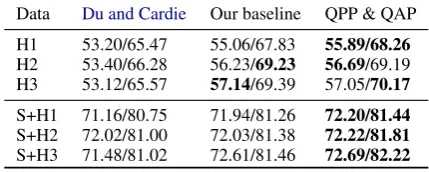
Data Du and Cardie Our baseline QPP & QAP
H1 53.20/65.47 55.06/67.83 55.89/68.26 H2 53.40/66.28 56.23/69.23 56.69/69.19 H3 53.12/65.57 57.14/69.39 57.05/70.17
S+H1 71.16/80.75 71.94/81.26 72.20/81.44 S+H2 72.02/81.00 72.03/81.38 72.22/81.81 S+H3 71.48/81.02 72.61/81.46 72.69/82.22
Table 5: The QA-based evaluation results for different QG systems. The two numbers of each item in this table are the EM/F1 scores. All results are the perfor-mance on our QA test set. “S” is short for “SQuAD”.
Match (EM) and F1.
More details about datasets, evaluation metrics, human evaluation setup, and model implement de-tails are provided in the Appendix.
6 Results
6.1 Question Generation
Baselines First, as shown in Table3, our base-line QG model obtains a non-trivial improvement over previous best QG system (Zhao et al.,2018) which proves the effectiveness of our newly intro-duced setups: introduce POS/NER features, use deep contexturalized word vectors (from ELMo or BERT), and tie output projection matrix with non-trainable word embedding matrix. Second, we apply three evaluation metrics as rewards to deal with the exposure bias issue and improve performance. All the metrics are significantly4
(p <0.001) improved except QPP, which supports that high traditional evaluation metrics do not al-ways correlate to high semantic similarity.
4The significance tests in this paper are conducted
Filter Data Size5 EM F1
H1
only
= 0.0 120k 54.55 67.91
= 0.2 84k 61.18 71.65
= 0.4 69k 61.97 72.48
= 0.6 55k 60.38 70.51
= 0.8 40k 57.47 66.48
SQuAD+H1
= 0.0 207k 72.97 82.18
= 0.2 171k 73.88 82.72
= 0.4 156k 73.47 82.62
= 0.6 142k 73.96 82.81
[image:8.595.94.271.62.191.2]= 0.8 127k 73.65 82.77
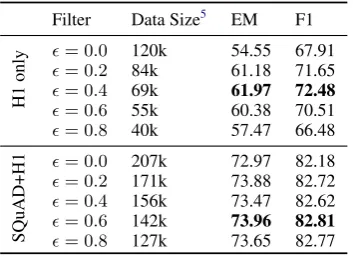
Table 6: The effect of QAP-based synthetic data filter. We filter out the synthetic data withQAP < . All results are the performance on our QA development set.
Semantics-Reinforced Models As shown in Ta-ble 3, when using QAP and QQP separately, all metrics are significantly (p < 0.001) im-proved over our baseline and all metrics ex-cept ROUGE-L are significantly (p < 0.05) im-proved over the models using traditional metrics as rewards. After applying multi-reward opti-mization, our model performs consistently best on BLEU4/METEOR/ROUGE-L and Q-BLEU1. Notably, using one of these two rewards will also improve the other one at the same time, but us-ing both of them achieves a good balance be-tween these two rewards without exploiting either of them and results in the consistently best perfor-mance on other metrics, which is a new state-of-the-art result. Human Evaluation Results: Ta-ble 4 shows the MTurk anonymous human eval-uation study, where we do a pairwise compari-son between our baseline and QPP&QAP model. We collected 300 responses in total, 160 of which voted the QPP&QAP model’s generation is better, 131 of which favors the baseline model, and 9 of which selected non-distinguishable.
QA-Based Evaluation As shown in Table5, we compare three QG systems using QA-based eval-uation on three different amounts of synthetic data and their corresponding semi-supervised QA se-tups (without filter). It can be observed that both our baseline and our best QG model can signif-icantly improve the synthetic data’s QA perfor-mance, which means they can act as better “an-notators” than the QG model proposed byDu and Cardie(2018). However, our best QG model only has a minor improvement over our baseline model, which means significant improvement over QG metrics does not guarantee significant better ques-tion annotaques-tion ability.
Data Data Size EM F1
De
v
set
SQuAD 87k 72.52 81.79
+ Beam5 399k 74.33 83.19
+ Beam10 706k 74.44 83.23
+ Beam15 853k 74.25 82.75
+ DivBeam10 595k 74.44 83.30
De
v
set
+ H1 142k 73.96 82.81
+ H2 255k 74.19 82.84
+ H4 424k 74.42 82.82
+ H6 506k 74.27 82.97
+ H8 705k 74.64 83.14
+ H10 930k 74.27 82.97
T
est
set SQuAD+ Beam10 87k706k 71.9273.43 81.2682.39
+ H8 705k 73.61 82.53
[image:8.595.316.519.63.241.2]+ Beam10 + H8 1.3M 73.43 82.11
Table 7: The results of our semi-supervised QA method using a BiDAF-QA model.
Methods New Data Size EM F1
Dhingra et al.base 0 71.54 80.69
+Cloze 3.2M 71.86 80.80
Our base 0 72.19 81.52
+Beam10 0 73.93 82.81
+H8 705k 74.12 82.83
Table 8: The comparison with the previous semi-supervised QA method. All results are the performance on the full development set of SQuAD, i.e., our QA test + development set.
6.2 Semi-Supervised Question Answering
Effect of the data filter As shown in Table 6, when using synthetic data only, adding the data filter can significantly improve QA performance. In terms of semi-supervised QA, the improvement is relatively smaller, due to the regularization from ground-truth data, but still consistent and stable.
Semi-Supervised QA results Table 7 demon-strates the semi-supervised QA results. Without introducing new articles, we keep beam search outputs as additional questions. It can be seen that using beam search with beam size 10 (+Beam10) improves the BiDAF-QA baseline by 1.51/1.13 absolute points on the testing set. With introduc-ing new articles, the best performance (+H8) im-proves the BiDAF-QA baseline by 1.69/1.27 ab-solute points on the testing set. We also combine the two best settings (Beam10+H8), but it does not perform better than using them separately.
We conduct two ablation studies on the devel-opment set. First, we compare beam search with
5“Data Size” counts the total number of examples in
[image:8.595.310.522.284.359.2]BLEU4 METEOR ROUGE-L Q-BLEU1 QPP QAP QA-Eval (H1)
Du and Cardie(2018) 15.16 19.12 – – – – 55.11/66.40
Our baseline (w. BERT) 18.05 22.41 46.57 49.38 29.08 54.61 58.63/69.97
+ QPP 18.51 22.87 46.65 49.97 30.14 55.67 60.49/71.81
+ QAP 18.65 22.91 46.76 50.09 30.09 57.51 60.12/71.14
[image:9.595.79.285.170.265.2]+ QPP & QAP 18.58 22.87 46.76 50.01 30.10 56.39 59.11/70.87
Table 9: The performance of our stronger BERT-QG models.
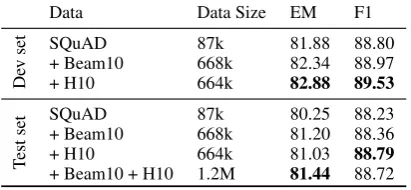
Data Data Size EM F1
De
v
set SQuAD 87k 81.88 88.80
+ Beam10 668k 82.34 88.97
+ H10 664k 82.88 89.53
T
est
set SQuAD+ Beam10 87k668k 80.2581.20 88.2388.36
+ H10 664k 81.03 88.79
+ Beam10 + H10 1.2M 81.44 88.72
Table 10: The results of our semi-supervised QA method using a stronger BERT-QA model.
different beam sizes and diverse beam search (Li et al., 2016), but all of them perform similarly. Second, increasing the size of synthetic data from H1 to H10, the performance saturates around H2-H4. We also observed that when using a big syn-thetic data, e.g., H10, the model converges even before all examples were used for training. Based on these results, we conjecture that there is an up-per bound of the effect of synthetic data which might be limited by the QG quality. To further improve the performance, more diverse and tricky questions need to be generated. To show how QG models help or limit the QA performance, we include some synthetic QA examples in Ap-pendix. Finally, we compare our semi-supervised QA methods withDhingra et al.(2018). As shown in Table 8, with no or less new data injection, our methods achieve larger improvements over a stronger baseline than their method.
6.3 QG and QA Results with BERT
The Bidirectional Encoder Representations from Transformers (BERT) (Devlin et al.,2018) has re-cently improved a lot of NLP tasks by substantial margins. To verify if our improvements still hold on based baselines, we propose a BERT-QG baseline and test our two semantics-enhanced rewards; further, we conduct our semi-supervised QA method on a BERT-QA baseline.
BERT-QG Without modifying our QG model’s architecture, we simply replaced ELMo used above with BERT. Table9 shows that our BERT-QG baseline improves previous ELMo-BERT-QG
base-line by a large margin; meanwhile, our QPP/QAP rewards significantly improve the stronger QG baseline and achieve the new state-of-the-art QG performance w.r.t both traditional metrics and QA-based QG evaluation. One difference is that the QAP-only model has the overall best performance instead of the multi-reward model. Note that, we also obtain the QPP and QAP rewards from BERT-based QPC and QA models, respectively.
BERT-QA Using our QAP-reinforced BERT-QG model, we apply the same semi-supervised QA method on a BERT-QA baseline. As shown in Table 10, though with smaller margins, our method improves the strong BERT-QA baseline by 1.19/0.56 absolute points on test set; even with-out introducing new articles, it obtains 0.95/0.13 absolute gains.
7 Conclusion
We proposed two semantics-enhanced rewards to regularize a QG model to generate semantically valid questions, and introduced a QA-based evalu-ation method that directly evaluates a QG model’s ability to mimic human annotators in generating QA training data. Experiments showed that our QG model achieves new state-of-the-art perfor-mances. Further, we investigated how to use our QG system to augment QA datasets and conduct semi-supervised QA via two synthetic data gener-ation methods along with a data filter and mixing mini-batch training. Experiments showed that our approach improves both BiDAF and BERT QA baselines even without introducing new articles.
Acknowledgments
References
Chris Alberti, Daniel Andor, Emily Pitler, Jacob De-vlin, and Michael Collins. 2019. Synthetic qa cor-pora generation with roundtrip consistency. arXiv preprint arXiv:1906.05416.
Dzmitry Bahdanau, Kyunghyun Cho, and Yoshua Ben-gio. 2014. Neural machine translation by jointly learning to align and translate. arXiv preprint arXiv:1409.0473.
Avrim Blum and Tom Mitchell. 1998. Combining la-beled and unlala-beled data with co-training. In Pro-ceedings of the eleventh annual conference on Com-putational learning theory, pages 92–100. ACM. Christopher Clark and Matt Gardner. 2018. Simple
and effective multi-paragraph reading comprehen-sion. InProceedings of the 56th Annual Meeting of the Association for Computational Linguistics (Vol-ume 1: Long Papers), pages 845–855.
Alexis Conneau, Douwe Kiela, Holger Schwenk, Loic Barrault, and Antoine Bordes. 2017. Supervised learning of universal sentence representations from natural language inference data. arXiv preprint arXiv:1705.02364.
Michael Denkowski and Alon Lavie. 2014. Meteor universal: Language specific translation evaluation for any target language. InProceedings of the ninth workshop on statistical machine translation, pages 376–380.
Jacob Devlin, Ming-Wei Chang, Kenton Lee, and Kristina Toutanova. 2018. Bert: Pre-training of deep bidirectional transformers for language understand-ing. arXiv preprint arXiv:1810.04805.
Bhuwan Dhingra, Danish Danish, and Dheeraj Ra-jagopal. 2018. Simple and effective semi-supervised question answering. In Proceedings of the 2018 Conference of the North American Chapter of the Association for Computational Linguistics: Human Language Technologies, Volume 2 (Short Papers), pages 582–587.
Li Dong, Jonathan Mallinson, Siva Reddy, and Mirella Lapata. 2017. Learning to paraphrase for question answering. InProceedings of the 2017 Conference on Empirical Methods in Natural Language Pro-cessing, pages 875–886.
Li Dong, Nan Yang, Wenhui Wang, Furu Wei, Xiaodong Liu, Yu Wang, Jianfeng Gao, Ming Zhou, and Hsiao-Wuen Hon. 2019. Unified language model pre-training for natural language understanding and generation. arXiv preprint arXiv:1905.03197.
Xinya Du and Claire Cardie. 2018. Harvest-ing paragraph-level question-answer pairs from wikipedia. InProceedings of the 56th Annual Meet-ing of the Association for Computational LMeet-inguistics (Volume 1: Long Papers), pages 1907–1917.
Xinya Du, Junru Shao, and Claire Cardie. 2017. Learn-ing to ask: Neural question generation for readLearn-ing comprehension. In Proceedings of the 55th An-nual Meeting of the Association for Computational Linguistics (Volume 1: Long Papers), pages 1342– 1352.
Nan Duan, Duyu Tang, Peng Chen, and Ming Zhou. 2017. Question generation for question answering. In Proceedings of the 2017 Conference on Empiri-cal Methods in Natural Language Processing, pages 866–874, Copenhagen, Denmark. Association for Computational Linguistics.
Bradley Efron and Robert J Tibshirani. 1994. An intro-duction to the bootstrap. CRC press.
Daniel Fried, Ronghang Hu, Volkan Cirik, Anna Rohrbach, Jacob Andreas, Louis-Philippe Morency, Taylor Berg-Kirkpatrick, Kate Saenko, Dan Klein, and Trevor Darrell. 2018. Speaker-follower mod-els for vision-and-language navigation. InAdvances in Neural Information Processing Systems, pages 3314–3325.
Ian Goodfellow, Jean Pouget-Abadie, Mehdi Mirza, Bing Xu, David Warde-Farley, Sherjil Ozair, Aaron Courville, and Yoshua Bengio. 2014. Generative ad-versarial nets. In Advances in neural information processing systems, pages 2672–2680.
Di He, Yingce Xia, Tao Qin, Liwei Wang, Nenghai Yu, Tie-Yan Liu, and Wei-Ying Ma. 2016. Dual learn-ing for machine translation. InAdvances in Neural Information Processing Systems, pages 820–828. Michael Heilman and Noah A Smith. 2010. Good
question! statistical ranking for question genera-tion. InHuman Language Technologies: The 2010 Annual Conference of the North American Chap-ter of the Association for Computational Linguistics, pages 609–617. Association for Computational Lin-guistics.
Tom Hosking and Sebastian Riedel. 2019. Evaluat-ing rewards for question generation models. arXiv preprint arXiv:1902.11049.
Unnat Jain, Ziyu Zhang, and Alexander Schwing. 2017. Creativity: Generating diverse questions us-ing variational autoencoders. In2017 IEEE Confer-ence on Computer Vision and Pattern Recognition (CVPR), pages 5415–5424. IEEE.
Robin Jia and Percy Liang. 2017. Adversarial exam-ples for evaluating reading comprehension systems. In Proceedings of the 2017 Conference on Empiri-cal Methods in Natural Language Processing, pages 2021–2031.
Yanghoon Kim, Hwanhee Lee, Joongbo Shin, and Ky-omin Jung. 2018. Improving neural question gen-eration using answer separation. arXiv preprint arXiv:1809.02393.
Diederik P Kingma and Jimmy Ba. 2014. Adam: A method for stochastic optimization. arXiv preprint arXiv:1412.6980.
Vishwajeet Kumar, Ganesh Ramakrishnan, and Yuan-Fang Li. 2018. A framework for automatic question generation from text using deep reinforcement learn-ing. arXiv preprint arXiv:1808.04961.
Igor Labutov, Sumit Basu, and Lucy Vanderwende. 2015. Deep questions without deep understanding. In Proceedings of the 53rd Annual Meeting of the Association for Computational Linguistics and the 7th International Joint Conference on Natural Lan-guage Processing (Volume 1: Long Papers), vol-ume 1, pages 889–898.
Mike Lewis and Angela Fan. 2019. Generative tion answering: Learning to answer the whole ques-tion. InInternational Conference on Learning Rep-resentations (ICLR).
Jiwei Li, Will Monroe, and Dan Jurafsky. 2016. A sim-ple, fast diverse decoding algorithm for neural gen-eration. arXiv preprint arXiv:1611.08562.
Yikang Li, Nan Duan, Bolei Zhou, Xiao Chu, Wanli Ouyang, Xiaogang Wang, and Ming Zhou. 2018. Visual question generation as dual task of visual question answering. In Proceedings of the IEEE Conference on Computer Vision and Pattern Recog-nition, pages 6116–6124.
Chin-Yew Lin. 2004. Rouge: A package for auto-matic evaluation of summaries. Text Summarization Branches Out.
David Lindberg, Fred Popowich, John Nesbit, and Phil Winne. 2013. Generating natural language ques-tions to support learning on-line. InProceedings of the 14th European Workshop on Natural Language Generation, pages 105–114.
Bang Liu, Mingjun Zhao, Di Niu, Kunfeng Lai, Yancheng He, Haojie Wei, and Yu Xu. 2019. Learn-ing to generate questions by learnLearn-ing what not to generate. arXiv preprint arXiv:1902.10418. Preksha Nema and Mitesh M Khapra. 2018. Towards a
better metric for evaluating question generation sys-tems. In Proceedings of the 2018 Conference on Empirical Methods in Natural Language Process-ing, pages 3950–3959.
Kishore Papineni, Salim Roukos, Todd Ward, and Wei-Jing Zhu. 2002. Bleu: a method for automatic eval-uation of machine translation. In Proceedings of the 40th annual meeting on association for compu-tational linguistics, pages 311–318. Association for Computational Linguistics.
Ramakanth Pasunuru and Mohit Bansal. 2018. Multi-reward reinforced summarization with saliency and entailment. InProceedings of the 2018 Conference of the North American Chapter of the Association for Computational Linguistics: Human Language Technologies, Volume 2 (Short Papers), pages 646– 653.
Romain Paulus, Caiming Xiong, and Richard Socher. 2017. A deep reinforced model for abstractive sum-marization.arXiv preprint arXiv:1705.04304.
Matthew Peters, Mark Neumann, Mohit Iyyer, Matt Gardner, Christopher Clark, Kenton Lee, and Luke Zettlemoyer. 2018. Deep contextualized word rep-resentations. In Proceedings of the 2018 Confer-ence of the North American Chapter of the Associ-ation for ComputAssoci-ational Linguistics: Human Lan-guage Technologies, Volume 1 (Long Papers), pages 2227–2237.
Pranav Rajpurkar, Jian Zhang, Konstantin Lopyrev, and Percy Liang. 2016. Squad: 100,000+ questions for machine comprehension of text. InProceedings of the 2016 Conference on Empirical Methods in Nat-ural Language Processing, pages 2383–2392.
Sathish Reddy, Dinesh Raghu, Mitesh M Khapra, and Sachindra Joshi. 2017. Generating natural language question-answer pairs from a knowledge graph us-ing a rnn based question generation model. In Pro-ceedings of the 15th Conference of the European Chapter of the Association for Computational Lin-guistics: Volume 1, Long Papers, pages 376–385.
Steven J Rennie, Etienne Marcheret, Youssef Mroueh, Jerret Ross, and Vaibhava Goel. 2017. Self-critical sequence training for image captioning. In 2017 IEEE Conference on Computer Vision and Pattern Recognition (CVPR), pages 1179–1195. IEEE.
Mrinmaya Sachan and Eric Xing. 2018. Self-training for jointly learning to ask and answer questions. In
Proceedings of the 2018 Conference of the North American Chapter of the Association for Computa-tional Linguistics: Human Language Technologies, Volume 1 (Long Papers), pages 629–640.
Rico Sennrich, Barry Haddow, and Alexandra Birch. 2016. Improving neural machine translation mod-els with monolingual data. In Proceedings of the 54th Annual Meeting of the Association for Compu-tational Linguistics (Volume 1: Long Papers), vol-ume 1, pages 86–96.
Minjoon Seo, Aniruddha Kembhavi, Ali Farhadi, and Hannaneh Hajishirzi. 2016. Bidirectional attention flow for machine comprehension. arXiv preprint arXiv:1611.01603.
The 30m factoid question-answer corpus. In Pro-ceedings of the 54th Annual Meeting of the Associa-tion for ComputaAssocia-tional Linguistics (Volume 1: Long Papers), volume 1, pages 588–598.
Linfeng Song, Zhiguo Wang, and Wael Hamza. 2017. A unified query-based generative model for question generation and question answering. arXiv preprint arXiv:1709.01058.
Linfeng Song, Zhiguo Wang, Wael Hamza, Yue Zhang, and Daniel Gildea. 2018. Leveraging context infor-mation for natural question generation. In Proceed-ings of the 2018 Conference of the North American Chapter of the Association for Computational Lin-guistics: Human Language Technologies, Volume 2 (Short Papers), pages 569–574.
Sandeep Subramanian, Tong Wang, Xingdi Yuan, Saizheng Zhang, Adam Trischler, and Yoshua Ben-gio. 2018. Neural models for key phrase extrac-tion and quesextrac-tion generaextrac-tion. In Proceedings of the Workshop on Machine Reading for Question An-swering, pages 78–88.
Xingwu Sun, Jing Liu, Yajuan Lyu, Wei He, Yan-jun Ma, and Shi Wang. 2018. Answer-focused and position-aware neural question generation. In Pro-ceedings of the 2018 Conference on Empirical Meth-ods in Natural Language Processing, pages 3930– 3939.
Hao Tan, Licheng Yu, and Mohit Bansal. 2019. Learn-ing to navigate unseen environments: Back trans-lation with environmental dropout. arXiv preprint arXiv:1904.04195.
Duyu Tang, Nan Duan, Tao Qin, Zhao Yan, and Ming Zhou. 2017. Question answering and ques-tion generaques-tion as dual tasks. arXiv preprint arXiv:1706.02027.
Duyu Tang, Nan Duan, Zhao Yan, Zhirui Zhang, Yibo Sun, Shujie Liu, Yuanhua Lv, and Ming Zhou. 2018. Learning to collaborate for question answering and asking. In Proceedings of the 2018 Conference of the North American Chapter of the Association for Computational Linguistics: Human Language Technologies, Volume 1 (Long Papers), pages 1564– 1574.
Wenhui Wang, Nan Yang, Furu Wei, Baobao Chang, and Ming Zhou. 2017. Gated self-matching net-works for reading comprehension and question an-swering. InProceedings of the 55th Annual Meet-ing of the Association for Computational LMeet-inguistics (Volume 1: Long Papers), pages 189–198.
Ronald J Williams. 1992. Simple statistical gradient-following algorithms for connectionist reinforce-ment learning. Machine learning, 8(3-4):229–256. Zhilin Yang, Junjie Hu, Ruslan Salakhutdinov, and
William Cohen. 2017. Semi-supervised qa with generative domain-adaptive nets. InProceedings of
the 55th Annual Meeting of the Association for Com-putational Linguistics (Volume 1: Long Papers), pages 1040–1050.
Zhilin Yang, Peng Qi, Saizheng Zhang, Yoshua Ben-gio, William W Cohen, Ruslan Salakhutdinov, and Christopher D Manning. 2018. Hotpotqa: A dataset for diverse, explainable multi-hop question answer-ing.arXiv preprint arXiv:1809.09600.
Xingdi Yuan, Tong Wang, Caglar Gulcehre, Alessan-dro Sordoni, Philip Bachman, Saizheng Zhang, Sandeep Subramanian, and Adam Trischler. 2017. Machine comprehension by text-to-text neural ques-tion generaques-tion. InProceedings of the 2nd Workshop on Representation Learning for NLP, pages 15–25. Yao Zhao, Xiaochuan Ni, Yuanyuan Ding, and Qifa
Ke. 2018. Paragraph-level neural question gener-ation with maxout pointer and gated self-attention networks. InProceedings of the 2018 Conference on Empirical Methods in Natural Language Process-ing, pages 3901–3910.
Qingyu Zhou, Nan Yang, Furu Wei, Chuanqi Tan, Hangbo Bao, and Ming Zhou. 2017. Neural ques-tion generaques-tion from text: A preliminary study. InNational CCF Conference on Natural Language Processing and Chinese Computing, pages 662–671. Springer.
Zhi-Hua Zhou and Ming Li. 2005. Tri-training: Ex-ploiting unlabeled data using three classifiers. IEEE Transactions on Knowledge and Data Engineering, 17(11):1529–1541.
Appendix
A Experiment Setup
A.1 Dataset
QG For QG, we use the SQuAD-based QG dataset6first introduced byDu et al.(2017) which was the most widely-used QG dataset in previous works (Song et al.,2018;Zhao et al.,2018;Du and Cardie,2018;Kim et al.,2018;Sun et al.,2018). It was derived from SQuADv1.1 (Rajpurkar et al., 2016). Since the testing set is not open, they sam-pled 10% articles from the training set as the test-ing set, and the original development set is still used for validation.
For the QA-based QG evaluation, we obtain new paragraphs with pre-extracted answer spans from HarvestingQA (Du and Cardie,2018). With-out using their provided questions, we have dif-ferent QG models act as “annotators” to generate questions, and then use the different QG-labeled synthetic datasets to train QA models. We use the same dev-test setup as described below.
6https://github.com/xinyadu/nqg/tree/
QA For QA, we use SQuADv1.1 (Rajpurkar et al.,2016). Previous semi-supervised QA works sampled 10% from training set as the testing set (Yang et al.,2017;Dhingra et al.,2018). Since we want to use the full training set in semi-supervised QA setup without any data size reduction, we in-stead split the original development set in half for validation and testing respectively.
For semi-supervised QA, first, without intro-ducing new articles, we generate new questions for SQuAD training set by keeping all beam search outputs. Second, with introducing new articles, we obtain new paragraphs with pre-extracted answer spans from HarvestingQA (Du and Cardie,2018). Without using their provided questions, we use our best QG model to label questions. Meanwhile, we investigate the influence of synthetic data size, so we sample 10% to 100% examples from Harvest-ingQA, which are denoted as H1-H10 in our ex-periments.
A.2 Evaluation Metrics
QG First, we use three traditional automatic evaluation metrics: BLEU4 (Papineni et al., 2002), METEOR (Denkowski and Lavie, 2014), ROUGE-L (Lin, 2004). Second, we adopt the new “Q-metrics” proposed byNema and Khapra (2018), and we only use “Q-BLEU1” that was shown to have the highest correlation with human judgments on SQuAD. We also take the QPP and QAP rewards as two additional evaluation metrics. Further, we conduct a pairwise human comparison between our baseline and best QG models. De-tailed human evaluation setup is described in the next section. For the QA-based QG evaluation, we use the same QA evaluation metrics as follows.
QA Following the standard evaluation method for SQuADv1.1 (Rajpurkar et al., 2016), we use Exact Match (EM) and F1 as two metrics.
A.3 Human Evaluation
We performed pairwise human evaluation between our baseline and the QPP&QAP multi-reward model on Amazon Mechanical Turk. We se-lected human annotators that are located in the US, have an approval rate greater than 98%, and have at least 10,000 approved HITs. We showed the annotators an input paragraph with the an-swer bold in the paragraph and two questions gen-erated by two QG models (randomly shuffled to anonymize model identities). We then asked them
to decide which one is better or choose “non-distinguishable” if they are equally good/bad. We give human three instructions about what is a good question: first, “answerability” – a good ques-tion should be answerable by the given answer; “making sense” – a good question should be mak-ing sense given the surroundmak-ing context; “over-all quality” – a good question should be as flu-ent, non-ambiguous, semantically compact as pos-sible. Ground-truth questions were not provided to avoid simple matching with ground-truth.
B Implementation Details
QG For ELMo-QG, we first tokenize and obtain the POS/NER tags by Standford Corenlp toolkit7, then lower-case the entire dataset. We use 2-layer LSTM-RNNs for both encoder and decoder with hidden size 600. Dropout with a probability of 0.3 is applied to the input of each LSTM-RNN layer. We use the pre-trained character-level word embedding from ELMo (Peters et al.,2018) both as our word embedding and output-projection ma-trix, and keep it fixed. We use Adam (Kingma and Ba, 2014) as optimizer with learning rate 0.001 for teacher forcing and 0.00001 for reinforcement learning. Batch size is set to 32. For stability, we first pre-train the model with teacher forcing until convergence, then fine-tune it with the mixed loss. Hyper-parameters are tuned on development set:
γqpp = 0.99,γqap = 0.97, andn:m= 3 : 1. We use beam search with beam size 10 for decoding and apply a bi-gram/tri-gram repetition penalty as proposed inPaulus et al.(2017).
For BERT-QG, we simply replace the ELMo used above to BERT (Devlin et al., 2018). To match with BERT’s tokenization, we use the WordPiece tokenizer to tokenize each word ob-tained above and extend the POS/NER tags to each word piece. Decoder’s word-piece outputs will be mapped to normal words by post-processing. Hyper-parameters are tuned on development set:
γqpp= 0.99,γqap = 0.97, andn:m= 1 : 3.
QA For BiDAF-QA, we implement the
BiDAF+Self-attention architecture proposed by Clark and Gardner (2018). We use GRUs for all RNN layers with hidden size 90 for GRUs and 180 for linear layers. Dropout with a probability of 0.2 is applied to the input of each GRU-RNN layer. We optimize the model using Adadelta with
7https://stanfordnlp.github.io/
Examples generated on SQuAD
Context: ...new york city consists offiveboroughs, each of which is a separate county of new york state... Ground-truth: how many boroughs does new york city contain ?
ELMo-QG: how many boroughs make up new york city ? BERT-QG: new york city consists of how many boroughs ?
Context: ...gendn gyatso traveled in exile looking for allies. however, it was not until1518that the secular phagmodru ruler captured lhasa from the rinbung, and thereafter the gelug was given rights to conduct the new years prayer...
Ground-truth: when was gelug was given the right to conduct the new years prayer ? ELMo-QG: in what year did the secular phagmodru ruler take over lhasa ?
BERT-QG: when did the secular phagmodru ruler capture lhasa from the rinbung ?
Context: ...chopin attended the lower rhenish music festival in aix-la-chapelle with hiller, and it was there that chopin met felix mendelssohn. after the festival, the three visited dsseldorf... they spent what mendelssohn described as “a very agreeable day”,playing and discussing musicat his piano...
Ground-truth: what two activities did frdric do while visiting for a day in dsseldorf with mendelssohn and hiller ? ELMo-QG: what did mendelssohn do at his piano ?
BERT-QG: what did chopin do at his piano ?
Context: ...to limit protests, officials pushed parents to sign a document, which forbade them from holding protests, in exchange of money, but some who refused to signwere threatened...
Ground-truth: what has happened to some who refuse to agree to not protest ? ELMo-QG: what did some who refused to sign ?
BERT-QG: what did the officials refused to sign ?
Examples generated on HarvestingQA
Context: ...nigeria prior to independence was faced with sectarian tensions and violence... some of the ethnic groups like the ogoni, have experienced severe environmental degradation due topetroleum extraction...
Du and Cardie(2018): what is the main reason for the ethnic groups ? ELMo-QG: why has nigeria experienced severe environmental degradation ? BERT-QG: why have the ogoni experienced severe environmental degradation ?
Context: ...vietnam is located on the eastern indochina peninsula... at its narrowest point in the centralqung bnh province, the country is as little as across...
Du and Cardie(2018): where is the country ’s country located ? ELMo-QG: in what province is vietnam located ?
BERT-QG: what province is vietnam ’s narrowest point ?
Context: ...the ottoman islamic legal system was set up differently fromtraditional european courts...
Du and Cardie(2018): where was the ottoman islamic legal system set ? ELMo-QG: the ottoman islamic legal system was set up from what ?
BERT-QG: what was the ottoman islamic legal system set up differently from ?
Context: ...the eastern shore of virginia is the site ofwallops flight facility, a rocket testing center owned by nasa...
Du and Cardie(2018): what is the eastern shore of virginia owned by ? ELMo-QG: what facility is owned by nasa ?
[image:14.595.76.525.63.526.2]BERT-QG: what is the name of the rocket facility located by nasa ?
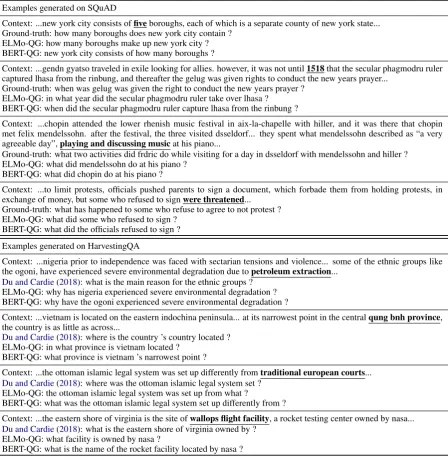
Table 11: Some synthetic QA examples generated by our QG models.
batch size 64. We also add ELMo to both the input and output of the contextual GRU-RNN layer as proposed in (Peters et al., 2018). To match with QG model’s setup, we also apply lower-case on QA datasets.
For BERT-QA, we use the pre-trained un-cased BERT-base model8 and fine-tune it on QA datasets.
QPC For ELMo-QPC, we follow the model ar-chitecture proposed by Conneau et al. (2017). First, two input questions are embedded with ELMo (Peters et al.,2018). Second, the embed-ded questions are encoembed-ded by two 2-layer
bidirec-8https://github.com/google-research/
bert
tional LSTM-RNNs separately with hidden size 512. Next, a max-pooling layer outputs the sen-tence embedding of each question, denoted byq1 andq2. Lastly, we input[q1, q2,|q1−q2|, q1∗q2] to an MLP to predict whether these two questions are paraphrases or not. This QPC model is trained using the Quora Question Pairs9 dataset. We use Adam (Kingma and Ba, 2014) as optimizer with learning rate 0.0004 and batch size 64. This model obtained 86% accuracy on QQP development set.
For BERT-QPC, we also use the pre-trained un-cased BERT-base model and fine-tune it on QQP dataset, which obtained 90% accuracy on QQP de-velopment set.
C Examples