Proceedings of the 55th Annual Meeting of the Association for Computational Linguistics (Short Papers), pages 32–37 Proceedings of the 55th Annual Meeting of the Association for Computational Linguistics (Short Papers), pages 32–37
Vector space models for evaluating semantic fluency in autism
Emily Prud’hommeaux†, Jan van Santen◦, Douglas Gliner† †Rochester Institute of Technology,◦Oregon Health & Science University
{emilypx,dgg5503}@rit.edu, [email protected]
Abstract
A common test administered during neu-rological examination is the semantic flu-ency test, in which the patient must list as many examples of a given semantic cate-gory as possible under timed conditions. Poor performance is associated with neu-rological conditions characterized by im-pairments in executive function, such as dementia, schizophrenia, and autism spec-trum disorder (ASD). Methods for analyz-ing semantic fluency responses at the level of detail necessary to uncover these dif-ferences have typically relied on subjec-tive manual annotation. In this paper, we explore automated approaches for scor-ing semantic fluency responses that lever-age ontological resources and distribu-tional semantic models to characterize the semantic fluency responses produced by young children with and without ASD. Us-ing these methods, we find significant dif-ferences in the semantic fluency responses of children with ASD, demonstrating the utility of using objective methods for clin-ical language analysis.
1 Introduction
Semantic fluency tasks, in which patients under-going neuropsychological evaluation must list as many items as possible in a particular semantic category in a fixed, brief period of time, are widely used by clinicians to evaluate language, develop-ment, and cognition. Performance on such tasks is usually measured in terms of the raw number of appropriate items produced. A more detailed anal-ysis of these lists, however, can reveal patterns as-sociated with a variety of neurological conditions, including autism, dementia, and schizophrenia.
Semantic fluency responses hold particular promise for shedding light on the language of chil-dren with autism spectrum disorder (ASD). ASD has been associated with atypical semantics and pragmatic expression since the condition was was first identified over 70 years ago (Kanner,1943). One linguistic feature of ASD, referenced in many of the diagnostic instruments for the disorder, is the use of words that are meaningful but unex-pected (Lord et al., 2002; Rutter et al., 2003), a phenomenon that could play an important role in the production of semantically related words.
In this paper, we present NLP-informed ap-proaches for automatically approximating the sub-jective manual methods described in the psychol-ogy literature for analyzing semantic fluency re-sponses. Applying these methods to data collected from young children with and without ASD, we find that none of the standard manual measures of semantic fluency are able to distinguish children with ASD from those without. Several compu-tationally derived measures, however, are signifi-cantly different between diagnostic groups. These results indicate that computationally derived mea-sures of semantic fluency tap into subtle differ-ences that would be difficult to detect using stan-dard manual metrics, lending support for the clin-ical utility of computational linguistic analysis.
2 Background
The semantic fluency task is a subtype of a more general word-generation task commonly referred to as verbal fluency. In such tasks, a participant must verbally produce a list of words belonging to some category (e.g., animals) within a predeter-mined amount of time, usually 60 seconds. Per-formance on verbal fluency tasks has been corre-lated with executive function, and differences in verbal fluency scores have been noted in a vari-ety of neurological conditions including dementia
(Henry et al., 2004), schizophrenia (Frith et al.,
1995), and autism (Turner, 1999; Geurts et al.,
2004;Spek et al.,2009;Begeer et al.,2014). The rate at which speakers generate words in a semantic fluency response has been observed to vary throughout the timed period, typically with several related words being produced in close suc-cession followed by a pause before a new burst of related words (Bousfield et al., 1954). Troyer et al. (1997) proposed two cognitive processes underlying this pattern: clustering and switching. Clustering refers to the tendency of speakers to list words in clusters according to their membership in a particular subcategory of the larger seman-tic category (e.g., pets for the larger category of
animals). Switching is the decision made by the speaker to abandon a subcategory when it has been exhausted and to list items in a new subcategory.
Autism is associated with deficits in executive function, and thus we should expect to see con-sistent patterns demonstrating deficits in seman-tic fluency performance in the ASD population. Several studies have found overall weaker perfor-mance, in terms of raw item count, in individu-als with ASD (Turner,1999;Geurts et al.,2004;
Spek et al.,2009); other more recent studies, how-ever, have not been able to replicate this finding (Lopez et al., 2005; Inokuchi and Kamio, 2013;
Begeer et al.,2014). Similarly conflicting results have been reported when evaluating the semantic relatedness of adjacent words, with some finding smaller clusters in ASD (Turner,1999), some find-ing larger clusters (Begeer et al.,2014), and still others finding no differences (Spek et al.,2009).
One likely source of these discrepancies is the subjectivity inherent in the cluster assignment task. Troyer et al. (1997) provide examples of common clusters and their member animals, but they note the difficulty in assigning items to sub-categories, explaining that their proposed subcate-gories were not generated using any existing tax-onomy but instead grew organically out of the pat-terns observed in the data. An additional compli-cation is that a word’s subcategory membership is dependent on its context. The wordcamel, for in-stance, could be assigned to any number of cate-gories (e.g., desert animal, zoo animal), depend-ing on the nearby words. This is particularly prob-lematic when analyzing the responses of children, whose semantic categories might not align with those of an adult annotator.
In response to these challenges, some recent work has focused on modeling the cluster-switch behavior using computational linguistic methods, in particular, using latent semantic analysis to cal-culate the semantic similarity between adjacent words. Mean scores over these similarity val-ues can capture a individual’s tendency to use a naming strategy relying on similarity ( Nicode-mus et al., 2014;Rosenstein et al.,2015). Other work has focused on setting thresholds over these similarity values in order to delineate the bound-aries between clusters or chains of related words (Rosenstein et al., 2015;Pakhomov and Hemmy,
2014). None of these studies, however, has com-pared the output of the automated methods to man-ual annotations in order to determine their accu-racy. Furthermore, the thresholds used for clus-ter boundary identification in these studies were set by “rule of thumb” rather than empirically or probabilistically.
To our knowledge, this is the first attempt to use distributional semantic models to analyze se-mantic fluency responses in children with autism spectrum disorder. More importantly, it is the first study that uses machine learning to validate the utility of these models for replicating and, perhaps improving upon, human annotation methods of se-mantic fluency responses.
3 Data
The participants in this study were 22 children with typical development (TD) and 22 high-functioning children with ASD, ranging in age from 4 to 9 years. ASD was diagnosed via clinical consensus according to the Diagnostic and Statistical Manual of Mental Disorders, 4th Edition (DSM-IV-TR) criteria for Autistic Dis-order (American Psychiatric Association, 2000) and the established thresholds on two commonly used diagnostic instruments: the Autism Diagnos-tic Observation Schedule (ADOS) (Lord et al.,
During administration of the task, the clinician asked the child to name as many animals as he could as quickly as possible. The children’s re-sponses were timed and recorded. The audio was then transcribed by a speech-language pathologist, and the transcripts were reviewed to remove extra-neous dialogue and to standardize spelling. Two manual annotations were performed: (1) seman-tic clusters (Troyer et al.,1997), in which a clus-ter consists of two or more animals belonging to same subcategory (giraffe, elephant, lion); and (2) semantic chains (Pakhomov and Hemmy, 2014), in which each animal shares something in com-mon at least with the immediately preceding an-imal (elephant, lion, cat). Inter-annotator agree-ment for labeling cluster boundaries according to the Troyer criteria was low (Cohen’sκ <0.4); we
therefore limit our discussion to semantic chains, whose boundaries were labeled with more sub-stantial agreement (κ= 0.71).
4 Features
4.1 Manually derived measures
Performance on a verbal fluency task is normally evaluated by counting the number of unique items produced in the designated time period. Credit is given both to a general category such asfishand to examples of that category, such assalmon; how-ever, a morphological or descriptive variation of another item (e.g.,doggyfordog) is considered a repetition and does not contribute to the total. We report this count, along with the number of seman-tic chains and mean length of semanseman-tic chain. 4.2 Semantic similarity measures
There are a number of ways to measure the seman-tic similarity between two words, some relying on manually curated knowledge bases and other de-rived distributionally from large text corpora. A high mean similarity between adjacent word pairs in a list of words might suggest that the list con-tains a small number of large clusters of strongly related words (a cluster-and-switch strategy) or a sequence of items each of which is closely re-lated to the previous item but not necessarily to the items before that (a chaining strategy). In either case, the participant is tapping into semantic sub-categories when producing his response. A lower mean similarity should indicate that a participant has produced a large number of small clusters or has selected items from the larger category seem-ingly at random.
One possible way to capture relatedness is by using a manually curated lexical ontology that im-plicitly encodes the similarity between pairs of words, such as WordNet (Fellbaum,1998). Var-ious algorithms have been proposed for assigning similarities scores for two synsets in WordNet by traversing the hierarchical trees connecting those synsets. Here we calculate the mean path sim-ilarity for each adjacent word pair in a partici-pant’s generated wordlist. Words not appearing in WordNet were manually replaced with equiv-alent synsets (e.g., puppy dog was replaced with
puppy). When multiple synsets were associated with a given item, we used the first synset whose hypernym included the synset foranimalor imag-inary being(e.g.,pegasus).
One disadvantage inherent in the WordNet on-tology of animal names is that it is derived from the biological taxonomy of the animal kingdom; that is, the degree to which two animals are seman-tically related within WordNet is determined pri-marily by their biological similarity and not by se-mantic features (e.g., region of origin, usual habi-tat) that a non-zoologist might use to organize an-imals names. In order to model multiple dimen-sions of similarity, we turn to the use of vector space models. We explore two vector-space rep-resentations: latent semantic analysis (LSA) ( Lan-dauer et al., 1998) and continuous space neural word embeddings (Bengio et al., 2003). Using the gensim Python library (ˇReh˚uˇrek and Sojka,
thresh-Feature TD ASD t
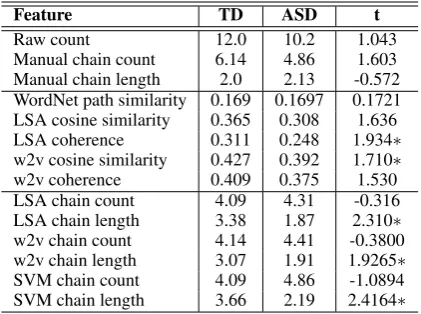
Raw count 12.0 10.2 1.043
[image:4.595.76.287.62.219.2]Manual chain count 6.14 4.86 1.603 Manual chain length 2.0 2.13 -0.572 WordNet path similarity 0.169 0.1697 0.1721 LSA cosine similarity 0.365 0.308 1.636 LSA coherence 0.311 0.248 1.934∗ w2v cosine similarity 0.427 0.392 1.710∗ w2v coherence 0.409 0.375 1.530 LSA chain count 4.09 4.31 -0.316 LSA chain length 3.38 1.87 2.310∗ w2v chain count 4.14 4.41 -0.3800 w2v chain length 3.07 1.91 1.9265∗ SVM chain count 4.09 4.86 -1.0894 SVM chain length 3.66 2.19 2.4164∗
Table 1: Mean values by diagnostic group for semantic fluency metrics (∗p <0.05, one-tailed).
old. First, while leaving one subject out, we iter-atively sweep through a range of possible values for the threshold to determine the value that max-imizes the accuracy of semantic chain boundary identification for the rest of the participants. We then apply that threshold to the left-out subject.
In addition to thresholding over individual simi-larity metrics, we also use three simisimi-larity metrics (WordNet path similarity, LSA cosine similarity, and word2vec cosine similarity) as features within a support vector machine to classify any pair of ad-jacent words as either containing a semantic chain boundary or as belonging to the same semantic chain. Using all two-word sequences found in the children’s responses and the manual indications of the locations of cluster boundaries, we perform leave-one-out cross validation to predict whether the second word in each word pair represents the start of a new chain or a continuation of the previ-ous chain.
Although the methods all achieved reasonable boundary identification accuracy, with AUC rang-ing from 0.65 to 0.8, we note that the goal of de-termining cluster boundaries in this way is not to replicate human cluster boundary insertion, which we know to be subjective and difficult to perform reliably. Rather, we are attempting to develop an objective way to insert boundaries that does not rely on an annotator’s ability to infer another indi-vidual’s semantic organization of the world. 5 Results
Table1shows the mean value for each group and the t-statistic for each of the features. In contrast to some previous work (Turner, 1999;Geurts et al.,
2004; Spek et al., 2009), we find no between-group differences in raw item count. These
re-sults, however, support other work that did not find such differences when comparing groups matched on verbal ability, as our groups are (Lopez et al.,
2005;Inokuchi and Kamio,2013).
Mean cosine similarity derived using the word2vec model is significantly different between the two groups, with the TD group showing a higher mean similarity between adjacent items. We also see that the global coherence measure, de-rived by taking the mean similarity over 100 ran-dom orderings of each list, is significantly higher in the TD group when derived using LSA.
Although there are no between-group differ-ences in the manually derived measures of chain count and chain length, we find differences in chain length when derived using both threshold-ing over similarity measures and machine learn-ing. In all three cases, children with typical devel-opment have longer semantic chains than children with ASD, suggesting that TD children employ the semantic chaining strategy that is reportedly pre-ferred by neurotypical adults. In short, there are differences in the semantic fluency responses of young children with ASD, and these differences would be difficult to reliably detect without ap-pealing to computational techniques.
Figure1shows two semantic fluency responses, one produced by a child with ASD and one by a child with TD, with plots indicating the cosine similarities between adjacent words derived from both the LSA and word2vec models. Semantic chain boundaries proposed by the SVM are indi-cated with vertical dashed lines. Note that LSA and word2vec similarity values are only some-what correlated, underscoring the potential utility of combining the two scores for chain boundary identification. As expected given the results in Ta-ble1, the child with ASD has generally lower co-sine similarity scores and many more chain bound-aries than the typically developing child.
6 Discussion and future work
One problem with applying the chaining and clus-tering paradigms to children is that the semantic features linking animals for a child might be very different those of adults. Well over half of the chil-dren in this study included the sequencecat, bear
Figure 1: Plots of successive word-pair cosine similarity values derived using LSA and word2vec models for a child with ASD (upper panel) and a child with TD (lower panel). Vertical dashed lines indicate semantic chain boundaries proposed by the SVM.
the same time, relying on large corpora of adult-focused texts may introduce problems: the low-est similarity values found in our data set involved the wordturkey, suggesting a preponderance in the data of the country rather than the bird. More sensitive text normalization methods could likely resolve this problem, but we also plan to build LSA and neural word embedding models using child language data (e.g., the CHILDES corpus (MacWhinney, 2000)) and child-oriented texts in the public domain.
Future work will focus on improving our meth-ods for identifying semantic chains while account-ing for different methods of semantic organiza-tion by combining informaorganiza-tion gained from the rich but out-of-domain data scenarios described here with in-domain experimental data. In addi-tion to incorporating more child-oriented training data, we plan to use graph-based models to cap-ture the ways in which speakers proceed through the semantic space (Abbott et al.,2015).
As the contradictory results in the literature in-dicate, the precise nature of the linguistic deficits associated with ASD is somewhat unclear. Many of the most widely reported linguistic deficits fail to obtain when participants are carefully matched, particularly on verbal IQ. The atypical language features that do persist under strict matching are usually semantic or pragmatic and, hence, more difficult to detect using easily scored standard lan-guage assessment instruments. Methods lever-aging large corpora that reflect neurotypical lan-guage use may prove to be one of the more useful tools for identifying atypical language in ASD.
Acknowledgments
This work was supported in part by NIH
grants R01DC013996, R01DC012033, and
References
Joshua T Abbott, Joseph L Austerweil, and Thomas L Griffiths. 2015. Random walks on semantic net-works can resemble optimal foraging. Psychologi-cal Review122(3):558–569.
American Psychiatric Association. 2000. DSM-IV-TR: Diagnostic and Statistical Manual of Mental Disor-ders. American Psychiatric Publishing, Washing-ton, DC.
Sander Begeer, Marlies Wierda, Anke M Scheeren, Jan-Pieter Teunisse, Hans M Koot, and Hilde M Geurts. 2014. Verbal fluency in children with autism spectrum disorders: Clustering and switching strate-gies. Autism18(8):1014–1018.
Yoshua Bengio, R´ejean Ducharme, Pascal Vincent, and Christian Jauvin. 2003. A neural probabilistic lan-guage model.Journal of machine learning research
3:1137–1155.
Weston Ashmore Bousfield, CHW Sedgewick, and BH Cohen. 1954. Certain temporal characteristics of the recall of verbal associates. The American Journal of Psychology67(1):111–118.
Christian Fellbaum. 1998. WordNet: An Electronic Lexical Database. MIT Press, Cambridge, MA. CD Frith, KJ Friston, S Herold, D Silbersweig,
P Fletcher, C Cahill, RJ Dolan, RS Frackowiak, and PF Liddle. 1995. Regional brain activity in chronic schizophrenic patients during the performance of a verbal fluency task. The British Journal of Psychia-try167(3):343–349.
Hilde M Geurts, Sylvie Vert´e, Jaap Oosterlaan, Herbert Roeyers, and Joseph A Sergeant. 2004. How spe-cific are executive functioning deficits in attention deficit hyperactivity disorder and autism? Journal of child psychology and psychiatry45(4):836–854. Julie D Henry, John R Crawford, and Louise H Phillips.
2004. Verbal fluency performance in dementia of the Alzheimer’s type: A meta-analysis. Neuropsy-chologia42(9):1212–1222.
Eiko Inokuchi and Yoko Kamio. 2013. Qualitative analyses of verbal fluency in adolescents and young adults with high-functioning autism spectrum dis-order. Research in Autism Spectrum Disorders
7:1403–1410.
Leo Kanner. 1943. Autistic disturbances of affective content.Nervous Child2:217–250.
Thomas K Landauer, Peter W Foltz, and Darrell La-ham. 1998. An introduction to latent semantic anal-ysis. Discourse processes25(2-3):259–284.
Brian Lopez, Alan Lincoln, Sally Ozonoff, and Zona Lai. 2005. Examining the relationship between ex-ecutive functions and restricted, repetitive symptoms of autistic disorder. Journal of Autism and Develop-mental Disorders35(4).
Catherine Lord, Michael Rutter, Pamela DiLavore, and Susan Risi. 2002. Autism Diagnostic Observation Schedule (ADOS). Western Psychological Services, Los Angeles.
Brian MacWhinney. 2000.The CHILDES project: The database, volume 2. Psychology Press.
Kristin K Nicodemus, Brita Elvev˚ag, Peter W Foltz, Mark Rosenstein, Catherine Diaz-Asper, and Daniel R Weinberger. 2014. Category fluency, la-tent semantic analysis and schizophrenia: a candi-date gene approach. Cortex55:182–191.
Serguei V.S. Pakhomov and Laura S. Hemmy. 2014. A computational linguistic measure of clustering be-havior on semantic verbal fluency task predicts risk of future dementia in the nun study. Cortex55:97– 106.
Radim ˇReh˚uˇrek and Petr Sojka. 2010. Software Frame-work for Topic Modelling with Large Corpora. In
Proceedings of the LREC 2010 Workshop on New Challenges for NLP Frameworks. pages 45–50.
Mark Rosenstein, Peter W. Foltz, Anja Vaskinn, and Brita Elvevg. 2015. Practical issues in developing semantic frameworks for the analysis of verbal flu-ency data: A norwegian data case study. In Proceed-ings of the 2nd Workshop on Computational Linguis-tics and Clinical Psychology. pages 124–133.
Michael Rutter, Anthony Bailey, and Catherine Lord. 2003. Social Communication Questionnaire (SCQ). Western Psychological Services, Los Angeles.
Annelies Spek, Tjeerd Schatorj´e, Evert Scholte, and Ina van Berckelaer-Onnes. 2009. Verbal fluency in adults with high functioning autism or asperger syn-drome. Neuropsychologia47(3):652–656.
Angela K Troyer, Morris Moscovitch, and Gordon Winocur. 1997. Clustering and switching as two components of verbal fluency: evidence from younger and older healthy adults. Neuropsychology
11(1):138–146.