Documents and Dependencies: an Exploration of
Vector Space Models for Semantic Composition
Alona Fyshe, Partha Talukdar, Brian Murphy and Tom Mitchell Machine Learning Department &
Center for the Neural Basis of Cognition Carnegie Mellon University, Pittsburgh
{afyshe|ppt|bmurphy|tom.mitchell}@cs.cmu.edu
Abstract
In most previous research on distribu-tional semantics, Vector Space Models (VSMs) of words are built either from topical information (e.g., documents in which a word is present), or from
syntac-tic/semantic typesof words (e.g.,
depen-dency parse links of a word in sentences), but not both. In this paper, we explore the utility of combining these two representa-tions to build VSM for the task of seman-tic composition of adjective-noun phrases. Through extensive experiments on bench-mark datasets, we find that even though a type-based VSM is effective for seman-tic composition, it is often outperformed by a VSM built using a combination of topic- and type-based statistics. We also introduce a new evaluation task wherein we predict the composed vector represen-tation of a phrase from the brain activity of a human subject reading that phrase. We exploit a large syntactically parsed corpus of 16 billion tokens to build our VSMs, with vectors for both phrases and words, and make them publicly available.
1 Introduction
Vector space models (VSMs) of word semantics use large collections of text to represent word meanings. Each word vector is composed of fea-tures, where features can be derived from global corpus co-occurrence patterns (e.g. how often a word appears in each document), or local corpus co-occurrence patterns patterns (e.g. how often two words appear together in the same sentence, or are linked together in dependency parsed sen-tences). These two feature types represent
dif-ferent aspects of word meaning (Murphy et al., 2012c), and can be compared with the paradig-matic/syntagmatic distinction (Sahlgren, 2006).
Global patterns give a more topic-based
mean-ing (e.g. judge might appear in documents also
containing courtand verdict). Certain local
pat-terns give a more type-based meaning (e.g. the
noun judge might be modified by the adjective
harsh, or be the subject ofdecide, as would related
and substitutable words such as referee or
con-ductor). Global patterns have been used in Latent Semantic Analysis (Landauer and Dumais, 1997) and LDA Topic models (Blei et al., 2003). Local patterns based on word co-occurrence in a fixed width window were used in Hyperspace Analogue to Language (Lund and Burgess, 1996). Subse-quent models added increasing linguistic sophisti-cation, up to full syntactic and dependency parses (Lin, 1998; Pad´o and Lapata, 2007; Baroni and Lenci, 2010).
In this paper we systematically explore the util-ity of a global, topic-based VSM built from what
we callDocumentfeatures, and a local, type-based
VSM built from Dependencyfeatures. Our
Doc-ument VSM represents each wordw by a vector
where each feature is a specific document, and the feature value is the number of mentions of word
win that document. Our Dependency VSM
rep-resents word wwith a vector where each feature
is a dependency parse link (e.g., the wordwis the
subject of the verb “eat”), and the feature value is the number of instances of this dependency
fea-ture for word w across a large text corpus. We
also consider a third Combined VSM in which
are dimensionality reduced using singular value decomposition (SVD). This is the first systematic study of the utility of Document and Dependency features for semantic composition. We construct all three VSMs (Dependencies, Documents, Com-bined) using the same text corpus and preprocess-ing pipeline, and make the resultpreprocess-ing VSMs
avail-able for download (http://www.cs.cmu.
edu/˜afyshe/papers/conll2013/). To
our knowledge, this is the first freely available VSM that includes entries for both words and adjective-noun phrases, and it is built from a much larger corpus than previously shared resources (16 billion words, 50 million documents). Our main contributions include:
• We systematically study complementarity of
topical (Document) and type (Dependency) features in Vector Space Model (VSM) for semantic composition of adjective-noun phrases. To the best of our knowledge, this is one of the first studies of this kind.
• Through extensive experiments on standard
benchmark datasets, we find that a VSM built from a combination of topical and type fea-tures is more effective for semantic compo-sition, compared to a VSM built from Docu-ment and Dependency features alone. • We introduce a novel task: to predict the
vec-tor representation of a composed phrase from the brain activity of human subjects reading that phrase.
• We explore two composition methods,
addi-tion and dilaaddi-tion, and find that while addiaddi-tion performs well on corpus-only tasks, dilation performs best on the brain activity task.
• We build our VSMs, for both phrases and
words, from a large syntactically parsed text corpus of 16 billion tokens. We also make the resulting VSM publicly available.
2 Related Work
Mitchell and Lapata (2010) explored several methods of combining adjective and noun vec-tors to estimate phrase vecvec-tors, and compared the similarity judgements of humans to the sim-ilarity of their predicted phrase vectors. They found that for adjective-noun phrases, type-based models outperformed Latent Dirichlet Allocation (LDA) topic models. For the type-based mod-els, multiplication performed the best, followed
by weighted addition and a dilation model (for de-tails on composition functions see Section 4.2). However, Mitchell and Lapata did not combine the topic- and type-based models, an idea we ex-plore in detail in this paper.
Baroni and Zamparelli (2010) extended the typ-ical vector representation of words. Their model used matrices to represent adjectives, while nouns were represented with column vectors. The vec-tors for nouns and adjective-noun phrases were derived from local word co-occurrence statistics. The matrix to represent the adjective was esti-mated with partial least squares regression where the product of the learned adjective matrix and the observed noun vector should equal the ob-served adjective-noun vector. Socher et al. (2012) also extended word representations beyond sim-ple vectors. Their model assigns each word a vec-tor and a matrix, which are composed via an non-linear function (e.g. tanh) to create phrase rep-resentations consisting of another vector/matrix pair. This process can proceed recursively, follow-ing a parse tree to produce a composite sentence meaning. Other general semantic composition frameworks have been suggested, e.g. (Sadrzadeh and Grefenstette, 2011) who focus on the opera-tional nature of composition, rather than the rep-resentations that are supplied to the framework. Here we focus on creating word representations that are useful for semantic composition.
In contrast to the composite model in (Griffiths et al., 2005), in this paper we explore the com-plementarity of semantics captured by topical in-formation and syntactic/semantic types. We fo-cus on learning VSMs (involving both words and phrases) for semantic composition, and use more expressive dependency-based features in our type-based VSM. A comparison of vector-space repre-sentations was recently published (Blacoe and La-pata, 2012), in which the authors compared sev-eral methods of combining single words vectors to create phrase vectors. They found that the best performance for adjective-noun composition used point-wise multiplication and a model based on type-based word co-occurrence patterns.
3 Creating a Vector-Space
To create the Dependency vectors, a 16 billion word subset of ClueWeb09 (Callan and Hoy, 2009) was dependency parsed using the Malt parser (Hall et al., 2007). Dependency statistics were then collected for a predetermined list of target words and adjective-noun phrases, and for arbitrary adjective-noun phrases observed in the corpus. The list was composed of the 40 thou-sand most frequent single tokens in the Ameri-can National Corpus (Ide and Suderman, 2006), and a small number of words and phrases used as stimuli in our brain imaging experiments. Ad-ditionally, we included any phrase found in the corpus whose maximal token span matched the
PoS patternJ+N+, whereJ andN denote
adjec-tive and noun PoS tags respecadjec-tively. For each unit (i.e., word or phrase) in this augmented list, counts of all unit-external dependencies incident on the head word were aggregated across the cor-pus, while unit-internal dependencies were ig-nored. Each token was appended with its PoS tag, and the dependency edge label was also included. This resulted in the extraction of 498 million de-pendency tuples. For example, the dede-pendency tu-ple (a/DT, NMOD, 27-inch/JJ television/NN,14),
indicates that a/DT was found as a child of
27-inch/JJ television/NN with a frequency of 14 in the corpus.
To create Document vectors, word-document co-occurrence counts were taken from the same subset of Clueweb, which covered 50 million doc-uments. We applied feature-selection for compu-tational efficiency reasons, ranking documents by
the number of target word/phrase types they con-tained and choosing the top 10 million.
A series of three additional filtering steps
selected target words/phrases, and
Docu-ment/Dependency features for which there was
adequate data.1 First, a co-occurrence frequency
cut-off was used to reduce the dimensionality of the matrices, and to discard noisy estimates. A cutoff of 20 was applied to the dependency counts, and of 2 to document counts. Positive pointwise-mutual-information (PPMI) was used as an association measure to normalize the observed co-occurrence frequency for the varying frequency of the target word and its features, and to discard negative associations. Second, the target list was filtered to the 57 thousand words and phrases which had at least 20 non-“stop word” Dependency co-occurrence types, where a “stop word” was one of the 100 most frequent Dependency features observed (so named be-cause the dependencies were largely incident on function words). Third, features observed for no more than one target were removed, as were empty target entries. The result was a Document co-occurrence matrix of 55 thousand targets by 5.2 million features (total 172 million non-zero entries), and a Dependency matrix of 57 thousand targets by 1.25 million features (total 35 million non-zero entries).
A singular value decomposition (SVD) matrix factorization was computed separately on the De-pendency and Document statistics matrices, with 1000 latent dimensions retained. For this step we used Python/Scipy implementation of the Im-plicitly Restarted Arnoldi method (Lehoucq et al., 1998; Jones et al., 2001). This method is com-patible with PPMI normalization, since a zero value represents both negative target-feature asso-ciations, and those that were not observed or fell below the frequency cut-off. To combine Docu-ment and Dependency information, we concate-nate vectors.
4 Experiments
To evaluate how Document and Dependency di-mensions can interact and compliment each other,
1In earlier experiments with more than 500 thousand
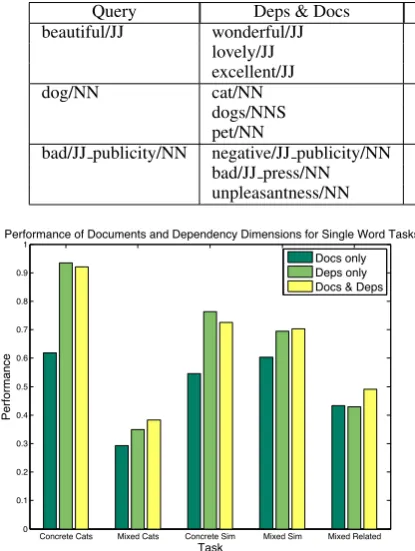
Table 1: The nearest neighbors of three queries under three VSMs: all 2000 dimensions (Deps & Docs); 1000 Document dimensions (Docs); 1000 Dependency dimensions (Deps).
Query Deps & Docs Docs Deps
beautiful/JJ wonderful/JJ wonderful/JJ lovely/JJ
lovely/JJ fantastic/JJ gorgeous/JJ
excellent/JJ unspoiled/JJ wonderful/JJ
dog/NN cat/NN dogs/NNS cat/NN
dogs/NNS vet/NN the/DT dog/NN
pet/NN leash/NN dogs/NNS
bad/JJ publicity/NN negative/JJ publicity/NN fast/JJ cash/NN loan/NN negative/JJ publicity/NN bad/JJ press/NN small/JJ business/NN loan/NN bad/JJ press/NN unpleasantness/NN important/JJ cities/NNS unpleasantness/NN
Concrete Cats Mixed Cats Concrete Sim Mixed Sim Mixed Related 0
0.1 0.2 0.3 0.4 0.5 0.6 0.7 0.8 0.9 1
Performance of Documents and Dependency Dimensions for Single Word Tasks
Task
Performance
Docs only Deps only Docs & Deps
Figure 1: Performance of VSMs for single word behavioral tasks as we vary Document and Depen-dency inclusion.
we can perform a qualitative comparison between the nearest neighbors (NNs) of words and phrases in the three VSMs – Dependency, Document, and Combined (Dependency & Document). Results appear in Table 1. Note that single words and phrases can be neighbors of each other, demon-strating that our VSMs can generalize across syn-tactic types. In the Document VSM, we get more topically related words as NNs (e.g.,vetandleash
for dog); and in the Dependency VSM, we see
words that might substitute for one another in a
sentence (e.g., gorgeous for beautiful). The two
feature sets can work together to up-weight the
most suitable NNs (as in beautiful), or help to
drown out noise (as in the NNs forbad publicity
in the Document VSM).
4.1 Judgements of Word Similarity
As an initial test of the informativeness of Doc-ument and Dependency features, we evaluate the representation of single words. Behavioral judgement benchmarks have been widely used to
evaluate vector space representations (Lund and Burgess, 1996; Rapp, 2003; Sahlgren, 2006). Here we used five such tests. Two tests are catego-rization tests, where we evaluate how well an au-tomatic clustering of our word vectors correspond to pre-defined word categories. The first “Con-crete Categories” test-set consists of 82 nouns, each assigned to one of 10 concrete classes (Battig and Montague, 1969). The second “Mixed Cat-egories” test-set contains 402 nouns in a range of 21 concrete and abstract classes from Word-Net (Almuhareb and Poesio, 2004; Miller et al., 1990). Both categorization tests were performed with the Cluto clustering package (Karypis, 2003) using cosine distances. Success was measured as percentage purity over clusters based on their plu-rality class, with chance performance at 10% and 5% respectively for the “Concrete Categories” and “Mixed Categories” tests.
The remaining three tests use group judgements of similarity: the “Concrete Similarity” set of 65 concrete word pairs (Rubenstein and Goode-nough, 1965); and two variations on the Word-Sim353 test-set (Finkelstein et al., 2002), par-titioned into subsets corresponding to strict at-tributional similarity (“Mixed Similarity”, 203 noun pairs), and broader topical “relatedness” (“Mixed Relatedness”, 252 noun pairs) (Agirre et al., 2009). Performance on these benchmarks is Spearman correlation between the aggregate hu-man judgements and pairwise cosine distances of word vectors in a VSM.
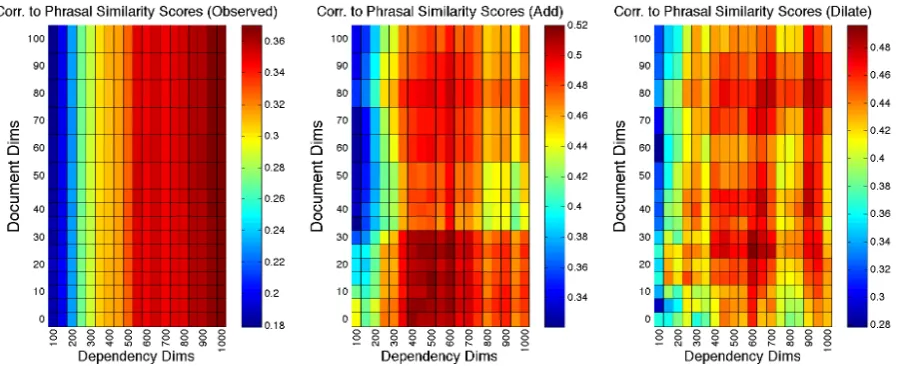
compet-Figure 2: The performance of three phrase representations for predicting the behavioral phrasal similar-ity scores from Mitchell and Lapata (2010). The highest correlation is 0.5033 and uses 25 Document dimensions, 600 Dependency dimensions and the addition composition function.
itive for less concrete word types, and for judge-ments of broader topical relatedness.
4.2 Judgements of Phrase Similarity
We also evaluated our system on behavioral data of phrase similarity judgements gathered from 18 human informants. The adjective-noun phrase pairs are divided into 3 groups: high, medium and low similarity (Mitchell and Lapata, 2010). For each pair of phrases, informants rated phrase similarity on a Likert scale of 1-7. There are 36 phrase pairs in each of the three groups for a to-tal of 108 phrase pairs. Not all of the phrases oc-curred frequently enough in our corpus to pass our thresholds, and so were omitted from our analy-sis. In several cases we also used pluralizations of the test phrases (e.g.“dark eyes”) where the singular form was not found in our VSM. After these changes we were left with 28, 24 and 28 in the high, medium and low groups respectively.
In total we have 80 observedvectors for the 108
phrase pairs. These adjective-noun phrases were included in the list of targets, so their statistics were gathered in the same way as for single words. This does not impact results for composed vectors, as all of the single words in the phrases do appear in our VSMs. A full list of the phrase pairs can be found in Mitchell and Lapata (2010).
To evaluate, we used three different representa-tions of phrases. For phrase pairs that passed our thresholds, we can test the similarity of observed representations by comparing the VSM
represen-tation of the phrase (no composition function). For all 108 phrase pairs we can test the composed phrase representations, derived by applying addi-tion and dilaaddi-tion operaaddi-tions to word vectors. Mul-tiplication is not used as SVD representations in-clude negative values, and so the product of two negative values would be positive.
Addition is the element-wise sum of two se-mantic feature vectorssadd
i =sadji +snouni , where
snouni , sadji , and saddi are the ith element of the
noun, adjective, and predicted phrase vectors, re-spectively. Dilation of two semantic feature vec-tors sadj and snoun is calculated by first
decom-posing the noun into a component parallel to the
adjective (x) and a component perpendicular to
the adjective (y) so thatsnoun =x+y. Dilation
then enhances the adjective component by multi-plying it by a scalar (γ):sdilate =γx+y. This can
be viewed as taking the representation of the noun, and up-weighting the elements it shares with the adjective, which is coherent with the notion of co-composition (Pustejovsky, 1995). Previous work
(Mitchell and Lapata, 2010) tuned theγ
parame-ter (γ = 16.7). We use that value here, though
[image:5.595.76.525.72.255.2]in-cluded all 1000 of the Document and 350 Depen-dency dimensions. For consistency the y axis in Figure 2 extends only to 100 Document dimen-sions: changes beyond 100 dimensions for ob-served vectors were minimal. By design, SVD will tend to use lower dimensions to represent the strongest signals in the input statistics, which typ-ically originate in the types of targets that are most frequent – in this case single words. We have ob-served that less frequent and noisier counts, as might be found for many phrases, are displaced to the higher dimensions. Consistent with this ob-servation, maximum performance occurs using a high number of dimensions (correlation of 0.37 to human judgements of phrase similarity).
Interestingly, using the single word vectors to predict the phrase vectors via the addition function gives the best correlation of any of the represen-tations, outperforming even the observed phrase representations. When using 25 Document di-mensions and 600 Dependency didi-mensions the correlation is 0.52, compared to the best per-formance of 0.51 using Dependency dimensions only. We speculate that the advantage of com-posed vectors over observed vectors is due to sparseness and resulting noise/variance in the ob-served phrase vectors, as phrases are necessarily less frequent than their constituent words.
The dilation composition function performs slightly worse than addition, but shows best per-formance at the same point as addition. Here, the highest correlation (0.46) is substantially lower than that attained by addition, and uses 25 dimen-sions of the Document, and 600 dimendimen-sions of the Dependency VSM.
To summarize, without documents, {observed,
addition and dilation}phrase vectors have
maxi-mal correlations{0.37, 0.51 and 0.46}. With
doc-uments, {observed, addition and dilation}phrase
vectors have maximal correlations{0.37, 0.52 and
0.50}. Our results using the addition function
(0.52) outperform the results in two previous stud-ies (Mitchell and Lapata, 2010; Blacoe and Lap-ata, 2012): (0.46 and 0.48 respectively). This is evidence that a VSM built from a larger corpus, and with both Document and Dependency infor-mation can yield superior results.
4.3 Composed vs Observed Phrase Vectors Next we tested how well our representations and semantic composition functions could predict the observed vector statistics for phrases from the vectors of their component words. Again, we explored addition and dilation composition
func-tions. For testing we have 13,575 vectors for
which both the adjective and noun passed our thresholds. We predicted a composed phrase vec-tor using the statistics of the single words and one of the two composition functions (addition
or dilation). We then sorted the list of observed
phrase vectors by their distance to thecomposed
phrase vector and recorded the position of the corresponding observed vector in the list. From this we calculated percentile rank, the percent of phrases that are further from the predicted vec-tor than the observed vecvec-tor. Percentile rank is:
100×(1−µrank/N) where µrank is the
aver-age position of the correct observed vector in the sorted list andN = 13,575is the size of the list.
Figure 3 shows the changes in percentile rank in response to varying dimensions of Documents and Dependencies for the addition function. Di-lation results are not shown, but the pattern of performance is very similar. In general, when one includes more Document dimensions, the per-centile rank increases. For both the dilation and addition composition functions the peak perfor-mance is with 750 Dependency dimensions and 1000 Document dimensions. Dilation’s peak formance is 97.87; addition peaks at 98.03 per-centile rank. As in Section 4.2, we see that the accurate representation of phrases requires higher SVD dimensions.
To evaluate when composition fails, we ex-amined the cases where the percentile rank was
<25%. Amongst these words we found an
over-representation of operational adjectives like “bet-ter” and “more”. As observed previously, it is possible that such adjectives could be better rep-resented with a matrix or function (Socher et al., 2012; Baroni and Zamparelli, 2010). Composi-tion may also be failing when the adjective-noun phrase is non-compositional (e.g. lazy susan); fil-tering such phrases could improve performance. 4.4 Brain Activity Data
100 250 500 750 1000 93
93.5 94 94.5 95 95.5 96 96.5 97 97.5 98
Number of Dependency Dimensions
Percentile Rank
Percentile Rank for Varing Doc. and Dep. Dimensions (Addition)
[image:7.595.80.282.72.209.2]0 Doc Dims 25 50 100 500 750 1000
Figure 3: The percentile rank of observed phrase vectors compared to vectors created using the ad-dition composition function.
and our predicted composed VSM for that phrase. We collected brain activity data using Magnetoen-cephalography (MEG). MEG is a brain imaging method with much higher temporal resolution (1
ms) than fMRI (∼2 sec). Since words are
natu-rally read at a rate of about 2 per second, MEG is a better candidate for capturing the fast dynamics of semantic composition in the brain. Some previous work has explored adjective-noun composition in the brain (Chang et al., 2009), but used fMRI and corpus statistics based only on co-occurrence with 5 hand-selected verbs.
Our MEG data was collected while 9 partici-pants viewed 38 phrases, each repeated 20 times (randomly interleaved). The stimulus nouns were chosen because previous research had shown them to be decodable from MEG recordings, and the ad-jectives were selected to modulate their most de-codable semantic properties (e.g. edibility, ma-nipulability) (Sudre et al., 2012). The 8 adjec-tives selected are (“big”, “small”, “ferocious”, “gentle”, “light”, “heavy”, “rotten”, “tasty”), and the 6 nouns are (“dog”, “bear”, “tomato”, “car-rot”, “hammer”, “shovel”). The words “big” and “small” are paired with every noun, “ferocious” and “gentle” with animals, “light” and “heavy” with tools and “rotten” and “tasty” with foods. We also included the words “the” and the word “thing” as semantically neutral fillers, to present each of the words in a condition without seman-tic modulation. In total there are 38 phrases (e.g. “rotten carrot”, “big hammer”).
In the MEG experiment, the adjective and paired noun were each shown for 500ms, with a 300ms interval between them, and there were 3
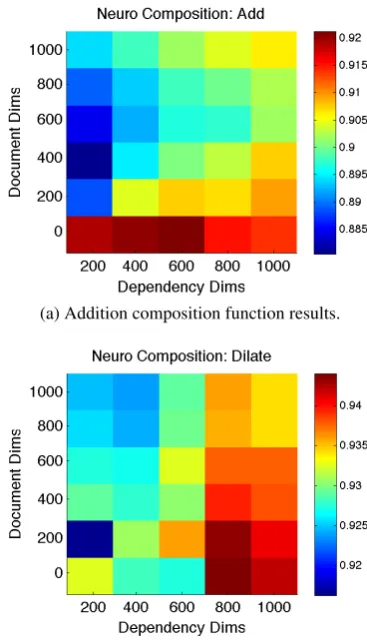
Figure 4: Results for predicting composed phrase vectors (addition [4a] and dilation [4b]) from MEG recordings. Results shown are the aver-age over 9 subjects viewing 38 adjective-noun phrases. This is the one task on which dilation outperforms addition.
(a) Addition composition function results.
(b) Dilation composition function results.
seconds in total time between the onset of subse-quent phrases. Data was preprocessed to maxi-mize the signal/noise ratio as is common practice – see Gross et al., (2012). The 20 repeated trials for each phrase were averaged together to create one average brain image per phrase.
To determine if the recorded MEG data can be used to predict our composed vector space rep-resentations, we devised the following
classifica-tion framework.2 The training data is comprised
of the averaged MEG signal for each of the 38 phrases for one subject, and the labels are the 38 phrases. We use our VSMs and composition func-tions to form a mapping of the 38 phrases to
com-2Predicting brain activity from VSM representations is
[image:7.595.320.504.161.483.2]posed semantic feature vectorsw → {s1. . . sm}. The mapping allows us to use Zero Shot Learn-ing (Palatucci et al., 2009) to predict novel phrases (not seen during training) from a MEG record-ing. This is a particularly attractive characteris-tic for the task of predicting words, as there are many words and many more phrases in the En-glish language, and one cannot hope to collect MEG recordings for all of them.
Formally, let us define the semantic
represen-tation of a phrase w as semantic feature vector
~sw = {s1...sm}, where the semantic space has
dimensionmthat varies depending on the number
of Document and/or Dependency dimensions we include. We utilize the mappingw→ {s1. . . sm}
to train m independent functions f1(X) →
s01, . . . , fm(X) → s0m where s0 represents the value of a predicted composed semantic feature. We combine the output off1. . . fm to create the final predicted semantic vectors~0 = {s0
1. . . s0m}. We use cosine distance to quantify the distance be-tween true and predicted semantic vectors.
To measure performance we use the2 vs. 2 test. For each test we withhold two phrases and train regressors on the remaining 36. We use the
re-gressorsf and MEG data from the two held out
phrases to create two predicted semantic vectors. We then choose the assignment of predicted se-mantic vectors (s~0
i and s~0j) to true semantic vec-tors (s~i ands~j) that minimizes the sum of cosine distances. If we choose the correct assignment (s~0
i 7→ s~i ands~0j 7→ s~j) we mark the test as
cor-rect. 2 vs. 2 accuracy is the number of 2 vs. 2
tests with correct assignments divided by the total
number of tests. There are (38 choose 2) = 703
distinct 2 vs. 2 tests, and we evaluate on the subset for which neither the adjective nor noun are shared (540 pairs). Chance performance is 0.50.
For each f we trained a regressor with L2
penalty. We tune the regularization
parame-ter with leave-one-out-cross-validation on training data. We train regressors using the first 800 ms of MEG signal after the noun stimulus appears, when we assume semantic composition is taking place.
Results appear in Figure 4. The best perfor-mance (2 vs. 2 accuracy of 0.9440) is achieved with dilation, 800 dimensions of Dependencies and zero Document dimensions. When we use the addition composition function, optimal
per-formance is 0.9212, at 600 Dependency and zero Document dimensions. Note, however, that the parameter search here was much coarser that in Sections 4.2 and 4.3, due to the computation re-quired. We used a finer grid around the peaks in performance for addition and dilation and found
minimal improvement (±0.5%) with the addition
of a small number of Document dimensions. It is intriguing that this neurosemantic task is the only task for which dilation outperforms addi-tion. All other composition tasks explored in this study were concerned with matching composed word vectors to observed or composed word vec-tors, whereas here we are interested in matching
composed word vectors to observedbrain activity.
Perhaps the brain works in a manner more akin to the emphasis of elements as modeled by dilation, rather than a summing of features. Further work is required to fully understand this phenomenon, but this is surely a thought-provoking result.3
5 Conclusion
We have performed a systematic study of comple-mentarity of topical (Document) and type (Depen-dency) features in Vector Space Model (VSM) for semantic composition of adjective-noun phrases. To the best of our knowledge, this is one of the first such studies of this kind. Through experi-ments on multiple real world benchmark datasets, we demonstrated the benefit of combining topic-and type-based features in a VSM. Additionally, we introduced a novel task of predicting vec-tor representations of composed phrases from the brain activity of human subjects reading those phrases. We exploited a large syntactically parsed corpus to build our VSM models, and make them publicly available. We hope that the findings and resources from this paper will serve to inform fu-ture work on VSMs and semantic composition.
Acknowledgment
We are thankful to the anonymous reviewers for their con-structive comments. We thank CMUs Parallel Data Labo-ratory (PDL) for making the OpenCloud cluster available, Justin Betteridge (CMU) for his help with parsing the corpus, and Yahoo! for providing the M45 cluster. This research has been supported in part by DARPA (under contract number FA8750-13-2-0005), NIH (NICHD award 1R01HD075328-01), Keck Foundation (DT123107), NSF (IIS0835797), and Google. Any opinions, findings, conclusions and recommen-dations expressed in this paper are the authors and do not necessarily reflect those of the sponsors.
References
Eneko Agirre, Enrique Alfonseca, Keith Hall, Jana Kraval-ova, and Marius Pas. 2009. A study on similarity and relatedness using distributional and WordNet-based ap-proaches.Proceedings of NAACL-HLT 2009.
Abdulrahman Almuhareb and Massimo Poesio. 2004. Attribute-based and value-based clustering: An evalua-tion. InProceedings of EMNLP, pages 158–165. Marco Baroni and Alessandro Lenci. 2010. Distributional
memory: A general framework for corpus-based seman-tics.Computational Linguistics, 36(4):673–721. Marco Baroni and Roberto Zamparelli. 2010. Nouns are
vectors, adjectives are matrices: Representing adjective-noun constructions in semantic space. In Proceedings of the 2010 Conference on Empirical Methods in Natu-ral Language Processing, pages 1183–1193. Association for Computational Linguistics.
W F Battig and W E Montague. 1969. Category Norms for Verbal Items in 56 Categories: A Replication and Ex-tension of the Connecticut Category Norms. Journal of Experimental Psychology Monographs, 80(3):1–46. William Blacoe and Mirella Lapata. 2012. A Comparison of
Vector-based Representations for Semantic Composition. InProceedings of the 2012 Joint Conference on Empirical Methods in Natural Language Processing and Computa-tional Natural Language Learning, pages 546–556, Jeju Island, Korea.
David M Blei, Andrew Y Ng, and Michael I Jordan. 2003. Latent Dirichlet Allocation.Journal of Machine Learning Research, 3(4-5):993–1022.
Jamie Callan and Mark Hoy. 2009. The ClueWeb09 Dataset.
http://boston.lti.cs.cmu.edu/Data/clueweb09/.
Kai-min Chang, Vladimir L. Cherkassky, Tom M Mitchell, and Marcel Adam Just. 2009. Quantitative modeling of the neural representation of adjective-noun phrases to ac-count for fMRI activation. InProceedings of the Annual Meeting of the ACL and the 4th IJCNLP of the AFNLP, pages 638–646.
Lev Finkelstein, Evgeniy Gabrilovich, Yossi Matias, Ehud Rivlin, Zach Solan, Gadi Wolfman, and Eytan Ruppin. 2002. Placing search in context: the concept revisited.
ACM Transactions on Information Systems, 20(1):116– 131.
Thomas L Griffiths, Mark Steyvers, David M Blei, and Joshua B Tenenbaum. 2005. Integrating topics and syn-tax. Advances in neural information processing systems, 17.
Joachim Gross, Sylvain Baillet, Gareth R. Barnes, Richard N. Henson, Arjan Hillebrand, Ole Jensen, Karim Jerbi, Vladimir Litvak, Burkhard Maess, Robert Oost-enveld, Lauri Parkkonen, Jason R. Taylor, Virginie van Wassenhove, Michael Wibral, and Jan-Mathijs Schoffe-len. 2012. Good-practice for conducting and reporting MEG research. NeuroImage, October.
J Hall, J Nilsson, J Nivre, G Eryigit, B Megyesi, M Nilsson, and M Saers. 2007. Single Malt or Blended? A Study in Multilingual Parser Optimization. InProceedings of the CoNLL Shared Task Session of EMNLPCoNLL 2007, volume s. 19-33, pages 933–939. Association for Compu-tational Linguistics.
Nancy Ide and Keith Suderman. 2006. The American Na-tional Corpus First Release.Proceedings of the Fifth Lan-guage Resources and Evaluation Conference (LREC). Eric Jones, Travis Oliphant, Pearu Peterson, and others.
2001. SciPy: Open source scientific tools for Python. George Karypis. 2003. CLUTO: A Clustering Toolkit.
Technical Report 02-017, Department of Computer Sci-ence, University of Minnesota.
T Landauer and S Dumais. 1997. A solution to Plato’s prob-lem: the latent semantic analysis theory of acquisition, in-duction, and representation of knowledge.Psychological Review, 104(2):211–240.
R B Lehoucq, D C Sorensen, and C Yang. 1998. Arpack users’ guide: Solution of large scale eigenvalue problems with implicitly restarted Arnoldi methods. SIAM. Dekang Lin and Xiaoyun Wu. 2009. Phrase clustering for
discriminative learning. InProceedings of the ACL. Dekang Lin. 1998. Automatic Retrieval and Clustering of
Similar Words. InCOLING-ACL, pages 768–774. K Lund and C Burgess. 1996. Producing high-dimensional
semantic spaces from lexical co-occurrence. Behavior Research Methods, Instruments, and Computers, 28:203– 208.
George A Miller, Richard Beckwith, Christiane Fellbaum, Derek Gross, and Katherine Miller. 1990. Introduction to WordNet: an on-line lexical database. International Journal of Lexicography, 3(4):235–244.
Jeff Mitchell and Mirella Lapata. 2010. Composition in distributional models of semantics. Cognitive science, 34(8):1388–429, November.
Brian Murphy, Partha Talukdar, and Tom Mitchell. 2012a. Comparing Abstract and Concrete Conceptual Represen-tations using Neurosemantic Decoding. InNAACL Work-shop on Cognitive Modelling and Computational Linguis-tics.
Brian Murphy, Partha Talukdar, and Tom Mitchell. 2012b. Selecting Corpus-Semantic Models for Neurolinguistic Decoding. InFirst Joint Conference on Lexical and Com-putational Semantics (*SEM), pages 114–123, Montreal, Quebec, Canada.
Brian Murphy, Partha Pratim Talukdar, and Tom Mitchell. 2012c. Learning Effective and Interpretable Semantic Models using Non-Negative Sparse Embedding. In Inter-national Conference on Computational Linguistics (COL-ING 2012), Mumbai, India.
Mark Palatucci, Geoffrey Hinton, Dean Pomerleau, and Tom M Mitchell. 2009. Zero-Shot Learning with Se-mantic Output Codes. Advances in Neural Information Processing Systems, 22:1410–1418.
James Pustejovsky. 1995. The Generative Lexicon. MIT Press, Cambridge.
Reinhard Rapp. 2003. Word Sense Discovery Based on Sense Descriptor Dissimilarity. Proceedings of the Ninth Machine Translation Summit, pp:315–322.
Herbert Rubenstein and John B. Goodenough. 1965. Con-textual correlates of synonymy. Communications of the ACM, 8(10):627–633, October.
Mehrnoosh Sadrzadeh and Edward Grefenstette. 2011. A Compositional Distributional Semantics Two Concrete Constructions and some Experimental Evaluations. Lec-ture Notes in Computer Science, 7052:35–47.
Magnus Sahlgren. 2006.The Word-Space Model: Using dis-tributional analysis to represent syntagmatic and paradig-matic relations between words in high-dimensional vector spaces. Dissertation, Stockholm University.
Richard Socher, Brody Huval, Christopher D. Manning, and Andrew Y. Ng. 2012. Semantic Compositionality through Recursive Matrix-Vector Spaces. InConference on Empirical Methods in Natural Language Processing and Computational Natural Language Learning. Gustavo Sudre, Dean Pomerleau, Mark Palatucci, Leila
We-hbe, Alona Fyshe, Riitta Salmelin, and Tom Mitchell. 2012. Tracking Neural Coding of Perceptual and Seman-tic Features of Concrete Nouns. NeuroImage, 62(1):463– 451, May.