J. Range Manage.
49:443-w
Effects of severity of defoliation on root function- ing in grasses.
BARRYTHORNTONAND PETERMILLARD
Authors are Research Objective Leader and Head of Plants Division, respectively, Macaulq Limd Use Research Institute, Craigiebuckler, Aberdeen AB15 SQH, Scotland UK.
Abstract
Grass shoots after defoliation can be supplied with the nitrogen required for regrowth by either root uptake or remobilization of stores. Whilst it is accepted that after a single defoliation inhibi- tion of root uptake and remobilization from roots occurs, it has not been established how the capability of roots to supply nitro- gen by uptake and from storage is affected with differing severi- ties of regular defoliation, as experienced by grazed swards. The objective was to examine this question using Agrosfis castellana Boiss et Reut, Festuca rubra L., L&urn perenne L. and Poa frivi- alis L., grasses associated with sites of differing fertility, grown in sand culture and defoliated weekly at a height of either 4 or 8 cm.
Nitrogen was supplied as NH~NOJ in a complete nutrient solu- tion. The use of ‘?I as a tracer allowed the nitrogen supplied to the shoot by root uptake and remobilization to be discriminated over a 35 day period. An increased severity of defoliation result- ed in decreased root mass, and increased nitrogen uptake per unit root weight for all species. Increased severity of defoliation did not affect uptake on a per plant basis for A. castelha, 0.54 mg N (plant)’ (week)’ and F. rubra, 0.40 mg N (plant)” (week)“, whilst mg N (plant)“ (week)’ decreased from 0.54 to 0.14, and 0.54 to 0.34 for L. perenne and P. trivialis respectively. For plants clipped at 4 or 8 cm, over 88% and 77% respectively of uptake appeared in the shoot. Nitrogen was remobilized from roots to the shoot for A. castelhna and F. rubra when clipped at 4 cm, and for A. castellana, L perenne and I? trivialis when clipped at 8 cm. Uptake by roots was more important than remobilization from roots in supplying nitrogen to the shoot. The ability to maintain the supply of nitrogen by uptake and remobilization to the shoot with increased severity of defoliation was species dependant.
Key Words: clipping height, pasture species, root uptake, remo- bilization, nitrogen
Grasses are often defoliated repeatedly by grazing herbivores (Curl1 and Wilkins 1982). Carbohydrate reserves are mobilized in response to defoliation and play a role in regrowth of plants (Bahrani et al. 1983, Gonzalez et al. 1989, Danckwerts 1993).
However, carbohydrate reserves are not always correlated to regrowth ability after defoliation (Davidson and Mihhorpe 1966a, Richards and Caldwell 1985) and nitrogen availability is consid-
Research was funded by the Scottish Office Agriculture and Fisheries Department. Authors thank M.R. Tyler for skilled technical assistance, and the Analytical Division of the hfacaulay Land Use Research Institute for uN analysis.
hCumscript accepted 19 Nov. 1995.
ered to be at least equally important (Ourry et al. 1994). After defoliation, roots of grasses can potentially supply nitrogen for laminae regrowth by uptake from the soil solution and remobi- lization from stores. On defoliation of previously uncut grass, nitrogen is remobilized from roots (Ourry et al. 1988, 1990, Thornton and Millard 1993), however root uptake is inhibited (Clement et al. 1978). What is less clear is how the capability of roots to supply nitrogen by absorption or mobilization from stor- age alters with differing height of repeated defoliation, as experi- enced under differing grazing intensities (Curl1 and Wilkins 1982).
We selected 4 grass species for this work Lolium perenne L.
and Poa trivialis L. which are associated with higher fertility sites, and Agrostis castellana Boiss et Reut and Festuca rubra L.
which are usually found on poorer sites (Grime et al. 1988). We used r5N to discriminate root uptake from remobilization of nitro- gen. The hypothesis that an increased severity of repeated defoli- ation reduces N availability for shoot growth, from both uptake and from storage, was then tested.
Materials and Methods
Sixty pots, 8cm diameter, each containing a mixture of sand and limestone chips, were sown with seed of either Agrostis castellana Boiss et Reut. cv. Highland; Festuca rubra L. cv.
Boreal; Lolium perenne L. cv. Aurora or Poa trivialis L. cv. Erte, and germinated in environmental cabinets, as described by Thornton et al. (1993), with a 16-hour photoperiod (250 pm01 mV2 s’) beginning 7 days after germination. The seedlings were watered to field capacity 3 times each week with a complete nutrient solution containing 3 mol mJ NH4NO3 at natural abun- dance. Details of the solution used are given in Thornton et al.
(1993). Pots were thinned to 20 seedlings 14 days after germina- tion. Plants in 30 pots for each species were clipped to 4-cm height, and the remaining plants were clipped to S-cm height ini- tially 22 days after germination and weekly thereafter.
After the sixth clipping plants were transferred to a tbermostati- tally controlled greenhouse with additional lighting of 140 pmol rns2 s-r at plant height from high pressure sodium lamps (G.E.C.
HPS.Ull, 4OOW) to provide a 16-hour photoperiod. The temper- ature of the greenhouse (day or night) remained in the range 20 2 5” C except for a few occasions at night when temperatures down to 10” C were recorded. Pots were laid out in a randomized block arrangement of 5 replicate blocks with treatments randomly applied within each block.
JOURNAL OF RANGE MANAGEMENT 49(5), September 1996 443
Immediately after the fifteenth weekly clipping, the unlabelled nutrient solutions were washed from the pots with 2 additions of 75 cm3 deionized water, then 3 additions of 75 cm3 nutrient solu- tion, identical except that the nitrogen was labelled with “N enriched to 5 atom %. Pots were then watered with the “N labelled solution 3 times weekly.
Five pots, 1 from each block, of each of the 8 treatment combi- nations of 4 species X 2 clipping heights, were destructively har- vested immediately (day 0) and after 7, 14,21,28, and 35 days.
At harvest plants were clipped to the appropriate height. The material removed by clipping after day 0 was referred to as leaf top. The root system was washed free from the sand limestone mixture onto a series of l-mm mesh sieves resulting in minimal root loss. Plants were then separated into leaves plus psuedostem below the clipping height, referred to as leaf base, and root mater- ial. Unharvested pots were clipped to the appropriate height as usual on days 7,14,21, and 28.
All plant material was weighed fresh and after freeze drying, then milled prior to analysis. The total N and “N concentrations in all samples were determined using an ANA-SIRA mass spec- trometer (VG Isogas, Middlewich, Cheshire, England). The “N calculations used have been described previously in Millard and Neilsen (1989). Briefly, the weight of “N present in the subsam- ple analysed by the mass spectrometer C (pg) was calculated using the equation C=15AB/(14OO+B) where A = weight of total N in subsample aualysed (pg) and B = “N atom per cent in the sample. Values of C were corrected for the natural abundance of
“N in the plant material which was taken to be 0.37 atom per cent, The weight of N in a tissue derived from uptake of labelled solution from day 0, W (mg), was then calculated from W=CED/A where D = N content of the tissue (mg) and E = fertil-
izer equivalent (gNg“ “N). Subtraction of the root uptake from the total N content gave a measure of unlabelled N content, assumed to be that present in the leaf base and roots on day 0.
The total N content of clippings, and the labelled N uptake into the whole plant (including material removed by clipping) provid- ed estimates of nitrogen losses and total N uptake respectively.
Relative nitrogen loss over the 35-day labelling period was calcu- lated as defined by Berendse et al. (1992), i.e. nitrogen loss as a percentage of total nitrogen uptake.
Analysis of variance (ANOVA) was conducted to assess whether differences were significant using Genstat 5 release 2.2 (Lawes Agricultural Trust, Rothamsted Experimental Station, England). Analyses were performed after log transformation of dry weight data and angular arcsine transformation of percentage data, in order to stabilize the variance.
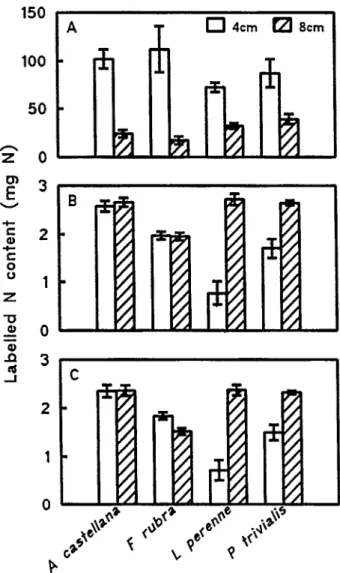
Uptake of labelled N per unit root weight was greater in all species for plants clipped at 4 compared to 8 cm (P < 0.001; Fig.
1A). Clipping height did not affect N uptake (plant)“ by A. castel- ha and F. rubra, but L. perenne and P. trivialis plants took up more N when clipped to 8 cm than to 4 cm (Fig. 1B). The increased uptake per dry weight root with the more severe defolia- tion (Fig. 1A) was, therefore, sufficient to mitigate the effect of increased defoliation on root mass (Table 1) for A. castellana and F. rubra, but not for L perenne and P. trivialis. For plants clipped to 4 cm, 88% of labelled N taken up by the plant subsequently appeared in the shoot, compared with 77% in plants clipped to 8 cm (Figs. lB, 1C). The effects of increasing severity of defoliation upon N uptake and translocation to the shoot and upon total N uptake per plant were similar, except for F. rubra where the amount of N translocated to the shoot was greater (P c 0.05) at the more severe defoliation (Fig. 1C).
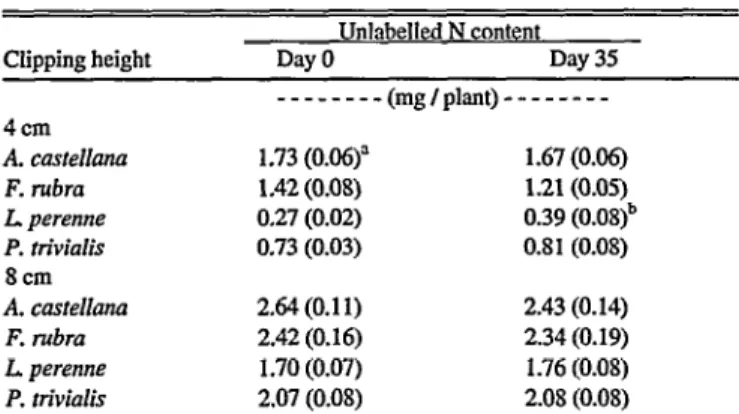
The unlabelled N content on day 0 and day 35 was similar in whole plants, which included clipped material removed over the
150 A T 0 4cm Iz1 8cm
At the second destructive harvest clipping to 4 cm had reduced both the biomass of root and leaf base of all grass species, com- pared with those clipped to 8 cm (P < 0.001 in each case, Table 1). When clipped to 4 cm L. perenne produced less root material than the other species, but plants produced similar amounts of root material when clipped to 8 cm (P ~0.05). The amount of leaf base produced decreased in the species order A. castellana, F.
rubra, P. trivialis, and L perenne when clipped to 4 cm, however when clipped to 8 cm only A. castellana produced significantly more than any other species (P < 0.001). For leaf tops an interac- tion between species and clipping height (P < 0.001) meant that clipping at 4 compared to 8 cm reduced the dry weight of L.
perenne and P. trivialis plants only (Table 1).
Fig. 1. Labelled N contents, over a 35 day period from changing to nutrient solutions containing labelled N, including material removed by clipping. A: Total plant content mg N (g dry wt root)-‘.
B: Total plant content mg N (plant)-‘. C Shoot content mg N (plant)“. Unhatched histograms are plants clipped to 4 cm, and hatched histograms are plants clipped to 8 cm. Values are means of 5 replicates f SE, except for L perenne clipped to 4 cm which is the mean of 3 replicates.
444 JOURNAL OF RANGE MANAGEMENT 49(5), September 1996
Table 1. Dry weight of the root, leaf base and leaf top of plants 7 days after changing to labelled N nutrient solutions.
Tissue Clipping Agrostis. Fesruca Lolium Pus
height custelhna rubra perenne trivialis
(cm)- -____--- (mglplaot)---
Root 4 25.3 (4.3)a 36.0 (18.5) 5.3 (0.8) 20.0 (6.2)
Root 8 68.5 (16.0) 86.0 (24.0) 60.7 (7.4) 76.8 (13.6)
L.ezifbase 4 100.6 (10.8) 49.4 (7.0) 7.4 (1.9) 26.7 (4.6) Leafbase 8 172.1 (14.7) 113.4 (8.5) 85.0 (6.8) 107.9 (18.1)
Leaftop 4 9.1 (0.8) 7.3 (1.1) 1.0 (0.4) 5.5 (0.6)
Leaftop 8 9.0 (1.7) 6.9 (0.5) 10.7 (0.4) 11.4 (0.8)
‘hiem (SE) of 5 replicates.
35day period beginning when labelling was initiated (P > 0.05, Table 2). This indicates there was no carry-over of unlabelled N when the N supply was changed to labelled N, and there were no significant losses of unlabelled N by root turnover or exudation.
Loss of unlabelled N from roots over the 35&y period, tbere- fore, represents remobilization from these structures to shoot material. The unlabelled N content of roots on day 0 at the start of the labelling period was greater for plants clipped at S-cm height than with those clipped at 4-cm (PcO.001, Fig 2). The reduction of unlabclled N in the roots with time was significant when considered over all species and clipping heights (P < 0.001, Fig. 2). An interaction indicated that significant reductions from day 0 to day 35 (PcO.05) only occurred for A. castellana and F.
rubra when clipped at 4 cm, and for A. castellana and P. trivialis when clipped at 8 cm. Unlabelled N was also reduced in roots of L perenne plants clipped at 8 cm, though in this instance it was from days 7 and 14 to day 28 (Fig. 2).
+ c 1.0
rd A castdiana
-n
6 1.0
z r
L perenne
r f rubra
r P irivia lis
z cz
,a-? ~ ri-~-f q-‘-$-“-y---~
0 7 14 21 28 35 0 7 14 21 28 35
Time (days)
Fig. 2. Unlabelled N contents (mg pIa&) remaining in root material of plants clipped to 4 cm 0, or 8 cm W. Values are means of 5 replicates * SE, except 4 cm L perenne on day 35 which is a mean of 3 replicates.
Table 2. The unlabelled N content of whole plants over a 35-day period from the time of changing to nutrient solutions containing labelled N, including material removed by clipping where appropriate.
Clipping height
Unlabelled N content
Day 0 Day 35
---(mg/p]ant)---
4cm
A. castelhna 1.73 (0.06)” 1.67 (0.06)
F’. rubra 1.42 (0.08) 1.21(0.05)
L. perenne 0.27 (0.02) 0.39 (0.08)b
P. Hvialis 0.73 (0.03) 0.8 1 (0.08)
8cm
A. caste&ma 2.64 (0.11) 2.43 (0.14)
F. rubra 2.42 (0.16) 2.34 (0.19)
L perenne 1.70 (0.07) 1.76 (0.08)
P. trhialis 2.07 (0.08) 2.08 (0.08)
ahfean (SE) of 5 replicates except b which is a mean of 3 replicates.
The relative N loss for all species was greater when clipped at 4 compared with 8 cm (P < 0.001, Fig. 3). An interaction between species and defoliation height (P < 0.01) indicated that when clipped at 4 cm the relative N loss of L perenne was only greater than that of F. mbra, whilst when clipped at 8 cm it was greater than P. trivialis and A. castellana, which in turn were greater than F. rubra (Fig. 3).
Discussion
Defoliating plants reduces root growth (Davidson and Milthorpe 1966b, Chapin and Slack 1979) which can be mani- fested as reduced root number (Richards 1984, Karl and Doescher 1991). A reduction in roots can potentially affect both root uptake and storage capabilities. In the present study root growth was reduced with increasing severity of defoliation.
g 120
:: o 80 - z
g 40 .- s 5 lx 0
0 4cm m 8cm
Fig. 3. Relative nitrogen loss (nitrogen loss in clippings as a percent- age of total nitrogen uptake) over a 35 day period from the time of changing to nutrient solutions containing Iabelled N. Unhatched histograms are plants clipped to 4 cm and hatched histograms are plants clipped to 8 cm. Values are means of 5 replicates + SE, except for L. perenne clipped to 4 cm which is the mean of 3 repli- cates.
JOURNAL OF RANGE MANAGEMENT 49(5), September 1996 445
A single defoliation caused a rapid, almost complete cessation of NO3- uptake by L. perenne roots, lasting at least 2 days (Clement et al. 1978). In contrast, Polley and Detling (1989) observed increased N uptake on a root weight basis in repeatedly defoliated Agropyron smithii Rydb. compared with undefoliated control plants. With a high N supply the increased uptake post defoliation per unit of root in A. smithii failed to offset a decrease in uptake caused by concomitant decline in root biomass. With a low N supply increased N uptake per unit of root balanced decreases in uptake caused by defoliation-induced decline in root biomass (Polley and Detling 1989). We found that N uptake increased on a root weight basis in response to an increased severity of repeated defoliation in all the species we studied.
Increased N uptake per unit of root offset the effect of root mass decreases on plant uptake in A. castellana and F. rubra but not in L. perenne or P. trivialis. Mechanisms of this response are unknown. In the sedge Eriophorum vaginatum L., Chapin and Slack (1979) found both a linear decrease in root weight per unit length with increasing number of defoliations and an increased uptake of phosphate on a root weight basis with defoliation. Root hairs are thought to facilitate root uptake by increasing the area available for uptake (Robinson and Rorison 1983). Species from infertile sites respond to a decreased N supply by increasing root hair density and length to a greater degree than species from fer- tile sites (Boot and Mensink 1990). The possibility exists that A.
castellana aud F. rabra, associated with lower fertility (Grime et al. 1988), respond to increased severity of defoliation with greater changes in root morphology than L perenne and P. trivialis.
Alternatively, species differences in canopy architecture may have led to the observed uptake differences. Uptake of NO3- requires active transport (Macklon et al. 1990) and depends on the level of radiation incident on the shoot in L. perenne (Clement et al. 1978). In Lolium multifroram Lam. Hansen (1980) found a close relationship between the diurnal variations of N03- uptake and root respiration, suggesting NO3- uptake was in part dependant on photosynthate. In the present study L perenne aud P. trivialis were the more erect species which would have lost proportionally more shoot material with the more severe clipping regime (Table 1). In turn, this may have restricted their ability to maintain NOg- uptake to a greater extent than A. castelluna or F.
rubru.
After a single defoliation of L perenne, stubble material pro- vided the major source of remobilized N for several days.
However, remobilization from roots occurs (Ourry et al.
1988,199O). Decreases in soluble protein and increases in pepti- dase enzyme activity of both stubble and roots after a single defo- liation also indicate both compartments supply N (Ourry et al.
1989). Remobilization of N from roots of L. perenne plants regu- larly defoliated to 6-cm height has previously been reported (Millard et al. 1990). We found remobilization from roots of reg- ularly clipped L perenne is dependant on the severity of defolia- tion, and the effect of defoliation severity differs between grass species. Our finding that repeatedly defoliated grass species, uptake by roots was more important in supplying N to the shoot than remobilization from roots, agrees with previous work on L perenne receiving a single defoliation (Ouny et al. 1990).
In the short term, immediately following defoliation, remobi- lization and root uptake are independent of each other, as the total amount of N remobilized is unaffected by changing the N supply (Ourry et al. 1990). In the long term, the 2 processes are obvious- ly related, since stored N must ultimately be derived from root
uptake. In this context it is worth noting that both A. custellana and F. rabru were able to maintain whole plant N uptake with increased severity of defoliation and remobilize N from roots at the more severe defoliation. Also, with the less severe defolia- tion, F. rubra was the only species not utilizing remobilization from roots, and had the lowest relative N loss. In this instance, remobilization from stubble alone and/or root.uptake may have been sufficient to supply N for regrowth.
In conclusion, uptake by roots was more important in supplying N to the shoots of repeatedly defoliated grasses than remohiiia- tion from roots. The hypothesis that increased severity of repeat- ed defoliation reduces the supply of N from both root uptake and remobilization to the shoot was proved to be incorrect, both sources increased or decreased dependant on the species. This species dependency will have implications for grass plants suh- ject to grazing in the field.
Literature Cited
Bahrani, J., E.R. Beaty, and K.H. Tan. 1983. Relationship between carbohydrate, nitrogen contents, and regrowth of tall fescue tillers. J.
Range Manage. 36~234-235.
Berendse, F., W.T. Elberse, and R.H.M.E. Geerts. 1992. Competition and nitrogen loss from plants in grassland ecosystems. Ecol. 73:46-53.
Boot, RG.A. and M. Mensink. 1990. Size and morphology of root sys- tems of perennial grasses from contrasting habitats as affected by nitrogen supply. Plant and Soil. 129:291-299.
Chapin, F.S. HI and M. Slack. 1979. Effect of defoliation upon root growth, phosphate absorption and respiration in nutrient-limited tundra graminoids. Oecologia. 4267-79.
Clement, C.R, M.J. Hopper, L.H.P. Jones, and E.G. Leafe. 1978. The uptake of nitrate by L.&urn perenne from flowing nutrient solution. II.
Effect of light, defoliation, and relationship to CO, flux. J. Exp. Bot.
29: 1173-l 183.
Cur& M.L. and RJ. Wins. 1982. Frequency and severity of defolia- tion of grass and clover by sheep at different stocking rates. Grass Forage Sci. 37:291-297.
Danckwerk, J.E. 1993. Reserve carbon and photosynthesis: their role in regrowth of Themeda triundru, a widely distributed subtropical grami- naceous species. Funct. Ecol. 7:634-641.
Davidson, J.L. and F.L. Milthorpe. 1966a. Leaf growth in DuctyZis glomerutu following defoliation. Arm. Bot. 30:173-184.
Davidson, J.L. and F.L. Milthorpe. 1966b. Tbe effect of defoliation on the carbon balance in Ductylisglomerutu. Ann. Bat. 30:185-198.
Gonzalez, B., J. Boucaud, J. Salette, J. Langlois, and M. Duyme.
1989. Changes in stubble carbohydrate content during regrowth of defoliated perennial ryegrass (Lolium perenne L.) on 2 nitrogen levels.
Grass Forage Sci. 44~411415.
Grime J.P., J.G. Hodgson, and R Hunt. 1988. Comparative plant ecol- ogy: a functional approach to common British species, Unwin Hyman, London.
Hansen, G.K 1980. Diurnal variation of root respiration rates and nitrate uptake as influenced by nitrogen supply. Physiol. Plant. 4k421-427.
Karl, M.G. and P.S. Doescher. 1991. Monitoring roots of grazed nnge- land vegetation with the root periscope/mini-rbizotron technique. J.
Range Manage. 44:29&298.
Ma&Ion, A.E.S., M.M. Ron, and A. Sim. 1990. Cortical cell fluxes of ammonium and nitrate in excised root segments of Allium cepu L.;
studies using 15N. J. Exp. Bot. 41:359-370.
Millard, P. and G.H. Neilsen. 1989. Tbe influence of nitrogen supply on tbe uptake and remobilization of stored N for the seasonal growth of apple trees. Ann. Bat. 63:301-309.
Millard, P., R.J. Thomas, and S.T. Buckland. 19‘90. Nitrogen supply affects the remobilization of nitrogen for the regrowth of defoliated Loliumperenne L. J. Exp. Bot. 41:941-947.
Ourry, A., J. Bigot and J. Boucaud. 1989. Protein mobilization from stubble and roots, and proteolytic activities during post-clipping regrowth of perennial ryegrass. J. Plant. Physiol. 13429%303.
446 JOURNAL OF RANGE MANAGEMENT 49(5), September 1996
Ourry, A, J. Boucaud and J. Salette. 1988. Nitrogen mobilization from stubble and roots during regrowth of defoliated perermial ryegrass. J.
Exp. Bot 39:803-809.
Ourry, A., J. Boucaud and J. Salette. 1990. Partitioning and remobi- lization of nitrogen during regrowth in nitrogen-deficient ryegrass.
Crop. Sci. 30:1251-1254.
Ourry, A., T.H. Kim, and J. Boucaud. 1994. Nitrogen reserve mobi- lization during regrowth of Medicago sativn L.. Plant Physiol.
105r831-837.
Polley, H.W. and J.K. Detliig. 1989. Defoliation, nitrogen, and compe- tition: effects on plant growth and nitrogen nutrition. Ecol.
70~721-727.
Richards, J.H. 1984. Root growth response to defoliation in 2 Agropyron bunchgrasses: field observations with an improved root periscope. Oecologia 64:21-25.
Richards, J.H. and M.M. Caldweli. 1985. Soluble carbohydrates, con- current photosynthesis and efficiency in regrowth following defolia- tion: a field study with Agropyron species. J. Applied. Ecol.
22907-920.
Robinson, D. and I.H. Rorison. 1983. Relationships between root mor- phology and nitrogen availability in a recent theoretical model describ- ing nitrogen uptake from soil. Plant Cell. Environ. 6641-647.
Thornton, B. and P. Millard. 1993. The effects of nitrogen supply and defoliation on the seasonal internal cycling of nitrogen in Moliniu cuerzdeu. J. Exp. Bat. 44:531-536.
Thornton, B., P. Millard, E.I. Duff, and S.T. Buckland. 1993. The rel- ative contribution of remobilization and root uptake in supplying nitro- gen after defoliation for regrowth of laminae in 4 grass species. New.
Phytol. 124689-694.
JOURNAL OF RANGE MANAGEMENT 49(5), September 1996 447