Tell Me Why: Using Question Answering as Distant Supervision for
Answer Justification
Rebecca Sharp*, Mihai Surdeanu*, Peter Jansen*,
Marco A. Valenzuela-Esc´arcega*, Peter Clark†and Michael Hammond* *University of Arizona
†Allen Institute for Artificial Intelligence
*{bsharp, msurdeanu, pajansen, marcov, hammond}@email.arizona.edu
Abstract
For many applications of question answer-ing (QA), beanswer-ing able to explain why a given model chose an answer is critical. However, the lack of labeled data for an-swer justifications makes learning this dif-ficult and expensive. Here we propose an approach that uses answer ranking as dis-tant supervision for learning how to select informative justifications, where justifica-tions serve as inferential connecjustifica-tions be-tween the question and the correct answer while often containing little lexical over-lap with either. We propose a neural net-work architecture for QA that reranks an-swer justifications as an intermediate (and human-interpretable) step in answer selec-tion. Our approach is informed by a set of features designed to combine both learned representations and explicit features to capture the connection between questions, answers, and answer justifications. We show that with this end-to-end approach we are able to significantly improve upon a strong IR baseline in both justification ranking (+9% rated highly relevant) and answer selection (+6% P@1).
1 Introduction
Developing interpretable machine learning (ML) models, that is, models where a human user can
understand what the model is learning, is consid-ered by many to be crucial for ensuring usabil-ity and accelerating progress (Craven and Shav-lik, 1996;Kim et al., 2015;Letham et al., 2015;
Ribeiro et al., 2016). For many applications of question answering (QA), i.e., finding short an-swers to natural language questions, simply pro-viding an answer is not sufficient. A complete
Question:
Which of these is a response to an internal stimulus? (A) A sunflower turns to face the rising sun. (B) A cucumber tendril wraps around a wire.
(C) A pine tree knocked sideways in a landslide grows up-ward in a bend.
(D)Guard cells of a tomato plant leaf close when there is little water in the roots .
Justification: Plants rely on hormones to send signals within the plant in order to respond to internal stimuli such as a lack of water or nutrients.
Table 1: Example of an 8th grade science question with a justification for the correct answer. Note the lack of direct lexical overlap present between the justification and the cor-rect answer, demonstrating the difficulty of the task of finding justifications using traditional distant supervision methods. approach must be interpretable, i.e., able to ex-plain why an answer is correct. For example, in the medical domain, a QA approach that an-swers treatment questions would not be trusted if the treatment recommendation is not explained in terms that can be understood by the human user.
One approach to interpreting complex models is to make use of human-interpretable information generated by the model to gain insight into what the model is learning. We follow the intuition of
Lei et al.(2016), whose two-component network first generates text spans from an input document, and then uses these text spans to make predictions.
Lei et al. utilize these intermediate text spans to infer the model’s preferences. By learning these human-readable intermediate representations end-to-end with a downstream task, the representations are optimized to correlate with what the model learns is discriminatory for the task, and they can be evaluated against what a human would consider to be important. Here we apply this general frame-work for model interpretability to QA.
In this work, we focus on answering multiple-choice science exam questions (Clark (2015); see example in Table 1). This domain is challenging as: (a) approximately 70% of science exam
tion shave been shown to require complex forms of inference to solve (Clark et al.,2013;Jansen et al.,
2016), and (b) there are few structured knowledge bases to support this inference. Within this do-main, we propose an approach that learns to both select and explain answers, when the only super-vision available is for which answer is correct (but not how to explain it). Intuitively, our approach chooses the justifications that provide the most help towards ranking the correct answers higher than incorrect ones. More formally, our neural net-work approach alternates between using the cur-rent model with max-pooling to choose the high-est scoring justifications for correct answers, and optimizing the answer ranking model given these justifications. Crucially, these reranked texts serve as our human-readable answer justifications, and by examining them, we gain insight into what the model learned was useful for the QA task.
The specific contributions of this work are: 1. We propose an end-to-end neural method for
learning to answer questions and select a high-quality justification for those answers. Our approach re-ranks free-text answer jus-tifications without the need for structured knowledge bases. With supervision only for the correct answers, we learn this re-ranking through a form of distant supervision – i.e., the answer ranking supervises the justifica-tion re-ranking.
2. We investigate two distinct categories of tures in this “little data” domain: explicit fea-tures, and learned representations. We show that, with limited training, explicit features perform far better despite their simplicity. 3. We demonstrate a large (+9%) improvement
in generating high-quality justifications over a strong information retrieval (IR) baseline, while maintaining near state-of-the-art per-formance on the multiple-choice science-exam QA task, demonstrating the success of the end-to-end strategy.
2 Related work
In many ways, deep learning has become the canonical example of the ”black box” of machine learning and many of the approaches to explaining it can be loosely categorized into two types: ap-proaches that try to interpret the parameters them-selves (e.g., with visualizations and heat maps
(Zeiler and Fergus,2014;Hermann et al.,2015;Li et al.,2016), and approaches that generate human-interpretable information that is ideally correlated with what is being learned inside the model (e.g.,
Lei et al.(2016)). Our approach falls into the lat-ter type – we use our model’s reranking of human-readable justifications to give us insight into what the model considers informative for answering questions. This allows us to see where we do well (Section6.2), and where we can improve (Section
6.3).
Deep learning has been successfully applied to many recent QA approaches and related tasks (Bordes et al., 2015; Hermann et al., 2015; He and Golub, 2016; Dong et al., 2015; Tan et al.,
2016, inter alia). However, large quantities of data are needed to train the millions of parame-ters often contained in these models. Recently, simpler model architectures have been proposed that greatly reduce the number of parameters while maintaining high performance (e.g., Iyyer et al.,
2015;Chen et al.,2016;Parikh et al., 2016). We take inspiration from this trend and propose a sim-ple neural architecture for our task to offset the limited available training data.
Another way to mitigate sparse training data is to include higher-level explicit features. Like
Sachan et al.(2016), we make use of explicit fea-tures alongside feafea-tures from distributed represen-tations to capture connections between questions, answers, and supporting text. However, we use a simpler set of features and while they use struc-tured and semi-strucstruc-tured knowledge bases, we use only free-text.
Our approach to learning justification reranking end-to-end with answer selection is similar to the
Jansen et al. (2017) latent reranking perceptron, which also operates over free text. However, our approach does not require decomposing the text into an intermediate representation, allowing our technique to more easily extend to larger textual knowledge bases.
The way we have formulated our justification selection (as a re-ranking of knowledge base sen-tences) is related to, but distinct from the task of answer sentence selection (Wang and Manning,
2010; Severyn and Moschitti, 2012, 2013; Sev-eryn et al., 2013; Severyn and Moschitti, 2015;
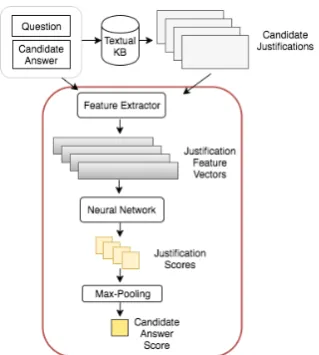
Figure 1: Architecture of our question answering approach. Given a question, candidate answer, and a free-text knowl-edge base as inputs, we generate a pool of candidate justifica-tions, from which we extract feature vectors. We use a neural network to score each and then use max-pooling to select the current best justification. This serves as the score for the can-didate answer itself. The red border indicates the components that are trained online.
a correctly selected sentence fully contains the an-swer text. Here, we have a variety of questions, many of which are non-factoid. Additionally, we have no direct supervision for our justification se-lection (i.e., no labels as to which sentences are good justifications for our answers), motivating our distant supervision approach where the per-formance on our QA task serves as supervision for selecting good justifications. Further, we are not actually looking for sentences that contain
the answer choice, as with answer sentence selec-tion, but rather sentences which close the ”lexical chasm” (Berger et al.,2000) between question and answer. This distinction is demonstrated in the ex-ample in Table1, where the correct answer does not overlap lexically with the question and only minimally with the justification. Instead, the jus-tification serves as a bridge between the question and answer, filling in the missing information for the required inference.
3 Approach
One of the primary difficulties with the explain-able QA task addressed here is that, while we have supervision for the correct answer, we do not have annotated answer justifications. Here we tackle this challenge by using the QA task performance as supervision for the justification reranking, al-lowing us to learn to choose both the correct an-swer and a compelling, human-readable justifica-tion for that answer.
Additionally, similar to the strategy Chen and Manning (2014) applied to parsing, we combine representation-based features with explicit fea-tures that capture additional information that is difficult to model through embeddings, especially with limited training data.
The architecture of our approach is summarized in Figure1. Given a question and a candidate an-swer, we first query an textual knowledge base (KB) to retrieve a pool of potential justifications for that answer candidate. For each justification, we extract a set of features designed to model the relations between questions, answers, and answer justifications based on word embeddings, lexical overlap with the question and answer candidate, discourse, and information retrieval (IR) (Section
4.2). These features are passed into a simple neu-ral network to generate a score for each justifica-tion, given the current state of the model. A final max-pooling layer selects the top-scoring justifi-cation for the candidate answer and this max score is used also as the score for the answer candidate. The system is trained using correct-incorrect an-swer pairs with a pairwise margin ranking loss ob-jective function to enforce that the correct answer be ranked higher than any of the incorrect answers. With this end-to-end approach, the model learns to select justifications that allow it to correctly an-swer questions. We hypothesize that this approach enables the model to indirectly learn to choose justifications that provide good explanations as to why the answer is correct. We empirically test this hypothesis in Section 6, where we show that in-deed the model learns to correctly answer ques-tions, as well as to select high-quality justifications for those answers.
4 Model and Features
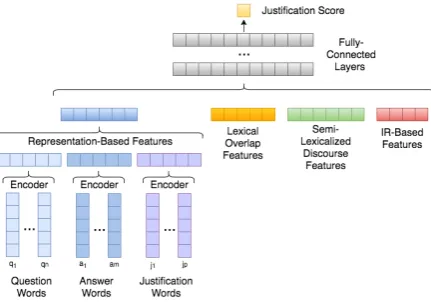
Our approach consists of three main components: (a) the retrieval of a pool of candidate answer jus-tifications (Section4.1); (b) the extraction of fea-tures for each (Section 4.2); and (c) the scoring of the answer candidate itself based on this pool of justifications (Section4.3). The architecture of this latter scoring component is shown in Figure2.
4.1 Candidate Justification Retrieval
bag-of-Figure 2: Detailed architecture of the model’s scoring com-ponent. The question, candidate answer, and justification are encoded (by summing their word embeddings) to create vec-tor representations of each. These representations are com-bined in several ways to create a set of representation-based similarity features that are concatenated to additional explicit features capturing lexical overlap, discourse and IR informa-tion and fed into a feed-forward neural network. The output layer of the network is a single node that represents the score of the justification candidate.
words (BOW) query using the content lemmas for the question and answer candidate, boosting the answer lemmas to have four times more weight1. We used Lucene2with atf-idf based scoring func-tion to return the top-scoring documents from the KB. Each of these indexed documents consists of a single sentence from our corpora, and serves as one potential justification.
4.2 Feature Extraction
For each retrieved candidate justification, we ex-tract a set of features based on (a) distributed rep-resentations of the question, candidate answer, and justification terms; (b) strict lexical overlap; (c) discourse relations present in the justification; and (d) the IR scores for the justification.
Representation-based features (Emb): To model the similarity between the text of each ques-tion (Q), candidate answer (A), and candidate jus-tification (J), we include a set of features that uti-lize distributed representations of the words found in each. First we encode each by summing the vectors for each of their words.3. We then com-pute sim(Q, A), sim(Q, J), andsim(A, J)
us-1We empirically found this answer term boosting to en-sure retrieval of documents which were relevant to the partic-ular answer candidate.
2https://lucene.apache.org
3While this BOW approach is not ideal in many ways, it performed equivalently to far more complicated approaches such as LSTMs and GRUs, also noted by (Iyyer et al.,2015), likely due to the limited training data in this domain.
ing cosine similarity. Using another vector repre-sentation of only theuniquewords in the justifica-tion, i.e., the words that do not occur in either the question or the candidate answer, we also compute
sim(Q, uniqueJ)andsim(A, uniqueJ). To create a feature which captures the relation-ship between the question, answer, and justifica-tion, we take inspiration from TransE, a popu-lar relation extraction framework (Bordes et al.,
2013). TransE is based on the premise that if two entities,e1 ande2are related by a relationr, then a mapping into k dimensions, m(x) ∈ Rk can
be learned such that m(e1) + m(r) ≈ m(e2). Here, we modify this intuition for QA by sug-gesting that given the vectorized representations of the question, answer candidate, and justifica-tion above,Q+J ≈A, i.e., a question combined with a strong justification will point towards an an-swer. Here we model this as an explicit feature, the euclidean distance betweenQ+JandA, and hypothesize that as a consequence the model will learn to select passages that maximize the quality of the justifications. This makes a total of six fea-tures based on distributed representations.
Lexical overlap features (LO): We additionally characterize each justification in terms of a simple set of explicit features designed to capture the size of the justification, as well as the lexical overlap (and difference) between the justification and the question and answer candidate. We include these five features: the proportion of question words, of answer words, and of the combined set of question and answer words that also appear in the justifica-tion; the proportion of justification words that do not appear in either the question or the answer; and the length of the justification in words.4
Semi-Lexicalized Discourse features (lexDisc):
These features use the discourse structure of the justification text, which has been shown to be use-ful for QA (Jansen et al.,2014;Sharp et al.,2015;
Sachan et al.,2016).
We use the discourse parser of Surdeanu et al.
[image:4.595.78.294.64.215.2]and modifier texts contain words from the question and/or the answer.
For example, for the question Q: What makes water a good solvent...? A: strong polarity, with a discourse-parsed justification [Water is an effi-cient solvent]e1 [because of this polarity.]e2, we
create the semi-lexicalized featureQ cause A, be-cause there is aCauserelation between EDUs e1 ande2,e1overlaps with the question, ande2 over-laps with the answer. Since there are 18 possible discourse relation labels, and the prefix and suffix can be any ofQ, A, QAorNone, this creates a set of 288 indicator features.
IR-based features (IR++): Finally, we also use a set of four IR-based features which are assigned at the level of the answer candidate (i.e., these fea-tures are identical for each of the candidate justi-fications for that answer choice). Using the same query method as described in Section4.1, for each question and answer candidate we retrieve a set of indexed documents. Using the tf-idf based re-trieval scores of these returned documents, s(di)
fordi ∈ D, we rank the answer candidates using
two methods:
• by the maximum retrieved document score for each candidate, and
• by the weighted sum of all retrieved docu-ment scores5:
X
di∈D
1
is(di) (1)
We repeat this process using an unboosted query as well, for a total of four rankings of the answer candidates. We then use these rankings to make a set of four reciprocal rank features, IR++0 , ..., IR++
3 , for each answer candidate (i.e., IR++0 = 1.0 for the top-ranked candidate in the first ranking, IR++0 = 0.5for the next candidate, etc.)
4.3 Neural Network
As shown in Figure 2, the extracted features for each candidate justification are concatenated and passed into a fully-connected feed-forward neural network (NN). The output layer is a single node representing the justification score. We then use max-pooling over these scores to select the current best justification for the answer candidate, and use its score as the score for the answer candidate it-self. For training, the correct answer for a given 5Weighted sum was based on the IR scores used in the winning Kaggle system from user Cardal (https://github. com/Cardal/Kaggle_AllenAIscience)
question is paired with each of the incorrect an-swers, and each are scored as above. We compute the pair-wise margin ranking loss for each training pair:
L= max(0, m−F(a+) +F(a−)) (2) whereF(a+)andF(a−)are the model scores for a correct and incorrect answer candidate andmis the margin, and backpropagate the gradients. At testing time, we use the trained model to score each answer choice (again using the maximum justification score) and select the highest-scoring.
As we are interested in not only correctly an-swering questions, but also selecting valid justi-fication for those answers, we keep track of the scores ofalljustifications and use this information to return the top k justifications for each answer choice. These are evaluated along with the answer selection performance in Section6.
5 Experiments
5.1 Data and Setup
We evaluated our model on the set of 8th grade science questions that was provided by the Allen Institute for Artificial Intelligence (AI2) for a re-cent Kaggle challenge. The training set contained 2,500 question, each with 4 answer candidates. For our test set, we used the 800 publicly-released questions that were used as the validation set in the actual evaluation.6 We tuned our model architec-tures and hyper-parameters on the training data us-ing five-fold cross-validation (trainus-ing on 4 folds, validating on 1). During testing, we froze the model architecture and all hyperparameters and re-trained on all the training data, setting aside a random 15% of training questions to facilitate early stopping.
5.2 Baselines
In addition to previous work, we compare our model against two strong IR baselines:
• IR Baseline: For this baseline, we rank an-swer candidates by the maximumtf.idf doc-ument retrieval score using an unboosted query of question and answer terms (see Sec-tion4.1for retrieval details).
• IR++: This baseline uses the same architec-ture as the full model, as described in Section
5.3 Corpora
For our pool of candidate justifications (as well as the scores for our IR baselines) we used the corpora that were cited as being most helpful to the top-performing systems of the Kaggle chal-lenge. These consisted of short, flash-card style texts gathered from two online resources: about 700K sentences from StudyStack7 and 25K sen-tences from Quizlet8. From these corpora, we use the top 50 sentences retrieved by the IR model as our set of candidate justifications. All of our corpora were annotated using using the Stanford CoreNLP toolkit (Manning et al., 2014), the de-pendency parser of Chen and Manning (2014), and the discourse parser ofSurdeanu et al.(2015).
While our model is able to learn a set of em-beddings, we found performance was improved when using pre-trained embeddings, and in this low-data domain, fixing these embeddings to not update during training substantially reduced the amount of model over-fitting. In order to pre-train domain-relevant embeddings for our vocabu-lary, we used the documents from the StudyStack and Quizlet corpora, supplemented by the newly released Aristo MINI corpus (December 2016 re-lease)9, which contains 1.2M science-related sen-tences from various web sources. The training was done using the word2vec algorithm (Mikolov et al., 2010, 2013) as implemented by Levy and Goldberg (2014), such that the context for each word in a sentence is composed of all the other words in the same sentence. We used embeddings of size 50 as we did not see a performance im-provement with higher dimensionality.
5.4 Model Tuning
The neural model was implemented in Keras (Chollet, 2015) using the Theano (Theano De-velopment Team, 2016) backend. For our feed-forward component, we use a shallow neural net-work that we lightly tuned to have a single fully-connected layer containing 10 nodes, glorot uni-form initialization, atanhactivation, and an L2-regularization of 0.1. We trained with the RM-SProp optimizer (Tieleman and Hinton, 2012), a learning rate of 0.001, 100 epochs, a batch size of 32, and early stopping with a patience of 5 epochs. Our loss function used a margin of 1.0.
7https://www.studystack.com/ 8https://quizlet.com/ 9http://allenai.org/
# Model P@1 Val P@1 Test
1 Random 25 25
2 IR Baseline 47.2 47
3 IR++ 50.7∗∗ 36.35
4 Iyyer et al.(2015) – 32.52
5 Khot et al.(2017) – 46.17
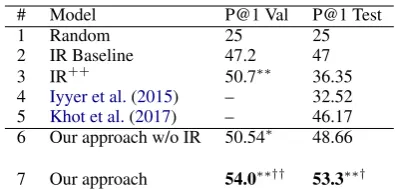
[image:6.595.314.512.60.155.2]6 Our approach w/o IR 50.54∗ 48.66 7 Our approach 54.0∗∗†† 53.3∗∗† Table 2: Performance on the AI2 Kaggle questions, measured by precision-at-one (P@1).∗s indicate that the difference be-tween the corresponding model and the IR baseline is sta-tistically significant (∗indicatesp < 0.05and∗∗ indicates p <0.001) and†s indicate significance compared to IR++,
All significance values were determined through a one-tailed bootstrap resampling test with 100,000 iterations.
Ablated Model P@1 Val
IR+++ LO 53.4∗∗††
IR+++ LO + lexDisc 53.6∗∗††
Full Model (IR+++ LO + lexDisc + Emb) 54.0∗∗†† Table 3: Ablation of feature groups results, measured by precision-at-one (P@1) on validation data. Significance is indicated as in Table2.
We experimented with burn-in, i.e., using the best justification chosen by the IR model for the first mini-batches, but found that models without burn-in performed better, indicating that the model benefited from being able to select its own justifi-cation.
6 Results
Rather than seeking to outperform all other sys-tems at selecting the correct answer to a question, here we aimed to construct a system system that can produce substantially better justifications for why the answer choice is correct to a human user, without unduly sacrificing accuracy on the answer selection task. Accordingly, we evaluate our sys-tem both in terms of it’s ability to correctly answer questions (Section 6.1), as well as provide high-quality justifications for those answers (6.2). Ad-ditionally, we perform an error analysis (Section
6.3), taking advantage of the insight the reranked justifications provide into what the model is learn-ing.
6.1 QA Performance
[image:6.595.310.518.248.292.2]shown is the average performance across five runs, each using different random seeds.
The best performing baseline on the validation data was a model using only IR++ features (line 3), but its performance dropped substantially when evaluated on test due to the failure of several ran-dom seed initializations to learn. For this reason, we assessed significance of our model combina-tions with respect to both the IR baseline as well as the IR++(indicated by∗and†s, respectively).
Our full model that combines IR++, lexical overlap, discourse, and embeddings-based fea-tures, has a P@1 of 53.3% (line 7), an absolute gain of 6.3% over the strong IR baseline despite using the same background knowledge.
Comparison to Previous Work: We compared our performance against another model that achieves state of the art performance on a differ-ent set of 8th grade science questions, TUPLE-INF(T+T’) (Khot et al.,2017). TUPLEINF(T+T’) uses Integer Linear Programming to find support for questions via tuple representations of KB sen-tences10. On our test data, TUPLEINF(T+T’) achieves 46.17% P@1 (line 5). As this model is independent of an IR component, we compare its performance against our full system without the IR-based features (line 6), whose performance is 48.66% P@1, an absolute improvement of 2.49% P@1 (5.4% relative) despite our unstructured text inputs and the far smaller size of our knowledge base (three orders of magnitude).
Sachan et al. (2016) also tackle the AI2 Kag-gle question set with an approach that learns align-ments between questions and structured and semi-structured KB data. They use only the training questions (splitting them into training, validation, and testing partitions), supplemented by questions found in online study guides, and report an accu-racy of 47.84%. By way of a loose comparison (since we are evaluating on different data parti-tions), our model has approximately 5% higher performance despite our simpler set of features and unstructured KB.
We also compare our model to our implementa-tion of the basic Deep-Averaged Network (DAN) Architecture of Iyyer et al. (2015). We used the same 50-dimensional embeddings in both models, so with the reduced embedding dimension, we re-10Notably, one portion of the tuple KB used was con-structed based on a different 8th grade question set than the one we use here.
duced the size of each of the DAN dense layer to 50 as well. For simplicity, we also did not im-plement their word-dropout, a feature that they re-ported as providing a performance boost. Using this implementation, the performance on the test set was 31.50% P@1. To help with observed over-fitting, we tried removing the dense layers and re-ceived a small boost to 32.52% P@1 (line 4). The lower performance of their model, which relies exclusively on latent representations of the data, underscores the benefit of including explicit fea-tures alongside latent feafea-tures in a deep-learning approach for this domain11.
In comparison to other systems that competed in the Kaggle challenge, our system comes in in 7th place out of 170 competitors (top 4%).12 Compared with the systems which disclosed their methods, we use a subset of their corpora and sub-stantially less hyperparameter tuning, and yet we achieve competitive results.
Feature Ablation: To evaluate the contribution of the individual feature groups, we additionally performed an ablation experiment (see Table 3). Each of our ablated models performed signifi-cantly better than the IR baseline on the validation set, including our simplest model, IR+++LO.
6.2 Justification Performance
One of our key claims is that our approach ad-dresses the related, but more challenging prob-lem of performing explainable question answer-ing, i.e., providing a high-quality, compelling jus-tification for the chosen answer. To evaluate this claim, we evaluated a random set of 100 test ques-tions that both the IR baseline and our full sys-tem answered correctly. For each question, we as-sessed the quality of each of the top five justifica-tions. For IR, these were the highest-scoring re-trieved documents, and for our system, these were 11Another difference between our system and that of the DAN baseline is our usage of a text justification. However, we suspect this difference is not the source of the perfor-mance difference: seeJansen et al.(2017), where a variant of the DAN baseline that included an averaged representa-tion of a justificarepresenta-tion alongside the averaged representarepresenta-tions of the question and answer failed to show a performance in-crease.
12Based on the public leaderboard (https://www.kaggle.
com/c/the-allen-ai-science-challenge/leaderboard).
The best scoring submission had an accuracy of 59.38%. Note that for the systems that participated, this set served as
Question
Q:Scientists use ice cores to help predict the impact of future atmospheric changes on climate. Which property of ice cores do these scientists use?
A:The composition of ancient materials trapped in air bubbles
Rating Example Justification
Good Ice cores: cylinders of ice that scientist use to study trapped atmospheric gases and particles frozen with in the ice in air bubbles
Half Ice core: sample from the accumulation of snow and ice over many years that have recrystallized and have trapped air bubbles from previous time periods
Topical Vesicular texture formation [has] trapped air bubbles.
[image:8.595.314.516.63.221.2]
Off-topic Physical change: change during which someproperties of material change but ... Table 4: Example justifications from the our model and their associated ratings.
Model Good@1 Good@5 NDCG@5
IR Baseline 0.52 0.64 0.55
Our Approach 0.61 0.74 0.62∗∗
Table 5: Percentage of questions that have at least one
good justification within the top 1 (Good@1) and the top 5 (Good@5) justifications, as well as the normalized dis-counted cumulative gain at 5 (NDCG@5) of the ranked justi-fications. Significance indicated as in Table2.
the top-scoring justifications as re-ranked by our model. Each of these justifications was composed of a single sentence from our corpus, though a fu-ture version could use multi-sentence passages, or aggregate several sentences together, as inJansen et al.(2017).
Following the methodology of Jansen et al.
(2017), each justification received a rating of ei-therGood(if the connection between the question and correct answer was fully covered), Half (if there was a missing link), Topical (if the justifi-cation was simply of the right topic), orOff-Topic
(if the justification was completely unrelated to the question). Examples of each rating are provided in Table4.
Results of this analysis are shown using three evaluation metrics in Table 5. The first two columns show the percentage of questions which had aGood justification at position 1 (Good@1), and within the top 5 (Good@5). Note that 61% of the top-ranked justifications from our system were rated as Good as compared to 52% from the IR baseline (a gain of 9%), despite the systems using identical corpora.
We also evaluated the justification ratings us-ing normalized discounted cumulative gain at 5 (NDCG@5) (as formulated in Manning et al.
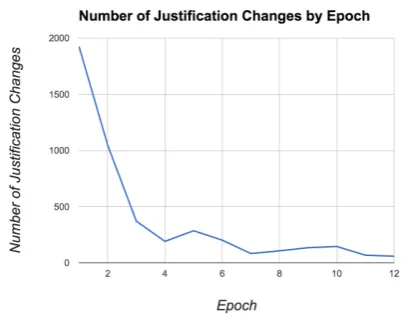
Figure 3: Number of questions for which our complete model chooses a new justification at each epoch during training. While this is for a single random seed, we see essentially identical graphs for each random initialization.
(2008), p.163), where we assigned Good justifi-cations a gain of 3.0,Half a gain of 2.0,Topicala gain of 1.0, andOff-Topica gain of 0.0. With this formulation, our system had a NDCG@5 of 0.62 while the IR baseline had a significantly lower NDCG@5 of 0.55 (p <0.001), shown in the third column of Table5.
Contribution of Learning to Rerank Justifica-tions: The main assertion of this work is that through learning to rank answers and justifications for those answer candidates in an end-to-end man-ner, we both answer questions correctly and pro-vide compelling justifications as to why the an-swer is correct. To confirm that this is the case, we also ran a version of our system that does not re-rank justifications, but uses the top-re-ranked justifi-cation retrieved by IR. This configuration dropped our performance on test to 48.7% P@1, a decrease of 4.6%, and we additionally lose all justification improvements from our system (see Section6.2), demonstrating that learning this reranking is key to our approach.
Additionally, we tracked the number of times a new justification was chosen by the model as it trained. We found that our system converges to a stable set of justifications during training, shown in Figure3.
6.3 Error Analysis
[image:8.595.72.287.65.256.2]Error Type Percent Short justification/High lexical overlap 53.3% Complex inference required 43.3%
Knowledge Base Noise 6.7%
Word order necessary 6.7%
Coverage 6.7%
Negation 3.3%
Other 6.7%
Table 6: Summary of the findings of the 30 question error analysis. Note that a given question may fall into more than one category.
Type: Short justification/High lexical overlap
Question: The length of time between night and day on Earth varies throughout the year. This time vari-ance is explained primarily by . Correct: Earth ’s angle of tilt
... the days are very short in the winter because the sun’s rays hit the earth at an extreme angle ... due to the tilt of the earth’s axis.
Chosen: Earth ’s distance from the Sun
Is light year time or distance? Distance
Table 7: Example of the system preferring a justification for which all the terms were found in either the question or an-swer candidate. (Justifications shown in italics)
in the top 5 returned by our system, but for a vari-ety of reasons, summarized in Table6, the system incorrectly ranked another justification higher.
The table shows that the most common form of error was the system’s preference for short justifi-cations with a large degree of lexical overlap with the question and answer choice itself, shown by the example in Table7. The effect was magnified when the correct answer required more explana-tion to connect the quesexplana-tion to the answer. This suggests that the system has learned that generally many unmatched words are indicative of an incor-rect answer. While this may typically be true, ex-tending the system to be able to prefer theopposite
with certain types of questions would potentially help with these errors.
Type: Complex inference required
Question: Mr. Harris mows his lawn twice each month. He claims that it is better to leave the clippings on the ground. Which long term effect will this most likely have on his lawn?
Correct: It will provide the lawn with needed nutrients. Table 8: Example of a question for which complex inference is required. In order to answer the question, you would need to assemble the event chain: cut grass left on the ground →grass decomposes→decomposed material provides nu-trients.
The second largest source of errors came from questions requiring complex inference (causal, process, quantitative, or model-based reasoning) as with the question shown in Table 8. This demonstrates not only the difficulty of the
ques-Type: Knowledge base noise
Question: If an object traveling to the right is acted upon by an unbalanced force from behind it the object
will .
Correct: speed up Chosen change direction
[image:9.595.97.290.59.143.2]Unbalanced force: force that acts on an object that will change its direction
Table 9: Example of a question for which knowledge base noise (here, in the form of over-generalization) was an issue.
tion set but also the need for systems that can ro-bustly handle a variety of question types and their corresponding information needs.
Aside from these primary sources of error, there were some smaller trends: 7% of the incorrectly chosen answers actually had justifications which “validated” them due to noise in the knowledge base (e.g., the example shown in Table9), 7% re-quired word-order to answer (e.g., mass divided by accelerationvs.acceleration divided by mass), another 7% of questions suffered from lack of cov-erage of the question concept in the knowledge base, and 3% failed to appropriately handle nega-tion (i.e., quesnega-tions of the formatWhich of the fol-lowing are NOT ...).
7 Conclusion
Here we propose an end-to-end question answer-ing (QA) model that learns to correctly answer questions as well as provide compelling, human-readable justifications for its answers, despite not having access to labels for justification quality. We do this by using the question answering task as a form of distant supervision for learning justifica-tion re-ranking. We show that our accuracy and justification quality are significantly better than a strong IR baseline, while maintaining near state-of-the-art performance for the answer selection task as well.
Acknowledgments
References
Adam Berger, Rich Caruana, David Cohn, Dayne Frey-tag, and Vibhu Mittal. 2000. Bridging the lexical chasm: Statistical approaches to answer finding. In
Proceedings of the 23rd Annual International ACM SIGIR Conference on Research & Development on Information Retrieval. Athens, Greece.
Antoine Bordes, Nicolas Usunier, Sumit Chopra, and Jason Weston. 2015. Large-scale simple ques-tion answering with memory networks. CoRR
abs/1506.02075.
Antoine Bordes, Nicolas Usunier, Alberto Garc´ıa-Dur´an, Jason Weston, and Oksana Yakhnenko. 2013. Translating embeddings for modeling multi-relational data. InNIPS.
Danqi Chen, Jason Bolton, and Christopher D. Man-ning. 2016. A thorough examination of the cnn/daily mail reading comprehension task. In As-sociation for Computational Linguistics (ACL).
Danqi Chen and Christopher D Manning. 2014. A fast and accurate dependency parser using neural net-works. InProceedings of the 2014 Conference on Empirical Methods in Natural Language Process-ing. pages 740–750.
F. Chollet. 2015. Keras. https://github.com/
fchollet/keras.
Peter Clark. 2015. Elementary school science and math tests as a driver for AI: take the Aristo challenge! In Blai Bonet and Sven Koenig, editors, Proceedings of the Twenty-Ninth AAAI Conference on Artificial Intelligence, January 25-30, 2015, Austin, Texas, USA.. AAAI Press, pages 4019–4021.
Peter Clark, Philip Harrison, and Niranjan Balasubra-manian. 2013. A study of the knowledge base re-quirements for passing an elementary science test.
InProceedings of the 2013 Workshop on Automated
Knowledge Base Construction. AKBC’13, pages
37–42.
Mark W Craven and Jude W Shavlik. 1996. Extracting tree-structured representations of trained networks.
Advances in neural information processing systems
pages 24–30.
Li Dong, Furu Wei, Ming Zhou, and Ke Xu. 2015. Question answering over freebase with multi-column convolutional neural networks. In Proceed-ings of Association for Computational Linguistics. pages 260–269.
Xiaodong He and David Golub. 2016. Character-level question answering with attention. In Pro-ceedings of the 2016 Conference on Empirical
Meth-ods in Natural Language Processing. Association
for Computational Linguistics, pages 1598–1607.
Karl Moritz Hermann, Tom´aˇs Koˇcisk´y, Edward Grefenstette, Lasse Espeholt, Will Kay, Mustafa Su-leyman, and Phil Blunsom. 2015. Teaching ma-chines to read and comprehend. InAdvances in Neu-ral Information Processing Systems (NIPS). Mohit Iyyer, Varun Manjunatha, Jordan Boyd-Graber,
and Hal Daum´e III. 2015. Deep unordered compo-sition rivals syntactic methods for text classification. InAssociation for Computational Linguistics. Peter Jansen, Niranjan Balasubramanian, Mihai
Sur-deanu, and Peter Clark. 2016. What’s in an expla-nation? characterizing knowledge and inference re-quirements for elementary science exams. In Pro-ceedings of COLING 2016, the 26th International Conference on Computational Linguistics:
Techni-cal Papers. The COLING 2016 Organizing
Commit-tee, Osaka, Japan, pages 2956–2965.
Peter Jansen, Rebecca Sharp, Mihai Surdeanu, and Pe-ter Clark. 2017. Framing qa as building and ranking intersentence answer justifications. Computational Linguistics.
Peter Jansen, Mihai Surdeanu, and Peter Clark. 2014. Discourse complements lexical semantics for non-factoid answer reranking. In Proceedings of the 52nd Annual Meeting of the Association for Com-putational Linguistics (ACL).
Tushar Khot, Ashish Sabharwal, and Peter Clark. 2017. Answering complex questions using open informa-tion extracinforma-tion. In Proceedings of Association for
Computational Linguistics (ACL).
Been Kim, Julie A. Shah, and Finale Doshi-Velez. 2015. Mind the gap: A generative approach to inter-pretable feature selection and extraction. InNIPS. Tao Lei, Regina Barzilay, and Tommi S. Jaakkola.
2016. Rationalizing neural predictions. In Proceed-ings of the 2016 Conference on Empirical Methods in Natural Language Processing.
Benjamin Letham, Cynthia Rudin, Tyler H Mc-Cormick, David Madigan, et al. 2015. Interpretable classifiers using rules and bayesian analysis: Build-ing a better stroke prediction model. The Annals of Applied Statistics9(3):1350–1371.
O. Levy and Y. Goldberg. 2014. Dependency-based word embeddings. InProceedings of the 52nd An-nual Meeting of the Association for Computational Linguistics (ACL). pages 302–308.
Jiwei Li, Xinlei Chen, Eduard Hovy, and Dan Juraf-sky. 2016. Visualizing and understanding neural models in nlp. InProceedings of the 2016 Confer-ence of the North American Chapter of the Associ-ation for ComputAssoci-ational Linguistics: Human
Lan-guage Technologies. Association for Computational
Linguistics, pages 681–691.
Christopher D Manning, Mihai Surdeanu, John Bauer, Jenny Finkel, Steven J Bethard, and David Mc-Closky. 2014. The stanford corenlp natural language processing toolkit. InProceedings of 52nd Annual Meeting of the Association for Computational Lin-guistics: System Demonstrations. pages 55–60.
Tomas Mikolov, Kai Chen, Greg Corrado, and Jeffrey Dean. 2013. Efficient estimation of word represen-tations in vector space. InProceedings of the Inter-national Conference on Learning Representations (ICLR).
Tomas Mikolov, Martin Karafiat, Lukas Burget, Jan Cernocky, and Sanjeev Khudanpur. 2010. Recurrent neural network based language model. In Proceed-ings of the 11th Annual Conference of the Interna-tional Speech Communication Association
(INTER-SPEECH 2010).
Ankur P. Parikh, Oscar T¨ackstr¨om, Dipanjan Das, and Jakob Uszkoreit. 2016. A decomposable attention model for natural language inference. In Proceed-ings of the 2016 Conference on Empirical Methods in Natural Language Processing.
Marco Ribeiro, Sameer Singh, and Carlos Guestrin. 2016. “Why Should I Trust You?”: Explaining the predictions of any classifier. InProceedings of the 2016 Conference of the North American Chap-ter of the Association for Computational
Linguis-tics: Demonstrations. Association for
Computa-tional Linguistics, pages 97–101.
Mrinmaya Sachan, Avinava Dubey, and Eric P Xing. 2016. Science question answering using instruc-tional materials. In The 54th Annual Meeting of the Association for Computational Linguistics. page 467.
Aliaksei Severyn and Alessandro Moschitti. 2012. Structural relationships for large-scale learning of answer re-ranking. InProceedings of the 35th Inter-national ACM SIGIR Conference on Research and Development in Information Retrieval.
Aliaksei Severyn and Alessandro Moschitti. 2013. Au-tomatic feature engineering for answer selection and extraction. In Proceedings of the Conference on Empirical Methods in Natural Language Processing
(EMNLP).
Aliaksei Severyn and Alessandro Moschitti. 2015. Learning to rank short text pairs with convolutional deep neural networks. In Proceedings of the 38th International ACM SIGIR Conference on Research and Development in Information Retrieval.
Aliaksei Severyn, Massimo Nicosia, and Alessandro Moschitti. 2013. Learning adaptable patterns for passage reranking. In Proceedings of the Seven-teenth Conference on Computational Natural
Lan-guage Learning (CoNLL).
Rebecca Sharp, Peter Jansen, Mihai Surdeanu, and Pe-ter Clark. 2015. Spinning straw into gold: Using free text to train monolingual alignment models for non-factoid question answering. InProceedings of the 2015 Conference of the North American Chap-ter of the Association for Computational
Linguis-tics: Human Language Technologies. Association
for Computational Linguistics, Denver, Colorado, pages 231–237.
Mihai Surdeanu, Thomas Hicks, and Marco A. Valenzuela-Esc´arcega. 2015. Two practical rhetor-ical structure theory parsers. In Proceedings of the North American Chapter of the Association for Computational Linguistics (NAACL): Software
Demonstrations.
Ming Tan, Cicero dos Santos, Bing Xiang, and Bowen Zhou. 2016. Improved representation learning for question answer matching. In Proceedings of the 54th Annual Meeting of the Association for
Compu-tational Linguistics (Volume 1: Long Papers).
As-sociation for Computational Linguistics, pages 464– 473.
Theano Development Team. 2016. Theano: A Python framework for fast computation of mathematical ex-pressions. arXiv e-printsabs/1605.02688.
Tijmen Tieleman and Geoffrey Hinton. 2012. Lecture 6.5-rmsprop: Divide the gradient by a running aver-age of its recent magnitude. COURSERA: Neural Networks for Machine Learning.
Di Wang and Eric Nyberg. 2015. A long short-term memory model for answer sentence selection in question answering. InProceedings of the 53rd An-nual Meeting of the Association for Computational Linguistics and the 7th International Joint Confer-ence on Natural Language Processing (Volume 2:
Short Papers). Association for Computational
Lin-guistics, pages 707–712.
Mengqiu Wang and Christopher Manning. 2010. Prob-abilistic tree-edit models with structured latent vari-ables for textual entailment and question answering. InProceedings of the 23rd International Conference on Computational Linguistics (Coling 2010). Coling 2010 Organizing Committee, pages 1164–1172. Matthew D. Zeiler and Rob Fergus. 2014.
Visual-izing and Understanding Convolutional Networks,