Review Article
Glucose metabolic disorder
in primary hyperparathyroidism:
a systematic review and meta-analysis
Qin Sun1*, Tao Zhang2*, Ping Chen1, Nan-Wei Tong3, Min Zhang1
1Department of Elderly Endocrinology, Sichuan Academy of Medical Sciences and Sichuan Provincial People’s
Hospital, Chengdu, Sichuan, China; 2Second Clinical Medical College, Chengdu University of Traditional Chinese
Medicine, Chengdu, Sichuan, China; 3Department of Endocrinology and Metabolism, West China Hospital,
Sich-uan University, Chengdu, SichSich-uan, China. *co-first authors.
Received March 14, 2019; Accepted July 12, 2019; Epub September 15, 2019; Published September 30, 2019
Abstract: Background: Primary hyperparathyroidism (PHPT) is associated with increased morbidity and mortality of cardiovascular disease (CVD). Studies have demonstrated that patients with PHPT have more metabolic disorders than age-matched healthy controls, which mainly include obesity, insulin resistance, dyslipidemia, hyperglycemia and hypertension. In this meta-analysis, metabolic disorders of PHPT patients were systematically reviewed. Meth-ods: Databases were searched for studies published between 2005 and 2017 that reported body mass index (BMI), insulin resistance and blood glucose in PHPT patients and healthy controls. Results: A total of nine eligible studies were identified. Compared to healthy controls, PHPT patients had higher levels of plasma insulin (SMD = 0.37, CI: 0.23~0.52, P = 0.014) and insulin resistance index (HOMA-IR) (SMD = 0.65, CI: 0.27~1.02, P = 0.009). However, BMI was not statistically different between PHPT patients and healthy controls (SMD = 0.09, CI: -0.14~0.31, P = 0.32). Although fasting blood glucose (FBG) levels of PHPT patients were similar to healthy controls (SMD = 0.06, CI: -0.36~0.47, P = 0.21), subgroup analysis showed that hypercalcemic primary hyperparathyroidism (HPHPT) pa-tients had higher FBG levels than healthy controls (SMD = 0.43, CI: 0.18~0.68, P = 0.025). Conclusions: Compared with healthy controls, PHPT patients had heavier insulin resistance, but only hypercalcemia PHPT patients had higher FBG levels. There was no significant difference in BMI between PHPT patients and healthy controls.
Keywords: Primary hyperparathyroidism, meta-analysis, insulin resistance, fasting blood glucose, body mass index
Introduction
Cardiovascular disease (CVD) leads to nearly one third of all deaths globally [1]. Plenty of risk factors are involved in the development of CVD. These risk factors mainly include hyperglyce-mia, obesity, hypertension and dyslipidemia. Additionally, insulin resistance plays an impor-tant role in CVD associated with metabolic syndrome (MetS) in obese patients [2]. As an endocrine disease with the core disorder of calcium-phosphorus metabolism, primary hy- perparathyroidism (PHPT) is mainly manifested in the mobilization of bone calcium and abnor-mal calcium deposition in the whole body. PHPT is associated with increased morbidity and mortality of CVD [3]. Recent evidence indicates that PHPT is associated with metabolic disor-ders such as glucose intolerance, obesity,
insu-lin resistance and decreased insuinsu-lin secretion, and these metabolic disorders are presumed to be the cause of increased mortality of CVD in PHPT patients [4-6]. A meta-analysis concludes that PHPT patients have a greater body weight than their eucalcemic peers, and increased body weight may contribute to the relationship between PHPT and some cardiovascular com-plications. However, other studies demonstrate a converse association [7, 8]. Therefore, stud-ies on the association between PHPT and meta-bolic disorders have yielded conflicting results. A further analysis on this association can be helpful in reducing the mortality of CVD in PHPT patients.
PHPT patients and healthy controls. In this meta-analysis, the association between PHPT and these metabolic disorders was systemati-cally evaluated.
Materials and methods
Searching strategy
Our data sources included PubMed, Medline, Embase, The Cochrane Library and Web of Science for all articles between 2005 and 2017. The following keywords were used in the online searching, including “primary hyper-parathyroidism”, “glucose”, “diabetes”, “diabe-tes mellitus”, “weight”, “obesity”, “insulin resis-tance”, “insulin” and “metabolic syndrome”. The searching was limited to English. Addi- tionally, hand searching was performed to iden-tify potentially relevant studies.
Inclusion criteria and exclusion criteria
The studies which met the following criteria were included in this meta-analysis: (1) case-control or cohort studies; (2) studies aimed at evaluating the association between PHPT and risk factors correlated with MS; (3) glucose metabolism parameters as study variables; and (4) studies providing presentation of quan-titative data (i.e., the number of cases and con-trols, mean and standard deviation).
The exclusion criteria included: (1) studies in which participants underwent parathyroidecto-my; (2) studies in which controls were selected from a population with comorbidities likely to impact MS; (3) studies that were not clear whether cases were primary hyperparathyroid-ism or secondary hyperparathyroidhyperparathyroid-ism; (4) case-only studies, review articles, commentar-ies, editorials, or case reports; (5) case groups and control groups were not comparable in age and gender.
Data extraction
Three reviewers (Qin Sun, Min Zhang and Tao Zhang) were responsible for extracting data from the selected articles independently. They compared the results and reached consisten-cies on all items. Characters extracted from the studies included year of publication, author, study type, cohort/study name, total number of cases and controls, participants’ gender,
aver-age aver-age at baseline, means of metabolic fac-tors [BMI, blood glucose, plasma insulin and insulin resistance index (HOMA-IR)] and their standard error (SE).
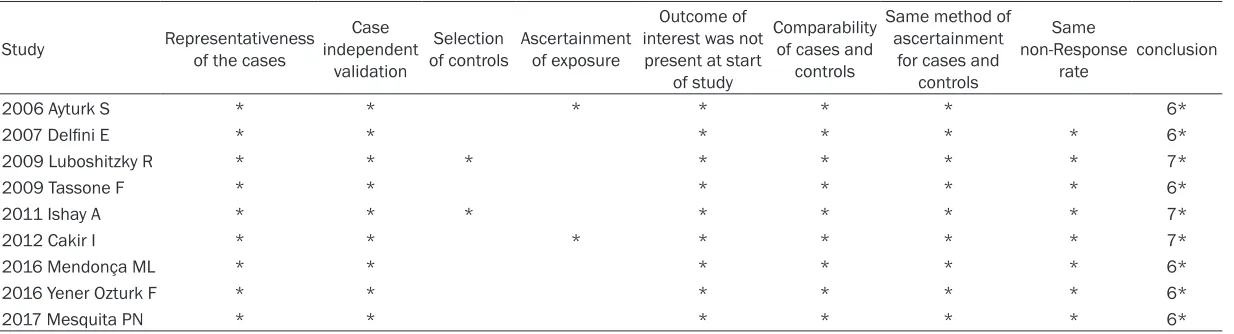
The quality of individual records was assessed with Newcastle-Ottawa quality-assessment scale [9]. Each study was assigned with 0~9 “stars” (more stars meant higher quality) by the reviewers to ensure the accuracy of extraction. This meta-analysis was conducted using STATA statistical software version 12.0 (STATA Corp LP, College Station, TX, USA). Mean differences (MD) of BMI, fasting blood glucose (FBG), fast-ing insulin and HOMA-IR were calculated for all eligible studies. Heterogeneity was evaluated through the χ2-based Cochran’s Q statistic and
I2 statistic. The percentages of I2 around 25%,
50% and 75% indicated low, medium and high heterogeneity, respectively. The fixed-effects model was used to calculate the pooled MD when there was no significant heterogeneity (P more than 0.10 and I2 less than 50%) among
the included studies; otherwise, the random-effects model was employed [10]. The potential publication bias was tested using both Begg’s rank correlation test and Egger’s linear regres-sion test [11, 12].
Results
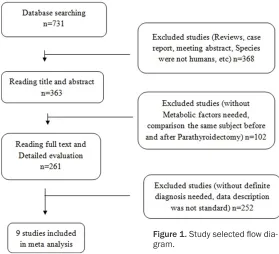
Selection of studies
patients and 455 controls. The detailed char-acteristics of the included studies are demon-strated in Table 1. Overall, the quality of the included studies was intermediate to high (Table 2).
Metabolic results in comparable groups
All nine studies reported usable data on FBG levels, and the FBG levels of the PHPT patients were similar to healthy controls (SMD = 0.06, 95% CI: -0.36~0.47, P = 0.21; I2 = 88.3%, P <
0.005). Subgroup analysis was then performed. Three studies involving 56 NPHPT patients and 64 healthy controls showed no significant dif-ference in FBG levels between NPHPT patients and healthy controls (SMD = -1.38, 95% CI: -3.89~0.45, P = 0.17; I2 = 96.6%, P < 0.005).
Five studies involving 265 HPHPT patients and 200 controls showed that HPHPT patients had higher FBG levels than healthy controls (SMD = 0.43, 95% CI: 0.18~0.68, P = 0.025; I2 = 36.1%, P = 0.181). The results are demonstrated in
Figure 2.
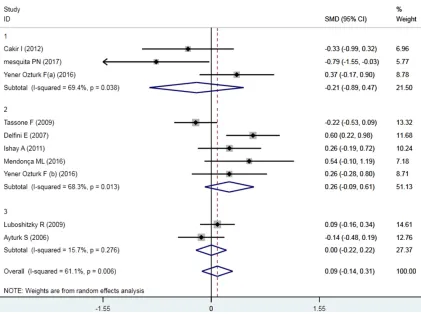
All nine studies reported usable data on BMI. Initial analysis indicated that there was no significant difference in BMI between PHPT patients and healthy controls (SMD = 0.09, 95% CI: -0.14~0.31, P = 0.32; I2 = 61.1%, P =
0.006). Subgroup analysis further showed no significant difference between BMI of NPHPT or
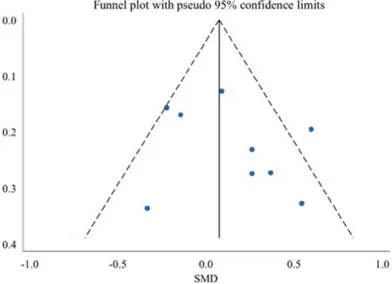
degree of asymmetry was not statistically sig-nificant as Begg’s test demonstrated (P = 0.92), which indicated a small publication bias. The results are shown in Figure 5.
Sensitivity analysis
Sensitivity analysis demonstrated that no indi-vidual significantly affected the difference of FBG levels, BMI, plasma insulin and HOMA-IR.
Discussion
As an endocrine disease with the core disorder in calcium-phosphorus metabolism, PHPT is mainly manifested in the mobilization of bone calcium and abnormal calcium deposition in the whole body [3]. Most of PHPT patients have hypercalcemia, also known as hypercalcemic primary hyperparathyroidism (HPHPT), and the others are defined as normocalcemic primary hyperparathyroidism (NPHPT) because of nor-mal blood calcium levels. Some NPHPT patients eventually develop hypercalcemia, however, other patients can maintain normal levels of blood calcium and parathyroid hormone (PTH) even when target organ damages occur, such as renal stones and osteoporosis [9, 13]. Recent evidence indicate that PHPT is also cor-related with metabolic disorders and some components of MS, such as glucose intoler-Figure 1. Study selected flow
dia-gram.
HPHPT patients and healthy controls. The results are dem-onstrated in Figure 3.
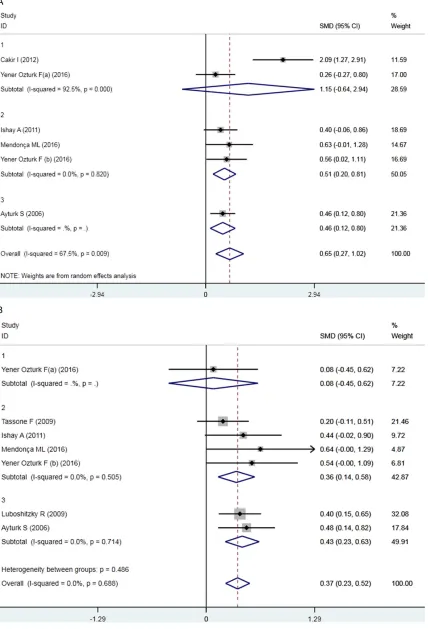
Six studies reported usable data on plasma insulin, and five studies reported usable data on HOMA-IR. Both plas-ma insulin and HOMA-IR were higher in PHPT patients than in healthy controls (plasma insulin: SMD = 0.37, 95% CI: 0.23~0.52, P = 0.014; I2 = 0%, P = 0.688; HOMA-IR: SMD = 0.65, 95% CI: 0.27~1.02, P = 0.009; I2 = 67.5%, P = 0.009).
The results are demonstrated in Figure 4A and 4B.
Publication bias
[image:3.612.92.371.72.326.2]Table 1. Study characteristics
Study Male (n, %) Age (year) PTH (pg/ml) Serum 25OHD (ng/ml) Serum Calcium (mg/dl)
PHPT Control PHPT Control PHPT Control PHPT Control PHPT Control
2006 Ayturk S 14, 22.9% 12, 15% 62.0 ± 10.0 59.8 ± 10.0 156 ± 67 52 ± 14 32.2 ± 19.9 29.9 ± 12.7 10.2 ± 0.7 9.5 ± 0.5
2007 Delfini E 11, 16.4% 10, 21.7% 57.9 ± 12.2 58.1 ± 12.9 109 ± 79.6 29 ± 2.3 - - 11.1 ± 1.1 9.4 ± 0.34 2009 Tassone F 29, 23.8% 14, 23.0% 59.3 ± 13.6 48.6 ± 14.0 203.2 ± 145.4 - - - 11.2 ± 1.0 9.2 ± 0.4 2009 Luboshitzky R 29, 20.9% 24, 21.6% 56.2 ± 11.8 55.6 ± 9.9 164.7 ± 118.0 45.2 ± 15.6 - - 10.8 ± 0.7 9.6 ± 0.4 2011 Ishay A 11, 32.4% 8, 19.1% 51.0 ± 11.8 49.9 ± 3.2 222.9 ± 189.8 48.8 ± 13.4 - - 11.2 ± 0.7 9.5 ± 0.4
2012 Cakir I - - 49.9 ± 2.4 48.3 ± 1.8 148.6 ± 19.0 49.5 ± 2.2 54.5 ± 12.4 - 9.7 ± 0.1 9.2 ± 0.1
2016 Mendonça ML - - 51.1 ± 11.3 50.1 ± 9.4 459.8 ± 462.2 44.5 ± 16.7 18.3 ± 4.8 24.7 ± 3.9 11.9 ± 1.1 9.6 ± 0.7 2017 Mesquita PN - - 65.15 ± 7.71 61.06 ± 7.65 100.58 ± 29.83 30.26 ± 12.0 35.32 ± 8.42 26.11 ± 8.9 9.28 ± 1.05 8.28 ± 0.45
2016 Yener Ozturk F
HPHPT 2, 8% 9, 30% 52.88 ± 11.71 53.63 ± 7.43 91.61 ± 17.31 47.84 ± 9.49 17.04 ± 11.32 - 9.71 ± 0.34 9.58 ± 0.32 NPHPT 4, 16.7% 9, 30% 56.63 ± 12.70 53.63 ± 7.43 170.28 ± 111.26 47.84 ± 9.49 13.51 ± 9.01 - 11.52 ± 1.30 9.58 ± 0.32
PTH: parathyroid hormone, 25OHD: 25-hydroxyvitamin D, PHPT: Primary hyperparathyroidism patients, HPHPT: hypercalcemic primary hyperparathyroidism group, NPHPT: normocalcemic primary hyperparathyroidism group.
Table 2. Study quality
Study Representativeness of the cases independent Case validation
Selection
of controls Ascertainment of exposure
Outcome of interest was not
present at start of study
Comparability of cases and
controls
Same method of ascertainment
for cases and controls
Same non-Response
rate conclusion
2006 Ayturk S * * * * * * 6*
2007 Delfini E * * * * * * 6*
2009 Luboshitzky R * * * * * * * 7*
2009 Tassone F * * * * * * 6*
2011 Ishay A * * * * * * * 7*
2012 Cakir I * * * * * * * 7*
2016 Mendonça ML * * * * * * 6*
2016 Yener Ozturk F * * * * * * 6*
2017 Mesquita PN * * * * * * 6*
[image:4.792.91.708.281.448.2]Figure 2. SMD in FBG in studies of PHPT and eucalcemic controls.
[image:5.612.93.514.398.712.2]ance, obesity, insulin resistance and reduced insulin secretion [19]. In addition, PHPT is cor-related with an increased risk of diabetes, car-diovascular mortality and stroke [6]. A meta-analysis has indicated that weight gain can elevate cardiovascular mortality [20]. However, until now no meta-analysis studies have been performed to assess the association between PHPT and other components of MS, such as glucose intolerance and insulin resistance. In this paper, we used meta-analysis to determine the difference in insulin resistance, insulin lev-els, BMI and glucose between patients with PHPT and healthy controls. To our knowledge, this was the first meta-analysis analyzing these metabolic disorders in patients with PHPT. Our results demonstrated no significant differ-ence in BMI between PHPT patients and healthy controls, which was inconsistent with the results of Bolland’s study [20]. This is likely explained by the fact that BMI was used as the criteria for obesity instead of body weight which was used in Bolland’s study. Furthermore, con-trols with matched body weight were used in all of the nine studies that were included in our meta-analysis in order to reduce confounding effects of body weight on insulin resistance and other metabolic disorders. Although no sig-nificant difference was found in BMI between PHPT and controls, PHPT patients had an aver-age BMI greater than 25 in all nine studies included in our meta-analysis, and BMI greater than 28 was seen in six studies. Therefore, we could not conclude that there was no signifi-cant difference in obesity between patients with PHPT and healthy controls. In consider-ation of an average BMI greater than 25 in all
the included studies, it was likely that PHPT patients tended to be overweight or even obese [21].
Our results also showed that insulin resistance was more sever in PHPT patients than in healthy controls according to fasting plasma insulin and HOM-IR. This difference in insulin resis-tance was independent of body weight because body weight was matched between groups. Subsequent subgroup analysis indicated that insulin resistance was more sever in both HPHPT and NPHPT than in healthy controls. Overweight or obese PHPT patients tend to have insulin resistance, and these patients may have abnormal glucose levels. Although not widely accepted, FBG levels of PHPT patients were shown to be elevated in some studies. In our study, no significant difference was found in FBG between PHPT patients and controls. However, subgroup analysis showed that FBG was significantly elevated in HPHPT patients compared with healthy controls, while no significant difference was shown between NPHPT patients and healthy controls. This sup-ports the speculation that hypercalcemia may be responsible for hyperglycemia in hyperpara-thyroidism [22, 23].
A critical question that arises from this study is the mechanism of the association between PHPT and body weight. The causal relationship can make sense in either direction. There is evi-dence that hypercalcemia or increased intra-cellular calcium concentrations in adipocytes cause insulin resistance and inhibits lipolysis in NPHPT patients [24], and PTH elevates intracel-lular calcium in many cell types [25, 26]. It is also possible that PTH influences adipocyte dif-ferentiation, because PTH acts directly on osteoblasts [26, 27]. These observations imply that increased PTH leads to increased fat mass, which induces increased insulin resis-tance. Therefore, insulin resistance may be a consequence of PHPT, and is likely to be cor-rected by parathyroidectomy [28-30].
[image:7.612.91.287.74.216.2]An alternative explanation for our findings is that increased body weight is involved in the development of PHPT. In many cases, 25-hydroxyvitamin D levels are inversely corre-lated with body weight, probably because vita-min D is sequestered by adipose tissue and is fat soluble [31]. Thus, increased body weight Figure 5. Begger’s funnel plot of publication bias for
may result in deficiency of vitamin D, which increases the risk of developing parathyroid adenomata [32, 33]. Leptin is mainly secreted by the white adipose tissue, and its circulating levels are positively correlated with fat mass. Studies demonstrate that the leptin receptor exists in the cytoplasm of the parathyroid chief cells, and high leptin levels in obese people may increase PTH secretion from the parathy-roid chief cells [34, 35].
Hyperglycemia occurs gradually along with functional defects of Islet β-cells induced by insulin resistance [36]. NPHPT is thought to be the early stage of PHPT and will progress into HPHPT in some cases [37]. Normal blood glu-cose level in NPHPT is likely explained by the fact that impairment of Islet β-cell function due to insulin resistance is relatively mild during the early stage of PHPT. Hyperglycemia may devel-op when Islet β-cell function is substantially impaired because of long term insulin resis-tance in HPHPT.
Parathyroidectomy is an effective treatment for PHPT patients, and normalization of PTH and blood calcium levels is considered an indicator of successful surgery. According to current guidelines, parathyroidectomy is recommend-ed for HPHPT patients, whilst close follow-up is an option for NPHPT patients without complica-tions such as ectopic calcium precipitation, renal stones and loss of bone mass, or NPHPT patients who are reluctant to undergo surgery [3, 13]. The findings of our study demonstrated that NPHPT patients had increased risk of obe-sity and insulin resistance, which could elevate cardiovascular mortality. Therefore, it might be recommended that NPHPT patients have timely parathyroidectomy at the early stage, i.e. prior to development of obesity and insulin resistance.
Beyond doubt, our study had some limitations. A meta-analysis could not solve inherent con-founding problems in the included studies, which might underestimate or exaggerate the effects. There was a lack of available robust tri-als and it is a challenge to extract reported data from the included studies. Not all identified studies were included because of different units and scales and difficulty in sourcing the required data from the original authors. The inability to acquire missing data from all eligible
studies was not unexpected and an understood part of the meta-analysis process. However, missing data and a small sample size limited evidence synthesis and the meta-analysis to some extent. Despite these limitations, this study considerably enriched our understanding of the association between PHPT and meta- bolic disorders by demonstrating that PHPT patients had obesity, impaired glucose toler-ance and insulin resisttoler-ance.
In conclusion, compared with healthy controls, PHPT patients had greater insulin resistance, but only hypercalcemia PHPT patients had higher FBG. There was no significant difference in BMI between PHPT patients and healthy controls.
Disclosure of conflict of interest
None.
Address correspondence to: Nan-Wei Tong, De- partment of Endocrinology and Metabolism, West China Hospital, Sichuan University, No. 37, National School Lane, Wuhou District, Chengdu 610041, Sichuan, China. Tel: +86-028-85422039; E-mail: [email protected]; Min Zhang, Department of El- derly Endocrinology, Sichuan Academy of Medical Sciences and Sichuan Provincial People’s Hospital, No. 32, West Two Section of The First Ring Road, Qingyang District, Chengdu 610072, Sichuan, China. Tel: +86-028-61362239; E-mail: 1946212398@ qq.com
References
[1] Al-Mallah MH, Sakr S and Al-Qunaibet A. Car-diorespiratory fitness and cardiovascular dis-ease prevention: an update. Curr Atheroscler Rep 2018; 20: 1.
[2] Nikolopoulou A and Kadoglou NP. Obesity and metabolic syndrome as related to cardiovascu-lar disease. Expert Rev Cardiovasc Ther 2012; 10: 933-939.
[3] Wilhelm SM, Wang TS, Ruan DT, Lee JA, Asa SL, Duh QY, Doherty GM, Herrera MF, Pasieka JL, Perrier ND, Silverberg SJ, Solórzano CC, Sturgeon C, Tublin ME, Udelsman R and Carty SE. The American association of endocrine surgeons guidelines for definitive manage-ment of primary hyperparathyroidism. JAMA Surg 2016; 151: 959-968.
hy-percalcemic patients. Endocr J 2016; 63: 111-118.
[5] Mendonça ML, Batista SL, Nogueira-Barbosa MH, Salmon CE and Paula FJ. Primary hyper-parathyroidism: the influence of bone marrow adipose tissue on bone loss and of osteocalcin on insulin resistance. Clinics (Sao Paulo) 2016; 71: 464-469.
[6] Pepe J, Cipriani C, Sonato C, Raimo O, Biamon-te F and Minisola S. Cardiovascular manifesta-tions of primary hyperparathyroidism: a narra-tive review. Eur J Endocrinol 2017; 177: R297-R308.
[7] Tassone F, Procopio M, Gianotti L, Visconti G, Pia A, Terzolo M and Borretta G. Insulin resis-tance is not coupled with defective insulin se-cretion in primary hyperparathyroidism. Diabet Med 2009; 26: 968-973.
[8] Mesquita PN, Dornelas Leão Leite AP, Chagas Crisóstomo SD, Veras Filho E, da Cunha Xavier L and Bandeira F. Evaluation of coronary calci-um score in patients with normocalcemic pri-mary hyperparathyroidism. Vasc Health Risk Manag 2017; 13: 225-229.
[9] Kiriakopoulos A, Petralias A and Linos D. Clas-sic primary hyperparathyroidism versus nor-mocalcemic and normohormonal variants: do they really differ? World J Surg 2018; 42: 992-997.
[10] Higgins JP and Thompson SG. Quantifying het-erogeneity in a meta-analysis. Stat Med 2002; 21: 1539-1558.
[11] Begg CB and Mazumdar M. Operating charac-teristics of a rank correlation test for publica-tion bias. Biometrics 1994; 50: 1088-1101. [12] Egger M, Davey Smith G, Schneider M and
Minder C. Bias in meta-analysis detected by a simple, graphical test. BMJ 1997; 315: 629-634.
[13] Bilezikian JP, Khan AA, Potts JT Jr; Third Inter-national Workshop on the Management of As-ymptomatic Primary Hyperthyroidism. Guide-lines for the management of asymptomatic primary hyperparathyroidism: summary state-ment from the third international workshop. J Clin Endocrinol Metab 2009; 94: 335-339. [14] Delfini E, Petramala L, Caliumi C, Cotesta D, De
Toma G, Cavallaro G, Panzironi G, Diacinti D, Minisola S, D’ Erasmo E, Mazzuoli GF and Letizia C. Circulating leptin and adiponectin levels in patients with primary hyperparathy-roidism. Metabolism 2007; 56: 30-36. [15] Ishay A, Herer P and Luboshitzky R. Effects of
successful parathyroidectomy on metabolic cardiovascular risk factors in patients with se-vere primary hyperparathyroidism. Endocr Pract 2011; 17: 584-590.
[16] Cakir I, Unluhizarci K, Tanriverdi F, Elbuken G, Karaca Z and Kelestimur F. Investigation of in-sulin resistance in patients with
normocalce-mic primary hyperparathyroidism. Endocrine 2012; 42: 419-422.
[17] Luboshitzky R, Chertok-Schaham Y, Lavi I and Ishay A. Cardiovascular risk factors in pri- mary hyperparathyroidism. J Endocrinol Invest 2009; 32: 317-321.
[18] Ayturk S, Gursoy A, Bascil Tutuncu N, Ertugrul DT and Guvener Demirag N. Changes in insulin sensitivity and glucose and bone metabolism over time in patients with asymptomatic pri-mary hyperparathyroidism. J Clin Endocrinol Metab 2006; 91: 4260-4263.
[19] Mendoza-Zubieta V, Gonzalez-Villaseñor GA, Vargas-Ortega G, Gonzalez B, Ramirez-Rente-ria C, Mercado M, Molina-Ayala MA and Fer-reira-Hermosillo A. High prevalence of meta-bolic syndrome in a mestizo group of adult patients with primary hyperparathyroidism (PHPT). BMC Endocr Disord 2015; 15: 16. [20] Bolland MJ, Grey AB, Gamble GD and Reid IR.
Association between primary hyperparathy-roidism and increased body weight: a meta-analysis. J Clin Endocrinol Metab 2005; 90: 1525-1530.
[21] Mathus-Vliegen L, Toouli J, Fried M, Khan AG, Garisch J, Hunt R, Fedail S, Štimac D, Lemair T, Krabshuis J, Kaufmann P, Roberts E and Ric-cardi G; World Gastroenterology Organization. World gastroenterology organisation global guidelines on obesity. J Clin Gastroenterol 2012; 46: 555-561.
[22] Raufman JP, Singh L and Zakai MD. Prosta-glandins do not mediate the actions of cholera toxin on pancreatic acini or gastric chief cells from the guinea pig. J Cell Physiol 1991; 146: 81-85.
[23] Taylor WH and Khaleeli AA. Coincident diabe-tes mellitus and primary hyperparathyroidism. Diabetes Metab Res Rev 2001; 17: 175-180. [24] McCarty MF and Thomas CA. PTH excess may
promote weight gain by impeding catechol-amine-induced lipolysis-implications for the impact of calcium, vitamin D, and alcohol on body weight. Med Hypotheses 2003; 61: 535-542.
[25] Civitelli R. Parathyroid hormone control of in-tracellular calcium. J Endocrinol Invest 1992; 15 Suppl 6: 35-41.
[26] Reid IR, Civitelli R, Halstead LR, Avioli LV and Hruska KA. Parathyroid hormone acutely ele-vates intracellular calcium in osteoblastlike cells. Am J Physiol 1987; 253: E45-51.
[27] Dorheim MA, Sullivan M, Dandapani V, Wu X, Hudson J, Segarini PR, Rosen DM, Aulthouse AL and Gimble JM. Osteoblastic gene expres-sion during adipogenesis in hematopoietic supporting murine bone marrow stromal cells. J Cell Physiol 1993; 154: 317-328.
resis-tance index in patients with primary hyperpara-thyroidism. Indian J Surg 2017; 79: 101-105. [29] Putnam R, Dhibar DP, Varshney S, Behera A,
Mittal BR, Bhansali A, Rao SD and Bhadada SK. Effect of curative parathyroidectomy on in-sulin resistance. Indian J Endocrinol Metab 2016; 20: 784-789.
[30] Cvijovic G, Micic D, Kendereski A, Milic N, Zoric S, Sumarac-Dumanovic M, Stamenkovic-Pej- kovic D, Polovina S, Jeremic D and Gligic A. The effect of parathyroidectomy on insulin sensitiv-ity in patients with primary hyperparathyroid-ism-an never ending story? Exp Clin Endocrinol Diabetes 2015; 123: 336-341.
[31] Andersen S, Noahsen P, Rex KF, Fleischer I, Al-bertsen N, Jørgensen ME, Schæbel LK and Laursen MB. Serum 25-hydroxyvitamin D, cal-cium and parathyroid hormone levels in Native and European populations in Greenland. Br J Nutr 2018; 119: 391-397.
[32] Haddad JG, Walgate J, Min C and Hahn TJ. Vita-min D metabolite-binding proteins in human tissue. Biochim Biophys Acta 1976; 444: 921-925.
[33] Bell NH, Epstein S, Greene A, Shary J, Oex-mann MJ and Shaw S. Evidence for alteration of the vitamin D-endocrine system in obese subjects. J Clin Invest 1985; 76: 370-373. [34] Polyzos SA, Duntas L and Bollerslev J. The
in-triguing connections of leptin to hyperparathy-roidism. Endocrine 2017; 57: 376-387. [35] Cheng SP, Doherty GM, Chang YC and Liu CL.
Leptin: the link between overweight and pri-mary hyperparathyroidism? Med Hypotheses 2011; 76: 94-96.
[36] Chen C, Cohrs CM, Stertmann J, Bozsak R and Speier S. Human beta cell mass and function in diabetes: recent advances in knowledge and technologies to understand disease pa- thogenesis. Mol Metab 2017; 6: 943-957. [37] Babwah F and Buch HN. Normocalcaemic