Proceedings of the 23rd Conference on Computational Natural Language Learning, pages 550–562 550
KnowSemLM
: A Knowledge Infused Semantic Language Model
Haoruo Peng1, Qiang Ning1, Dan Roth1,2 Department of Computer Science
1University of Illinois at Urbana-Champaign, Urbana, IL 61801, USA
2University of Pennsylvania, Philadelphia, PA 19104, USA
{hpeng7,qning2}@illinois.edu, [email protected]
Abstract
Story understanding requires developing ex-pectations of what events come next in text. Prior knowledge – both statistical and declar-ative – is essential in guiding such expecta-tions. While existing semantic language mod-els (SemLM) capture event co-occurrence in-formation by modeling event sequences as se-mantic frames, entities, and other sese-mantic units, this paper aims at augmenting them with causal knowledge (i.e., one event is likely to lead to another). Such knowledge is mod-eled at the frame and entity level, and can be obtained either statistically from text or stated declaratively. The proposed method,
KnowSemLM1, infuses this knowledge into a semantic LM by joint training and inference, and is shown to be effective on both the event cloze test and story/referent prediction tasks.
1 Introduction
Natural language understanding requires a coher-ent understanding of a series of evcoher-ents or actions in a story. In story comprehension, we need to under-stand not only what events have appeared in text, but also what is likely to happennext. While event extraction has been well studied (Ji and Grishman, 2008; Huang and Riloff, 2012; Li et al., 2013; Peng et al., 2016; Nguyen et al., 2016; Nguyen and Grishman, 2016), the task of predicting fu-ture events (Radinsky et al., 2012; Radinsky and Horvitz,2013) has received less attention.
One perspective is to utilize the co-occurrence information between past and future events learned from a large corpus, which has been stud-ied in script learning works (Chambers and Ju-rafsky,2008;Pichotta and Mooney,2014,2016a; Peng and Roth,2016;Peng et al.,2017). However, only considering co-occurrence information is not
1Related resources refer to https://cogcomp.
seas.upenn.edu/page/publication_view/886.
sufficient for modeling event sequences in natural language. Human decisions on the likelihood of a specific event depend on bothlocal context– what has happened earlier in text – andglobal context
– knowledge gained from human experience. This paper leverages both thelocalandglobalcontext information to model event sequences, and shows that it can lead to more accurate predictions of fu-ture events. For example, the following text snip-pet describes a scenario of someone taking a flight:
... I checked in at the counter, took my luggage to the security area, got cleared ten minutes in ad-vance, and waited for my plane ...
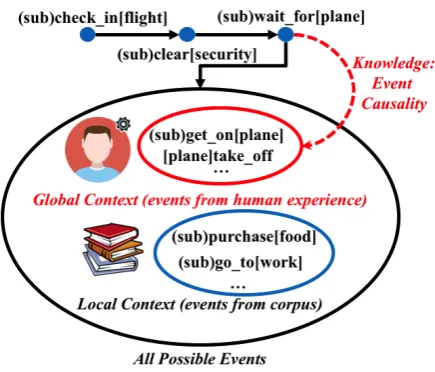
This example consists of a series of events, i.e., “check in (a flight)”, “be cleared (at the secu-rity)”, “wait for (the plane)”, etc., which humans who have traveled by plane are very familiar with. However, this event sequence appears infrequently in text.2 Consequently, only relying on event co-occurrence in text is not sufficient – there is also a need to model some “common sense” information. The local and global contexts in this ex-ample are illustrated in Figure 1. The ex-isting event sequence is “(sub)check in[flight]”, “(sub)clear[security]” and “(sub)wait for[plane]” (denoted by blue dots), where “sub” means subject. Language models (LM) for statisti-cal co-occurrences of events can capture this lo-cal context and generate a distribution over all possible events, e.g., “(sub)purchase[food]” and “(sub)go to[work]”, as in the blue circle.
More importantly, global context is the knowl-edge of event causality learned from human ex-perience in the form of “cause-effect” event pairs (i.e., one event leads to another). One such pair is represented as “(sub)wait for[plane] ⇒
2The events “check in” and “be cleared” only co-occur
Figure 1:Local and global context information when modeling event sequences. The blue dots are events that are already described in text. The blue circle indi-cates local context, i.e., event sequences inferred from a large corpus via semantic LMs; the red circle repre-sents global context, i.e., events learned from human experience via knowledge of event causality (which may overlap with local context). For event represen-tations, we abstract over the surface forms of semantic frames and entities, where “sub” represents the shared common subject. The proposed KnowSemLM lever-ages both information to better predict future events.
(sub)get on[plane]”, which means that one has to wait for a plane before getting on it (red dashed arrow in Figure 1). Global context, as a result, helps generate a distribution over a focused set of expected events, as in the red circle. Note that the causality links have directions, and one event might lead to multiple possible events, e.g., one has to wait for the plane before it takes off “(sub)wait for[plane] ⇒ [plane]take off”. Such connections can be viewed as temporal relations. Here, we consider causality to include tempo-ral orderings of events which align with common sense. More discussions are provided in Sec. 6.
Thus, we propose KnowSemLM, a knowledge infused semantic language model. It combines knowledge from external sources (in the form of event causality) with the basic semantic LM (Peng et al., 2017) trained on a given text corpus. Our model is a generative model of events, where each event is either generated based on a piece of knowledge or generated from the semantic LM. When predicting future events at inference time, we generate two distributions over events: one from the given knowledge, and the other from the semantic LM. We also learn a binary variable that selects the distribution from which we take the
next event. In this way, the proposedKnowSemLM has the ability to generate event sequences based on both local and global context, and better imitate the story generation process.
This knowledge infused semantic LM operates on abstractions over the surface form – semantic frames and entities. We associate each semantic unit (frames and entities) with an embedding and construct a joint embedding space for each event. We trainKnowSemLM on a large corpus and use the same embedding setting for events involved in the knowledge. The event causality knowledge is mined either statistically from the training corpus or declaratively for constrained domains (both in the form of event pairs). In the statistical way, we utilize a set of discourse connectives to identify “cause-effect” event pairs and filter them based on their counts; if provided with event templates for specific domains, we also manually write down such pairs based on human experience. In both ways, we further enrich the knowledge base by considering transitivity among event pairs.
We evaluateKnowSemLMon two tasks – event cloze test and story/referent predictions. In both cases, we model text as a sequence of events and apply trainedKnowSemLM to calculate con-ditional probabilities of future events given text and knowledge. We show that KnowSemLM can outperform competitive results from models with no such knowledge. In addition, we demonstrate the language modeling ability of KnowSemLM through quantitative and qualitative analysis.
The main contributions can be summarized as follows: 1) formulation of knowledge used in story generation as event causality; 2) pro-posal of KnowSemLM to integrate such event causality knowledge into semantic language mod-els; 3) demonstration of the effectiveness of KnowSemLMvia multiple benchmark tests.
The rest of the paper is organized as follows. We define how we model events and event causal-ity knowledge in Sec. 2, followed by the descrip-tion of the knowledge infusedKnowSemLM(Sec. 3). The training procedure ofKnowSemLMis de-tailed in Sec. 4, followed by our experimental re-sults and analysis (Sec. 5) and related work (Sec. 6). We conclude in Sec. 7.
2 Event and Knowledge Modeling
event causality model used in this paper.
2.1 Event Representation
To preserve the full semantic meaning of events, we need to consider multiple semantic aspects: semantic frames, entities, and sentiments. We adopt the event representation proposed in Peng et al.(2017), which is built upon abstractions of three basic semantic units: (disambiguated) se-mantic frames, subjects & objects in such seman-tic frames, and sentiments of the frame text.
In a nutshell, the event representation is a com-bination of the above three semantic elements.
... Steven Avery committed murder. He was ar-rested, charged and tried ...
For example, the event representations of the above text would be (four separate events):
PER[new]-commit.01-ARG[new](NEG) ARG[new]-arrest.01-PER[old](NEU) ARG[new]-charge.05-PER[old](NEU) ARG[new]-try.01-PER[old](NEG)
Here, “commit.01”, “arrest.01” and so on rep-resent disambiguated predicates (“01” and “05” refer to the disambiguated senses in VerbNet). The arguments (subject and object) of a predi-cate are denoted with NER types (“PER, LOC, ORG, MISC”) or “ARG” if unknown, along with a “[new/old]” label indicating if it is the first appear-ance in the sequence. Additionally, the sentiment of a frame is represented as positive (POS), neural (NEU), or negative (NEG).
We formally define such an explicit and ab-stracted event as e. Computationally, the vector representation of an event evec is built in a joint semantic space:
evec =Wfrf +Were+Wsrs.
During language model training, we learn frame embeddingsWf (rf, re, rsare one-hot vectors for each unique frame, entity and sentiment abstrac-tion, respectively) as well as the transforming ma-tricesWeandWs.
2.2 Knowledge: Causality between Events
We model the knowledge gained from human ex-perience as pre-determined relationship between events. Since we are modeling event sequences, the knowledge of one event leads to another is very important, hence event causality. We formally de-fine a piece of event knowledge as
ex⇒ey,
meaning that theoutcomeeventeyis a possible re-sult of thecausaleventex. Note that event causal-ity here is directional, and one event may lead to multiple different outcomes. We group all event knowledge pairs with the same causal event, thus eventexcan lead to a set of events:
ex⇒ {ey1, ey2, ey3,· · ·, eym}.
We store all such event causality structures in a knowledge base KBEC.
3 Knowledge Infused SemLM
With a proper modeling of events and event causality above, this section explains the pro-posed KnowSemLM, a method to inject causal-ity knowledge into a semantic LM. Specifically, KnowSemLM is based on FES-RNNLM ( Frame-Entity-Sentiment infused Recurrent Neural Net Language Model) proposed inPeng et al.(2017). We briefly review FES-RNNLM and describe how KnowSemLMadds knowledge on top of it.
3.1 FES-RNNLM
To model semantic sequences and train the joint event representations in Sec. 2.1, we build neural language models over such sequences.Peng et al. (2017) uses Log-Bilinear Language model (Mnih and Hinton, 2007), but since we require the use of event causality knowledge to be based on past events, we choose to implement an RNN language model (RNNLM) where the generation of future events is only dependent on past events.
For ease of explanation, we denote a seman-tic sequence of joint event representations as [e1, e2,· · · , et], withetbeing the tth event in the sequence. Thus, we model the conditional proba-bility of an eventetgiven its context as
plm(et|e1,· · ·, et−1) =softmax(Wsht+bs)
= exp(e
vec
t (Wsht+bs))
P
e∈Vexp(evec(Wsht+bs)) .
Note that the softmax operation is carried out over the event vocabularyV, i.e., all possible events in the language model. Moreover, the hidden layer
ht in RNN is computed as: ht = φ(evect Wi + ht−1Wh+bh), whereφis the activation function. For language model training, we learn parameters
Ws, bs, Wi, Wh, and bh, and maximize the se-quence probabilityQk
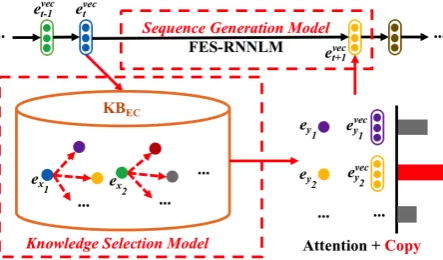
Figure 2: Overview of the computational workflow for the proposed KnowSemLM. There are two key components: 1) a knowledge selection model, which activates the use of knowledge based on probabilisti-cally matching causal event and produce a distribution over outcome events via attention; 2) a sequence gen-eration model, which takes input from both the knowl-edge selection model and the base semantic language model (FES-RNNLM) to generate future events via a copying mechanism. Note that the single dots indicate explicit event representations while three consecutive dots stand for event vectors.
3.2 KnowSemLM
In Figure 2, we show the computational work-flow of the proposedKnowSemLM. There are two key components: 1) a knowledge selection model, which activates the use of knowledge based on probabilistically matching causal events and pro-duces a distribution over outcome events; 2) a se-quence generation model, which takes input from both the knowledge selection model and the base semantic language model (FES-RNNLM) to gen-erate future events via a copying mechanism.3
Knowledge Selection Model
For an event in the sequenceet, we first match it with possible causal events{ex}in the knowledge base KBECbased on the bi-focal attention of pre-vious events. Thus, from the knowledge base, we get a list of outcome eventsVy ,{ey1, ey2,· · · }.
Computationally, we model the conditional probability of matching with causal eventex and outcome eventey from knowledge base given the context ofe1, e2,· · ·, etas
pkn(ex⇒ey|e1, e2,· · ·, et)
= exp(e
vec
x Waht) exp(evecy Wbht)
P
e∈Vx,e0∈Vyexp(e
vecW
aht) exp(e0vecWbht) .
3The proposed computational framework ofKnowSemLM is similar to DynoNet proposed inHe et al.(2017). Compared to DynoNet, the knowledge base utilized here operates on event level representations rather than on tokens.
Here, we use the bi-focal attention mecha-nism (Nema et al.,2018) via attention parameters
Wa, Wb, and apply it on the hidden layerht, which embeds information from all previous events in the sequence. Therefore, we produce a distribution over the set of possible outcome eventsVy. Sequence Generation Model
The base semantic LM produces a distribution over events from the language model vocabulary, which representslocal context, while the knowl-edge selection model generates a set of outcome events with a probability distribution, which rep-resents global context of event causality knowl-edge. The sequence generation model then com-bines the local and global context for generat-ing future events. Therefore, we model the con-ditional probability of event et+1 given context p(et+1|Context) = p(et+1|e1, e2,· · ·, et,KBEC). This overall distribution is computed via a copy-ing mechanism (Jia and Liang,2016), i.e., we ei-ther generate the next event (ei) from the language model vocabulary (V) or copy from the outcome event set (ey) based on the following probabilities:
(
p(et+1 =ei ∈ V|Context) = (1−λ)plm(ei)
p(et+1 =ey ∈ Vy|Context) =λpkn(ey).
Here, λis a learned scaling parameter to choose between events from LM vocabularyV and events from event causality knowledge base KBEC.
4 Construction ofKnowSemLM
4.1 Dataset and Preprocessing
Dataset:We use the New York Times (NYT) Cor-pus4(from year 1987 to 2007) as the training cor-pus. It contains over 1.8M documents in total.
Preprocessing: We preprocess all training doc-uments with Semantic Role Labeling and Part-of-Speech tagging. We also implement the ex-plicit discourse connective identification module of a shallow discourse parser (Song et al.,2015). Additionally, we utilize within-document entity co-reference (Peng et al., 2015a) to produce co-reference chains and get the anaphoricity informa-tion. To obtain all annotations, we use the Illinois NLP tools (Khashabi et al., 2018).5 Further, we obtain event representations from text with frame, entity and sentiment level abstractions by follow-ing procedures described inPeng et al.(2017).
4
https://catalog.ldc.upenn.edu/ LDC2008T19
4.2 Knowledge Mining
Statistical Way: Part of the human knowledge can be mined from text itself. Since discourse con-nectives are important for relating different text spans, we carefully select discourse connectives which can indicate a “cause-effect” situation. For example, “The police arrested Jack because he killed someone.” In this sentence, readers can gain the knowledge of “the person who kills shall be arrested”, which can be represented as “PER[*]-kill.01-*[*](*)⇒*[*]-arrest.01-PER[old](*)” ac-cording to the abstractions specified in Sec. 2.
In practice, we choose 22 “cause-effect” con-nectives/phrases (such as “because”, “due to”, “in order to”). We then extract all event pairs con-nected by such connectives from the NYT train-ing data, and abstract over their surface forms to get the event level representations. Finally, we fil-ter cases where the direction of the event causal-ity pairs is unclear from a statistical standpoint. Specifically, we calculate the ratio of counts of one direction over another, i.e. θ = #(ex⇒ey)
#(ey⇒ex).
Ifθ > 2, then we storeex ⇒ ey as knowledge; whileθ <0.5, we only keepey ⇒ex. In the case of0.5< θ <2, we filter both event causality pairs since we are unsure of the knowledge statistically. After the above filtering procedures, we auto-matically get 8,293 different pairs of event pairs (without human efforts). According to Sec. 2, we merge them if they have the same causal event, i.e.
ex ⇒ ey andex ⇒ ez becomesex ⇒ {ey, ex}. Thus, we get a total of 2,037 causal events (trees); and on average, each causal event has 4 possible outcome events. Furthermore, those event pairs of knowledge defined in this work are transitive, e.g., if e1 ⇒ e2 ande2 ⇒ e3, then we can have
e1 ⇒ e3. Considering thistransitivity, we iterate
over all pairs twice, and derive more event causal-ity pairs, achieving a total number of 9,022.6
Declarative Way:Besides mining knowledge au-tomatically from text corpus, we also take full advantage of human input in some practical sit-uations. For the InScript Corpus (Modi et al., 2017), it specifies 10 everyday scenarios, e.g., “Bath”, “Flight”, “Haircut”. In each scenario, the corpus also provides event templates and the corresponding event template annotations for the text. Examples of such generated event
causal-6We do not further carry out the transitivity expansion
process, since empirically the noise it introduces outweighs the benefits it brings (see Sec. 5.4 for details).
Method Accuracy
Granroth-Wilding and Clark(2016) 49.57%
Wang et al.(2017) 55.12%
KnowSemLMw/o knowledge 39.23%
KnowSemLMw/o transit. & fine-tuning 43.56%
KnowSemLMw/o fine-tuning 45.28%
[image:5.595.314.516.64.143.2]KnowSemLM 56.27%
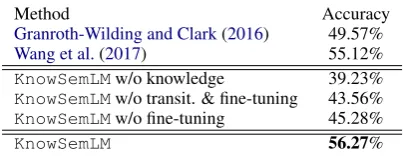
Table 1: Accuracy results for the event cloze task.
KnowSemLMoutperforms previously reported results and we show the ablation study results for model with-out the use of knowledge (w/o knowledge), withwith-out the use of knowledge transitivity as described in Sec 4.2 (w/o transit.) and without fine-tuning on the dev data (w/o fine-tuning), resepctively.
ity knowledge can be referred back to Sec. 1, e.g., “(sub)wait for[plane]⇒(sub)get on[plane]”. In total, we manually generate 875 event causal-ity pairs and group them with 121 causal events. Here, since during the manual generation process, we try to cover all event causality knowledge that makes sense; we do not further apply the transitive property and expand.
4.3 Model Training
Based on the formulation in Sec. 3, we apply the overall sequence probability as the objective:
Qk
t=1p(et|e1, e2,· · ·, et−1,KBEC).wherekis the sequence length. For the sequence generation model, we implement the Long Short-Term Mem-ory (LSTM) network with a layer of 64 hidden units while the dimension of the input event vec-tor representation is 200. Because we carry out the same event-level abstractions as inPeng et al. (2017), the event vocabulary is the same, with the size of∼4M different events.7
5 Experiments
We show thatKnowSemLMcan achieve better per-formance for the event cloze test and story/referent prediction tasks compared to models without the use of knowledge. We also evaluate the language modeling ability ofKnowSemLMthrough quanti-tative and qualiquanti-tative analysis.
5.1 Application for Event Cloze Test
Task Description and Setting: We utilize the MCNC task and dataset proposed in Granroth-Wilding and Clark(2016) as the benchmark evalu-ation. For each test instance, the goal is to recover the event (defined as predicate with associated en-tities) from an event chain given multiple choices.
Since the event definition in this task is compat-ible with our representation defined in Sec 2.18, we can directly convert event chains into our se-mantic event sequences. In this application task, we trainKnowSemLMon the NYT portion of the Gigaword9 corpus, and also fine-tune on the de-velopment set specified in this task10.
Application of KnowSemLM: For each test case (i.e., an event chain inside a document), we first construct the event level representation as de-scribed in Sec. 2 for each event in the chain. We then applyKnowSemLM to obtain the overall se-quence probability by replacing the missing event with each candidate choice. The final decision is made by choosing the event with the highest prob-ability. Note that the event causality knowledge here for both training and testing is generated au-tomatically from NYT corpus specified in Sec. 4.2 (the Statistical Way). To efficiently calculate the sequence probability, we limit the context window size surrounding the missing event to be 10.
Results: The accuracy results are shown in Ta-ble 1. We compare KnowSemLM with previous reported results on this event cloze test (Granroth-Wilding and Clark, 2016; Wang et al., 2017). KnowSemLM outperforms both baselines and we further carry out the ablation study to measure the impact of knowledge, transitivity of knowledge, and fine-tuning. We can see that it is important for the semantic LM to consider knowledge and also learn the process of applying such knowledge in event sequences, i.e., the fine-tuning step.
5.2 Application for Story Prediction
Task Description and Setting:We use the bench-mark ROCStories dataset (Mostafazadeh et al., 2017), and follow the test setting in Peng et al. (2017). For each instance, we are given a four-sentence story and the system needs to pre-dict the correct fifth sentence from two choices; with the incorrect ending being semantically un-reasonable, or un-related. Instead of treating the task as a supervised binary classification prob-lem with a development set to tune, we evaluate KnowSemLM in an unsupervised fashion where
8
Our event representation is abstracted on a higher level. Thus, we process the original NYT documents, where event chains come from, for abstraction purposes; and then match it to the event chains in the test data.
9
https://catalog.ldc.upenn.edu/ LDC2011T07
10https://mark.granroth-wilding.co.uk/
papers/what_happens_next/
Baselines Accuracy
Seq2Seq 58.0%
Mostafazadeh et al.(2016) 58.5%
Seq2Seq with attention 59.1%
Model w/o Knowledge S. M.V.
FES-LM (Peng et al.,2017) 62.3% 61.6%
Knowledge Model S. M.V.
[image:6.595.308.525.64.180.2]KnowSemLM 66.5% 63.1%
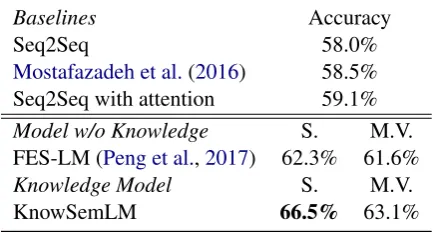
Table 2: Accuracy results for story cloze test in the unsupervised setting. “S.” represents the inference method with the single most informative feature while “M.V.” means majority voting.
we directly evaluate on the test set. In such a way, we can directly compare with the FES-LM model proposed in Peng et al. (2017), which is base model of KnowSemLM without the use of knowledge. Similar to the training of FES-LM, we fine tuneKnowSemLMon the in-domain short story training data, with the model trained on NYT corpus as initialization.11
Application ofKnowSemLM:For each test story, we generate a set of conditional probability fea-tures from KnowSemLM. We first construct the event level representation as described in Sec. 2. We then utilize the conditional probability of the fifth sentence given previous context sentences and the knowledge base KBEC as features. Here KBEC is generated automatically from NYT cor-pus specified in Sec. 4.2 without human efforts. We get multiple features depending on how long we go back in the context in terms of events. In practice, we get at most 12 events as context since one sentence can contain multiple events. Thus, for each story, we generate at most 12 pairs of conditional probability features from two given choices. Every pair of such features can yield a decision on which ending is more probable. Here, we test two different inference methods: a single most informative feature (where we go with the decision made by the pair of features which have the highest ratio) or majority voting based on the decision made jointly by all feature pairs.
Results: The accuracy results are shown in Ta-ble 2. We compare KnowSemLM with Seq2Seq baselines (Sutskever et al., 2014) and Seq2Seq with attention mechanism (Bahdanau et al., 2014). We also include the DSSM system
11We iterate over the NYT corpus until it converges on the
Method Accuracy Base (Modi et al.,2017) 62.65% EntityNLM (Ji et al.,2017) 74.23%
Base∗ 60.58%
Base∗w/ FES-RNNLM 63.79%
[image:7.595.88.272.62.154.2]Base∗w/KnowSemLM 76.15%
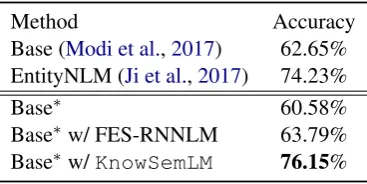
Table 3: Accuracy results for the referent predic-tion task on InScript Corpus. We re-implement the base model (Modi et al., 2017) as “Base∗”, and ap-ply KnowSemLM to add additional features. “Base∗ w/ FES-RNNLM” is the ablation study where no event causality knowledge is used. Even though “Base∗” model performs not as good as the original base model, we achieve the best performance with added
KnowSemLMfeatures.
from Mostafazadeh et al. (2016) as the original reported result. KnowSemLM outperforms both baselines and the base model without the use of knowledge, i.e., FES-LM. The best performance achieved byKnowSemLMuses single most infor-mative feature, with the feature being the condi-tional probability depending on only the nearest preceding event and event causality knowledge).
5.3 Application for Referent Prediction
Task Description and Setting: For referent pre-diction task, we follow the setting inModi et al. (2017), where the system predicts the referent of an entity (or a new entity) given the preceding text. The task is evaluated on the InScript Cor-pus, which contains a group of documents where events are manually annotated according to pre-defined event templates. Each document contains one entity which needs to be resolved. The In-Script Corpus can be divided into 10 situations and is split into standard training, development, and testing sets. We fine-tuneKnowSemLMon the In-Script Corpus training set, with the model trained on NYT corpus as initialization.
Application of KnowSemLM: For each test case (i.e., an entity inside a document), each can-didate choice will be represented as a differ-ent evdiffer-ent represdiffer-entation. Note that the event representation here comes from the event tem-plates defined in the InScript Corpus. In the meantime, we can extract the event sequence from the preceding context. Thus, we can ap-plyKnowSemLMto compute the conditional prob-ability of the candidate event et+1 given the
event sequence and the event causality
knowl-Perplexity
FES-RNNLM 121.8
KnowSemLMw/o transitivity 120.7
KnowSemLM 120.4
Narrative Cloze Test (Recall@30)
FES-RNNLM 47.9
KnowSemLMw/o transitivity 49.3
[image:7.595.315.516.64.179.2]KnowSemLM 49.6
Table 4: Results for perplexity and narrative cloze test. Both studies are conducted on the NYT hold-out data. “FES-RNNLM” represents the semantic LM without the use of knowledge. The numbers show that
KnowSemLMhas lower perplexity and higher recall on narrative cloze test, which demonstrates the contribu-tion of the infused knowledge.
Match/Event Activation/Event λ
NYT 0.13 0.03 0.36
InScript 0.82 0.28 0.46
Table 5: Statistics for the use of event causality knowledge in KnowSemLM. We gather the statistics for both NYT and InScript Corpus. “Match/Event” rep-resents average number of times a causal event match is found in the event causality knowledge base per event; while “Activation/Event” stands for the average num-ber of times we actually generate event predictions from the outcome events of the knowledge base. In ad-dition, we believe the ratio of “Activation/Event” over “Match/Event” co-relates with the scaling parameterλ.
edge:pk(et+1|et−k, et−k+1,· · · , et,KBEC).Here, knowledge in KBEC is generated manually from event templates specified in Sec. 4.2. Moreover, indexkdecides how far back we consider the pre-ceding event sequence. We then add this set of conditional probabilities as additional features in a base model (re-implementation of the linear model proposed inModi et al.(2017), namely “Base∗”) to train a classifier to predict the right referent.
[image:7.595.318.514.285.317.2]5.4 Analysis ofKnowSemLM
First, to evaluate the language modeling ability of KnowSemLM, we report perplexity and narrative cloze test results. We employ the same experimen-tal setting as detailed inPeng and Roth(2016) on the NYT hold-out data. Results are shown in Ta-ble4. Here, “FES-RNNLM” serves as the seman-tic LM without the use of knowledge for the abla-tion study. The numbers shows thatKnowSemLM has lower perplexity and higher recall on narrative cloze test; which demonstrates the contribution of the infused event causality knowledge. The results w.r.t. the transitivity evaluation shows that the ex-pansion through knowledge transitivity improves the model quality.
We also gather the statistics to analyze the us-age of event causality knowledge inKnowSemLM. We compute two key values: 1) average num-ber of times a causal event match is found in the event causality knowledge base per event (so that we can potentially use the outcome events to pre-dict), i.e. “Match/Event”; 2) average number of times we actually generate event predictions from the outcome events of the knowledge base (result of the final probability distribution), i.e. “Activa-tion/Event”. We get the statistics on both NYT and InScript Corpus, and associate the numbers with the scaling parameter λ in Table 5. The frequency of event matches and event activations from knowledge are both much lower in NYT than in InScript. Moreover, we can compute the chance of an outcome event being used as the prediction when it participates in the probability distribution. On NYT, it is 0.03/0.13 = 23%; while on In-Script, it is0.28/0.82 = 34%. We believe such chance co-relates with the scaling parameterλ.
For qualitative analysis, we provide a compar-ative example between KnowSemLM and FES-RNNLM in practice. The system is fed into the following input:
... Jane wanted to buy a new car. She had to borrow some money from her father. ...
So, on an event level, we abstract the text as “PER[new]-want.01-buy.01-ARG[new](NEU), PER[old]-have.04-borrow.01-ARG[new](NEU)”. For FES-RNNLM, the system predicts the next event as “PER[old]-sell.01-ARG[new](NEU)” since in training data, there are many co-occurrences between the “borrow” event and “sell” event (coming from financial news articles in NYT). In contrast, for KnowSemLM, since
we have the knowledge “PER[*]-borrow.01-ARG[*](*)⇒PER[old]-return.01-ARG[old](*)”, meaning that something borrowed by someone is likely to be returned, the predicted event would be “PER[old]-return.01-ARG[old](NEU)”. This is closer to the real text semantically: ... She promised to return the money once she got a job ...
Such an example shows thatKnowSemLMworks in situations where 1) the required knowledge is stored in the event causality knowledge base, and 2) the training data contains scenarios where required knowledge is put into use.
6 Related Work
Our work is built upon the previous works for se-mantic language models (Peng and Roth, 2016; Peng et al., 2017; Chaturvedi et al., 2017). This line of work is in general inspired by script learn-ing. Early works (Schank and Abelson, 1977; Mooney and DeJong, 1985) tried to learn scripts via construction of knowledge bases from text. More recently, researchers focused on utilizing statistical models to extract high-quality scripts from large amounts of data (Chambers and Ju-rafsky, 2008;Bejan, 2008; Jans et al., 2012; Pi-chotta and Mooney,2014;Granroth-Wilding and Clark, 2016; Rudinger et al., 2015; Pichotta and Mooney, 2016a,b). Other works aimed at learn-ing a collection of structured events (Chambers, 2013;Cheung et al.,2013;Balasubramanian et al., 2013;Bamman and Smith, 2014;Nguyen et al., 2015; Inoue et al., 2016). In particular, Ferraro and Durme(2016) presented a unified probabilis-tic model of syntacprobabilis-tic and semanprobabilis-tic frames while also demonstrating improved coherence. Several works have employed neural embeddings (Modi and Titov, 2014a,b; Frermann et al., 2014; Titov and Khoddam, 2015). Some prior works have used scripts-related ideas to help improve NLP tasks (Irwin et al., 2011;Rahman and Ng, 2011; Peng et al.,2015b).
at-tention to encode sentences and produced a strong baseline. Lee and Goldwasser (2019) considered the problem of learning relation aware event em-beddings for commonsense inference, which can account for different relations between events, be-yond simple event similarity. We differ from them because the basic semantic unit we model is event level abstractions instead of word tokens.
The definition of event causality knowledge in this work includes temporal ordering relation-ships. Much progress has been made in iden-tifying and modeling such relations. In early works (Mani et al.,2006;Chambers et al.,2007; Bethard et al., 2007;Verhagen and Pustejovsky, 2008), the problem was formulated as a clas-sification problem for determining the pair-wise event temporal relations; while recent works (Do et al.,2012;Mirza and Tonelli,2016;Ning et al., 2017,2018) took advantage of utilizing structural constraints such as transitive properties of tem-poral relationships via ILP to achieve better re-sults. Comparatively, the concept of event causal-ity knowledge here is broader and more flexible. Any event causality relation gained from human experience could be represented and utilized in KnowSemLM; as shown in Sec. 4.2 that such knowledge can be both mined from corpus and written down declaratively.
Since we formulate the semantic sequence mod-eling problem as a language modmod-eling issue, we also review recent neural language modeling liter-ature.Bengio et al.(2003) introduced a model that learns word vector representations as part of a sim-ple neural network architecture for language mod-eling.Collobert and Weston(2008) decoupled the word vector training from the downstream train-ing objectives, which paved the way forCollobert et al.(2011) to use the full context of a word for learning the word representations. The skip-gram and continuous bag-of-words (CBOW) models of Mikolov et al. (2013) propose a simple single-layer architecture based on the inner product be-tween two word vectors. Mnih and Kavukcuoglu (2013) also proposed closely-related vector log-bilinear models, vLBL and ivLBL, and Levy and Goldberg (2014) proposed explicit word embed-dings based on a PPMI metric. Additionally, re-searcher have been attempting to infuse knowl-edge into the language modeling process (Ahn et al.,2016;Yang et al.,2016;Ji et al.,2017;He et al.,2017;Clark et al.,2018).
Most recently, pre-trained language models such as BERT (Devlin et al.,2019), GPT (Radford et al.,2018), and XLNET (Yang et al.,2019) have achieved much success for language modeling and generation tasks. Our proposed knowledge in-fused semantic language model can not be directly applied upon such word-level pre-trained language models. However, as future works, we are inter-ested in exploring the possibility of pre-training a semantic language model with frame and entity abstractions on a large corpus with event causality knowledge, and fine-tune it on application tasks.
7 Conclusion
This paper proposes KnowSemLM, a knowledge infused semantic LM. It utilizes both local con-text (i.e., what has been described in con-text) and global context (i.e., causality knowledge about events) to predict future events. We show that such event causality knowledge can be obtained statistically from a corpus or declaratively in specific scenarios. Similar to previous works, KnowSemLM takes advantage of event-level ab-stractions to achieve generalization. Evaluations demonstrate that the knowledge awareness of the proposed KnowSemLM helps improve results on tasks such as the event cloze test and story/referent prediction.
Acknowledgments
References
Sungjin Ahn, Heeyoul Choi, Tanel P¨arnamaa, and Yoshua Bengio. 2016. A neural knowledge lan-guage model.arXiv preprint arXiv:1608.00318.
Dzmitry Bahdanau, Kyunghyun Cho, and Yoshua Ben-gio. 2014. Neural machine translation by jointly learning to align and translate. In Proceedings of the International Conference on Learning Represen-tations (ICLR).
Niranjan Balasubramanian, Stephen Soderland, Mausam, and Oren Etzioni. 2013. Generating coherent event schemas at scale. InProceedings of the Conference on Empirical Methods in Natural Language Processing (EMNLP).
David Bamman and Noah A. Smith. 2014. Unsuper-vised discovery of biographical structure from text.
Transactions of the Association for Computational Linguistics (TACL).
Cosmin Adrian Bejan. 2008. Unsupervised discovery of event scenarios from texts. InProceedings of the 21st International Florida Artificial Intelligence Re-search Society Conference.
Yoshua Bengio, R´ejean Ducharme, Pascal Vincent, and Christian Jauvin. 2003. A neural probabilistic lan-guage model. Journal of Machine Learning Re-search (JMLR).
Steven Bethard, James H Martin, and Sara Klingen-stein. 2007. Timelines from text: Identification of syntactic temporal relations. InProceedings of the International Conference on Semantic Computing (ICSC).
Susan Brown, Claire Bonial, Leo Obrst, and Martha Palmer. 2017. The rich event ontology. In Proceed-ings of the Events and Stories in the News Workshop.
Zheng Cai, Lifu Tu, and Kevin Gimpel. 2017. Pay at-tention to the ending: Strong neural baselines for the ROC story cloze task. InProceedings of the Annual Meeting of the Association for Computational Lin-guistics (ACL).
Nathanael Chambers. 2013. Event schema induction with a probabilistic entity-driven model. In Pro-ceedings of the Conference on Empirical Methods in Natural Language Processing (EMNLP).
Nathanael Chambers and Daniel Jurafsky. 2008. Un-supervised Learning of Narrative Event Chains. In
Proceedings of the Annual Meeting of the Associa-tion for ComputaAssocia-tional Linguistics (ACL).
Nathanael Chambers, Shan Wang, and Dan Juraf-sky. 2007. Classifying temporal relations between events. InProceedings of the Annual Meeting of the ACL on Interactive Poster and Demonstration Ses-sions.
Snigdha Chaturvedi, Haoruo Peng, and Dan Roth. 2017. Story comprehension for predicting what hap-pens next. In Proceedings of the Conference on Empirical Methods in Natural Language Processing (EMNLP).
Jackie Chi Kit Cheung, Hoifung Poon, and Lucy Van-derwende. 2013. Probabilistic Frame Induction. In
Proceedings of the Conference of the North Amer-ican Chapter of the Association for Computational Linguistics (NAACL).
Elizabeth Clark, Yangfeng Ji, and Noah A Smith. 2018. Neural text generation in stories using entity repre-sentations as context. InProceedings of the Confer-ence of the North American Chapter of the Associa-tion for ComputaAssocia-tional Linguistics (NAACL).
Ronan Collobert and Jason Weston. 2008. A unified architecture for natural language processing: deep neural networks with multitask learning. In Pro-ceedings of the International Conference on Ma-chine Learning (ICML).
Ronan Collobert, Jason Weston, L´eon Bottou, Michael Karlen, Koray Kavukcuoglu, and Pavel P. Kuksa. 2011. Natural language processing (almost) from scratch. Journal of Machine Learning Research (JMLR).
Jacob Devlin, Ming-Wei Chang, Kenton Lee, and Kristina Toutanova. 2019. BERT: Pre-training of deep bidirectional transformers for language un-derstanding. In Proceedings of the Conference of the North American Chapter of the Association for Computational Linguistics (NAACL).
Quang Do, Wei Lu, and Dan Roth. 2012. Joint infer-ence for event timeline construction. InProceedings of the Conference on Empirical Methods in Natural Language Processing (EMNLP).
Francis Ferraro and Benjamin Van Durme. 2016. A unified bayesian model of scripts, frames and lan-guage. In Proceedings of the AAAI Conference on Artificial Intelligence (AAAI).
Lea Frermann, Ivan Titov, and Manfred Pinkal. 2014. A hierarchical bayesian model for unsupervised in-duction of script knowledge. InProceedings of the Conference of the European Chapter of the Associa-tion for ComputaAssocia-tional Linguistics (EACL).
Mark Granroth-Wilding and Stephen Clark. 2016. What Happens Next? Event Prediction Using a Compositional Neural Network Model. In Proceed-ings of the AAAI Conference on Artificial Intelli-gence (AAAI).
Ruihong Huang and Ellen Riloff. 2012. Modeling tex-tual cohesion for event extraction. InProceedings of the AAAI Conference on Artificial Intelligence (AAAI).
Naoya Inoue, Yuichiroh Matsubayashi, Masayuki Ono, Naoaki Okazaki, and Kentaro Inui. 2016. Model-ing context-sensitive selectional preference with dis-tributed representations. InProceedings of the Inter-national Conference on Computational Linguistics (COLING).
Joseph Irwin, Mamoru Komachi, and Yuji Mat-sumoto. 2011. Narrative schema as world knowl-edge for coreference resolution. In Proceedings of the SIGNLL Conference on Computational Natural Language Learning (CoNLL).
Bram Jans, Steven Bethard, Ivan Vulic, and Marie-Francine Moens. 2012. Skip n-grams and rank-ing functions for predictrank-ing script events. In Pro-ceedings of the Conference of the European Chap-ter of the Association for Computational Linguistics (EACL).
Heng Ji and Ralph Grishman. 2008. Refining event ex-traction through cross-document inference. In Pro-ceedings of the Annual Meeting of the Association for Computational Linguistics (ACL).
Yangfeng Ji, Chenhao Tan, Sebastian Martschat, Yejin Choi, and Noah A Smith. 2017. Dynamic entity rep-resentations in neural language models. In Proceed-ings of the Conference on Empirical Methods in Nat-ural Language Processing (EMNLP).
Robin Jia and Percy Liang. 2016. Data recombina-tion for neural semantic parsing. InProceedings of the Annual Meeting of the Association for Computa-tional Linguistics (ACL).
Daniel Khashabi, Mark Sammons, Ben Zhou, Tom Redman, Christos Christodoulopoulos, Vivek Sriku-mar, Nicholas Rizzolo, Lev Ratinov, Guanheng Luo, Quang Do, Chen-Tse Tsai, Subhro Roy, Stephen Mayhew, Zhili Feng, John Wieting, Xiaodong Yu, Yangqiu Song, Shashank Gupta, Shyam Upadhyay, Naveen Arivazhagan, Qiang Ning, Shaoshi Ling, and Dan Roth. 2018. CogCompNLP: Your Swiss Army Knife for NLP. In Proceedings of the Language Resources and Evaluation Conference (LREC).
I-Ta Lee and Dan Goldwasser. 2019. Multi-relational script learning for discourse relations. In Proceed-ings of the Annual Meeting of the Association for Computational Linguistics (ACL).
Omer Levy and Yoav Goldberg. 2014. Linguistic reg-ularities in sparse and explicit word representations. InProceedings of the SIGNLL Conference on Com-putational Natural Language Learning (CoNLL).
Qi Li, Heng Ji, and Liang Huang. 2013. Joint event extraction via structured prediction with global fea-tures. InProceedings of the Annual Meeting of the Association for Computational Linguistics (ACL).
Inderjeet Mani, Marc Verhagen, Ben Wellner, Chong Min Lee, and James Pustejovsky. 2006. Ma-chine learning of temporal relations. InProceedings of the 21st International Conference on Computa-tional Linguistics and the 44th annual meeting of the Association for Computational Linguistics.
Tomas Mikolov, Kai Chen, Greg Corrado, and Jeffrey Dean. 2013. Efficient estimation of word represen-tations in vector space. InProceedings of Workshop at ICLR.
Paramita Mirza and Sara Tonelli. 2016. CATENA: Causal and temporal relation extraction from nat-ural language texts. In Proceedings of the Inter-national Conference on Computational Linguistics (COLING).
Andriy Mnih and Geoffrey Hinton. 2007. Three new graphical models for statistical language modelling. In Proceedings of the International Conference on Machine Learning (ICML).
Andriy Mnih and Koray Kavukcuoglu. 2013. Learning word embeddings efficiently with noise-contrastive estimation. In Proceedings of the Conference on Neural Information Processing Systems (NeurIPS).
Ashutosh Modi and Ivan Titov. 2014a. Inducing neu-ral models of script knowledge. In Proceedings of the SIGNLL Conference on Computational Natural Language Learning (CoNLL).
Ashutosh Modi and Ivan Titov. 2014b. Learning se-mantic script knowledge with event embeddings. In
ICLR Workshop.
Ashutosh Modi, Ivan Titov, Vera Demberg, Asad Say-eed, and Manfred Pinkal. 2017. Modeling seman-tic expectation: Using script knowledge for refer-ent prediction. Transactions of the Association for Computational Linguistics (TACL).
Raymond J. Mooney and Gerald DeJong. 1985. Learn-ing schemata for natural language processLearn-ing. In
Proceedings of the International Joint Conference on Artificial Intelligence (IJCAI).
Nasrin Mostafazadeh, Nathanael Chambers, Xiaodong He, Devi Parikh, Dhruv Batra, Lucy Vanderwende, Pushmeet Kohli, and James F. Allen. 2016. A cor-pus and cloze evaluation for deeper understanding of commonsense stories. InProceedings of the Confer-ence of the North American Chapter of the Associa-tion for ComputaAssocia-tional Linguistics (NAACL).
Nasrin Mostafazadeh, Michael Roth, Annie Louis, Nathanael Chambers, and James Allen. 2017. LS-DSem 2017 Shared Task: The Story Cloze Test. In
Proceedings of the 2nd Workshop on Linking Models of Lexical, Sentential and Discourse-level Seman-tics.
Khapra. 2018. Generating descriptions from struc-tured data using a bifocal attention mechanism and gated orthogonalization. InProceedings of the Con-ference of the North American Chapter of the Asso-ciation for Computational Linguistics (NAACL).
Kiem-Hieu Nguyen, Xavier Tannier, Olivier Ferret, and Romaric Besanc¸on. 2015. Generative event schema induction with entity disambiguation. In
Proceedings of the Annual Meeting of the Associ-ation for ComputAssoci-ational Linguistics (ACL).
Thien Huu Nguyen, Kyunghyun Cho, and Ralph Gr-ishman. 2016. Joint event extraction via recurrent neural networks. InProceedings of the Conference of the North American Chapter of the Association for Computational Linguistics (NAACL).
Thien Huu Nguyen and Ralph Grishman. 2016. Mod-eling skip-grams for event detection with convolu-tional neural networks. InProceedings of the Con-ference on Empirical Methods in Natural Language Processing (EMNLP).
Qiang Ning, Zhili Feng, and Dan Roth. 2017. A struc-tured learning approach to temporal relation extrac-tion. In Proceedings of the Conference on Em-pirical Methods in Natural Language Processing (EMNLP).
Qiang Ning, Hao Wu, Haoruo Peng, and Dan Roth. 2018. Improving Temporal Relation Extraction with a Globally Acquired Statistical Resource. In Pro-ceedings of the Conference of the North American Chapter of the Association for Computational Lin-guistics (NAACL).
Haoruo Peng, Kai-Wei Chang, and Dan Roth. 2015a. A joint framework for coreference resolution and mention head detection. In Proceedings of the SIGNLL Conference on Computational Natural Language Learning (CoNLL).
Haoruo Peng, Snigdha Chaturvedi, and Dan Roth. 2017. A joint model for semantic sequences: Frames, entities, sentiments. In Proceedings of the SIGNLL Conference on Computational Natural Language Learning (CoNLL).
Haoruo Peng, Daniel Khashabi, and Dan Roth. 2015b. Solving hard coreference problems. In Proceed-ings of the Conference of the North American Chap-ter of the Association for Computational Linguistics (NAACL).
Haoruo Peng and Dan Roth. 2016. Two discourse driven language models for semantics. In Proceed-ings of the Annual Meeting of the Association for Computational Linguistics (ACL).
Haoruo Peng, Yangqiu Song, and Dan Roth. 2016. Event detection and co-reference with minimal su-pervision. In Proceedings of the Conference on Empirical Methods in Natural Language Processing (EMNLP).
Karl Pichotta and Raymond J. Mooney. 2014. Sta-tistical script learning with multi-argument events. In Proceedings of the Conference of the European Chapter of the Association for Computational Lin-guistics (EACL).
Karl Pichotta and Raymond J. Mooney. 2016a. Learn-ing statistical scripts with LSTM recurrent neural networks. InProceedings of the AAAI Conference on Artificial Intelligence (AAAI).
Karl Pichotta and Raymond J Mooney. 2016b. Using sentence-level lstm language models for script infer-ence. InProceedings of the Annual Meeting of the Association for Computational Linguistics (ACL).
Alec Radford, Karthik Narasimhan, Tim Salimans, and Ilya Sutskever. 2018. Improving language understanding by generative pre-training. URL https://s3-us-west-2. amazonaws. com/openai-assets/researchcovers/languageunsupervised/language understanding paper. pdf.
Kira Radinsky, Sagie Davidovich, and Shaul Markovitch. 2012. Learning causality for news events prediction. In Proceedings of the Interna-tional World Wide Web Conferences (WWW).
Kira Radinsky and Eric Horvitz. 2013. Mining the web to predict future events. InProceedings of the ACM International Conference on Web Search and Data Mining (WSDM).
Altaf Rahman and Vincent Ng. 2011. Coreference res-olution with world knowledge. In Proceedings of the Annual Meeting of the Association for Computa-tional Linguistics (ACL).
Elena Rishes, Stephanie M Lukin, David K Elson, and Marilyn A Walker. 2013. Generating different story tellings from semantic representations of narrative. In International Conference on Interactive Digital Storytelling, pages 192–204. Springer.
Rachel Rudinger, Pushpendre Rastogi, Francis Ferraro, and Benjamin Van Durme. 2015. Script induction as language modeling. InProceedings of the Con-ference on Empirical Methods in Natural Language Processing (EMNLP).
Roger C. Schank and Robert P. Abelson. 1977.Scripts, plans, goals, and understanding: An inquiry into human knowledge structures. Oxford, England: Lawrence Erlbaum.
Yangqiu Song, Haoruo Peng, Parisa Kordjamshidi, Mark Sammons, and Dan Roth. 2015. Improving a pipeline architecture for shallow discourse parsing. InProceedings of the SIGNLL Conference on Com-putational Natural Language Learning (CoNLL).
Ivan Titov and Ehsan Khoddam. 2015. Unsupervised induction of semantic roles within a reconstruction-error minimization framework. In Proceedings of the Conference of the North American Chap-ter of the Association for Computational Linguistics (NAACL).
Marc Verhagen and James Pustejovsky. 2008. Tem-poral processing with the TARSQI toolkit. In Pro-ceedings of the International Conference on Compu-tational Linguistics (COLING).
Zhongqing Wang, Yue Zhang, and Ching-Yun Chang. 2017. Integrating order information and event re-lation for script event prediction. In Proceedings of the Conference on Empirical Methods in Natural Language Processing (EMNLP).
Zhilin Yang, Zihang Dai, Yiming Yang, Jaime Car-bonell, Ruslan Salakhutdinov, and Quoc V Le. 2019. XLNet: Generalized autoregressive pretrain-ing for language understandpretrain-ing. arXiv preprint arXiv:1906.08237.
Zichao Yang, Phil Blunsom, Chris Dyer, and Wang Ling. 2016. Reference-aware language models. In