Abstract— The paper concerns an open problem in the area of Content Based Image Retrieval (CBIR) and presents an original method for noisy image data sets by applying an artificial immune system model. In this regard, appropriate feature extraction methods in addition to a beneficial similarity criterion contribute to retrieving images from a noisy data set precisely. The results show some improvement and resistance in the noise tolerance of content based image retrieval in a database of various images.
Index Terms— artificial immune system, content based noisy image retrieval, Fuzzy linking histogram, similarity criterion
I. INTRODUCTION
HE significant growth of the Internet and high
availability of large number of images in various white-black or color types encourage us to finding a solution for image retrieval in order to tackle the difficulties of considerable increasing image data sets. In this regard each innovated technique of CBIR plays crucial role for retrieving images precisely. Although currently implemented CBIR systems achieved a lot of improvements to correctly retrieve proper images, encountering noisy images in image data sets is another difficulty in content based image retrieval requiring reach a compromise. Noise filtering (reduction) in images is a classical and prevailing task in the subject of Image processing and recognition but it is not a certain solution [1]. In addition to performance, precision and speed the CBIR methods have to provide a certain level of noise resistance, at least as far as the standard noise which is typical for the process of image retrieval. EFIRS (Effective and Fast Image Retrieval System) is an example of that systems which has been developed at the Bulgarian Academy of Sciences (BAS) for the needs of the Patent Office of Republic of Bulgaria (PORB), and specifically for their vast IDBs of trademark images [1][3][4].
Impulse noise is caused by malfunctioning pixels in camera sensors, faulty memory locations in hardware, or transmission in a noisy channel. Two common types of impulse noise are the salt-and-pepper noise and the random
Manuscript received April 22, 2009. This work is a result of Maedeh Beheshti’s M.SC thesis in the Department of Computer Engineering at Iran University of Science and Technology.
Morteza Analoui is with the College of Computer Engineering of Iran University of Science and Technology (IUST), Narmak, Tehran, Iran.
(email: [email protected])
Maedeh Beheshti is with the College of Computer Engineering of Iran University of Science and Technology (IUST), Narmak, Tehran, Iran. (corresponding author to provide phone: +98-21-8480-2628; fax: +98-261-654-8712; e-mail: maedehbeheshti@ comp.iust.ac.ir).
valued noise. For images corrupted by salt-and-pepper noise (respectively random-valued noise), the noisy pixels can take only the maximum and the minimum values (respectively any random value) in the dynamic range. There are many works on the restoration of images corrupted by impulse noise [14]. In this paper we try to apply artificial immune clustering algorithm to show its effectiveness in noisy image retrieval. In other words, in addition to appropriate feature extraction our concentration for similarity criterion in noisy image data sets is on a robust clustering. Natural immune system is a sustainable and powerful defense system that exhibits many signs of intelligence and cognitive learning [11][6]. Through CBIR systems like classic histogram, developed artificial immune systems based on immune mechanism provides evolutionary learning mechanisms of unsupervised learning, self-organizing, etc, and combines with some merits of learning systems such as classifier, neural network and so on. It has strong capacity of processing robustness information, and provides a new capacity of solving complex problem. Artificial immune system has successfully been used in some fields such as image recognition, etc [2].
II. FEATURE EXTRACTION &SPATIAL FUZZY LINKING HISTOGRAM
The proposed method of fuzzy linking histogram [7][9] uses a small number of bins produced by linking the triplet from the L*a*b* color space into a single histogram by means of a fuzzy expert system. The L*a*b* color space was selected because it is a perceptually uniform color space which approximates the way that humans perceive color and perform better than other color spaces in various retrieval tests performed in the laboratory for this exact purpose [5][7][9].
In this paper, we have enhanced this method by adding spatial feature to fuzzy linking histogram method. We call the enhanced method “Spatial Fuzzy linking histogram”. In L*a*b*, L* stands for luminance, a* represents relative greenness-redness and b* represents relative blueness-yellowness. All colors and gray levels can be expressed using a combination of three L*, a* and b* components. In fuzzy linking histogram a* component is subdivided into five regions representing green, greenish, the middle of the component, reddish and red [7][9]. The b* component is subdivided into five regions representing blue, bluish, the middle of the component, yellowish and yellow [7][9]. The L* component is subdivided into only three regions: dark, dim, bright areas [7][9]. We have tried to enhance this method by inserting spatial information in horizontal and vertical position. In this way X and Y position axes are defined as two more inputs to the fuzzy linking system. X
Content-based Image Retrieval Using Artificial
Immune System (AIS) Clustering Algorithms
Morteza Analoui, and Maedeh Beheshti
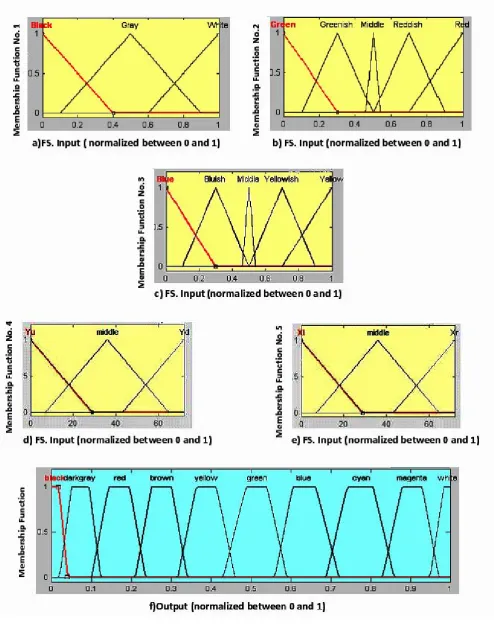
and Y give us more information about the spatial position of a pixel in color image. The X component is subdivided into three regions representing left, middle and right in horizontal axis. The Y component is subdivided into three regions representing up, middle and down in vertical axis. The spatial fuzzy linking of five components (L*, a*, b*, X, Y) is made according to at least 40 fuzzy rules which leads to output of the system. Fig 1:a-b-c-d-e) shows the fuzzification of the five mentioned inputs through triangular membership function and Fig 1:f) shows one output through trapezoidal membership function. The output spatial fuzzy linking histogram is divided to 10 bars which approximately indicate black, dark gray, red, brown, yellow, green, blue, cyan, magenta and white colors. The Mamdani type of fuzzy inference is used in which the fuzzy sets from the output MFs of each rule are combined through the aggregation operator which is set to max and the resulting fuzzy set is defuzzified to produce the output of the system [7][9][15]. The implication factor which determines the process of shaping the fuzzy set in the output MFs based on the results of the input MFs is set to min and the OR and AND operators are set to max and min, respectively.
III. IMAGE NOISE &ARTIFICIAL IMMUNE SYSTEMS
The random variation of brightness or color information in images causes image noise produced by the sensor and circuitry of a scanner or digital camera [16]. Image noise can also originate in film grain and in the unavoidable shot noise of an ideal photon detector. Image noise is generally attended as an unexpected by-product of image capture. There are different types of noises, Amplifier noise (Gaussian noise) that the standard model of it is additive, independent at each pixel and independent of the signal intensity. Salt and pepper noise or "impulsive" noise sometimes called spike noise. An image containing salt-and-pepper noise will have dark pixels in bright regions and bright pixels in dark regions.
Dealing with large image data sets which are sometimes containing noisy images make us provide some scalable clustering techniques. In this regard some clustering techniques assume that clusters are hyper-spherical, clean of noise, similar in size and span the whole data space [11][12]. Robust clustering algorithms have recently been proposed to handle noisy data [12][13]. In[8], we proposed a new similarity criterion for CBIR based on a new unsupervised AIS learning approach, called TECNO-CBIR. The proposed method is based on another clustering algorithm which is called Tracking Evolving Clusters in Noisy Streams. This approach improves learning abilities, scalability, robustness and automatic scale estimation [10][11][12][13]. In comparison with some existing scalable clustering algorithms in areas like, insensitivity to initialization, robustness to noise, time complexity, required number of clusters, handling evolving clusters and robust automatic scale estimation, they proved that TECNO-Streams is more powerful than the other models. In Tecno-CBIR the input image feature vector is considered as an antigen. According to (1) the ith antibody represents a soft
influence zone with the size proportional to 2 , j iAg
Ab
, that
(1) When Agj has been
presented to Abi pure
stimulation and optimal scale can be updated incrementally using the (2) and (3) respectively:
(2)
(3)
According to the noisy image data set some crucial parameters such as optimal scale or wmin has been changed
precisely. In order to create antigen and antibody vectors Agj, j=1,…,PA (PA= maximum population of Antigens) and
T N
Ab Ab Ab
AB[ 1, 2,..., ] have been defined respectively. Because of time consuming and computational resources only 50x50 size images have been used in this implementation. Inevitably, according to the spatial fuzzy linking histogram, the input feature vector contains 2500 elements. Each time just one antigen from an image data set (Agj ) is presented to the immune network, each of which is
selected by random. With each presentation the stimulation and the scale measures will be updated and the antigen index, j, will increase with the time. It indicates time differentiation for entering antigen into the immune network.
In Tecno-CBIR, antibodies are the dynamic weighted B-cells (D-W-B-Cell) and represent an influence zone over the domain of discourse consisting of the training image data set [10]. In this experiment the images have been selected from Internet sites such as
http://utopia.duth.gr/~konkonst and http://www.cs.washington.edu/research/imagedatabase. All
the images in these sites are free and their subjects are related to the area of arts, sports, animals, culture and so on. In order to make an appropriate data set containing a variety of clear images and noisy ones, we tried to create some extra noisy images by inserting salt and pepper noise of density 0.03, 0.05, 0.15, brightened and blurred images through linear filtering. Obviously, Image deblurring (or restoration) is an old problem in image processing, and it continues to attract the attention of researchers and practitioners alike. A number of real-world problems from astronomy to consumer imaging find applications for image restoration algorithms. Plus, image restoration is an easily visualized example of a larger class of inverse problems that arise in all kinds of scientific, medical, industrial and theoretical problems. Besides that, it's just fun to apply an
2 , , 1 , 1 exp j i j i j i j i Ag Ab Ag Ab Ag Ab Ag Ab w W P ) (exp 25 exp 1 1 1 , 1 2 , 2 , 1 2 , j i j i j i j i j i j i j i Ag Ab Ag Ab Ag Ab Ag Ab Ag Ab Ag Ab Ag Ab w W d w W
Ag AG|w wmin
IZ
j iAg
Ab j
well you did [16]. Using mathematical descriptions like deconvlucy function is a solution to deblur an image but time consuming and high memory allocation in order to run these mathematical models every time in each image data
set is one of its drawbacks. In this regard due to declining the mentioned model’s repercussions we try to get two beneficial methods of feature extraction and similarity
[image:3.595.52.547.106.732.2]criterion together and show the evaluation results as well.
Fig 1: a-b-c-d-e) Fuzzy system input membership function of L*, a*, b*, Y and X f) Output of the fuzzy system
A. Cloning & Memory Construction
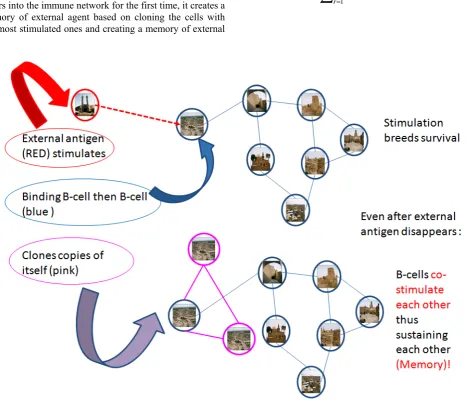
Fig 2 shows that the cloning and memory creation operations have been made using at least one of the existent antibodies stimulation for an input antigen. Antibody cloning and memory construction are made with respect to their stimulation levels and their age condition. In this regard, the Agclonei is calculated based on (4) and the
condition ofAgeminAgeiAgemax should be realized. In this
experiment we have considered kclone=.97 ، Agemin=2 and
Agemax=10. As it is illustrated in fig 2, when an antigen
enters into the immune network for the first time, it creates a memory of external agent based on cloning the cells with the most stimulated ones and creating a memory of external
agent that facilitates faster recognition of the same cells when they re-enter to the network. Even after disappearance of the external antigen, b-cells co-stimulate each other and in this way sustaining each other. Thus a memory network of images will be constructed. With memory construction, image retrieval speed will increase. It is obvious that the speed factor has an important role in image retrieval.
[image:4.595.65.534.180.592.2](4)
Fig 2: cloning procedure
IV. RESULTS &EVALUATION
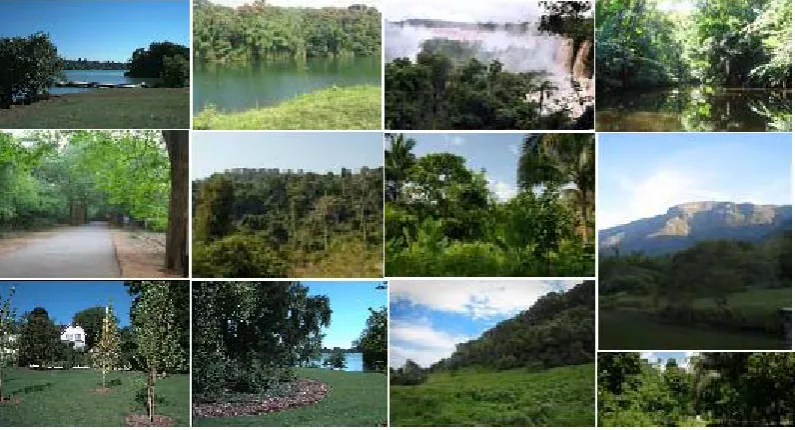
In our proposed Tecno-CBIR approach the retrieval begins when a new image is entered into the system. In this case, the system will try to find the closest images from the clusters to the new one [8]. It is actually true for noisy image data sets. In Figures 3(a-d), two query images and the respective resulting spatial fuzzy histograms for original and noisy image are presented. Because of making a comparison between Tecno-CBIR results for noisy images and histogram-based retrieval system results, we only choose three image datasets. These images are shown as the
in database (green, cat, sunset, etc.). According to fig 3(c) and fig 3(d) the spatial fuzzy linking histogram results for original image and noisy one are almost similar. One can easily notice the dominant colors in each of the images. In the first image fig 3(a), bin 7, 9 and 10 (Fig 3(c)) are activated because of the green trees, blue and white sky, magenta mountains. After applying Spatial fuzzy linking histogram on the noisy image, the output histogram shows the same activated histogram in fig 3(d). Due to the lack of space, we only attended to the first dataset and show the feature extraction results.
B
P
r r
i clone
clonei
n stimulatio
n stimulatio K
Ag
Fig 3: (a) Query Image (b) Blurred Query image (c) Spatial Fuzzy Linked histogram of Query (d) Spatial Fuzzy Linked histogram of Blurred Query
The Tecno-CBIR algorithm starts with k-means technique so early clustering will be done over B-cells population. In order to show the effectiveness of an appropriate similarity criterion, three more tasks were executed to test the robustness of the system on various noisy images. First of all, salt and pepper of density 0.15 and random noise was inserted to the query image, then the brightness of the images was increased and decreased, and finally the images were blurred (Fig. 3(b)) by a filter. The filter becomes a vector for horizontal and vertical motions. [7] claimed the accuracy percentages for fuzzy linking histogram were decreased 5–10% when noisy images have been added to the data sets, which has strongly direct effect on Tecno-CBIR tests because of using their feature extraction approach. But after evaluatins we found that Tecno-CBIR similarity approach is more effective and sustainable than histogram-based solution. Fig 4 shows some correct retrieved images when one noisy image act as a query. Also it is true for retriving images from a dataset which is a mixture of original and noisy ones. In this regards, the most crucial problems with noisy image datasets happen with salt & pepper noise. Such images loose some appropriate features so extracted spatial fuzzy histogarm for them concentrates on one or two bar which makes a lot of
difficulties for Tecno-CBIR systems. In order to show Tecno-CBIR effectiveness for noisy images a diagram of precision/recall comparison ( Fig. 5) has been constructed. According to the diagram, 3 datasets’ output of Tecno-CBIR for noisy images show approprate funcion of the propposed system for noisy datasets in retriving 20 images. It represents also a comparison between Tacno-CBIR action on dataset 1 and histogram-based function again on dataset 1. As the diagram shows the output of two systems is alike but by comparison of red and pink lines we found out that Tecno-CBIR is more sustainable than histogram-based for selecting as a similarity criterion in retrieving noisy image. At the end of two representative lines for dataset 1 (Fig 5) by Tecno-CBIR and histogram-based, the first one shows a linear characteristic in retriving noisy images which sometimes has some up and down in retrieval. But another line (histogram-based) has a decresing characteristic specially after 16th retieval. In other words, we could
[image:5.595.52.534.51.169.2]eliminate the histogram-based downward trends in rerieving cotent-based noisy images to a stable state through proposd similarity criterion.
[image:5.595.99.497.512.727.2]V.CONCLUSION
In this paper, a new spatial fuzzy linking approach along with an effective similarity criterion based on immune systems applied on noisy data sets. The proposed fuzzy linking histogram and Tecno-CBIR system, each of which, had appropriate results in content-based image retrieval and previous results from past experiences proved it. In this regard, in order to prove their robustness and consistency in more dynamic environments we tried to show their response on the noisy data sets. Fortunately the evaluation results on noisy data sets are satisfying. According to the results and evaluation, not only there is no drop in the acquired results but also there is an improvement from downward trends in histogram-based method to a steady one in proposed solution. The most difficulties happen in salt & pepper noisy environment but as a final conclusion, in comparison with histogram-based method, the proposed method performs better.
Fig5. Comparison of the two methods Tecno-CBIR (3datasets) & Histogram-based (1 dataset)
REFERENCES
[1] Dimo Dimov and Alexander Marinov, “Geometric-Morphological Method for Artifact Noise Isolation in the Image Periphery by a Contour Evolution Tree”, International Conference on Computer Systems and Technologies – CompSysTech , 2006.
[2] Dou Wei, Liu Zhan-sheng and Wang Xiaowei, “Application of Image Recognition Based on Artificial Immune in Rotating Machinery Fault Diagnosis”, IEEE, 2007.
[3] Dr. Fuhui Long, Dr. Hongjiang Zhang and prof. David Dagan Feng,
Fundamentals of content-based image retrieval, 2001, chapter 1. [4] Fuzzy Image Segmentation, university of waterloo.
[5] H.J. Zimmerman, in: Fuzzy Sets, Decision Making and Expert Systems,
Kluwer Academic Publishers, Boston, MA, 1987. [6] I. Cohen. Tending Adam’s Garden. Springer Verlag, 2000.
[7] K. Konstantinidis , A. Gasteratos , I. Andreadis, “Image retrieval based on fuzzy color histogram processing”, Optics Communications 248 , pages 375–386,,2005.
[8] Morteza Analoui, Maedeh Beheshti, Maryam Tayefeh Mahmoudi and Zahra Jadidi “Tecno-Streams approach for Content-based Image Retrieval”, Proceedings of the World Congress on Nature and Biologically Inspired Computing, IEEE, 2010.
[9] Maryam Tayefeh Mahmoudi, Maedeh Beheshti, Caro Lucas and Fattaneh Taghiyareh, “OWA Fuzzy Linking Histogram approach for Image Retrieval”, International Conference on Computational Cybernetics, November 26-29,IEEE, 2009.
[10] Olfa Nasaroui , Fabio Gonzalez and Dipankar Dasgupta, “The Fuzzy Artificial Immune System: Motivations, Basic Concepts, and
[11] Olfa Nasraoui, Cesar Cardona, Carlos Rojas, Fabio Gonzalez , “Mining Evolving User Profiles in NoisyWeb Clickstream Data with a Scalable Immune System Clustering Algorithm”, fifth webkdd workshop , 2003.
[12] Olfa Nasraoui, Cesar Cardona Uribe, Carlos Rojas Coronel, “Tecno-Streams: Tracking Evolving Clusters in Noisy data streams with a scalable Immune system learning model”, IEEE computer society, 2003.
[13] Olfa Nasraoui, “Web usage mining & personalization in noisy, dynamic and ambiguous environments”,workshop, http://www.louisville.edu/~o0nasr01,2006.
[14] V.R.Vijay Kumar, S.Manikandan, D.Ebenezer, P.T.Vanathi and P.Kanagasabapathy, “High Density Impulse noise Removal in Color Images Using Median Controlled Adaptive Recursive Weighted Median Filter”, IAENG International Journal of Computer Science, 2007.
[15] Www.mathworks.com, MATLAB and Simulink for Technical Computing , 2008.