warwick.ac.uk/lib-publications
Original citation:Crafts, N. F. R.. (2014) What does the 1930s' experience tell us about the future of the Eurozone? JCMS: Journal of Common Market Studies, 52 (4). pp. 713-727.
Permanent WRAP URL:
http://wrap.warwick.ac.uk/81074
Copyright and reuse:
The Warwick Research Archive Portal (WRAP) makes this work by researchers of the University of Warwick available open access under the following conditions. Copyright © and all moral rights to the version of the paper presented here belong to the individual author(s) and/or other copyright owners. To the extent reasonable and practicable the material made available in WRAP has been checked for eligibility before being made available.
Copies of full items can be used for personal research or study, educational, or not-for profit purposes without prior permission or charge. Provided that the authors, title and full bibliographic details are credited, a hyperlink and/or URL is given for the original metadata page and the content is not changed in any way.
Publisher’s statement:
"This is the peer reviewed version of the following articleCrafts, N. F. R.. (2014) What does the 1930s' experience tell us about the future of the Eurozone? JCMS: Journal of Common Market Studies, 52 (4). pp. 713-727. which has been published in final form at
http://dx.doi.org/10.1111/jcms.12145 This article may be used for non-commercial purposes in accordance with Wiley Terms and Conditions for Self-Archiving."
A note on versions:
The version presented here may differ from the published version or, version of record, if you wish to cite this item you are advised to consult the publisher’s version. Please see the ‘permanent WRAP URL’ above for details on accessing the published version and note that access may require a subscription.
What Does the 1930s’ Experience Tell Us about the Future of the Eurozone?
Nicholas Crafts
University of Warwick
January 2014
Abstract
If the Eurozone follows the precedent of the 1930s, it will not survive. The attractions of escaping from the gold standard then were massive and they point to a strategy of devalue and default for today’s crisis countries. A fully-federal Europe with a banking union and a fiscal union is the best solution but may be politically infeasible. However, it may be possible to underpin the Euro by a ‘Bretton-Woods compromise’ that accepts some retreat from deep economic integration and provides greater policy space since exit entails risks of financial crisis that were not present eighty years ago.
JEL Classification: F33; N14
Keywords: financial repression; gold standard; macroeconomic trilemma; political trilemma.
1
Introduction
The economic crisis in Europe that started in 2008 has been the most serious since the 1930s. Not surprisingly, the experience of that decade can be seen as a guide to the dangers that Europe now faces and the policy responses that may be forthcoming. Looking at the 1930s in this way is not reassuring. That decade not only experienced the Great Depression but it was also a period notorious for banking crises, currency wars, exchange controls, protectionism and sovereign default. The gold standard collapsed, central banks lost their independence, and the public lost faith in the market economy.
If the 1930s’ debacle were repeated, the prognosis for the Eurozone would be gloomy. In order to assess the likelihood of its collapse and potentially to avert this outcome, it is important to understand in some depth the evolution of economic policy and its rationale in the aftermath of the shocks that battered the European economy following the Wall Street Crash. This paper provides just such an analysis.
The legacy of the post-2008 crisis is one of misalignments of real exchange rates, high public debt to GDP ratios, a prolonged period of fiscal consolidation, a fragile banking system and levels of real GDP appreciably below pre-crisis expectations. The design of European Monetary Union is revealed as fundamentally flawed. The policy space available to troubled Eurozone economies appears to be uncomfortably narrow. The status quo does not seem to offer a viable future. Using Rodrik’s political trilemma to reconsider the 1940s’ response to the damage done by the 1930s, this paper argues that the survival of the Eurozone could be made more likely by some retreat from deep economic integration and/or easing the fiscal pain entailed in reasserting strict controls on national policy sovereignty.
1.
Economic Disintegration in the 1930s: an Outline
The Great Depression of the early 1930s was characterized by deflation, slump and financial crises; prices declined, there were substantial and prolonged falls in real GDP and unemployment rose dramatically while banking and currency crises proliferated. The responses of policymakers comprised a major globalization backlash which entailed greatly increased barriers to international trade and capital flows. Economic policy was very much the domain of the nation state and was orientated to domestic needs; attempts at international policy coordination such as the 1933 World Economic Conference failed.
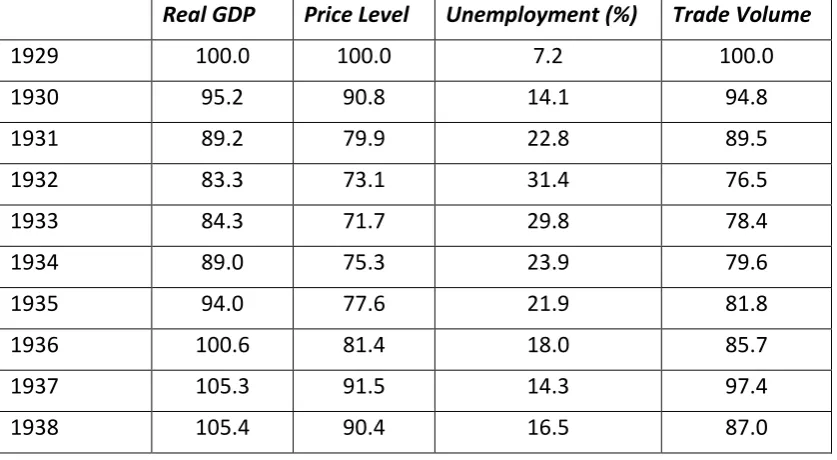
2 The 1930s are rightly notorious for high unemployment but internationally comparable data are scarce; the figures in Table 1 are useful for suggesting how rapidly unemployment rose and how slowly it fell in the industrial sector but significantly exaggerate overall levels of unemployment. Table 1 also reports a steep decline in the volume of trade which fell initially by about 24 per cent and never regained its 1929 peak. Increased barriers to trade played an important role in reducing trade volumes. Models based on import demand functions (Madsen, 2001) and on the historical relationship between world production and trade (Irwin, 2012) both suggest that protectionism accounted for around 40 per cent of the fall. The goals of protectionist policies were typically to safeguard employment, to improve the balance of payments and to raise prices.
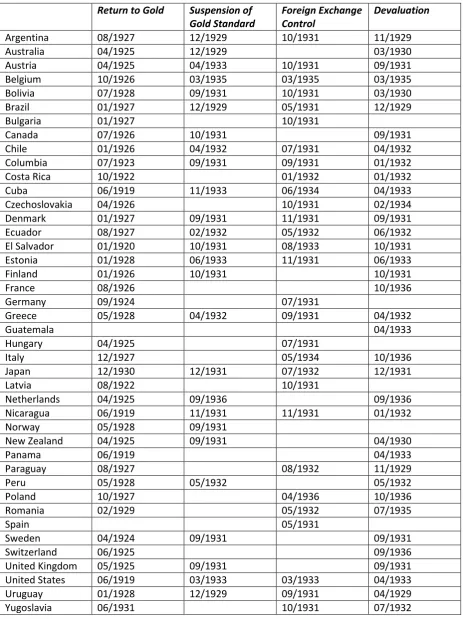
Table 2 chronicles the collapse of the gold standard in the 1930s. Famously, the United Kingdom made an ignominious exit in September 1931 having returned to gold only 6 years earlier. Virtually all major economies were on gold in 1929 but by late 1936 the French devaluation signalled the final demise of an international monetary system based on free convertibility of currencies into gold at a fixed parity. The price of staying on the gold standard was real exchange rate appreciation and massive deflationary pressure on prices. For example, by late 1933 France had experienced a loss of competitiveness of almost 30 per cent vis-a-vis the United Kingdom.
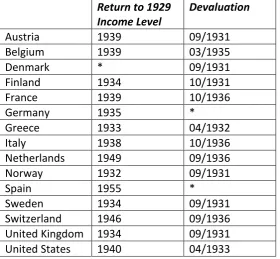
It is also apparent from Table 2 that foreign exchange controls, i.e., restrictions on the international capital mobility, became widespread. The macroeconomic trilemma states that a country can have at most two of a fixed exchange rate, independent monetary policy and unrestricted capital mobility (Obstfeld and Taylor, 2004). Whereas in the 1920s the modal choice was to sacrifice independent monetary policy, in the 1930s typically one or both of capital mobility and a fixed exchange rate were discarded. Table 3 shows that there was a strong correlation between abandonment of the fixed gold-standard exchange rate and recovery so that, on average, countries seem to have benefited from revising their macroeconomic trilemma choice.
Finally, as Table 4 reports, sovereign default was widespread in the 1930s – much more so than in the debt crisis of the 1980s – and was an important part of the world economic crisis and the withdrawal of Latin American countries in particular from the world economy. Debts were owed to private bondholders rather than banks and this was important in permitting a relaxed attitude by lender governments (Eichengreen and Portes, 1989).
2.
Economic Disintegration in the 1930s: Analysis
Wolf (2008) performed an econometric analysis of the decision to leave the gold standard. His results were that a country was more likely to leave if its main trading partner did, if it had returned to gold at a high parity, if it was a democracy, or if the central bank was independent. It was less likely to leave if it had large gold reserves, less price deflation, and strong banks. In other words, decisions to leave the gold standard were influenced by the strength of worries about loss of monetary discipline, the extent of deflationary pain, and deteriorating international competitiveness. The model predicts departures well and indicates that France was under the least pressure to exit in the early 1930s. It also suggests that democratic politics undermined the gold standard.
3 example, this can be clearly seen in the pivotal case of the United Kingdom. The electorate in the 1929 election when the Labour Party won 37 per cent of votes and 47 per cent of seats, was 29 million compared with 7.7 million in 1910. By the late 1920s, the major parties all recognized that unemployment was a key issue (Booth, 1987). The changed political climate resulted in the politicization of monetary policy even after the return to gold and was reflected in the great reluctance of the Bank of England to raise interest rates in the 1931 crisis when Bank Rate was only increased to 4.5 per cent.1
For the typical open economy, the big problem as the Depression took hold was deflationary pressure as world output and prices fell whilst being severely constrained in policymaking by membership of the gold standard. The macroeconomic trilemma tells us that such a country can only have two of a fixed exchange rate, capital mobility and an independent monetary policy. It follows that, for countries on the gold standard, any monetary-policy response to the deflationary shocks needed to be coordinated across countries (thereby allowing unchanged interest rate differentials) but international coordination was out of the question.
Besides having no control over monetary policy, staying on the gold standard required reductions in prices and money wages to maintain competitiveness, and entailed high real interest rates and increases in real labour costs (Newell and Symons, 1988). The severity and duration of the downturn increased the longer a country remained on the gold standard (Bernanke, 1995). Leaving gold delivered autonomy over monetary policy which was conducive to lower interest rates and real wage rates. The collapse of the gold standard clearly triggered a ‘beggar-thy-neighbour’ currency war but nevertheless this delivered global reflation and was part of the solution not part of the problem (Eichengreen, 2013). In the post gold-standard world, central banks tended to lose control over the conduct of monetary policy which passed to governments. Indeed, Goodhart (2010) described the1930s to the 1960s as an era of ‘the subservience of central banks’.
Staying on the gold standard without capital controls increased the risk of a banking crisis as balance sheets deteriorated (Accominotti, 2012), although these crises were experienced in many countries and were associated with weaknesses in banking systems as well as the deflationary pressures which stressed them. Countries which went through banking crises were exposed to much larger decreases in real output; the median banking crisis lasting a year lowered industrial output by 12 per cent (Bernanke and Carey, 1996).
The gold standard collapsed under the pressure of deflation. This problem stemmed from the behaviour of balance-of-payments-surplus countries and the asymmetric requirement for adjustment placed on deficit countries. Irwin (2010) calculated that through their ‘gold hoarding’ policies the Federal Reserve and the Banque de France together directly accounted for half the 30 per cent fall in prices that occurred in 1930 and 1931. Deflation was accompanied by high real interest rates; central bank discount rates averaged 5 per cent as late as the end of 1931 and still almost 3.5 per cent in mid-1933.
1 The UK exit from gold in 1931 can be plausibly be interpreted as a ‘second-generation currency crisis’ when a
4 The goals of protectionist policies were typically to safeguard employment, to improve the balance of payments and to raise prices. Unlike today, there were no constraints from WTO membership. Protectionism is usually thought of as the triumph of special-interest groups but it may have been more a substitute for a macroeconomic-policy response. Eichengreen and Irwin (2010) found that, on average, tariffs were higher in countries that stayed on gold longer and so had less scope to use monetary or fiscal policies to promote economic recovery.
Default was typically triggered by the increased burden of debt service as the depression intensified and export prices fell while real interest rates rose. In the 1930s, maintaining debt service tended to be associated with fiscal austerity and measures to improve the current account of the balance of payments while the decision to suspend payments was often accompanied by fiscal expansion and monetary reflation.2 An analysis of the implications of default shows that it promoted growth, especially for heavy defaulters (Eichengreen and Portes, 1990).
This analysis highlights several points relevant to today’s Eurozone crisis. First, back in the 1930s devaluation, perhaps accompanied by default, was the route to recovery. Macroeconomic-trilemma choices were dramatically revised. Second, the existence of the fixed exchange rate system was undermined by surplus countries which placed large burdens of adjustment on economies with weak balance of payments positions. Third, exit from the gold standard was contagious. Fourth, exposure to costly banking crises was intensified by gold-standard membership in a capital-mobile world. Fifth, when orthodox macroeconomic policies were unavailable as a way to fight unemployment, protectionism was to be expected.
3.
The ‘Cheap Money’ Policy in the United Kingdom
Leaving the gold standard in September 1931 allowed the UK to develop its so-called ‘cheap money’ policy by mid-1932. This entailed setting Bank Rate at 2 per cent and pushing short-term interest rates close to zero. It is generally agreed that ‘cheap money’ provided a significant conventional monetary stimulus which worked through raising investment, especially in house-building (Broadberry, 1986), and played a major part in triggering a strong recovery during which real GDP grow at almost 4 per cent per year from 1933 to 1937. The aim was also to deliver ‘unconventional’ monetary stimulus once at the interest-rate lower bound (ZLB) by increasing expectations of future inflation and thus lowering real interest rates. The Chancellor of the Exchequer announced the objective of raising prices in July 1932 and subsequently reiterated it frequently.
After leaving gold, control of monetary policy passed to the Treasury and debt management considerations took higher priority. The opportunity to redeem the 5% War Loan was taken in mid-1932 and £1.92 billion was converted to 3.5% War Loan 1952 thereby saving interest payments of £28.8 million annually. At the same time, the so-called ‘cheap money’ policy became reasonably settled and clearly articulated; the Treasury Bill rate fell from 3.77% in the first quarter of 1932 to 0.60% in the third quarter of that year, a level close to which it remained through 1938 (Howson, 1975). Real interest rates fell rapidly (Chadha and Dimsdale, 1999). The fall in the exchange rate
2
5 from $3.80 in March 1932 to $3.28 in December 1932 is consistent with escaping the liquidity trap in the ‘Foolproof Way’, as is the large increase in foreign exchange reserves over the next four years which reflected government intervention to keep the pound down.3 This strategy was credible given that the Treasury was in charge not the Bank of England.4 Cheap money and a rise in the price level were clearly in the Treasury’s interests from 1932 as a route to recovery, better fiscal arithmetic, and to provide an alternative to the Pandora’s Box of jettisoning balanced-budget orthodoxy and adopting Keynesianism.
The interwar British economy lived under the shadow of a large public debt to GDP ratio, a legacy of World War I. Both price deflation and recession threatened fiscal sustainability; this prompted fiscal consolidation in the early 1930s which improved the structural budget surplus/GDP ratio by 4 percentage points between 1929/30 and 1933/34 (Middleton, 2010). After peaking in 1933 at 1.792, worries about a rising public debt to GDP ratio eased and, as Table 5 reports, by 1938 it had fallen to 1.438 even though by then rearmament was well under way.
The stark difference from the period prior to leaving gold is seen in Table 5. After the falling-price years of the early 1930s, the required primary budget surplus fell steeply and, indeed, since the real interest rate exceeded the growth rate, it would have been possible to run modest primary budget deficits and still have stabilized d. In fact, primary surpluses continued, albeit smaller relative to GDP, through 1938. A check on the fiscal arithmetic shows that 2/3 of the fall in d during the recovery came from primary budget surpluses with 1/3 from the interest rate/growth rate differential.5 This experience does, however, highlight that ‘financial repression’ considerably reduced the fiscal squeeze required to improve this fiscal indicator.6 It also makes very clear why the Treasury liked ‘cheap money’ and its policy to raise the price level was credible.
This discussion throws up a number of points that bear on policy issues for Eurozone countries. First, at the ZLB, price deflation rather than inflation is public enemy number one. Second, falling prices make achieving fiscal sustainability at high public debt to GDP ratios very demanding in terms of the required budget surplus so that, if deflation is required to restore competitiveness in a fixed exchange rate system, austerity fatigue is a likely consequence. Third, by the same token, financial repression which reduces or even eliminates the need to run a primary budget surplus has major political attractions when sovereigns are highly indebted.
4.
The Euro Area 5 Years After the Crisis Started
3
Svensson (2003) suggested that a ‘foolproof’ way to escape the liquidity trap is to combine a price-level target path with an initial currency devaluation and a crawling exchange-rate peg which requires a higher price level in equilibrium and can be underpinned by creating domestic currency to purchase foreign exchange. The main difficulty is to make a credible commitment that this policy won’t be reversed at the first sign of recovery, cf. the Bank of Japan in the 1990s.
4
This would not have been the case had the Bank of England run monetary policy. Governor Norman disliked cheap money and regarded it as a temporary expedient (Howson, 1975).
5 These proportions are derived using the method proposed by Ali-Abbas et al. (2011), which is an application
of the fiscal sustainability formula in footnote 2.
6 ‘Financial repression’ occurs when governments intervene to gain access to funds at below market interest
6 Economic performance in Eurozone countries remains very weak. Current OECD estimates are that for the Euro Area as a whole real GDP in 2014 will still not be below the pre-crisis peak while in the worst affected country, Greece, real GDP may be only about 75 per cent of 2007. Prolonged recession has been accompanied by rapidly rising unemployment - from 7.4 per cent in 2007 to a predicted 12.3 per cent in 2014 in the Euro Area but with much more dramatic increases in several countries including both Greece and Spain where unemployment is predicted to be around 28 per cent in 2014. Price deflation has generally been avoided but inflation remains very low so the growth of nominal GDP in the Euro Area is projected to average only about 1.5 per cent per year in 2013 and 2014.
Current account positions have adjusted substantially in southern Europe. By 2012, deficits were much smaller so that on the basis of relative unit labour costs only Italy was in a (slightly) weaker position than in 1999. Even so, further improvements in competitiveness are needed to stabilize net external debt to GDP ratios or, preferably, to reduce them to less vulnerable levels, say, 35 per cent of GDP. For Portugal and Spain improvements in competitiveness relative to the rest of the Euro Area of about 30 per cent are required while for Greece the figure is nearly 80 per cent (Guillemette and Turner, 2013). If this is delivered through falls in domestic wages and prices, many more years of high unemployment will have to be endured. Indeed, Euro-periphery economies appear close to downward nominal wage rigidity – only in Greece were labour costs lower in 2012 than in 2008.
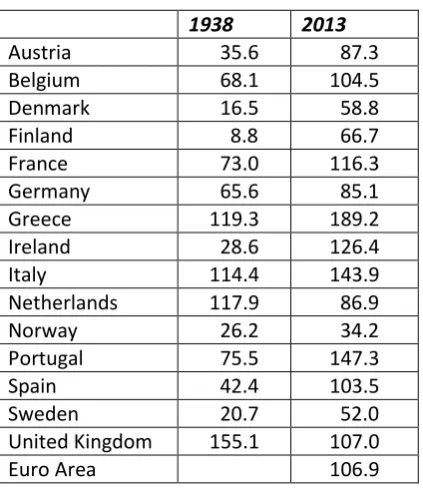
Table 6 reports high public debt to GDP ratios across the Euro Area. The fiscal compact prescribes a gross government debt ratio of 60% and that 1/20th of the excess over this level be removed each year. OECD (2013) calculates that to meet this rule Greece will have to maintain a primary budget surplus of about 9% of GDP, Italy and Portugal about 6% of GDP, and Ireland and Spain about 3.5% of GDP for every year from 2014 to 2023. If fiscal orthodoxy is the route back to Maastricht, this will be very painful. The 1930s’ precedent says that countries trapped in this position may resort to protectionism, for example, through greater reluctance to implement the Single Market in services and the creeping protectionism documented by Global Trade Alert (Evenett, 2013).
Fears of sovereign debt crises have been exacerbated by banking crises which themselves are made more serious by sovereign default – the deadly feedback effects of the ‘doom-loop’. According to IMF criteria, there have been systemic banking crises in eight Eurozone economies since 2008 with borderline-systemic crises in four more (Laeven and Valencia, 2012). The threat to public finances from financial instability is much greater than in previous generations because bank balance sheets are now much larger relative to GDP. In six countries this ratio was at least 3 by 2009 whereas until the 1970s it was typically less than 1 in advanced countries (Obstfeld, 2013). Equally, the threat to financial stability from sovereign default is considerably greater now than in the 1930s because debt ratios are generally larger (Table 6) and the debts are owed to banks rather than private bondholders.7
5.
The Future of the Eurozone through a Political-Trilemma Lens
Prima facie, the precedent of the 1930s seems to suggest that the Eurozone will not survive, at least in its current scope, since devaluation and default has attractions for the periphery countries of
7 Relatively low public debt to GDP ratios in the late 1930s reflect lower pre-crisis debt levels, weak automatic
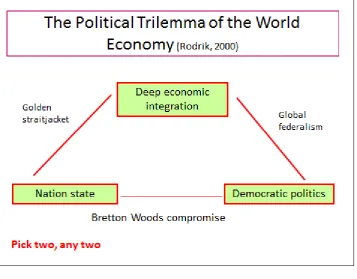
7 Southern Europe; this would allow greater policy sovereignty and a route to an early return to growth. These arguments can be articulated in the framework of Rodrik’s political trilemma (Figure 1), recently used by Crum (2013) to consider the future of the Eurozone. The trilemma is that it is possible to have at most two of deep economic integration, democratic politics and the nation state. If a ‘golden straitjacket’ choice is made, then democratic politics is subservient to a rules-based system of governance while if ‘global federalism’ is chosen, the nation state loses at least some political authority but democracy obtains at the federal level.
The 1930s’ implosion of the Gold Standard can be understood in these terms. While the ‘golden straitjacket’ was acceptable in the context of limited democracy in the 19th century, in the 1930s democratic politics at the level of the nation state over-ruled this policy choice. To retain the benefits of deep economic integration required democratic politics at a supranational level but this was not feasible. When reconstruction of the international economy was undertaken at Bretton Woods, economic integration was severely restricted by controls on international capital flows.
The idea of the ’Bretton-Woods Compromise’ was to sacrifice some aspects of economic integration to provide sufficient policy space to make saving the remaining aspects (moving back to freer trade) politically acceptable. Capital controls were attractive not only because they allowed independent monetary policy but also because they reduced tax competition, which facilitated greater expenditure on social transfers, and because they underpinned financial repression which reduced the fiscal pain of public debt reduction, cf. the British experience reported in Table 8 where about 60 per cent of the reduction in the debt ratio of 134.8 percentage points between 1950 and 1970 came from the interest rate/growth rate differential.8
Despite the apparent precedent of the 1930s, the Eurozone has not yet collapsed so this time may be different because the benefit/cost ratio of leaving the gold standard was rather different from that of exit from the Euro. First, this may be a Pyrrhic victory because it could well engender capital flight and a devastating bank run – or, put differently, ‘the mother of all financial crises’ (Eichengreen and Temin, 2013). Second, in the shadow of the ‘doomloop’, the perception of dire consequences of devaluation and default led to the provision of financial support with conditionality under the auspices of the Troika. Third, the European Central Bank has acted as a lender of last resort not only to banks but also to sovereigns through sovereign debt purchases and its offer of outright monetary transactions (OMT).
Furthermore, the thrust of policy proposals by the European Commission (2012) is initially to strengthen the ‘Golden Straitjacket’ to preserve deep economic integration and the primacy of the nation state but at the expense of democracy. The Commission charts a two-pronged attack on the ‘doomloop’ with new fiscal rules together with a banking union through a single supervisory mechanism (SSM) followed by a single resolution mechanism (SRM). Crum (2013, p. 615) sees this as “‘executive federalism’... a strategy with considerable justification” since ‘democratic (global) federalism’ is out of reach and the only realistic alternative is collapse of EMU.
Yet, European Commission (2012) envisages that these reforms progress to ‘democratic federalism’. Later stages of the process would include a full fiscal union and participatory federal democracy
8 Ali-Abbas et al. (2011) found that, on average, major reductions in the debt ratio during 1945 to 1970 were
8 including direct election of an EU President. However, given the size of bank balance sheets relative to national economies, an effective banking union, which would ensure financial stability and break the doom-loop, entails more than the SSM and SRM; it requires a supranational fiscal backstop that underpins deposit insurance and provides a financial stability fund (Obstfeld, 2013). So, ‘executive federalism’ may not be enough to save EMU but ‘democratic federalism’ could. However, voters across Europe have very different preferences for design of a reformed EU, i.e., ‘heterogeneity costs’ are probably too high to allow the realization of these putative benefits.9
The economic history of the 1930s says nothing about the feasibility of ‘democratic federalism’ as a solution to the political trilemma. It does, however, both speak to the design of ‘executive federalism’ and it signposts a modern equivalent to the ‘Bretton-Woods Compromise’.
If big primary surpluses are required to achieve fiscal sustainability in democratic countries which face high debt to GDP ratios and low nominal GDP growth, history suggests that ‘austerity fatigue’ is a real worry and, in some cases, the maximum politically feasible budget surplus may be too small (Buiter and Rabhari, 2013). A different design for the ECB under ‘executive federalism’ may be appropriate. As the 1930s underlines, a key starting point is for the ECB to ensure there is no price deflation in the Eurozone. The experience of monetary policy at the ZLB suggests that the Eurozone may be more likely to survive if the ECB credibly targets higher rates of inflation for a period; this would also reduce real interest rates and real wages and improve competitiveness in the periphery (Schmitt-Groheˊand Uribe, 2013). Debt relief (a modern alternative to the defaults of the 1930s) could also reduce the burden of fiscal consolidation, an undertaking which might entail effective monetization of some of the debt by the ECB (Paris and Wyplosz, 2013).10
It is unlikely that 1950s-style capital controls will be reintroduced on but a modern version of the ‘Bretton-Woods Compromise’ might seek to facilitate ‘financial repression’ by manipulating the interest rates paid on government debt in order to use the interest rate/growth rate differential to bear some of the burden of debt reduction, as in 1930s’ Britain. Although EU rules guarantee free movement of capital and the independence of the European Central Bank, countries largely retain sovereignty over fiscal and financial matters and that gives them scope for financial repression (van Riet, 2013). Even at the European level, Basel III rules for capital adequacy of banks will privilege government bonds as zero risk and EU law allows for capital controls in exceptional circumstances. Governments under financial stress may well be granted increased leeway to introduce national regulatory actions and moral suasion in support of government debt financing.11 A more radical solution, which is probably beyond reach, would be to transform the ECB into a ‘subservient’ central bank.
6.
Conclusions
At face value, the example of the 1930s suggests that for struggling Eurozone economies there are big attractions of a strategy of devaluation and default, and exit from the currency union. These
9
Spolaore (2013) notes that on measures of ethnic, linguistic and cultural diversity typically used to proxy for ‘heterogeneity costs’ the EU countries are not good candidates to form a European federation.
10
Their proposal entails purchases of sovereign debt in exchange for perpetual interest-free loans.
11 Van Riet (2013) itemizes measures already undertaken that epitomize financial repression, especially in
9 potentially include improved competitiveness and circumvention of downward nominal wage rigidity, less need to run primary budget surpluses in pursuit of fiscal sustainability and the opportunity to implement a new monetary-policy framework. However, whether exit can be achieved without triggering a massive financial crisis is doubtful.
An option that was not available in the 1930s is major institutional reform to deliver a fully-federal Europe with a banking union, a fiscal union and democratic legitimacy. In principle, this certainly could sustain a combination of deep economic integration and democratic politics with the implication that the currency union is saved by downsizing the role of the nation state. Unfortunately, this requires a level of political agreement across EU member states that is unlikely to be achieved.
10
References
Accominotti, O. (2012) ‘London, Merchant Banks, the Central European Panic, and the Banking Crisis of 1931’, Journal of Economic History, Vol. 72, No. 1, pp. 1-43.
Ali Abbas, S. M., Belhocine, N., El-Ganainy, A. and Horton, M. (2011) ‘Historical Patterns and
Dynamics of Public Debt – Evidence from a New Database’, IMF Economic Review, Vol. 59, No. 4, pp. 717-742.
Bernanke, B. (1995) ‘The Macroeconomics of the Great Depression: a Comparative Approach’. Journal of Money, Credit and Banking, Vol. 27, No. 1, pp. 1-28.
Bernanke, B. and Carey, K. (1996) ‘Nominal Wage Stickiness and Aggregate Supply in the Great Depression’. Quarterly Journal of Economics, Vol. 111, No. 3, pp. 853-883.
Bernanke, B. and James, H. (1991) ‘The Gold Standard, Deflation, and Financial Crisis in the Great Depression: an International Comparison’. In Hubbard, R. G. (ed) Financial Markets and Financial Crises (Chicago: University of Chicago Press).
Booth, A. (1987) ‘Unemployment and Interwar Politics’. In Glynn, S. and Booth, A. (eds.) The Road to Full Employment (London: Allen & Unwin).
Broadberry, S.N.(1986) The British Economy between the Wars: a Macroeconomic Survey (Oxford: Basil Blackwell).
Buiter, W. and Rahbari, E. (2013) ‘Why Do Governments Default and Why Don’t They Default More Often? CEPR Discussion Paper No. 9492 (London: Centre for Economic Policy Research).
Chadha, J. S. and Dimsdale, N. H. (1999) ‘A Long View of Real Rates’. Oxford Review of Economic Policy, Vol. 15, No. 2, pp. 17-45.
Crafts, N. and Fearon, P. (2013) ‘Depression and Recovery in the 1930s: an Overview’. In N. Crafts and P. Fearon (eds) The Great Depression of the 1930s: Lessons for Today (Oxford: Oxford University Press).
Crum, B. (2013) ‘Saving the Euro at the Cost of Democracy’. Journal of Common Market Studies, Vol. 51, No. 4, pp. 614-630.
Eichengreen, B. (1996) ’Deja Vu All Over Again: Lessons from the Gold Standard for European Monetary Unification’. In Bayoumi, T., Eichengreen, B. and Taylor, M. (eds) Modern Perspectives on the Gold Standard (Cambridge: Cambridge University Press).
Eichengreen, B. (2013) ‘Currency War or International Policy Coordination?’ Journal of Policy Modeling, Vol. 35, No. 3, pp. 425-433.
11 Eichengreen, B. and Irwin, D. (2010) ‘The Slide to Protectionism in the Great Depression: Who Succumbed and Why?’ Journal of Economic History, Vol. 70, No. 4, pp. 871-897.
Eichengreen, B. and Jeanne, O. (2000) ‘Currency Crisis and Unemployment: Sterling in 1931’. In Krugman, P. (ed) Currency Crises (Chicago: University of Chicago Press).
Eichengreen, B. and Portes, R. (1989) ‘Settling Defaults in the Era of Bond Finance’. World Bank Economic Review, Vol. 3, No. 2, pp. 211-239.
Eichengreen, B. and Portes, R. (1990) ‘The Interwar Debt Crisis and Its Aftermath’. World Bank Research Observer, Vol. 5, No. 1, pp. 69-94.
Eichengreen, B. and Temin, P. (2013) ‘Fetters of Gold and Paper’. In Crafts, N. and Fearon, P. (eds) The Great Depression of the 1930s: Lessons for Today (Oxford: Oxford University Press).
European Commission (2012) A Blueprint for a Deep and Genuine Economic and Monetary Union: Launching a European Debate (Brussels).
Evenett, S. J. (2013), What Restraint? Five Years of G20 Pledges on Trade (London: Centre for Economic Policy Research).
Feinstein, C. H. (1972) National Income, Expenditure and Output of the United Kingdom, 1855-1965 (Cambridge: Cambridge University Press).
Goodhart, C. A. E. (2010) ‘The Changing Role of Central Banks’. BIS Working Paper No. 326 (Basel: Bank for International Settlements).
Guillemette, Y. and Turner, D. (2013) ‘Policy Options to Durably Resolve Euro Area Imbalances’. OECD Economics Department Working Paper No. 1035. (Paris: OECD).
Howson, S. (1975) Domestic Monetary Management in Britain, 1919-1938 (Cambridge: Cambridge University Press).
IMF (2013), Historical Public Finance Database http://www.imf.org/external/up/fad/histdb/
Irwin, D. (2010) ‘Did France Cause the Great Depression’. NBER Working Paper No. 16350 (New York: National Bureau of Economic Research).
Irwin, D. (2012) Trade Policy Disaster: Lessons from the 1930s (Cambridge, Mass.: MIT Press).
League of Nations (1941) Statistical Yearbook, 1940/1 (League of Nations: Geneva).
Laeven, L. and Valencia, F. (2012) ‘Sytemic Banking Crises Database: an Update’. IMF Working Paper 12/163 (Washington, DC.: International Monetary Fund).
Maddison, A. (1985) Two Crises: Latin America and Asia 1929-38 and 1973-83 (Paris: OECD).
12 Madsen, J. (2001) ‘Trade Barriers and the Collapse of World Trade during the Great Depression’. Southern Economic Journal, Vol. 67, No. 4, pp. 848-868.
Middleton, R. (1996) Government versus the Market. (Cheltenham: Edward Elgar).
Middleton, R. (2010) ‘British Monetary and Fiscal Policy in the 1930s’. Oxford Review of Economic Policy, Vol. 26, No. 3, pp. 414-441.
Mitchell, J., Solomou, S. and Weale, M. (2012) ‘Monthly GDP Estimates for Interwar Britain’. Explorations in Economic History, vol. 49, No. 4, pp. 543-556.
Newell, A. and Symons, J. (1988) ‘The Macroeconomics of the Interwar Years: International
Comparisons’. In Eichengreen, B. and Hatton, T. J. (eds) Interwar Unemployment in International Perspective (London: Kluwer).
Obstfeld, M. (2013) ‘Finance at Center Stage: Some Lessons of the Euro Crisis’. CEPR Discussion Paper No. 9415 (London: Centre for Economic Policy Research).
Obstfeld, M. and Taylor, A. M. (2004) Global Capital Markets: Integration, Crisis, and Growth (Cambridge: Cambridge University Press).
OECD (2013), Economic Outlook (Paris: OECD).
Rodrik, D. (2000) ‘How Far will International Economic Integration Go?’ Journal of Economic Perspectives, Vol. 14, No. 1, pp. 177-186.
Schmitt-Groheˊ, S. and Uribe, M. (2013) ‘Downward Nominal Wage Rigidity and the Case for Temporary Inflation in the Eurozone’. Journal of Economic Perspectives, Vol. 27, No. 3, pp. 193- 211.
Spolaore, E. (2013) ‘What Is European Integration Really About? A Political Guide for Economists’. Journal of Economic Perspectives, Vol. 27, No. 3, pp. 125-144.
Sturzenegger, F. and Zettelmeyer, J. (2007) Debt Defaults and Lessons from a Decade of Crises (Cambridge, Mass.: MIT Press).
Svensson, L. E. O. (2003) ‘Escaping from a Liquidity Trap and Deflation: the Foolproof Way and Others’. Journal of Economic Perspectives, Vol. 17, No. 4, pp. 145-166.
The Maddison Project (2013) Per Capita GDP Update. http://www.ggdc.net/maddison-project
Van Riet, A. (2013) ‘Financial Repression to Ease Fiscal Stress: Turning Back the Clock in the Eurozone?’. Paper presented to Banco Central do Brasil 8th Annual Seminar on Risk, Financial Stability and Banking, Sao Paolo.
Wolf, H. C. and Yousef, T. M. (2007) ‘Breaking the Fetters: Why Did Countries Exit the Interwar Gold Standard?’ In Hatton, T. J., O’Rourke, K. H. and Taylor, A. M. (eds) The New Comparative
13 Wolf, N. (2008) ‘Scylla and Charybdis: Explaining Europe’s Exit from Gold, January 1928
14
Table 1. The Great Depression in the Advanced Countries
Real GDP
Price Level
Unemployment (%)
Trade Volume
1929
100.0
100.0
7.2
100.0
1930
95.2
90.8
14.1
94.8
1931
89.2
79.9
22.8
89.5
1932
83.3
73.1
31.4
76.5
1933
84.3
71.7
29.8
78.4
1934
89.0
75.3
23.9
79.6
1935
94.0
77.6
21.9
81.8
1936
100.6
81.4
18.0
85.7
1937
105.3
91.5
14.3
97.4
1938
105.4
90.4
16.5
87.0
Sources:
Real GDP: Maddison (2010), western European countries plus western offshoots.
Price Level: League of Nations (1941); data are for wholesale prices, weighted average of 17 countries.
Unemployment: Eichengreen and Hatton (1988); data are for industrial unemployment, unweighted average of 11 countries.
15
Table 2. Dates of Changes in Gold Standard Policies
Return to Gold Suspension of
Gold Standard
Foreign Exchange Control
Devaluation
Argentina 08/1927 12/1929 10/1931 11/1929
Australia 04/1925 12/1929 03/1930
Austria 04/1925 04/1933 10/1931 09/1931
Belgium 10/1926 03/1935 03/1935 03/1935
Bolivia 07/1928 09/1931 10/1931 03/1930
Brazil 01/1927 12/1929 05/1931 12/1929
Bulgaria 01/1927 10/1931
Canada 07/1926 10/1931 09/1931
Chile 01/1926 04/1932 07/1931 04/1932
Columbia 07/1923 09/1931 09/1931 01/1932
Costa Rica 10/1922 01/1932 01/1932
Cuba 06/1919 11/1933 06/1934 04/1933
Czechoslovakia 04/1926 10/1931 02/1934
Denmark 01/1927 09/1931 11/1931 09/1931
Ecuador 08/1927 02/1932 05/1932 06/1932
El Salvador 01/1920 10/1931 08/1933 10/1931
Estonia 01/1928 06/1933 11/1931 06/1933
Finland 01/1926 10/1931 10/1931
France 08/1926 10/1936
Germany 09/1924 07/1931
Greece 05/1928 04/1932 09/1931 04/1932
Guatemala 04/1933
Hungary 04/1925 07/1931
Italy 12/1927 05/1934 10/1936
Japan 12/1930 12/1931 07/1932 12/1931
Latvia 08/1922 10/1931
Netherlands 04/1925 09/1936 09/1936
Nicaragua 06/1919 11/1931 11/1931 01/1932
Norway 05/1928 09/1931
New Zealand 04/1925 09/1931 04/1930
Panama 06/1919 04/1933
Paraguay 08/1927 08/1932 11/1929
Peru 05/1928 05/1932 05/1932
Poland 10/1927 04/1936 10/1936
Romania 02/1929 05/1932 07/1935
Spain 05/1931
Sweden 04/1924 09/1931 09/1931
Switzerland 06/1925 09/1936
United Kingdom 05/1925 09/1931 09/1931
United States 06/1919 03/1933 03/1933 04/1933
Uruguay 01/1928 12/1929 09/1931 04/1929
Yugoslavia 06/1931 10/1931 07/1932
16
Table 3. Dates of Changes in Gold Standard Policies and Economic Recovery
Return to 1929
Income Level
Devaluation
Austria
1939
09/1931
Belgium
1939
03/1935
Denmark
*
09/1931
Finland
1934
10/1931
France
1939
10/1936
Germany
1935
*
Greece
1933
04/1932
Italy
1938
10/1936
Netherlands
1949
09/1936
Norway
1932
09/1931
Spain
1955
*
Sweden
1934
09/1931
Switzerland
1946
09/1936
United Kingdom 1934
09/1931
United States
1940
04/1933
Notes: real GDP per person never fell below the 1929 level in Denmark, Germany did not devalue but by imposing exchange controls effectively left the gold standard in July 1931, Spain was not on the gold standard.
17
Table 4. Sovereign Debt Defaults, 1929-1938
Austria
1932
Bolivia
1931
Brazil
1931
Bulgaria
1932
Chile
1931
Colombia
1932
Costa Rica
1937
Cuba
1933
Dominican Republic
1931
Ecuador
1931
El Salvador
1931
Germany
1932
Guatemala
1933
Hungary
1931
Nicaragua
1932
Panama
1932
Paraguay
1932
Peru
1931
Poland
1936
Romania
1933
Uruguay
1933
Yugoslavia
1933
18
Table 5. Fiscal Sustainability Data for United Kingdom, 1925-1938 and 1950-70
b
i
π
g
b*
1925-9 average
6.78
4.72
-0.99
2.22
5.85
1933-8 average
5.04
3.67
1.67
3.59
-2.56
1950-70 average
2.33
4.17
3.93
2.98
-3.58
Notes:
The required primary budget surplus to GDP ratio, b*, satisfies the condition that Δd = 0, where Δd = -b + (i – π – g)d. d fell from 1.633 to 1.584 between 1925 and 1929, from 1.792 to 1.438 between 1933 and 1938, and from 1.995 to 0.647 between 1950 and 1970.
Sources:
19
Table 6. General Government Gross Debt (%GDP)
1938 2013
Austria 35.6 87.3
Belgium 68.1 104.5
Denmark 16.5 58.8
Finland 8.8 66.7
France 73.0 116.3
Germany 65.6 85.1
Greece 119.3 189.2
Ireland 28.6 126.4
Italy 114.4 143.9
Netherlands 117.9 86.9
Norway 26.2 34.2
Portugal 75.5 147.3
Spain 42.4 103.5
Sweden 20.7 52.0
United Kingdom 155.1 107.0
Euro Area 106.9
Notes: data for Austria refer to 1937 and for Spain to 1940.
20