Original citation:
Coppo, Paolo. (2016) Visualizing, rather than deriving Russell-Saunders terms : a classroom
activity with quantum numbers. The Journal of Chemical Education, 93 (6). pp. 1085-1090.
Permanent WRAP URL:
http://wrap.warwick.ac.uk/78416
Copyright and reuse:
The Warwick Research Archive Portal (WRAP) makes this work by researchers of the
University of Warwick available open access under the following conditions. Copyright ©
and all moral rights to the version of the paper presented here belong to the individual
author(s) and/or other copyright owners. To the extent reasonable and practicable the
material made available in WRAP has been checked for eligibility before being made
available.
Copies of full items can be used for personal research or study, educational, or not-for profit
purposes without prior permission or charge. Provided that the authors, title and full
bibliographic details are credited, a hyperlink and/or URL is given for the original metadata
page and the content is not changed in any way.
Publisher’s statement:
“This document is the Accepted Manuscript version of a Published Work that appeared in
final form in Journal of Chemical Education, copyright © American Chemical Society after
peer review and technical editing by the publisher.
To access the final edited and published work
http://pubs.acs.org/page/policy/articlesonrequest/index.html
.”
A note on versions:
The version presented here may differ from the published version or, version of record, if
you wish to cite this item you are advised to consult the publisher’s version. Please see the
‘permanent WRAP url’ above for details on accessing the published version and note that
access may require a subscription.
Visualizing, rather than deriving Russell-Saunders
terms: a classroom activity with quantum numbers
Paolo Coppo*
Department of Chemistry, University of Warwick, Gibbet Hill, Coventry, CV4 7AL, United Kingdom.
5
ABSTRACT
A one hour classroom activity is presented, aimed at consolidating the concepts of microstates and Russell-Saunders energy terms in transition metal atoms and coordination complexes. The unconventional approach, based on logic and intuition rather than rigorous mathematics, is designed to stimulate discussion and enhance
10
familiarity with quantum numbers in classes of Chemistry undergraduate students.
ABSTRACT GRAPHIC
KEYWORDS
Inorganic chemistry, physical chemistry, problem solving/decision making,
15
INTRODUCTION 20
Teaching and learning modern Chemistry implies an elementary understanding of quantum physics.1 While the derivation of quantum mechanics equations is beyond the
scope of a degree course in Chemistry, familiarity with the meaning of quantization, quantum numbers and their operations is essential to understand atomic and molecular structure, as well as spectroscopy.2,3 Recent studies, supporting years of
25
practice, suggest the use of analogies and methods to visualize concepts is an effective way to engage students in active learning.4-6 Conventionally, teaching the concepts of
spin multiplicity and atomic energy terms (Russell-Saunders terms) involves deriving the combinations of n-electrons in d-orbitals (microstates), using factorial formulas. Once the number of microstates in a system is defined, Russell-Saunders coupling of
30
the individual electrons quantum numbers produces a numerical table of microstates. 7-11 A mathematical elimination process yields the assignment of energy terms, which are
given capital letters S, P, D, F etc. to reflect their combined quantum number L. The atomic terms are then correlated to molecular symmetry terms, without an attempt to visualize them, given that neither textbooks nor software packages offer this option.12
35
While the process is formally correct and allows derivation of the full energetic picture in multi-electron d-metal orbitals, it is an abstract way to represent combinations of electrons in orbitals. 13-15 In the author’s experience, feedback from students criticize
the approach as it does not contextualize S, P, D, F energy terms and does not make clear how these differ from s, p, d, f orbitals. The elimination process can be
40
unpopular, as unique microstates of the same ML are assigned to an energy term
without a rationale.
The counter argument is the assignment of a microstate to a defined energy term is only obvious in a limited number of cases, where the symmetry is obvious by lack of degeneracy (A molecular energy terms). However, the process of rationalizing a
45
operations as well as symmetry and helps understanding the significance of energy states and the electronic transitions between them.
The activity hereby discussed aims at providing students and tutors with a method to visualize combinations of electrons in orbitals (microstates) and assign them to an
50
atomic or molecular energy term using a set of meaningful criteria. The treatment of microstates throughout the process is not trivialized and therefore the activity is best suited to an undergraduate level workshop, aimed at consolidating the material covered in the course. Although students can work alone on the supplied activity sheet, the solution of the problems as group activity is encouraged to promote discussion and
55
sharing of ideas. For group activities, the use of laminated d-orbital diagrams combined with non-permanent markers is also advised.
The entry level requires familiarity with the n, l, mL and ms quantum numbers,
notions of point group symmetry and an understanding of the octahedral crystal field energy split of d-orbitals.
60
METHODOLOGY
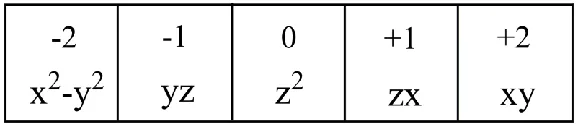
Rarely discussed in textbooks, but obvious to the naked eye, it is possible to subdivide the five d-orbitals into one symmetry A orbital, and two pairs of symmetry E orbitals in a C5v point group.16,17 We can assign a defined angular momentum to any of
65
the five d-orbitals, based on their extension relative to the axes. Using an analogy to compare an atom to a planet, if the vertical (polar) axis z of a spherical atom is taken as the reference, then magnetic quantum number ml =0 is assigned to the dz2 orbital, that
has mainly pole-to-pole extension. This orbital transforms with symmetry A. Orbitals dxy and dx2-y2 of symmetry E2 will be assigned to ml + 2 and -2 respectively, to account
70
will be assigned to orbitals dzx and dyz of symmetry E1, as the polar and equatorial
components balance out. These will be referred to as the “tropical” orbitals, to maintain the analogy with a planet. The pair also transforms into each other, but with a 90°
75
rotation about a C4 axis. The assignment of + and – sign to the angular momentum of
[image:5.612.108.398.208.271.2]the E pairs is arbitrary, but consistent throughout the activity (see figure 1).
Figure 1. Assignment of a quantum number ml to individual d-orbitals.
80
ACTIVITY 1: THE GROUND STATE TERMS
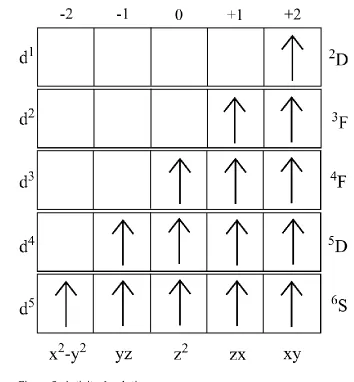
This simple exercise introduces the use of letters and numbers to define Russell-Saunders terms. Given that Hund’s rule assigns lowest energy to the highest spin configurations, the populated ground state configurations of atoms will be those of the greatest multiplicity. Therefore, one way to simplify the treatment of microstates and
85
Russell-Saunders terms is to consider only electron configurations of the highest spin multiplicity. The argument for this is that they are sufficient to rationalize the electronic spectra of many common coordination complexes, such as those of d1 –d3 metal ions, as
well as the low-field high-spin complexes of d4-d5 metal ions. For those complexes, low
spin transitions are not observed in the absorption spectra and therefore the relevant
90
electronic states are somewhat less important. This activity involves finding the
combination of electrons with the highest spin and the highest angular momentum, by adding up the individual ms and ml of every electron (Russell-Saunders coupling) in a
set of d1-d5 atoms, to obtain MS and ML. The next step is to convert the MS into
multiplicity by using the simple formula 2S +1 and to convert a population of ML into
95
momentum ML means lowest repulsions between electrons, which in turn mean lower
energy of the system, also pointing at the highest L term as the ground state one (see figure 2).
[image:6.612.91.445.158.540.2]100
Figure 2. Activity 1 solution.
ACTIVITY 2: THE MICROSTATES
In line with the previous activity, the students are required to concentrate only on the microstates that satisfy the Hund’s rule of maximum spin multiplicity. Those microstates represent the electronic configurations of the ground state and those of the
105
spin allowed excited states in a d2 ion and the transitions between them are those
pointing arrows will be used for consistency. The number of such combinations (N) is predictable, using the simple formula below (see equation 1), where d is the number of orbitals and n is the number of electrons. Each combination can exist and is called
110
“microstate”.
(1) N = 𝑑!
𝑛!(𝑑−𝑛)!
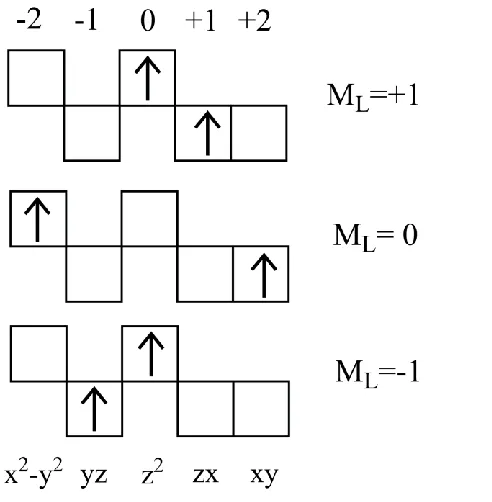
The students are asked to work out the ML of each combination of electrons, as a
sum of the ml assigned to each occupied orbital, as shown in figure 1
(-3,-2,-1,-1,0,0,+1,+1,+2,+3). The presence of a population of seven ML values from -3 to +3 of
115
“triplet” multiplicity implies the existence of the term L = 3F, which will contain one
microstate per possible value of ML, by definition. The remaining microstates with ML
-1, 0, +1 can only be assigned to a term L = 3P. The ten microstates can be divided into
two families: 3F and 3P, which are called energy terms. In the previous activity 3F was
found to be the ground state energy term, implying that those microstates belonging to
120
3P are higher in energy. While d-orbitals are degenerate in a set, combinations of singly
occupied orbitals might differ in energy in view of electron-electron repulsions: if the electrons are closer to each other, we expect them to form a higher energy microstate, so in this case, one belonging to 3P. Those four microstates with ML -3,-2, +2, +3 can be
unequivocally assigned to the term 3F at this stage (see figure 3). The remaining six
125
microstates could belong to each of the two terms. In order to assign the remaining microstates to a given term, it is helpful to observe what happens when the d2 atom is
Figure 3. Activity two solution.
ACTIVITY 3: ASSIGNMENT BY ENERGY AND SYMMETRY
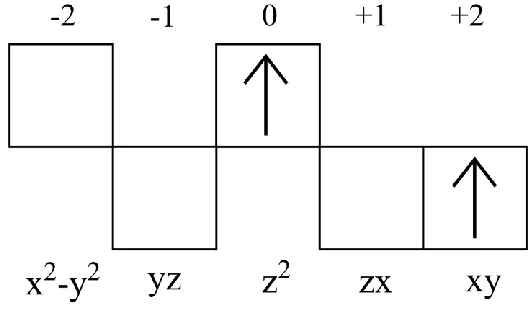
In this activity, the d-orbitals are split in an octahedral ligand field, where the dz2
and the dx2-y2 orbitals form a pair of high energy orbitals, with symmetry eg and the
remaining orbitals form a triplet degenerate, low energy set of label t2g. In keep with the
135
[image:9.612.106.372.232.387.2]mL assignment in figure 1, the ligand field produces the diagram shown in figure 4.
Figure 4. Energy split of d-orbitals, ordered by increasing ml.
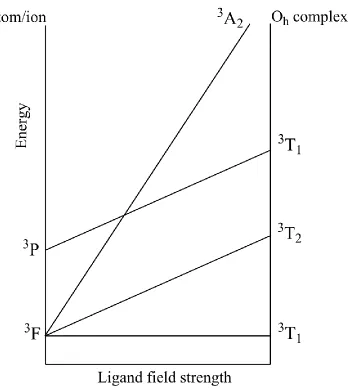
The students are introduced to a correlation between the d2 atom and a d2
octahedral complex (figure 5). The diagram shows how the same microstates exist in
140
Figure 5. Simplified correlation diagram between triplet multiplicity atomic terms and
the corresponding molecular terms in an octahedral ligand field. 145
The ligand field-induced split can be used by students to assign the remaining microstates to their energy term. Four states have already been assigned to 3F, based
on their ML being unique of a 3F term. In view of the octahedral ligand field split, the
three microstates with both electrons in lower energy orbitals (t2g) unequivocally belong
150
to a 3T1 ground state term, correlating with 3F in the diagram. The only microstate with
correlating with 3F from figure 5. Following these assignments, only one set of ML = 0
and +1 is left and they have to be assigned to a 3T1 term correlating with 3P. The two
microstates with one electron in t2g and one in eg, having ML = 2 and -3 can be safely
155
assigned to a 3T2 term correlating with 3F, as on balance they will be higher than 3T1
and lower than 3A2 in a Oh ligand field. The latest assignment, only leaves two
microstates, both having ML = -1 that cannot be distinguished either by combined
energy, or by their ML. This method goes as far as assigning eight out of ten microstates
of triplet multiplicity (see figure 6).
Figure 6. Activity 3 solution.
Electron repulsions offer an alternative method students can use to assign
165
combinations of electrons in orbitals to a given term. From figure 6, there are six microstates with one electron in t2g and one electron in eg. From figure 5, these belong
to the two triplet degenerate terms 3T2 and 3T1 of intermediate energy (remember we
have already assigned the remaining four microstates to the lowest and the highest energy term in the Oh complex).
170
The spatial extension of the occupied orbitals can be broken down into three
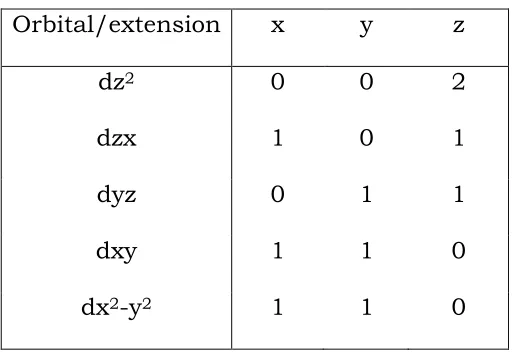
components, representing the x, y and z axes (see table 1). One set of three microstates extend along all three axes: xyz = 121 (dyz + dx2-y2); 211 (dx2-y2 + dzx); 112 (dxy + dz2)
and one set extends along two axes only: xyz = 103 (dzx + dz2); 013 (dyz + dz2); 220 (dxy
+dx2-y2). Only the latter is a complete set of quantum numbers, with ML = -1, 0, +1, as
175
from figure 1 assignment.
Orbital/extension
x
y
z
dz
20
0
2
dzx
1
0
1
dyz
0
1
1
dxy
1
1
0
[image:13.612.84.340.438.615.2]dx
2-y
21
1
0
Table 1. Orbitals spatial extension along the three axes.
It is reasonable to conclude that they not only belong to the same symmetry label, but they can be unequivocally assigned to 3P (see figure 7). This assignment is
consistent and completes the one discussed previously. The other set can be assigned to 3T2 correlating to the term 3F by exclusion. As discussed in activity 2, the microstates
assigned to 3P should be higher in energy, in the absence of a ligand field. Our
185
[image:14.612.108.354.280.531.2]assignment means that the two electrons in those microstates are confined in a restricted region of space, which is consistent with the notion of higher energy as a result of increased electron-electron repulsions.
Figure 7. Activity 4. Assignment to 3P by symmetry comparison. All three microstates 190
have spatial distribution of electrons in two directions only, according to table 1.
Ultimately, students need to be able to perceive a value in their assignments and relate them to the theory learned and the laboratories practical experiments. The four populations of microstates correspond to three possible families of electron transitions
195
octahedral complexes in the practical laboratories. The 3A2 ← 3T1 transition is the only
one that involves relocation of two electrons and therefore, when visible, it is generally a very weak band in the UV absorption spectrum. Visualization of the individual
microstates shows the double excitation very clearly.
200
It is possible to assign in similar fashion the ten quartet microstates in a d3 ion and
the five quintet microstates in a d4 metal ion, the latter assignment being particularly
easy and could be used as a “warm-up” exercise (see supplementary material).
The activity was trialed as part of a year two module in transition metals chemistry at Warwick. The activity was broken in three parts, giving small groups of three
205
students ten minutes to solve each part. Each activity was then commented by the tutor, prior to moving to the next. The understanding, based on clickers responses, went from 43% for activity one, to 57% for activity two, to 72% for the final activity. Overall, out of 48 students, 81% found it useful to help understanding microstates and quantum numbers.
210
CONCLUSIONS
In conclusion, a method to consolidate the concepts of “microstate” and “energy term”, complementary to the textbook treatment, is presented in the form of an activity for undergraduate students. The activity allows students to correlate atomic microstates with molecular equivalents and rank them by energy. The main feature is that a
215
ASSOCIATED CONTENT
Supporting Information
220
Supporting information includes: a description of the activities, an activity sheet, printouts of d-orbital boxes in degenerate and non-degenerate form for lamination and assignment of microstates for d3 and d4 atoms.
AUTHOR INFORMATION
Corresponding Author
225
*E-mail: [email protected]
ACKNOWLEDGMENTS
Dr V. Stavros is gratefully acknowledged for useful discussions.
REFERENCES
1. Greca, I. M.; Freire, O. Jr. Teaching introductory quantum physics and chemistry: caveats 230
from history of science and science teaching to the training of modern chemists. Chem. Educ.
Res. Pract.2014, 15, 286-296.
2. Morpurgo, S. Group theory and crystal field theory: a simple and rigorous derivation of the
spectroscopic terms generated by t2g2 electronic configuration in a strong octahedral field. J.
Chem. Educ. 2007, 84, 151-155.
235
3. Liu, Y.; Liu, Y; Liu B. A new method for obtaining Russell-Saunders terms. J. Chem. Educ.2011, 88, 295-298.
4. Didis, N. The analysis of analogy use in the teaching of introductory quantum theory, Chem. Educ. Res. Pract., 2015, 16, 355-376.
5. Belt, S. T.; Evans, E. H.; McCreedy, T. Overton, T. L.; Summerfield, S. A problem
240
based learning approach to analytical and applied chemistry, Univ. Chem. Educ.,
2002, 6, 65-72.
6. Garofalo A. Housing electrons: relating quantum numbers, energy levels and electron configurations J. Chem. Educ., 1997, 74, 709-710.
7. Hyde, K. E. Methods for obtaining Russell-Saunders term symbols from electronic
245
configurations, J. Chem. Educ., 1975, 52, 87-89.
8. Joshi, B. D. Primitive microstates and Russell-Saunders terms for multielectron atoms, J. Chem. Educ. 1976, 53, 245.
9. Kiremire, E. M. R. A numerical algorithm technique for deriving Russell-Saunders (R-S) terms, J. Chem. Educ., 1987, 64, 951-953.
10. Gorman, M. Rules for writing ground state Russell-Saunders symbol J. Chem. Educ., 1973, 50, 189-190.
11. Arias, F.; Sagues, F. Obtaining Russell-Saunders terms, Educ. in Chem., 1990, 27, 83-84.
12. Weller, M.; Overton, T.; Rourke, J.; Armstrong, F. Inorganic Chemistry 6th ed.
255
Oxford University press, Oxford. ISBN 978-0-19-964182-6. Ch. 20 pp.536. 13. Carlin, R. L. Electronic spectra of transition metal complexes, J. Chem. Educ.,
1963, 40, 135-143.
14. Orofino, H.; Faria, R. B., Obtaining the electron angular momentum coupling spectroscopic terms, jj, J. Chem. Educ., 2010, 87, 1451-1454.
260
15. Liu, Y.; Liu, Y; Drew, M. G. B. The use of three simple related procedures in determining the Russell-Saunders terms of equivalent electrons, Chem. Educator, 2012, 17, 118-124.
16. Cotton, F. A. Chemical applications of group theory, interscience pubs. (division of John Wiley & Sons inc. ) New York, 1963.
265