Original citation:
Zhu, Huanzhou, He, Ligang, Fu, Songling, Li, Rui, Han, Xie, Fu, Zhangjie, Hu, Yongjian and Li,
Chang-Tsun. (2017) WolfPath : accelerating iterative traversing-based graph processing
algorithms on GPU. International Journal of Parallel Programming .
Permanent WRAP URL:
http://wrap.warwick.ac.uk/95444
Copyright and reuse:
The Warwick Research Archive Portal (WRAP) makes this work of researchers of the
University of Warwick available open access under the following conditions.
This article is made available under the Creative Commons Attribution 4.0 International
license (CC BY 4.0) and may be reused according to the conditions of the license. For more
details see: http://creativecommons.org/licenses/by/4.0/
A note on versions:
The version presented in WRAP is the published version, or, version of record, and may be
cited as it appears here.
DOI 10.1007/s10766-017-0533-y
WolfPath: Accelerating Iterative Traversing-Based
Graph Processing Algorithms on GPU
Huanzhou Zhu1 · Ligang He1 · Songling Fu2 · Rui Li3 · Xie Han4 · Zhangjie Fu5 ·
Yongjian Hu6 · Chang-Tsun Li7
Received: 15 September 2017 / Accepted: 28 September 2017 © The Author(s) 2017. This article is an open access publication
Abstract There is the significant interest nowadays in developing the frameworks of parallelizing the processing for the large graphs such as social networks, Web graphs, etc. Most parallel graph processing frameworks employ iterative processing model. However, by benchmarking the state-of-art GPU-based graph processing frameworks, we observed that the performance of iterative traversing-based graph algorithms (such as Bread First Search, Single Source Shortest Path and so on) on GPU is limited by the frequent data exchange between host and GPU. In order to tackle the problem, we develop a GPU-based graph framework called WolfPath to accelerate the processing of iterative traversing-based graph processing algorithms. In WolfPath, the iterative pro-cess is guided by the graph diameter to eliminate the frequent data exchange between host and GPU. To accomplish this goal, WolfPath proposes a data structure called Lay-ered Edge list to represent the graph, from which the graph diameter is known before the start of graph processing. In order to enhance the applicability of our WolfPath
B
Ligang He1 Department of Computer Science, University of Warwick, Coventry CV4 7AL, UK
2 College of Polytechnic, Hunan Normal University, Changsha, China
3 College of Computer Science and Network Security, Dongguan University of Technology,
Dongguan, China
4 School of Electronics and Computer Science and Technology, North University of China,
Taiyuan, China
5 School of Computer and Software, Nanjing University of Information Science and Technology,
Nanjing, China
6 School of Electronic and Information Engineering, South China University of Technology,
Guangzhou, China
framework, a graph preprocessing algorithm is also developed in this work to convert any graph into the format of the Layered Edge list. We conducted extensive exper-iments to verify the effectiveness of WolfPath. The experimental results show that WolfPath achieves significant speedup over the state-of-art GPU-based in-memory and out-of-memory graph processing frameworks.
Keywords Graph processing·GPGPU·Parallel computing
1 Introduction
The demand for efficiently processing large scale graphs has been growing fast nowa-days. This is because graphs can be used to describe a wide range of objects and computations and graph-based data structures are the basis of many applications
[19,22–24,26,30,36,46,48]. Traditionally, motivated by the need to process very
large graphs, many frameworks have been developed for processing large graphs on
distributed systems. Examples of such frameworks include Pregel [28], GraphLab
[25], PowerGraph [9] and GraphX [10]. However, since developing distributed graph
algorithm is challenging, some researchers divert their attention to design the graph processing system that handle large scale graphs on a single PC. The research
endeav-ours in this direction have delivered the systems such as GraphChi [17], PathGraph
[45], GraphQ [39], LLAMA [27] and GridGraph [51]. However, these systems suffer
from the limited degree of parallelism in conventional processors. GPU is renowned for
its potential to offer the massive degree of parallelism in many areas [3,4,11,21,32,42–
44,49,52]. Therefore, much research now resort to use GPU to accelerate the graph
processing process. The exemplar GPU-based graph processing systems include
Medusa [47], Gunrock [40], CuSha [16], Frog [35] and MapGraph [6].
Many of these graph processing frameworks employ iterative processing techniques
[38,41,50]. Namely, graph processing involves many iterations. Some iterative graph
processing algorithms use the threshold value (e.g., in the PageRank algorithm) or the number of vertices/edges (e.g., in the Minimum-cut algorithm) to determine the termi-nation of the algorithms. In these algorithms, the iteration count is known beforehand. However, in iterative traversing-based graph processing, the algorithm is driven by the graph structure and the termination of the algorithm is determined by the states of vertices/edges. Therefore, these algorithms need to check the state of vertices/edges at the end of every iteration to determine whether to run the next iteration. In each iteration, either synchronous or asynchronous methods can be used to compute and update the values of vertices or edges in the graph. The processing terminates when all vertices meet the termination criteria.
at this point. However, current GPU devices and frameworks (CUDA [5] and OpenCL
[37]) do not support synchronization among different thread blocks during the
exe-cution of the kernel. Therefore, to synchronize between different thread blocks, the program has to exit the kernel, and copy the data back to the host and use the CPU to determine whether the computation process is complete. This frequent data exchange between host and GPU introduces considerable overhead.
To address this problem, we present WolfPath, a framework that is designed to improve the iterative traversing-based graph processing algorithms (such as BFS and SSSP) on GPU. Our development is motived by the facts that: (1) the iterative graph processing algorithm converges when the computations on all vertices have been com-pleted; (2) the iterative traversing-based graph processing on GPU requires frequent data exchange between GPU and host memory to determine the convergence point; (3) the maximum number of iterations needed to complete a traversing-based graph processing algorithm is determined by the graph’s diameter (longest shortest path).
WolfPath has following features. First, a graph in WolfPath is represented by a tree structure. In doing so, we manage to obtain very useful information, such as the graph diameter, the degree of each vertex and the traversal order of the graph, which will be used by WolfPath in graph computations. Second, we design a layered graph structure, which is used by WolfPath to optimize GPU computations. More concretely, for all vertices in the same depth of the graph tree, we group all the edges that use these vertices as source vertex into a layer. All the edges in the same layer can be processed in parallel, and coalesced memory access can be guaranteed. Last but not least, based on the information we gain from the graph model, we design a computation model that does not require frequent data exchange between host and GPU.
The rest of the paper is organised as follows. Section2overviews the limitation of
iterative graph processing technique used by the state-of-art graph processing
frame-works. Section3presents the graph modelling and in-memory data structure proposed
in this paper. Section4presents the details of the WolfPath framework, including the
iterative processing model and the graph partition method when the graph can not fit
into GPU. Experimental evaluation is presented in Sect.5. Section6discusses related
work. Finally, Sect.7concludes this paper.
2 Motivation: the Limitation of Current Approach
Many parallel graph processing frameworks are based on the iterative processing model. In this model, the computation goes through many iterations. In each iter-ation, either synchronous (such as Bulk Synchronous parallel used by Pregel) or asynchronous (Parallel sliding window used by GraphChi) methods can be used to compute and update the vertex or edge values. The computation terminates when all vertices meet the application specific termination criterion (e.g, the results of all vertices remain unchanged).
pass-ing or shared memory. On GPU, the threads are organised in thread blocks and the communication can be divided into two types: intra- and inter-block communication. Intra-communication refers to the communications between the threads within a block, which is achieved via shared memory or global memory in GPU. On the con-trary, the inter-block communication is the communications across different thread blocks. However, there is no explicit support for data communication across different thread blocks. Currently, inter-block data communication is realized through the GPU
global memory followed by a barrier synchronization in CPU [5,37]. The barrier is
implemented by terminating the execution of the current kernel and re-launching the kernel.
The reason for the lack of support for inter-block communications on GPU is as follows. On GPU, the number of thread blocks launched by an application is normally much larger than the number of Streaming Multiprocessors (SM). However, When a large number of threads try to communicate between different blocks, it can cause the deadlock. An example is given as follows to illustrate the deadlock issue. Suppose that there are 5 thread blocks and only 4 SMs and that each thread block will occupy all resources on a SM. Assume blocks 1–4 execute on 4 SMs. When synchronization occurs, blocks 1–4 will wait until block 5 finishes. However, block 5 will never be executed on any SM since all SMs are busy and there are no resources available. Consequently, the deadlock occurs.
Due to the lack of support for inter-block communications, implementing iterative graph computation algorithm on GPU is much more challenging than on CPU. To demonstrate this, let us first consider how the iterative computation is implemented
on CPU. Algorithm 1 shows the high level structure of the iterative computation
on CPU. The loop is controlled by the flagvariable, which is set to be true at the
beginning. Next, all processes/threads execute a user-defined function,compute(), and
then invoke theupdate_conditionfunction to check if the user-specified termination
condition is met. Each process/thread has its own f lagvariable, which is updated by
update_conditionfunction. Theupdate_conditionfunction returnsfalseif the program
reaches the termination condition and returnstr ueif otherwise. The f lagvariable
is synchronised between all the processes/threads. If its value is f alse, the iteration
terminates.
Algorithm 1Iterative Computation on CPU f lag←tr ue
whilef lag==tr uedo compute();
ifupdate_condi ti on()==f alsethen f lag←f alse
When executing the above code in parallel on a CPU-based system, the
synchroniza-tion of the f lagvariable can be easily achieved through shared memory or message
processing on GPU, many state-of-art graph processing frameworks use the following
approach. The f lagvariable is stored in the global memory of GPU. Each thread also
has a locald_f lagvariable. If a thread meets the termination condition in the current
iteration, it sets its ownd_f lagtofalse. Thend_f lagis synchronised between all
the threads within a thread block. One thread in each thread block updates the global f lagvariable if the value ofd_f lagin this thread block is f alse. Next, the program
exits the kernel and copies the value of f lagback to the host, which is used by the host
program to determine whether another kernel should be launched (i.e., continuing to
perform the computation). This technique is outlined Algorithms2and3.
Algorithm 2Iterative processing kernel functionupdate_kernel(boolf lag)
for allthreads in parallel:do
ifupdate_condi ti on()==f alsethen f lag←f alse
Algorithm 3Iterative processing host f lag←tr ue
whilef lag==tr uedo functioncopy_flag_to_gpu
functionupdate_kernel(f lag) functioncopy_flag_to_cpu
Clearly, in order to decide whether to launch the next iteration, the value of f lag
needs to be exchanged between host and GPU frequently. These operations incur a significant overhead. If the number of iterations needed to complete the graph
com-putation is known beforehand, the exchange of f lagbetween host and GPU can be
eliminated, which can potentially improve the performance.
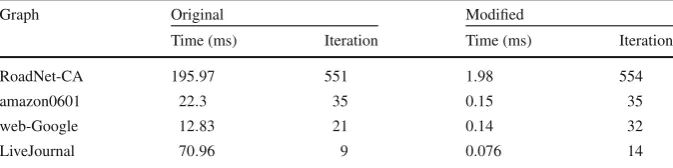
We conduct the experiments to investigate the extra overhead caused by exchanging the f lagvariable. Four real world graphs, which are listed in Table1, are used in this experiment. We determine the diameter of the graph using the BFS algorithm
implementated on CuSha framework [5]. We record the computation time and the
number of iterations it takes to complete the algorithm. We can prove that the number of iterations the iterative graph computation has to perform must be less than or equal
to the graph diameter. Instead of using the f lagvalue to determine the termination
condition of the graph computation, we terminate the computation when the number of iterations equals to the graph diameter. We re-run the modified program and record
the computation time. The results are listed in Table2.
As can be seen from Table2, the computation time of modified program is much
mea-Table 1 Real world graphs
used in the experiments Graph Vertices Edges
GPU In memory Graph
RoadNet-CA [20] 1,965,206 5,533,214
amazon0601 [20] 403,394 3,387,388
Web-Google [20] 8,75,713 5,105,039
[image:7.439.51.388.187.271.2]LiveJournal [20] 4,847,571 68,993,773
Table 2 The computation time comparison of Original CuSha and Modified CuSha
Graph Original Modified
Time (ms) Iteration Time (ms) Iteration
RoadNet-CA 195.97 551 1.98 554
amazon0601 22.3 35 0.15 35
web-Google 12.83 21 0.14 32
[image:7.439.168.390.301.372.2]LiveJournal 70.96 9 0.076 14
Table 3 Memory copy and
computation time Graph Memory copy (ms) Computation (ms)
RoadNet-CA 0.36 0.004
amazon0601 0.63 0.004
Web-Google 0.6 0.004
LiveJournal 7.9 0.005
sured the average time for performing data copying and the average computation time
per iteration in the experiments. The results are listed in Table3:
The results from Table3show that the data copy time is greater than the computation
time by 90–1500 times. These results indicate that it is worth performing the exces-sive iterations, comparing with copying data. We observe another interesting point in
Table3. No matter which graph the algorithm is processing, only one integer (i.e., the
value of the f lagvariable) is copied between GPU and host. However, the average
memory copying time per iteration is different for different graphs. This is because the synchronisation cost between thread blocks is different for different graphs. More threads are involved in synchronisation, the longer the synchronization takes.
3 Graph Representation in WolfPath
In this section, we present the graph model to help determine the number of iterations when processing a graph on GPU iteratively. We also present the detailed data structure of our in-memory graph representation, which is designed in the way that can improve the coalescence in-memory access so as to achieve the higher performance.
3.1 Graph Modelling in WolfPath
The experimental results shown in last section suggest that using the number of iter-ations can improve the performance in graph processing. However, because graph processing algorithms are data driven, it is difficult to determine the number of
itera-tions for different graph inputs before the program starts. Much research [14,15,18,28]
have been conducted to tackle this problem. The research shows that when processing graph algorithms iteratively, the upper bound of the number of iterations is the diam-eter of a graph, i.e., the number of the nodes on the path corresponding to the graph
diameter [31].
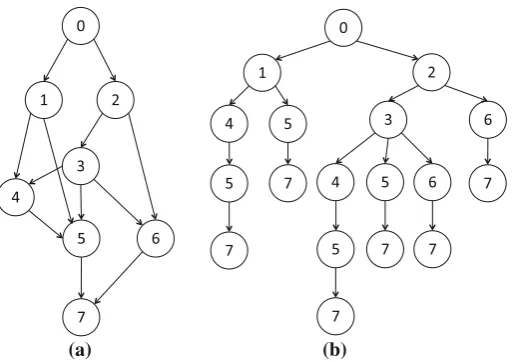
In WolfPath, we model the graph as a layered tree structure. That is, we first represent the graph as a tree-like structure, then group the vertices that in the same depth into one layer. By modelling the graph this way, the diameter of the graph is the distance from the root vertex to the deepest leaf vertex.
If some vertices in the same layer are connected, we duplicate these vertices in the next level. By duplicating these vertices, the vertex value updated in the current level can be sent to the next level. The reason for this design is as follow. The vertices in the current level and the next level form a group of edges. If a vertex is both source and destination of different edges, the calculated values of their neighbouring vertices may not settle (i.e., the calculated values are not final values of the vertices) after one iteration. Therefore, by duplicating these vertices in the next level, the updated value of their neighbouring vertices will be recomputed.
Based on the above description, given a graph G = (V,E), a layered tree T =
(Vt,Et)is defined as follows. Vt ⊆ V and Et ⊆ E. The root vertex of the tree,
denoted byvr t ∈Vt, is the vertex which does not have in-edges.degr eei n(v)denotes
the in-degree of vertexv. Thendegr eei n(vr t)=0.
∀vt ∈ Vt, ifdegr eei n(vt)is greater than 0, then∃v ∈ Vt s.t.(v, vt) ∈ Et. If the
out-degree of vertexvt, denoted bydegr eeout(vt), is 0, thenvt is called a leaf vertex
ofT. Given a levelLi,∀vt ∈Li, if∃v∈Lis.t.et =(vt, v), thenvis also in the level
Li+1. Figure1b gives the tree structure of the graph shown in Fig.1a.
3.2 Graph Data Structure in WolfPath
As shown in the previous research [16], one of the main factors that limits the
(a) (b)
Fig. 1 An example graph and its layered tree representation.aExample graph andbLayered tree repre-sentation
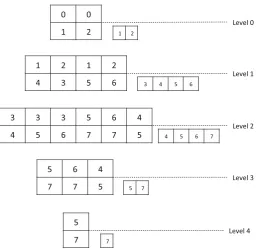
Based on the layered tree structure, we design a layered edge list structure to store the graph in the memory. In this design, each level in the layered tree is represented by
two arrays,source arrayanddestination array, which are used to store the source and
destination vertexes of each edge in that level respectively. Thei-th entry in the source
array and thei-th entry in the destination array form an edge in the level. We also
create an array for each layer to store the updated values of the destination vertices in
that layer. An example is shown in Fig.2.
It provides the following benefits to use this structure to store a graph in memory. First, the consecutive threads can read/write the consecutive elements from/to the source and destination arrays in the global memory. Therefore the coalesced global memory access can be guaranteed. Second, because all the edges in each layer are independent to each other, we can process them in parallel. In addition, if one layer is too big to fit in the GPU global memory, we can split it into multiple smaller edge lists. Third, multiple layers can be combined together to fully utilise the computation power of GPU. We will discuss the last two advantages in more detail in a later section.
4 The WolfPath Framework
In this section, we first describe how WolfPath executes a traversing-based graph processing algorithm in parallel. Then we present how WolfPath tackle the issue of GPU under-utilisation and how WolfPath partition a large scale graph when it can not be fit in the GPU global memory.
4.1 Preprocessing
[image:9.439.93.350.53.234.2]Fig. 2 An example of layered edge list structure for graph in Fig.1a
memory and converts it into the CSR format. Next, it uses Algorithm4to build the
layered tree, and then writes the layered tree back to a file stored in the disk. It is worth noting that this program is only run once for a graph. When processing a graph, WolfPath will first check if there exists a corresponding layered tree file. If the file exists, WolfPath will use it as the input. Otherwise, it will convert the graph into this
new format. Algorithm4is used to build the layered tree.
Algorithm 4Building layered tree 1:functionbuild_tree(graphG, vertexvr t)
2: TreeT←null
3: QueueQ←null 4: Q.enqueue(vr t)
5: node_level[V] ←0
6: whileQ! =nulldo
7: v=Q.dequeue()
8: level=node_level[v]
9: for allneighboruofvdo
10: ifu∈/Tthen
11: T.add_edge(v,u)
12: Q.enqueue(u)
13: node_level[u]+ =1
14: else ifu∈T&&u∈ {w∈T|w.level=level}then
15: T.add_edge(v,u)
16: Q.enqueue(u)
17: node_level[u]+ =1
Algorithm4is based on the breadth-first algorithm (BFS). The algorithm constructs
[image:10.439.92.350.52.302.2]starts with adding the vertexvr tintoQ(Line 4). In order to quickly retrieve the level
information of each node, the algorithm also maintains an array callednode_level
(Line 5), which is used to store the level information of each node. The size of this
array is equal to the number of vertices (denoted byV) in the graphG. This array is
indexed by vertex id. The algorithm initialises all vertices in this array to 0 (Line 5). Then the algorithm performs the following steps iteratively (Line 6): it pops out the
first vertexvfrom the queue (Line 7), and reads its level information fromnode_level
(Line 8).∀e:v →u ∈ E (Line 9), ifu ∈/ T (Line 10), oruhas already been added
intoTbut is in the same level asv(Line 14), the algorithm adds edgev,u inT (Line
11, 15). Next, the algorithm putsuin the queue by performingenqueue(u)(Line 12,
16), sets the level ofuto the current level plus 1 (Line 13 and 17). This process repeats
untilQbecomes empty.
4.2 The Computation Model of WolfPath
The computation process of WolfPath is as follows. In WolfPath, the graph is processed layer by layer. For each layer, three operations are performed by GPU in parallel: the
read, compute and write operations. Fori-th level in the graph, the read operation
reads the updated vertex value from the global vertex array. The compute operation acts on each edge and uses the data gathered from the read operation to compute the value for its edge/vertices. The write operation writes the updated value to the global vertex value array. So the updated values can be used in next iteration by the read operation. Hence, The computation model in WolfPath is synchronous and guarantees that all updates from a previous compute phase are seen only after the write operation is completed and before the next read operation starts. The whole process terminates when all the levels have been processed, that is, the number of iterations is equal to
the number of levels of the graph. This process is outlined in Algorithm5.
Algorithm 5Computation process of WolfPath 1:functionprocessing(Layered TreeT, root vertexvr t)
2: i←0
3: vr t=D E F AU L T_V ALU E 4: whilei<T.leveldo
5: ifi! =0then
6: for allvertexes in parallel in levelido 7: read vertex value from leveli−1 8: for allEdges in parallel in levelido 9: compute the update value 10: for allvertexes in parallel in levelido 11: write vertexes value to update value array
4.3 Combined Edge List
the graph layer by layer and the graphs have the nature of irregular data structure, such representation may cause the under-utilisation of GPU.
Each layer in the graph may have different numbers of edges. This number varies
dramatically between levels. For instance, consider the graph shown in Fig.1. The
first layer has 2 edges only. on the other hand, the second and third layer have 4 and 6 edges respectively. Hence, the number of threads required to process the first level is far less than the computing power (i.e., the number of processing cores) of GPU.
To overcome this problem, we propose the combined edge list, which is a large edge list that is constructed from multiple layers of edge lists. The combined edge
list is constructed in the following way. We first define a number M E, which is the
minimum amount of edges to be processed by GPU. Then we add the number of edges level by level starting from the first level of the layered tree. Once the total number of
edges is greater or equal toM E, we group these levels together and then re-count the
edges from the next level. This process repeats until all levels have been processed. The way of building the combined edge list ensures that each combined edge list is formed by consecutive edge lists from the layered tree. Hence, each combined edge list can be treated as a sub-graph of the original graph. Therefore, the number of iterations required to process a combined edge list is equal to the number of levels used to form
this tree. So Algorithm5is re-designed as Algorithm6.
Algorithm 6Processing the Combinaed Edge List 1:functionprocessing(Layered TreeT, root vertexvr t)
2: C E L←build_Combi ned_Edge_Li st(T)
3: i←0
4: vr t=D E F AU L T_V ALU E 5: whilei<C E L.countdo 6: levels←C E S[i].level 7: whilej<leveldo
8: parallel process all edges inC E L[i]
It is very important that we group the consecutive levels together to form a combined
edge list. Because the result of the vertices in levelidepends on those in leveli−1,
the results from the previous iteration need to be passed to the next iteration, which can be easily achieved by grouping the consecutive levels together. If we group the non-consecutive levels into a list, passing results between different levels requires lot of data transferring between host and GPU memory, which will harm the performance.
There remains one question: how do we choose the value forM E? If the number of
M Eis too small, the resulting edge list may not fully occupy the GPU. On the contrary,
if it is too large, the size of the edge list may exceed the size of the GPU memory. Since it is desired that the GPU is fully occupied, the maximum active threads can be used to determine the minimum number of edges per combined edge list. The maximum number of active threads is the number of threads that a GPU can run simultaneously
in theory, which can be found by Eq.1, whereNsm is the number of multiprocessors
(SMs),M Wpsmis the maximum number of resident warps per SM and theTpwis the
threads per warp.
4.4 Out of GPU Memory Processing
Comparing with the host platform, the GPU has a limited memory space. The size of real world graphs may be from few gigabytes to terabytes, which are too large to fit in the GPU global memory. Therefore, in this section, we develop an out-of-GPU-memory engine that can process such large scale graphs.
The general process of developing an out-of-GPU-memory engine is to first partition the graph into graphs that can fit into GPU memory, and then process these sub-graphs in GPU one at a time. Therefore, our first objective in designing such an engine is to achieve good performance in graph partitioning. Ideally, the performance of this process should be as close as possible to the performance of loading the graph into memory. The second objective is that after partitioning the graph, the graph framework has to deal with the frequent data exchange between GPU and host memory. Otherwise, the performance will take hit.
Based on the design of Layered Edge List, these two goals can be achieved. The process of partitioning the graph is similar to building the combined edge list. We start with the first layer and accumulate the vertices in the layers until the size of accumulated vertices becomes larger than the GPU globa memory. We group all the accumulated vertices as a sub-graph and start the accumulating process again from the current layer. The partitioning process is complete when we have processed all layers in the graph.
The complexity of such partitioning method is ON, where N is the number of
layers in the graph. Given the fact that most real world graphs, especially the social
network graphs, do not have a big diameter, the number ofNwill not be very large.
After partitioning the graph, each sub-graph is processed in order based on their positions in the graph. That is, the processing starts with the sub-graph that contains the first layer. The next sub-graph to be processed is the one that follows the first sub-graph. In addition, the updated values of the vertices in the last layer of the current sub-graph need to be passed to the next sub-graph. This can be achieved by retaining the updated vertex values in the global memory after the computation is finished. Therefore, when next graph is loaded into the GPU global memory, the data needed by the sub-graph is in the global memory. To process each sub-sub-graph, we use the same method as that for in-GPU-memory processing. Combining multiple layers into a sub-graph enables us to fully utilise the GPU.
It is possible that the size of one layer is larger than the GPU memory. in this case, we can split this layer into multiple parts and compute one part at a time. This works because all the edges in a layer are independent to each other and it is therefore safe to partition a layer into multiple small chunks and process them separately.
4.5 Optimisation for GPU
4.5.1 Shared Memory
Writing the updated value into theupdated value arraywill cause the random access
to the global memory. To address this issue, we use the shared memory in GPU to store the vertex array, which can enhance the performance of random access, since the access to the shared memory is much faster than global memory.
The following method is used in WolfPath to use the shared memory effectively. The shared memory in GPU is shared between all the threads in a thread block. Therefore, the input edge list is split into small blocks in WolfPath, and a vertex array is constructed for each block. Each edge block is processed by one thread block. Multiple thread blocks are processed in parallel. In each thread block, edges are processed in parallel by the threads.
During the execution, the threads first fetch the updated vertex values into the shared memory of the block. The consecutive threads of the block read consecutive elements of the local vertex value array. Hence, reading requests are coalesced to the minimum number of memory transactions. After the computation, the threads first write the newly computed values into the shared memory, and then perform synchronisation between different thread blocks by writing the data from the shared memory to the global memory.
4.5.2 Asynchronous Execution
WolfPath asynchronously performs computation and communication. Specifically, it leverages the CUDA Streams and the hardware support such as Hyper-Qs provided by NVIDIAs Kepler to enable data streaming and computation in parallel. WolfPath creates multiple CUDA Streams to launch multiple kernels and overlap memory copy-ing and computation in order to transfer data asynchronously. This is motivated by the fact that an edge list in WolfPath can be split into many sub-arrays. Each of these sub-arrays is independent to each other. WolfPath exploits this fact and does not move the entire edge list in a single copy performed by a CUDA stream. Instead, WolfPath creates multiple CUDA Streams to move these sub-arrays to the GPU. As the result, many hardware queues in GPU are used concurrently, which improves the overall throughput.
5 Experimental Evaluation
In this section, we evaluate the performance of WolfPath using two types of graph dataset: small sized graphs that can fit into the GPU global memory (called in-memory graphs in the experiments) and large scale graphs that do not fit (out-of-memory graphs). The size of a graph is defined as the amount of memory required to store the edges, vertices, and edge/vertices values in user-defined datatypes.
Small graphs are used to evaluate WolfPath’s performance in in-memory graph processing against other state-of-art in-memory graph processing systems (e.g., CuSha
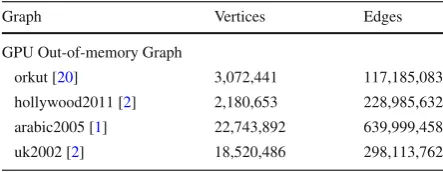
Table 4 Real world graphs
used in the experiments Graph Vertices Edges
GPU Out-of-memory Graph
orkut [20] 3,072,441 117,185,083
hollywood2011 [2] 2,180,653 228,985,632
arabic2005 [1] 22,743,892 639,999,458
uk2002 [2] 18,520,486 298,113,762
with other out-of-core frameworks that can process large graphs on a single PC (e.g., GraphChi and X-Stream).
The eight graphs listed in Tables1and4are publicly available. They cover a broad
range of sizes and sparsity and come from different real-world origins. For example, Live-Journal is directed social networks graph. RoadNetCA is the California road
network.orkutis an undirected social network graph.uk-2002is a large crawl of the
.uk domains, in which vertices are the pages and edges are links.
We choose two widely used searching algorithms to evaluate the performance, namely Breadth First Search (BFS) and Single Source Shortest Paths (SSSP).
The experiments were conducted on a system with a Nvidia GeForce GTX 780Ti graphic card, which has 12 SMX multiprocessors and 3 GB GDDR5 RAM. On the host side, we use the Intel Core i5-3570 CPU operating at 3.4 GHZ with 32 GB DDR3 RAM. The benchmarks were evaluated using CUDA 6.5 on Fedora 21. All the programs were compiled with the highest optimisation level (-O3).
5.1 Performance Evaluation
5.1.1 Comparison with Existing In-Memory Graph Processing Frameworks
In this section, we compare WolfPath with the state-of-art in-memory processing
solu-tions such as CuSha [16] and Virtual Warp Centric [13]. In the experiments, we use the
CuSha-CW method, because this strategy provides the best performance in all CuSha strategies. Both CuSha and Virtual Warp Centric apply multi-level optimisations to the in-memory workloads.
We first compare the computation times among WolfPath, CuSha and VWC.
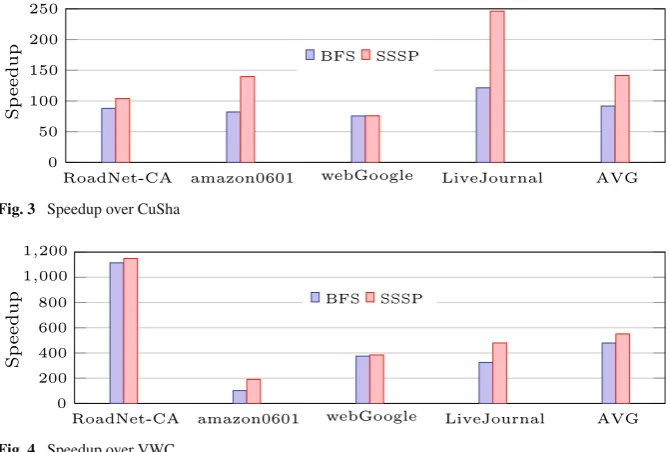
Fig-ures3and4show the speedup of WolfPath over CuSha and VWC.
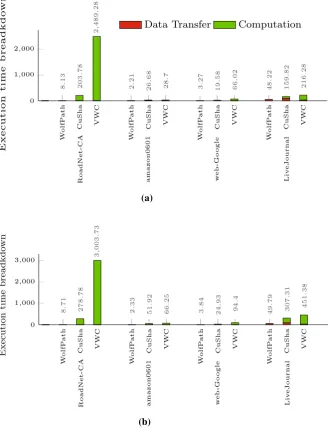
We also list the breakdown performances in Fig.5. In these experiments, the Data
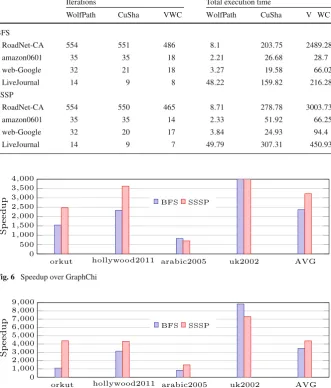
Transfer is time taken to move data from the host to GPU, the computation refers to the time taken for actual execution of the algorithm. We also recorded the number of iterations that each algorithm takes in different systems, these results are listed in
Table5.
As can be seen from these results, WolfPath outperforms CuSha and Virtual Warp Centric. Although WolfPath requires more iteration to complete the algorithm, the
average speedup of WolfPath over CuSha is more than 100×, and 400×over VWC.
[image:15.439.163.388.61.146.2]coa-webGoogle
RoadNet-CA amazon0601 LiveJournal AVG
0 50 100 150 200 250
Sp
eedup
BFS SSSP
Fig. 3 Speedup over CuSha
webGoogle
RoadNet-CA amazon0601 LiveJournal AVG
0 200 400 600 800
1,000
1,200
Sp
eedup
BFS SSSP
Fig. 4 Speedup over VWC
lesced memory access. On the other hand, with carefully designed data structures, both WolfPath and CuSha can access graph edge in a sequential manner, hence memory performance is much better. We also noticed that WolfPath takes more iterations than other implementations. This is because in iterative computation model, the compu-tation can be converged very fast, but WolfPath is bounded by the graph diameter, which is the upper bound of the iteration count. However, as discussed in the previous section, compare to memory copy operation, computation is much faster. Therefore, WolfPath still outperforms other systems.
5.1.2 Comparison with GPU Out-of-Memory Frameworks
The results shown in the last section demonstrate WolfPath’s performance in process-ing in-memory graphs. However, many real-world graphs are too large to fit in GPU memory. In this section, we examine the WolfPath’s ability to process large graphs which cannot fit into GPU memory. To the best of our knowledge, the state-of-art
GPU-based graph processing frameworks [6,16,47] assume that the input graphs can
fit in the GPU memory. Therefore, in this work, we compare WolfPath (WP) with two
CPU-based, out-of-memory graph processing framework: GraphChi (GC) [17] and
X-Stream (XS) [33]. To avoid disk I/O overhead in systems such as GraphChi and
X-Stream, the dataset selected in the experiments can fit in host memory but not in GPU memory.
As shown in Figs.6and7, WolfPath achieves an average speedup of 3000×and
4000×over GraphChi and X-Stream (running with 4 threads), respectively, despite
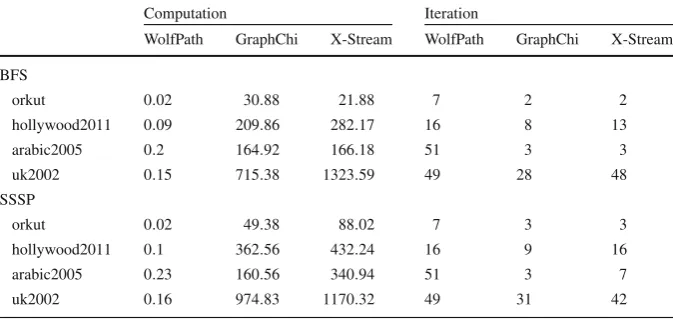
its need to move the data between GPU and CPU. We also list the computation time
[image:16.439.52.387.56.282.2] [image:16.439.56.387.61.152.2]W olfP ath W olfP ath W olfP ath W olfP ath
CuSha VW CuSha CuSha CuSha
C VW C VW C VW C 0 1,000 2,000
8 . 13 2 . 21 3 . 2 7 48 . 22 203 . 78 26 . 68 19 . 58 159 . 82 2 , 489 . 2 8 2 8 . 7 66 . 02 216 . 2 8 Execution time breadkdo wn
Data Transfer Computation
RoadNet-CA amazon0601 web-Go
ogle
Liv
eJournal
(a)
W o lfP ath W o lfP ath W o lfP ath W o lfP ath
CuSha VW CuSha CuSha CuSha
C VW C VW C VW C 0 1,000 2,000 3,000
8 . 7 1 2 . 33 3 . 8 4 49 . 79 278 . 78 51 . 92 24 . 93 307 . 31 3 , 003 . 73 66 . 25 9 4 . 4 4 51 . 3 8 Execution time breadkdo w n
RoadNet-CA amazon0601 we
b-Go
ogle
Liv
eJournal
(b)
Fig. 5 Execution time breakdown of WolfPath, CuSha and VWC on different algorithms and graphs. The
time unit is milliseconds.aBFS andbSSSP
pre-processing and the computation is overlapped with I/O operations, we use the total execution time of the system as the comparison.
As can be seen from the Table6, although WolfPath performs more iterations than
[image:17.439.56.385.62.491.2]Table 5 Number of iterations executed by different systems and total execution times (ms)
Iterations Total execution time
WolfPath CuSha VWC WolfPath CuSha V WC
BFS
RoadNet-CA 554 551 486 8.1 203.75 2489.28
amazon0601 35 35 18 2.21 26.68 28.7
web-Google 32 21 18 3.27 19.58 66.02
LiveJournal 14 9 8 48.22 159.82 216.28
SSSP
RoadNet-CA 554 550 465 8.71 278.78 3003.73
amazon0601 35 35 14 2.33 51.92 66.25
web-Google 32 20 17 3.84 24.93 94.4
LiveJournal 14 9 7 49.79 307.31 450.93
orkut hollywood2011 arabic2005 uk2002 AVG
0 500
1,000
1,500
2,000
2,500
3,000
3,500
4,000
Speedup
BFS SSSP
Fig. 6 Speedup over GraphChi
orkut hollywood2011 arabic2005 uk2002 AVG
0
1,000
2,000
3,000
4,000
5,000
6,000
7,000
8,000
9,000
Speedup
BFS SSSP
Fig. 7 Speedup over X-Stream
5.2 Memory Occupied by Different Graph Representation
From Fig.5, we can see that VWC has the shortest data transfer time. This is because it
[image:18.439.55.387.80.469.2] [image:18.439.57.390.381.470.2]Table 6 Execution times of WolfPath, GraphChi and X-Stream on different algorithms and graphs. The time is in seconds
Computation Iteration
WolfPath GraphChi X-Stream WolfPath GraphChi X-Stream
BFS
orkut 0.02 30.88 21.88 7 2 2
hollywood2011 0.09 209.86 282.17 16 8 13
arabic2005 0.2 164.92 166.18 51 3 3
uk2002 0.15 715.38 1323.59 49 28 48
SSSP
orkut 0.02 49.38 88.02 7 3 3
hollywood2011 0.1 362.56 432.24 16 9 16
arabic2005 0.23 160.56 340.94 51 3 7
uk2002 0.16 974.83 1170.32 49 31 42
RoadNet-CA amazon0601 webGoogle LiverJournal
0 400 800
1,200
1,600
2,000
OccupiedSpace(MB)
CSR Wolf CuSha-CW
Fig. 8 Memory occupied by each graph using CSR, CuSha-CW, WolfPath
Figure8shows the memory consumed by WolfPath’s Layered Edge List,
CuSha-CW and CSR. The Layered Edge List and CuSha-CuSha-CW need 1.37×and 2.81×more
space on average than CSR. CuSha uses 2.05×more memory than WolfPath, because
it represents each edge with 4 arrays.
5.3 Preprocessing Time
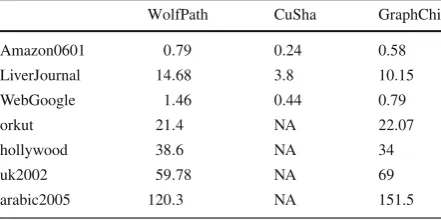
Table7shows the preprocessing time of WolfPath, CuSha, and GraphChi. The
pre-processing time refers to the time taken to convert the graph from the raw data to the framework specified format (e.g, layered tree in WolfPath or Shard in GraphChi). It consists of the graph traversing time and the time to write the data into the stor-age. Because CuSha is unable to process the graph larger than GPU memory, the corresponding cells in the table are marked as NA.
[image:19.439.51.388.83.243.2]Table 7 Preprocessing time (s)
WolfPath CuSha GraphChi
Amazon0601 0.79 0.24 0.58
LiverJournal 14.68 3.8 10.15
WebGoogle 1.46 0.44 0.79
orkut 21.4 NA 22.07
hollywood 38.6 NA 34
uk2002 59.78 NA 69
arabic2005 120.3 NA 151.5
RoadNet-CA amazon0601 webGoogle LiveJournal
0 10 20 30 40 50 60 70 80
ExecutionTime(ms)
OP-WP WP
Fig. 9 Performance comparison with and without optimisation
will only write a copy of data into shard. In contrast, WolfPath traverses the data using the BFS-based algorithm and then writes the data into a temporary buffer before it writes the data to the hard disk. Therefore, the workload of WolfPath is heavier than two other systems.
For graphs larger than GPU memory, WolfPath performs better than GraphChi when processing uk2002 and arabic2005. This is because GraphChi generates many shard files for these two graphs, and hence it takes longer to write to the disk.
From this experiment, we argue that in WolfPath, although the preprocessing is time-consuming, the pre-processing is worthwhile because of the following reasons: First, for each graph, WolfPath only needs to convert it once. Second, the resultant format provides better locality and performance for iterative graph computations.
5.4 Effect of Optimisation Techniques
As shown in previous experimental results, the memory accessing operations are the dominant factor that affect the performance, and therefore are our primary target of
optimization. Figure9shows that the performance improves significantly thanks to the
2 optimization techniques discussed in Sect.4.5, including asynchronous execution
[image:20.439.167.388.61.171.2]6 Related Work
Using GPUs for graph processing was first introduced by Harish and Narayanan [12].
Since then, the CSR format has become the mainstream representation to store graphs
on GPU. Merrill et al. [29] present a work efficient BFS algorithm. They use different
approaches to minimize the workload imbalance. Virtual Warp Centric was proposed
in [13] to tackle the workload imbalance problem and reduce the intra-warp divergence.
Medusa [47] is a GPU-based graph processing framework that focuses on
abstractions for easy programming. MapGraph [6] implements the runtime-based
opti-misation to deliver good performance. Based on the size of the frontier and the size of the adjacency lists for the vertices in the frontier, MapGraph can choose from different scheduling strategies.
The graph processing solutions described above use the CSR format to represent the
graph, hence suffering from the random access to the graph data. CuSha [16] addresses
the inefficient memory access by introducing the G-Shard and Concatenated Windows. However, as shown in this paper, CuSha requires frequent data exchange between host and GPU, which leads to long overall execution time.
All of the approaches above make the fundamental assumption that the input graphs fit into GPU memory, which limits the usage of these solutions. However, WolfPath does not suffer from such restriction.
Most existing Out-of-Memory graph processing frameworks are CPU based, these frameworks are aiming to process graphs that do not fit into host memory. For instance,
GraphChi [17] is the first disk-based graph processing framework and designed to run
on a single machine with limited memory. X-Stream graph processing framework [33]
uses the edge-centric processing model that takes as input a binary formatted edge-list. It does not require preprocessing, but requires frequent disk I/O to fetch data.
Totem [7,8] is a hybrid platform that uses both GPU and CPU. It statically partitions
a graph into the parts of residing in GPU and host memories based on the degree of vertices. However, as the size of the graph increases, only a fixed portion of the graph
is able to fit in the GPU memory, resulting in GPU underutilization. GraphReduce [34]
aims to process the graphs that exceed the capacity of the GPU memory. It partitions the graph into shards and loads one or more shards into the GPU memory at a time. In GraphReduce, each shard contains a disjoint subset of vertices. The edges in each shard are sorted in a specific order.
7 Conclusion
Acknowledgements This work is partially supported by the EU Horizon 2020—Marie Sklodowska-Curie Actions through the project entitled Computer Vision Enabled Multimedia Forensics and People Identi-fication (Project No. 690907, Acronym: IDENTITY), Guangzhou City Science Foundation, (Project No. 201510010275), the Natural Science Foundation of China (Grant Numbers. 61370226, 61672156), PAPD and CICAEET.
Open Access This article is distributed under the terms of the Creative Commons Attribution 4.0
Interna-tional License (http://creativecommons.org/licenses/by/4.0/), which permits unrestricted use, distribution,
and reproduction in any medium, provided you give appropriate credit to the original author(s) and the source, provide a link to the Creative Commons license, and indicate if changes were made.
References
1. Boldi, P., Rosa, M., Santini, M., Vigna, S.: Layered label propagation: a multiresolution coordinate-free ordering for compressing social networks. In: Srinivasan, S., Ramamritham, K., Kumar, A., Ravindra, M.P., Bertino, E., Kumar, R. (eds.) Proceedings of the 20th International Conference on World Wide Web, pp. 587–596. ACM Press, New york (2011)
2. Boldi, P., Vigna, S.: The WebGraph framework I: Compression techniques. In: Proceedings of the Thir-teenth International World Wide Web Conference (WWW 2004), pp. 595–601. ACM Press, Manhattan, USA (2004)
3. Chen, B., Yang, J., Jeon, B., Zhang, X.: Kernel quaternion principal component analysis and its
appli-cation in rgb-d object recognition. Neurocomputing (2017).https://doi.org/10.1016/j.neucom.2017.
05.047
4. Chen, C., Li, K., Ouyang, A., Tang, Z., Li, K.: Gpu-accelerated parallel hierarchical extreme learning
machine on flink for big data. IEEE Trans. Syst. Man Cybern. Syst.PP(99), 1–14 (2017).https://doi.
org/10.1109/TSMC.2017.2690673
5. Corporation, N.: NVIDIA CUDA C Programming Guide. NVIDIA Corporation, version 9.0.176 edn
(2017).http://docs.nvidia.com/cuda/cuda-c-programmingguide/index.html#axzz4atgDRVPb
6. Fu, Z., Personick, M., Thompson, B.: Mapgraph: a high level api for fast development of high performance graph analytics on gpus. In: Proceedings of Workshop on GRAph Data Management
Experiences and Systems, GRADES’14, pp. 2:1–2:6. ACM, New York, NY, USA (2014).https://doi.
org/10.1145/2621934.2621936
7. Gharaibeh, A., Beltrão Costa, L., Santos-Neto, E., Ripeanu, M.: A yoke of oxen and a thousand chickens for heavy lifting graph processing. In: Proceedings of the 21st International Conference on Parallel Architectures and Compilation Techniques, PACT ’12, pp. 345–354. ACM, New York, NY,
USA (2012).https://doi.org/10.1145/2370816.2370866
8. Gharaibeh, A., Costa, L.B., Santos-Neto, E., Ripeanu, M.: On graphs, gpus, and blind dating: a workload to processor matchmaking quest. In: Proceedings of the 2013 IEEE 27th International Symposium on Parallel and Distributed Processing, IPDPS ’13, pp. 851–862. IEEE Computer Society, Washington,
DC, USA (2013).https://doi.org/10.1109/IPDPS.2013.37
9. Gonzalez, J.E., Low, Y., Gu, H., Bickson, D., Guestrin, C.: Powergraph: distributed graph-parallel computation on natural graphs. In: Proceedings of the 10th USENIX Conference on Operating Systems Design and Implementation, OSDI’12, pp. 17–30. USENIX Association, Berkeley, CA, USA (2012).
http://dl.acm.org/citation.cfm?id=2387880.2387883
10. Gonzalez, J.E., Xin, R.S., Dave, A., Crankshaw, D., Franklin, M.J., Stoica, I.: Graphx: graph processing in a distributed dataflow framework. In: Proceedings of the 11th USENIX Conference on Operating Systems Design and Implementation, OSDI’14, pp. 599–613. USENIX Association, Berkeley, CA,
USA (2014).http://dl.acm.org/citation.cfm?id=2685048.2685096
11. Gu, B., Sheng, V.S., Wang, Z., Ho, D., Osman, S., Li, S.: Incremental learning for v-support vector
regression. Neural Netw.67(C), 140–150 (2015)
12. Harish, P., Narayanan, P.J.: Accelerating large graph algorithms on the gpu using cuda. In: Proceed-ings of the 14th International Conference on High Performance Computing, HiPC’07, pp. 197–208.
Springer-Verlag, Berlin, Heidelberg (2007).http://dl.acm.org/citation.cfm?id=1782174.1782200
Program-ming, PPoPP ’11, pp. 267–276. ACM, New York, NY, USA (2011).https://doi.org/10.1145/1941553. 1941590
14. Kang, U., Tsourakakis, C.E., Appel, A.P., Faloutsos, C., Leskovec, J.: Hadi: Mining radii of large
graphs. ACM Trans. Knowl. Discov. Data5(2), 8:1–8:24 (2011).https://doi.org/10.1145/1921632.
1921634
15. Kang, U., Tsourakakis, C.E., Faloutsos, C.: Pegasus: a peta-scale graph mining system implementation and observations. In: Proceedings of the 2009 Ninth IEEE International Conference on Data Mining,
ICDM ’09, pp. 229–238. IEEE Computer Society, Washington, DC, USA (2009).https://doi.org/10.
1109/ICDM.2009.14
16. Khorasani, F., Vora, K., Gupta, R., Bhuyan, L.N.: Cusha: vertex-centric graph processing on gpus. In: Proceedings of the 23rd International Symposium on High-performance Parallel and Distributed
Computing, HPDC ’14, pp. 239–252. ACM, New York, NY, USA (2014).https://doi.org/10.1145/
2600212.2600227
17. Kyrola, A., Blelloch, G., Guestrin, C.: Graphchi: large-scale graph computation on just a pc. In: Proceedings of the 10th USENIX Conference on Operating Systems Design and Implementation,
OSDI’12, pp. 31–46. USENIX Association, Berkeley, CA, USA (2012).http://dl.acm.org/citation.
cfm?id=2387880.2387884
18. Lattanzi, S., Moseley, B., Suri, S., Vassilvitskii, S.: Filtering: a method for solving graph problems in mapreduce. In: Proceedings of the Twenty-Third Annual ACM Symposium on Parallelism in
Algo-rithms and Architectures, SPAA ’11, pp. 85–94. ACM, New York, NY, USA (2011).https://doi.org/
10.1145/1989493.1989505
19. Shen, J., Tan, H.W., Wang, J., Wang, J.W., Sungyoung, L.: A novel routing protocol providing good
transmission reliability in underwater sensor networks. J. Internet Technol.16, 171–178 (2015).https://
doi.org/10.6138/JIT.2014.16.1.20131203e
20. Leskovec, J., Krevl, A.: SNAP Datasets: Stanford large network dataset collection (2014).http://snap.
stanford.edu/data
21. Li, J., Li, X., Yang, B., Sun, X.: Segmentation-based image copy-move forgery detection scheme.
IEEE Trans. Inf. Forensics Secur.10(3), 507–518 (2015)
22. Li, K., Tang, X., Li, K.: Energy-efficient stochastic task scheduling on heterogeneous computing
systems. IEEE Trans. Parallel Distrib. Syst.25(11), 2867–2876 (2014).https://doi.org/10.1109/TPDS.
2013.270
23. Li, K., Tang, X., Veeravalli, B., Li, K.: Scheduling precedence constrained stochastic tasks on
hetero-geneous cluster systems. IEEE Trans. Comput.64(1), 191–204 (2015).https://doi.org/10.1109/TC.
2013.205
24. Liu, J., Li, K., Zhu, D., Han, J., Li, K.: Minimizing cost of scheduling tasks on heterogeneous multicore
embedded systems. ACM Trans. Embed. Comput. Syst.16(2), 36:1–36:25 (2016).https://doi.org/10.
1145/2935749
25. Low, Y., Gonzalez, J., Kyrola, A., Bickson, D., Guestrin, C., Hellerstein, J.M.: Graphlab: a new
frame-work for parallel machine learning. CoRR (2010).arXiv:1006.4990
26. Ma, T., Zhou, J., Tang, M., Tian, Y., Al-Dhelaan, A., Al-Rodhaan, M., Lee, S.: Social network and tag
sources based augmenting collaborative recommender system. IEICE Trans. Inf. Syst.98(4), 902–910
(2015)
27. Macko, P., Marathe, V.J., Margo, D.W., Seltzer, M.I.: Llama: efficient graph analytics using large multiversioned arrays. In: 2015 IEEE 31st International Conference on Data Engineering, pp. 363–
374 (2015).https://doi.org/10.1109/ICDE.2015.7113298
28. Malewicz, G., Austern, M.H., Bik, A.J., Dehnert, J.C., Horn, I., Leiser, N., Czajkowski, G.: Pregel: a system for large-scale graph processing. In: Proceedings of the 2010 ACM SIGMOD International Conference on Management of Data, SIGMOD ’10, pp. 135–146. ACM, New York, NY, USA (2010).
https://doi.org/10.1145/1807167.1807184
29. Merrill, D., Garland, M., Grimshaw, A.: Scalable gpu graph traversal. In: Proceedings of the 17th ACM SIGPLAN Symposium on Principles and Practice of Parallel Programming, PPoPP ’12, pp. 117–128.
ACM, New York, NY, USA (2012).https://doi.org/10.1145/2145816.2145832
30. Pan, Z., Jin, P., Lei, J., Zhang, Y., Sun, X., Kwong, S.: Fast reference frame selection based on content
similarity for low complexity hevc encoder. J. Vis. Commun. Image Represent.40–B, 516–524 (2016)
31. Plimpton, S.J., Devine, K.D.: Mapreduce in MPI for large-scale graph algorithms. Parallel Comput.
32. Rong, H., Ma, T., Tang, M., Cao, J.: A novel subgraph k+ -isomorphism method in social network
based on graph similarity detection. Soft Comput. (2017).
https://doi.org/10.1007/s00500-017-2513-y
33. Roy, A., Mihailovic, I., Zwaenepoel, W.: X-stream: edge-centric graph processing using streaming partitions. In: Proceedings of the Twenty-Fourth ACM Symposium on Operating Systems Principles,
SOSP ’13, pp. 472–488. ACM, New York, NY, USA (2013).https://doi.org/10.1145/2517349.2522740
34. Sengupta, D., Song, S.L., Agarwal, K., Schwan, K.: Graphreduce: processing large-scale graphs on accelerator-based systems. In: Proceedings of the International Conference for High Performance Computing, Networking, Storage and Analysis, SC ’15, pp. 28:1–28:12. ACM, New York, NY, USA
(2015).https://doi.org/10.1145/2807591.2807655
35. Shi, X., Luo, X., Liang, J., Zhao, P., Di, S., He, B., Jin, H.: Frog: asynchronous graph processing on
gpu with hybrid coloring model. IEEE Trans. Knowl. Data Eng.PP(99), 1 (2017).https://doi.org/10.
1109/TKDE.2017.2745562
36. Shi, X., Zheng, Z., Zhou, Y., Jin, H., He, L., Liu, B., Hua, Q.S.: Graph processing on gpus: a survey.
ACM Comput. Surv. (2017).https://staticcuris.ku.dk/portal/files/182749408/gpusurvey.pdf
37. Stone, J.E., Gohara, D., Shi, G.: Opencl: a parallel programming standard for heterogeneous computing
systems. IEEE Des. Test12(3), 66–73 (2010).https://doi.org/10.1109/MCSE.2010.69.
38. Wang, J., Li, T., Shi, Y., Lian, S., Ye, J.: Forensics feature analysis in quaternion wavelet domain for
distinguishing photographic images and computer graphics. Multimed. Tools Appl. (2017).https://
doi.org/10.1007/s11042-016-4153-0
39. Wang, K., Xu, G., Su, Z., Liu, Y.D.: Graphq: graph query processing with abstraction refinement— scalable and programmable analytics over very large graphs on a single pc. In: 2015 USENIX Annual Technical Conference (USENIX ATC 15), pp. 387–401. USENIX Association, Santa Clara, CA (2015).
https://www.usenix.org/conference/atc15/technical-session/presentation/wang-kai
40. Wang, Y., Davidson, A., Pan, Y., Wu, Y., Riffel, A., Owens, J.D.: Gunrock: a high-performance graph processing library on the gpu. In: Proceedings of the 20th ACM SIGPLAN Symposium on Principles and Practice of Parallel Programming, PPoPP 2015, pp. 265–266. ACM, New York, NY, USA (2015).
https://doi.org/10.1145/2688500.2688538
41. Xiong, L., Xu, Z., Shi, Y.: An integer wavelet transform based scheme for reversible data hiding in
encrypted images. Multidimension. Syst. Signal Process. (2017).
https://doi.org/10.1007/s11045-017-0497-5
42. Yang, W., Li, K., Mo, Z., Li, K.: Performance optimization using partitioned spmv on gpus and
multicore cpus. IEEE Trans. Comput.64(9), 2623–2636 (2015).https://doi.org/10.1109/TC.2014.
2366731
43. Yuan, C., Sun, X., Lv, R.: Fingerprint liveness detection based on multi-scale lpq and pca. China
Commun.13(7), 60–65 (2016)
44. Yuan, C., Xia, Z., Sun, X.: Coverless image steganography based on sift and bof. J. Internet Technol.
18(2), 435–442 (2017)
45. Yuan, P., Zhang, W., Xie, C., Jin, H., Liu, L., Lee, K.: Fast iterative graph computation: a path centric approach. In: Proceedings of the International Conference for High Performance Computing,
Network-ing, Storage and Analysis, SC ’14, pp. 401–412. IEEE Press, Piscataway, NJ, USA (2014).https://doi.
org/10.1109/SC.2014.38
46. Zhang, Y., Sun, X., Wang, B.: Efficient algorithm for k-barrier coverage based on integer linear
pro-gramming. China Commun.13(7), 16–23 (2016)
47. Zhong, J., He, B.: Medusa: simplified graph processing on gpus. IEEE Trans. Parallel Distrib. Syst.
25(6), 1543–1552 (2014).https://doi.org/10.1109/TPDS.2013.111.
48. Zhou, Z., Wang, Y., Wu, J., Yang, C., Sun, X.: Effective and efficient global context verification for
image copy detection. IEEE Trans. Inf. Forensics Secur.12(1), 48–63 (2017)
49. Zhou, Z., Wu, J., Huang, F., Sun, X.: Fast and accurate near-duplicate image elimination for
visual sensor networks. Int. J. Distrib. Sens. Netw.13(2), 435–442 (2017).https://doi.org/10.1177/
1550147717694172
50. Zhou, Z., Yang, C., Chen, B., Sun, X., Liu, Q., Wu, Q.J.: Effective and efficient image copy detection
with resistance to arbitrary rotation. IEICE Trans. Inf. Syst.E99–D(6), 1531–1540 (2016)
51. Zhu, X., Han, W., Chen, W.: Gridgraph: Large-scale graph processing on a single machine using 2-level hierarchical partitioning. In: 2015 USENIX Annual Technical Conference (USENIX ATC 15), pp.
375–386. USENIX Association, Santa Clara, CA (2015).https://www.usenix.org/conference/atc15/
52. Zhu, X., Li, K., Salah, A., Shi, L., Li, K.: Parallel implementation of mafft on cuda-enabled graphics
hardware. IEEE/ACM Trans. Comput. Biol. Bioinf.12(1), 205–218 (2015).https://doi.org/10.1109/