A Survey on Modeling and Enhancing Reliability of
Wireless Sensor Network
Latha Venkatesan1, S. Shanmugavel2, Chandrasekaran Subramaniam1 1Velammal Engineering College, Anna University, Chennai, India
2Anna University, Chennai, India
Email: [email protected], [email protected], [email protected]
Received December 17, 2012; revised January 18, 2013; accepted January 28, 2013
ABSTRACT
Design of reliable wireless sensor network (WSN) need to address the failure of single or multiple network components and implementation of the techniques to tolerate the faults occurred at various levels. The issues and requirements of reliability improvement mechanism depend on the available resources and application for which the WSN is deployed. This paper discusses the different modeling approaches to evaluate the reliability and classification of the approaches to improve it. Also the paper analyzes reliability enhancement by existing fault tolerant methods in WSN and compares the performance of these techniques with the technique we developed. From the results of the analysis we highlight the challenges and the characteristics of the sensor network affects the reliability and give some scope of future research directions in order to enhance reliability.
Keywords: Component Reliability Modeling; Reliability Measure; Reliability Requirements; Fault Tolerance; Quality
of Information
1. Introduction
A wireless sensor network is a collection of large number of sensor nodes deployed over the region or inside the target which is to be detected, monitored or tracked. Each sensor node consists of processing capability, memory, a RF transceiver, a power source, and accommodate vari-ous sensors and actuators [1]. These nodes self organize into a cooperative network [2] to communicate in an ad hoc fashion and transmit the sensor measurements to the end user. Such systems can revolutionize the way we live and work. Currently, wireless sensor networks are begin-ning to be deployed at an accelerated pace. It is not un-reasonable to expect that in 10 - 15 years that the world will be covered with wireless sensor networks with ac-cess to them via the Internet. Many applications have been proposed including environmental, medical, mili-tary, transportation, entertainment, crisis management, homeland defense, and smart spaces [3]. These applica-tions may require reliable network for collecting all data without loss from nodes. But on the other hand the inex-pensive sensor nodes may not be highly reliable since they are limited in energy, memory space and proces- sing capabilities, and the onboard sensors have direct contact with the environment. This results in error intro-duced in some of the sensor measurements while sensing, processing or reporting the data to the sink. So in order to improve data integrity and detection reliability [4],
the faulty sensor data have to be detected and filtered out while data without fault are aggregated and sent. Even when the object or event is reliably detected, error may be introduced in mutihop communication due to poor link quality and to improve the network based reliability can be by suitable routing protocol. Also even if the de- vices and links are working properly, sometimes the event or targets may not get detected due to limited cov- erage and connectivity and inefficient placement of sen- sor nodes.
level. In the early phase for example during the deploy- ment, reliability modeling can be used to predict the network performance to provide information for suitable position of the sensor nodes. Reliability modeling and analysis are key steps to the design and optimization of sensor network systems. There has been little work done in the reliability modeling and analysis of WSN.
The reliability improvement process is an iterative process that is applied step by step in each stage of im- plementation of WSN. It can be improved one or multi- ple components like hardware, software or any ser- vice/functions of the network in order to achieve mini- mum required reliability. One of the approaches to im- prove the reliability of a system is fault tolerance (FT) defined as tolerating the faults which may occur during node placement, topology control, target or event detec- tion, data aggregation, routing and information process- ing. Fault tolerance, is achieved by hardware or informa- tion redundancy. Usually redundancy can result in in- creased design complexity and increased costs but re- dundancy is an inherent property of the sensor network. Nodes in WSNs are prone to be failure due to energy depletion, hardware failure, communication link errors, malicious attack etc [6] can be tolerated by hardware and software redundancy, which in turn improves the inher- ent reliability, and information redundancy and time re- dundancy will improve the operational redundancy. In general statistical reliability with level β [8] of WSN is a QoS (Quality of Service) level where during every pre- determined time window, a predetermined size of ran- dom sensed data are delivered to the sink node from every source, each with a probability of at least β. But studying the characteristics, and considering constraints of WSN, it is understood that the overall reliability de- pends on many aspects spans from reliable sensing to receiving information in the sink and application under- lying.
Most of research works with the objective of reliability improvement addresses network transport protocol and improve end-to-end reliability. Reliability improvement is achieved by improving any one or two aspects with minimal consideration of characteristics of the WSN. In this paper we attempt to examine the existing reliability enhancement techniques which will tolerate some faults and compare them based on their performance. The re- mainder of the paper is organized as follows: In Section 2 the aspects previous survey works are discussed, in Section 3 methods used for modeling and analyzing the reliability of WSN and its classification are explained. In Section 4 the factors influence the reliability of WSN are investigated, in Section 5 various existing reliability en- hancement approaches are compared based on the per-formance and conclusions are made in Section 6.
2. Previous Work
In WSN a large number of sensor nodes continually sense data from the environment and the critical event data need to be reliably delivered to the sink. The sink receives all the information from these sensor nodes, processes it and sends them to the end user. Therefore, given the nature of error prone wireless links, presence of moving nodes and failing nodes, ensuring reliable trans-fer of data from resource constrained sensor nodes to the sink is one of the major challenges in WSNs. There is extensive research done on reliable transport protocol and survey on existing data transport reliability protocols in wireless sensor networks is presented in [9,13,14]. The network may be congested and sensor nodes may drop packet when the data packets generated by a large num- ber of sensor nodes exceed the network capacity. In order to achieve reliability, the dropped packets must be re- transmitted which in turn leads to wastage of energy and bandwidth, very important stringent factors in WSN. Thus the reliability enhancement is achieved with the trade between reliable data transmission and network resources. In order to mitigate this problem, the reliable transport protocol consists of two essential mechanisms: congestion control (detection and avoidance), and loss detection and recovery with the minimum possible en- ergy consumption. A Comparison between the protocols based on the method by which it recover the losses (End to End recovery, Hop to Hop recovery), messages to de- tect losses control congestion, type and level of reliability, energy efficiency, packet-driven reliability or event- driven reliability. Also a classification of reliability as Packet or event reliability is concerned with how much of information is required to notify the sink of an occur- rence of something happening in the environment.
WSN to achieve the connectivity. The connectivity of a graph is minimum number of nodes that must be re- moved in order to portion the graph in to more than one connected component. Connectivity affects the robust- ness and throughput of the wireless sensor network. Both the coverage and connectivity are related to each other for improving the performance of Wireless sensor net- works. The issues in maintaining sensing coverage and connectivity by keeping a minimum number of sensor nodes in the active mode in wireless sensor networks are presented in [15,17]. Various approaches to model the coverage are compared based on how they address the issues in coverage; some of them are coverage types, deployment strategy, sensing model, sensing area and nature of the algorithm. The system parameters, such as the initial energy of a node, the radio transmission rate, and the energy consumption rate, are assumed to same for all the nodes.
Sensor network is fault prone in the sense that 1) Con- sists of low cost, less reliable sensor nodes with limited energy, 2) Sensor nodes are deployed in the unattended hostile environment, 3) Erroneous communication through Low quality Wireless links, 4) Multihop com- munication between node and sink, leads to low per- formance and reliability. The nature of faults occurred in the WSN is different from other networks. Additionally, manual inspection of faulty sensor nodes after deploy- ment is typically impractical. Nevertheless, many WSN applications are mission-critical, requiring continuous operation. Thus, in order to meet application require- ments reliably, WSN must have the ability to detect and recover from faults, the two mechanisms of FT. The ob- jective of fault detection is to provide any countermea- sures, the first step a system must perform is to detect that a specific functionality is or will be faulty. Fault Recovery is, after the system has detected a fault, the next step is to prevent or recover from it. Enhancing the service availability and reliability in WSNs through the use of fault tolerance techniques is presented in [20,21]. These papers explains the taxonomy of classification of faults and the corresponding failure are defined and the methodology to detect the faults and how redundancy is used to recover from failure. The other two techniques of FT are identification and isolation of faults are explained in [22] with respect to WSN. The paper [23] present and classify various approaches for redundancy in the area of wireless sensor networks, related to sensing, communica-tion and informacommunica-tion processing.
3. Reliability Modelling and Analysis
Methods
Reliability is one of the most important performance measures and high level of reliability is a significant re- quirement for a wireless sensor networks using in Indus-
trial and medical environments. Reliability level of the network can evaluated using the tool called as reliability modeling. Reliability modeling and analysis are key steps to the design and optimization of sensor network systems. The approach generally taken to investigate the reliability of a highly reliable WSN is
1) Develop a mathematical model of the reliability measure of the network;
2) Measure or estimate the parameters of the model; 3) Compute the network reliability based upon the model and the specified parameters.
During the deployment of WSN, reliability modeling can be used to predict the performance of the network elements to provide the information for the design of WSN suitable for an application in hand. For a network already deployed in the field reliability modeling com- bined with failure data analysis, can be used to identify the critical components, apply Fault tolerance and en- hance reliability.
3.1. Reliability Measure
The There exist a number of reliability measures for a wireless network depending on the network and its ap- plications. For a telecommunication network it is obvi- ously communication issues that meet certain connec- tivity requirements. Whereas for the sensor network the focus is on information gathering, processing and com- munication issues to meet the coverage and connectivity requirements. Different criteria can be considered in or- der to express or measure the reliability of a network. The main ones are the following:
Reliability measure of connectivity falls within any one of the categories, which are 2-terminal reliability, k-terminal reliability, all terminal reliability and many sources to terminal reliability. For example 2-terminal reliability can be computed using computationally ef- ficient source to terminal path sets or cut sets enu- meration algorithm;
Hardware reliability measure are MTTR and MTTF;
The coverage reliability measure is guaranteed de-sired level of coverage (at least k-coverage) of event or target at all times formulated by either Boolean sensing model or collaborative sensing model [25];
Capacity/Max flow measure is defined as the prob-ability that the maximum flow of the network is not less than the given demand.
QoS reliability measure is guaranteed date transfer timely and guaranteed bandwidth data accuracy time- ly depends upon user/applications demand [26];
Information reliability ensures that the nodes transmit to the sink only information concerning significant events or targets.
ser-vice to the end user.
3.2. Classification of Reliability Modeling and Evaluation
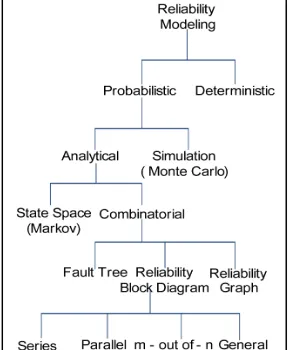
Reliability of WSN, depends on combination of hard- ware, software and wireless link is modeled in many ways analogous to reliability modeling of hardware sys- tem. Reliability modeling aims at using abstract repre- sentation of the network as means for assessing their re- liability. The basic reliability modeling techniques avail- able in the existing work in WSN field are classified as shown in Figure 1.
Two of the most commonly used Deterministic reli-ability modeling and analysis methods are First Order Reliability Method (FORM) and the Second Order Reli- ability Method (SORM). The advantages of the tech-niques is less computational effort than Probabilistic models, but not suitable for modeling the reliability of real time applications of WSN. In a more restrictive sense, the term reliability is defined to be the probability that a wireless sensor network performs its mission suc- cessfully. Because the mission is often specified in terms of time, reliability is often defined as the probability that a system will operate satisfactorily for a given period of time. Thus reliability may be a function of time and can be estimated essentially using probability modeling. When the set of operating components and the set of failed components of a network are specified, it is possi- ble to compute the probability that the system is operat- ing and thus the reliability of the system. In probabilistic modeling, the concepts and methods of probability the- ory to compute the reliability of a complex system like sensor network.
[image:4.595.100.245.544.719.2]Combinatorial model: It can be used to analyze tran- sient or steady state network. These model types are similar in that they capture conditions that make a system
Figure 1. Classification of reliability models.
cannot be modelled. Because fault trees are easier to solve than Markov models, fault trees should be used wherever these fundamental assumptions are not violated. Fault tree and reliability block diagram are called as non state space models.
Path Enumeration methods: A reliability graph is equivalent to a non-series-parallel reliability block dia- gram and directly analyzed by many algorithms to re- solve the reliability problem. Any communication net- work can be considered as directed graph G = (V, E), where V—vertices represents the sensor nodes and sinks, Eedges represents the link between the two nodes. Graphical modeling is the exact method in which there are two classes for the computation of the network reli-ability, which are path or cut enumeration methods and network reduction methods. In path enumeration method, first step is the enumeration of all the minimum paths for a working network to provide a Boolean expression called as Structure function. These minimal paths are different for each reliability problem. For example two terminal reliability of the network is the probability that there exist atleast one or more successful paths from the target sensor node to the sink. The second step is com- putation of this Boolean expression probability. The computational problem to determine the complete set of minimal paths or cuts and to construct and evaluate the structure and reliability functions is difficult. In general, if there are kcuts or paths, the corresponding reliability equation will have (2k − 1) terms. Several techniques
available to reduce the structure function and compute the reliability in polynomial time. WSN application for structure health monitoring can represented by a proposi- tional directed acyclic graph (PDAG) through which the reliability is evaluated in three steps [49]. In first step the connectivity information of the network is represented in the matrix form and using LDF algorithm, the structure function is determined. The structure function consists of connectivity to node and link connected using logical AND, OR operators. In the second step the complex network structure function is reduced by introducing the context sensitive information of sensor network. The context of a wireless sensor network may be expressed in terms of the network elements or the conditions in which the sensor nodes are deployed. The third step is computa- tion of network reliability for the reduced context aware structure function is obtained by assigning the probabili- ties of connectivity to the nodes and the edges. The re- duced expression consists of minpaths from source to sink, connected by logical operators and the reliability of the WS network is the reliability of that min path which has the maximum reliability out of many min paths.
In the network reduction algorithms are based on graph topology, reduce the size of the graph by removing some structures. Then it is possible to compute the reli-
ability in linear time and the reduction will result in a single edge. The Binary Decision Diagram (BDD) struc- ture provides compact representation of Boolean expres- sions and is used to work out the terminal reliability of the links. Set of algorithms for efficient construction and manipulation of BDD structure. An enhanced ordered binary decision diagram (OBDD) algorithm is proposed in [37] to evaluate the reliability of wireless sensor net- works (WSNs), based on the considerations of the com- mon cause failure (CCF) and a large number of nodes in WSNs. It is also shown that OBDD can decrease the cost of OBDD constructions and storage. Decomposition al- gorithms compute k-terminal reliability in linear time by decomposing the graph into sub graphs. k-coverage and k-connectivity reliability can be computed as the prod- uct of coverage or connectivity probability of all nodes and links in the path [27,28]. The performance metrics of WSN-Packet delivery ratio [29], message delay [30] with a reasonable overhead (in terms of retransmissions, ac- knowledgement messages, and control messages) is also measured. For computation of reliability the probability of link existence and failure rate of node are not only considered but also reliability of a node depends on various environmental parameters such as noise, tem- perature, pressure and magnetic effects are also consid- ered. The development of reliability model needs to take in account all of these parameters [31].
State enumeration methods: A very basic method of
possible configurations increases exponentially with the number of mobile nodes. So the enumeration methods can be employed for networks of relatively small size and there is a need of faster computational procedures that can provide an accurate approximation of complex WSN. In [43] paper, the author present a hexagon tessel- lation sensor network model with role assignment scheme and estimate the reliability and lifetime distribu- tion by employing a new improved Monte Carlo scheme
which incorporates both simulation and analytic methods and is suitable for the WSN. Also it is shown that the node sub-roles and node density have important effects on the network reliability and lifetime. A new concept known as event reliability is defined in [44] and the au- thor propose Event Reliability Protocol (ERP), an event-to-sink reliability protocol that serves to improve the scalability of event detection in a WSN by minimiz- ing the unnecessary retransmission of data packets com- ing from multiple nodes in an event’s locality. The per- formance of the protocol is simulated and Event reliabi- lity is analysed using a network simulator GloMoSim.
Characteristic aspects of sensor networks such as li- mited accessibility and dynamic topology changes com- plicate the usage of traditional reliability evaluation methods. The limitations of the traditional models over- come by presenting [45] a model-based approach to as- sess the reliability of redundant sensor networks.
Weibull failure model can be used in reliability theory to model the time to failure or life time modelling pre- sented in [46] to examine the coverage and reliability of distributed sensor networks that are designed for surveil- lance applications. In Weibull distribution the failure rate is proportional to a power of time and it can be used to model life time of WSN defined as the time to first fai- lure. In the reliability modeling field, we sometimes en- counter systems with uncertain structures, and the use of fault trees and reliability diagrams is not possible. To overcome this problem, Bayesian approaches offer a considerable efficiency in this context. The paper [47] introduces recent contributions in the field of reliability modeling with the Bayesian network approach. Bayesian reliability models are applied to systems with Weibull distribution of failure. The advantages of this modeling approach are presented in the case of systems with an unknown reliability structure, those with a common cause of failures and redundant ones.
4. Factors Affecting Reliability in WSN
A basic way to improve the reliability is to have redun- dant components; it may be hardware, software or infor- mation. Reliability analysis of the WSN provides a measure of the performance of the WSN. As the impor- tance of reliability in WSN is discussed in the previous section, this section it is appropriate to investigate the
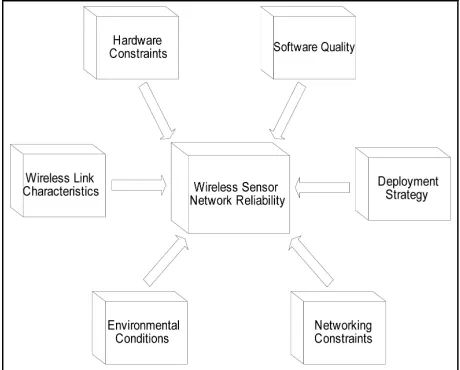
[image:6.595.308.538.534.719.2]factors affecting reliability so that the reliability can be improved by improving these parameters. In order to ensure that the network supports the application’s re- quirements, it is important to understand how each of the categories of wireless sensor networking affects reliabili- ty. Challenges to achieving reliability on Wireless Sensor Networks can be divided to four main categories which are network elements, networking characteristics, condi- tions in which WSN is deployed and strategies used to design the network for an application are represented in
Figure 2.
The first kind of problems comes from the limited re- sources of Wireless Sensor Networks nodes. A sensor node has a limited power without recharging capability affects the hardware reliability. The node is able to sense the environment using sensors and ADC used to convert to digital signal has low accuracy and low resolution will affect the information reliability. Similarly the processor with low computational power and memory space affects the Quality of Information (QoI).
Next kind of problems comes from software engineer- ing point of view adds more challenges to achieve reli- ability of sensor network. In general, sensor networks software can be layered into levels: sensor node software, middleware and sensor network software. The sensor node software is the bottom layer contains sensor soft- ware and node software. The sensor software (Operating System) has full access to the sensor hardware, execute the process by which events occurred in the real world is sampled and converted into machine-readable signals. Malfunction or bucks in the software or programs will affect the QoS and information reliability. The node software process the raw data, receive and process the query and transmit the data to toe next node includes system software for network maintenance and applica- tion specific software related with packet reliability.
Next ica-
re related to the networking ch
by the environmental co
s related to strategies used to build th
less communications, re- so
5. Reliability Improvement in WSN
twork reli- level, a collection of common services for appl
tion development, called middleware; reside over the operating system related with service reliability. Appli- cation programs use this middleware according to their own specific requirements; these programs often access the individual node resources and local services. Finally, the sensor network software specifies the main tasks and required services of transporting the data and query through the network, maintain the performance and achieve network reliability.
Third sort of problems a
aracteristics and nature of wireless communication link. The asymmetry of links makes link quality estimation hard and invalidates many assumptions made in other environments. Correlated losses due to obstacles, mobi- lity and interference can lead to consecutive losses, de- creasing the effectiveness of erasure code. Weak correla- tion between quality and distance, hidden terminal prob- lems, and dynamic change of connectivity complicates the situation further [48]. In addition, as its communica- tion bandwidth is narrow, overhead due to the error cor- recting coding cannot be added with the data packet. All these features of wireless communication link degrade the transport or packet reliability.
Fourth kind of problems raised
nditions affects the sensing unit and wireless trans- ceiver components of a sensor node since they directly interact with the environment, which is subject to variety of physical, chemical, and biological factors. The prob- ability that a sensor suffers a physical attack in such an environment is therefore much higher. It results in low reliability of performance of sensor nodes. Even if condi- tion of the hardware is good, the communication between sensor nodes is affected by many factors, such as signal Strength, antenna angle, obstacles, weather conditions, and interference [50].
Fifth set of problem
e application which includes deployment, scalability, security and responsiveness. Deployment strategy is an important issue to place the sensor nodes, relay nodes, base station and sink in the proper position to maximize coverage, connectivity, detection and communication reliability and thus improve the life time of the sensor network. Given the area to be covered, energy, range of sensing and transmission radius of the node, many tech- niques are available for calculating the number and posi- tion of the nodes. Many aspects of WSN like topology management, power management, and routing requires suitable placing of the nodes deployment problem can be stated in many ways and there is no one systematic methodology for solving the deployment problem. But improper deployment may hamper the service provided by the sensor network which leads decrement the overall network reliability. In typical wireless ad hoc networks,
reliability and scalability are always inversely coupled. In other words, it becomes more difficult to build a reli- able ad hoc network as the number of nodes increases. This is due to the network overhead that comes with the increased size of the network.
Because of the nature of wire
urce limitation on sensor nodes, size and density of the networks, unknown topology prior to deployment, and high risk of physical attacks to unattended sensors, it is a challenge to provide security in WSNs. Security attacks modify the information by packet damage and render the information unavailable by dropping the packets affects the information and packet reliability. Wireless networks are vulnerable to security attacks due to nature of wire- less communications, resource limitation on sensor nodes, size and density of the networks, dynamic topology and the attackers may device different types of security threats to make the WSN system unstable. Typical treats and adequate defense techniques in WSNs are summa- rized in [51]. The security mechanisms are actually used to detect, prevent and recover from the security attacks. A wide variety of security schemes to counter malicious attacks and these can be categorized and listed in [52]. But the question is how much the security mechanisms are secure? The reliability of security systems is con- nected with proper implementation of software and hardware components of security systems. When security of information systems is considered it is needed to ana- lyze three attributes: confidentiality, availability and in- tegrity. If these goals are not met then no proper routing, clustering, aggregation process carried over in a WSN and the reliability will certainly decreases. Responsive- ness is the ability of the network to quickly adapt itself to changes in topology. To achieve high responsiveness, an ad hoc network should issue and exchange more control packets, which will naturally result in less scalability and less reliability.
The approaches proposed to reinforce the ne
tworking constraint and can be meet
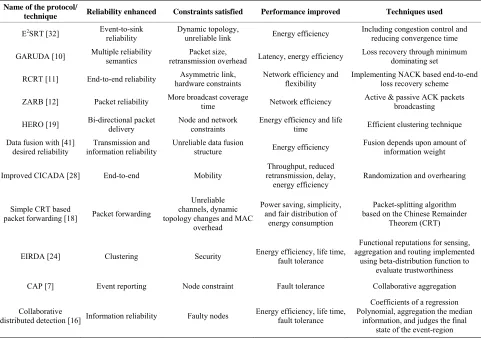
Table 1. Comparison of reliability improvement techniques.
Name of the protocol/
Reliability enhanced Constraints satisfied Performance improved Techniques used
number of reliable links and each link must be economi- cally feasible. The transport layer of WSN provides mechanisms for establishing a connection between sen- sor network and end users, while supporting Quality of Service (QoS) mechanisms to ensure the properties of the link lives up to a required quality of connection and reli- ability. In general, there are several approaches to achieve reliability against unreliable link, e.g., automatic repeat request, multi-path routing and source coding. On the other side the overhead increases and network be- come overloaded. That is, these traditional approaches are not suitable for WSN, many research works concen- trate in improving the existing transport layer protocols or developing new efficient reliable data transfer scheme that satisfy the constraints and improve the performance. To cope with the above issues, many works has been proposed for efficient reliable data transfer scheme, some of them are network coding [53], cross-layer strategy that considers physical layer (i.e., power control), MAC layer (i.e., retransmission control) and network layer (i.e., routing protocol) jointly [54], hybrid method based on multipath data sending [55] and behavior-based trust mechanism [56].
Scalability is ne
out in WSN through efficient clustering. The cluster head node is used to receive data from other nodes in the clus- ter, aggregate it and then transmitting the processed in- formation. Data aggregation is a process whereby data from sensors in an area is gathered for performing fusion to eliminate redundant data to provide the useful fused information to the base station and improve reliability and life time of the network. The clustering and cluster head selection process involves many issues of power efficiency [57], traffic distribution, link quality distance to sink etc to guarantee reliability. Aggregated values when transmitted to sink, aggregated values from other clusters can be fused using in the intermediate nodes to reduce traffic in WSN. Rule based Fuzzy logic, trust based, weight based, rough set theory are some of the secure and reliable techniques to tolerate faulty nodes and improve the credibility of the fused content in the presence malicious nodes.
Sensors deployed in the real world senses the physical parameters include temperature, acoustics, light and pol- lution. Sensor network in the war field need to detect, classify and track the objects in the vicinity. The reliabil- ity can be defines as the successful detection by a node to correctly estimate a target’s presence while avoiding
technique
E2SRT [32] Event-to-sink
reliability
Dynamic topology,
unreliable link Energy efficiency
Including congestion control and reducing convergence time
GARUDA [10] Multiple reliability retrans ead Latency, energy efficiency Lo
RCRT [11] End-to-end reliability h Implementing NACK based end-to-end
ZARB [12] Packet reliability M Network ef Acti ets
HERO [19] Bi-directional pac Node and network Energy ef e Efficient cluster
Data fusion with [41] Tran and in
Unre sion Energy ef Fusion depen
Improved CICADA [28] End-to-end Mobility
T
Randomization and overhearing
Simple CRT based
p ] Packet forwarding
Unreliable
cha ic
topo C
Power saving, simplicity, Packet-splitting algorithm
ba er
EIRDA [24] Clustering Security Energy efficiency, life time,
Functional reputations for sensing, a
CAP [7] Event reporting Node constraint Fault tolerance
Collaborative
distributed detection [16] Information reliability Faulty nodes Energy efficiency, life time, fault tolerance Polynomial, aggregation the median information, and judges the final state of the event-region semantics
Packet size, mission overh
ss recovery through minimum dominating set Asymmetric link,
ardware constraints
Network efficiency and
flexibility loss recovery scheme ve & passive ACK pack ore broadcast coverage
time ficiency broadcasting
ket delivery smission
constraints
ficiency and lif time
ficiency
ing technique
desired reliability formation reliability
liable data fu structure
ds upon amount of information weight
hroughput, reduced retransmission, delay,
energy efficiency
acket forwarding [18
nnels, dynam logy changes and MA
overhead
and fair distribution of energy consumption
sed on the Chinese Remaind Theorem (CRT)
fault tolerance
ggregation and routing implemented using beta-distribution function to
evaluate trustworthiness
Collaborative aggregation
false detections in which no target is present. Hence to r
use the measurements of a group of
gn, deployment and functional aspects of a reliable WSN are analyzed in this paper. Also the neces-
ts of reliability in WSN application
vices provided by WSN.
REFERE
incr rac comes necessary to f
ease the accu y of the detection algo ithm it be-
sensors while discard the faulty nodes. Faults are en- countered at any stage of WSN development, from the high-level design of embedded software down to hard- ware faults, energy failures, or harsh environmental con- ditions. This makes it necessary to add fault tolerance capability to tolerate the faulty hardware/software/fun- ctions, so that the overall reliability of the surveillance system can be improved. A fault diagnostic model using case based reasoning technique in a Wireless Sensor Network (WSN) for Wildlife Preservation application is proposed in [42]. In the case based reasoning, semantic tracking is applied to detect the various faults in the hardware and software modules utilized in the sensors over different zones, network and service levels. The correctness and context of the data is checked using the semantic engine with verification rules. The fault detec-tion in WSN can be improvised using the algorithms proposed in this work. The first part of the algorithm decides the occurrence of fault based on a Fault Ontology for REpetitive Semantic Tracking (FOREST) and the second part using the Weak Inactive Link Data (WILD) method to locate the fault in the corresponding cluster or the device. Some of the approaches/protocol/techniques used in WSN to enhance its reliability are compared in
Table 1.
6. Conclusion
Various desi
sity and requiremen s are discussed in detail. The existing research works with the notion of improving reliability are studied elaborately, compared based on their performance and reliability measures. Many of the works are available to improve the communication reliability of WSN by modifying the existing MAC, routing and transport protocols. Many methodologies to improve the sensing and coverage reli- ability are developed exceptionally for WSN by improv- ing the aggregation and deployment techniques. On ana- lyzing the works, it is shown that the reliability can effi- ciently improved by adopting fault tolerance in the de- sign of various functions especially event/target detection and data aggregation/fusion techniques. It is understood that all reliability techniques concentrate in energy effi- ciency and are aimed to improve the life time of the net- work. At the same time less number of works are avail-able to satisfy the other node and network constraints of WSN and improve QoS parameters. Also need to de- velop the concept to define the relation between security and reliability, quantify information security, design and testing methodologies based on the application and ser-
[1] I. F. Akyildiz, W. Su, Y. Sankarasubramaniam and E. Cayirci, “Wireless Sensor Network: A Survey,” IEEE Communications Magazine, Vol. 40, No. 8, 2002, pp. 102-114.
NCES
doi:10.1109/MCOM.2002.1024422
[2] J. Agre and L. Clare, “An Integrated Architecture for Co- operative Sensing Networks,” IEEE Journal Computer, Vol. 33, No. 5, 2000, pp. 106-108. doi:10.1109/2.841788 [3] J. A. Stankovic, “Wireless Sensor Networks,” IEEE Com-
puter, Vol. 41, No. 10, 2008, pp. 92-95. doi:10.1109/MC.2008.441
[4] R. Kim, J. Song and B. F. Spencer, Jr., “Reliability Analy- sis of Wireless Sensor Networks,” Proceedings of the
1, No. 2, 2005,
, pp.
Workshop on Advanced Smart Materials and Smart Structures Technology, Dalian, July 2011, pp. 1-12. [5] D. Bein, V. Jolly, B. Kumar and S. Latifi, “Reliability
Modeling in Wireless Sensor Networks,” International Journal of Information Technology, Vol. 1
pp. 1-9.
[6] H. Liu, A. Nayak and I. Stojmenović, “Fault Tolerant Al- gorithms/Protocols in Wireless Sensor Networks” In: S. C. Misra, I. Woungang and S. Misra, Eds., Guide to Wireless Sensor Networks, Springer Veglag, London, 2009 261-291. doi:10.1007/978-1-84882-218-4_10
[7] W. Yuan, S. V. Krishnamurthy and S. K. Tripathi, “Im- proving the Reliability of Event Reports in Wireless Sen- sor Networks,” Proceedings of the 9th International
er Journal Symposium on Computers and Communications, Vol. 1, 2004, pp. 220-225.
[8] Z. Rosberg, R. P. Liu, T. L. D. Yi, F. Dong and S. Jha, “Statistical Reliability for Energy Efficient Data Trans- port in Wireless Sensor Networks,” Spring
Wireless Networks, Vol. 16, No. 7, 2010, pp. 1913-1927. doi:10.1007/s11276-009-0235-5
[9] A. Ayadi, “Energy-Efficient and Reliable Transport Pro- - tocols for Wireless Sensor Networks: State-of-Art,”
Journal Wireless Sensor Network, Vol. 3, No. 3, 2011, pp. 106-113. doi:10.4236/wsn.2011.33011
[10]S.-J. Park, R. Vedantham, R. Sivakumar and I. F. Akyildiz, “GARUDA: Achieving Effective Reliability for Down- stream Communication in Wireless Sensor Networks,”
IEEE Transactions On Mobile Computing, Vol. 7, No. 2, 2008, pp. 214-230. doi:10.1109/TMC.2007.70707 [11]J. Paek and R. Govindan, “RCRT: Rate-Controlled Reli-
able Transport for Wireless Sensor Networks,” ACM Transactions on Sensor Networks, Vol. 7, No. 3, 2010, pp. 305-317. doi:10.1145/1807048.1807049
[12]T.-W. Sung, T.-T. Wu, C.-S. Yang and Y.-M. Huang, “Reliable Data Broadcast for Zigbee Wireless Sensor Networks,” International Journal On Smart Sensing And Intelligent Systems, Vol. 3, No. 3, 2010, pp. 504-520. [13]A. G. Bagadi, S. Sarode and J. W. Bakal, “A Survey of
[14] K. K. Sharma, R. B. Patel and H. Singh, “A Reliable and Energy Efficient Transport Protocol for Wireless Sensor Networks,” International Journal of Computer Networks
& Communications, Vol. 2, No. 5, 2010, pp. 92-103. doi:10.5121/ijcnc.2010.2506
[15]J. J. Winston and B. Paramasivan, “A Survey on Connec- tivity Maintenance and Preserving Coverage for Wireless Sensor Networks,” International Journal of Researc
e-orks,” Proceedings of the
, pp. 1033-1040.
h and Reviews in Wireless Sensor Networks, 2011, Vol. 1, No. 2, pp. 11-18.
[16]Z. ShuKui, G. ShengRong, C. ZhiMing and F. J. Xi , “A Reliable Collaborative Detection Scheme of Event-R gion in Wireless Sensor Netw
International Symposium on Information Processing, 2009, pp. 021-024.
[17]G. J. Fan and S. Y. Jin, “Coverage Problem in Wireless Sensor Network: A Survey,” Journal of Networks, Vol. 5, No. 9, 2010
[18]G. Campobello, A. Leonardi and S. Palazzo, “Improving Energy Saving and Reliability in Wireless Sensor Net- works Using a Simple CRT-Based Packet-Forwarding Solution,” EEE/ACM Transactions on Networking, Vol. 20, No. 1, 2012, pp. 191-205.
[19]E. Cañete, M. Díaz, L. Llopis and B. Rubio, “HERO: A Hierarchical, Efficient and Reliable Routing Protocol for Wireless Sensor and Actor Networks,” Computer Com- munications Vol. 35, No. 11, 2012, pp. 1392-1409. doi:10.1016/j.comcom.2012.04.003
[20]R. V. Kshirsagar and B. Jirapure, “A Survey on Fault De- tection and Fault Tolerance in Wireless Sensor Net- works,” International Journal of Computer Applications, Vol. 3, No. 1, 2011, pp. 130-138.
[21]S. Mishra, L. Jena and A. Pradhan, “Fault Tolerance in Wireless Sensor Networks,” International Journal of Ad- vanced Research in Computer Science and Software En- gineering, Vol. 2, No. 10, 2012, pp. 146-153.
[22]L. Paradis and Q. Han, “A Survey of Fault Management in Wireless Sensor Networks,” Journalof Network and Sys- tems Management, Vol. 15, No. 2, 2007, pp. 171-190. doi:10.1007/s10922-007-9062-0
[23]F. Koushanfar, M. Potkonjak, A. Sangiovanni-Vincentelli, “Fault Tolerance Techniques for Wireless Ad Hoc Sensor Networks,” Proceedings of the IEEE Conference Sensors, Vol. 2, 2002, pp. 1491-1496.
doi:10.1109/ICSENS.2002.1037343
[24]H. Sethi, D. Prasad and R. B. Patel, “EIRDA: An Energy Efficient Interest based Reliable Data Aggregation Pro tocol for Wireless Sensor Networks,” International Jour-
-works,” Ph.D. Thesis, The ong Kong, 2005.
. 738-754.
a-
ternational Conference on Sensor
l
ireless Distributed Sensor Networks Subject to
nal of Computer Applications, Vol. 22, No. 7, 2011, pp. 20-25.
[25]X. Chen, “On Fault Tolerance, Performance, and Reliabili- ty for Wireless and Sensor Net
Chinese University of Hong Kong, H
[26]E. Felemban, C.-G. Lee and E. Ekici, “MMSPEED: Multi- path Multi-SPEED Protocol for QoS Guarantee of Reli- ability and Timeliness in Wireless Sensor Networks,”
IEEE Transactions on Mobile Computing, Vol. 5, No. 6, 2006, pp
[27]Y.-L. Jin, H.-J. Lin, Z.-M. Zhang, Z. Zhang and X.-Y.
Zhang, “Estimating the Reliability and Lifetime of Wire- less Sensor Network,” Proceedings of the 4th Intern tional Conference on Wireless Communications, Net- working and Mobile Computing, October 2008, pp. 1-4. [28]B. L. Braem, B. Blondia, C. Moerman and I. Demeester,
“Improving Reliability in Multi-Hop Body Sensor Net- works,” Second In
Technologies and Applications, August 2008, pp. 342- 347.
[29]J. Shin, U. Ramachandran and M. Ammar, “On Improving the Reliability of Packet Delivery in Dense Wireless Sensor Networks,” Proceedings of the 16th Internationa Conference on Computer Communications and Networks, August 2007, pp. 718-723.
[30]H. M. F. AboElFotoh, S. S. Iyengar and K. Chakrabarty, “Computing Reliability and Message Delay for Coopera- tive W
Random Failures,” IEEE Transactions on Reliability, Vol. 54, No. 1, 2005, pp. 145-156.
doi:10.1109/TR.2004.842540
[31]N. V. Doohan, D. K. Mishra and S. Tokekar, “Reliability Analysis for Wireless Sensor Networks Considering En-
ansport for Wireless
Wireless Communications
vironmental Parameters Using MATLAB,” Proceedings of the 3rd International Conference on CICSN, 2011, pp. 99-102.
[32]S. Kumar, Z. Feng, F. Hu and Y. Xiao, “E2SRT: En- hanced Event-to-Sink Reliable Tr
Sensor Networks,” Journal of
and Mobile Computing, Vol. 9, No. 10, 2009, pp. 1301- 1311. doi:10.1002/wcm.705
[33]F. K. Shaikh, A. Khelil and N. Suri, “On Modeling the Reliability of Data Transport in Wireless Sensor Net- works,” Proceedings of 15th EUROMICRO International
E Pacific Rim International
sors, Vol. 12,
Conference on Parallel, Distributed and Network-Based Processing, Feburary 2007, pp. 395-402.
[34]D. S. Kim, R. Ghosh and K. S. Trivedi, “A Hierarchical Model for Reliability Analysis of Sensor Networks,”
Proceedings of the 16th IEE
Symposium on Dependable Computing, December 2010, pp. 247-248.
[35]I. Silva, L. A. Guedes, P. Portugal and F. Vasques, “Reli- ability and Availability Evaluation of Wireless Sensor Networks for Industrial Applications,” Sen
No. 1, 2012, pp. 806-838. doi:10.3390/s120100806 [36]L. Xing and H. E. Michel, “Integrated Modeling for Wire-
less Sensor Networks Reliability and Security,” Proceed- ings of the Annual Conference on Reliability and Main- tainability Symposium, January 2006, pp. 594-600.
, pp.
ol. 5, [37]Y.-F. Xiao, S.-Z. Chen, X. Li and Y.-H. Li, “Reliability Evaluation of Wireless Sensor Networks Using an En- hanced OBDD Algorithm,” Proceedings of the IEEE In- ternational Conference on Communications, 2009 453-457.
[38]W. W. Bein, D. Bein and S. Malladi, “Reliability and Fault Tolerance of Coverage Models for Sensor Net- works,” International Journal of Sensor Networks, V No. 4, 2009, pp. 199-209.
doi:10.1504/IJSNET.2009.027628
-79.
ust 2011, pp. 1-6.
as, “Data Fusion with
.2010.93
Analysis in Wireless Sensor Networks,” International Journal of Engineering and Technology, Vol. 3, No. 2, 2011, pp. 74
[40]A. Munir and A. Gordon-Ross, “Markov Modeling of Fault-Tolerant Wireless Sensor Networks,” Proceedings of 20th International Conference on Computer Commu- nications and Networks, Aug
[41]H. Luo, H. Tao, H. Ma and S. K. D
Desired Reliability in Wireless Sensor Networks,” IEEE Transactions on Parallel and Distributed Systems, Vol. 22, No. 3, 2011, pp. 501-512.
doi:10.1109/TPDS
nications
, Sensor Net- ssing, 2011, pp. 377-382.
ettergren, “Coverage and Reli-[42]V. Latha, C. Subramaniam and S. Shanmugavel, “Fault
Tolerant Wireless Sensor Network Using Case Based Reasoning with Semantic Tracking,” Proceedings of the WSEAS International Conference on Commu , July 2011, pp. 240-246.
[43]M. A. Mahmood and W. K. G. Seah, “Event Reliability in Wireless Sensor Networks,” Proceedings of 7th Interna- tional Conference on Intelligent Sensors
works and Information Proce
[44] K. El-Darymli, F. Khan and M. H. Ahmed, “Reliability Modeling of Wireless Sensor Network for Oil and Gas Pipelines Monitoring,” Sensors & Transducers Journal, Vol. 106, No. 7, 2009, pp. 16-26.
[45]E. G. Rowe and T. A. W
ability of Randomly Distributed Sensor Systems with Heterogeneous Detection Range,” International Journal of Distributed Sensor Networks, Vol. 5, No. 4, 2009, pp. 303-320. doi:10.1080/15501320802299853
[46]A. Taherkordi, M. A. Taleghan and M. Sharifi, “Achieving Availability and Reliability in Wireless Sensor Networks Applications,” Proceedings of the 1st International Con- ference on Availability, Reliability and Security, 2006, pp. 529-535. doi:10.1109/ARES.2006.21
[47]A. Zaidi, B. O. Bouamama and M. Tagina, “Bayesian Reliability Models of Weibull Systems: State of Art,” In- ternational Journal of Applied Mathematics and Com- puter Science, Vol. 22, No. 3, 2012, pp. 585-600.
and R. Fonseca, “Reliable Transfer on Wireless
ari and L. U. Kadam, “Wireless Sensor Net-
n by Adaptive Network Coding in Wireless Sensor
te-
[48]P. S. Patheja, A. Waoo and P. Shrivastava, “Fault Tolerant, Energy Saving Method for Reliable Information Propaga-
tion in Sensor Network,” International Journal of Smart Sensors and Ad Hoc Networks, Vol. 1, No. 4, 2012, pp. 34-38.
[49]L. Venkatesan, C. Subramaniam and S. Shanmugavel, “Reliability Modeling of Context Aware Wireless Sensor Network,” International Journal of Information and Ele- ctronics Engineering, Vol. 2, No. 5, 2012, pp. 710-715. [50]S. Kim
Sensor Networks,” Proceedings of the 1st Annual IEEE Communications Society Conference on Sensor and Ad Hoc Communications and Networks, October 2004, pp. 449-459.
[51]Z. S. Bojkovic, B. M. Bakmaz and M. R. Bakmaz, “Secu- rity Issues in Wireless Sensor Networks,” International Journal of Communications, Vol. 2, No. 1, 2008, pp. 106- 115.
[52]H. C. Chaudh
works: Security, Attacks and Challenges,” International Journal of Networking, Vol. 1, No. 1, 2011, pp. 04-16. [53]T.-G. Li, C.-C. Hsu and C.-F. Chou, “On Reliable Trans-
missio
Networks,” Proceedings of the IEEE International Con- ference on Communications, June 2009, pp. 1-5. [54]H. Kwon, T. H. Kim and S. Choi, “A Cross-Layer Stra
gy for Energy-Efficient Reliable Delivery in Wireless Sensor Networks,” IEEE Transactions on Wireless Com- munications, Vol. 5, No. 12, 2006, pp. 1-11.
doi:10.1109/TWC.2006.256992
[55]S. Saqaeeyan and M. Roshanzadeh, “Improved Multi-Path and Multi-Speed Routing Protocol in Wireless Sensor Networks,” International Journal of Computer Network and Information Security, Vol. 4, No. 2, 2012, pp. 8-14. doi:10.5815/ijcnis.2012.02.02
[56]T. Ryutov and C. Neuman, “Trust based Approach for Im- proving Data Reliability in Industrial Sensor Networks,” ftp://ftp.isi.edu/isi-pubs/tr-631.pdf