Practical Investigation of Factors Affecting
Selection of Dispute Resolution Methods in
Construction Projects: A Survey
R.G. Marale, A. K. Kanase, Manish Khandare
P. G Student, Department of Civil Engineering, RMD Sinhgad School of Engineering Warje, Pune, India
Associate Professor, Department of Civil Engineering, Sinhgad Institute of Technology and Science, Narhe,
Pune, India
Assistant Professor, Department of Civil Engineering, RMD Sinhgad School of Engineering Warje, Pune, India
ABSTRACT: Construction projects are increasingly complex, resulting in complex contract documents. Complex
construction can likewise result in complex claims and disputes. Disputes have become an endemic feature of the Indian construction industry. If they are not resolved promptly they can escalate causing schedule delays, lead to claims that require litigation proceedings for resolution and destroy business relationships. The competitive nature and contractual complexity inherent within construction can aggravate the incidence of disputes. Research over the last two decades has revealed that factors such as scope changes, poor contract documentation, restricted access, unforeseen ground conditions, and contractual ambiguities are contributors of disputes. This study provides an insight into the factors which impact upon the selection of dispute resolution methods for construction in the Indian industry. The twelve factors used are cost, speed, outcome, enforceability, privacy and confidentiality, open and fairness, control, flexibility creative remedies and relationships. Through questionnaire survey, the relative importance of these factors in the selection of dispute resolution methods is examined and through interviews, the efficiency of the current alternative dispute resolution methods operating in India is compared with each other.
KEYWORDS: Disputes, Dispute Resolution Methods, Litigation, Arbitration, Dispute Resolution Board, SPSS,
Principal component Analysis, etc.
I. INTRODUCTION
Today, India is the second fastest growing economy in the world. The Indian construction industry is an integral part of the economy and a conduit for a substantial part of its development investment, is poised for growth on account of industrialization, urbanization, economic development and people's rising expectations for improved quality of living. In India, construction is the second largest economic activity after agriculture. Construction accounts for nearly 65 per cent of the total investment in infrastructure and is expected to be the biggest beneficiary of the surge in infrastructure investment over the next five years. Investment in construction accounts for nearly 11 per cent of India’s Gross Domestic Product (GDP). €239.68 billion is likely to be invested in the infrastructure sector over the next five to 10 years - in power, roads, bridges, city infrastructure, ports, airports, telecommunications, which would provide a huge boost to the construction industry as a whole.
completion of the construction project. Thus, it is important to be aware of the causes of disputes in order to complete the construction project in the desired time, budget and quality.During the last two decades the Indian construction industry has been in an intense period of introspection, specifically examining how it can improve its performance and productivity. Time and cost overruns in construction projects has become a ubiquitous feature of the industry. Significant factors that have been identified as contributing to time and cost overruns in Indian construction projects are rework, variations, incorrect design and incomplete documentation, and late authority approvals. As a result of such issues arising in projects, conflict and disputes may occur, which can lead to the disruption of construction schedules, increased project costs, and even adversely influence relationships between project participants. If a dispute is not resolved promptly, then it may escalate, and ultimately require litigation proceedings, which can be extremely costly for the parties concerned.
II. LITERATURE REVIEW
In EmreCakmaket. Al, (2013) proposed a An analysis of causes of disputes in the construction industry using analytical network process. This system aims to analyze the main causes of disputes which occur in the construction industry. In order to reach this aim, a literature review has been undertaken to identify the common construction disputes. The disputes derived from a cross-section of the literature, were classified into main categories and the main causes of construction disputes were determined. Finally, an analysis was carried out using the analytical network process (ANP) approach to determine their relative importance.
A.A. Elziny et al. (2016), concentrated on problem of dispute management in Egyptian construction projects. This study presents a comprehensive review of the available literature on analysis of disputes. The objective of this study was to provide an expert system can evaluate the overall dispute settlement procedures at company’s projects. The most important source of disputes was ‘‘contract management’’, the second was ‘‘contract documents’’, the third was financial issues, the fourth was ‘‘project related issues’’, and the lowest one was ‘‘other sources’’ such as force majeure, and loose of construction laws The study indicates that the contract management can be considered the main factor that can affect the existence of disputes due to many reasons such as the issues related to the owner and the contractor, their management of the contract, time schedule prepared by the contractor and required update.
According to Zhang Yang (2012), contracts are main part of dispute management system. Constructional project contracts are the agreements made by construction project owners (contract issuing parties) and construction enterprises (contractors) according to basic construction procedures in order to complete specific construction and installation projects and to define the rights and obligations of both parties.
Mitkus S. et al. (2013) analyzed the causes of conflicts arising between client and contractors in the construction industry. Having analyzed publications addressing disputes in construction projects, the researchers arrived at the conclusion in this study that externally visible circumstances of conflict are usually identified in the contemporary scientific literature as the causes of conflicts. A construction contract agreement is analyzed as a product of communication between the parties to a construction contract agreement. The research has revealed that a contract allowing a room for being differently (subjectively) interpreted by the parties constitutes the main cause of conflicts in construction projects. It means that the most frequent cause of construction conflicts is unsuccessful communication between the parties to a construction contract agreement. Due attention to the drawing up of construction contract agreements would create strong immunity against conflicts and disputes. Other causes of conflicts in the construction industry identified in this article include unfair behavior of construction participants and psychological defense mechanisms.
Output of study made by Iyer et al. (2008) is the issues which prompted to develop the current system are mainly the gaps in contract documents leading to disputes. While a foolproof contract document might reduce the issues drastically, it is practically near to impossible to have such a foolproof contract. There are reasons for inconsistencies and discrepancies in large contracts which are beyond the control of the drafter of the contract.
III. DISPUTE RESOLUTION MECHANISAM
3.1 Disputes in construction industry
Disputes are one of the main factors which prevent the successfully completion of the construction project. Thus, it is important to be aware of the causes of disputes in order to complete the construction project in the desired time, budget and quality. Construction claims are also found in almost every construction project. It is the seeking of consideration or change by one of the parties involved in the construction process. Nowadays, the substantially increasing volume of claims are the result of the rising complexity of the projects, the price structure of the construction industry and the legal approach taken by a lot of owners and contractors. There are several researches that show the order of magnitude of the effects from construction claims on cost and time of the projects. During the past two decades, serious disputes concerning construction contracts have become increasingly common in construction projects
3.2 Causes of Disputes
The genesis of many disputes often lie in the contract document itself-it is often observed that tenders are hastily made and sufficient attention is not paid.
Changes in Contract work
Differing in unusual site conditions actually encountered Suspension of Work
Variation in quantities
Damage due to natural disasters and force-majeure Re-inspection and acceptance
Termination for the convenience of the client Possession prior to completion
Escalation of price due to inflation Acceleration of work progress Ripple effect
Currency fluctuation effect
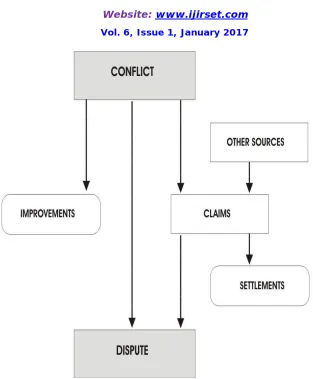
Figure 3.1: Conceptual model of conflict, claim and dispute
3.3
Dispute Resolution MethodsDifferent types of dispute resolution methods have been used extensively around the world. Applications, processes, and procedures of these dispute resolution methods operated easily in construction industry.
Present commonly used dispute resolution methods in construction industry. i. Litigation
ii. Negotiation iii. Arbitration
iv. Mediation and Conciliation v. Adjudication
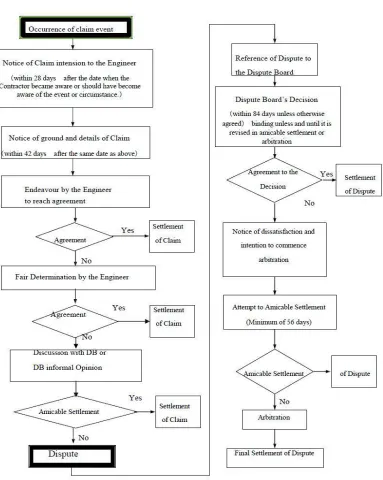
Figure 3.2:Procedure of claim and dispute settlement
IV. RESEARCH METHODOLOGY
4.1 Research methods
generalizability. Thus, a thorough investigation of the options available and what best achieves the researchers goals are necessary.
Quantitative research
Quantitative research focuses on testing a hypothesis or a theory proposed deductively at the beginning of the research. The study is composed of variables, measured with numbers, and analyzed using statistical procedures. Thus, data generated from quantitative research are countable, tangible, and objective in nature. Using this type of research method is preferred when researching a fact about a concept or a question by collecting factual evidence and studying the relationships between these facts.
Qualitative research
Qualitative research focuses on attitudes, behaviors, meanings, and experiences through obtaining an in-depth opinion from the respondents. Since it involves a deeper look at people’s opinions, it involves a less number of people compared to the quantitative method and is subjective in nature. Since construction engineering research involves studying aspects that involve people, social science research methodologies are usually inherited. This becomes especially true when studying topics involving human behaviors, such as trust and culture.
Qualitative research can be categorized to exploratory and attitudinal. Exploratory is used when there is a limited amount of knowledge on the topic. Thus, it is used to diagnose the problem, screen alternatives, and discover new ideas. Attitudinal researchsubjectively evaluates the opinion or perception of a person towards a particular question/problem.
Statistical analysis
Statistical methods are tools that distinguish between results compatible with chance and those no longer explained by chance. It is a method of analyzing data in a more objective manner. Statistical analysis could be achieved descriptively and inferentially. Descriptive statistics summarize the information in a collection of data to make it easier to assimilate, yet not distort the information. Examples are mean, median, and mode to measure central tendency of a variable or variance, standard deviation, and range to measure dispersion.
Inferential methods are used to make predictions about characteristics of a population, based on information in a sample from that population, compare, and relate between the variables in question. The statistical test used is usually dependent on the types of variables and the distribution of the data set.
Statistical Package for the Social Sciences (SPSS) Software
SPSS is a Windows based program that can be used to perform data entry and analysis and to create tables and graphs. SPSS is capable of handling large amounts of data and can perform all of the analyses covered in the text and much more.
Factor Analysis
Factor analysis is a method of data reduction. It does this by seeking underlying unobservable variables that are reflected in the observed variables.Factor analysis is a technique that requires a large sample size. Factor analysis is based on the correlation matrix of the variables involved, and correlations usually need a large sample size before they stabilize.
Principal Component Analysis
Principal Component Factor analysis was performed on the set of data obtained from scale rating to identify a relative small number of factors that can be used to represent relationships among sets of many interrelated attributes.
It is a way of identifying patterns in data, and expressing the data in such a way as to highlight their similarities and differences. Since patterns in data can be hard to find in data of high dimension, where the luxury of graphical representation is not available, PCA is a powerful tool for analysing data. The other main advantage of PCA is that once you have found these patterns in the data, and you compress the data, i.e. by reducing the number of dimensions, without much loss of information.
V. DATA COLLECTION AND SITE SURVEY
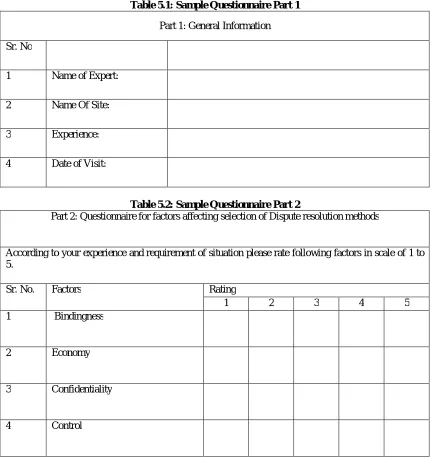
Following are the sample questionnaire:
Table 5.1: Sample Questionnaire Part 1
Part 1: General Information
Sr. No
1 Name of Expert:
2 Name Of Site:
3 Experience:
4 Date of Visit:
Table 5.2: Sample Questionnaire Part 2
Part 2: Questionnaire for factors affecting selection of Dispute resolution methods
According to your experience and requirement of situation please rate following factors in scale of 1 to 5.
Sr. No. Factors Rating
1 2 3 4 5
1 Bindingness
2 Economy
3 Confidentiality
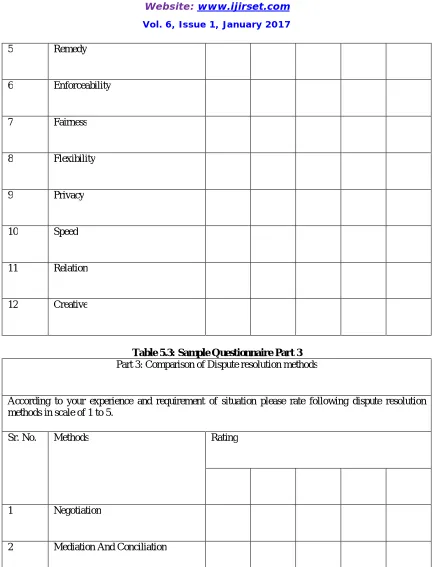
5 Remedy
6 Enforceability
7 Fairness
8 Flexibility
9 Privacy
10 Speed
11 Relation
12 Creative
Table 5.3: Sample Questionnaire Part 3 Part 3: Comparison of Dispute resolution methods
According to your experience and requirement of situation please rate following dispute resolution methods in scale of 1 to 5.
Sr. No. Methods Rating
1 Negotiation
3 Arbitration
4 Adjudication
5 Dispute Resolution Board
6 Litigation
VI. ANALYSIS
Thedata analysis will be carried out using SPSS (Statistical Package for Social Sciences) a statistical software tool for data analysis. The research focus on 12 different factors these are belwo
1. Economy 2. Speed 3. Relation 4. Flexibility 5. Confidentiality 6. Enforceability 7. Privacy 8. Fairness 9. Bindingness 10. Control 11. Remedy 12. Creative
Principal component analysis (PCA) is a statistical procedure that uses an orthogonal transformation to convert a set of observation of possibly correlated variables into a set of values of linearly uncorrelated variables called principal components. The number of principal components is less than or equal to the number of original variables.
VII. CONCLUSION
Dispute between the parties to construction projects are of great concern to the industry. A comprehensive study is necessary to understand the behavior of these dispute resolution methods. The theory described in these report discuss the philosophies and the selection factors of the dispute resolution methods.
REFERENCES
[1] EmreCakmak and Pinar IrlayiciCakmak proposed An analysis of causes of disputes in the construction industry using analytical network process 2nd World Conference On Business, Economics And Management -WCBEM 2013.
[2] A.A. Elziny at.al. proposed An expert system to manage dispute resolutions in construction projects in Egypt in Ain Shams Engineering Journal Elsevier (2016)
[3] Zhang Yang proposed The Study on Law Disputes in Construction Project Contract Relationship International Conference on Medical Physics and Biomedical Engineering Elsevier (2012)
[4] SigitasMitkus and Tomas Mitkus Causes of conflicts in a construction industry: a communicational approach Contemporary Issues in Business, Management and Elsevier Education 2013
[5] A. H. Abdul Tharim at.al. proposed Factors of Conflict in Construction Industry: A Literature Review The 2nd International Building Control Conference Elsevier 2011
[6] K.C. Iyer propsed Understanding time delay disputes in construction contracts International Journal of Project Management 26 Elsevier (2008). [7] ChaitanyaKhekale and NityanandFutane, “Management of Claims and Disputes in Construction Industry”. International Journal of Science and Research (IJSR), Volume 4 Issue 5, May 2015.
[8] ShaikhSk Sameer, DrRajendra B. Magar, FauwazParkar, “Claims and Disputes in Construction Projects”. International Journal for Research in Applied Science & Engineering Technology (IJRASET), Volume 4 Issue XI, November 2016.