University of Southampton Research Repository
ePrints Soton
Copyright © and Moral Rights for this thesis are retained by the author and/or other copyright owners. A copy can be downloaded for personal non-commercial
research or study, without prior permission or charge. This thesis cannot be
reproduced or quoted extensively from without first obtaining permission in writing from the copyright holder/s. The content must not be changed in any way or sold commercially in any format or medium without the formal permission of the
copyright holders.
When referring to this work, full bibliographic details including the author, title, awarding institution and date of the thesis must be given e.g.
UNIVERSITY OF SOUTHAMPTON
An Investigation into Composites Size Effects
using Statistically Designed Experiments
Leigh Stuart Sutherland
Submitted for the Degree of
Doctor of Philosophy
Departments of Ship Science
and Mathematics
UNIVERSITY OF SOUTHAMPTON ABSTRACT
FACULTIES OF ENGINEERING AND APPLIED SCIENCE, AND MATHEMATICAL STUDIES
DEPARTMENTS OF SHIP SCIENCE AND MATHEMATICS Doctor of Philosophy
AN INVESTIGATION INTO COMPOSITES SIZE EFFECTS USING STATISTICALLY DESIGNED EXPERIMENTS
By Leigh Stuart Sutherland
In this study, the problem of scaling design data from test to ship scales has been outlined. The meaning of the term 'size effect' has been clarified through the consideration of dimensional analysis and engineering modelling techniques. The mathematical models used to quantify the strength 'size" effect for fibrous composites have been described, and the effect of the 'scale' of production on the material properties has also been considered.
A review of the literature on composites size effects indicated that the problem concerns the possible joint effects of a number of variables on the mechanical properties of the material. Also, the measurement of these properties is known to give considerable experimental scatter. Such problems benefit from the methods of statistically designed experimentation, and an introduction to these techniques has been given.
The methods of experimental design were used to plan, execute and statistically analyse the results of a test programme involving over 400 specimens. Both tensile and flexural four-point bending tests were used in three distinct test series; one concerning vacuum assisted hand laid-up unidirectional laminates, and two concerning Woven-Roving (WR) E-glass / polyester laminates typically used in maritime applications. The effects of coupon type on the tensile tests and of interlaminar shear stress on the flexural tests were also investigated for the WR laminates.
The experimental design techniques used were non-standard, involving both nested factor and split-plot design structures. A distinction was made between the strength variation amongst separate laminates and the variation in strength of coupons cut from the same panel. The use of experimental design methods proved to be extremely efficient, and allowed the interaction between variables to be investigated. Simple designs, with sufficient specimen replications, are advocated for the study of composites such as those considered here.
Contents
List of Figures i
List of Tables iv
Acknowledgements vii
Nomenclature viii
(Chapter 2) viii
(Chapters 3 and 4) viii
(Chapter 5) x
(Chapters 6, 7 and 8) x
(Appendix A) xi
(Appendix D) xi
1. Introduction 1
1.1 Composite Materials 1
1.2 Scaling Problem 2
1.3 Aims 3
2. Engineering Experimental Modelling 4
2.1 Background 4
2.2 Dimensional Analysis 6
2.3 The Theory of Models 10
2.4 Distorted models and Scale Effects 13
3. Analysis of Size Effects 17
3.1 Weakest Link Theory 17
3.2 Extensions of Weakest Link Theory for Composite Materials 23
3.3 Scaling of FRP 28
3.4 Linear Elastic Fracture Mechanics 31
4. Strength Size Effects Literature Review 35
4.1 History of Statistical Strength Theory 35
4.2 Brittle Materials Size Effects 35
4.3 Brittle Fibres Size Effects 36
4.4.1 Statistical Strength Theories 37
4.4.2 Carbon Composites Size Effects 39
4.4.3 Glass Composites Size Effects 42
4.4.4 Effects of'Scale' 43
4.4.5 Other Distribution Functions 43
4.5 Synopsis of the Current Situation 44
4.6 Methodology 46
5. Experimental Design 49
5.1 History 49
5.2 Overview 50
5.3 Factorial Experimentation 54
5.4 Statistical Analysis Techniques 60
6. Uni-Directional Tests 62
6.1 Test Programme Development 62
6.2 Specimen Sizing 64
6.3 Specimen Manufacture 66
6.4 Experimental Details 67
6.5 Data 69
6.6 Method of Analysis of Tensile Data 70
6.7 Method of Analysis of Flexural Data 77
6.8 Findings of the Data Analyses 77
6.8.1 Model Fitting 77
6.8.2 Checking the Adequacy of the Model 80
6.8.3 Conclusions on the Importance of the Factors 83
6.9 Engineering Interpretation 90
7. Woven Roving Manufacturer Tests 97
7.1 Test Programme Development 97
7.2 Specimen Sizing 99
7.3 Specimen Manufacture 101
7.4 Experimental Details 102
7.5 Data 103
7.8 Findings of the Data Analyses 107
7.8.1 Model Fitting 107
7.8.2 Checking the Adequacy of the Model 109
7.8.3 Conclusions on the Importance of the Factors 111
7.9 Engineering Interpretation 116
8. Final Woven Roving Tests 120
8.1 Test Programme Development 120
8.2 Specimen Sizing ...125
8.3 Specimen Manufacture 125
8.4 Experimental Details 126
8.5 Data 126
8.6 Method of Analysis of Tensile Data 127
8.7 Method of Analysis of Flexural Data 128
8.8 Findings of the Data Analyses 129
8.8.1 Model Fitting 129
8.8.2 Checking the Adequacy of the model 131
8.8.3 Conclusions on the Importance of the Factors 134
8.9 Engineering interpretation 141
8.10 Tensile Geometry Tests 144
8.11 Interlaminar Shear Strength Tests 148
9. Discussion 149
9.1 Strength Data Comparisons 149
9.2 Marine Composites Size Effects 153
9.3 Experimental Design Experience 157
10. Conclusions 162
11. Further Work 165
Appendix A Buckingham Pi Theory
Appendix B Unidirectional Test Data
Appendix C Method of Contrasts
Appendix D Analysis of Variance (ANOVA) Example
Appendix F Derivation of K« for Four-Point Flexural Tests
Appendix G Woven Roving Manufacturer Test Data
Appendix H Woven Roving Manufacturer Tests Data Analysis
Appendix I Final Woven Roving Tests Data
Appendix J Final Woven Roving Tests Data Analysis
Appendix K Reinforcement and Matrix Materials Data
Appendix L Failure Modes and Load Strain Plots
List of Figures
Figure 2.1: Four-point bending 8
Figure 3.1: Logarithmic Plot of Weibull Strength Data 20
Figure 3.2: Logarithmic Plot of a Strength Size Effect 22
Figure 3.3: Bundle of Fibres Elements 24
Figure 3.4: Illustration of Fibre Load Sharing 24
Figure 3.5: Ineffective Length (5) and Effective Length (k) 26
Figure 3.6: Logarithmic Plot of the Bundle of Fibres Model 27
Figure 3.7: Logarithmic Plot of Bundle of Fibres Model 28
Figure 3.8: Ply-Level Scaling 30
Figure 3.9: Sub-Laminate Level Scaling 31
Figure 3.10: Stressed Crack 31
Figure 3.11: Plastic zone at the Crack Tip 33
Figure 5.1: Illustration of Interaction 57
Figure 5.2: Illustration of a three-way interaction 57
Figure 6.1: Schematic of unidirectional test programme 64
Figure 6.2: Flexural Test Configuration 67
Figure 6.3: Tensile Test Configuration 68
Figure 6.4: Specimen Coding 69
Figure 6.5: Illustration of Main Effects Plot 73
Figure 6.6: Illustration of Interaction Plot 73
Figure 6.7: Hypothetical Data and Fitted Line Illustrating Residuals 74
Figure 6.8: Residual Plots 75
Figure 6.9: Definition of Linear and Quadratic Effects 75
Figure 6.10: Tensile Stress Residual Plots 81
Figure 6.11: Tensile Strain Residual Plots 82
Figure 6.12: Flexural Stress Residual Plots 82
Figure 6.13: Flexural Strain Residual Plots 83
Figure 6.14: Tensile Stress Main Effects Plots 84
Figure 6.15: Tensile Strain Main Effects Plot ....84
Figure 6.16: Flexural Stress Main Effects Plots 85
Figure 6.17: Flexural Strain Main Effects Plot 85
Figure 6.18: Tensile Stress Interactions Plot 86
Figure 6.20: Flexural Stress Interactions Plots 87
Figure 6.21: Flexural Strain Interactions Plot 87
Figure 6.22: Unidirectional Flexural Failure Stress 93
Figure 6.23: Unidirectional Flexural Failure Strain 93
Figure 6.24: Unidirectional Flexural Failure Stress 94
Figure 6.25: Unidirectional Flexural Failure Strain 94
Figure 7.1: 15-run, Central Composite Design 98
Figure 7.2: W.R. Manufacturer Experimental Series 99
Figure 7.3: Tensile Stress Residual Plots ...110
Figure 7.4: Flexural Stress Residual Plots 110
Figure 7.5: Flexural Strain Residual Plots I l l
Figure 7.6: Tensile Stress Main Effects Plots 112
Figure 7.7: Flexural Stress Main Effects Plots 113
Figure 7.8: Flexural Strain Main Effects Plots 113
Figure 7.9: Tensile Stress Interactions Plots 115
Figure 7.10: Flexural Stress Interactions Plots 115
Figure 7.11: Flexural Strain Interactions Plots 116
Figure 8.1: Skewed Warp and Weft 122
Figure 8.2: 'Butting System' 123
Figure 8.3: Final W.R. Test Series Structure 124
Figure 8.4: Tensile Stress Residual Plots 132
Figure 8.5: Tensile Strain Residual Plots 132
Figure 8.6: Flexural Stress Residual Plots 133
Figure 8.7: Flexural Strain Residual Plots 133
Figure 8.8: Tensile Stress Main Effects Plots 136
Figure 8.9: Tensile Strain Main Effects Plots 136
Figure 8.10: Flexural Stress Main Effects Plots 137
Figure 8.11: Flexural Strain Main Effects Plots 137
Figure 8.12: Tensile Stress Interactions Plots 138
Figure 8.13: Tensile Strain Interactions Plots 138
Figure 8.14: Flexural Stress Interactions Plots 139
Figure 8.15: Flexural Strain Interactions Plots 139
Figure 8.16: Tensile Geometry Test Coupons 145
Figure 8.17: Variation of Initial Modulus with Specimen Type 146
Figure 8.19: Variation of Failure Strain with Specimen Type 147
Figure 9.1 Comparison of Experimental and Published Data 151
Figure C.I: Main Effects Plot C-2
Figure C.2: AxB Interaction C-3
Figure C.3: BxA Interaction C-4
Figure D.I :F density function D-4
Figure F.I: Four-Point Bending F-l
Figure J. 1: Tensile Geometry Tests Homogeneity of Modulus Variance J-l 5
Figure J.2: Tensile Geometry Tests Homogeneity of Failure Stress Variance J-15
Figure J.3: Tensile Geometry Tests Homogeneity of Failure Strain Variance J-16
Figure L.I: Unidirectional Specimen Failures L-l
Figure L.2: W.R. Manufacturer Specimen Failures L-2
Figure L.3: Final W.R. Tensile Specimen Failures L-3
Figure L.4: Final W.R. Flexural Specimen Failures L-4
Figure L.5: Final W.R. Tensile Geometry and ILSS Specimen Failures L-5
Figure L.6: Sample Flexural Load Strain Plot L-6
List of Tables
Table 2-1: Pertinent Variables 9
Table 5.1: LK(2) Experimental design 55
Table 5.2: "One-at-a-time' Experiment 55
Table 5.3 : L4(2%) Fractional Factorial Design 59
Table 6.1: Experimental design of unidirectional tensile tests 63
Table 6.2: Experimental design of unidirectional flexural tests 63
Table 6.3: Unidirectional Flexural Test Factor Levels 65
Table 6.4: Unidirectional Tensile Test Factor Levels 66
Table 6.5: Instron Cross-Head Speeds 69
Table 6.6: Classification of Factors and Interactions 71
Table 6.7: Classification of Factors and Interactions 77
Table 6.8: Modified Whole-Plot and Sub-Plot Sums of Squares Comparisons 79
Table 6.9: Sub-Plot Coefficients of Variation 79
Table 6.10: R-Square Values 80
Table 6.11: Whole-Plot Sums of Squares Normalised with respect to Sub-Plot Error. 83
Table 6.12: Sub-Plot P-Values for Unidirectional Tests 89
Table 6.13: Unidirectional Flexural Strengths w.r.t. Thickness 92
Table 6.14: Unidirectional Flexural Strengths w.r.t. Length 92
Table 6.15: Unidirectional Flexural Weibull Moduli Estimates 95
Table 7.1: 15-Run, Central Composite Design 99
Table 7.2: Flexural Test Geometric Factor Levels 100
Table 7.3: Tensile Test Geometric Factor Levels 101
Table 7.4: Cross-Head Speeds 102
Table 7.5: Classification of Factors and Interactions 104
Table 7.6: Whole-Plot and Sub-Plot Sums of Squares Comparisons 108
Table 7.7: Sub-Plot Coefficients of Variation 108
Table 7.8: R-Square Values 109
Table 7.9: Whole-plot Sums of Squares Normalised with respect to Sub-Plot Error.. I l l
Table 7.10: Sub-Plot P-Values for W.R. Manufacturer Tests 114
Table 8.1: Panel Codes 123
Table 8.2: Flexural Test Factor Levels 125
Table 8.3: Tensile Test Factor Levels 125
Table 8.5: Classification of Tensile Factors and Interactions 127
Table 8.6: Classification of Flexural Factors and Interactions 128
Table 8.7: Whole-Plot and Sub-Plot Coefficient of Variation Comparisons 130
Table 8.8: R-Square values 131
Table 8.9: Summary of P-Values for Final W.R. Tests 135
Table 8.10: Tensile Test Geometry Results 147
Table 8.11: P-values for Identical Means 147
Table 9.1: Comparison of Experimental and Published Data 149
Table 9.2: Comparison of Experimental and Published Data 150
Table 9.3: W.R. E-Glass / Polyester Strengths (11) 152
Table 9.4: Average Strengths 152
Table B.I: Uni-Directional Tensile Tests Results B-2
Table B.2: Uni-Directional Flexural Tests Results B-4
Table C.I: Hypothetical results of an Experimental design C-l
Table C.2: Response Table C-2
Table C.3: Contrast Values C-5
Table D. 1: One factor, two level experiment with five replications D-l
Table D.2: Example Experiment D-5
Table D.3: ANOVA Example D-6
Table E.I: Tensile Correlation Matrix E-l
Table E.2: Flexural Correlation Matrix E-l
Table E.3: Tensile Stress Means and Standard Errors E-2
Table E.4: Tensile Stress ANOVA E-3
Table E.5: Tensile Strain Means and Standard Errors E-4
Table E.6: Tensile Strain ANOVA E-5
Table E.7: Flexural Stress Means and Standard Errors E-7
Table E.8: Flexural Stress ANOVA E-8
Table E.9: Flexural Strain Means and Standard Errors E-10
Table E. 10: Flexural Strain ANOVA E-l 1
Table G.I: Woven Roving Manufacturer Tensile Tests Results G-l
Table G.2: Woven Roving Manufacturer Flexural Tests Results ..G-2
Table H. 1: Tensile Correlation Matrix H-l
Table H.2: Flexural Correlation Matrix H-l
Table H.4: Tensile Stress Means H-2
Table H.5: Tensile Stress ANOVA H-3
Table H.6: Tensile Strain Parameter Estimates and Standard Errors H-4
Table H.7: Tensile Strain Means H-4
Table H.8: Tensile Strain ANOVA H-5
Table H.9: Flexural Stress Parameter Estimates and Standard Errors H-6
Table H.10: Flexural Stress Means H-7
Table H.11: Flexural Stress ANOVA H-8
Table H.I2: Flexural Strain Parameter Estimates and Standard Errors H-9
Table H.13: Flexural Strain Means H-10
Table H.14: Flexural Strain ANOVA H-ll
Table I.I: Final Woven Roving Tensile Tests Results 1-4
Table 1.2: Final Woven Roving Flexural Tests Results 1-7
Table 1.3: Tensile Geometry Tests Results 1-7
Table 1.4: Interlaminar Shear Strength Tests Results 1-8
Table J.I: Tensile Correlation Matrix J-l
Table J.2: Flexural Correlation Matrix J-l
Table J.3: Tensile Stress Whole-Plot Means and Standard Errors J-2
Table J.4: Tensile Stress Sub-Plot Means and Standard Errors J-3
Table J.5: Tensile Stress ANOVA J-4
Table J.6: Tensile Strain Whole-Plot Means and Standard Errors J-5
Table J.7: Tensile Strain Sub-Plot Means and Standard Errors 3-6
Table J.8: Tensile Strain ANOVA J-7
Table J.9: Flexural Stress Whole-Plot Means and Standard Errors J-8
Table J.10: Flexural Stress Sub-Plot Means and Standard Errors J-9
Table J.I 1: Flexural Stress ANOVA J-10
Table J.I2: Flexural Strain Whole-Plot Means and Standard Errors J-ll
Table J.13: Flexural Strain Sub-Plot Means and Standard Errors J-12
Table J.14: Flexural Strain ANOVA J-13
Table J.I5: Tensile Geometry Tests Descriptive Statistics J-14
Table J.I6: Tensile Geometry Tests P-values for Identical Means J-l6
Table K.I: Unidirectional Reinforcement Details K-l
Table K.2: W.R. Manufacturer Tests Woven Roving Details K-3
Table K.3: W.R. Manufacturer Tests Resin Properties K-4
Acknowledgements
The Author would like to express his great appreciation of;
Dr. Ajit Shenoi (Department of Ship Science) and Dr. Sue Lewis (Department of
Mathematics) for their encouragement, and expert advice in the fields of composite materials
and experimental design, respectively.
Professor Price for the use of the Department of Ship Science facilities.
Mr. Alan Dodkin and Mr. John Holness at Vosper Thomycroft U.K Ltd. for their valuable
input and the supply of the woven roving laminates and associated data.
Miss Christine Sexton (Department of Mathematics) for her advice and help concerning the
statistical methods used.
Mr. Deryk Taylor (Department of Civil Engineering) for his help and expertise in the testing
of the specimens.
Mr Jim Baker (Institute of Sound and Vibration Research) for the production of the
unidirectional specimens
Dr. Peter Smith and Dr. John MacDonald (Department of Social Statistics) for their advice
concerning graphical modelling techniques
Mr. Ken Yeates (Department of Civil Engineering) for the use of the Instron test rig.
Mr. Mark Foster (Department of Civil Engineering) for his help in cutting out the woven
roving coupons.
Mrs. Jenni Gunn (Department of Civil Engineering/Environmental) for the burn-off tests of the
woven roving coupons.
Miss Jaki Grigg for her help with the burn-off tests and interpretation of the failure mode
Nomenclature
Chapter 2 b d E F 1 L m M P P T X aP
e Y Xn
a Chapters a b C C.V. d E F(CT) F,,(a) i K » Breadth Depth Young's ModulusForce primary quantity
Support span
Length primary quantity
Indicates model
Mass primary quantity
Indicates prototype
Load
Time primary quantity
Secondary physical quantity
Power ensuring dimensional homogeneity
Power ensuring dimensional homogeneity
Strain
Power ensuring dimensional homogeneity
Scaling factor
Pi Term
Stress
3 and 4
Half crack length
Breadth
Ratio of maximum to nominal stresses in over-stressed fibre
Coefficient of variation
Depth
Young's Modulus
Probability of failure
Probability of failure of a chain of n elements
ith value in an ordered set of strength values
Stress intensity factor
Ks 1 L m mb md m, n N N P Q,(CT) r * S(o) U.D.L V X y z 5 s q>(c)
n
e
a Of CTMax a.Stress distribution factor Length
Length of fibres
Weibull shape parameter or modulus
Weibull modulus in breadth direction
Weibull modulus in depth direction
Weibull modulus in length direction
Number of elements
Number of fibres around each i-plet
Number of fibres
Number of values in an ordered set of strength values
Load
Number of i-plets present
Number of i-plets created
Distance between crack tip and elemental volume
x-axis extent of plastic zone
Probability of survival
Uniformly distributed load
Volume Cartesian co-ordinate Cartesian co-ordinate Cartesian co-ordinate Ineffective length Strain
(Weibull) Distribution function
Effective length
Pi Term
Angle between crack and line joining crack tip and elemental volume
Stress
Stress corresponding to critical stress intensity factor
Stress at which first i-plet appears
Stress at which i-plets become unstable
Maximum stress in over-stressed fibre
ault ays X Chapter 5 a ab abc ac b be c y a
P
8 8 Y Tl Chapters 6, B CW CL 1 md m, mv M Mod q RWei bull threshold stress Ultimate strength
Yield stress
Weibull scale parameter
Shear stress
Coded value of factor A
Coded interaction between A and B
Coded interaction between A, B and C
Coded interaction between A and C
Coded value of factor B
Coded interaction between B and C
Coded value of factor C
Response variable Unknown parameter Unknown parameter Unknown parameter Random error Unknown parameter Unknown parameter Unknown parameter 7and 8 Butts factor
Coded width factor
Coded length factor
Indicates linear effect
Weibull modulus based on depth
Weibull modulus based on length
Weibull modulus based on volume
Woven roving manufacturer factor
Initial Modulus
Indicates quadratic effect
s
T Vf X Y a Skew factor Thickness factorFibre volume fraction
Hypothetical factor
Hypothetical response variable
Hypothetical Y-axis intercept
Coefficient corresponding to effect of ith factor
Intercept
p
£ E E ^lens.ult ^tens.ult °flex.ult ^flex.ult Appendix A i k M N Pi Qk Qn r x,n
Hypothetical effect of X Sub-plot error
Hypothetical Random error
Whole-plot error
Ultimate tensile stress
Ultimate tensile strain
Ultimate flexural stress
Ultimate flexural strain
Exponents in physical equation
Exponents in physical equation
Number of Pi terms
Number of primary physical quantities
Coefficient in physical equation
Dimensionless number
ith secondary physical quantity
kth primary physical quantity
nth physical quantity
Ratio of similar physical quantities
Exponents of ith Pi term
ith Pi term
Appendix D
fa Pooled degrees of freedom
F F-ratio
Ho Null hypothesis
nR Number of experimental replications
N Total number of responses
Sj2 Variance of high and low averages about the mean
sR2 Variance for Rth factor level
S2 Pooled variance
SSO pooled sum of squares
y Average response for experiment
yR Average response for R t h factor level
yR i Response variable for ith replication of Rth factor level
a Significance level
fi Average response
u, F-ratio degree of freedom
1. Introduction
1.1 Composite Materials
A composite structural material consists of more than one phase at a macroscopic scale. The
mechanical properties of the composite are designed to be superior to that of the constituent
materials considered independently. Usually, two phases are present, a stiff, strong
reinforcement set in a less stiff and weaker matrix. The characterisation of these materials
ranges from low performance composite materials, where the reinforcement usually consists
of short fibres or particles and the matrix is the main load bearing constituent, to high
performance composites, where continuous fibres carry most of the load in the direction of
their alignment. The matrix of a high performance composite supports and protects the fragile
and unstable fibres, and also serves to transfer load to and between the fibres. The interface
between the two phases can be very important in controlling the failure of the composite. The
materials considered in this study are fibre reinforced plastic composites, or F.R.P. , where
the fibres are set in a synthetic polymer.
The first fibreglass boat was made in 1942 by the US Navy, this was followed by larger craft,
and 1979 saw the completion of the first 60m, all F.R.P. vessel, HMS Brecon. These
materials are now common throughout the marine industry, and are used in the construction
of windsurfers, dinghies, canoes, speedboats, yachts, workboats, lifeboats, submarines,
offshore platforms and Navy patrol boats and minehunters. The vast majority of marine
composites use E-glass fibres, most commonly in the form of a balanced woven roving, in a
cold-curing polyester resin matrix. Usually such composites are fabricated using contact
moulding in an open female mould using 'spray-up' or 'hand lay-up' methods. Spray-up
entails the incorporation of short glass fibre rovings into a stream of resin which is sprayed
onto the mould. Hand lay-up involves the successive laying down of reinforcement material
plies onto a liberally applied layer of resin, followed by wetting out and consolidation by
rolling or brushing into this wet resin. Some automation of the lay-up process has been
achieved, but unless constant production is required, inactive periods require uneconomical
cleaning of the equipment between production runs. These techniques lead to composites
with generally lower and more variable mechanical properties than those commonly used in
the aerospace industry, where the fibres are pre-impregnated with resin in a controlled
1.2 Seating Problem
The relatively recent introduction of FRP composite technology, together with the large range
of materials used and being introduced, mean that a broad design base, such as that available for
many metals, has not yet been compiled for FRP materials. Hence much testing of composite
components has to be carried out either on full scale prototypes, or, in order to save both time
and expense, on small scale models using the principles of dimensional analysis. It follows
therefore, that any discrepancies encountered whilst scaling from model to full size (i.e. any size
effects) should be both identified and understood. Similarly, much of the design of composite
components is based on material properties derived from small laboratory scale coupons, often
leading to a trial and error approach if the properties obtained in the laboratory tests do not
correctly predict the component behaviour.
It has been thought for some time that a strength 'size effect' may exist for some composites,
which is usually (but not exclusively) detrimental with increasing size. This is thought to be due
to the increased probability of a larger specimen containing a flaw large enough to lead to
failure. However, an accurate quantitative description of such effects, or even concrete evidence
of their existence, has proved elusive. These problems may be compounded by the fact that a
separately manufactured specimen will not necessarily have the same properties as a
comparable specimen cut from the full scale structure. This latter effect is due more to the scale
of production than to the actual size of the composite laminate considered. Hence it may be
helpful to think of this as a 'scale effect' rather than a 'size effect'.
The scaling problem is especially complex for composites due to the intricate nature of their
micro-structure. Difficulties arise when it becomes either very difficult, or impossible to scale,
for example, such elements as fibre diameter and fibre / matrix interface. The 'custom-made'
nature of composites introduces further complications, as there are many possible material
variables to be considered, such as manufacturing route, manufacturing conditions, fibre and
matrix materials, stacking sequence, fibre volume fraction and void content.
Similarly, the measured mechanical properties of composites are dependent on testing variables,
such as test method, environmental conditions, test set-up, specimen geometry, failure mode
problem of testing standards comprises a whole field of research on its own and is considered to
be outside the scope of this study.
Other features of composites testing are the high degree of experimental scatter obtained in the
mechanical properties obtained, and also the difficulty encountered in repeating such results.
This is especially relevant for hand laid up marine composites, whose mechanical properties are
much more variable than those of aerospace pre-preg laminates.
1.3 Aims
The aim of this study has been to investigate the existence of 'size effects' which affect the
strength of composites used in the marine industry. A test programme at the coupon scale has
been completed in order both to identify the relevant important factors and also the manner in
which they interact. Statistical experimental design methods have been used to plan and
analyse the results of this test programme, and the sources of the variability commonly seen
in composites empirical strength data are investigated. The materials covered in the study
include E-glass and carbon reinforcements set in epoxy and polyester matrices. The
reinforcements include uni-directional (UD) and woven roving (WR) cloths. The effects of
2. Engineering Experimental Modelling
2.1 Background
There are many texts concerning experimental modelling and the field of dimensional
analysis. David and Nolle (1982) provide a very thorough yet clear explanation from an
engineering point of view, and a similar approach is also taken by Murphy (1950) and Emori
and Schuring (1977). Langhaar (1951) provides an account of the theory of models with
respect to dimensional analysis. Texts mainly concerning dimensional analysis include
Isaacson and Isaacson (1975), Barenblatt (1987), Taylor (1974), and Bridgman (1922).
The use of scale models by engineers in order to predict the performance of the full scale
article has been an integral part of the design process for centuries. The first "modern"
scientist to do so was Cauchy, who investigated the vibration behaviour of model plates and
rods in 1829. In 1869 W. Froude made the first models for use in a water-basin in order to
predict full scale ship performance, and in 1883 O. Reynolds carried out his classic model
experiments on the motion of fluids in pipes. The beginning of the century saw the Wright
brothers successfully complete the first heavier than air powered flight in an aircraft designed
using scale wing models in a wind tunnel.
There are many fields of application of scale models including architecture, aerospace
engineering, hydrology, meteorology and geophysics, but the oldest and best known is that of
naval architecture. An important part of the design of any ship involves model testing;
frictional and wave-making resistance, propeller performance, manoeuvrability, ship bending
and vibration and sea-keeping are all investigated using this technique. The design of large
and complex structures also uses model prediction extensively, although this is being
replaced by computational methods such as finite element analysis. However, the use of such
computational methods with composite materials is limited by factors such as the lack of
material data available and the complexity and inherent variability of the material system.
Hence model construction, testing, re-designing and re-testing, often many times, is still an
integral part of composite component design.
The use of experimental modelling may well reveal factors or behaviour that would not have
current strong tendency toward computerisation, the researcher in physical and engineering
sciences relies more than ever on experimentation. More theory demands more testing, not
less; otherwise, the theorist would drift toward playing mere games." Further, the limitations
of experimental data must also be remembered; the data obtained through model tests is
empirical in nature and does not necessarily disclose any underlying physical laws. Hence
care must be taken when extrapolating outside the ranges of the variables considered.
There are, broadly speaking, three methods of predicting the performance of an engineering
structure (Murphy (1950));
(i) The physical laws concerning the system are used to give a mathematical model
and the system performance is predicted using this analysis,
(ii) The structure itself is fabricated and tested before use,
(iii) Tests are conducted on a scale model.
The first method becomes impractical for complex structures concerning many variables and
the designer must be confident that the theories used are not only correct but also complete.
The second method has the obvious drawback of being both expensive and time consuming
unless small, easily fabricated items are in question. This often leaves model experiments as
the most reliable yet cost effective route to final product design.
The purpose of an experimental engineering model is often to gain information about the
behaviour of the full sale component or prototype through tests conducted on an easier to
manage model. By "easier to manage" we may mean that the model is smaller, for example
when considering a ship, or that the process takes a much shorter time at model scale, for
example river sedimentation problems. It must be noted that these cases are only examples;
the model may be larger than the prototype if the latter is too small to be easily manipulated.
However, in the field of composite structure design the models are usually smaller than the
prototype for reasons of economy. Experimental modelling may also be used for purposes
other than the design of an engineering product, such as the investigation of physical
processes. This is particularly true for those phenomena where the effect of scale is thought to
In order for the use of experimental model scale testing to be successful it is imperative that
the unique relationship between the behaviour of the model and that of the prototype is well
understood. It must be known that the model and prototype obey the same physical laws and
that all the relevant features are correspondent if the model data is to be extrapolated to full
scale. The unique relationship between model and prototype is broadly referred to as
similarity and the conditions required to ensure similarity are developed using a technique
known as dimensional analysis which is based on our concepts and conventions of
measurements and observations.
2.2 Dimensional Analysis
The use of dimensional analysis is directed towards finding pertinent non-dimensional
combinations of variables for the physical system. These terms are subsequently employed in
order to ascertain the required relationships between model and prototype. There is no one set
of algorithms that the experimenter may follow in order to come to the correct relationship;
there is no one correct method. Much is left up to the experimenters knowledge of the field
and ingenuity. In fact Emori and Schilling (1977) describe scale modelling as an art rather
than a technique and points out that each problem must be treated anew.
In the field of mechanics it is usual to describe systems using three "basic", or primary
quantities, mass (M), length (L) and time (T). Mass is often replaced with force (F) by
engineers (through the use of Newton's second law), since this more directly corresponds
both to the measurements taken and to the results required. The choice of primary quantities
is purely arbitrary in much the same way as is the measuring system we have chosen to adopt.
The primary quantities must, however, satisfy three conditions;
(i) They must be mutually independent,
(ii) They must be measurable,
(iii) They must be sufficient in number to define the dimensions of every pertinent
variable.
The methods of dimensional analysis are based upon two principles inherent to the
(i) The ratio of the magnitudes of two like quantities is independent of the units used,
if the same units are used for both quantities,
(ii) General relationships may be established between two quantities only when they
have the same dimensions.
From these axioms follows the concept of an homogenous equation which is defined as an
expression which remains valid for any measuring system used throughout the equation in
question (David and Nolle (1982)).
Any variables pertinent to the system considered may be expressed as functions of the
primary quantities, examples of such secondary quantities include stress and velocity. Using
the concept of homogenous equations it can be shown (David and Nolle (1982)) that the
dimensions of any such physical quantity (x) can be expressed as the product of powers of the
primary quantities of the system;
(2-1)
where a, p and y are powers ensuring dimensional homogeneity.
The basis of the mechanics of dimensional analysis is the use of non-dimensional groups or
Pi terms after the "Pi-theorem" as set out by Buckingham (1914). The use of such groups not
only enables similarity conditions between model and prototype to be established but also
reduces the number of variables that has to be considered. This may save the experimental
effort required considerably. There are three main methods of obtaining non-dimensional
groups;
(i) The system equation approach,
(ii) Rayleiglvs method,
(iii) The Buckingham-Pi method.
The first method is dependent upon a thorough knowledge of the system concerned and a
complete mathematical analysis to yield the system equations. These equations are then
normalised to give non-dimensional groups. The method has the advantages that, once the
mathematical model has been established and solved, the extraction of the non-dimensional
However, the mathematical model may be unknown, too complex, too time consuming or
even insoluble, requiring alternative methods for obtaining Pi terms. The Rayleigh and
Buckingham-Pi methods use dimensional analysis to identify Pi terms. The reader is directed
to David and Nolle (1982) for an explanation of the former and to Appendix A for the
background and theory of the latter.
The results of both dimensional analysis approaches are more easily interpreted and utilised if
the non-dimensional groups relevant to the problem are selected, i.e. terms which have some
physical meaning are advantageous. To do this requires an understanding of both the physical
processes and the relevant variables of the system. It is hence also important that initially all
the pertinent variables are selected. Omission of any variables involved in the system
processes will result in errors in the prediction of prototype behaviour from model
experiments. Conversely, selection of unnecessary or uninvolved variables may not affect the
validity of the model, but may entail unnecessary complexity, possibly obscuring the physical
relevance of the non-dimensional groups developed.
As previously mentioned, there is no one set of algorithms which provides a single path to the
dimensional analysis, and so it is easiest to provide a simple example to illustrate how the
technique is applied. Consider the example of the four-point bending of a thin beam as shown
in Figure 2.1;
b
O
(J
1/3
1
IT
O
o
Figure 2.1: Four-point bending
Firstly the pertinent variables are selected. For this example it is initially assumed that the
only relationship known to apply to the variables of the system is that shown on the right
hand side of Figure 2.1. i.e. that the specimen material behaves in a linearly elastic manner;
G = Ee ( 2.2 )
The pertinent variables and their respective dimensions are given in Table 2-1.
Variable 1
P o 8
E b d
Definition
Support length Load
Stress Strain
Young's Modulus Specimen width Specimen depth
Primary Quantity L
F FL-2
[I] FL-2
L L
Table 2-1: Pertinent Variables
The number of independent Pi terms required is equal to the difference between the number of system variables and the number of primary quantities involved. In this case there will be 5 Pi terms.
Once the relevant variables have been identified the Buckingham Pi theory is applied. Taking 1
and P to be the fundamental units;
ni=IaiP'ntr (2.3)
This equation must be dimensionally homogenous, i.e.;
(2.4)
Hence; LalFfilFL~2 = L°F° (2.5 )
Equating indices gives; ax=2 ( 2 . 6 )
i.e. / V (2.7)
1 P
Similar procedures give;
U2=£ (2.8)
„ 12E (2.9)
_ * (210)
It is perhaps not surprising that strain appears as a Pi term, since it is already defined as a
non-dimensional quantity.
2.3 The Theory of Models
Once a set of Pi terms has been identified the next step is to use them to give the relationship
between model and prototype behavior. It is convenient to consider two types of Pi terms, the
test parameter and the design parameters or conditions. The test parameter is the Pi-term
containing the variable which is to be predicted and the design conditions are those containing
the other system variables. As is normal engineering practice the system or prototype is
expressed as a relationship between the parameter to be predicted and those which can be
measured;
n
1=F(n
2,n,,n
4,...n
5.) (2.12)
where ITi is the test parameter and II2 to Ils are the design conditions.
For the four point bending example considered above, the stress in the beam could be of
interest. If this is the case then the Pi term containing this variable (TIi) would be taken as the
test parameter;
I2a J b d\ (2.13)
Since equation ( 2.12 ) is entirely general it also applies to the model system since the latter is
a function of the same variables;
n
lm= F{n
2m,n
3a,n
4m,...n
Sm,) (2.14)
where the subscript m denotes model.
Therefore the relationship between prototype and model may be expressed as;
n,
=F(n
2,n
3,n
4,.,.n,,) (2.15)
Take the case where that all the test parameters are equivalent between prototype and model;
i.e. n2= n2 / H (2.16)
n, =
n,,,,
etc.
Since the function F is the same for model and prototype, it follows that;
n , = n
l m(2.17)
The prediction equation ( 2.17 ) is valid if all the design conditions are satisfied, i.e. if
equations ( 2.16 ) are true. In this case there is complete similarity and all of the relevant
aspects of the prototype are faithfully reproduced in the model.
Complete similarity can be further subdivided into distinct types of similarity relating to
specific Pi terms. For example if a Pi-term contains only geometric variables, such as length,
width, depth or angles, and the design condition concerning this Pi-term is satisfied then
geometrical similarity is said to exist. This is the most obvious interpretation of the term
similarity, but many types may be defined including those concerning;
(i) Geometry,
(ii) Material properties,
(iii) Forces, moments etc.,
(iv) Mass distribution,
(v) Timing,
In the case of complete similarity there is said to be a true model and predictions using this
model will be accurate, if all the pertinent variables were included initially.
The design conditions must now be met through manipulation of the system variables. In
order to do this the ratio of a variable for the prototype to its value for the model is defined as
a scaling factor. For example, for variable X;;
, *-, (2-1 8>
From this definition it follows that for similarity the corresponding scaling factor for a Pi-term should have a value of one;
i e . n , , (2.19)
A 1
Expressing each design condition or Pi-term as a function of the relevant variables, x,;
i-e- n , = / ( x , ) (2.20)
Hence, for complete similarity;
The equations (2.21 ) can then be used to give the required scaling factors. The number of design scaling factors which may be independently varied is limited to the difference between the number of variables and the number of Pi terms. For the previous example of four point bending of a beam, this would amount to only two variables. Returning to this example will illustrate how the model variable values may be derived from the equivalent prototype values and the Pi terms resultant from the dimensional analysis. Firstly, restating the test parameter and including its scale factor form;
n l2o . . _%K (2-22)
n
'"T" '
ni
~~I7
The corresponding equations for the design conditions are;
n2 = e ; Am = A£ (2.23)
n
-tE.
x
-£h.
(224)
3" P ' m~ AP
n =* •
A
= ^
( 2 2 5 )4 / ' n4 A,
n =f f . ^ = Ad_ (2.26)
5 / ' n5 A;
Xa=l ; A, =10 (2.27)
This means that the two variables which may be independently varied have been set and the equations ( 2.22) to ( 2.26) provide the values of the other five;
; A, = l (2.28)
Xb = 10 ; kd = 10
Hence, if the model is scaled geometrically by a factor of 1/10 then in order to achieve the same stress strain state as in the prototype a load of 1/100 that at full scale must be applied.
To summarise the procedure for the use of a completely similar model;
(i) List all the relevant system variables,
(ii) Employ dimensional analysis techniques to give a set of non-dimensional Pi terms, (iii) Set the values of the required scaling factors
(iv) Use the requirement that all Xm must be unity to give the other scaling factors, (v) Use the scaling factors together with the prototype variable values to give the corresponding model values.
Murphy (1950) devotes a whole chapter to the application of completely similar experimental models to structural problems.
2.4 Distorted models and Scale Effects
distortion is usually simply that the loads applied to the model are either too large or too
small to ensure similarity, but these forces can also be applied at non-commensurate
positions. Material properties distortion may occur because, for example, the Young's
modulus or Poisson"s ratio of the material used to fabricate the model is not the same as that
of the prototype. It may also be because of different stress strain behaviour of the model and
prototype, especially if non-linear elastic or plastic behaviour occurs.
A distorted model may arise either because it is not possible to set all the variables in order to
achieve complete similarity, or because it is not desired to. Using the previous example to
illustrate this, it may not be practical to produce a beam of one tenth of the width of the
prototype to the required precision. It could also be that the way in which the width of the
beam affects the strength independently of the length is of interest. In either case some
recourse must be taken to reconstitute the relationship between model and prototype. Usually
additional knowledge in the form of an equation not used in the dimensional analysis
performs this task.
Returning once more to the beam bending example, if the width of the model is twice the
value for complete similarity, then what is the required load to achieve equivalent stress
states? This may be found from the equation developed from simple beam theory linking the
maximum stress in the beam to its geometry and the load applied;
PI ( 2.28)
cr = bd2
From this it can be seen that the applied load must be twice that for the completely similar
model, i.e. the value of XP must be 50. Murphy (1950) devotes a whole chapter to the subject
of distorted structural models.
It is convenient here to illustrate how using the system equations produces the relationship
between model and prototype variables by a more direct route than does dimensional
analysis. Expressing equation ( 2.28 ) in terms of scaling factors gives;
It is then relatively easy to produce a set of the scaling factors on the right hand side of
equation ( 2.29 ) to give a value of Xa of unity.
Once the analysis has been completed the prototype behaviour may be predicted from the
experiments performed on the model. It is often the case that on construction of the prototype
these predictions are found to be inaccurate to some degree. This is often referred as a "scale
effect", since the scale of the system appears to affect its behaviour. However this is simply a
name given to an unknown phenomenon which has not been included in the initial appraisal
of the system and hen?e the scaling relationship used. In other words the model is still
distorted since we have not allowed for all the features of the system considered. David and
Nolle (1982) suggest some reasons for such differences between model and prototype
behaviour;
(i) Some effect may be insignificant at prototype size but significant at model size or
vice versa. For example the effect of surface tension on storm waves is slight whereas
this force will have a large effect upon the waves produced in a laboratory scale
hydrological model of an estuary.
(ii) There may be a change in behaviour. For example the flow regime may change
from laminar to turbulent.
(iii) Measurement or construction accuracy may be different for different scales. For
example it may be easy to fabricate a one metre prototype to a tolerance of one
millimetre, but impossible to obtain the equivalent tolerance for a one centimetre
model.
(iv) The material properties are affected by scale. This may be due to differences in
fabrication methods, for example.
Some of these points will be addressed with respect to marine composite structures in
Chapters.
From a design point of view such scale effects may be allowed for using previous model and
prototype scale experimentation experience to give "engineering" factors. A more scientific
approach is to carry out experiments on a range of scaled systems with the view to use the
in Chapter 4. it is thought that such a scale effect may occur for certain composite materials.
In order to try to quantify and explain any such effects the second approach is taken here
3. Analysis of Size Effects
In order to enable accurate design, any scale effects concerning the material properties of
fibre reinforced plastic composites (see Section 1.2 and Chapter 2) need to be identified,
understood and then compensated for. Here, the methods used to describe such effects, both
quantitatively and qualitatively, are outlined. In section 2.4 four possible causes for scale
effects were suggested. When considering the strength and stiffness of a structural material
such as fibre reinforced composites it is possible to rationalise these into two main categories;
(i) Differences due solely to the amount of material considered,
(ii) Differences between model and prototype due to construction techniques and
conditions, difficulties in scaling certain variables and other distortions.
The first category has been the main preoccupation of the literature on the subject of material
strength scaling (see Chapter 4). The underlying principle here is that the strength of brittle
materials is controlled by the presence of defects, or flaws in the material and that a larger
amount of material will contain more of these flaws. This approach is often referred to as
statistical strength theory and is considered in sections 3.1 and 3.2.
The second category is far more wide ranging, but generally concerns the different
implications of constructing structures at small scale and at large scale. For example, the
small scale process may take place under carefully controlled laboratory conditions whereas
the large scale process may take place in a workshop environment. It may also be difficult to
scale exactly between prototype and model due to physical constraints on the system. Section
3.3 considers these types of effect. A possible distortion of the similarity across scale is
suggested by linear elastic fracture mechanics (L.E.F.M) and the background to this theory is
given in section 3.4.
3.1 Weakest Link Theory
Statistical strength theory or statistical weakest link theory has formed the basis of
conventional brittle fracture study for many years. The concept of the weakest link was first
used by Pierce (1926) to investigate the strengths of long lengths of cotton yarns by
considering them to made up of shorter lengths linked together. Shortly after this study,
the subject, giving his name to the most widely used distribution used in weakest link theory
and showing that the theory could be applied to many brittle materials. More research in the
field by Epstein (Epstein (1948a), Epstein (1948b)) recognised the close relationship between
weakest link theory and the statistical theory of extreme values.
Weakest link theory is based on the assumption that the material is made up of smaller
elements linked together and that, like the links in a chain, failure of the material as a whole
occurs when any one of these elements or "links" fail. The probability of failure of each link
subjected to a stress increase from 0 to a is described by the distribution function F(a). The
probability of survival of that link is then given by;
It is also assumed that F(c) describes the strength distribution for every element and that each
F(a) is an independent randomly distributed variable. The probability of survival of n
elements in series is then given by;
» [ ( ) ] "
(3.2)
Hence the probability of failure of a chain of n elements is given by;
= \-[\-F(*)]' (3.3)
Equation ( 3.3 ) forms the basis of statistical weakest link theory. The equation shows that,
since F(a) must be positive and less than one, for a given stress level a, as the number of
elements increases so does the probability of failure. In other words as the chain becomes
larger it becomes weaker and a scale effect has been described.
The function F(a) may be described generally as;
F(o-) = l-exp[-^(c7)] ( 3 > 4)
The function cp(o) must be positive, non-decreasing and tend to zero at a specified value of a,
au say, in order to give a form of F(a) comparable with material strength behaviour. Hence to
A specific form of cp(cr) was put forward by Weibull (1939) and is still used widely today. He
describes it as the simplest mathematical function which is positive, non-decreasing and tends
to zero at a value of a of au. This function has become known as the "Weibull distribution"
and is given by;
.j^J°-°,,) (3.5)
(3.6)
i.e.
F(o) = 1 - exp a-a,,
Where a,, is the threshold stress below which failure does not occur and a0 and m are called
the scale parameter and the shape parameter respectively. This form is termed the three
parameter distribution.
Weibull does not argue any theoretical reasoning behind the derivation of this function, but
simply states that it fits many real data sets and is also simple to use. This leads to a
probability of failure of n elements in series of;
o-cr,.V'l (3.7)
For the strength of a material subjected to an increasing load from zero to a there is zero
chance of failure only when there is no applied load. This means that au is usually taken to be
zero and hence the two parameter form is used;
( 3 . 8 ) = l - e x p -n
Considering a volume of material comprising of small elemental volumes, 8V, instead of a
chain of "links" gives;
( 3 . 9 )
1 \.t)
dV
For tensile testing the stress o is uniformly distributed through the material volume. Initially
(3.10)
In order to use this equation to describe experimental data it is convenient to express equation
( 3.10 ) in a linear form. Rearranging and taking logarithms twice gives;
In In 1 = m ln(cr) - m ln(cr0) + ln( V) (3.11)
Hence a plot of ln(a) versus the left hand side of this equation for N replications of an
experimental strength test for a given volume of material, V, will give a linear relationship if
the material strength variability is described by the Weibull distribution. From the slope and
y-axis intercept of this line both the shape and scale parameter respectively may be estimated.
Varying the volume of material translates the line vertically as shown in Figure 3.1 .
V
ln(c)
Figure 3.1: Logarithmic Plot of Weibull Strength Data
The calculation of Fv(o) for a set of experimentally obtained stresses, a, can be carried out
using a statistical approximation technique as described by Weibull (1939). Here the N values
of a obtained for a given volume, V, are arranged in ascending order, and for the i^ value ;
ir,(CT) = _ L _ (3.12)
Alternatively, the shape parameter m may be approximated from the coefficient of variation
m^C.V.-1.22 ( 3.13 )
Similarly, Hitchon and Phillips (1978) quote;
12
m w
C.V. (3.14)
Considering the more general case of a varying stress field through the material volume. In
Cartesian co-ordinates;
a = cx{x,y,z) ( 3 1 5 )
Hence, from equation ( 3.9 );
dV (3.16)
On integration we can express this generally as;
(3.17)
Where Ks is a factor dependent upon the stress distribution and ar is a reference stress at a
specific point in the material.
For tensile tests the stress distribution is uniform and hence K, has a value of one. The
derivation of Ks for four-point bending is given in Appendix F and results in;
m + 2
K = (3.18)
If the strength distribution of a material is described by Weibull theory then it is possible to
correlate the strengths of specimens or components of differing size. An assumption is made
that the values of the shape and scale parameters m and CT0 are material constants,
independent of the size of the specimen and its stress field. Considering two specimens of
•y, = 1 - exp (3.19)
Fr2 = l - e x p
Assuming that we are interested in the same probability of failure at each size, for example
the mean strength with a probability of failure of 0.5, gives;
a (v\~» (3.20)
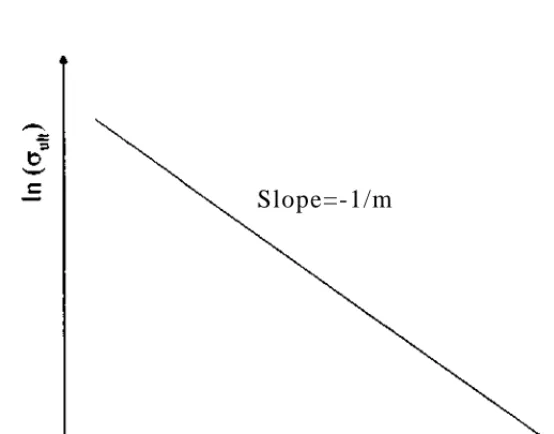
This equation directly links strength to volume and hence quantifies the size effect. A
logarithmic plot of stress versus volume gives a straight line relationship of slope -1/m, as
shown in Figure 3.2 .
Slope=-1/m
[image:41.548.138.415.309.526.2]ln(V)
Figure 3.2: Logarithmic Plot of a Strength Size Effect
We can extend this approach to include the effect of differing stress distributions by using
equation ( 3.17 ) to give;
This equation again quantifies the size effect but also includes the influence of differing stress
For anisotropic materials such as fibre composites both the strength distributions and the
effects of flaws in differing directions may not be the same. Integrating equation ( 3.9 ) over
length instead of volume, for example gives;
Similarly for breadth and depth;
n. (hXk (3.23)
a,
S^Jd^ <
3'
24>
o
x[dj
Where mi, nib and ma are not necessarily equal.
The theory as applied to anisotropic materials is referred to as modified weakest link theory.
Although almost all of the literature on composite materials concerns the Weibull distribution
many others are available. Other distributions which have been considered include the
rectangular and Laplace distributions (Epstein (1948a)).
3.2 Extensions of Weakest Link Theory for Composite Materials
Weakest link theory accurately describes the failure of brittle materials. However, although
most composite materials fail at very low tensile strains, final failure generally occurs after
some damage accumulation. There is much available literature suggesting the constituent
fibres of many composites do behave as brittle materials (Moreton (1969), Metcalf and
Schmitz (1964), Watson and Smith (1985), Padgett et al. (1995)). This is one of the
assumptions of the theory first put forward by Rosen (1964) and Zweben and Rosen (1970),
but damage accumulation is also taken into account. The solution of the damage accumulation
problem proffered by Zweben and Rosen involves many simplifications and assumptions.
Further work by Harlow and Phoenix (1978a) and Smith (1980) gave comprehensive exact
mathematical solutions. However these more complicated models also require the estimation
comparatively large and so the simpler and more easily interpreted theory of Zweben and
Rosen is outlined here, as described in more detail by Batdorf (1990). The bundle of fibres
model, as first suggested by Daniels (1945), is in fact an extension of simple Weibull theory. A
chain of elements is again considered, but in this case the elements are assumed to consist of
many fibres, as illustrated in Figure 3.3.
Figure 3.3: Bundle of Fibres Elements : , . . . , , ,
Daniels assumed that for a loose bundle of fibres when an individual fibre failed, the bundle as
a whole did not fail due to redistribution of the load equally among the other fibres. However,
a fibre reinforced plastic composite material consists of high stiffness and high strength fibres
embedded in a relatively low modulus weak polymer matrix. The fibres in an undamaged
unidirectional uniaxially loaded composite carry the majority of the load. In a similar manner
to Daniels, Zweben and Rosen hypothesised that when the first of these fibres failed the
composite as a whole did not fail, because of load transfer by the matrix. However, they
supposed that the load previously taken by the broken fibre is now transferred via the matrix
only to the adjacent fibres, around the break and then back to the original fibre. A
consequence of this shear transfer is that, for a certain length either side of the break, the
failed fibre carries less load whilst those adjacent carry more. This is shown in Figure 3.4.
Matrix \
• -':: I ' -" V . "
CT | *
..:-:,: , ::; x:x:;:;:
CT
'mm'^w v ""
m^
1
. / | \
CT j . VS;;S:::s
\ :
\ •
/
/ - • ' : •
i
i
[image:43.551.51.498.21.254.2]T E N S I O N
The length over which this shear transfer occurs is known as the "ineffective length" denoted
by 5. Despite the fact that the adjacent fibres now carry more load, since 8 is small the
probability of a critical flaw occurring in this length is also small and hence failure is
unlikely. Also the excess load is shared amongst all neighbouring fibres and so the load
increase is not large.
This type of isolated fibre breakage is termed a "singlet" and as the load is increased more of
these will appear. As the load is further increased it becomes more likely that the over
stressed parts of the adjacent fibres should themselves fail. When this occurs there are two
adjacent broken fibres and this is termed a "doublet". Still further loading will give rise to
more singlets and doublets and then "triplets". This continues until a critical "multiplet"
occurs and the process becomes unstable, resulting in the failure of the composite as a whole.
Considering the two parameter Weibull distribution;
a) (3.25)
For the fracture of a fibre this may be interpreted as the number of defects unable to sustain a
stress a per unit length of fibre. Hence the number of singlets formed in N fibres of length L
is;
4^1"
(3J6)
This assumes that the ineffective length 5 is much less than the fibre length L. A further
assumption is that N is large so that the number of flaws at the edges of the composite and
hence not surrounded by other fibres is small.
In order to simplify the analysis the ineffective length for a singlet 5, is replaced by a
conceptual '"effective length" A.,. Each fibre adjacent to a singlet has a maximum increase in
stress in the plane of the break. The effective length is that which, when subjected to this
maximum stress, has the same probability of failure as the ineffective length subjected to the
Figure 3.5: Ineffective Length (8) and Effective Length (k)
The total length of overloaded fibres surrounding the Q, singlets is hence Qin,^, where n, is
the number of fibres around each singlet. Defining the ratio of aMax to a as C, gives the
number of failures expected in this length as;
n nr,A
C^Y
( 3'
2 7>
This is the number of singlets converted to doublets at stress a and may be generalised to
higher order multiplets;
QM = C.a (3.28)
This is not generally equal to the number of i-plets present at load a since some will have
been converted to higher order multiplets, the actual number is hence;
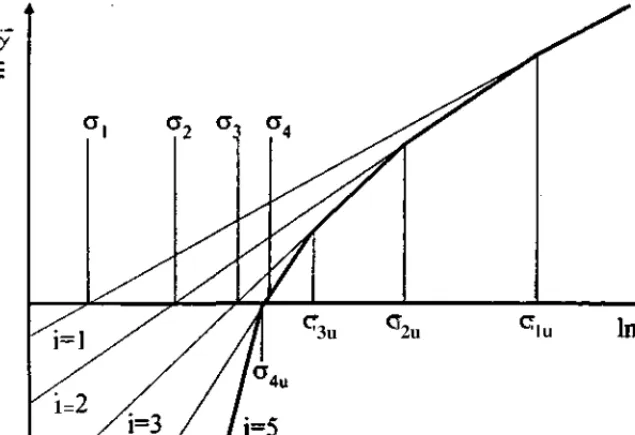
It can be seen from equation ( 3.28 ) that a logarithmic plot of Q< against a for the ith
'3u J2u ' l u
[image:46.553.120.438.19.236.2]1=
Figure 3.6: Logarithmic Plot of the Bundle of Fibres Model
Using this graph it is possible to predict the failure behaviour of the material as the stress is
increased. As the stress is increased the first fibre failure occurs at a, where the singlet (i = 1)
line cuts the In Q, = 0 line, i.e. where the number of singlet failures is one. Simple Weibull
theory, whereby the initial failure is said to lead to catastrophic failure would predict failure
of the material as a whole at this point and the i = 1 line does in fact correspond to this
theory. However failure does not occur in this case and further increase of stress results in
more singlets and at a, the first doublets are formed. Since all doublets are formed from
singlets there can never be more doublets than singlets. Hence at CT1U the i = 2 line follows that
for i = 1. Above this stress any singlets formed are unstable and are immediately converted
into doublets. From this it is apparent that failure of the material occurs when the stress at
which a certain multiplet first appears is equal to or greater than that at which it is unstable.
i e- a'*°* (3.30)
This occurs when the envelope of the Q{ lines indicated in bold in Figure 3.6 cuts the ln(cr)
axis. For the case in Figure 3.6 further increase in stress from a2 results in more singlets and
doublets until, at a:, the first triplets are formed. Further stress produces more singlets,
doublets and triplets. At a4 the first quadruplet is formed, but this is unstable and failure of
the material results.
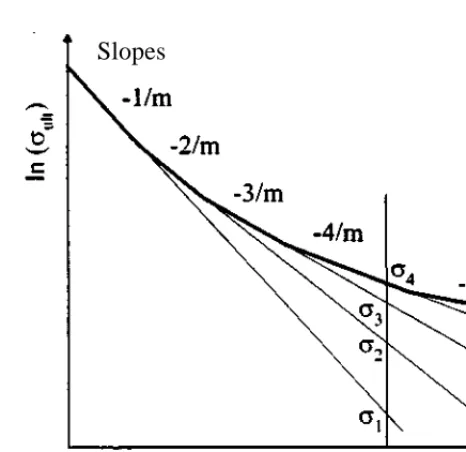
From equations ( 3.26 ) to ( 3.28 ) it is apparent that the number of multiplets is proportional
V. Hence a change in V translates the lines in Figure 3.6 vertically, changing the values of the
intercepts with the ln(a) axis. This relationship may be represented on a logarithmic plot of
failure stress against NL, as shown in Figure 3.7. This plot is analogous to that for simple
Weibull theory (see Figure 3.2).
Slopes
-5/m
[image:47.551.162.395.113.339.2]ln(NL)
Figure 3.7: Logarithmic Plot of Bundle of Fibres Model
The failure line is again the bold line, the dashed line indicating the situation shown in Figure
3.6 where failure occurs when the first quadruplet is formed. As the material volume is
increased the failure stress again decreases, i.e. a strength size effect is present. The order of
the critical multiplet is seen to increase with composite volume. Also, the dependence of
strength on volume decreases as larger amounts of material are considered.
The example above is only an illustration, the exact form of the curve will change with the
values of the parameters m, an, rij, k, and Q . The predictions made using the model are thus
highly dependent upon the estimation of these parameters.
3.3 Scaling of FRP
The most obvious reason for differences between the material properties of the full scale
prototype and small scale models or test specimens is that the material itself is not the same at
both scales. This possibility is often overlooked in favour of precise mathematical models
such as those described in sections 3.1, 3.2 and 3.4. However, the properties of fibre
stage. Johnson (1979) discusses the influence of fabrication and environment on the
properties of FRP and some of the sources of material property discrepancies between model
and prototype construction are suggested below.
The model and prototype may be constructed in two quite different environments. The model
may involve laboratory preparation of test specimens using small amounts of material under
very controlled conditions. Conversely, the full scale marine article will probably be
constructed