2017, Volume 4, e4219 ISSN Online: 2333-9721 ISSN Print: 2333-9705
DOI: 10.4236/oalib.1104219 Dec. 25, 2017 1 Open Access Library Journal
Dark Matter, a Direct Detection
Stéphane Le Corre
Ecole Polytechnique Fédérale de Lausanne, Lausanne, CH, Switzerland
Abstract
In a previous paper, we demonstrated that the linearized general relativity could explain dark matter (the rotation speed of galaxies, the rotation speed of dwarf satellite galaxies, the movement in a plane of dwarf satellite galaxies, the decreasing quantity of dark matter with the distance to the center of galaxies’ cluster, the expected quantity of dark matter inside galaxies and the expected experimental values of parameters Ωdm of dark matter measured in CMB). It
leads, compared with Newtonian gravitation, to taking in account the second component (gravitational field) of the gravitation (imposed by general relativ-ity) without changing the gravity field (also known as gravitomagnetism). In this explanation, dark matter would be a uniform gravitational field that em-beds some very large areas of the universe generated by the clusters. In this ar-ticle we are going to see that this specific gravitational field, despite its weak-ness, could be soon detectable, allowing testing this explanation of dark mat-ter. It should generate a slight discrepancy in the expected measure of the Lense-Thirring effect of the Earth. In this theoretical frame, the Lense-Thirring effect of the “dark matter” would be a value between around 0.3 milliarcse-cond/year and 0.6 milliarcsemilliarcse-cond/year in the best case. In the LAGEOS or Gravity Probe B experiments, there was not enough precision (around 0.3% for the expected 6606 mas∙y−1 geodetic and around 19% for the expected 39
mas∙y−1 frame-dragging precessions). In the GINGER experiment, there could
be enough one; the expected accuracy would be around 1%. If this discrepancy was verified, it would be the first direct measure of the dark matter.
Subject Areas
Modern Physics, Theoretical Physics
Keywords
Dark Matter, Galaxies: Formation, Galaxies: Evolution, Gravitation
How to cite this paper: Le Corre, S. (2017) Dark Matter, a Direct Detection. Open Access Library Journal, 4: e4219.
https://doi.org/10.4236/oalib.1104219
Received: November 29, 2017 Accepted: December 22, 2017 Published: December 25, 2017
Copyright © 2017 by author and Open Access Library Inc.
This work is licensed under the Creative Commons Attribution International License (CC BY 4.0).
http://creativecommons.org/licenses/by/4.0/
DOI: 10.4236/oalib.1104219 2 Open Access Library Journal
1. Introduction
One of the most important mysteries of astrophysics is the problem of dark matter. This latter component represents at least five times the quantity of the ordinary mass. And until now, this term cannot be explained. We therefore find that our theories operate in a highly coherent and precise manner both on our scale and at large astrophysical scales. But as far as large scales are concerned, this coherence and precision is only possible on the condition of making the hypothesis of the existence of this new term of dark matter. A way to solve this problem is to propose new theories (MOND theories for example), but we can note that the term of dark matter, even if it is an ad hoc term, doesn’t generate any contradiction inside our current theories. In fact, we could even pretend that this term demonstrates the extraordinary consistency of our current theories because of the multiplicity of the ways to deduce the quantity of this term lead-ing to its more and more coherent and precise measure. Another way is to pro-pose that this term represents a new exotic matter. This explanation is more shared and certainly more studied. But until now, no new matter has been di-rectly detected, despite more and more experiences. A third way is to propose an explanation in the frame of current theories. That’s the purpose of the present work. The term of dark matter will be explained by a physical phenomenon of general relativity that is generally neglected.
General relativity implies the existence of two gravitational components. In addition to the gravity field, there is a gravitational field (together giving what is called the gravitomagnetism) just like the magnetic field in electromagnetism. The new gravitational field can be measured by its precession effect, known as Lense-Thirring effect. Several experiments have validated this effect for the Earth gravitational field, NASA's LAGEOS satellites or Gravity Probe B [1] with an accuracy of around 19%. Some new experiments will try to obtain a higher ac-curacy, for example GINGER [2] with an expected accuracy of around 1%.
In [3], a solution is proposed to explain the dark matter, compliant with gen-eral relativity. This explanation leads to the assumption that we are embedded in a relatively uniform gravitational field generated by larger structures than galax-ies (likely the clusters). Just like the Earth gravitational field can be measured, this hypothetical embedding gravitational field could be measured by its preces-sion effect (Lense-Thirring effect). Such a measure will be a direct measure of the “dark matter”. We are going to calculate the magnitude of this measure. This value is consistent with its non-detection until now. But it seems accessible to the next generation of experiments. In the most advantageous case, the accuracy of 1% (as expected in GINGER experiment) could be enough to detect it.
DOI: 10.4236/oalib.1104219 3 Open Access Library Journal
of particles of dark matter would be doomed to failure (it would be equivalent to search for particles of magnetic field). With general relativity, the ordinary mat-ter would be sufficient to generate the gravitational field to explain the dark matter term (just like charged particles generate magnetic field). Dark matter would be then another proof of the power of this theoretical frame (of the same importance as curvature of light trajectories, Lense-Thirring effect or gravita-tional waves).
2. Dark Matter Explained by General Relativity
2.1. From General Relativity to Linearized General Relativity
From general relativity, one deduces the linearized general relativity in the ap-proximation of a quasi-flat Minkowski space (gµν =ηµν +hµν;hµν 1). Withthe following Lorentz gauge, it gives the following field equations as in [4] (with
2 2 2 1 c t ∂ = − ∆ ∂ ): 4 8π
0; 2 G
h h T
c
µν µν µν µ
∂ = = − (1)
With:
1
; ; ;
2
hµν =hµν − ηµνh h≡hσσ hνµ =ηµσhσν
h= −h (2)
The general solution of these equations is:
(
)
(
)
34
, 4
, G T ct d
h ct
c
µν
µν = − − −
−
∫
x y yx y
x y (3)
In the approximation of a source with low speed, one has:
00 2 0
; i i; ij i j
T =ρc T =c uρ T =ρu u (4)
And for a stationary solution, one has:
( )
( )
34 4 d T G h c µν µν = −
−
∫
yx y
x y (5)
At this step, by proximity with electromagnetism, one traditionally defines a scalar potential ϕ and a vector potential i
H . There are in the literature several
definitions as in [5] for the vector potential Hi. In our study, we are going to define:
00 0
2
4 4
; ; 0
i
i H ij
h h h
c c
ϕ
= = = (6)
With gravitational scalar potential ϕ and gravitational vector potential i
H :
( )
( )
( )
( ) ( )
( ) ( )
3
3 1 3
2 d d d i i i G u u G H K c
ρ
ϕ
ρ
−ρ
≡ − − ≡ − = − − −
∫
∫
∫
y x y x yy y y y
x y y
x y x y
DOI: 10.4236/oalib.1104219 4 Open Access Library Journal
With
K
a new constant defined by:2
GK=c (8)
This definition gives 1 28
~ 7.4 10
K− × − very small compare to G.
The field equations (1) can be then written (Poisson equations):
1 2
4π
4π ; i G i 4π i
G H u K u
c
ϕ
ρ
ρ
−ρ
∆ = ∆ = = (9)
With the following definitions of g (gravity field) and k (gravitational field), those relations can be obtained from the following equations (also called gravitomagnetism):
1
;
0; 0;
4π ; 4π p
div
div G K
ϕ
ρ
−= − =
= =
= − = −
g grad k rot H
rot g k
g rot k j
(10)
With the Equations (2), one has:
00 11 22 33 0
2
2 4
; ; 0
i
i H ij
h h h h h h
c c
ϕ
= = = = = = (11)
The equations of geodesics in the linear approximation give:
(
)
2
2
00 0 0
2 d 1 ~ 2 d i
ij ik j
j k j j k
x
c h c h h v
t − δ ∂ − δ ∂ − ∂ (12)
It then leads to the movement equations:
(
)
2
2
d
~ 4 4
dt − ϕ+ ∧ = + ∧
x
grad v rot H g v k (13)
Remark: Afterwards, we will use relations defined with the parameterized post-Newtonian formalism (PPN). All previous relations can be retrieved start-ing with the PPN formalism. From [6] one has:
(
)
( )
( ) ( )
30 1 2
1
4 4 ; d
2
i
i i i
u G
g V V
c ρ
γ α
= − + + =
−
∫
y yx y
x y (14)
The gravitomagnetic field and its acceleration contribution are:
(
0)
; ig = ∧ gi g = ∧ g
B ∇ e a v B (15)
And in the case of general relativity (that is our case):
1
1; 0
γ = α = (16)
It then gives:
(
)
0 4 ; 4
i
i i g i
g = − V B = ∧ −∇ Ve (17)
And with our definition:
( )
( )
3( )
2 d
j ij j
i ij i
u G
H H V
c
ρ
δ
δ
= − = =
−
∫
y y y xx y (18)
One then has:
(
)
(
)
0 4 ; 4 4 4
i j i
i i g i ij
DOI: 10.4236/oalib.1104219 5 Open Access Library Journal 4
g =
B rot H
With the following definition of gravitational field:
4
g =B
k (20)
One then retrieves our previous relations:
; g g 4
= = ∧ = ∧
k rot H a v B v k (21)
A last remark: The interest of our notation is that the field equations are strictly equivalent to Maxwell idealization (in particular the speed of the gravita-tional wave obtained from these equations is the light celerity). Only the move-ment equations are different with the factor “4”. But of course, all the results of our study could be obtained in the traditional notation of gravitomagnetism with the relation
4
g =B
k .
2.2. From Linearized General Relativity to Dark Matter
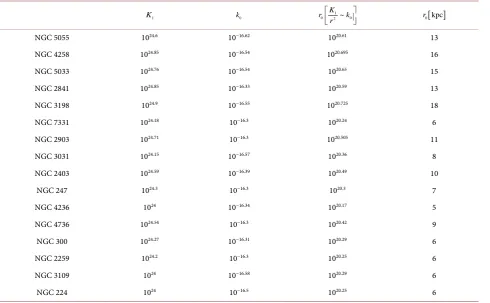
The article [3] demonstrates that the dark matter can be explained by the gravi-tational field k. It means that dark matter shouldn’t be some matter but the ef-fect of a gravitational field. This field is very similar to the magnetic field in elec-tromagnetism. But, in the dynamic of a galaxy, this term is neglected. One of the main results of [3] is the expected values of this field being able to explain the curve of rotation of the galaxies, with k0 the gravitational field of “dark matter”
(Table 1):
16.62 16.3
0
10− < k <10− (22)
As demonstrated in [3], these values justify that it can’t be produced by the galaxy, in agreement with the fact that this term for galaxies can be neglected. But, these values should be able to be produced by the clusters, embedding then large areas of the Universe.
3. Gravitational Field of Clusters (Dark Matter): A Way to
Directly Measure Dark Matter
Just like for the electromagnetism with the magnetic field, thisgravitational field implies a phenomenon of precession. It is known as the Lense-Thirring effect. As this gravitational field of clusters should embed large area of the Universe, it should in particular embed the earth. So, instead of taking into account only the own gravitational field of the earth, we are also going to take into account the hypothetical embedding gravitational field that explains the dark matter. We are first going to recall what the equations in the general relativity are for the Lense-Thirring effect. And secondly, we will use it to test this solution by calcu-lating the contribution to the precession effect generated by this gravitational field that explains the dark matter.
3.1. Gravitational Field and Precession Effect
The equations of the motion for the spin four-vector Sµ have been studied in
DOI: 10.4236/oalib.1104219 6 Open Access Library Journal
Table 1. Distance r0 to the center of the galaxy where the internal gravitational field 1 2 K
r generated by the galaxy becomes
equivalent to the external gravitational field k0 generated by the galaxies’ cluster.
1
K k0
1 0 2 ~ 0
K
r k
r
r0[ ]kpc
NGC 5055 1024.6 10−16.62 1020.61 13
NGC 4258 1024.85 10−16.54 1020.695 16
NGC 5033 1024.76 10−16.54 1020.65 15
NGC 2841 1024.85 10−16.33 1020.59 13
NGC 3198 1024.9 10−16.55 1020.725 18
NGC 7331 1024.18 10−16.3 1020.24 6
NGC 2903 1024.71 10−16.3 1020.505 11
NGC 3031 1024.15 10−16.57 1020.36 8
NGC 2403 1024.59 10−16.39 1020.49 10
NGC 247 1024.3 10−16.3 1020.3 7
NGC 4236 1024 10−16.34 1020.17 5
NGC 4736 1024.54 10−16.3 1020.42 9
NGC 300 1024.27 10−16.31 1020.29 6
NGC 2259 1024.2 10−16.3 1020.25 6
NGC 3109 1024 10−16.58 1020.29 6
NGC 224 1024 10−16.5 1020.25 6
deduced from the equations seen in paragraph 2.1. From [1], one can write the following equations:
(
)
(
)
2
1 1
2 c 4
α
γ ϕ γ α
= + ∧ + + ∧
S grad v rot h S (23)
Which lead to define a geodetic vector field ΩG and a “gravito-magnetic”
(frame-dragging) vector field ΩLT:
(
)
(
)
2
1 1
;
2 4
G LT
c
α
γ
ϕ
γ α
= + ∧ = +
grad v rot h
Ω Ω (24)
These expressions use the PPN formalism. For general relativity, α=1 and
as seen before (16), γ =1, it leads to:
2
3 1
;
2 2
G LT
c
ϕ
= grad ∧v = rot h
Ω Ω (25)
In our notation (20):
; 4
=h =
H k rot H (26)
One then has
2
LT = k
[image:6.595.59.550.113.416.2]DOI: 10.4236/oalib.1104219 7 Open Access Library Journal
3.2. Measure of the Dark Matter
In our solution, around the Earth, k represents the addition of two terms, the own gravitational field of the earth kE and the external uniform gravitational
field of the clusters (the dark matter) k0: 0
E
= +
k k k (28)
In the same way, the Lense-Thirring effect ΩLT is then composed of the own
Earth gravitational field term ΩLT E_ and of a new supplementary term of “dark matter” ΩLT DM_
0 _ _
2 2
LT = kE+ k = LT E+ LT DM
Ω Ω Ω (29)
The term ΩLT E_ is the traditional frame-dragging precession:
(
)
_(
)
2 3 2 3 5
3 ;
4 2
E
E LT E
G G
c r c r r
= = ∧ = − ⋅
h J r
H r J Ω r J (30)
In the Gravity Probe B experiment, the expected value for the frame-dragging precession was:
_ 39 milliarcsecond year
LT GPB =
Ω (31)
Let’s evaluate the order of magnitude of the external gravitational field (the dark matter) around the Earth. From [3], an average value is:
16.5 1 _ 2 0 ~ 2 10 s
LT DM
− −
= k ×
Ω
_ 0.4 milliarcsecond year
LT DM =
Ω (32)
In fact, from the sample of galaxies studied in [3], one obtains the interval (22) for k0. If we assume that these galaxies can be representative of our own galaxy,
the expected discrepancy should be in the following interval:
(
)
_
0.3< ΩLT DM <0.6 milliarcsecond year (33)
3.3. Discussion about the Expected Value of Lense-Thirring Effect
_
LT DM
Ω represents around 1% of ΩLT GPB_ , (indeed
1
0.4 mas y⋅ − ~ 0.01 39×
1
mas y⋅ − ). But until now, ΩLT GPB_ is only known with a precision 19% [1].
We need to have a better accuracy on this kind of experiments to hope to detect this discrepancy. GINGER experiment should have a precision of 1%. It could be enough to begin to detect a discrepancy.
But there are several aspects of the experiment that can play a role in decreas-ing or increasdecreas-ing this discrepancy. The Sun is at around 8kpc from the galactic center. In [3] we have seen that at this distance the gravitational field of the ga-laxy could be of the same magnitude than k0 (column r0
[ ]
kpc in Table 1). Therefore the expected values should be around 2 times greater than the pre-vious calculated values of ΩLT DM_ . But one also have to take into account theunknown direction of k0, implying that the magnitude of the effect could be
DOI: 10.4236/oalib.1104219 8 Open Access Library Journal
4. Conclusion
In [3], general relativity explains the dark matter as the gravitational field of the clusters. This solution implies a Lense-Thirring effect detectable around the Earth with some experiments as Gravity Probe B. Compared to the expected value of the frame-dragging precession around the Earth (ΩLT GPB_ =39 milliarcsecond year), in
this solution, the dark matter should generate a discrepancy in the following in-terval (in milliarcsecond/year) 0.3< ΩLT DM_ <0.6 (for the most advantageous
direction of k0). The previous experiments (LAGEOS or Gravity Probe B)
didn’t have sufficient accuracy (19% for the measure of the frame-dragging pre-cession in Gravity Probe B). The expected discrepancy needs at least a precision of 1%. The next generation of experiments (as GINGER) will have such an ac-curacy. So, in the best case, a precision of 1% could begin to reveal a discrepancy in the measure of the expected precession effects. Without any detection, a higher accuracy would still be required to definitively declare that this solution is irrelevant. In particular if the direction of k0 is very disadvantageous. But if
this discrepancy was measured, it will be the first direct measure of the dark matter.
References
[1] Adler, R.J. (2015) The Three-Fold Theoretical Basis of the Gravity Probe B Gyro Precession Calculation. https://doi.org/10.1088/0264-9381/32/22/224002
[2] Ruggiero, M.L. (2015) Sagnac Effect, Ring Lasers and Terrestrial Tests of Gravity.
Galaxies, 3, 84-102. https://doi.org/10.3390/galaxies3020084
[3] Le Corre, S. (2015) Dark Matter, A New Proof of the Predictive Power of General Relativity. https://arxiv.org/abs/1503.07440
[4] Hobson, M., et al. (2006) General Relativity. Cambridge University Press, Cam-bridge. https://doi.org/10.1017/CBO9780511790904
[5] Mashhoon, B. (2008) Gravitoelectromagnetism: A Brief Review. https://arxiv.org/abs/gr-qc/0311030