warwick.ac.uk/lib-publications
A Thesis Submitted for the Degree of PhD at the University of Warwick
Permanent WRAP URL:
http://wrap.warwick.ac.uk/108289
Copyright and reuse:
This thesis is made available online and is protected by original copyright.
Please scroll down to view the document itself.
Please refer to the repository record for this item for information to help you to cite it.
Our policy information is available from the repository home page.
POLYNOMIAL FUNCTIONS ON 0, 2i+l
B arry W illia m WETHERILT
A th e s is submitted fo r the degree o f Doctor o f Philosophy a t
the U n iv e r s ity o f Warwick, November 1981.
Mathematics In s t it u t e
U n iv e r s ity o f Warwick
BRITISH THESES
N O T I C E
The quality o f this reproduction is heavily dependent upon the quality o f the original thesis submitted fo r m icrofilm ing. Every effo rt has been made to ensure the highest quality o f reproduction possible.
If pages are missing, contact the university which granted the degree.
Som e pages may have indistinct print, especially if the original pages w ere poorly produced o r if the university sent us an inferior copy.
Previously copyrighted m aterials (jo urnal articles, published texts, etc.) are no t film ed.
Reproduction o f this thesis, other than as perm itted under the United Kingdom C opyright Designs and Patents A ct 1988, o r under specific agreem ent w ith the copyright holder, is prohibited.
T H IS T H ESIS H A S B E E N M IC R O FILM ED EX A C T LY A S R EC EIV ED
T H E B R IT IS H , L IB R A R Y
D O C U M E N T SU P P L Y C EN T R EBoston Spa, W etherb y W e s t Yorkshire, LS23 7BQ
Acknowledgements
Summary
§0 P re lim in a r ie s and n otatio n
0.1 The general lin e a r group and polynom ial functions 1
0.2 The Schur algebra 6
0.3 Polynom ial fun ctio n s on subgroups o f G 11
0.4 B ilin e ar forms and subgroups o f G 14
§1 C h e v a l l e y 's th e o re m f o r G a n d Q p & tl
1.1 Unipotent and diagonal subgroups o f G 16
1.2 The Big C e ll and C h e v a lle y 's theorem fo r G 18
1.3 The B ig C e ll and C h e v a lle y 's theorem fo r O211+I 26
11 The kernel of - V - k. I G UlK [r]
2.1 P re lim in a rie s 35
2.2 The kernel of t u• K[Ug] * K[Ur J 36
2.3 The kernel of f T •
t k • K[TC] * K lTr ] 39
2.4 The kernel o f K+[G )[d ‘ ' ] * K l r l l d " ' ] 40
2.5 The K-algebra
b k 47
2.6 The kernel of
57
53 Modular Theory
3.1 The K-algebra K 6 Z[Tq]
3.2 Modular Reduction 64
54 The Schur algebras o f Ooa | j(Q )
4.1 The coalgebras Kr [r ] 66
4.2 The KG module e£ 70
4.3 The r-maps 8 ^ . 71
4,4 T raceless tensors 74
4.5 Decomposition o f e£ in c h a r a c t e r is t ic zero 77
4.6 Connection w ith Schur algebras Sr g ( r ) 80
i i Representation theory I
5.1 Representation theory o f G 92
5.2 Weights o f r = ° 2)l+1 103
5.3 Ir r e d u c ib le modules o f Sr g ( r ) 107
i £ Representation theory I I
6.1 The ir r e d u c ib le Kr-module Ar EK 117
6.2 The Qr nodules g 126
6.3 A Z-form o f g 134
6.6 The Kr modules K 154
B ib !iog rap h y 157
Appendix A 159
Appendix B 162
1
Acknowledgements
I would lik e to thank my su p e rviso r P ro fe s s o r J . A . Green fo r his
help and guidance over the past three y e a r s , my w ife H ila r y fo r
h er i n f i n i t e p atien ce and understanding, my parents f o r t h e ir never
ending support and Peta M c A llis te r fo r her expert ty p in g .
I g r a t e fu lly acknowledge the f in a n c ia l support o f the S .R .C . during
Summary.
This th e s is 1s an attem pt to g e n e ralis e to the odd orthogonal group ,
over an I n f i n i t e f i e l d K not o f c h a r a c te r is tic two, the work o f Schur [ S ] , and more re ce n tly Green [ G ], on the general lin e a r group G^ using the
approach o f Weyl [W ] 1n c h a r a c t e r is t ic zero. The sp e cia l fe a tu re here is th a t we t r e a t r K as merely a group o f m atrices defined by the vanishing
o f polynomials in i t s c o e f f ic ie n ts (th e c la s s ic a l view ) ra th e r than a group
generated by elements d erived from an asso ciated L ie a lg e b ra , the approach
used i n i t i a l l y by C h e v alley and adopted by most authors in re ce n t tim es.
A f te r g e n e ra lis in g G reen's [G ] Schur algebra fo r to in §0
we prove in §1 C h e v a lle y 's famous theorem on the 'B ig C e l l ' in GK and
then, by an easy e x te n sio n , prove i t f o r the B ig C e ll in . C h e v a lle y 's
o r ig in a l proof uses re p re se n ta tio n s o f L ie a lg e b ra s , ours re q u ire s nothing but a l i t t l e knowledge o f the coordinate rin g K+[G ] o f a l l 'polyn o m ial' fu n ctio n s on G^ . We d efine K [ r ] , the co ord in ate rin g o f r K , to be
the space o f a l l polynomial fun ctio n s on G^ r e s t r ic t e d to and in s2
give a generating s e t o f the kernel o f the r e s t r ic t io n map
h,k:K+[G ] -*■ K [ r ] . Th is g e n e ralises W ey l's r e s u lt in c h a r a c t e r is t ic zero.
In §3 we use th is r e s u lt to show th a t the fa m ily , o r 'schem e', o f rings K [ r ] (K varying over a l l i n f i n i t e f ie ld s not o f c h a r a c t e r is t ic two) is
'd e fin e d over Z' ; in f a c t K [ r ] is n a t u r a lly isomorphic to K 0 Z[Tq3 , where Z[Tq] is the subring o f Q [r ] spanned by 'monomial' fu n ctio n s.
This enables us to form ulate a 'm odular' re p re se n ta tio n theory fo r r which
connects polynomial re p re se n ta tio n s o f Tq w ith those o f r K .
In §4 we in v e s tig a te the Schur algebras o f Tq fo llo w in g Weyl [W] and
in §5 fin d a complete s e t o f ir r e d u c ib le s fo r each o f them, once again
fo llo w in g the lead o f Weyl. In §6 we attempt to 're d u ce' these modules modulo p to obtain 'W e yl' modules fo r , a task only p a r t i a l ly
0.0
Throughout K w i l l denote an i n f i n i t e f i e l d o f a r b it r a r y c h a r a c te r is tic
unless stated otherw ise and, when no confusion should a r is e , we s h a ll w rite
the tensor product 8K as 8 . Fo r an in te g e r n > 0 , EK(n ) (o r ju s t
Ek ) w ill denote an n-dimensional K-space w ith basis ( e ^ . e ^ , . . . ,e n> .
I f r > 0 is another in te g e r we denote the r- fo ld tensor product
Ek 8 Ek 8 . . . 8 Ek by e£ and d e fin e e£ to be K .
Denote by I ( n , r ) the s e t o f r- tu p le s w ith e n tr ie s from n = i l , 2 , . . . , n )
Then E^ has basis
(e . : = e . 8 e . 8 . . . 8 e .
l
1l
12 1p
: i = ( i , , ! , ... 1r ) e I ( n . r ) } .\ c r0.1 The general lin e a r group and polynomial functions
We denote the group o f a l l non-singular n*n m atrices g = (9liv) p ven
w ith e n trie s in K by Gn K o r , when no confusion should a r i s e , v a rio u s ly
by Gn , Gk , G(K) and G .
Then G „ acts n a t u r a lly on the l e f t o f E „ (n ) by extending lin e a r l y
n,K ^
to the whole o f E^(n ) the a ctio n
0.1a
g.e = E g e fo r a l l v e n , geG v .
a v yeri wv u — n,K
Hence G „ acts on E^ (n ) by extending lin e a r ly to the whole o f E£(n)
n, k n ^
( r > 0) the action
g (e . fi e. « . . . a e . ) • g .e . a g .e, a . . .a g .e .
11
12
V
11
'zV
( f o r a l l e I ( n , r ) » 9 e Gn «) and Gn>|< a cts t r i v i a l l y
on E^(n ) = K .
Thus, the group algebra KG^ K o f Gr k c o n s is tin g o f formal sums
Z X .g (X e K, f i n i t e l y many 4 0 )
9‘ Gr .K 9 9
acts on E^(n) , making i t in to a l e f t KGn ^-module.
0.1c
For any s e t 0 we d e fin e Kn to be the s e t o f fu n ctio n s f :f i K .
Then Kn is a commutative K-algebra w ith operations defined 'p o in tw is e '
e .g . i f f , f ' e K then f f ' e Kn is the fu n ctio n which takes x e n to
f ( x ) f ' ( x ) e K . L e t r be any group, then we can extend each f e Kr
li n e a r l y to the whole o f the group algebra Kr o f r and id e n t if y Kr
w ith HomK( K r,K ) , the K-algebra o f K - lin e ar maps Kr -*• K . G K
Now fo r p ,v e ri d e fin e cyv e K n’ to be the K-l in e a r fu n ctio n
which maps each 9 e Gn k to i t s (u » v )th c o e f f ic ie n t gy v e K .
Denote by K+l Gn K1 the K-subalgebra o f K n,K generated by these
fu n ctio n s . Then K+|Gn K] i s by d e fin it io n the K-algebra o f polynomial
fu n ctio n s on G „ and sin ce K is i n f i n i t e the c „ ( u ,v e n) are
n,K wv —
a lg e b r a ic a lly independent over K . Thus K+[Gn can be regarded as
the K-algebra o f polynomials in n2 indeterm inates c yv (m,v e n) .
Fo r an in te g e r r > 0 we denote by Kr [Gn the K-subspace of
K+[G^ K] spanned by monomials in the cyv ( u ,v e n) which are o f degree
r , (thus K °[G n K] » K m where TL is the constant fu n ctio n
g 1 (geGn ) . Thus the dimension o f Kr [Gn>((] as a K-space 1s
("V'1» ■
For r > 0 , l e t G ( r ) be the symmetric group on r = { l , 2 , . . . , r > .
Then G (r) acts on the r ig h t o f I ( n , r ) by
0. Id
< V * 2 ... 1r> -' ‘ ... 1i.(r)>
( fo r a l l ( i i »12* — »1 r ) e U n . r ) , it e G ( r ) ) .
Hence G (r) acts on I ( n , r ) * I ( n , r ) : i f i , j e I ( n , r ) and n e G (r )
then (i,j)T T = ( iTTtJTT) .
For i , j e I ( n , r ) we w r ite i ^ j i f i and j are in the same
G (r ) o r b it o f I ( n , r ) , th a t is i f i = Jtt fo r some n e G ( r ) . S im ila r ly
f o r h,k e I ( n , r ) we w r ite ( i , h ) ^ ( j , k ) i f i = jn and h = kir fo r
some ir e G (r ) . Denote by T ( n ,r ) a s e t o f re p re s e n ta tiv es o f the G (r )
o rb its in I ( n , r ) x I ( n , r ) .
Now, given i , j e I ( n , r ) we w rite c ^ fo r the element
CV l C ,2 V ' CV r 1" KrtG">Kl '
0.1e
Kr [ G l
( I . J ) e T ( n . r )
s in ce c le a r ly c ^ runs over a l l monomials o f degree r in the n
generators cyv ( y , v e ji) o f K+[G^] » as (1 *J ) runs over T ( n ,r ) .
Hence
2
O . l f
2 | T (n , r )| . dimK Kr [Gn] . ( " " " ' I •
L e t V be a f i n i t e dimensional l e f t KG^-module w ith basis
( v , , v , , . . . ,vm ) . 1 2 m Then
O .lg
g-vb = £ Pab(g )* a fo r a11 be- ’ scGn aem
G
where the pflb e K (a.bem) , ( c a lle d 'c o e f f i c i e n t fu n ctio n s ' o f V ). G
Denote by c f ( V ) the K-subspace o f K n spanned by the pflb (a.bem) .
I t is easy to show th a t th is d e fin it io n is independent o f the choice of
b a s is o f V . We c a l l i t the c o e f f ic ie n t space o f V .
We denote by M ^G^) the category o f f i n i t e dimensional l e f t KGn-modules
V such th a t c f ( V ) c. K+[Gn] . Then every V in H^(Gn) gives r is e to a
f i n i t e dimensional rep resen tation Pv :Gn GL(V) o f Gn c a lle d a polynomial
re p re s e n ta tio n . This extends li n e a r l y to a re p re se n ta tio n (a ls o denoted by
5
-O .lh Example
The module E1^ is in the category MK( ° n) f o r a l l r >_ 0 , sin ce
by (0 .1 a ,b ) we have equations
g .e . - E c . ^ g j e ,
V
J c l ( n . r ) , geG K .j i e l ( n . r ) 1j 1 n,K
Hence c f (E ^ ) = K-span { c ^ : i , j e l ( n , r ) > .
L e t M^(G ) denote the subcategory o f MK(Gn) co n s is tin g o f those
modules V e MK( Gn) such th a t c f ( V) c. Kr [Gn] . These are the polynomial
modules which affo rd rep resen tation s whose c o e f f ic ie n ts are homogeneous of
degree r in the c^v (g .v c ji) . C le a r ly e£ is in M^(Gn ) .
O . l i Theorem
L e t V e MK(Gn) , then
y . i * v<r > r>0
where each is a KG -submodule o f V w ith c M?3(G ) .
n K n
Proof
The proof given by Schur [S ,p .5 J f o r K = t , the complex numbers,
works f o r any i n f i n i t e f i e l d .
i t is enough to study homogeneous re p resen tation s ie . those in M£(Gn )
fo r a l l r >, 0 .
Remark
K+[Gn] can be regarded as the coordinate rin g o f the a f f in e semigroup
M „ o f a l l nxn m atrices w ith e n trie s in K . This means we can consider n»K
polynomial rep resentations o f Gn K as r a tio n a l re p resen tation s o f Mn K
and v ic e versa .
F i n a l l y , we w rite
M G„ ] Kr [ G l
the space o f polynomials in the c ^ (w .ven) o f degree <_ r .
0.2 The Schur algebra
L e t C be a K-coalgebra with c o m u ltip lic a tio n A:C -*■ CfiC and co u n it
e:C K , (see [Sw] fo r d e fin it io n o f coalgebra and re la te d term in o logy).
0.2a Examples
(1 ) We can consider K as a one dimensional K-coalgebra with
a( 1k) = 1K fi 1K and e ( 1K) = 1^ .
(2 ) The K-algebra K+[G] has a K-coalgebra s tr u c tu r e . C o m u ltip lica tio n
is d efin e d by extending lin e a r ly and m u lt ip lic a t iv e ly to the whole o f K+[G J:
7
-A (c ) - l c fl c ( y , v c n) .
pv pen pp pv
This a ris e s from the equations
V , < S - 9 ' ) *
^„i9>cpv( i '> (u ' v c
S>where g ,g ' e G^ K .
The co u n it e :K +[G] + K is defined by extending e (U ) - 1K and
0.2c
1 y = v ( y , v e rO e (c ) = {
“ v 0 y t v
This is e v a lu a tio n a t the id e n t it y o f Gn k •
(3 ) S in ce a (K r IG ] ) c Kr [GJ « Kr [G] and
4(Kr lG )) s Kr [G] a Kr [G] , both Kr [GJ and Kr [G] are K-subcoalgebras
o f K+[G] .
0.2d
Me can make C* = HomK(C ,K ) in to an a s s o c ia tiv e K-algebra w ith u n it
e by d e fin in g m u lt ip lic a tio n as fo llo w s:
i f f , f ' e C* then f f ' - ( f ■ f ' )A:C ♦ K (where K 8K is id e n tif ie d w ith K ).
For any r > 0 we c a l l the dual space s£(Gn) o f Kr [Gn) a Schur
algebra fo llo w in g Green [ G . p . l l ] . Then by (0 .2 d ) i f r > 0 , i , j c I ( n , r )
and e sJ^(G^) we have
♦•♦'(c,,) * i
♦(c
1
k)^‘(ckj) .
1J k e l ( n . r ) J
We denote by Ci j the element o f s£(Gn) defined by
0.2e
1 ( 1 . J ) * (h ,k ) (h .k e I ( n , r ) ) . C4 i (c hk) = t
i j hk 0 ( i , j ) jt- (h .k )
C le a r ly i-. - ch k i f f ( i , j ) n. (h,k> and th e re fore s£(Gn) has basis
i j h,K ^
: ( i . j ) c T ( n , r ) } . For any r > 0 d e fin e e:KGn - W to be
the unique K - lin e a r map such th a t fo r g e G ^ K , e (g ) is e va lu a tio n a t
9 . I . e .
e (g )( c ) = c (g ) fo r a l l c e Kr [Gn] .
We w r ite eg f o r c (g ) ; e ( l G) is the co u n it o f Kr [Gn ) .
L e t mod(s£(Gn) ) denote the category o f f i n i t e dimensional l e f t
s£(Gn) modules.
0 .2 f Proposi tio n
For any r >_ 0 the K - lin e a r map e:KGn s £ (Gn ) an epimorphism
9
-and mod(s£(Gn) ) using the ru le
g.v = e . v g fo r a l l g e G „,veVn,K
where V c MJ^(Gn) o r mod(s£(Gn) ) .
Proof
The case K = C is due to Schur [ S ] , fo r the general case see Green
[G, 12.4].
0.2g Remark
I f V e m£(G ) has basis ( V j. V g , . . . , vm> such th a t fo r b e m ,
9 e G„ . K
9 'v b ' £m pa b (9 )v a aem
then the a ctio n o f s£(Gn ) on V is g ive n by
4>. v. = Z ♦(Pab^v a f o r a11 be- ’ 4’eSK^Gn^ ’
a cm
Define Sr K(Gn) to be the extern al d ir e c t sum
0.2h
sk
''<G> ■ ■ * S°K(Gn>
s r K( Gn) has basis
0.21
(Ci j : ( i , j ) e Tr (n ) : » T ( n ,r ) u T(n,r-1 ) u . x » T (n ,0 )} .
I f | = e a . . c . . e S „( G ) we denote by the component
(1.J)eTr (n) r ’K n
of f in S^(Gn ) ie .
<-( i. J ) e l<-( p .n ) au ' u
We s h a ll sometimes w rite 4> as the r+ l-tuple .
9 e Gn K » * r ^ is e v a lu a tio n a t 9
0 .2 j P ro p o sitio n
For any r .> 0 er :KGn s r K( Gn) is an e PimorPh'ism o f K-algebras.
Proof
The case r = 0 is immediate . C le a r ly
£r (KGn) c S p, K(Gn) ■ Suppose Sr>K(Gn) ,ji er (KGn) , then there e x is ts a
non zero element c e Kr [Gn] such th a t er ( g ) ( c ) = c (g ) = 0 f o r a l l
g c Gn K . By the ir r e le v a n c e o f a lg e b raic in e q u a lit ie s , lW ,p.4] we
- 11
0 . 3 Polynomial fu n ctio n s on subgroups o f G .
L e t r be any subgroup o f G^ . Elements o f K+1G] can be regarded,
by r e s t r ic t io n to r , as fu n ctio n s on r o r lin e a r fun ctio n s on the group
algeb ra Kr . We d e fin e K [r ] c. Kr to be the s e t o f these r e s tr ic te d
fu n c tio n s . Then K [ r ] is a K-subalgebra o f Kr and in h e r its a K-coalgebra
s tru c tu re from K+[G] . The r e s t r i c t i o n map \ : K +[G] -► K [r ] Is a s u r je c tiv e
morphism o f K-algebras and K-coalgebras. The subspace ’r K(K r. [G ]) in h e r its
a K-coalgebra s tr u c tu r e from Kr [G] , denote i t by [ r ] and fo r
1 . j e I ( n , r ) w r ite c j j f o r '^K( c i ^ ) . Denote by Sr>K( r ) the dual o f
Kp[ r ] . By (0.2d) we can g iv e Sr K( r ) a K-algebra s tr u c tu r e . The su r
j e c t i v e morphism o f K-coalgebras
V . K : Kr [G1^ Kr [ r l
c 1j * C1J
induces an in je c t iv e morphism o f K-algebras
0.3a
S r,K<r > ’ Sr.K<G) •
We s h a ll id e n t if y Sr K( r ) w ith i t s image 1n Sr>K(G) .
We c a ll Sr K( p) a ' Schur alg e b ra' of r .
0.3b Lenina
Fo r any subgroup r o f G and non-negative in te g e r r we have
where Kr is considered as a K-subalgebra o f KG .
Proof
Le t 4> e Sr k(G) , then <J> e Sf K( r ) i f f the kernel o f Kr [G] -*• K
contains the kernel o f f K , (th e n 4> can be considered as a fu n ctio n
on
Kr [rl) .
Le t 4> = £r (a ) (aeK r) then c e ker v r K im p lies that c ( a ) = er ( a ) ( c ) = 0 and hence e p(K r ) Ç Sr>K( r ) •
Now, suppose Sr K( r ) <£ er (K r ) . Then there e x is ts some non-zero
c e Kr [ r ] w ith c = v r K( c *) f o r some c ' e Kr [G] such that er ( a ) ( c ' ) = c ' ( a ) = 0 fo r a l l a e Kr i e . c ' e k e r f ^ so th a t
V r K^c ' ) = c = 0 » a c o n tra d ic tio n .
We d efin e e j: K r -*■ Sr K( r ) to be the r e s t r ic t io n o f er :KG -*• Sr K (G)
to Kr .
L e t V be a f i n i t e dimensional l e f t Kr-module with basis t v i * v2 ** * **vm^*
then fo r b e m
9■vb * E P Î b ( 9 )v a (9 £ r ) aem
where pîjb e Kr (a ,b e m) .
As in §0.1 we d efine the c o e f f i c i e n t space c f ( V) to be the K-span
o f the p£b (a ,b e m) and as befo re i t is independent o f the ch o ice of
b asis.
13
-V such th a t c f ( -V ) c Kr [ r ] . As an example a module in Mr K(G) is
the d ir e c t sum o f modules from m£(G ) , m£ ^ ( G ) , ... M^(G) by (0 .1 1 ).
We have the analogue o f ( 0 . 2 f ) .
0.3c Pro p o s itio n
L e t r be a subgroup o f G . Then the category o f f i n i t e dimensional
l e f t Sr K( r ) modules and Mr K( r ) are e q u iv a le n t using the ru le
a .v = e j ( a ) . v (a e K r, v e V)
where V is in e ith e r o f the c a te g o r ie s .
Proof
The proof follow s th a t o f ( 0 . 2 f ) given in [G, S2.4J and uses (0 .3 b ).
0.3d Remark
S in c e , f o r V e MK( r ) we have V e Mr K( r ) fo r some r > 0 , to study
the Kr modules in MK( r ) i t is enough by (0 .3 c ) to work w ith the f i n i t e
dimensional a s s o c ia tiv e K-algebras Sr K( r ) ( r > 0) . A ll th is a p p lie s to
r = G o f co u rse, although by ( O . l i ) and (0 .2 f ) we can confine our atte n tio n
to s£(G) (p > 0) .
In the case c h a r a c te r is tic K equals zero, th is was the technique used
by Schur [S ] on G and Weyl [W] on the other c la s s ic a l groups (see below ).
Green [G] has extended S ch u r's work to an a r b it r a r y i n f i n i t e f i e l d and we
0.4 B ilin e a r forms and subgroups o f G
L e t B:E^ * E^ -*■ K be a b i l i n e a r form defined by a matrix
B = (B (e ,e ) ) _ . Then the s e t — ' ' p ’ v " u , v e j i
0.4a
r B = igeGn K | B (g e .g e ') = B ( e , e ') V e .e 'c E ^ }
i s a subgroup o f ^ and i f we denote by g*" the transpose o f the
m atrix g , then
0.4b
( i i ) The m atrix B^ = ^ y ie ld s the even orthogonal group, 02)l(K ) •
( i i i ) The m atrix B = J 2ä+1 y ie ld s the odd orthogonal group, 02i + l ^ * r B = (9 tG n,K I gt- 9 = ’
0.4c Examples
Fo r an in te g e r i. > 0 , l e t
J, 0
(ixfc)-m atrix.
i
0
0 J
1 y ie ld s the sym plectic group, Sp2a(K ) ( i ) The m atrix JÎ
15
-Henceforth r „ K (n = 2*+ l) , or when no co nfu sion should a r is e r K ,
r (K ) or r , w i l l denote the odd orthogonal group 02ji+1(K ) '
0.4d Remark
Many o f the techniques used on 02a+i ( K ) ™ subse(luent sections can
also be a p p lie d , with some m o d ific a tio n s , to the sym plectic and even
orthogonal groups. These s im ila r it ie s (and d i s s i m i l a r i t i e s ) are o u tlin ed
§1. C h e v a lle y 's theorem fo r G and (^fc+l
1.1 Uni potent and diagonal subgroups o f G
We d e fin e the fo llo w in g subgroups o f G :
UG: = (u n i potent upper tria n g u la r m a tr ic e s ), a uni potent group
Ug: = iu n ip o te n t lower tria n g u la r m a tr ic e s ), a u nipotent group
Tg: * (non s in g u la r diagonal m a tr ic e s ), a commutative group
WG: = {perm utation m a tr ic e s ), isomorphic to G (n) .
1.1a
I t is easy to see th a t J Ug J n - U3 , where J n is the m atrix
n n
defin ed in (0 .4 c ).
We can now s ta te the fo llo w in g w e ll known theorem.
1.1b Theorem (B ru h a t, C h e valley)
We have G = U^.w.Tg.Ug (a d i s jo i n t u n ion ).
w e
W
gProof
Stein b erg [ S t , p .36] proves (by hand) th a t G = L J Ug.w.Tg.Ug .
wcWG
S in ce J (= 0n) is a permutation m atrix we can rep lace Ug by UgJ ,
a ls o JG = G and th e re fo re
G - U (OUgJ).w. T U - U U^.
w.T
g.Ug .
17
-1.1c
I t 1s c l e a r th a t K[UG] and K[U^] are polynomial rin gs over K
f r e e l y generated by the ( 2) coordinate fu n ctio n s (c ^ v : 1 < u < v < n)
and i c l : 1 £ v < u <_ n l r e s p e c t iv e ly , where c^v and cjjv denote the
image o f c yv e K+[G] 1n K[UG] and K[U^1 r e s p e c t iv e ly . A lso K[TGJ
is a polynomial rin g over K f r e e ly generated by { c j y : yen} , where
c uu ^ma9e c u v e ^[TG] . C le a r ly K[TG] has a basis
o f monomials:
( « { , ' ’ ‘ c22> 2
where V X 2... xn c Z>?
Denote by A (G) the s e t o f n-tuples w ith e n t r ie s from Z>Q and fo r
\ = (Xr X2, . . . , X n ) e A(G) by xA K the fu n c tio n o f TG given by (1 -Id)
i e .
l . l e
xX,K^d i a 9 { t r t 2 * ' ' ” t n ^ = *1 fc2 t n »
(where d i a g ( t 1 , t 2, . . . , t n) e TG is the m atrix w ith t 1#t 2... t R on the
diagonal from l e f t to r i g h t ) .
J G We c a l l elements o f A(G) ‘w e ig h ts' and f o r XeA(G) xx>K e K is
the 'c h a r a c te r o f weight X '. C le a r ly (x x>K : X e A (G )} is a basis o f
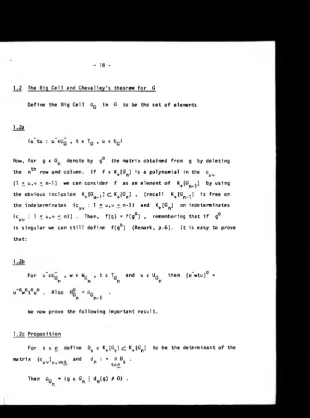
1.2 The Big C e ll and C h e v a lle y 's theorem fo r G
Define the B ig C e ll fig in G to be the s e t o f elements
1.2a
(u 't u : u~eUg , t e Tg , u e Ug)
Now, fo r g e Gn denote by g ° the m atrix obtained from g by d e le tin g
the n**1 row and column. I f f e K+[Gn] is a polynomial in the cyv
(1 £ p,\> £ n-1) we can consider f as an element o f K+ ] by using
the obvious in c lu s io n K+[Gr _^J d K+[Gn] , ( r e c a ll K+[Gn_^] is fre e on
the indeterm inates { c yv : 1 £ p , v £ n - U and K+tGn] on indeterm inates
{ c yy : 1 £ m,v £ n J) . Then, f ( g ) = f ( g ° ) , remembering that i f g°
is s in g u la r we can s t i l l defin e f ( g ° ) (Remark, p .6 ). I t is easy to prove
th at:
1.2b
For u"eUg , w e Wg , t e Tg and u e Ug then (u "w tu )° =
n n n n
u 0w °t °u 0 . A lso fig = fig
n n-1
We now prove the fo llo w in g important r e s u lt.
1,2c P ro p o sitio n
For s e n d efin e D$ e K+[G$] <£ K+[Gn] to be the determinant o f the
m atrix (c ) _ and d „ : = n D„ .
' wv'p.ves^ n Scn s
Then fi~ =
[image:27.340.22.333.23.442.2]- 19
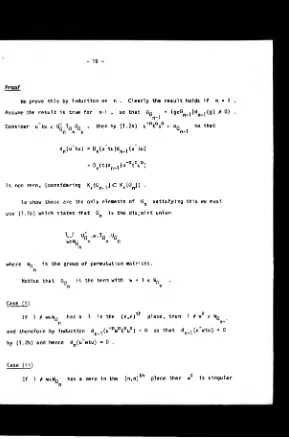
Proof
We prove th is by in d u ctio n on n . C le a r ly the r e s u l t holds i f n = 1
Assume the r e s u l t is true fo r n-1 , so th a t
fig
= {geG^ ^ |dn.j
(g ) + 0} n-1Consider u tu e U~ Tg Ug , then by (1 .2 b ) u ° t ° u ° e fig so th a t
n n n n-1
dn(u "tu ) = Dn (u "tu )d ni (u 't u )
■ Dn( t ) d n_ 1<u-°t0u0 )
is non zero, (co n sid e rin g K+[Gn_ j ] C K+[Gn] ) .
To show these are the only elements of Gn s a t is f y in g th is we must
use (1.1b) which s ta te s th a t Gn is the d is jo in t union
O UG .w.Tq .Ug
weWg n n n
where Wr is the group o f permutation m a trice s.
Notice th a t fir is the term w ith w = 1 e Wfi
Case ( i )
I f 1 t weWg has a 1 in the ( n ,n ) th p la ce , then 1 / w ° e Wg
n n-1
and th e re fore by in d u ctio n dn_ j(u 0w °t °u 0 ) = 0 so th a t dn_ j( u wtu) = 0
by (1.2 b ) and hence dn(u wtu) = 0 .
Case ( i i )
[image:28.343.28.317.25.464.2]so th a t Dn_ j ( w ° ) = 0 . I t now fo llo w s th a t (u w t u )° = u~0w °t °u 0 is
s in g u la r so th a t Dn-1 (u ’ wtu) = 0 and th e re fore dn (u "w tu ) = 0 .
1.2d Remark
Before proceeding fu rth e r we make some general remarks concerning
rin g s o f fr a c t io n s and r e fe r the reader to [A.M.S3] fo r more d e t a ils .
L e t R be any commutative rin g w ith id e n t it y and S be a m u ltip li-
c a t i v e l y closed subset con tain in g the id e n t it y . We d e fin e an equivalence
r e la t io n ~ on R*S as fo llo w s:
( r , s ) -v (r-|,s.|) i f f ( r s 1 - r-jS)s' = 0 fo r some s ' e S .
We denote by r/s the equivalence c la s s o f ( r , s ) and g iv e the set
R [S _1] o f a l l these cla sse s a comnutative rin g s tru c tu re :
th is is not in j e c t i v e , but i f every element o f S is not a zero d iv is o r
then r / l R = r j/ 1 R i f f ( r - r ^ s - 0 f o r some s e S , i e . r - r ] - 0 .
Thus R can be id e n t if ie d w ith a subring o f R IS * 1] in th is case and w<
w r ite r f o r r / l R .
stru c tu re in the obvious manner. I f S i s generated by a s in g le element
Hence, = (geGn : dn(g) ^ 0} •
n
ss
There is a rin g homomorphism R -*■ R [S given by r -*■ r / l R . In general
I f R is a K-algebra then R [S -1] in h e r its from R a K-algebra
21
-1,2e Example
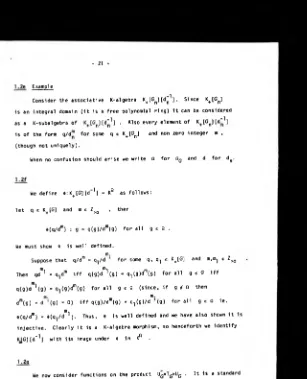
Consider the a s s o c ia tiv e K-algebra K+[Gn] [ d n^ ]. Sin ce K+l® nl
is an in te g ra l domain ( i t is a fre e polynomial r in g ) i t can be considered
as a K-subalgebra o f [Gn] [d "1 ] . Also every element o f K+[GnJ [t*” ' ]
is o f the form q/d" fo r some q t K+(GnJ and non 2er0 tn teger m ,
(though not u n iq u e ly ).
When no confusion should a r is e we w rite ii f o r fig and d f o r
dn-1.2f
We defin e * :K +[G ][d _1] - Kn as fo llo w s:
l e t q e K+[G] and m e Z>Q , then
4>(q/dm) : g q(g)/dm(g ) f o r a l l g e n .
We must show * is w ell d efined. m.
Suppose th a t q/dm = q ^ d f o r some q , q 1 e K+[G] and m,m1 e Z>Q
Then qd”1' = q ^ " 1 i f f q lg ld ” 1 (g ) = q, (g )dra(g) f o r a l l g t i i f f
q (g )d m,(g ) ■ q1(g)d m(g ) fo r a l l g e l l (s in c e , i f g ( a then
m m.
dm(g ) * d ' (g ) = 0) i f f q (g )/d m(g ) « q1 (g)/d (g ) fo r a l l g e t i ie .
*(q/dm) = * (q 1/d"'1 ) . Thus, * is w e ll defined and we have also shown i t is
in je c t i v e . C le a r ly i t is a K-algebra morphism, so henceforth we id e n tify
I^ G Jld ’ 1] w ith i t s image under * in K° .
1.2g
[image:30.344.23.330.25.404.2]procedure to show th a t the K-algebra A = K[Ug] 8 K[Tg] Cl K[Ug] can be
uG*TG*UG
id e n tif ie d w ith a K-subalgebra o f K v ia the map which takes
f^ 8 f 2 8 f^ e A to the fu n ctio n mapping ( u " , t , u ) to f j ( u J f g i t J f j f u )
For a proof th a t th is is a w e ll defined in je c t iv e K-algebra morphism see
fo r example [H, §2.4]. We id e n tif y A w ith i t s image in
U^»t0«Ug
Now, w r ite 6(6^) f o r the element (18dy81) e A , where dy eK[Tg]
is the r e s t r i c t i o n o f d e K+[G] to Tg ( in f a c t dy = X ( n>n_ ^ ,1 ),K ^ *
UG*TG*^G
Then, sin ce we consider A as a K-subalgebra of K , i t i s easy
to show th a t A[6~*] can be id e n tif ie d w ith a K-subalgebra of
UpxTpxUp _ _I
K v ia the map which takes q/6 e A[6 ] to the fu n ctio n mapping
( u " , t , u ) to q (u " ,t ,u )/ 6 m( u " , t , u ) . Henceforth we id e n t if y A[6 with
ur xTGxUr
i t s image in K . A ls o , sin ce A is an in te g ra l domain ( i t is
isomorphic to a free polynomial r in g ) we can id e n tify i t w ith a subalgebra
o f A ( S '’ ] .
1,2h
D efine a map * = » Tg < U j » nG by *n ( u ', t , u ) - u 'tu .
n n n n
C le a r ly t h is is s u r je c t iv e . Suppose th a t ♦n(u’ , t , u ) = ♦n( ui » t j * ui ) »
then u "tu = u^tjU-| • Hence (u ^ )” ^ u "t = t^u^u ^ and sin ce the L .H .S .
is a lower tr ia n g u la r m atrix and the R .H .S . is an upper tr ia n g u la r m atrix
we see th a t t = t j , u = u^ and u = u-j . Thus <i>n is a ls o i n je c t i v e .
23
-1,2 i Theorem (C h e v a lle y )
The map <|>n :Ug x Tg x Ug ■+ nG induces an isomorphism o f K-algebras
n n n n
V M Gnl l d n 'j * ] • X[Tg ] a K[Ug ) ) [ * ; ' )
n n n
such th a t $n( l/ d n ) = l /6n .
Proof
1 * UG *TG *^G
Given f e K+[Gn] [ d ‘ ' ] we d e fin e *n( f ) e K n to be the
com position fo<j>n » then <f>n( f ) ( u , t , u ) = f (u tu ) .
We must f i r s t show th a t the image o f <)>n l i e s in
A - l « '1) ■ ]
a
K[TC]a
K[UG ] ) [ « ■ '].
n n n
Now, sin ce 4>n is c le a r ly a K-algebra map we need only consider f = c yv ' (y .v c n ) and f = l/ d „ .
— ' n
( i ) I f f * c yv (u .v e n ) then ♦ „ ( % „ ) ( u \ t , u ) « c y v (u ‘ tu )
= E cU (u ” )c T ( t ) c U (u ) . Hence,
pen up
'
p p''
p v'♦*(c ) = E c U
a
CTa
CU e A i« ’ 1] . rr p v ' pen pp pp pv n ' n(1 1 ) I f f * l/ d n then ♦ * (l/d n) ( u ' , t , u ) - l/ d n( u 't u ) - 1 / d „(t) .
Hence ♦ *(l/d fl) . 1/1 I d j I I ■ l / s n .
* * Now <i>n is s u r je c t iv e , so th a t 4>n is in je c t iv e sin ce i f <|>n( f ) * 0
then <|>*(f ) (u ~ , t , u ) = f(u ~ tu ) ■ 0 fo r a l l u tu e iig i e . f = 0 .
n n
To prove the theorem i t remains to show th a t $n is s u r je c t iv e .
We proceed by in d u ctio n on n . I f n = 1 then G^ = Tg^ and
K [G jj = [ d ^ ] is c e r t a in ly isomorphic v ia 4^ to (lflK [T g j f t l ) [6^ ] Suppose th a t the theorem is true fo r n-1 . Now, as remarked above, we
can co n sid er K+[Gn_^J as a K-subalgebra o f K+[GnJ • We then have an
In c lu s io n i : K+[Gn_ , ) [ d ^ , l * K t [Gn) [ d ‘ ’ l such th a t i ( c uv) ■ c pv
(u ,v e n-1) and 1 (l/ d -j) = Dn/dn • C le a r ly we can a ls o consider
K[Ug ] , K[Tg ] and K[Ug ] as K-subalgebras o f K[U^ ] , K[Tg ]
n- 1 n- 1 n- 1 n n
and K[Ug ] r e s p e c t iv e ly . Thus we o b tain an in c lu s io n
n _
i ■
V l 1'«-!1 * V
O
such that J(C • 1 *
‘ c“u * 1 ® ’ •
JO »
cjv a l) -
1
* cjv a l , JO a l a e“v) - i a i i c “( (u.vcnO)
and J ( l / « n. , ) » (1
a
X ( l i , ..., ) « l ) / « n ■ Now, i t is easy to see th a t0 - J ** ., : K. l G„ - l l l d n -l) * AnISn 'l • B* , " duct,on C l 1s an 1s°
-morphism and i t then follow s th a t c|Jv a 1 81 (y ,v e n - l) , H 1
(X c A(Gn) : xn * 0) and 1 fi 1 fi c^v (u ,v c n - l) are a l l in the image of
<t>* . F u rth e r, s in ce 4>ni ( l / d n_-,) = (1 a X(1, 1 , . . . , 1 )® 1^ 6n then
1 « x (0 ,0 ,..0 ,1 )® ' - ( ’ • ‘ (1 .1 ...,1 )» ' ) 2 ‘ n-2/ s n is 1n the * “ * of ‘ n
Hence every 1 B xx ® 1 (X e A(Gn) ) is in th is image.
I t remains to show th a t y 8 1 a 1 (ven) and 1 a 1 l c ^ n (uen) *
are in the image o f <t>n . Now
E C
p e]l
i f
lp
a
cu
25
-but c“ p = 0 when p > 1 and = 1 . Thus, we can re w rite
M e , ) n in as 1 8 c l , i i 8c "in and sin ce there e x is ts a X c A(G ) such n th a t
( 1 a xA » l / « n ) ( u ' , t , u ) - c ^ i t) - 1
we see th a t 1 a 1 a c^n is in the image o f 4>n . S im ila r ly
and sin ce c^ S a c^
there e x is t a X e A(G )
8 ‘ Ì , 8 ‘ f n + 18« ¡ 1 8 c2n
is now shown to be in the image of
such th a t
and
[ l i x , < v « n ) ( u ' . t , u ) - 4 2( t ) - ’
we see th a t 1 8 1 8 Cgn is also in the image.
Proceeding in th is way we can show th a t 1 8 1 8 c pn is in the image of
<j>* fo r a l l y e n_ and by a s im ila r method c|{v 8 1 8 1 (ve n ) are also in the image.
This completes the p roof.
1,2 j C o ro lla ry to the proof o f ( 1 .2 i)
L e t K = Q and d e fin e Z+[Gq] to be the subring o f Q+[Gq] Z-spanned
by monomials in the co ordinate functions c yv (u .v e n ) and Z[UG^ ] ,
r e s t r i c t i o n maps. Then
♦ * ( V G„1> ■ <z l% Q )l 8 ZITG(Q)i 8 ZWoiQ)))“ ' ' ) •
Proof
L e t K = Q in ( 1 . 2 i ) and observe th a t the proof works over Z .
1,2k Remark
The proof o f (1 .2 1 ) d if f e r s from C h e v a lle y 's o r ig in a l proof in so
f a r as our approach uses p re cis e knowledge o f the two K-algebras involved
ra th e r than the a ctio n s o f generating elements o f the group on c e r ta in
modules. Of course i t is not s u rp ris in g th a t we can do th is f o r the
r e l a t i v e l y s tra ig h tfo rw a rd group G , but we s h a ll a ls o use th is approach
on the odd orthogonal group in the next s e c tio n . These proofs u n derline our
approach, th a t is we a re d e fin in g our groups as the zeros o f a s e t o f p oly
nomials ra th e r than groups generated by c e r ta in m atrices.
1.3 The Big C e ll and C h e v a lle y 's theorem f o r 02A+1
Henceforth unless s ta te d otherw ise we s h a ll assume th a t the c h a r a c t e r is t ic
o f K i s not 2 . The reason behind th is r e s t r ic t io n is explained in Remark
(1 .3 h ).
We defin e the fo llo w in g subgroups o f the odd orthogonal group r = r n (K )
(n-2 1+1, t>0) :
- 27
and the subset fir : = fig^r , (the Big C e l l ) .
1,3a Lemma
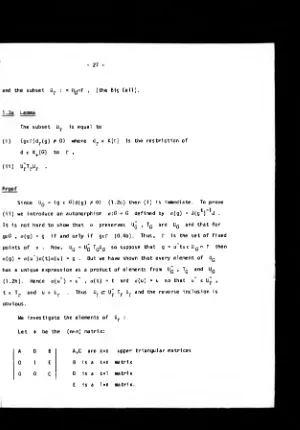
The subset fip is equal to
( i ) tg e r|d r (g ) / 0} where dr e K [r ] is the r e s t r ic t io n o f
d e K+[G] to T ,
( i i ) u ;T r ur .
Proof
S in ce fig = (g e G |d (g ) ^ 0} (1 .2 c) then ( i ) is immediate. To prove
( i i ) we introduce an automorphism o:G G defined by o (g ) = J ( g t ) ^ J .
I t is not hard to show th a t o preserves Ug • tg and Ug and th a t fo r geG , o (g ) = g i f and only i f ger (0 .4 b ). Thus, r is the s e t of fixed
points o f a . Now, fig = Ug TgUg so suppose th a t g = u "tu e f ig a r then
o (g ) = o ( u " ) o ( t ) o ( u ) = g . But we have shown th a t every element o f fig
has a unique expression as a product o f elements from Ug , Tg and Ug
(1 .2 h ). Hence o(u ‘ ) = u" , o ( t ) = t and o (u ) = u so th a t u~ e u ’ ,
t e Tp and u e Uf . Thus fip c Tp Uf and the reverse in clu s io n is
o b viou s.
We in v e s tig a te the elements o f Up :
L e t * be the (n*n) m atrix:
A D B A,C are upper tr ia n g u la r m atrices
0 1 E B i s a *XJI matrix
0 0 C D i s a 1* 1 ma t r i x
[image:36.343.26.326.22.452.2]Then * e
ur i f and o n ly i f n * « J n ie .
A t 0 0 0 0 J £ A D B 0 0
D l l 0 0 1 0 0 1 E * 0 1 0
Bl Efc Ct J t 0 0 o o r>
0
0Expanding th is we ob tain the fo llo w in g r e la tio n s :
1,3b
( R l ) A ^ C ■ J ,
(R2) E * D ^ C - 0
(R3) Bl J t C + El E + c ‘ j t B * 0
(R4) Cl J t A . J ,
(R5) C ^ D . E1 - 0 .
I t is c le a r th a t ( R l ) is e q u iva le n t to (R4) and (R2) to (R 5 ). Thus
( R l ) , (R2) and (R3) are necessary and s u f f ic ie n t co n d itio n s fo r * to belong
to r . Now, i f we choose A a r b i t r a r i l y (upper tr ia n g u la r u n ip oten t) we
then determine C by ( R l ) . F u r th e r , i f we choose D a r b i t r a r i l y we determine
E by (R 2 ). We must now check th a t (R3) does not in te r f e r e w ith our freedom
to choose A and D a r b i t r a r i l y and see to what ex te n t we are fr e e to choose
B :
L e t F ■ < V u . v . £ = " V * " d " " ( \ v > U , v « i ' E ‘ E • The" (" 3)
can be r e w ritte n as:
29
-g iv in -g f yv + f yp = -hyv ( p . v e l) .
Hence, each (ue£) is determined by A and D and i f \
f (u<v) a r b i t r a r i l y , A and D determine each f (u>\>) , JJV ' '
is no r e la t io n between A and D .
t- 1 t
Now, s in ce B = (by v ) y sttl ■ J t Cfc F we can choose the by ,
a r b i t r a r i l y , the r e s t being determined by A and D v ia C and
We can now prove:
1,3c P ro p o s itio n
The fo llo w in g s e t o f fu n ctio n s on Up f r e e ly generate
K-algebra K[Ur ) :
1.3d
<‘ !!v : (w .v ) < R ,}
where c y ^ e K[Ur ] is the r e s t r ic t io n o f cyv e K+[G] to Up
= { ( y , v ) e nxn : 1 < _ v < t , u+1 £ v < 2t+ l-u )
We can rep resent these elements on a schematic m atrix (*• =
1 * * 1 * ■ * *
1 * ¡ * ! *
1 '• * •
i(r = element o f (1.3 d )
‘ choose
but there
(u+v<i)
F .
the
and
Proof
The fu n ctio n s (1 .3 d ) a l l H e in K[Ur J , sin ce 1t 1s c e r ta in ly
generated by the s e t o f functions
1.3e
Ur
{c : 1 < y < v < n ) .
yv - —
The c a lc u la tio n s above on ♦ show th a t i f a r b it r a r y values in K
are assigned to each o f the fun ctio n s in (1.3d) then there is a uniquely
defined element o f Up on which they take these v a lu e s . This shows th a t
the fu n ctio n s (1.3 d ) are a lg e b r a ic a lly independent and th a t every fu n ctio n
in (1 .3 e ) is a polynomial over K in them. This completes the proof.
We can also prove in a s im ila r way:
1,3 f P ro p o s itio n
The fo llo w in g s e t o f *2 fu n ctio n s on Up f r e e ly generate the
K-algebra K[Up] :
K 3 a
( u .v ) e R;>
where c ^ e K[U~J is the r e s t r ic t io n o f cyv e K+[G] to Up and
R* = t ( y , v ) e n^n : 1 <_v < l , v+1 < y ± 2t+ l-v)
1,3h Remark
31
y ie ld s 2f = -h (pen) . I f the c h a r a c t e r is t ic o f K i s 2 th is
J mm p p ' —
im plies t h a t a l l o f the e n tr ie s in E are zero. Then (R2) im plies th a t
D is determined by A . On the other hand the e n tr ie s {b^v : p+v <_ * } can
be chosen a r b i t r a r i l y ( t more than b e fo re ). A ll th is means th a t K[Ur J
2 2
is no lon g er f r e e ly generated by the 9. fu n ctio n s (1 .3 d ) but by the i
functions
Ur
{ c y^ : l<y<£, p+l<y<t, t+2<_v<2t+2-pl .
I t is to a vo id th is com p lication th a t we assume the c h a r a c te r is tic o f K is
not 2.
1.3i Remark
U_ * U
I f K = Q , observe th a t each c ^ u . v e n ) li e s in Z [cy v : (p .vJe R ^ ] ,
where Z is the subring o f Q generated by Z and J . The need to
ad join J to Z a ris e s from the r e la t io n 2fyji = - h ^ (yen ) , ( c f . (1 .3 h )).
We now turn our a tte n tio n to Tr . I t is r e a d ily seen th a t a diagonal
m atrix d i a g { t ] , t2>. . . , t n> l i e s in r i f and o n ly i f t ^ t ^ ^ = 1 (yen ) . Thus t-j , t 2, . . . , t A can be chosen a r b i t r a r i l y non zero and t| +1 = 1 . I t follow s t h a t K[Tr ] has a basis o f monomials
U i
Tp a , T Ciy Ip o a
(c l j ) (c 2,2 ^ ^c t+l,» + l^
1 p
Denote by A ( r ) the s e t o f *.+1-tuples a = (c^ ,<»2, . . . ,a Jl+1) such
t h a t a.j .cig,. . . e Z and e {0 ,1 } . As with Tg we can define
the ch a ra cte r K o f r g iv e n by ( 1 . 3 j ) . Thus
1.3k
xo.K<d
1
*
9
(tl
>t2
.... ‘I-1-*!’
where c = ±1 .
. t , '> ■ t / t .“ l “ 2
We c a l l elements o f A ( r ) 'w e ig h ts ' and x£ K (a e A (r )) a 'ch a ra cte r
o f weight a ' . C le a r ly K[Tp] has a basis (x£ K - a e A (r ) } .
Follow in g ( 1 .2 f ) and (1 .2 g ) we can id e n t if y the K-algebras K l r H d " 1] fir
and Ap * K[Up] 8 K[Tr J 8 K[Ur ] w ith K-subalgebras o f K and
U’ xT »U
K r e s p e c t iv e ly . N otice however th a t K [r] is no longer an
in te g r a l domain. A ls o , the co u n te rp art o f 6, 6r : = (1 8 dy 8 1) e Af i s in v e r t ib le s in c e the r e s t r i c t i o n dy o f d e K+[G] to Tr is the
c h a ra cte r xr (n _ 1 > n . 3... 0) which has In v e rs e x [ , . „ >3_ n ...0) i " \ ■
Thus Ar [ s ' ’ ] = Ar .
We a ls o have the analogue o f (1 .2 h ):
1 .31
The map ♦I>:U" * Tr * Up - o r d efined by ♦r (u ’ , t , u ) - u’ tu is a
b i je c t io n .
33
-1,3m Theorem (C h e v a lle y )
The map 4>r : U~ * Tf * Up ftp Induces an isomorphism o f K-algebras:
♦ * : K I r ]
[dj:'j
* Ktuf]a
K[Tr ]a
Klu,.] .Proof
i * ur*Tr*ur
G iven f e K [r] [ d” 1 ] we defin e ♦r ( f ) e K to be the composition
fo<|>r , then -|>*(f ) ( u ~ , t , u ) = f jj “ tu ) .
As in the proof o f ( 1 . 2 i ) <J>* is an in je c t iv e K-algebra morphism
in to Ar . We have o n ly to show th a t <t-r is s u r je c t iv e .
Take any element a e Aj, , then th ere e x is ts an element
a e ( K[U^J a K[Tg] fi K[Ug] ) [6_1] such th a t a r e s tr ic te d to U* » Tf * Up is p r e c is e ly a , ( o f course a is not uniquely determined by a ) . By
(1 .2 1 ) th ere e x is ts q e K +[G] and m e Z>Q such th a t ♦ (q/dm) = a ie .
q (u " t u )
dm(u~tu)
a ( u " , t , u )
fo r a l l (u , t , u ) e UG * tg * UG .
This eq uation holds in p a r tic u la r f o r a l l (u , t , u ) e Uf * Tf x Uf and
i t fo llo w s th a t
• a
where q e K [r] i s the r e s t r ic t io n o f q e K+[G] to r .
1,3n C o ro lla ry to the p roof o f (1.3m) and (1 .2 J ) .
Le t K ■ Q and d e fin e
Z[rp)
. zCu7 (q)3 • ZCTr(Q) 1 and ZCUr(Q)-1to be the images o f Z+[Gp ] under the re s p e c tiv e r e s t r ic t io n maps.
Then
♦ • (Z LI-Q Kd ^ l)
• zcu;(Q)] »
Z [T r ( Q ) ]a z w r(p)j •
Proof
35
-§2. The kernel o f ^ : K ^ G I -» K [ r ]
2.1 P r e lim in a r ie s
In t h is ch apter we s h a ll fin d a generating s e t fo r the kernel o f the
r e s t r ic t io n map »K:K+COI -> M r ] as an id e al o f K+[G ] . However, our
f i r s t move s h a ll be to compute the kernel o f the r e s t r ic t io n map
2.1a
¿ ¡ f - ^ i M V a m t g i a m u g i * Mu"r i a K iTr j a M U r i
where *K -U’ xTvU , i f *K a v j a yJJ and
is r e s t r ic t io n M - V - K[U’ ] ,
’ ¡t is r e s t r ic t io n m t g i K [Tr l and
is r e s t r ic t io n m ug : - K[Up] .
We have:
ke r a ki tg ] a K[UG] +
J a K[UG] ♦ K[U^ 1 a K[TG 1 a ker v
u
K •Hence i t is enough to consider the kern els of
s e p a r a te ly , th is s h a ll be done in (2 .2 ) and (2 .3 ). We s h a ll then use
the isomorphisms given by C h e v a lle y 's theorem (1 .2 1 , 1.3m) to achieve our
aim. B e fo re we commence, a d e fin it io n :
2.1c D e fin itio n
For any subgroup G o f G and a ,B c n we d e fin e the follow in g
elements o f K[G] :
where f o r ven v : = n+l-v and 6 a , B-?
0 a/B
N o tice th a t i f C an (n*n) m a trix , then
2. le
2.2 The kernel o f 4^ : KCU^l -» KfUp]
2.2a Pro p o s itio n
37
-: K[Ug ] - K[Ur ]
is generated as an id e al o f KCUg] by the s e t o f elements
a.ßefi
and a ls o by the elements
a )
a.ßefl , ß > a }
Proof
Consider the m atrix CU = ( c U )' p v 'y .v e jl
By ( 2 . Id ) FU„ (a ,S e n ) is the ( a , e ) th c o e f f ic ie n t o f the m atrix
ctp —
(CU) t J CU - J . L e t F be the id e a l o f K[Ur ] generated by a l l these
' ' n n o
elem ents. Then, sin ce CU is an upper tria n g u la r uni potent m a trix , i t is
not d i f f i c u l t to see th a t F is a ls o generated by the s e t o f elements (2 .2 b ),
(th ese are the e n tr ie s o f (CU) t J nCU - J R below the diagonal which runs from
the top r i g h t hand to bottom l e f t hand c o rn e rs ). Now, sin ce f o r any g e Up ,
q t j g - J is a zero m a trix i t is c le a r th a t F is contained in the kernel
3 nJ n
o f tjJrKCUg] - K[Ur 3 .
Denote by c^v (u .v e n ) the image o f c|Jv in K[UG]/F and l e t Z
be the m atrix (c ) . Then Z is an upper tr ia n g u la r uni potent matrix
' jjv'u»veri
and Cl J C - J ; 0 . I t fo llo w s th a t 1f we submit t to the process
n n
described in ( S i . 3) we s h a ll show, as 1n the proof o f ( 1 .3 c ), th a t every
{ c yv : ( u . v ) e R£} , (though these elem ents do not n e c e s s a r ily f r e e ly
generate K[UG] / F ) . I t fo llo w s imm ediately th a t
KCUg] - K[cJ[u : ( u . v ) t « , ] ♦ F . . . . (1 )
But we a ls o have th a t
K[Ug 3 - KDcMv : ( ii , v ) e R£ ] ® ker . . . . (2 )
the sum being d i r e c t sin ce t4'|((CyV' : (v » v ) e f r e e ly generate the K-algebra y]J(K[UG] ) = K[Ur ] , (1 .3 c ).
Now, l e t z e ker , then using (1 ) we have z = x+y with
x e K[c[Jv : (m,v) e R£] and y e F . B u t F c ker vjj , thus
x c Ker K [cjjv : ( u ,v ) e R£] = (0 ) by ( 2 ) , and th e re fo re z e F .
This proves th a t the s e t o f elements (2 .2 b ) generates ke r 4^ . To show th a t the s e t o f elements (2 .2 c ) a ls o generates the kernel
we submit the lower tr ia n g u la r u nipotent m a trix (CU) t to a process s im ila r
to th a t f o r upper tr ia n g u la r unip oten t m a trice s in ( s i . 3 ) , and thereby show
th a t
K[Ug ] - Krc“ jU : ( n .v ) e « ¡1 + H
where H Is the id e al o f K[Ug] generated by the elements ( 2 .2 c ). Now,
i t is easy to see th a t ( v , u ) e R£ i f f ( u .v ) e R£ . Hence
K[Ug 3 ■ K [cjjv : (w ,v ) c R£] + H
- 39
and the r e s t o f the proof fo llo w s as b efo re.
In a s im ila r way we can prove:
2.2d Proposi tio n
The kernel o f the r e s t r i c t i o n map
: KCUg] - K[U~]
is generated as an id e al o f K[U g ] by the s e t o f elements
2.2e
{F U : a , Sen , B > a )
ap —
and also by the s e t o f elements
2.2f
{H^„ : a,Ben , 6 < a )
aB
2.3 The kernel o f 4^ : K[TC] -» K [Tr ]
We have shown in (1 .1 c) t h a t K [Tg] is f r e e l y generated as a K-algebra
by the elements { c ^ : pen} > and in ( 1 .3 j) th a t KfTj,] is the K-algebra
K(Xr X2... Xr At+1
where X
V
I t follow s th a t the kernel o f yJ is th e re fo re generated as an
id e a l o f KCTq] by the elements
2.3b
CT c l- - li/rT n (wen)
uu u p k l i g j
B u t HT- = FT- = cT C7- - L r y ! (Me£) •
p p pu p p u p k l,g j
Hence, we have
2.3c Pro p ositio n
The kernel o f the r e s t r ic t io n map
»K : « V * « V
is generated as an id e a l o f K[Tg] by the s e t o f elements
{H^— = F^— : aen , 0 > a }
aa act — ~
Now, by (2 .1 b ) p rop o sition s (2 .2 a ,d ) and (2 .3 c) give gen eratin g elements
o f the kernel o f as an id e a l o f K[Uq] fi K[Tg] 8 K[Uq]
2.4 The kernel o f : K ,[ G][d~^ 1 - K m t d' 1 T
We prove a general lemma concerning rin g s o f f r a c t io n s .
2.4a Lemma
L e t R and Rj be commutative rin g s w ith id e n t it y and f : R -*■ Rj be
an epimorphism o f r in g s . L e t S be a m u lt ip lic a t iv e ly closed subset o f R
- 41
0 - (ker f > [S' 1 ] - R [ S " ’ ] T* R ^ f l S ) ' 1) - 0
i s e xact, where f o r r e R , s e S
T ( r / s ) ■ f ( r ) / f ( s ) e R , [ f ( S ) ' 1J .
P ro o f
We must f i r s t check th a t T : R[S~^] -*• R [ f ( S ) is w e ll d e fin e d .
Suppose th a t r/s = r ' / s ' in R [S , then ( r s ' - r ' s ) s " = 0 in R fo r
some s " e S . Thus ( f ( r ) f ( s * ) - f ( r * ) f ( s ) ) f ( s * *) = 0 in R^ so th a t
f ( r ) / f ( s ) * f ( r ' ) / f ( s ' ) in R , [ f ( S ) ' 1] g iv in g T ( r / s ) - T ( r V s 1) , which
shows th a t T is w e ll defin ed as re q u ire d .
Now, sin ce f is an epimorphism i t fo llo w s th a t T is a ls o . I t
th e re fo re remains to show th a t ker T = (k e r f ) [S ^] = {r/ s : reker f , s e S } .
Suppose th a t 7 ( r / s ) = 0 then f ( r ) / f ( s ) is zero in R -|[f(S) so th a t
th e re is some s ' e S w ith f ( r ) f ( s ' ) = f ( r s ' ) = 0 in R^ . Then r s 'e ker f
and r/s = r s '/ s s ' e (k e r f ) [ S ' ^ ] as re q u ire d .
We can now co n s tru ct the fo llo w in g coirm utative diagram:
_U"*T*U
(ke r ij* >,T><U) [ a' 1 ] * AK( s " ’ ] Ar ( K ) [<r
u * t i
♦k
wn * r ( K )
- k+[G ][d -1]
K
^ k [ r ] [ d ‘ ' ]+ + +
where AK « K[U£] ft K[Tg] fi K[Ug]
Ar (| () - K[ Up] i K[Tp] Q K[Up]
J K = kernel o f : K+[G] K [r ]
and d e K+[G] , 6 e A^ are the elements described in (1 .2 c ,g ) and d „ e K [r ] , 6r e Ar ,„x t h e ir co u n terp arts with re sp ect to r (K ) . R e c a ll
r i 1 1* ;
Ar ( K ) l * r ' * Ar ( K ) ■ ( 1 ' 3, p ' 3 2 )'
io
U’xT*U
The f i r s t and second h o riz o n tal rows are exact by (2 .4 a ), i'K
and being the n atu ral maps induced by 4^ *T*U and r e s p e c t iv e ly .
The upper row o f v e r t i c a l isomorphisms a r is e from C h e v a lle y 's theorem (1 .2 1 )
and (1.3m) and the bottom row o f v e r t i c a l maps are a l l monomorphisms s in c e K+[G] is an in te g ra l domain (1 .2 e) and:
2.4c Lenina
The element dr e K [ r ] is not a zero d iv is o r , th e re fo re K [r] can be
id e n t if ie d w ith a K-subalgebra o f K ^ H d ” 1] , (1 .2 d ).
Proof
See appendix A.
2.4d D e fin it io n
L e t I K be the id e a l o f K+[G] generated, as an id e a l, by the s e t of
<FGa
6 a,8 e n)
43
-D efine BK to be the K-algebra K+[ G ] / I K , then we have a s . e . s .
2.4e
where e :K +[G] -*-*■ BK is the n atu ral map.
By app lyin g (2 .4 a) we a ls o have the s . e . s .
2.4f
I K[d_1 J Kt [ O J [ d '’ ] e~ BK[d ‘ ' ]
where dg: = 0(d ) e B^ .
C le a r ly ¡ K c J K = k e r f K : K+[G] -► K [r ] . Hence y d ' 11 C. J K[d_1 ) ,
but in f a c t we have:
2.4q Pro p o s itio n
The id e a ls I ^ d ' 1] and . y d ' 1] of K+[G ][d -1J a re e q u a l.
Proof
I t is enough to show e q u a lity o f the id e a ls *K( I K
[ d _ 1 1 > a " d
4, * ( J Kld-1] ) in AKl«- ’ l .
By (2 .4 b ). ♦ * (J|t[ d " 1 ) ) - (k e r ” T“ U ) l « _1]| and by (2.1b ), (2.2a ,d ) and (2 .3 c ) the fo llo w in g elem ents o f AK d AK[<5 1'] generate i t as an id e a l
o f Ak[ « _1] :
FU 81 a 1 a,0 e n 0 > a
a0
1 S FT- S 1 a e n a > a
act
l
a
la
hu „ o.b t nL e t X = { (a ,@ ) : a,3 e n 6 > « ) and t o t a l l y order i t le x ic o g r a p h ic a lly so th a t ( a ' ,3 ’ ) < ( a , 6 ) i f f o ' < a or a ' = a and 3' < 6 •
Now, fo r ( a ,3) e X d e fin e I( a ,3) to be the id e al o f AK[6-1] generated by the elements
♦ X v » •
w ith ( o ' , S ' ) e S and ( a ' , 3 ') ± ( “ »8)
Claim
For any ( « . 8 ) e
x , I
( a ,3) is the id e al o f AK[6~1] generated by the elementsFU" , 1 1 1 1 , a 3 1 8 FT . . . 8 1 , a 3 1 8 1 8 h“ , .a p
f or a l l ( o \ B ' ) c X , ( o \8' ) < ( a , 9) . (note t lw t F^. 0. * 0 unless o ' = S ' and f
“ ,-,
= 0 - h“ ,-, ) .
Proof o f Claim
L e t ( a , 3) e X , then
(1)
p,h,keri
.U‘ U ' a T c T 9 r U CU
uhci k " c hhc kk " c huc kB
Now, sin ce ■0 i f w > v , the sum can be taken over a l l h,k e n_ with h <_ a a nd k <_ 3 .
- 45
O U
Eh<o k<8
< C » « M *
CU c u c ha kg) + 6 — (18 F — 8 1 )
Note th a t sin ce 8 _> a the co n d itio n s h <_ a , k <_ 8 imply 1T> b > a > h . Thus the terms Fdk have (h ,k ) e X and (h ,k ) <. ( a ,8)
in our o rd e rin g . We show th is is p r e c is e ly $K(F® ) .
Expanding each Fdk and F^— we have:
h<_a k<8
u,h,keri ■U c ”
'yh wk • ‘ I / k k » « 6-h<o £ sh . ï ( ,a c hhc k<8
Now 6^ = 0 unless h = IT , but then a = h and k = 6 sin ce
It > B > a > h . Thus the second sum is 6a g (l ^ cI a Caa S 1 ) and th is shows th a t 4>K( Fa e ) equals ( i i ) .
S i m i l a r l y , i t can be shown t h a t f o r ( a ,8) e X
« " > ■ h£a (c«hc ek 1
k<8
“ Huh t ) * « .5(1 » F i r « ' )
We can now prove the c la im by in d u ctio n on ( o ,6) e X . F ix ( a ,8) e X and denote by (“0»3Q) the elem ent o f X next below ( a ,6) in our ordering. Assume the cla im is tru e f o r I ( a0,60 ) then by the id e n t it ie s ( i i ) and ( i i i ) we have, modulo I ( a0»30 ) »
and
♦*(HG I = H c T t ! . l H U, i l r ( l l F - l l ) .
Kv aB aa BB «6 aB v aa '
F u fi 1 a 1 and 1 a 1 a Hun 1n the case B > a
aB aB
(u s in g the f a c t th a t (1 a Ca0c B8 a 1) ^ c A K [6 ^ and by
Hence the claim is true fo r ( a , B ) . I t remains o n ly to s t a r t the
in d u c tio n . L e t ( a ,B ) = (1 ,1 ) , the minimal element o f X , then
M F n> > n > tt H
U
11
and sin ce (1 a c T lcTl ® E AK[6_1] the Proo f of the claim is complete.
Now, s e t ( a ,B ) = ( n , l ) , the maximal element o f X . Then
* -l * ~1
I ( n , l )
c. <>K(IKld
] ) by d e fin it io n and by the claim I ( n , l ) = <*>K( J K[d ] ) s in c e they are both generated as id e a ls by the same elements o f A ^ C A^[6S in c e we alread y have I K[ d " ^ ] c . J K[d i t follow s th a t
♦K(iKi d' ' ] ) = ♦ *(JK« r , )>
p ro vin g the theorem.
47
-2.4h C o ro lla ry
There is an isomorphism o f K-algebras
♦ : BK[d'B’]
K[r] [d
;1
]
such t h a t fo r x e K+[G] , m e Z >_ o
* < 8 (x)/<£) = .
Pro of
Using ( 2 .4 b ,f ,g ) we have the fo llo w in g commutative diagram:
I K[ d ' ' ] ->K+[ G l[d ‘ ' ] - i — ■~ B K[d ‘ ' ]
id id : q
* ♦ f a *
J K[d_1] -*• K+[G] [d“ 1] K [ r ] Id “ 1] .
Hence, there must be an isomorphism 4- between BK[ d ^ ] and K [ r ] [dp^]
g ive n by
♦ (0(x)/d£) = f K(x)/d™
fo r a l l x e K+[G] , m e Z>Q
2.5 The K-algebra BK
The aim o f th is se ctio n is to show th a t BK is a reduced a lg e b ra , th a t
is i t s n i lr a d ic a l, which is the id e a l o f BK co n s is tin g o f a l l n ilp o te n t
2.5a Pro p ositio n
The K-algebra bK[ d^' ) is reduced.
Pro o f
By (2.4h) and the id e n t if ic a t io n o f ( S I . 3 ), BK( d " ' ] is isomorphic to
. Op
a su b alye b ra of the alg e b ra o f fu n ctio n s K . S in c e K c e r t a in ly
c o n ta in s no non zero n ilp o te n t elem en ts, the n ilr a d ic a l o f B^[dg ] is
z e ro . I t is th e re fo re a reduced alg e b ra as re q u ire d .
We need to show th a t BK has a Hopf algebra s tr u c tu r e , to t h is end we
p rove:
2.5b Lemma
I. is a c o id e a l o f K [G] so th a t in h e r it s a coalgebra s tru c tu re
from K+[G] .
P ro o f
R e c a ll th a t in (0 .2 a ) we gave K+[G] a coalgebra s tru c tu re w ith
c o m u ltip lic a tio n
a:K +[ü] - K+[G] fi K +[G]
such t h a t a(c ) = E c S c (u .v e n ) and c o u n it e :K [G] -*■ K ,
wv pen pp pv
e v a lu a tio n a t the id e n t it y o f G .
By d e f in it io n , I K is a co id e al i f
a ( i K) c k+(G]
a
I K♦
I Ka
k +[G]49
-Now, fo r any a, 6 e n i t is c le a r th a t
f> g> ■ 0 - O V and i t is not hard to show that
:G ) = i _ u v f g a cpa \>B c 0 + ( i » f GJ
P » v e £ ' aB
f i m) = z c c . a hg + (HG„ « 1)
o 6 ; otp B v p v
p »veil aB
S in c e these elements generate I K as an id e al o f K+[G] and
a ( x y ) = A ( x ) A (y ) * e ( xy ) = e ( x ) e ( y ) f o r a l l x .y e K+[G] i t follow s th a t I K is a co id e al. Then BK = K+[ G J / I K can be given a coalgebra s tru c tu re
by d e fin in g c o m u ltip lic a tio n Ag : BK -► BK a BK by
V x* 'k> ■ E ( x ( l ) * *K> 8 <x (2 ) * V
where l ( l | ■ [ l ( | | I l ( I ) ( x c K +[ G] ) (using the notatio n o f [S w ]) .
and c o u n it e B : b k K by
e B (x + I K) = e (x ) (x e K+[ G ] ) .
T h is completes the proo f.
To show that BK is a Hopf algeb ra we now o n ly need a K-algebra
morphism s B -.B^ B^ , c a lle d an 'a n t ip o d e ', s a t is f y in g
2.5c