A New Fast Iterative Blind Deconvolution Algorithm
Mamdouh F. Fahmy1, Gamal M. Abdel Raheem1, Usama S. Mohamed1, Omar F. Fahmy2
1Department Electrical Engineering, Assiut University, Assiut, Egypt; 2Department of Electrical Engineering, Future University,
Cairo, Egypt.
Email: [email protected]
Received December 8th,2011; revised January 9th, 2012; accepted January 18th, 2012
ABSTRACT
Successful blind image deconvolution algorithms require the exact estimation of the Point Spread Function size, PSF. In the absence of any priori information about the imagery system and the true image, this estimation is normally done by trial and error experimentation, until an acceptable restored image quality is obtained. This paper, presents an exact es-timation of the PSF size, which yields the optimum restored image quality for both noisy and noiseless images. It is based on evaluating the detail energy of the wave packet decomposition of the blurred image. The minimum detail en-ergies occur at the optimum PSF size. Having accurately estimated the PSF, the paper also proposes a fast double up-dating algorithm for improving the quality of the restored image. This is achieved by the least squares minimization of a system of linear equations that minimizes some error functions derived from the blurred image. Moreover, a technique is also proposed to improve the sharpness of the deconvolved images, by constrained maximization of some of the de-tail wavelet packet energies. Simulation results of several examples have verified that the proposed technique manages to yield a sharper image with higher PSNR than classical approaches.
Keywords: Blind Image Deconvolution; Image Enhancement
1. Introduction
The goal of blind deconvolution is to recover two convolved signals f and h from their convolved (and normally noisy), version g. Neither f nor h is known. In image processing, f represents the true image, whereas h represents the Point Spread Function PSF, which is responsible for blurring f. Even if we have a priori information about the PSF, recovering the original image by inverse filtering is usually counterproductive, as it involves noise amplification, [1,2]. At this point it is worth mentioning that, not all blurring causes can be pre- cisely determined. In general, the PSF can be described by the 2D Gaussian as in atmospheric turbulence or by circular PSF as in defocusing effects [3]. However, Cen- tral limit theorem implies that receiving blurred version of the image is closer to blurring the original image by a Gaussian distribution PSF. Note that the Gaussian PSF is one of the most difficult cases to deal with in blind de- convolution, as it can be factored into two Gaussian PSF. In the noiseless case g h **f . Solution starts by
choosing an initial guess of f, (normally taken to be the blurred image itself), then obtain h as the least squares solution of gh**f . Iteration is reversed and we
seek to estimate f using the estimated h. However, as the size of h is much smaller than f, this approach is computationally prohibitive. Many efficient techniques
have been proposed to solve this problem, [4-9]. In [4], an Iterative Blind Deconvolution technique IBD has been proposed by alternate updating the 2-D FFT of f and h, until the relation G
1, 2
F
1, 2
H 1,2
, isalmost satisfied. In its initial versions, it suffered from poor convergence, yet in latter versions [5], its robust- ness to noise and convergence properties are highly im- proved. An alternate double iteration algorithm that has good anti-noise capability has also been described in [6, 7]. It is known as the Richards-Lucy algorithm, and is characterized with robustness to either Poisson or Gau- ssian noise, [8,9]. In [5-10], a thorough treatment of di- fferent blind deconvolution techniques can be found. All these techniques require an exact estimation of the blu- rring PSF size. In view of the absence of any priori information about the PSF size, the application of the IBD, Richards-Lucy or any other blind deconvolution algorithms will fail to yield good quality restored images. This paper, addresses this problem. It shows how the optimum blurring size, can be accurately estimated for both noisy and noiseless images. Then, using this esti- mated PSF size the performance of IBD, RL or any other blind deconvolution algorithm is further improved. This improvement is achieved by iterating between updating the restored imagef m nˆ
,
and the PSF h m nˆ
,
thattions of the error e m n
,
g m n
,
g m nˆ
,
where ˆ ˆˆ
g h f . Further, the paper also describes a technique
for improving the sharpness of the deconvolved image, through maximizing some of the wavelet packet detail energies, while minimizing the residual reconstruction error energy. Simulation results of several images blurred by Gaussian or circular PSF, have verified that the proposed techniques substantially improve the quality of the restored images.
2. The Fast Iterative Blind Deconvolution
Algorithm
2.1. Mathematical Preliminaries
If the original image f of size MN is blurred by an
unknown transfer function h of size JK, then the
blurred image g is computed as
1 1
0 0 ,
, J K , ,
k j
g m n h k j f m k n j w m n
(1)w(m,n)is the associated zero—mean additive noise. For simplicity, let M = N, J KNp. Using circular con-volution properties, overlap is avoided if each row vec-tors of f, g and w is paddedby zeros to make its length equals M0, where M0 = M + Np – 1=N0. So, if f, g and w represent M0N0 × 1 column vectors formed by stacking the rows of the extended matrices, Equation (1) can be expressed as
g Hf w (2)
H is the block circulant M0N0 × M0N0 matrix, defined by
0 1
0 0
0 1 1
1 0 2
1 2 0
.... .... .... . .... .... M N N
H H H
H H H
H
H H H
(3a) 0 0 0( ,0) ( , 1) .... ( ,1) ( ,1) ( ,0) .... ( , 2)
. ....
....
( , 2) ( , 1) .... ( ,0)
e e e
e e e
j
e e e
h j h j N h j
h j h j h j
H
h j N h j N h j
(3b) Equation (2), suggests that, f can be recovered as
1
t t
f H H H gw
(4)
This equation indicates that even in case of prior knowledge of h and w, the inverse of
H Ht apart from requiring huge amount of computation for or- dinary sized images, can result in an unbounded per-turbation in the solution f. This problem is solved by taking the 2-D FFT of both h and f, as is ex- plained in the next section.
2.2. The Constrained Lest Squares Error Algorithm
The constrained least squared error algorithm [1,2], uses the 2-D FFT techniques, to obtain the restored image. It aims to obtaining a restored image f m nˆ
,
that is the solution of the following constrained optimization prob- lem: Find the optimum f m nˆ
,
, that mini- mize the objective function J,
ˆ , h m n
Minimize
2
1, 2 ˆ 1, 2 π 1, 2 π
J Q F for all
Subject to
2 21, 2 Hˆ 1, 2 1, 2
G F (5)
1 1
1 2 1 1 ( ) 1 2 0 0 ˆ
, , e
ˆ M N j m n
m n
n
H h m
,
2 2
1 2 1 1 ( ) 1 2 0 0 ˆ
ˆ , M N , e j m n m n
F f m n
Using the Lagrange multiplier technique, this problem can be formulated as
Minimize
2
1 2 1 2
2 2
1 2 1 2 1 2
ˆ
, ,
ˆ
, Hˆ , ,
J Q F
G F
(6)
The solution to this constrained minimization problem, can be shown to be
*
1 2 1 2
1 2 2 2
1 2 1 2
, ,
ˆ , ˆ
ˆ , , G F Q H H
(7)
Now, the function Q
1, 2
ˆF
is chosen to boost the high frequency energies of
1, 2
,. As all natural images have pre-dominant low frequency content, mini- mizing J means that the true imagef m n
is obtained,or at least nearly obtained. Q can be chosen in many dif- ferent ways. In [1], two formulas were given to q m n
,
to approximate Laplacian function. In this paper, a sim- pler of Q
1, 2
that satisfies the high frequency em- phasis requirements, is proposed. It is chosen as
1 2
1 2 1 , ˆ , Q F
. Using this choice, leads to the
following iterative restoration algorithm
* 1 2
1 2 2
1 2 1 1 2 , 1 ˆ , , ˆ k ,
This is precisely the update algorithm cited without proof in [4]. There, it is proposed to apply this update formula to estimate Hˆ
1, 2
. This results in the so-called Iterative Blind Deconvolution algorithm, IBD. It is an improved version of the original Iterative De-convolution described [3], and overcome many of its shortcomings. This algorithm is implemented using the MatLab function deconvblind.Now, the success of the IBD algorithm, as well as many other iterative deconvolution algorithms in estima- ting the original images depends on the precise estima- tion of the PSF order. The next section shows how this order is precisely estimated, in view of no priori informa- tion about the PSF order.
2.3. PSF Size Estimation
All iterative blind deconvolution algorithms require an estimate of the PSF size. To our knowledge, this is done on trial and error basis until good quality re- stored image is obtained. An analytical method is now given to estimate the optimum PSF size.
To analyze this problem, let the estimated PSF and image, be
ˆ , , ,
ˆ , ,
h m n h m n h m n , ,
f m n f m n f m n
where f m n
,
and are the original image and the true PSF filter. Note that in all blind decon-volution algorithms, controls
,h m n
,h m
n f m n
,
.So, the blurred received image g m n
, , is given by
ˆ ˆ
, , ** ,
, , ** ,
, ** , ,
g m n h m n f m n
h m n h m n f m n f m n
h m n f m n e m n
,
(9)
Clearly, due to the uncertainty of h m n e m n
,
, ,
can be considered as additive noise. It mainly af- fects the high frequency energy bands of the image.As the perturbation gets smaller, their
energy contribution to e(m,n) becomes smaller. This suggests to decompose e(m,n) using n-level wavelet packet decomposition and compute the detail energy in the last (high) wavelet packet WPn.
,h m n
If the blurred image is contaminated with zero mean AWGN, then the blurred noisy image has to be de-noised prior to PSF order estimation. The thres- hold level is computed as, [11]
2loge
T N (10)
2
is the variance of the WPn. It is determined through estimating its pdf distribution as described in [12]. N is its length when converted to a column vector. The fol-
lowing example, illustrates PSF estimation in both the noiseless and noisy cases, for Gaussian and circular de- focusing blurring filters
Ex. 1:
The proposed PSF order estimation method is verified by the following simulations. The test images used, are blurred using 8 × 8 Gaussian filter with 210, and circular averaging filter (pillbox), with radius r = 3. For an arbitrary PSF order, the program estimates the de-blurred image, using the Matlab function deconvblind, or deconvlucy. The parameters of these algorithms are: Number of cycles = 40, Threshold 0.005, The error signal e(m,n) is decomposed using 2-level “sym4” wave- let decomposition. Figure 1 shows the behavior of the
detail energy of the HH sub-band with different PSF or- der, for these blurred images. This precise PSF estima- tion subsequently leads to a significant improvement restored image quality, as will be shown in the following section.
In the noisy case, the blurred image is contaminated
with zero mean AWGN of . The blurred noisy
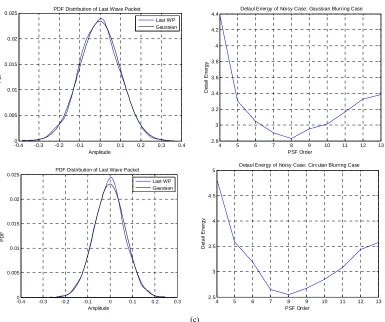
image variances are [0.0557 0.0421 0.0265], respectively. In order to de-noise this noisy image, it is decomposed with 2-level “sym4” wavelet decomposition. The prob- ability distribution function pdf,of the last HH wavelet packet is computed using the Bspline pdf estimation technique proposed in [12], using 3-level cubic Bspline wavelet with 128 histogram bins. Figure 2, compares the
pdf of the HH sub-bandwith Gaussian random variable distribution having the same mean and variance. It also shows detail energy performance for both Gaussian and circular blurring PSF. Again, this figure shows that apart from accurately estimating the pdf, it yields the optimum PSF size for further deblurring.
2 0.01
2.4. The Proposed Fast Iterative Blind Deconvolution Algorithm
The proposed Fast Iterative Blind Deconvolution algo- rithm FIBD, is initialized by estimating the PSF order, as described above using rough estimations of the original image provided by available algorithms, (like decon- vblind, deconvlucy,···). Having estimated the blurring PSF order, the algorithm iterates between updating the restored image f m nˆ
,
and the PSF . The up- date is based on minimizing some arbitrary Mxlargest absolute error deviations of
ˆ ,h m n
**
h f
e g . The algo-
rithm works in the spatial domain and is summarized as follows:
1) For the kth estimate, evaluate **
k k
gh f .
Evaluate H from as in Equations (3a) and 3(b). Evaluate the error
ˆ
h
ˆ
Δg g g . Arrange Δg in a
vector form.
4 5 6 7 8 9 10 11 12 13 0.5
1 1.5 2 2.5 3
Detail Packet Energy Gaussian Blurring Case
De
ta
il E
n
e
rg
y
4 5 6 7 8 9 10 11 12 13
1 1.5 2 2.5 3 3.5 4 4.5 5 5.5
PSF Size
E
rr
or
E
n
er
gy
Detail Error Energy. Defocusing Circular PSF
(a)
4 5 6 7 8 9 10 11 12 13
0.5 1 1.5 2 2.5 3
Detail Packet Energy Gaussian Blurring Case
De
ta
il E
n
e
rg
y
4 5 6 7 8 9 10 11 12 13
0.5 1 1.5 2 2.5 3 3.5 4 4.5 5
PSF Size
E
rr
or
E
n
er
gy
Detail Error Energy. Defocusing Circular PSF
(b)
4 5 6 7 8 9 10 11 12 13
0.8 1 1.2 1.4 1.6 1.8 2 2.2 2.4 2.6
Detail Packet Energy Gaussian Blurring Case
De
ta
il
E
n
e
rg
y
4 5 6 7 8 9 10 11 12 13
0.5 1 1.5 2 2.5 3 3.5 4 4.5 5
PSF Size
E
rr
or
E
n
er
gy
Detail Error Energy. Defocusing Circular PSF
[image:4.595.62.542.89.705.2](c)
-0.40 -0.3 -0.2 -0.1 0 0.1 0.2 0.3 0.4
0.005 0.01 0.015 0.02 0.025
PDF dDstrubution of Last Wave Packet
Amplitude
PD
F
Last WP Gaussian PDF Distrubution of Last Wave Packet PDF Distribution of Last Wave Packet
4 5 6 7 8 9 10 11 12 13
1.5 2 2.5 3 3.5 4
4.5 Noisy Case: Gaussian Bluring P
E
rr
or
E
ner
gy
-0.40 -0.3 -0.2 -0.1 0 0.1 0.2 0.3
0.005 0.01 0.015 0.02 0.025
PDF dDstrubution of Last Wave Packet
Amplitude
PD
F
Last WP Gaussian PDF Distrubution of Last Wave Packet PDF Distribution of Last Wave Packet
4 5 6 7 8 9 10 11 12 13
2.5 3 3.5 4 4.5 5 5.5
De
ta
il En
e
rg
y
PSF Order
Detaul Energy of Noisy Case: Circulan Blurring Case
(a)
-0.40 -0.3 -0.2 -0.1 0 0.1 0.2 0.3 0.4 0.5
0.005 0.01 0.015 0.02 0.025 0.03
PDF dDstrubution of Last Wave Packet
Amplitude
PD
F
Last WP Gaussian PDF Distrubution of Last Wave Packet PDF Distribution of Last Wave Packet
4 5 6 7 8 9 10 11 12 13
1.5 2 2.5 3 3.5 4 4.5
Noisy Case: Gaussian Bluring P
Er
ro
r E
n
e
rg
y
-0.4 -0.3 -0.2 -0.1 0 0.1 0.2 0.3
0 0.005 0.01 0.015 0.02 0.025 0.03
PDF dDstrubution of Last Wave Packet
Amplitude
PD
F
Last WP Gaussian PDF Distrubution of Last Wave Packet PDF Distribution of Last Wave Packet
4 5 6 7 8 9 10 11 12 13
2 2.5 3 3.5 4 4.5 5
De
ta
il En
e
rg
y
PSF Order
Detaul Energy of Noisy Case: Circulan Blurring Case
-0.40 -0.3 -0.2 -0.1 0 0.1 0.2 0.3 0.4
0.005 0.01 0.015 0.02 0.025
PDF dDstrubution of Last Wave Packet
Amplitude
PD
F
Last WP Gaussian PDF Distrubution of Last Wave Packet PDF Distribution of Last Wave Packet
4 5 6 7 8 9 10 11 12 13
2.8 3 3.2 3.4 3.6 3.8 4 4.2 4.4
De
ta
il En
e
rg
y
PSF Order
Detaul Energy of Noisy Case: Gaussian Blurring Case
-0.4 -0.3 -0.2 -0.1 0 0.1 0.2 0.3
0 0.005 0.01 0.015 0.02 0.025
PDF dDstrubution of Last Wave Packet
Amplitude
PD
F
Last WP Gaussian PDF Distribution of Last Wave Packet
4 5 6 7 8 9 10 11 12 13
2.5 3 3.5 4 4.5 5
De
ta
il E
n
e
rg
y
PSF Order
Detaul Energy of Noisy Case: Circulan Blurring Case
[image:6.595.118.503.83.405.2](c)
Figure 2. The pdf of the HH sub-band & detail energy performance for both Gaussian and circular blurring PSF. (a) Cameraman; (b) Lena; (c) Mandrill.
Matlab command
V Ix, xm
sort
Δg
. Subsequen-tly, Sort H( )k
as k
,
s xm xm
H H I I .
2 , , **
m n
e m n e g h f
or more simply asthe least squares solution of Equation (4), when h and f are interchanged.
3) For a prescribed number Mx, pick the Mx lar- gest deviations of Mx. Denote by
Δ Δ 1: .
x
M xm x
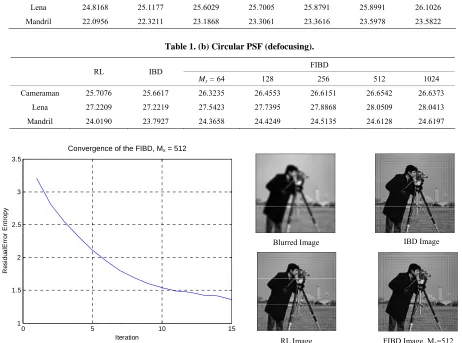
g g I endM end Ex. 2: The blurred images of Ex. (1), are deconvolved through minimizing the largest Mx peak deviations of the absolute error of e(m,n). Tables 1(a) and (b)
compare the PSNR improvements of the proposed FIBD technique, over the standard deconvlucy (RL) and deconvblind (IBD) algorithms for both 8 × 8 Gaussian and Circular PSF with r = 3 filters.
Partition
11 12
21 22
s
x
x
H H
H
M
H H
M
( ) ˆk 4) Only update
x
M
f responsible for the Mx lar- gest deviations of Mx. The update increments toge- ther with the updated Δ
x
M
g , are given by
12 ( )
22
Δ Δ kx
M H
g f
H
(11)
1
0 0 ;Δ x
k
k k
x M
f f zeros M N M f
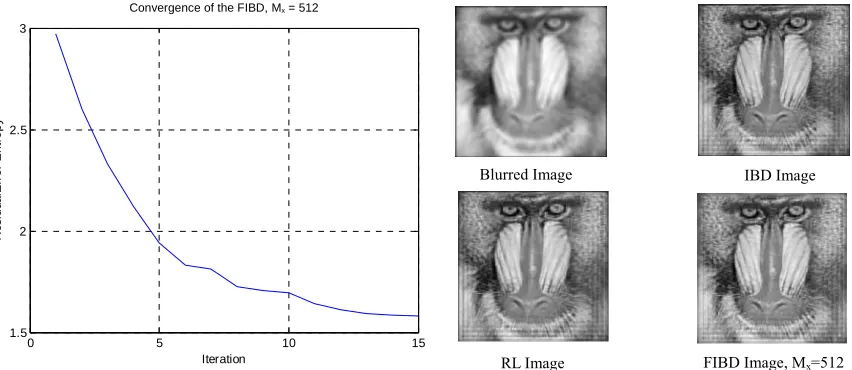
These tables indicate that the proposed FIBD algo- rithm yields a significant PSNR improvement, over the standard RL and IBD algorithms. This is due to the fact that the algorithm modifies pixels responsible for the severest image degradation, unlike other methods using 2-D FFT that considers all parts of the image to have equal importance. Figures 3-5, show the rate of conver-
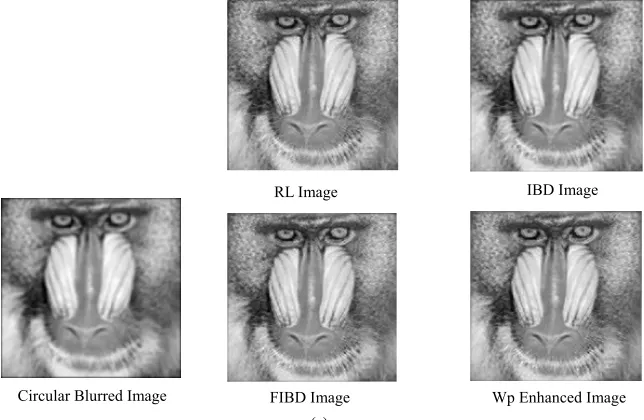
gence as well as the deconvolved images, for the Gaus- sian blurring filter, whereas Figure 6 illustrated the blur-
ring and deconvolved images in the circular blurring case. To end this section, it is worth pointing out that, if the PSF size is chosen different from the value estimated in the previous section, severe degradation of the quality of This concludes the image restoration cycle.
Updating ( )k
h proceeds similarly through minimi- zing the energy of gg using the updated image
1
ˆk ,
Table 1. (a) Gaussian PSF.
FIBD
RL IBD
Mx = 64 128 256 512 1024
Cameraman 23.5290 23.6468 25.0114 25.1386 25.3356 25.5039 25.6131
Lena 24.8168 25.1177 25.6029 25.7005 25.8791 25.8991 26.1026 Mandril 22.0956 22.3211 23.1868 23.3061 23.3616 23.5978 23.5822
Table 1. (b) Circular PSF (defocusing).
FIBD
RL IBD
Mx = 64 128 256 512 1024
Cameraman 25.7076 25.6617 26.3235 26.4553 26.6151 26.6542 26.6373 Lena 27.2209 27.2219 27.5423 27.7395 27.8868 28.0509 28.0413
Mandril 24.0190 23.7927 24.3658 24.4249 24.5135 24.6128 24.6197
0 5 10 15
1 1.5 2 2.5 3 3.5
R
e
si
du
al
E
rr
or
E
nt
ropy
Iteration
Convergence of the FIBD, Mx=512
Convergence of the FIBD, Mx = 512
Blurred Image IBD Image
[image:7.595.73.521.103.174.2]RL Image FIBD Image, Mx=512
Figure 3. The rate of convergence as well as the deconvolved Cameraman images for Gaussian case.
0 5 10 15
1.8 1.9 2 2.1 2.2 2.3 2.4 2.5 2.6
R
e
s
idu
al
E
rr
or
E
nt
ropy
Iteration
Convergence of the FIBD, Mx=512 Convergence of the FIBD, Mx = 512
IBD Image Blurred Image
RL Image FIBD Image, Mx=512
[image:7.595.65.527.145.488.2] [image:7.595.79.515.522.716.2]0 5 10 15 1.5
2 2.5 3
R
e
s
idu
al
E
rr
or
E
n
tr
opy
Iteration
Convergence of the FIBD, Mx=512
Convergence of the FIBD, Mx = 512
Blurred Image
RL Image FIBD Image, Mx=512
[image:8.595.88.514.87.272.2]IBD Image
Figure 5. The rate of convergence as well as the deconvolved Mandril images for Gaussian case.
Circular Blurred Image
RL Image IBD Image
FIBD Image Wp Enhanced Image
(a)
Circular Blurred Image
RL Image IBD Image
Circular Blurred Image
RL Image IBD Image
FIBD Image Wp Enhanced Image
[image:9.595.138.460.87.297.2](c)
Figure 6. The blurring and deconvolved images.
the deconvolved image occurs.
3. Improving Sharpness of the Restoration
Quality
As blurring affects the energies of the high frequency bands of the image, it is clear that deblurring should boost these high frequency energies. To explain this idea, consider the Matlab Cameraman image that is blurred using a Gaussian PSF of size 8 × 8 and . Table 2 compares the percentage sub-band energies of 1-level
“Sym4” wavelet decomposition, of the original Camera- man image, with those obtained for blurred, RL, IBD and the proposed FIBD deconvolved images. The FIBD im- age is obtained using Mx = 64. This table indicates that natural images have a significant amount of energy con- centration in its LL sub-band. Moreover, blurring reduces the LH, HL and HH sub-bands. It also suggests that, the deblurred image quality can be improved through boost- ing the energies of the wavelet packets LH, HL, HH. This goal can be achieved by processing these sub-bands by a 2D mask H0 that optimizes their energies while mini- mizing the residual energy of er
2 10
J . In order to reduce the effects of noise amplifications that predominates the HH sub-band, only the coefficients of the LH and HL are modified. The steps of the optimization algorithm can be summarized as follows:
1) Apply the FIBD algorithm to determine the opti- mum deconvolved image ˆ k
,
f m n , for the received blurred image g(m, n).
2) Obtain the 1-level “Sym4” wavelet packet decompo- sition of ˆf .
3) For an arbitrary 2-D matrix H0, normalize it to be a unity variance matrix, (in order to avoid collapsing to
zero in subsequent minimization steps). Filter the packets LH and HL coefficients with H0. Then, reconstruct the image from its modified wavelet packet using the syn-thesis bank to get y(m, n). Evaluate the residual error
11 11
0 0ˆ
, , , ,
N N er
r l
J m n g m n h r l y m r n l
(12)4) Using any unconstrained minimization algori- thm, find the elements of H0 that optimizes the detail packet energies while minimizing the error energy.
Tables 3(a) and (b) compare the PSNR improvements
achieved with the classical IBD, FIBD as well as the Wave packet Optimized FIBD, using Mx = 64, 128, re-spectively when applying these steps to the above blurred images. In order to speed up computations, the 2-D mask H0, is taken to be 4 × 4.
Edge improvements are checked by evaluating the norm of the difference between the exact edge of the original image, and the restored image edge. Table 4
compares the edge improvement of the optimized FIBD with the RL and IBD restorations for Gaussian blurring PSF. This table indicates that, coupled with the PSNR improvement, except for the Mandril image, the pro- posed FIBD and its optimized wavelet version are shar- per than RL and IBD counterparts. Thus, one can con- clude that FIBD and its optimized wavelet version pro- vide a superior deblurring image restoration technique.
Figures 6(a)-(c), compare the RL, IBD, FIBD and the
optimized FIBD for the 3 Matlab images, with the FIBD technique for Mx= 64.
4. Conclusion
Table 2. % Sub-band energy concentration.
WP Original Blurred RL IBD FEIBD
LL 99.2777 99.9890 99.7106 99.5414 99.6324 LH 0.2204 0.0049 0.1230 0.1883 0.1403
HL 0.4264 0.0061 0.1652 0.2680 0.2250
HH 0.0755 0.0000 0.0012 0.0023 0.0023
Table 3. (a) Wavelet packet PSNR improvement for Gaussian blurred images.
FEIBD Opt. FEIBD
Blurring Type IBD
64 128 64 128
Cameraman 23.6468 25.0114 25.1386 25.3257 25.3742
Lena 25.1177 25.6029 25.7005 25.4704 25.5538
Mandril 22,3211 23.1868 23.3061 23.3489 23.3914
Table 3. (b) Wavelet packet PSNR improvement for circular blurred images.
FEIBD Opt. FEIBD
Blurring Type IBD
64 128 64 128
Cameraman 25.6617 26.3235 26.4553 26.3346 26.4336
Lena 27.2219 27.5423 27.7395 27.0878 27.1839
Mandril 23.7927 24.3658 24.4249 24.3802 24.4237
Table 4. Edge error energy: Gaussian blurring.
WP Decomposition
Blurring Type RL IBD
64 128
Cameraman 53.6004 53.6656 51.9808 52.0000
Lena 52.4309 50.4480 49.3457 49.3254
Mandril 48.2804 48.4562 49.6588 49.7896
there is no priori information about both the true image and/or the blurring PSF, the size of the blurring PSF, can be accurately estimated for both noiseless and noisy blurred images. The paper also describes how using this estimated PSF size; the IBD or RL deconvolved images can be significantly improved. The proposed algorithms characterized by its fast convergence as a result of solv- ing expressing pixels modifications as the solution of a set of linear equations. A novel method was also de- scribed to increase the sharpness of the deconvolved im- ages. It remains to extend this work to the noisy case.
REFERENCES
[1] M. J. T. Smith and A. Docef, “A Study Guide for Digital
Image Processing,” Scientific Publishers Inc., Georgia, 1999.
[2] R. C. Gonzalez and R. E. Woods, “Digital Image
Proc-essing,” 2nd Edition, Addison-Welsely Publishing Com-pany, Reading, 1987.
[3] R. L. Lagendijk and J. Biemond, “Iterative Identification
and Restoration of Images,” Kluwer Academic Publishers,
Boston, 1991. doi:10.1007/978-1-4615-3980-3
[4] G. R. Ayers and G. C. Danty, “Ierative Blind
Deconvolu-tion Method and Its applicaDeconvolu-tions,” Optics Letters, Vol. 13,
No. 7, 1988, pp. 547-549.
doi:10.1364/OL.13.000547
[5] D. Kundur and D. Hatzinakios, “Blind Image
Deconvolu-tion Revisted,” IEEE Magazine on Signal Processing,
Vol. 13, No. 6, 1996, pp. 61-63.
[6] D. A. Fish, A. M. Brinicombe, E. R. Pike and J. G. Walker, “Blind Deconvolution by Means of the
Richard-son-Lucy Algorithm,” Journal of the Optical Society of
America A, Vol. 12, No. 1, 1995, pp. 58-65.
doi:10.1364/JOSAA.12.000058
[7] D. S. C. Biggs and M. Andrews, “Acceleration of
Itera-tive Image Restoration Algorithms,” Applied Optics, Vol.
36, No. 8, 1997, pp. 1766-1775.
doi:10.1364/AO.36.001766
[8] M. Jiang and G. Wang, “Development of Blind Image
[image:10.595.81.518.202.274.2] [image:10.595.79.518.314.386.2] [image:10.595.79.517.418.485.2]Science and Ology, Vol. 11, 2003, pp. 13-19.
[9] H. Y. Liu, Y. S. Zhang and J. I. Song, “Study on the
Methods of Super Resolution Image Reconstruction,” The
International Archives of the Photognanmetry, Remote Sensing and Spatial Information Science, Vol. XXVII,
Part B2, Beijing, 2008.
[10] D. Kundur and D. Hatzinakios, “Blind Image Deconvo-
lution,” IEEE Magazine on Signal Processing, Vol. 13,
No. 3, 1996, pp. 43-64.
[11] S. Mallat, “A Wavelet Tour of Signal Processing, the
Sparse Way,” Academic Press, New York, 2009.
[12] M. F. Fahmy, G. M. Fahmy and O. M. Fahmy, “Bspline
Wavelets in Signal De-Noising and Image Compression,”
Journal of Signal, Image and Video Processing, Vol. 5,
No. 2, 2011, pp. 141-153.