warwick.ac.uk/lib-publications
A Thesis Submitted for the Degree of PhD at the University of Warwick
Permanent WRAP URL:
http://wrap.warwick.ac.uk/106718/
Copyright and reuse:
This thesis is made available online and is protected by original copyright.
Please scroll down to view the document itself.
Please refer to the repository record for this item for information to help you to cite it.
Our policy information is available from the repository home page.
THE EFFECT OF IMAGERY ABILITY ON
IMITATION
OF A CLOSED-MOTOR TASK
Adel. S. Abdulgabbar, B.Sc.
V I
« i a w
« j u a u w
DEDICATION
T ab i» o f Contenta
ACKNOWLEDGEMENT________________________________________________
XII
A BSTRACT____________________________________________________________
XID
CHATTER 1
Motor learning---- ..--- ...--- ..---....— ... ....____1
1.1 Motor learning A the cognitive process aa... 1
1.1.1 Brief introduction to learning thaoriaa... 3
1.1.2 Adams' Theory... 1.1.3 Schmidt's Schema Theory... ... ...7
1.1.4 Similarities between Adams' A Schmidt's Theories... 9
1.1.5 Cognitive processes--- --- --- 10
1.1.6 Annett's proposed theory 1.1.7 Automatic and controlled processing...18
CHATTER 2 Observational learning...21
2.1 Observational Learning and Imitation...21
2.1.1 Sheffield's Symbolic Representational Theory... .22
2.1.2 Bandura s Social Cognitive Learning T h eory... 22
2.1.3 Cognitive processes in observational learning... .25
2.1.4 Symbolic/verbal codes in cognitive representation...25
2.1.5 Imaginal/non-verbal coding in the cognitive representation... 28
2.1.6 Meaningfulness of the cognitive representation... 29
2.2 Verbal instruction...32
2.2.1 Understanding & coding verbal instructions... 33
2.3 Memory...3 5 2.3.1 Functional components of memory... ...36
2 3 .2 Short-term memory (STM) & Long-term memory (LTM)... 38
2.3.3 The processes involved in recalling movement information... 40
23.4 The recall of motor or verbal serial information...42
2.4 Individual differences... 46
2.4.1 Motor ability___ ________________________________________________ 47 CHAPTERS Mental imagery 3.1 Mental imagery 3.1.1 Imagery ability... —...50
3.1.2 Introspective questionnaires... 50
3.1.3 Imagery 4c motor performance... 54
3.1.4 Imagery as a mediational process...55
3.1.5 The characteristic of the task... 3 9 3.2 Mental imagery theories...62
33.1 Paivio s Dual Coding Theory____________________________________62 3 3 .2 Kosslyn’s CRT Theory---68
3 .3 3 Neisser's theory of mental imagery... .67
3.34 Concluding remarks...68
3 3 The paper folding (origami) task... 69
C H A PTER 4
T he e ffe ct of imagery ability on observational learning (imitation) Ik
verbal instruction... ...72
4.1 Experiment (I) part (I)-... „„„„„„„77
4.1.1 M ethod_________________________________________________________71
4.1.2 General procedural...JO
4.1.3 R esults... .86
4.1.4 Discussion... 99
4.1.5 C onclusion__________ __________________ ________ ________ ________ 97
C H A T T E R S
M otor recall Ik verbal recall under long-term memory (LTM )... .98
5.1 Experiment I Part 2 .» ... ...99
5.1.1 M ethod________________________________________________________ .99
5.1.2 Procedures ... 1^)1
5.1.3 R esults... 106
5.1.4 Discussion It Conclusion...I l l
CH A TTER 6
T he e ffe ct of demonstration content and imagery ability on imitating a
closed m otor task... ...112
6.1 Experiment 0
6.1.1 M ethod__________________________ 115
I I I
6.1.2 General procedure--- ---...______ ,________ ...„.„„„,.120
6.1.3 Results— ...._________ ___ _______ _____ __ __________________ «____ 127 6.1.4 Discussion...138
6.1.3 C onclusion... 139
CHATTER 7 The effect of Imagery ability and the amount of information in a demonatration on learning a m otor task ... ...„„....141
7.1 Experiment —144 7.1.1 M ethod... 145
7.1.2 General procedure... 148
7.1 J R esults--- 153
7.1.4 Discussion--- 162
7.1.5 Summary of findings... 166
CHATTERS Conclusion, positions and d iie c tio n s...167
8.1 Conclusion from the present study ...167
8.2 A position for imagery ability in Imitation and Observational learning... 171
8.3 Future Directions... 181
BIBLIOGRAPHY References ... ... ... ...183
Appendix 1.2 Experiment 1 pert 1. Anova summary Q M I...203
Appendix 1.3 The 13 idlls for the star paper folding task...204
Appendix 1.4 Verbal instructions for the star origami task ... 205
Appendix 1.5 Experiment I part 1. Anova summary accuracy scores...206
Appendix 1.6 Experiment I part 1. Anova summary perform ance time...207
Appendix 2.1 Experiment 1 part 2. Anova summary Q M I... .205
Appendix 2.2 Experiment 1 part 2. Anova summary accuracy scores... 209
Appendix 2.3 Experiment I part 2. Anova summary perform ance time...210
Appendix 3.1 Experiment II. Anova summary Q M I...211
Appendix 3.2 Experiment II. Anova summary accuracy scores... 212
Appendix 3.3 Experiment II. Anova summary perform ance tim e... 213
Appendix 3.4 Experiment □. Anova summary reproduction trials...214
Appendix 4.1 Experiment III. Anova summary QML... 215
Appendix 4.2 Experiment III. Anova summary accuracy scores... 216
Appendix 4.3 Experiment in. Means differences accuracy scores ...217
Table 4. a Mean for high and low imager* on Bett's (QMI) rating score«...79
Table 4.b Mean 4k standard deviation accuracy scores for all subjects...87
Table 4.c Mean performance time for all subjects... 90
Table 5.a The mean 4k standard deviation for high and low imagers... 100
Table 5.b Mean accuracy scores for all subjects... ... 106
Table 5.c Mean accuracy scores for all subjects...„... 108
Table 5.d The number 4k type of errors for all subjects... 110
Table 6.a The mean for high and low imagers' rating scores on Betts (QMD---116
Table 6.b Mean accuracy scores for all subjects... ...129
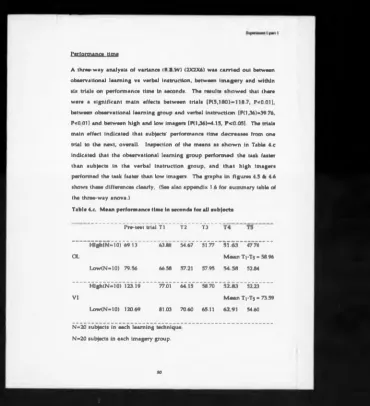
Table 6 c Mean performance time in seconds for all subjects...„„...134
Table 6 d Mean 4k standard deviation of the number of trials for all sub jects--- 138
Table 7 a The mean for high and low imagers on Betts (QMI) rating ■cow s---146
Table 7.b Mean accuracy scores for all subjects ...„„„155
Table 7.c Mean performance time in seconds for all subjects... 159
Table 7.d Performance time and accuracy scores correlations...162
T A B L E S
F IG U R E S
1.1 Action, language and im agination... ...13
2.1 Component subprocesses in the social learning analyaia of
observational learning... .23
2.2 The 18 aeriea of patterns Hall's used In his study...„„„31
2.3 The memory structures of Atkinson J i Shiffrin... .37
2.4 Results from the experiment by Craik showing the serial position
curves for the recall o f 15 words in a list... .43
2.5 Results from the experiment by Magill A Dowell showing the serial
position curves for the recall of a series of three, six or nine
movements on a linear positioning task ... ...45
3.1 Schematic of the structure of verbal and non-verbal symbolic
system s... ...
4.1a Observational learning technique... 83
4.1b The experimental seated in front of the subject while he is
performing the task... .83
4.2a Verbal instruction technique... „....83
4.2b The experimental seated in front of the subject while he is
performing the task...83
4.3 Experiment I part 1. Differences in accuracy score between high 4c
low imagers... .88
4.4 Experiment I part 1. Interaction in accuracy score between OL vs VI
4c imagery groups...89
4.5 Experiment I part 1. Differences in performance time between OL
vs VI techniques 4c trials... 91
4.6 Experiment I part 1. Differences in performance time between high
vs low imagers l i trials...92
4 7 Experiment I pert 1. Interaction in performance tim e between
learning techniques 4c trials... ...94
9.1 Diagram of the star folding task in the form of a hierarchical
structure... ... 105
5.2 Experiment I part 2. Differences in accuracy scores between verbal
4k motor rscalL... ...107
5.3 Experiment I part 2. Differences in performance tim e between
writing 4k performing the task...109
6.1a Experiment II. The thirteen end results (Er) stills for the
meaningful origami task... 117
6.1b Experiment II. The thirteen arbitrary (Ar) stills for the meaningful
origami task... 117
6.2a Experiment II. The thirteen end results (Er) stills for the
non-meaningful origami task...118
6.2b Experiment II. The thirteen arbitrary (Ar) stills for the
non-meaningful origami task...»...118
6.3a Experiment II. Diagram of the experimental set u p ...121
6.3b Experiment n. The subjects were tested on imitation and recalling
the two origami tasks... 122
6.3c Experiment II. The distribution of selected still pictures and time
interval in seconds for the Er 4k At groups... 126
6.3d Experiment n. Diagram of the Rabbit folding task in the form of a
hierarchical structura...»»»»»..»..»»»»»»»»»»».»».»»»...»..»..»...122
6.4 Experiment II. Differences in accuracy scores between high 4k low
Im agsrs... 130
6.5 Experiment II. Differences in accuracy scores between meaningful
4k non-meaningful t a s k s ... »»..»»»...131
6.6 Experiment H. Interaction in accuracy scores between meaningful
6.7 Experiment II. Differences In performance time between
meaningful 4c non meaningful tasks...135
6.8 Experiment II. Interaction in performance time between (Er) & (Ar)
groups 4c trials... ... ... ...T,„TI... T...135
6.9 Experiment II. Differences in reproduction trials between high 4c
low imagers...137
7.1 Experiment m . The diagram for the 13 Rabbit sdlls...ISO
7 2 Experiment m . The diagram for the 8 Rabbit stills...150
7 3 Experiment Ul. The diagram for the 4 Rabbit stills...150
7.4 Experiment ID. Differences in accuracy scores between high 4c low
im agers... 156
7.5 Experiment III. Differences in accuracy scores between 13,8 4c 4
stills conditions
7.6 Experiment m . Interactions in accuracy between active 4c passive
groups 4c stills conditions
7.7 Experiment m . Interaction in accuracy between active vs passive
learning groups 4c trisls...158
7.8 Experiment HI. Differences in performance time between 13, 8 4c 4
stills conditions... ... 161
7.9 Experiment m . Interaction in performance time between active vs
passive groups 6c trials... 161
8.1 Illustration of the processes and connections believed to be active
during imitation following instructions and imagery practice... 173
8.2 Sample proto col... 177
A JJD K LYlA llU N b
Accl-Acc5
_
Accuracy score for aach numbered trial.A nova
_
Analysis of variance.Ar
_
Arbitrary.BL
_
Bottom left.BR
_
Bottom right.C
_
Centre.CRT
_
Cathode-ray-tube.DP
_
Degree of freedom.Er
_
End results.P
_
F-Ratio.Fd
_
Fold.HIGH
.
High imagers.KR
_
Knowledge of results.LH
_
Left half.LOW
_
Low imagers.LStip
_
Left side tip.LTMM
-
Long-term motor memory.LTVM
_
Long-term verbal memory.M
_
Meaningful.M-acc
.
Motor recall accuracy score.MIQ
-
Movement imagery questionnaire.M S
.
Mean square.N
.
Number of subjects.N M
_
Non-meaningful.OL
_
Observational learning.P
_
Level of significance.P-tim e Performance time.
UMI
- The thorteneii form of Rett's questionnaires upon mental Imagery
r
_
Pearson correlation coefficients.KH
_
Right halfRS
_
Right sideSd Standard deviation.
s s . Sum of squares.
T1-T5
_
Performance time for each numbered trial.TL
_
Top leftTPtip
.
Top part tip.T R
.
Top right.V-acc
-
Verbal recall accuracy score.VI
_
Verbal instruction.V V IQ
_
Vividness of visual imagery questionnaire.W -tim e
_
Writing time.ACKNOWLEDGEMENTS
Many individuals must be remembered in term of their role in this work. 1 owe them all deep gratitude. Pint of all I muat thank Allah, God. The fln t person to whom I am grateful is Professor John Annett, who accepted the supervision of this work despite his many commitments. Professor Annett has always been a source of encouragement and assistance in our numerous sessions in the course of my research. He helped organising my thought. Indeed the structure and the development of this thesis owes much to this guidance. The second person to whom I m ust express my gratitude is Dr. Glyn Collls whose help could always be relied upon. It was he who for some time guided me in solving some of the statistical problem s. Five other members of staff of the Warwick Psychology Department were of great assistance to m e during the research. I extend my gratitude to Dave Allison, Dave Sleight, Andrew Barnacle, Greg Milligan and Jim Brock bank. Thanks are also due to Chris Richley for her help and patience In retyping this thesis. Further I must thank the Psychology Department, and my colleagues in the postgraduate department for providing me with a generally friendly atmosphere in which to work, I would like to express my gratitude to my friend Abdelnour Bcladad for all his help and support.
My sincere gratitude to my Mother, Ala hah for her moral support, and my brothers and sister, particularly Dr Zohair, Dr Hassan, Dr Mohammed, Dr Tariq, Dr Alaa and Amal for all their help.
Finally I express my deep gratitude and appreciation to my wife Noha. I owe many thanks, sympathies for the considerable amount o f neglect she suffered during the tim e of the study up to the preparation of this thesis. She was always of tremendous support and assistance.
It must, how ever, be pointed out that much of this work is the result of the author's efforts and he solely bears responsibility for any errors.
A BST R A C T
This thesis sets out to explore the process of motor skill acquisition and presents
a thorough investigation of the role played by imagery ability in the recall and
reproduction of a motor task. The im portance of cognitive processes, such as
imaging, in motor learning is becom ing increasingly obvious and needs to be
understood. Having described the three phases involved in motor learning -
cognitive, asaodative and autonomous- and discussed certain relevant learning
theories- the closed-loop theory and th e schema theory- the thesis moves on to
exam ine trad itional Instructional m ethods and the con trast betw een
observational learning and verbal instruction techniques, analysing in detail the
concept of mental imagery in context of the recall of m otor task.
The latter half of the thesis presents a series of experiments designed to quantify
the role of Imagery ability in reproduction of an origam i (paper-folding) task
using the different instructional m ethods and a v ariety of modelled
demonstrations and comparing accuracy and perform ance time.
The thesis concludes that observers w ho transform modelled actions into either
symbolic or visual images achieve a higher level of learning and a higher
standard of reproduction than non-imagers, and looks forward to an expansion
of research into imaging in a variety of contexts.
The results of this study have im plications for those w orking in selecting new
trainees for most industrial firms, an d their concern w ith the assessment of
selecting individuals on their learning ability and the factors contributing to this
as well as the possible instructional m ethods to be carefully considered with
Chapter 1 Motor learning
M M u loi learning A. Ihc cognitive processes.
Por m any year« psychologists have been formulating models and theories
that a re specific to m otor skill acquisition and Important as aids to
definition.. Fitts (1964) recognized that both cognitive and non-cognitive
processes occur in motor learning and that although skill learning is
prim arily a continuous process.it involves three different phases.
The “e a r fy phase“; covers only the time required to understand
Instructions, to complete a few preliminary trials, and to establish the
proper cognitive set for the task. In learning how to drive a car, one
attends to kinesthetic and visual information about the hands and feet,
inform ation which is later acted upon automatically. At this phase
in stru ctio n s snd dem onstrations are the most e ffectiv em ean s of
com m unicating the initial set of short, fixed, sequences necessary to
perform the task. This collection of units is called a cognitive set.
The "in term ediatt phase", involves learning to make certain associations
and to respond to specific cues, while at the same time m astering the
cognitive sets. At this phase the errors become less and less gross in
nature. The learners are now concentrating on refining the skill. They
have developed an ability to detect some of their errors in perform ing the
task b u t this ability to locate their errors is not perfect. Thus an
inexperienced driver may be able to get the car moving, but often he, or
she, still makes some mistake in pressing the clutch instead of the brakes.
feet properly, grip the steering w heel correctly, and so on. Such type« of
detection are of a rather elem entary nature but represent a definite step
forward in the learning process. At this phase variability of performance
from one attempt to another also begins to decrease.
T he third and "fin a l pha*e" is that in which the cognitive processes, such
as verbal mediation, are no longer in evidence, but In which repeated
practice of the skill makes it becom e progressively more automatic. The
Individual no longer has to attend to every phase of the skill, but has
learned to perform most of the skill automatically. Highly skilled drivers
concentrate on the road, and som e of the specific adjustments that they
m ust make in their everyday driving to make a particular journey. They
d o not think about each individual move of the driving routine, for these
have become automatic. Instead, they have learned to concentrate on
those of the more critical aspects o f the skill, that are particularly difficult.
In this phase, skilled performers are now able, not only to detect their own
errors, but also to make the proper adjustments to correct them. The
autonomous phase is the result o f a tremendous amount of practice; it
allow s performers to produce a response without having to concentrate on
the entire skill movement. T he classic study in this field is Crossman's
(1959) study of cigar rollers. T he time to operate a cigar-rolling machine
decreased over a period of four years, by which time a person reached the
maximum degree of skill required to reach the mechanical operating limit
o f the machine.
Fitts & Posner (1967) label Fitts' three-stage-model in order to describe the
Stage (1): Cognitive.
Stage (2): Associative.
Stage (3): Autonomous.
1.1.1. Brief introduction tg learning ihcorin
Two important learning theories appeared in the early seventies. The first
was proposed by Adams (1971) as the Closed-loop Theory, and the second
was Schmidt s (1975)
Schema Theory.
1.1.2. Adima Theory
The basis for any closed-loop theory is a reference mechanism for error
assessment, which can be used to compare a movement being made with
performance in the past. In Adams' theory, this reference mechanism is
called the perceptual trace . It involves the memory of past movements
and is responsible for determ ining the quality of a movement in
progress. This trace must be developed by appropriate practice of the
movement being learned. Information is fed back by means of sensory
pathways from the muscles, joints, eyes, ears, and so on. Adams' concept
of the perceptual trace depends on the availability of knowledge of
results (KR). As a part of practice, the individual com bines this KR
information with the feedback information received through his or her
own sensory system. Eventually, the perceptual trace becom es strong
enough for the individual to be able to detect and correct his or her own
error when making the movements. When this occurs, Adams indicates
that the individual has moved from the verbal-motor stage of learning
into the motor stage of learning, where the m ovem ent can be made
"automatically''.
Adams considered the perceptual trace as the reference mechanism used
to establish how far a limb movement should go. He needed to specify a
mechanism for getting the limb moving in the first place, and in the
proper direction. To accommodate this need, Adams proposed memory
tra c e, as a mechanism by which to "select and Initiate a response,
preceding the use of the perceptual trace". The memory trace is also
developed as a result of practice, but, in contrast to the perceptual trace,
was described by Adams as a "modest motor program". That is, this trace
does not operate as a closed-loop system, but an open-loop that sends out
all the necessary information to initiate the movement. No feedback
information is needed to accomplish this task.
A dam s saw KR as information to be used in conjunction with the
perceptual trace in order to make the next response different from the
last one by having fewer errors. A number of review s include the
em pirical work on KR, which showed how it is undeniably a strong
variable component in motor learning (Adams, 1971; Annett, 1969;
Newell, 1976; Salmoni, Schmidt It Walter, 1964).
The crucial assumption of Adam's closed-loop theory is that feedback has
a strong role to play. Comparison of performance in ski 11-acquisition
trials with KR, and in trials without KR, should reveal just how strong.
Furthermore, the greater the experience with feedback over trials, the
m ore stable subsequent perform ance should b e in trials with KR
withdrawn. In short, Adams considered as feedback essential to the error
detection and correction which is basic to of a closed-loop system. Pinally
perceptual trace regulate« the movement after it ha« started. Adam«
supported hi» theory with evidence from the studies that follow.
To investigate the importance of feedback in regulating movement,
Adams, Gopher St Lintern (1977) examined the effects of visual and
proprioceptive feedback on motor learning. There were fourteen groups.
The subjects learned a self-paced displacement of the arm by moving a
slide along a linear track. The conditions of feedback were either
augmented or minimal. Specifically, there was (a) augmented visual
feedback, where a subject could see the apparatus and his movement, or
minimal visual feedback, where visual cues were absent, (b) augmented
proprioceptive feedback, w here spring tension was on the slide, or
m inim al proprioceptive feedback, where the spring tension was
removed from the slide, or (c) combinations of these four conditions.
Seven groups had 15 and the other seven had 150 acquisition trials with
KR before being given 50 test trials without KR. The results showed that
when proprioceptive and visual feedback are varied, the greater the
feedback the better the performance on trials both with and without KR
Newell (1974) investigated the effect of withdrawing KR on motor
learning. The task was to move a slide along a horizontal linear
trackway. Subjects were randomly assigned to one of seven independent
experimental conditions, with 20 subjects per group. The groups were as
follows:- group one had KR withdrawn after Trial 2, group two had KR
withdrawn after Trial 7, group three had KR withdrawn after Trial 17,
group four had KR withdraw n after Trial 32, group five had KR
withdrawn after Trial 52, group six was given KR after every trial, and
group seven had no KR after any trial. The results showed that the
performance stability when KR la withdrawn. Furthermore, the greater
the number of acquisition trials with KR, the greater the subject's
capability for estim ating the accuracy of response (Adams, Gopher A
Lintem,1977; Newell A Chew, 1974). Thus, the most common finding is,
that the more trials there are with KR, the more steady the performance
is (Adams, Gopher * Untem, 1977; Newell, 1974; Newell * Chew, 1974).
Newell (1976b) had different results in his study to investigate the ability
o f a response recognition mechanism. New ell reasoned that if
observational learning techniques were used to give perceptual
experience with feedback stimuli, the subject should develop a strong
perceptual trace, even though no movement had been made. When
given practice on the motor task, without KR, the subject should learn,
becau se the perceptual trace is the basis for error perception,
corresponding to KR from an external source. The task was to leam to
m ove a slide over a 10.16cm. distance, in 100ms. The subject first
listened to a tape-recording of instructions for the movement, and
observed a demonstration by the experimenter of how the slide moved.
The subject then attempted the task without KR. The results showed
that there was a positive transfer from the auditory pre-training as well
as some improvement with repetition.
Feedback and the amount of practice were related to error detection and
correction (Adams 4c Goetz, 1973), which are essential for a closed-loop
system, but are feedback and the perceptual trace independent of each
other? Newell 4c Chew (1974) used a fast ballistic movement, and argued
that after practice the elimination of auditory and visual feedback should
affect error estimation based on the perceptual trace, but not response
Schmidt (1975) argued that becauae of delay» in procvaaing feedback, the
subject needs to becom e less and less dependent upon feedback for
performance. During learning the emphasis shifts from the feedback-
controlled Jerky perform ance to the sm ooth execution o f almost
com pletely open-loop movement. Thus, the problem for the subject in
learning motor skills, is to develop these open-loop programs, and free
h im self from feedback involvem ent. Schm idt accommodated his
criticisms of Adams' Closed-loop theory on motor learning , in what he
called the Schema Theory.
1.1 3 . Schmidt » Schcmi Theory
In 1975 Richard Schm idt presented an alternative theory of motor
learning. Rather than considering the memory and perceptual traces as the
control mechanisms of a movement, the theory presented schemas. A
schema is an outline of a set of rules that serves to provide the basis for a
decision.
Schmidt stated that we learn on the basis of abstracting different pieces of
information about each movement, and throughout these experiences, we
construct a schema, or an outline, which will enable us successfully to carry
out the movement. He proposed that four Items of information are
involved in the abstraction for each movement,
thus:-1) The Intitial Condition, which involves such things as the
position of limbs and body in relation to the response before It
is made.
2) The Response Specifications, which involve the stored
information, b y the performer, on the specific , such as
direction, • p ~ d . force, etc... . for carrying out the
m ovem ent.
3) The Sensory Consequences of the Movement, which are
determ inedfrom sensory feedback received through the
various sensory systems during, and after the movement is
actually made.
4) The Response Outcome, where the information needed to
compare the actual outcome with the intended outcome is
abstracted from the response outcome.
The schema of the motor response is actually made of two schemas. First is
the recall tchcm a . w hich is involved in the production of a desired
movement. It acts together with the generalized motor program, which
Schmidt views as an abstract memory structure, to initiate a desired
movement in accordance w ith the demands of the situation. The recall
schema sets the specific parameters, or rules, that the program must follow
in order to produce the required response. The recall schema is developed
on the basis of abstracting and storing information about responses that
have been made in the past. Three sources of information are necessary to
develop the recall schem a. 1) Information obtained about the initial
conditions of the response situation. 2) Inform ation indicating the
response specifications from past responses requiring sim ilar movements
which has been stored. 3) Information about the outcome of the previous
responses.
Motor Looming ft Iho cognlMvo pon m
T o continue and terminate the m ovem ent, Schm idt proposed the
recognition »chrma This schema is the reference mechanism used to
compare sensory feedback with a particular movement. It is developed In
the same way as the recall schema, by abstracting Information from past
experiences. In particular, the inform ation abstracted and stored is
comprised of the intitial conditions of each response, past response
outcomes, and actual sensory feedback, related to those past responses.
Schmidt finds support for his theory in the results o f a number of studies.
O ne of the main assumptions of the schema theory, is that the subject
develops a recognition schema over the course of practice with KR, and
that he uses the comparison of the actual feedback and the expected sensory
consequences generated on each trial as the mechanism by which he
arrives at the correct response. The evidence w as evaluated by Schmidt
from the results of a study by Bilodeau, Bilodeau 4k Schumsky (1999) on the
effects of introducing and withdrawing KR early and late in practice. These
results showed that no learning can occur w ithout KR. The theory also
predicts that error detection will increase with KR practice. Newell (1974)
and Newell 4c Chew (1974) have shown this quite clearly (see explanation
o f Adams theory ).
Schmidt's theory then, emphasizes the abstract, or general nature of what
is stored in the control centre, as opposed to Adams' more specific view of
what Is represented.
1.1.4 S lm iltrillji between A d tm i ft Schmidt'» Tlreorte»
The motor learning theories of Adams (1971) and Schmidt (1975) have
feedback information from the sense«, and both incorporate a role fo r
m otor programs. Both theories suggest memory related construct* in
w hich information is stored and which are directly involved in the
initiation and carrying out of a response. The two theories assign an
im portant role to KR Information during the learning of motor sk ills.
Both indicate that as a result of the appropriate amount and type of
practice, learners can produce correct responses with the aid of KR, and
each theory establishes a means for the performer to detect an error either
while the movement is being performed or before another movement is
made.
l.l CngnlUv« pramt»
In spite of what the Fitts (1964) and Fitts 4c Posner (1967) models show
about the existence of the cognitive processes in the early stages of skill
learning, w e still know little more about the actual role of cognitive
processes in the development of skill learning (Newell, 1981).
What does Cognitive imply?
1) Cognitive processes are conscious and dependable, e.g. a chess
player is aware of every piece he/she moves when playing, and can also
rely on his skill knowledge in making each move correctly.
2) Cognitive processes are variable and adaptable, e g a chess player
can change his/her playing strategy in each different chess game, and can
use this strategy in any other game that would require similar moves as in
chess.
3) Cognitive processes involve acceee to, and from, a knowledge bate
e g the cheat player can get acceaa to a cognitive map and uae it in any way
he/ahe chooaea to achieve the goal. Tolman (1948) waa the firat to uae the
term cognitive map' in hie deacription of the apatial knowledge that
seemed to be acquired by rata in a maze. In a typical experiment, a group of
rats waa trained to go down a particular path to reach food in a goal box.
When the original path waa blocked, many of the rata aeiected another
path that alao led in the direction of the goal. They had learned more than
)uat a sequence of responses that would lead to the goal.
An example of the cognitive aspects of m otor acts is the memory and
recall of movement. Brewer k Pani (1965) argued that, even if there is
agreement that conscious processes occur during the early stages of the
acquisition of a motor skill, it is not clear exactly what types of processes
these are. For example, they may involve motor images, imageless
thoughts, or other types of memory representation used in "effort after
production".
If it Is the case that memory representation o f motor acts is by nature
unclear and difficult to investigate, then this deserves greater attention,
since it is the purpose of science to explain, not to ignore.
The correlation between memory representation and reproduction of that
movements, forms the cognitive basis of m otor learning. Learning a new
skill is based on the acquisition of knowledge which is stored in memory
and can be saved up, or retrieved. Memory representation can be thought
of as involving both symbolic and imaginal (non-symbolic) codes.
In the C AM of observational learning, Gerst (1971), Bandura St Jeffery (1973),
Bandura, Jeffery It Bachicha (1974) and Jaffary (1976) hava shown that
symbolic coding plays an Important rola In rapraMntational development,
whilst Carroll * Bandura, (1962, 1983, 1967;) Bandura 4i Jaffary, (1973;) and
Martans, Burwitz It Zuckarman, (1976) hava also shown tha importance of
imaglnal coding In tha cognltiva process Moreover, some of these studies
hava shown that a combined coding strategy would lead to more accurate
recall of tha motor task (Bandura * Jeffery, 1973; Jaffary, 1976).
BecauM tha main affects of coding strategies occur within memory, it is
im possible to distinguish tha affects of coding processes without
identifying memory repraMntations. A full explanation of imaginal
coding of motor movement must include an understanding of how these
movements are represented in memory.
One way to investigate the cognitive processes, presumed to be involved in
tha acquisition of motor skills was proposed by Annatt (1982) in his
"Action, Language and Imagination" paper. He was particularly interested
in the relationship between verbal (symbolic) and motor (non-symbolic)
processes. Annetts proposed model (Figure 1.1) shows tw o important
subsets of entities: the top part of the figure represents input of two kinds -
visually perceived human action and language input, such as verbal
instructions; the m iddle part of the diagram represents the internal
processes which can lead to two kinds of overt response (as shown in the
figure).
Me also stated that there are eight possible ways in which output can be
accrued, which he thought of as routes through the model. The model
describes six basic experiments as routes from the external world of objects
and events, three o f which produce the actions shown on the left side of
the diagram and three of which produce the verbalizations shown on the
right of the diagram.
R o u te (l):- Refers to any experiment in w hich an object or
event (excluding human action or language) evokes a non
verbal response, e g. a tracking task.
R o u te(2):- Refers to any experiment in which the input and
output are non-verbal actions, e.g. a task of im itating human
m ovem ents.
R o u te (3):- Refers to any experiment in w hich the input is
verbal and the output is non-verbal e.g. a task involving verbal
instructions in order to produce motor movement.
R o u te M):- Refers to any experiment in w hich an object or
event evokes a verbal response, e.g. a task o f naming or
describing something.
Routes (1) it (4) are of no particular interest in the context of this thesis,
they were m erely mentioned here to give a com plete description of
Annett's diagram.
R o u te(S):- Refers to any experiment in which a verbal input
and verbal output represent the task of reading, with a time
interval between input and output.
Route(6):- Refers to any experiment in which the input is non
verbal and the output is verbal, e.g. a task of describing the
actions of other individuals.
Annett suggested that in Routes (3) St (6) both tasks described are
sym m etrical, and in volve tra n sa ctio n s across the hypothetical
action /language bridge.
The central part of the diagram is also divided horizontally into
representation and production processes, which are theoretically separable,
depending on how one views the nature o f the internal processes depicted
in Figure 1.1. A nnett in fact defined two routes, which both involve
memory.
Route(7):- Refers to any experiment in which the individual
could give, from the stored representation of an action, or
sequence of actions, a verbal account, e.g. a task of asking
subjects how they would perform a given action, such as
swimming the breaststroke, tying a knot, getting from A to B,
and so on (Annett, Kiss St Perera, 1978; Annett, 1986). Subjects
are thus required to produce a verbal account based on some
form of memorized or imagined representation of the action.
R o u te(8):- Refers to any experiment in which the individual
refers to the verbal representation of an action or sequence of
actions, to produce the corresponding action, e g. a task of
follow ing a route through a strange city on the basis of a
remembered set of Instructions.
Routes (3), (6), (7) 4c (8) all imply a translation between verbal and non
verbal coding, that is the hypothetical action/language bridge.
H aving briefly outlined Annetts (1982) m odel, and the kinds of
experiments thought to be relevant to all routes in the diagram, we now
turn to the central theoretical assumptions underlying the model
1) There are largely independent systems concerned with the perception
and production of actions, and with the perception and production of
language.
2) The perceptual, or representational aspect, of each of these systems is
intimately linked w ith the relevant action, or utterance, production
mechanisms.
3) There is an action/language bridge which can carry traffic in either
direction.
4) The transactions across the bridge must b e conducted in a common
currency.
The key issues concern how actions are represented, what kind of coding
enables us to perceive and comprehend the actions of other people to
produce sim ilar actions ourselves, and how to translate relatively easily
between actions and the appropriate descriptive vocabulary and to follow
instructions.
Moreover, Annett (1965), in his review of the cognitive processes in motor
learning, accepted the distinction between cognitive and non-cognitive
processes in motor learning in the proposed model of Pitts (1964) and Fitts
4c Posner (1967). Annett reviewed some of the previous studies of the two
important kinds o f cognitive processes, those which involve imaginal
(non-verbal) and those which involve sym bolic representations. He
concluded that all actions seem to benefit from a kind of dual coding, in
which some aspects are capable of being represented in images, principally
visual in nature, and which represent Important spatial characteristics of
the task. He also stated that at the same time some of these motor codes
might be "pure", that is, not accessible to consciousness but manifested in
the ability to produce actions. In that connection Annett's works (1982,
1985) will be discussed more fully in the following chapters of this thesis
because of his recognition of the important role of the cognitive processes
in skill acquisition.
It can be concluded from all three theories of motor learning that we have
Just presented that there is a growing appreciation in motor skill learning
of the cognitive approach.
Cognitive learning theories stress the im portance of higher mental
processes, such as attitudes, beliefs, and perceptions. Cognitive theorists
are interested in intellectual processes, and they investigate the ways
sub)ects develop and use rules of logic, problem solving, and language.
Obviously, the subjects of their studies are almost exclusively human
beings.
M .7. Automatic tnd controlled it
By contrast, Schneider 4kShiffrin (1977) presented a motor learning theory called Automatic and Controlled Processing Theory. This claimed that
m otor learning can occur without the Involvem ent of any cognitive
processes, assuming that automatic processing Is generally a fast, parallel,
fairly effortless process that is not limited by short-term memory capacity,
is not under direct subject control, and perform s well-developed skilled
behaviours. It typically develops when subjects process stim uli in
consistent fashion over many trials; it is difficult to suppress, modify, or
ignore, once learned. Controlled processing is often slow, generally serial,
takes much energy, is capacity limited, and subject regulated, and is used to
deal with novel or inconsistent information. It is needed in situations
where the required response varies from one trial, or situation, to the next,
and is easily modified, suppressed, or ignored at the desire of the subject.
Finally, all tasks are carried out by complex mixtures of controlled and
autom atic processes used in combination. Shiffrln 4kSchneider used the results of roughly 14 experiments, reported in Schneider 4k Shiffrin (1977),
and Shiffrin 4kSchneider (1977) to support their theory.
Spelke, Hirst 4kNeisser (1976) have studied the development of skills for attending to, and acting on, two simultaneous messages. Two subjects
participated in the study. The tasks involved the subjects reading short
stories to themselves while dictating a list of w ords at the same time. The
results of the experiment showed that, as the subjects had more practice,
they w ere able to copy words, detect relationship between words, and
categorize words for meaning, while reading as effectively and as rapidly as
when reading was the only task, to be perform ed. From this it was
suggested that learning to perform the two tasks at the same tim e was
developed by automatic and controlled processing.
Although the research In this thesis Is primarily concerned with cognitive
learning, it was essential to present an outline of this theory in ord er to
understand how we learn and control movements.
Having discussed Adams', Schmidt's, Schneider & Shiffrln's theories, it
seems that the three theories have certain limitations, e g. Adams' and
Schm idt's theories were based on the important role of feed b ack
information from the senses while Schneider A Shiffrin's theory was
based on the important role of overt practice. However, in the case of
observational learning, if the spatial and temporal feature of m odelled
behavior can be easily determined, encoded, and cognitively rehearsed,
accurate reproduction can be achieved with little or no overt practice or
response feedback (Bandura, Jeffery, 1973; Gerst, 1971).
The three theories were lim ited to either slow lim b -p ositioning
movements, rapid ballistic movements, or item recognition tasks. They
didn't give an explanation of what type of coding strategies the learner
used in order to understand how to execute the movements of the task, or
if the task involved long sequential movements, what were the cru cial
aspects of the movements that the learner coded into memory, in o rd er to
recall the motor task.
At this point in time, it is essential for us to investigate and determ ine
advantages of the cognitive processes and appropriate learning strategies
for learning a sequential motor task, and the effect of individual ability
upon learning the task.
The m oti popular methods for conveying information about the goal and
appropriate action sequences are verbal instructions and observational
learning, but to introduce to the learner the goal of the act together with
the actions that will accomplish the desired outcom e, instructors
autom atically resort to observational learning methods to supplement
verbal instructions. Adams (1987) emphasized that observational learning
was underdeveloped for a long time until the 1970s, when Bandura
presented his social learning theory. However, because both instructional
methods involve cognitive processes, one might use both techniques to
look more closely at Annett's (1982) model, and one can examine how
these cognitive processes are being represented in their analogue (non-
symbolic) form, and what type of human characteristics could have some
affect on these kinds of cognitive processes.
The following chapter will discuss theories and studies on observational
O b s e r v a t io n a l L e a rn in g
In order to investigate how actions are reproduced and what kind of
coding enables us to perceive and comprehend the action of other people,
it was essential to explore in detail the middle part of the diagram in figure
1.1 by conducting a few experiments to establish what internal processes
lead to of overt perform ance. Tw o instructional methods were used,
observational learning and verbal instruction, to bring about overt
perform ance and m ake it possible to detect m ismatches between
performance and coded Images.
In this thesis we are considering imitation as the given instruction to the
learner, who has observed a modelled demonstration of a motor task.
2.1. Observational Learning and Imitation
The study of imitation has a history dating back to the early work of Tarde
(1903) and Mcdougall (1908). These researchers suggested that the idea of
model imitation was basic to the philosophical nature of the field at that
time. Later imitation was reinterpreted as a function of associative or
instrum ental conditioning (A llport,1924; H olt, 1931; Humphry, 1921;
Miller 4c Dollard, 1941). However, the process of learning by example has
been interpreted by psychologists in a number of different ways, but most
frequently emphasized is the observational aspect. Observational learning
has been the main concern of some cognitive psychologists since the
2.1.1. national Thaory
Sheffield (1961) bated hit Symbolic Representational Theory upon retearch
concerned with the effectiveneai of uting filmed dem ontlraliont in
communicating motor ikillt, He found that when an individual obtervet
a dem onitration of a motor skill, he or the form u latei a cognitive
tymbolic representation of that tklll, which subsequently act» at a blueprint
to guide him or her inthe overt reproduction of the tkill. Thit perceptual
blueprint enablea the individual to recall the modelled act tymbolically,
and tranalate this sequence of symbols into overt performance.
Despite thit important early work by Sheffield and h it associates, many
important questions relating to observational learning for effective
reproduction remain unanswered. Bandura (1971, 1977, 1986), with his
Social C ognitive Learning Theory, advanced our know ledge of the
processes involved and stim ulated a great deal o f research on
observational learning.
2.1.2. Bandura s Social Cognitive Learning Theory
Bandura's S o c ia l C ognitive Learning Theory is the most influential theory
on observational learning referred to today. Bandura emphasizes four
interrelated sub-processes. The processes and som e o f the variables
affecting them are shown in Figure 2.1.
0*1 u
The first process is the attentional process, w hich determines what it
s tltc tiv tly observed and what information is extracted from on-going
modelled events. M inas (1980) and Yussen (1974) have shown that
observational learning is enhanced by factors that channel attention to
critical features of modelled performance.
The secon d ma)or subfunction in observational learning concerns the
retention process. If modelling influences are to have enduring effects, the
m odelled In form ation must be transform ed and restructured into
appropriate sym bolic representations which function as internal models
for action (Bandura i t Jeffery, 1973; Bandura, Jeffery 4c Bachicha, 1974;
Gerst, 1971; Jeffery, 1976; Scully It Newell, 1985)
The th ird subfunction of modelling is the production process which
involves translating the cognitive processes of the modelled activities into
appropriate action s. The behaviour is m odified by the process of
com parison to ach ie v e close correspondence betw een the internal
processes and action. With representational development and internal
transform ation of conception to correspondin g action, reliance on
performance feedback should decrease ( Carroll it Bandura, 1962).
The fou rth subfunction is the motivational process, which is concerned
w ith incentiv e fa cto rs that govern o b serv atio n al le arn in g and
performance. Incentive factors facilitate acquisition through their impact
on attentional and retentional processes, and affect perform ance by
motivating observers to execute what they have learned observationally.
The motivators m ay be extrinsic, vicarious or self-generated by means of
Ota
H ere my primary concern is with tha retention process, which is the
seco n d subfunction in Bmndurm’• C o g n i t iv e L em m in g T h e o r y .
Observational learning in humans involves tw o representational systems
im aginal and verbal. During exposure to modelling stimuli, sequences of
corresponding sensory experiences (images) occur and appear to become
associated, or integrated, by mere contiguity (Sheffield, 1961). Both
Bandura and S heffield described this response acquisition phase of
observational learning.
2.1
A Cognitive process« in observational learning
T w o cognitive processes symbolic/verbal and imaginal/non-verbal seem
to be involved In retaining information in observational learning and
studies have shown the Importance of both.
2.1.4 Symbolic/ verbal codes in cognitive representation
Researchers have show n that there are certain cognitive activities that aid
representational development, such as symbolic coding, for both children
(Bandura, Grusec, 4c Menlove, 1966; Coates 4c Hartup, 1969) and adults
(Bandura St Jeffery, 1973; Bandura, Jeffery St Bachicha, 1974; Gerst, 1971;
Jeffery, 1976; Scully 4c Newell, 1965).
Bandura, Grusec, 4c Menlove (1966) have investigated the effects of
symbolization on delayed reproduction of modelling stimuli. A group of
children between the ages of 6 and 8 years w ere tested in three different
conditions concurrent verbalization, passive learning and competing
observed the models under s positive incentive set. The rem aining
subjects were provided with an incentive to learn the model's responses.
The stimuli task consisted of watching a 4-minute colour film in which an
adult male model exhibited a series of relatively novel patterns of
behaviour. The results provided evidence for the facilitative role of
symbolization in observational learning, and that observational learning
was not influenced by incentive sets.
Furthermore, Coates 4c H artup (1969) also exam ined the effects of
verbalization in observational learning. Children between the age of 7 and
8 years were tested in demonstrating the matching responses of the model
under one of the th re e conditions, induced v erb alization , free
verbalization, and passive observation. A 7-minute colour film depicting
the behaviour of a male model was used. The model displayed 20 critical
characteristics. The results demonstrated developmental changes in the
role of verbalization in observational learning.
O ther studies have exam ined the role of sym bolic coding in the
developm ent of c o g n itiv e rep resen tation in ad u lts u n d ergoin g
observational learning.
Gerst (1971) investigated several procedures by which individuals could
commit to memory a dem onstration of a motor task. Subjects w ere
assigned to three experimental conditions and one control condition. Each
group was instructed to use a mental image, a verbal description o r a
concise label of a modelled act. The control group was instructed not to
use any coding strategy. The modelling stimuli that the subjects observed
and later reproduced w ere motoric responses from the language of the
deaf. The results demonstrated the enhancement of the imaginal coding
on observational learning. They alao provided evidence that symbolic
coding operation play an important role in observational learning.
Furthermore, Bandura 4c Jeffery (1973) exam ined the effects of symbolic
coding and different types of rehearsal on retention of modelled
performance. The task was a six com ponent action that appeared in
varying combinations in the more complex modelled performance. The
results showed that most subjects in the non-coders immediate response
reproduction condition, created their own coding strategy using direction
and length of movements as a means of representing the models action.
This also provided further evidence to support C rest's work on the
im portance of symbolic processes in determ ining both the level of
observational learning and the retention of modelled responses over time.
Further evidence was provided by the w ork of Bandura, Jeffery, 4c
Bachicha (1974) when they examined the influence of memory codes and
cumulative rehearsal on observational learning. The modelling stimuli
were identical to those used in the experiment of Bandura 4c Jeffery (1973).
Their results lend further support to the finding that sym bolic codes
enhance observational learning and retention of modelled behaviour.
The work of Jeffery (1976) on the influence of sym bolic and motor
rehearsal in observational learning, was concerned with the effects of
mode and patterning of rehearsal on the acquisition and retention of
modelled activities varying in organizational com plexity. Subjects
observed a model performing manual construction tasks, having either
high or low organizational requirements. Immediately after exposure to
the model, subjects rehearsed the task either sym bolically, motorically,
symbolically and then motorically, or m otorically and then symbolically.
A control group engaged In a detraction task to prevent any opportunities
for rehearsal. The results from the subjects performance reflected the
Influential role that symbolic codes play In the acquisition and retention of
modelled acts.
These studies demonstrated that observers who transform m odelled
actions into either descriptive words, linguistic constructions resem bling
fam iliar a ctiv ities, o r visual im agery achieve a higher level of
observational learning
2.1.3. Im igjrn l/ n on -v tib jl coding in the cocu U v t rcp rtttn tilia n
Cognitive representation may differ in a variety of dimensions, depending
on w h eth er the m od ality is p rim arily s y m b o lic / v e rb a l or
im aginal/nonverbal. A num ber of studies w ere carried o u t on
observational learning in order to investigate how information was being
coded in the cognitive representational form. The results revealed that
coding is not strictly sym bolic/verba 1 form but also involves an
imaginal/nonverbal form ( Bandura It Jeffery, 1973; Martens, Burwitz, It
Zuckerman. 1976; Carroll It Bandura, 1982, 1985, 1987).
Martens, Burwitz, It Zuckerman (1976) have investigated modelling effects
on m otor performance. Four experiments have been carried ou t to
examine the influence of observing a correct model, a learning sequence
model, and an incorrect model, on the performance of two m otor skills.
The findings from the fourth experiment suggested that inform ation is
coded and conveyed through observation in order to function in the
Likewise, Carroll * Bandura (1982) demonstrated the importance of
making observable those parts of the model's movements that are
normally out of view. A complex arm movement was modelled, and a
television system was used to make the unobservable sides of the
movements observable. The task was to perform a modelled response of a
sequence of nine different response components which varied as to the
spatial attributes of the paddle, arm, and wrist. The results from the
experiment were consistent with the proposition that actions are first
organized cognitively before being successfully enacted. Furthermore,
Carroll A Bandura (1985, 1987), using the same modelled action pattern
that was used in their prior experiment ( Carroll * Bandura, 1982), studied
the role of timing visual monitoring and translating cognition into action
in observational learning. The results from the two studies lend more
support to the assum ption that subjects achieved som e cognitive
representation of the modelled activity before reproducing the movement
pattern.
2.1.6 Meanin^fulness of the cognitive representation
The ease with which a stimulus evokes an image is assumed to be related
to the performance of a remembered task. The more meaningful and
available the image, the better the performance. The importance of
meaningfulness to the cognitive processes in observational learning has
been shown by Bandura 8c Jeffery, (1973) Bandura, Jeffery, 8k Bachich,
(1974).
M oreover, th e m em ory of movem ents is influenced by their
Individual il that parson can readily relate the movement to something
already known. For example, a movement that forms the shape of a
triangle is considered more meaningful than one that makes an
unfamiliar, abstract pattern.
Hall (1980) has provided evidence on how movement meaningfulness
influences remembering the movement pattern. Subjects were presented
with closed multidimensional movements (as shown In Figure 2.2) by
means of a pantograph, a movement device that allows the subject to
m ake the exact sam e arm movement as the experim enter. The
recognition test was to ask subjects to indicate whether or not each pattern
t+mmnrnu I L
Figur« U . Th* 18 a«rin of pattami Hall uMd ln hia etudy. (Adaptad from Hall, 1900)
Hall's experiment, among others, suggests that movements have some
Inherent meaningfulness to people. The more meaningful a movement Is
to a person, the easier It Is to remember that movement. This point is an
important one to be considered when providing instructions to students to
help them remember how to perform a skill. We will come back to it later
(in experiment 3), when we consider strategies that influence coding or the
memory of a sequential motor task.
It is clear that observation provides useful information about appropriate
behaviour. A model can quickly and efficiently convey what to do, or give
a precise image of a task s demands. Verbal instruction can do this also,
more efficiently for some skills but usually less efficiently for m otor skills.
Annett (1989) has pointed out the action/language bridge, Figure (1.1),
required the assumption of an internal representation of action which is
somehow accessible to, and modifiable by, both the perceived actions of
others and verbal instruction. This representational system must b e able
to access output mechanisms so that perceived action can be imitated and
verbal instruction can be obeyed.
Verbal instruction presents us with both, a translation problem and a
control problem how words are expressed in actions and how actions are
expressed in words, and how some instructions, once lodged in verbal
memory, come to control the on-going actions of the learner, but other
instructions used to control initial actions, drop out of consciousness after