A Decoder for
Probabilistic Synchronous Tree Insertion Grammars
Steve DeNeefe∗ and Kevin Knight∗
USC Information Sciences Institute 4676 Admiralty Way
Marina del Rey, CA 90292, USA
{sdeneefe,knight}@isi.edu
Heiko Vogler†
Department of Computer Science Technische Universit¨at Dresden
D-01062 Dresden
Abstract
Synchronous tree insertion grammars (STIG) are formal models for syntax-based machine translation. We formal-ize a decoder for probabilistic STIG; the decoder transforms every source-language string into a target-language tree and cal-culates the probability of this transforma-tion.
1 Introduction
Tree adjoining grammars (TAG) were invented in (Joshi et al. 1975) in order to better character-ize the string sets of natural languages1. One of TAG’s important features is the ability to introduce two related syntactic units in a single rule, then push those two units arbitrarily far apart in sub-sequent derivation steps. For machine translation (MT) between two natural languages, each being generated by a TAG, the derivations of the two TAG may be synchronized (Abeille et al., 1990; Shieber and Shabes, 1990) in the spirit of syntax-directed transductions (Lewis and Stearns, 1968); this results in synchronous TAG (STAG). Recently, in (Nesson et al., 2005, 2006) probabilistic syn-chronous tree insertion grammars (pSTIG) were discussed as model of MT; a tree insertion gram-mar is a particular TAG in which the parsing prob-lem is solvable in cubic-time (Schabes and Wa-ters, 1994). In (DeNeefe, 2009; DeNeefe and Knight 2009) a decoder for pSTIG has been pro-posed which transforms source-language strings into (modifications of) derivation trees of the pSTIG. Nowadays, large-scale linguistic STAG rule bases are available.
In an independent tradition, the automata-theoretic investigation of the translation of trees
∗
financially supported by NSF STAGES project, grant
#IIS-0908532. †
financially supported by DFG VO 1011/5-1.
1
see (Joshi and Shabes, 1997) for a survey
led to the rich theory of tree transducers (G´ecseg and Steinby, 1984, 1997). Roughly speaking, a tree transducer is a finite term rewriting system. If each rewrite rule carries a probablity or, in gen-eral, a weight from some semiring, then they are weighted tree transducers (Maletti, 2006, 2006a; F¨ul¨op and Vogler, 2009). Such weighted tree transducers have also been used for the specifi-cation of MT of natural languages (Yamada and Knight, 2001; Knight and Graehl, 2005; Graehl et al., 2008; Knight and May 2009).
Martin and Vere (1970) and Schreiber (1975) established the first connections between the two traditions; also Shieber (2004, 2006) and Maletti (2008, 2010) investigated their relationship.
The problem addressed in this paper is the decoding of source-language strings into target-language trees where the transformation is de-scribed by a pSTIG. Currently, this decoding re-quires two steps: first, every source string is translated into a derivation tree of the underly-ing pSTIG (DeNeefe, 2009; DeNeefe and Knight 2009), and second, the derivation tree is trans-formed into the target tree using an embedded tree transducer (Shieber, 2006). We propose a trans-ducer model, called a bottom-up tree adjoining transducer, which performs this decoding in a sin-gle step and, simultaneously, computes the prob-abilities of its derivations. As a basis of our ap-proach, we present a formal definition of pSTIG.
2 Preliminaries
For two setsΣandA, we letUΣ(A)be the set of all (unranked) trees overΣin which also elements ofA may label leaves. We abbreviate UΣ(∅) by UΣ. We denote the set of positions, leaves, and non-leaves ofξ ∈UΣbypos(ξ)⊆N∗,lv(ξ), and nlv(ξ), resp., where ε denotes the root of ξ and w.idenotes theith child of positionw;nlv(ξ) = pos(ξ)\lv(ξ). For a positionw∈pos(ξ), the la-bel ofξ atw(resp., subtree of ξ atw) is denoted
by ξ(w) (resp.,ξ|w). If additionallyζ ∈ UΣ(A), thenξ[ζ]wdenotes the tree which is obtained from
ξ by replacing its subtree at w by ζ. For every ∆⊆Σ∪A, the setpos∆(ξ)is the set of all those positionsw ∈pos(ξ)such thatξ(w) ∈ ∆. Simi-larly, we can definelv∆(ξ)andnlv∆(ξ). The yield ofξ is the sequenceyield(ξ) ∈(Σ∪A)∗ of sym-bols that label the leaves from left to right.
If we associate withσ ∈Σa rankk∈ N, then
we require that in every treeξ ∈UΣ(A)every σ-labeled position has exactlykchildren.
3 Probabilistic STAG and STIG
First we will define probabilistic STAG, and sec-ond, as a special case, probabilistic STIG.
LetN andT be two disjoint sets of, resp., non-terminals and non-terminals. A substitution ruleris a tuple(ζs, ζt, V, W, Padjr )where
• ζs, ζt ∈ UN(T)(source and target tree) and
|lvN(ζs)|=|lvN(ζt)|,
• V ⊆lvN(ζs)×lvN(ζt)(substitution sites),V
is a one-to-one relation, and|V|=|lvN(ζs)|,
• W ⊆nlvN(ζs)×nlvN(ζt)(potential
adjoin-ing sites), and
• Padjr :W →[0,1](adjoining probability). An auxiliary ruleris a tuple(ζs, ζt, V, W,∗, Padjr )
whereζs,ζt,W, andPadjr are defined as above and
• V is defined as above except that |V| = |lvN(ζs)| −1and
• ∗= (∗s,∗t)∈lvN(ζs)×lvN(ζt)and neither
∗s nor∗toccurs in any element of V;
more-over,ζs(ε) = ζs(∗s)andζt(ε) = ζt(∗t), and
∗s 6= ε 6= ∗t; the node ∗s (and∗t) is called
the foot-node ofζs(resp.,ζt).
An (elementary) rule is either a substitution rule or an auxiliary rule. The root-category of a ruler is the tuple(ζs(ε), ζt(ε)), denoted byrc(r).
A probabilistic synchronous tree ad-joining grammar (pSTAG) is a tuple G = (N, T,(Ss, St),S,A, P) such that N
andT are two disjoint sets (resp., of nonterminals and terminals),(Ss, St)∈N×N (start
nontermi-nal),S andAare finite sets of, resp., substitution rules and auxiliary rules, andP :S ∪ A →[0,1] such that for every(A, B)∈N ×N,
X
r∈S rc(r)=(A,B)
P(r) = 1 and X
r∈A rc(r)=(A,B)
P(r) = 1
assuming that in each case the number of sum-mands is not zero. In the following, letGalways denote an arbitrary pSTAG.
Ss
α A↓ A
α a
r1
⇐⇒
St
B
β
B↓ β a
P(r1) = 1 Pr1
adj(a) =.9
A
A γ b,c
∗
r2
⇐⇒ B
B
δ B b
c ∗
P(r2) =.4 Pr2
adj(b) =.2 Pr2
adj(c) =.6
A
A A
λ d
∗ e ⇐⇒r3
B
µ B d,e
∗
P(r3) =.6 Pr3
adj(d) =.3 Pr3
adj(e) =.8
A
α
r4
⇐⇒ B
β
P(r4) =.1
A
γ
r5
⇐⇒ B
δ
[image:2.595.328.500.62.285.2]P(r5) =.9
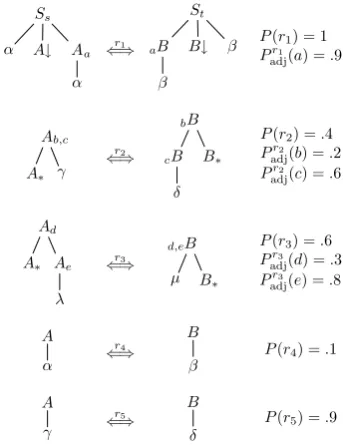
Figure 1: The running example pSTAGG.
In Fig. 1 we show the rules of our running ex-ample pSTAG, where the capital Roman letters are the nonterminals and the small Greek letters are the terminals. The substitution site (in rule r1) is indicated by↓, and the potential adjoining sites are denoted2bya,b,c,d, ande. For instance, in for-mal notation the rulesr1andr2 are written as fol-lows:
r1= (Ss(α, A, A(α)), St(B(β), B, β),{↓},{a}, Padjr1)
where↓= (2,2)anda= (3,1), and
r2= (A(A, γ), B(B(δ), B),∅,{b, c},∗, Padjr2)
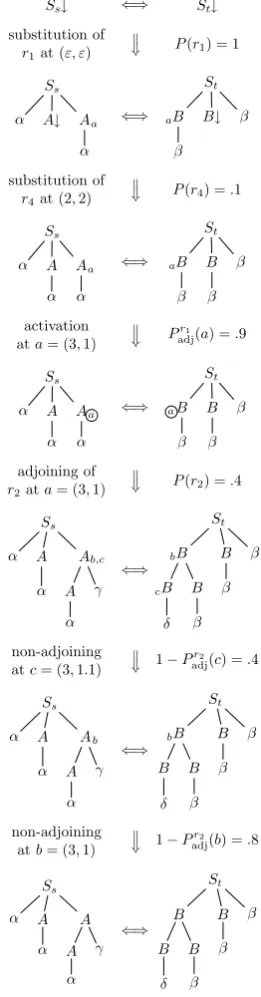
whereb= (ε, ε),c= (ε,1), and∗= (1,2). In the derivation relation of G we will distin-guish four types of steps:
1. substitution of a rule at a substitution site (substitution),
2. deciding to turn a potential adjoining site into an activated adjoining site (activation), 3. deciding to drop a potential adjoining site,
i.e., not to adjoin, (non-adjoining) and 4. adjoining of a rule at an activated adjoining
site (adjoining).
In the sentential forms (defined below) we will maintain for every adjoining site w a two-valued flag g(w) indicating whether w is a potential (g(w) =p) or an activated site (g(w) =a).
The set of sentential forms ofGis the setSF(G) of all tuplesκ= (ξs, ξt, V, W, g)with
2
• ξs, ξt∈UN(T),
• V ⊆lvN(ξs)×lvN(ξt)is a one-to-one
rela-tion,|V|=|lvN(ξs)|=|lvN(ξt)|,
• W ⊆nlvN(ξs)×nlvN(ξt), and
• g:W → {p,a}.
The derivation relation (of G) is the binary relation ⇒ ⊆ SF(G) × SF(G) such that for every κ1 = (ξ1s, ξt1, V1, W1, g1) and κ2 = (ξ2s, ξt2, V2, W2, g2) we have κ1 ⇒ κ2 iff one of the following is true:
1. (substitution) there are w = (ws, wt) ∈ V1 andr= (ζs, ζt, V, W, Padjr )∈ S such that
– (ξs1(ws), ξt1(wt)) = rc(r),
– ξs2=ξs1[ζs]ws andξ
2
t =ξt1[ζt]wt, – V2 = (V1\ {w})∪w.V,3 – W2 =W1∪w.W, and
– g2 is the union ofg1 and the set of pairs (w.u,p)for everyu∈W;
this step is denoted byκ1 =w,r⇒κ2;
2. (activation) there is aw∈W1withg1(w) = p and (ξs1, ξt1, V1, W1) = (ξs2, ξ2t, V2, W2), andg2is the same asg1 except thatg2(w) = a; this step is denoted byκ1=w⇒κ2;
3. (non-adjoining) there is w ∈ W1 with g1(w) = p and (ξ1s, ξt1, V1) = (ξs2, ξt2, V2), W2 = W1 \ {w}, andg2 is g1 restricted to W2; this step is denoted byκ1 =¬⇒w κ2;
4. (adjoining) there arew ∈ W1 withg1(w) = a, and r = (ζs, ζt, V, W,∗, Padjr ) ∈ A such
that, forw= (ws, wt),
– (ξs1(ws), ξt1(wt)) = rc(r),
– ξs2=ξs1[ζs′]ws whereζ
′
s=ζs[ξ1s|ws]∗s, ξt2 =ξt1[ζt′]wtwhereζt′ =ζt[ξt1|wt]∗t, – V2 is the smallest set such that (i) for
every(us, ut)∈V1we have(u′s, u′t) ∈ V2 where
u′s=
us ifwsis not a prefix ofus,
ws.∗s.u ifus=ws.ufor someu;
andu′tis obtained in the same way fromut,
wt, and∗t, and (ii)V2containsw.V; – W2is the smallest set such that (i) for every
(us, ut) ∈ W1 \ {w}we have(u′s, u′t) ∈
W2 where u′s and u′t are obtained in the
same way as for V2, and g2(u′s, u′t) =
g1(us, ut) and (ii) W2 contains w.W and g2(w.u) =p for everyu∈W;
this step is denoted byκ1
w,r
=⇒ κ2. 3
w.V ={(ws.vs, wt.vt)|(vs, vt)∈V}
In Fig. 2 we show a derivation of our running example pSTAG where activated adjoining sites are indicated by surrounding circles, the other ad-joining sites are potential.
Ss↓ ⇐⇒ St↓
substitution of
r1at (ε, ε)
=
⇒ P(r
1) = 1
Ss
α A↓ A
α
a ⇐⇒
St
B
β B↓ β
a
substitution of
r4at (2,2)
=
⇒ P(r
4) =.1
Ss α A α A α a ⇐⇒ St B β B β β a activation ata= (3,1)
=
⇒ Pr1
adj(a) =.9
Ss α A α A α a ⇐⇒ St B β B β β a adjoining of
r2ata= (3,1)
=
⇒ P(r
2) =.4
Ss α A α A A α γ b,c ⇐⇒ St B B δ B β B β β b c non-adjoining atc= (3,1.1)
=
⇒ 1−Pr2 adj(c) =.4
Ss α A α A A α γ b ⇐⇒ St B B δ B β B β β b non-adjoining atb= (3,1)
=
⇒ 1−Pr2 adj(b) =.8
[image:3.595.352.483.131.631.2]Ss α A α A A α γ ⇐⇒ St B B δ B β B β β
Figure 2: An example derivation with total proba-bility1×.1×.9×.4×.4×.8 =.01152.
The only initial sentential form is κin = (Ss, St,{(ε, ε)},∅,∅). A sentential formκis final
if it has the form(ξs, ξt,∅,∅,∅). Letκ ∈ SF(G).
A derivation (of κ) is a sequence dof the form κ0u1κ1. . . unκn with κ0 = κin and n ≥ 0, κi−1
ui
denoteκnalso bylast(d), and the set of all
deriva-tions ofκ(resp., derivations) byD(κ)(resp.,D). We calld∈Dsuccessful iflast(d)is final.
The tree transformation computed by G is the relation τG ⊆ UN(T) × UN(T) with
(ξs, ξt) ∈ τG iff there is a successful derivation
of(ξs, ξt,∅,∅,∅).
Our definition of the probability of a deriva-tion is based on the following observaderiva-tion.4 Let d ∈ D(κ) for someκ = (ξs, ξt, V, W, g). Then,
for every w ∈ W, the rule which created w and the corresponding local position in that rule can be retrieved from d. Let us denote this rule by r(d, κ, w)and the local position byl(d, κ, w).
Now let d be the derivation κ0u1κ1. . . unκn.
Then the probability ofdis defined by
P(d) = Y 1≤i≤n
Pd(κi−1 ⇒ui κi)
where
1. (substitution)Pd(κi−1
w,r
=⇒κi) =P(r)
2. (activation) Pd(κi−1
w
=⇒ κi) = Pr ′
adj(w′) where r′ = r(d, κi−1, w)andw′ = l(d, κi−1, w) 3. (non-adjoining)
Pd(κi−1 ¬
w
=⇒ κi) = 1−Pr ′
adj(w′) where r′ andw′are defined as in the activation case 4. (adjoining)
Pd(κi−1
w,r
=⇒κi) =P(r).
In order to describe the generative model of G, we impose a deterministic strategy sel on the derivation relation in order to obtain, for every sentential form, a probability distribution among the follow-up sentential forms. A deterministic derivation strategy is a mapping sel : SF(G) → (N∗ × N∗) ∪ {⊥} such that for every κ = (ξs, ξt, V, W, g) ∈ SF(G), we have thatsel(κ) ∈
V ∪W ifV ∪W 6=∅, andsel(κ) =⊥otherwise. In other words,selchooses the next site to operate on. Then we define⇒selin the same way as⇒but in each of the cases we require thatw = sel(κ1). Moreover, for every derivationd∈D, we denote by next(d) the set of all derivations of the form duκwherelast(d)⇒selu κ.
The generative model of G comprises all the generative stories of G. A generative story is a treet ∈ UD; the root of tis labeled by κin. Let w ∈ pos(t) andt(w) = d. Then either w is a leaf, because we have stopped the generative story
4
We note that a different definition occurs in (Nesson et al., 2005, 2006).
atw, orwhas|next(d)|children, each one repre-sents exactly one possible decision about how to extend dby a single derivation step (where their order does not matter). Then, for every generative storyt, we have that
X
w∈lv(t)
P(t(w)) = 1 .
We note that (D,next, µ) can be considered as a discrete Markov chain (cf., e.g. (Baier et al., 2009)) where the initial probability distribution µ : D → [0,1] mapsd = κin to1, and all the other derivations to0.
A probabilistic synchronous tree insertion grammar (pSTIG) G is a pSTAG except that for every rule r = (ζs, ζt, V, W, Padjr ) or r =
(ζs, ζt, V, W,∗, Padjr )we have that
• ifr∈ A, then|lv(ζs)| ≥2and|lv(ζt)| ≥2,
• for∗ = (∗s,∗t)we have that∗sis either the
rightmost leaf ofζs or its leftmost one; then
we callr, resp., L-auxiliary in the source and R-auxiliary in the source; similarly, we re-strict ∗t; the source-spine of r (target-spine
ofr) is the set of prefixes of∗s(resp., of∗t)
• W ⊆nlvN(ζs)×{L,R}×nlvN(ζt)×{L,R}
where the new components are the direction-type of the potential adjoining site, and • for every(ws, δs, wt, δt) ∈ W, ifwslies on
the source-spine ofrandris L-auxiliary (R-auxiliary) in the source, thenδs = L(resp.,
δs = R), and corresponding restrictions hold
for the target component.
According to the four possibilities for the foot-node∗we callrLL-,LR-,RL-, orRR-auxiliary. The restriction for the probability distributionPof Gis modified such that for every(A, B)∈N×N andx, y∈ {L,R}:
X
r∈A,rc(r)=(A,B)
risxy−auxiliary
P(r) = 1 .
In the derivation relation of the pSTIG G we will have to make sure that the direction-type of the chosen adjoining sitewmatches with the type of auxiliarity of the auxiliary rule. Again we as-sume that the data structure SF(G) is enriched such that for every potential adjoining site w of κ∈SF(G)we know its direction-typedir(w).
We define the derivation relation of the pSTIG Gto be the binary relation⇒I ⊆ SF(G)×SF(G)
(ii) if adjoining takes place atw, then the used aux-iliary rule must bedir(w)-auxiliary. Since⇒I is
a subset of⇒, the concepts of derivation, success-ful derivation, and tree transformation are defined also for a pSTIG.
In fact, our running example pSTAG in Fig. 1 is a pSTIG, where r2 and r3 are RL-auxiliary and every potential adjoining site has direction-type RL; the derivation shown in Fig. 2 is a pSTIG-derivation.
4 Bottom-up tree adjoining transducer
Here we introduce the concept of a bottom-up tree adjoining transducer (BUTAT) which will be used to formalize a decoder for a pSTIG.
A BUTAT is a finite-state machine which trans-lates strings into trees. The left-hand side of each rule is a string over terminal symbols and state-variable combinations. A state-variable is either a sub-stitution variable or an adjoining variable; a substi-tution variable (resp., adjoining variable) can have an output tree (resp., output tree with foot node) as value. Intuitively, each variable value is a transla-tion of the string that has been reduced to the cor-responding state. The right-hand side of a rule has the formq(ζ)whereqis a state andζ is an output tree (with or without foot-node);ζmay contain the variables from the left-hand side of the rule. Each rule has a probabilityp∈[0,1].
In fact, BUTAT can be viewed as the string-to-tree version of bottom-up tree transducers (En-gelfriet, 1975; Gecseg and Steinby, 1984,1997) in which, in addition to substitution, adjoining is al-lowed.
Formally, we let X = {x1, x2, . . .} andF = {f1, f2, . . .} be the sets of substitution variables and adjoining variables, resp. Each substitu-tion variable (resp., adjoining variable) has rank 0 (resp., 1). Thus when used in a tree, substitu-tion variables are leaves, while adjoining variables have a single child.
A bottom-up tree adjoining transducer (BU-TAT) is a tupleM = (Q,Γ,∆, Qf, R)where
• Qis a finite set (of states),
• Γis an alphabet (of input symbols), assuming thatQ∩Γ =∅,
• ∆is an alphabet (of output symbols), • Qf ⊆Q(set of final states), and
• Ris a finite set of rules of the form
γ0q1(z1)γ1 . . . qk(zk)γk p
→q(ζ) (†)
wherep∈[0,1](probability of(†)),k ≥ 0, γ0, γ1, . . . , γk ∈ Γ∗, q, q1, . . . , qk ∈ Q,
z1, . . . , zk ∈ X ∪ F, and ζ ∈ RHS(k)
where RHS(k) is the set of all trees over ∆∪ {z1, . . . , zk} ∪ {∗}in which the nullary
∗occurs at most once.
The set of intermediate results of M is the set IR(M) = {ι | ι ∈ U∆({∗}),|pos{∗}(ι)| ≤ 1} and the set of sentential forms of M is the set SF(M) = (Γ∪ {q(ι) | q ∈ Q, ι ∈ IR(M)})∗. The derivation relation induced by M is the bi-nary relation ⇒ ⊆ SF(M)×SF(M) such that for everyξ1, ξ2 ∈ SF(M)we define ξ1 ⇒ ξ2 iff there areξ, ξ′ ∈SF(M), there is a rule of the form (†)inR, and there are ζ1, . . . , ζk ∈ IR(M) such
that:
• for every1≤i≤k: ifzi ∈X, thenζi does
not contain∗; ifzi ∈ F, then ζi contains∗
exactly once,
• ξ1 =ξ γ0q1(ζ1)γ1 . . . qk(ζk)γkξ′, and
• ξ2 =ξ q(θ(ζ))ξ′
where θ is a function that replaces variables in a right-hand side with their values (subtrees) from the left-hand side of the rule. Formally, θ: RHS(k) → IR(M)is defined as follows:
(i) for everyξ =δ(ξ1, . . . , ξn) ∈ RHS(k),δ ∈
∆, we haveθ(ξ) =δ(θ(ξ1), . . . , θ(ξn)),
(ii) (substitution) for every zi ∈ X, we have
θ(zi) =ζi,
(iii) (adjoining) for every zi ∈ F and ξ ∈
RHS(k), we have θ(zi(ξ)) = ζi[θ(ξ)]v
wherev is the uniquely determined position of∗inζi, and
(iv) θ(∗) =∗.
Clearly, the probablity of a rule carries over to derivation steps that employ this rule. Since, as usual, a derivation dis a sequence of derivation steps, we let the probability ofdbe the product of the probabilities of its steps.
The string-to-tree transformation computed by Mis the setτM of all tuples(γ, ξ)∈Γ∗×U∆such that there is a derivation of the formγ ⇒∗q(ξ)for someq∈Qf.
5 Decoder for pSTIG
Now we construct the decoderdec(G)for a pSTIG Gthat transforms source strings directly into tar-get trees and simultaneously computes the proba-bility of the corresponding derivation of G. This decoder is formalized as a BUTAT.
have to transform the source tree ζs of a rule r
into a left-hand side ρ of a dec(G)-rule. This is done similarly to (DeNeefe and Knight, 2009) by traversing ζs via recursive descent using a
map-ping ϕ (see an example after Theorem 1); this creates appropriate state-variable combinations for all substitution sites and potential adjoining sites of r. In particular, the source component of the direction-type of a potential adjoining site deter-mines the position of the corresponding combina-tion in ρ. If there are several potential adjoining sites with the same source component, then we create aρfor every permutation of these sites. The right-hand side of a dec(G)-rule is obtained by traversing the target tree ζt via recursive descent
using a mappingψρand, whenever a nonterminal
with a potential adjoining sitewis met, a new po-sition labeled byfw is inserted.5 If there is more
than one potential adjoining site, then the set of all those sites is ordered as in the left-hand sideρ from top to bottom.
Apart from these main rules we will employ rules which implement the decision of whether or not to turn a potential adjoining sitewinto an ac-tivated adjoining site. Rules for the first purpose just pass the already computed output tree through from left to right, whereas rules for the second pur-pose create for an empty left-hand side the output tree∗.
We will use the state behavior ofdec(G)in or-der to check that (i) the nonterminals of a substi-tution or potential adjoining site match the root-category of the used rule, (ii) the direction-type of an adjoining site matches the auxiliarity of the chosen auxiliary rule, and (iii) the decisions of whether or not to adjoin for each rule r ofGare kept separate.
Whereas each pair(ξs, ξt)in the translation of
Gis computed in a top-down way, starting at the initial sentential form and substituting and adjoin-ing to the present sentential form, dec(G) builds ξtin a bottom-up way. This change of direction is
legitimate, because adjoining is associative (Vijay-Shanker and Weir, 1994), i.e., it leads to the same result whether we first adjoin r2 to r1, and then alignr3 to the resulting tree, or first adjoin r3 to r2, and then adjoin the resulting tree tor1.
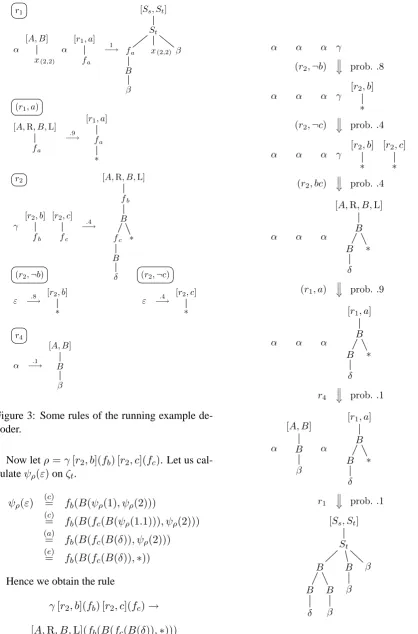
In Fig. 3 we show some rules of the decoder of our running example pSTIG and in Fig. 4 the
5
We will allow variables to have structured indices that are not elements ofN. However, by applying a bijective
re-naming, we can always obtain rules of the form(†).
derivation of this decoder which correponds to the derivation in Fig. 2.
Theorem 1. Let G be a pSTIG over N and T.
Then there is a BUTAT dec(G) such that for ev-ery(ξs, ξt) ∈UN(T)×UN(T)andp∈[0,1]the
following two statements are equivalent:
1. there is a successful derivation of (ξs, ξt,∅,∅,∅)byGwith probabilityp,
2. there is a derivation from yield(ξs) to
[Ss, St](ξt)bydec(G)with probabilityp.
PROOF. Let G = (N, T,[Ss, St],S,A, P) be a
pSTIG. We will construct the BUTAT dec(G) = (Q, T, N∪T,{[Ss, St]}, R)as follows (where the
mappingsϕandψρwill be defined below):
• Q= [N×N]∪[N× {L,R} ×N× {L,R}] ∪{[r, w]|r∈ A,wis an adjoining site ofr}, • R is the smallest set R′ of rules such that for every r ∈ S ∪ A of the form (ζs, ζt, V, W, Padjr )or(ζs, ζt, V, W,∗, Padjr ):
– for everyρ ∈ ϕ(ε), ifr ∈ S, then the
main rule
ρP→(r)[ζs(ε), ζt(ε)] ψρ(ε)
is in R′, and if r ∈ A and r is δsδt
-auxiliary, then the main rule
ρP→(r)[ζs(ε), δs, ζt(ε), δt] ψρ(ε)
is inR′, and
– for everyw = (ws, δs, wt, δt) ∈ W the
rules
qw fw P
r
adj(w)
−→ [r, w] fw(∗)
withqw = [ζ(ws), δs, ζt(wt), δt]for
ac-tivation atw, and the rule
ε1−P r
adj(w)
−→ [r, w](∗)
for non-adjoining atware inR′. We define the mapping
ϕ: pos(ζs)→ P((T ∪Q(X∪F))∗)
withQ(X∪F) = {q(z) | q ∈ Q, z ∈ X∪F} inductively on its argument as follows. Letw ∈ pos(ζs)and letwhavenchildren.
(b) (substitution site) Let ζs(w) ∈ N and let
w′ ∈pos(ζt)such that(w, w′)∈ V. Then
ϕ(w) ={[ζs(w), ζt(w′)] x(w,w′)
}.
(c) (adjoining site) Let ζs(w) ∈ N and let there
be an adjoining site in W with w as first component. Then, we defineϕ(w) to be the smallest set such that for every permutation (u1, . . . , ul)(resp.,(v1, . . . , vm)) of all the
L-adjoining (resp., R-L-adjoining) sites inW with was first component, the set6
J◦ϕ(w.1)◦. . .◦ϕ(w.n)◦K
is a subset of ϕ(w), where J = {u′1. . . u′l} andK={v′m. . . v1′}and
u′i= [r, ui] fui
andvj′ = [r, vj] fvj
for1≤i≤land1≤j≤m.
(d) Letζs(w)∈ N,w6=∗, and letwbe neither
the first component of a substitution site inV nor the first component of an adjoining site in W. Then
ϕ(w) =ϕ(w.1)◦. . .◦ϕ(w.n) .
(e) Letw=∗. Then we defineϕ(w) ={ε}. For everyρ∈ϕ(ε), we define the mapping
ψρ: pos(ζt)→UN∪F∪X(T∪ {∗})
inductively on its argument as follows. Let w ∈ pos(ζt)and letwhavenchildren.
(a) Letζt(w)∈T. Thenψρ(w) =ζt(w).
(b) (substitution site) Let ζt(w) ∈ N and let
w′ ∈pos(ζs)such that(w′, w) ∈ V. Then
ψρ(w) =x(w′,w).
(c) (adjoining site) Letζt(w) ∈ N and let there
be an adjoining site in W with w as third component. Then let{u1, . . . , ul} ⊆ W be
the set of all potential adjoining sites withw as third component, and we define
ψρ(w) =fu1(. . . ful(ζ). . .)
where ζ = ζt(w)(ψρ(w.1), . . . , ψρ(w.n))
and the ui’s occur inψρ(w) (from the root
towards the leaves) in exactly the same order as they occur inρ(from left to right).
(d) Letζt(w) ∈ N,w 6=∗, and letwbe neither
the second component of a substitution site inV nor the third component of an adjoining site inW. Then
ψρ(w) =ζt(w)(ψρ(w.1), . . . , ψρ(w.n)).
6
using the usual concatenation◦of formal languages
(e) Letw=∗. Thenψρ(w) =∗.
With dec(G) constructed as shown, for each derivation of G there is a corresponding deriva-tion ofdec(G), with the same probability, and vice versa. The derivations proceed in opposite direc-tions. Each sentential form in one has an equiv-alent sentential form in the other, and each step of the derivations correspond. There is no space to present the full proof, but let us give a slightly more precise idea about the formal relationship be-tween the derivations ofGanddec(G).
In the usual way we can associate a deriva-tion tree dtwith every successful derivation dof G. Assume that last(d) = (ξs, ξt,∅,∅,∅), and
let Es andEt be the embedded tree transducers
(Shieber, 2006) associated with, respectively, the source component and the target component of G. Then it was shown in (Shieber, 2006) that τEs(d
t) = ξ
s and τEt(d
t) = ξ
t where τE
de-notes the tree-to-tree transduction computed by an embedded tree transducer E. Roughly speaking, Es and Et reproduce the derivations of,
respec-tively, the source component and the target com-ponent ofG that are prescribed by dt. Thus, for κ= (ξs′, ξt′, V, W, g), ifκin⇒∗Gκandκis a prefix
ofd, then there is exactly one subtreedt[(w, w′)] of dt associated with every (w, w′) ∈ V ∪ W, which prescribes how to continue at(w, w′)with the reproduction ofd. Having this in mind, we ob-tain the sentential form of the dec(G)-derivation which corresponds to κ by applying a modifica-tion ofϕtoκ where the modification amounts to replacingx(w,w′)andf(w,w′)by τEt(dt[(w, w′)]);
note thatτEt(d
t[(w, w′)])might contain∗.
As illustration of the construction in Theorem 1 let us apply the mappingsϕandψρto rule r2 of Fig. 1, i.e., to r2 = (ζs, ζt,∅,{b, c},∗, Padjr2)
with ζs = A(A, γ), ζt = B(B(δ), B),
b = (ε,R, ε,L),c= (ε,R,1,L), and∗= (1,2). Let us calculateϕ(ε)onζs. Due to (c),
ϕ(ε) =J◦ϕ(1)◦ϕ(2)◦K.
Since there are no L-adjoinings atε, we have that J ={ε}. Since there are the R-adjoiningsbandc atε, we have the two permutations(b, c)and(c, b). (v1, v2) = (b, c):K={[r2, c](fc)[r2, b](fb)}
(v1, v2) = (c, b):K={[r2, b](fb)[r2, c](fc)}
Due to (e) and (a), we have thatϕ(1) ={ε}and ϕ(2) ={γ}, resp. Thus,ϕ(ε)is the set:
r1
(r1, a)
r2
(r2,¬b) (r2,¬c)
r4 α
[A, B]
x(2,2)
α
[r1, a]
fa
1
−→
[Ss, St]
St
f
B
β
x β
a (2,2)
[A,R, B,L]
fa
.9
−→
[r1, a]
f
∗ a
γ
[r2, b]
fb
[r2, c]
fc
.4
−→
[A,R, B,L]
f
B
f
B
δ
∗ b
c
ε −→.8 [r2, b]
∗
ε −→.4 [r2, c]
∗
α −→.1
[A, B]
B
[image:8.595.85.271.56.455.2]β
Figure 3: Some rules of the running example de-coder.
Now letρ=γ[r2, b](fb) [r2, c](fc). Let us
cal-culateψρ(ε)onζt.
ψρ(ε)
(c)
= fb(B(ψρ(1), ψρ(2)))
(c)
= fb(B(fc(B(ψρ(1.1))), ψρ(2)))
(a)
= fb(B(fc(B(δ)), ψρ(2)))
(e)
= fb(B(fc(B(δ)),∗))
Hence we obtain the rule
γ[r2, b](fb) [r2, c](fc)→
[A,R, B,L](fb(B(fc(B(δ)),∗)))
which is also shown in Fig. 3.
α α α γ
α α α γ [r2, b]
∗
α α α γ [r2, b]
∗
[r2, c]
∗
α α α
α α α
α
[A, B]
B
β α
[A,R, B,L]
B
B
δ
∗
=
⇒
=
⇒
=
⇒
=
⇒
=
⇒
[Ss, St]
St
B
B
δ B
β B
β β
prob..8
prob..4
prob..4
prob..9
prob..1
=
⇒ prob..1 [r1, a]
B
B
δ
∗ (r2,¬b)
(r2,¬c)
(r2, bc)
(r1, a)
r4
r1
[r1, a]
B
B
δ
∗
[image:8.595.77.496.61.696.2]References
A. Abeille, Y. Schabes, A.K. Joshi. Using lexicalized TAGs for machine translation. In Proceedings of the 13th International Conference on Computational Linguistics, volume 3, pp. 1–6, Helsinki, Finland, 1990.
C. Baier, M. Gr¨oßer, F. Ciesinski. Model checking linear-time properties of probabilistic systems. In Handbook of Weighted Automata, Chapter 13, pp. 519–570, Springer, 2009.
S. DeNeefe. Tree adjoining machine translation. Ph.D. thesis proposal, Univ. of Southern California, 2009.
S. DeNeefe, K. Knight. Synchronous tree adjoining machine translation. In Proc. of Conf. Empirical Methods in NLP, pp. 727–736, 2009.
J. Engelfriet. Bottom-up and top-down tree transfor-mations — a comparison. Math. Systems Theory, 9(3):198–231, 1975.
J. Engelfriet. Tree transducers and syntax-directed se-mantics. In CAAP 1982: Lille, France, 1982.
A. Fujiyoshi, T. Kasai. Spinal-formed context-free tree grammars. Theory of Computing Systems, 33:59– 83, 2000.
Z. F¨ul¨op, H. Vogler. Weighted tree automata and tree transducers. In Handbook of Weighted Automata, Chapter 9, pp. 313–403, Spinger, 2009.
F. G´ecseg, M. Steinby. Tree Automata. Akad´emiai Kiad´o, Budapest, 1984.
F. G´ecseg, M. Steinby. Tree languages. In Handbook of Formal Languages, volume 3, chapter 1, pages 1–68. Springer-Verlag, 1997.
J. Graehl, K. Knight, J. May. Training tree transducers. Computational Linguistics, 34(3):391–427, 2008
A.K. Joshi, L.S. Levy, M. Takahashi. Tree adjunct grammars. Journal of Computer and System Sci-ences, 10(1):136–163, 1975.
A.K. Joshi, Y. Schabes. Tree-adjoining grammars. In Handbook of Formal Languages. Chapter 2, pp. 69– 123, Springer-Verlag, 1997.
K. Knight, J. Graehl. An overview of probabilis-tic tree transducers for natural language processing. In Computational Linguistics and Intelligent Text Processing, CICLing 2005, LNCS 3406, pp. 1–24, Springer, 2005.
K. Knight, J. May. Applications of Weighted Au-tomata in Natural Language Processing. In Hand-book of Weighted Automata, Chapter 14, pp. 571– 596, Springer, 2009.
P.M. Lewis, R.E. Stearns. Syntax-directed transduc-tions. Journal of the ACM, 15:465–488, 1968.
A. Maletti. Compositions of tree series transforma-tions. Theoret. Comput. Sci., 366:248–271, 2006.
A. Maletti. The Power of Tree Series Transducers. Ph.D. thesis, TU Dresden, Germany, 2006.
A. Maletti. Compositions of extended top-down tree transducers. Information and Computation, 206:1187–1196, 2008.
A. Maletti. Why synchronous tree substitution gram-mars? in Proc. 11th Conf. North American Chap-ter of the Association of Computational Linguistics. 2010.
D.F. Martin and S.A. Vere. On syntax-directed trans-ductions and tree transducers. In Ann. ACM Sympo-sium on Theory of Computing, pp. 129–135, 1970.
R. Nesson, S.M. Shieber, and A. Rush. Induction of probabilistic synchronous tree-insertion gram-mars. Technical Report TR-20-05, Computer Sci-ence Group, Harvard Univeristy, Cambridge, Mas-sachusetts, 2005.
R. Nesson, S.M. Shieber, and A. Rush. Induction of probabilistic synchronous tree-inserting grammars for machine translation. In Proceedings of the 7th Conference of the Association for Machine Transla-tion in the Americas (AMTA 2006), 2006.
Y. Schabes, R.C. Waters. Tree insertion grammars: a cubic-time, parsable formalism that lexicalizes context-free grammar without changing the trees produced. Computational Linguistics, 21:479–513, 1994.
P.P. Schreiber. Tree-transducers and syntax-connected transductions. In Automata Theory and Formal Languages, Lecture Notes in Computer Science 33, pp. 202–208, Springer, 1975.
S.M. Shieber. Synchronous grammars and tree trans-ducers. In Proc. 7th Workshop on Tree Adjoin-ing Grammars and Related Formalisms, pp. 88–95, 2004.
S.M. Shieber. Unifying synchronous tree-adjoining grammars and tree transducers via bimorphisms. In Proc. 11th Conf. European Chapter of ACL, EACL 06, pp. 377–384, 2006.
S.M. Shieber, Y. Schabes. Synchronous tree-adjoining grammars. In Proceedings of the 13th Interna-tional Conference on ComputaInterna-tional Linguistics, volume 3, pp. 253–258, Helsinki, Finland, 1990.
K. Vijay-Shanker, D.J. Weir. The equivalence of four extensions of context-free grammars. Mathematical Systems Theory, 27:511–546, 1994.