Data point selection for self-training
Ines Rehbein
SFB 632: Information structure University of Potsdam
Abstract
Problems for parsing morphologically rich languages are, amongst others, caused by the higher variability in structure due to less rigid word order constraints and by the higher num-ber of different lexical forms. Both properties can result in sparse data problems for statis-tical parsing. We present a simple approach for addressing these issues. Our approach makes use of self-training on instances se-lected with regard to their similarity to the an-notated data. Our similarity measure is based on the perplexity of part-of-speech trigrams of new instances measured against the annotated training data. Preliminary results show that our method outperforms a self-training setting where instances are simply selected by order of occurrence in the corpus and argue that self-training is a cheap and effective method for improving parsing accuracy for morphologi-cally rich languages.
1 Introduction
Up to now, most work on statistical parsing has been focussed on English, a language with a configura-tional word order and little morphology. The in-herent properties of morphologically rich languages include a higher variability in structure due to less rigid word order constraints, thus leading to greater attachment ambiguities, and a higher number of dif-ferent word forms, leading to coverage problems caused by sparse data. These issues pose a great challenge to statistical parsing.
One sensible way to treat these issues is the de-velopment of more sophisticated parsing models
adapted to the language-specific properties of mor-phologically rich languages. Another, simpler ap-proach, tries to overcome the problems outlined above by expanding the training data. Possible ap-proaches for expansion include self-training and ac-tive learning.
For self-training a parser is trained on a seed dataset of gold trees and applied to new text, either coming from the same domain or, in the context of domain adaptation, from a domain different from the seed data. The parser output trees are then added to the seed data and the parser is re-trained on its own output. For the in-domain setting it is quite unin-tuitive why this approach should work, as we only add more of what the parser already knows, and we also include a considerable amount of errors in the training set.
Active learning, on the other hand, tries to expand the training set by selecting those instances which provide the parser with a high amount of new infor-mation.1 The underlying idea is that those instances have yet to be learned by the parser and thus will support the learning process. These instances have to be labelled by a human coder (often called the or-acle) and then added to the seed data. The parser is re-trained and new instances can be selected, based on the new model. The intuition why this approach should work is more straightforward than for the self-training setting: we do provide the model with new, unseen information and, assuming that our or-acle is right, the amount of noise is kept to a mini-mum. The great advantage of self-training, however,
1
Common measures for data point selection are based on the uncertainty of the model with regard to its own predictions.
is that it is unsupervised, thus obviating the need for human annotation.
In this study we test the potential of self-training for parsing morphologically rich languages. We present experiments for German, a language with rich morphology (relative to English) and semi-free word order, and show that self-training can improve parsing accuracy when only a small amount of la-belled training data is available. Furthermore, we show that selecting sentences for self-training on the basis of similarity to the training data is a good strat-egy which can further improve results while avoid-ing the downside of expensive human annotation.
The paper is structured as follows. Section 2 re-ports on related work. Section 3 describes the setup of our experiments and reports preliminary results. In Section 4 we conclude and outline future work.
2 Related work
The question whether or not self-training can be em-ployed to improve parsing accuracy and to over-come sparse data problems has gained a lot of at-tention in recent years. While training a generative parsing model on its own output (Charniak, 1997; Steedman et al., 2003) does not seem to work well, McClosky et al. (2006a; 2006b) showed promising results when combining the self-training approach with a two-stage reranking parser model (Charniak and Johnson, 2005). This triggered a number of follow-up studies especially in the area of domain adaptation (Bacchiani et al., 2006; Foster et al., 2007; McClosky et al., 2010), where self-training is used to adapt the parser to a target domain for which no (or only a small amount of) annotated training data is available.
(Reichart and Rappoport, 2007) are the first to re-port successful self-training using a generative pars-ing model only. They claim that the crucial differ-ence to earlier studies is the size of the seed data and the number of parser output trees added to the training data. In their experiments they train a reim-plementation of Collins’ parsing model 2 on a small seed set of trees (100-2000 trees) from the WSJ and add automatically parsed analyses for WSJ sections 2-21. Then they test their models on section 23 of the WSJ and report a substantial improvement for the in-domain self-training setting.
Discussion has focussed on the question of which factors are responsible for the success (or failure) of self-training. Reichart and Rappoport (2007) show that the number of unknown words is a good indi-cator of the usefulness of self-training when applied to small seed data sets. McClosky et al. (2008) have provided a thorough analysis and conclude that an important source of improvement comes from see-ing words already known to the parser in new con-texts. A question which, until now, has not gained much attention is the impact of language-specific features on the effect of self-training.
Another strand of research related to our work is that of cross-language adaptation of parsers, where there exists labelled data for one language but none (or only little) for the other. Zeman and Resnik (2008) present cross-language adaptation of a constituency parser by mapping the part-of-speech tags from the source and target languages into a uni-versal tagset, claiming that the similarities between two closely related languages allow for abstraction from the level of word forms. They apply their method to Danish and Swedish, two closely related languages, and present an f-score of 66.4% for con-stituency trees for Swedish after having trained their parser on data from the Danish treebank.
Sørgaard (2011) pushes this line of research fur-ther and applies it to languages as different as Arabic, Bulgarian, Danish and Portuguese. The basic approach is similar to (Zeman and Resnik, 2008). Sørgaard (2011) delexicalises the treebanks and maps the part-of-speech tags into one common tagset. Crucial for the success of his approach is the filtering of the training data. Sørgaard only trains on the 90% of the source trees which are most similar to the target language. As a similarity measure he uses perplexity on the basis of POS ngrams. The results are quite impressive. Despite the very dif-ferent properties of the languages Sørgaard achieves f-scores in the range of 50-75% on full-length sen-tences.
in-stances which are similar to the training data, which might mean that they do not contribute new, useful information for the parser. Nevertheless, we hope that, since they are similar to what the parser already knows, it might handle these instances reasonably well and therefore the amount of noise added to the training set will be small. At the same time we as-sume with McClosky et al. (2008) that one important factor in self-training is providing the parser with ad-ditional context for already known words, and there-fore presume that selecting similar sentences will support the learning process.
3 Self-training experiments
3.1 Data
In our experiments we use data from two German treebanks. We take syntactically annotated trees from the TiGer treebank (Brants et al., 2002) and raw text from the T¨uBa-D/Z treebank (Telljohann et al., 2005). The T¨uBa-D/Z (Release 6) consists of 55 814 sentences, TiGer (Release 2) includes 50 474 sentences. Sentence length in the two tree-banks is comparable, with around 17 words per sen-tence. TiGer is annotated with phrase structure trees, dependency (grammatical relation) information and POS tags, according to the Stuttgart T¨ubingen Tag Set (STTS) (Schiller et al., 1995). The tree struc-ture is flat and does not contain unary nodes as non-local dependencies are encoded by the use of cross-ing branches.
Both treebanks include German newspaper text, coming from two different newspapers (Frank-furter Rundschau and taz). Rehbein and van Gen-abith (2007) showed that there are considerable do-main differences between the two treebanks and that the texts can easily be separated on the basis of the distribution of part-of-speech tags in the two cor-pora.
3.2 Preprocessing
We use the TiGer trees as our training data and the sentences in the T¨uBa-D/Z for expanding the corpus. Our setup is as follows.
First we normalised different forms of apostro-phes in the text.2 Then we divided the 50474 trees
2
TiGer uses “ and ‘ for opening and ” and ’ for closing dou-ble quotes, T¨uBa-D/Z uses ‘ for opening and ’ for closing single
in TiGer into training and test set, following the pro-posal described in Dubey (2004). We split the data into 20 buckets by placing the first tree of the tree-bank into bucket 1, the second tree into bucket 2, and so on. We then combined the content of buckets 1 to 19 into the training set (47951 trees), and used bucket 20 as our test set (2523 trees).
From the randomly ordered training set we cre-ated 8 new training subsets of increasing size, putting the first 5000 trees in the training set in sub-set 1, the first 10000 trees in subsub-set 2, and so on, up to 40000 trees (subset 8). We resolved the crossing branches in the TiGer trees by attaching the non-head child nodes higher up in the tree, following (K¨ubler, 2005).
3.3 Data point selection
In the next step we created language models for each of the 8 TiGer training subsets on the basis of the part-of-speech trigrams3and computed the per-plexity for each sentence in the T¨uBa-D/Z treebank based on its part-of-speech trigrams. The T¨uBa-D/Z POS tags used in our experiments have been assigned using the RFTagger (Schmid and Laws, 2008). For TiGer, we used the gold POS tags.
Perplexity (Equation 1) is an information-theoretic measure and can be used to assess the ho-mogeneity of a corpus. It can be unpacked as the inverse of the corpus probability, normalised by cor-pus size. The perplexity of a sentence from the T¨uBa-D/Z tells us how similar this sentence is to the TiGer training data.
P P(W) = N s
1
P(w1w2...wN)
(1)
For each of the 8 subsets we selected the 25000 sentences from the T¨uBa-D/Z with the lowest per-plexity, thus the T¨uBa-D/Z sentences most similar in structure to the respective TiGer training subset. Then we parsed the selected sentences and added them to the TiGer training data (subsets 1-8). We re-trained the parser and evaluated against the TiGer test set, comparing the results against the
perfor-quotes but does not distinguish between opening and closing double quotes.
mance of the parser when trained on the original subset from the TiGer treebank.
3.4 Parsing experiments
For our experiments we use the unlexicalised Berke-ley parser (Petrov et al., 2006) and the lexicalised form of the Stanford parser (Klein and Manning, 2003). The Berkeley parser is an unlexicalised la-tent variable PCFG parser which uses a split-and-merge technique to automatically refine the train-ing data. The splits result in more and more fine-grained subcategories, which are merged again if not proven useful. We train a PCFG from each of the 8 training subsets by carrying out six cycles of the split-and-merge process. The model is language-agnostic. The Stanford parser provides a factored probabilistic model combining a PCFG with a de-pendency model. We use the Stanford parser in its lexicalised, markovised form.4
Both parsers were trained on the syntactic nodes of the trees only, stripping off the grammatical func-tion (GF) labels from the trees. We add the GF to the parser output in a postprocessing step, using the method of (Seeker et al., 2010), and include GF in the evaluation. Training the parser on syntactic node labels without GF has the advantage of con-siderably reducing the number of atomic labels in the grammar. As a result, we obtain smaller gram-mars which are more efficient for parsing, and we also avoid sparse data problems. We also lose infor-mation, but the treebank refinement techniques used by the Berkeley parser easily recover this informa-tion and thus yield comparable results for both set-tings. As an additional benefit we avoid the problem of multiple governable GF assigned to children of the same parent node, an error occasionally made by the Berkeley parser. The method by (Seeker et al., 2010), on the other hand, uses linguistically in-formed hard constraints to prevent these errors.
While we computed perplexity on the basis of the gold POS tags in TiGer treebank and automatically assigned POS tags to the T¨uBa-D/Z sentences, for parsing we used raw text as input and let the parsers assign their own POS tags.
4Parameters: hmarkov=1, vmarkov=2
3.5 Results
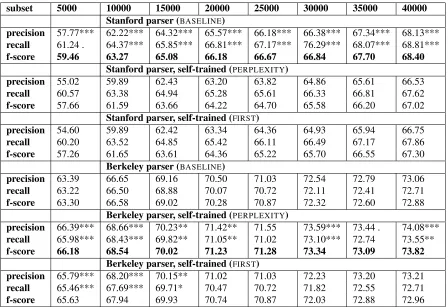
We compare the impact of self-training on parsing accuracy for a lexicalised (Stanford) and an unlexi-calised (Berkeley) parsing model. For self-training we test the following settings: a) selecting new training data from T¨uBa-D/Z based on perplexity, adding the 25 000 parser output trees most similar to the TiGer training subset (PERPLEXITY) and b) adding the first 25 000 sentences from the T¨uBa-D/Z (FIRST) to each of the TiGer training subsets.
Table 1 shows results for the different settings in-cluding GF in the evaluation.5 In general, the results for the Berkeley parser are much higher (according to thePARSEVALmetric) than the results for the lex-icalised version of the Stanford parser. The most striking finding is that for the Stanford parser self-training was not able to improve parsing accuracy over the baseline of training the parser on the (much smaller) TiGer training subsets only, while for the Berkeley parser we get a significant improvement of 2.9% and 1.9% f-score for the two smallest train-ing subsets. With increastrain-ing size of the traintrain-ing set the gap between the results achieved on the original TiGer training data and on the expanded training sets becomes smaller, but even for the largest training set we achieve a significant improvement of 0.9%.
While results for the Stanford parser are much lower than the ones for Berkeley and self-training fails to outperform the baseline in all cases, the gen-eral trend for the self-training settings (PERPLEX -ITY,FIRST) is the same. Selecting new training in-stances on the basis of similarity helps mostly for smaller data sets, while for the larger training sets there does not seem to be a significant difference be-tween the two settings. This finding is quite intu-itive. In the self-training setting we have a trade-off between new information provided to the parser and noise added to the training set. For small training sets new context information has a far higher im-pact, while for training sets of increasing size we already have more information in the labelled data, and thus the gains from providing additional context to the parser are lower than the harm we cause by
5
For significance testing we use the Randomized Parsing Evaluation Comparator provided by Dan Bikel
(http://www.cis.upenn.edu/˜dbikel/
subset 5000 10000 15000 20000 25000 30000 35000 40000 Stanford parser (BASELINE)
precision 57.77*** 62.22*** 64.32*** 65.57*** 66.18*** 66.38*** 67.34*** 68.13***
recall 61.24 . 64.37*** 65.85*** 66.81*** 67.17*** 76.29*** 68.07*** 68.81***
f-score 59.46 63.27 65.08 66.18 66.67 66.84 67.70 68.40 Stanford parser, self-trained (PERPLEXITY)
precision 55.02 59.89 62.43 63.20 63.82 64.86 65.61 66.53
recall 60.57 63.38 64.94 65.28 65.61 66.33 66.81 67.62
f-score 57.66 61.59 63.66 64.22 64.70 65.58 66.20 67.02
Stanford parser, self-trained (FIRST)
precision 54.60 59.89 62.42 63.34 64.36 64.93 65.94 66.75
recall 60.20 63.52 64.85 65.42 66.11 66.49 67.17 67.86
f-score 57.26 61.65 63.61 64.36 65.22 65.70 66.55 67.30
Berkeley parser (BASELINE)
precision 63.39 66.65 69.16 70.50 71.03 72.54 72.79 73.06
recall 63.22 66.50 68.88 70.07 70.72 72.11 72.41 72.71
f-score 63.30 66.58 69.02 70.28 70.87 72.32 72.60 72.88
Berkeley parser, self-trained (PERPLEXITY)
precision 66.39*** 68.66*** 70.23** 71.42** 71.55 73.59*** 73.44 . 74.08***
recall 65.98*** 68.43*** 69.82** 71.05** 71.02 73.10*** 72.74 73.55**
f-score 66.18 68.54 70.02 71.23 71.28 73.34 73.09 73.82 Berkeley parser, self-trained (FIRST)
precision 65.79*** 68.20*** 70.15** 71.02 71.03 72.23 73.20 73.21
recall 65.46*** 67.69*** 69.71* 70.47 70.72 71.82 72.55 72.71
[image:5.612.83.531.53.360.2]f-score 65.63 67.94 69.93 70.74 70.87 72.03 72.88 72.96
Table 1: Parsing results (PARSEVAL) for the different self-training settings, including GF in the evaluation (asterisks indicate significant differences between self-training and the baseline:p=0.001***,p=0.005**,p=0.01*,p=0.05.)
including erroneous parser output trees.
So far, it is not clear to us why the lexicalised parser performs poorly in the self-training setting. This result is in line with (Huang and Harper, 2009), who observed that the PCFG-LA parser used in their experiments benefitted more from self-training as compared to a lexicalised generative parser. How-ever, our results are not necessarily an effect of lex-icalisation, but might be due to the overall lower accuracy of the Stanford parser on German (see K¨ubler (2008)). A quantiative and qualitative error analysis might give us some interesting insight into the underlying reasons and into the question when and why self-training will work for parsing.
4 Conclusions and future work
We presented preliminary results on self-training ex-periments for German, a language with rich mor-phology and semi-free word order. We proposed a new approach to self-training where we select new instances on the basis of similarity to the seed train-ing data. Our results show that this strategy helps to
boost self-training results especially for small seed data, but also obtains a significant improvement for larger training sets.
Our approach offers plenty of room for improve-ment. In future work we plan to investigate the adequacy of different similarity measures for self-training, and also to measure similarity on different levels (so far we have only considered the part-of-speech level). An obvious extension is the integra-tion of a reranker in order to add a different view on the selection process. We expect that this will have a positive impact on our results.
Finally, we plan to have a closer look at the impact of language-specific properties on self-training. Our intuition is that the potential of self-training might be larger for morphologically rich languages, but this claim has yet to be tested.
Acknowledgments
References
Michiel Bacchiani, Michael Riley, Brian Roark, and Richard Sproat. 2006. Map adaptation of stochastic grammars. Computer Speech and Language, 20. Sabine Brants, Stefanie Dipper, Silvia Hansen, Wolfgang
Lezius, and George Smith. 2002. The TIGER tree-bank. InProceedings of the First Workshop on Tree-banks and Linguistic Theories.
Eugene Charniak and Mark Johnson. 2005. Coarse-to-fine n-best parsing and maxent discriminative rerank-ing. InThe 43rd Meeting of the Association for Com-putational Linguistics (ACL).
Eugene Charniak. 1997. Statistical parsing with a context-free grammar and word statistics. In Proceed-ings of the Fourteenth National Conference on Artifi-cial Intelligence (AAAI).
Amit Dubey. 2004. Statistical Parsing for German: Modeling syntactic properties and annotation differ-ences. Ph.D. thesis, Saarland University, Germany. Jennifer Foster, Joachim Wagner, Djam´e Seddah, and
Josef van Genabith. 2007. Adapting WSJ-trained parsers to the British National Corpus using in-domain self-training. In Proceedings of the Tenth Interna-tional Workshop on Parsing Technologies (IWPT). Zhongqiang Huang and Mary Harper. 2009.
Self-training pcfg grammars with latent annotations across languages. InProceedings of the 2009 Conference on Empirical Methods in Natural Language Processing, EMNLP ’09.
Dan Klein and Chris Manning. 2003. Accurate unlex-icalized parsing. In The 41st Annual Meeting of the Association for Computational Linguistics (ACL). Sandra K¨ubler. 2005. How do treebank annotation
schemes influence parsing results? or how not to com-pare apples and oranges. In Proceedings of the 5th International Conference on Recent Advances in Nat-ural Language Processing (RANLP).
Sandra K¨ubler. 2008. The page 2008 shared task on pars-ing german. InProceedings of the ACL Workshop on Parsing German, Columbus, Ohio.
David McClosky, Eugene Charniak, and Mark Johnson. 2006a. Effective self-training for parsing. InHuman Language Technology conference - North American chapter of the Association for Computational Linguis-tics annual meeting (HLT-NAACL).
David McClosky, Eugene Charniak, and Mark Johnson. 2006b. Reranking and self-training for parser adapta-tion. InThe 21st International Conference on Com-putational Linguistics and 44th Annual Meeting of the Association for Computational Linguistics (ACL-COLING).
David McClosky, Eugene Charniak, and Mark Johnson. 2008. When is self-training effective for parsing? In
Proceedings of COLING.
David McClosky, Eugene Charniak, and Mark Johnson. 2010. Automatic domain adaptation for parsing. In
Human Language Technologies: The 2010 Annual Conference of the North American Chapter of the As-sociation for Computational Linguistics.
Slav Petrov, Leon Barrett, Romain Thibaux, and Dan Klein. 2006. Learning accurate, compact, and in-terpretable tree annotation. InThe 21st International Conference on Computational Linguistics and 44th Annual Meeting of the Association for Computational Linguistics (ACL-COLING).
Ines Rehbein and Josef van Genabith. 2007. Why is it so difficult to compare treebanks? TIGER and T¨uBa-D/Z revisited. In Proceedings of the Sixth International Workshop on Treebanks and Linguistic Theories. Roi Reichart and Ari Rappoport. 2007. Self-training
for enhancement and domain adaptation of statistical parsers trained on small datasets. InThe 45th Annual Meeting of the Association for Computational Linguis-tics (ACL).
Anne Schiller, Simone Teufel, and Christine Thielen. 1995. Guidelines f¨ur das Tagging deutscher Textcor-pora mit STTS. Technical report, IMS-CL, University Stuttgart, Germany.
Helmut Schmid and Florian Laws. 2008. Estimation of conditional probabilities with decision trees and an application to fine-grained pos tagging. In Proceed-ings of the 22nd International Conference on Compu-tational Linguistics, COLING-08.
Wolfgang Seeker, Ines Rehbein, Jonas Kuhn, and Josef van Genabith. 2010. Hard constraints for grammatical function labelling. InThe 48th Annual Meeting of the Association for Computational Linguistics (ACL). Anders Sørgaard. 2011. Data point selection for
cross-language adaptation of dependency parsers. In The 49th Annual Meeting of the Association for Compu-tational Linguistics: Human Language Technologies (ACL-HLT).
Mark Steedman, Miles Osborne, Anoop Sarkar, Stephen Clark, Rebecca Hwa, Julia Hockenmaier, Paul Ruhlen, Steven Baker, and Jeremiah Crim. 2003. Bootstrap-ping statistical parsers from small datasets. In The 11th Conference of the European Chapter of the As-sociation for Computational Linguistics (EACL). Heike Telljohann, Erhard W. Hinrichs, Sandra K¨ubler,
and Heike Zinsmeister. 2005. Stylebook for the T¨ubingen Treebank of Written German (T¨uBa-D/Z). Technical report, University T¨ubingen, Germany. Daniel Zeman and Philip Resnik. 2008. Cross-language