Mining Multi-word Named Entity Equivalents from Comparable Corpora
Abhijit Bhole Microsoft Research India
Bangalore, India
Goutham Tholpadi Indian Institute of Science
Bangalore, India
Raghavendra Udupa Microsoft Research India
Bangalore, India
Abstract
Named entity (NE) equivalents are useful in many multilingual tasks including MT, transliteration, cross-language IR, etc. Recently, several works have addressed the problem of mining NE equivalents from comparable corpora. These methods usually focus only on single-word NE equivalents whereas, in practice, most NEs are multi-word. In this work, we present a generative model for extracting equivalents of multi-word NEs (MWNEs) from a comparable corpus, given a NE tagger in only one of the languages. We show that our method is highly effective on three language pairs, and provide a detailed error analysis for one of them.
1 Introduction
NEs are important for many applications in natu-ral language processing and information retrieval. In particular, NE equivalents, i.e. the same NE expressed in multiple languages, are used in sev-eral cross-language tasks such as machine trans-lation, machine transliteration, cross-language in-formation retrieval, cross-language news aggrega-tion, etc. Recently, the problem of automatically constructing a table of NE equivalents in multi-ple languages has received considerable attention from the research community. One approach to solving this problem is to leverage the abundantly available comparable corpora in many different languages of the world (Udupa et al., 2008; Udupa et al., 2009a; Udupa et al., 2009b). While consid-erable progress has been made in improving both recall and precision of mining of NE equivalents from comparable corpora, most approaches in the literature are applicable only to single-word NEs, and particularly to transliterations (e.g. Tendulkar and.tea;nqu+.l+.k+.=). In this work, we consider the more
general problem of MWNE equivalents from com-parable corpora.
In the MWNE equivalents mining problem, a NE in the source language could be related to a NE in the target language by, not just transliteration, but a combination of translitera-tion, translatranslitera-tion, acronyms, deletion/addition of terms, etc. To give an example, Figure 1 shows a pair of comparable articles in English and Hindi. ‘Sachin Tendulkar’ and ‘.sa;a;.ca;na .tea;nqu+.l+.k+.=’ are MWNE equivalents, and both words have been transliterated. Another example is the pair ‘Siddhivinayak Temple Trust’ and ‘;a;sa;a:;dÄâ;a;va;na;a;ya;k ma; ///a;nd:= siddhivinayak mandir’. Here, the first word has been transliterated, the second one translated, and the third omitted in Hindi. The task is to (a) identify these MWNEs as equivalents, (b) infer the word correspondence between the MWNE equivalents, and (c) identify the type of correspondence (transliteration, translation, etc.).
Such NE equivalents would not be mined cor-rectly by the previously mentioned approaches as they would mine only the pair (Siddhivinayak,
;a;sa;a:;dÄâ;a;va;na;a;ya;k). In practice, most NEs are multi-word and hence it makes sense to address the prob-lem of mining MWNE equivalents.
To the best of our knowledge, this is the first work on mining MWNEs in a language-neutral manner.
In this work, we make the following contribu-tions:
• We perform an empirical study of MWNE occurrences, and the issues involved in min-ing (Section 2).
• We define a two-tier generative model for
MWNE equivalents in a comparable corpus (Section 4).
• We propose a modified Viterbi algorithm for identifying MWNE equivalents, and
Mumbai, July 29: Sachin Tendulkar will make his Bollywood debut with a cameo role in a film about the miracles of Lord Ganesh. Tendulkar, widely regarded as one of the world's best batsmen, will play himself in Vighnaharta Shri Siddhivinayak," a film about the god, who is sometimes referred to as Siddhivinayak. "He will play a small role, as himself, either in a song sequence or in an actual scene," said Rajiv Sanghvi, whose company is handling the film's production. Tendulkar's office confirmed the cricketer would be shooting for the film after he returns from Sri Lanka where India is touring at the moment. Tendulkar, a devotee of Ganesh, had offered to be a part of the project and will not be charging for the role. The film is being produced by the Siddhivinayak Temple Trust, which looks after a famous temple dedicated to Ganesh in Mumbai.
[ अपनी बल्ऱेबाजी से दुननया भर के क्रिकेटप्रेममयों को अपना दीवाना बनाने वाऱे ]/O [ सचिन तेंडुऱकर ]/[ Sachin Tendulkar ] [ अब ]/O [ बॉऱीवुड ]/[ Bollywood ] [ में पदापपण करने जा रहे हैं और गणपनि पर बनने वाऱी एक क्रिल्म में वह नजर आएॉगे ]/O
[ गणपनि के परमभक्ि ]/O [ सचिन ]/[ Sachin ] [ ' ]/O [ ववध्नहतता ससविववनतयक ]/[ Vighnaharta Shri Siddhivinayak ] [ ' क्रिल्म में एक सॊक्षऺप्ि भूममका ननभाएॉगे ]/O
[ क्रिल्म का ननमापण ]/O [ ससविववनतयक मंदिर ]/[ Siddhivinayak Temple Trust ] [ न्यास कर रहा है , जो मुॊबई के प्रभादेवी इऱाके में स्थिि इस मशहूर मॊददर की देखरेख करिा है ]/O
[ न्यास के प्रमुख ]/O [ सुभतष मतयेकर ]/[ Subhash Mayekar ] [ ने कहा ]/O [ सचिन ]/[ Sachin ] [ कई साऱ से ननयममि रूप से इस मॊददर में आ मीडिया की खबरों के अनुसार क्रिल्म के ननमापण से जुड़ी कॊपनी के प्रमुख ]/O [ रतजीव संघवी ]/[ Rajiv Sanghvi ] [ ने कहा ]/O [ सचिन ]/[ Sachin ] [ की इसमें सॊक्षऺप्ि भूममका होगी ]/O [ वह ]/O [ सचिन तेंडुऱकर ]/[ Sachin Tendulkar ] [ के रूप में ही नजर आएॉगे ]/O
Figure 1: An example of MWNE mining.
for inferring correspondence information (Section 4.3).
• We evaluate the method on three language
pairs (involving English (En), Arabic (Ar), Hindi (Hi) and Tamil (Ta)) (Section 6).
In our method, we assume the existence of the fol-lowing linguistic resources: a NE tagger, a transla-tion model, a transliteratransla-tion model, and a language model. We show good mining performance for En-Hi and En-Ta. We perform error analysis for En-Ar, and identify sources of error (Section 6.5).
2 Empirical Study of Multi Word NE Equivalents
To understand the various issues in mining MWNE equivalents from comparable corpora, we took a random sample of 100 comparable
En-Hi news article pairs from the Indian news portal WebDunia1. The English articles had682 unique NEs of which 252 (37%) were person
names,130(19%) were location names, and300
(44%) were organization names. A substantial
percentage of the names comprised of more than one word: locations25%, person names96%, and
organizations98%. For each English MWNE, we
manually identified its equivalent (if any) in the comparable Hindi article. We observed that the MWNEs studied usually conformed to one/some of the following characteristics:
1. Each word in the Hindi MWNE is a translit-eration of some word in the English MWNE.
1http://www.webdunia.com
E.g. (Mahatma Gandhi,ma;h;a;tma;a ga;<a;Da;a) where (Mahatma, ma;h;a;tma;a) and (Gandhi, ga;<a;Da;a) are transliterations.
2. At least one word in the Hindi MWNE is a translation of some word in the English MWNE while the remaining words are transliterations. E.g. (New Delhi, na;IR ;a;d;+:a
nai dillee) where (New, na;IR) is a trans-lation and (Delhi,;a;d;+:a) is a transliteration.
3. MWNEs contain abbreviations (initials). E.g. (M. K. Gandhi,O;;ma. :ke. ga;<a;Da;a) where (M,O;;ma) and (K,:ke) are initials.
4. One-to-one correspondence between the words in the English and Hindi MWNEs. E.g. (New Delhi,na;IR ;a;d;+:a)
5. One-to-many correspondence between the words in the English and Hindi MWNEs. E.g. (Card, :pra;Za;~ta;a :pa:a prashasti patr).
6. Many-to-one correspondence between the words in the two MWNEs. E.g. (Air force,
va;a;yua;sea;na;a vayusena).
7. Sequential correspondence between words in the two MWNEs. E.g. (High Court,o+.a;ta;ma nya;a;ya;a;l+.ya ucchatam nyayalay) where (High, o+.a;ta;ma) and (Court, nya;a;ya;a;l+.ya) are equivalents.
yuddha sammaan) where the correspon-dence is (Battle, yua:;dÄâ), (Honour, .sa;mma;a;na) and (Gurais,gua:=+a;I+.sa).
9. Some words in the English MWNE do not have an equivalent in the Hindi MWNE. E.g. (Department of Telecommunication, dU:=+sMa;.ca;a:= ;a;va;Ba;a;ga doorsanchaar vibhaag) where ‘of’ does not have an counterpart in the Hindi MWNE.
10. Acronym transliteration by transliterating each character separately. E.g. (IRRC,
A;a;IRA;a:=A;a:=+sa;a ai aar aar si) and (RBC,A;a:= ba;a .sa;a aar bi si).
11. Acronym transliteration by transliterating as a whole. E.g. (SAARC,.sa;a;kR saark) and (TRAI,f";a;IR traai).
Our study revealed that each of the above char-acteristics is statistically important. Nearly 37% of location names and 77% of organization names involved both transliteration and translation. 12% of person names, 30% of location names and 45% of organization names had either one-to-many or many-to-one correspondence between words. 36% of organization names had non-sequential correspondence between words. These statis-tics clearly indicate that MWNEs need special treatment and any non-trivial MWNE equivalent mining technique must take into account the characteristics described above.
3 Problem Description
Given a pair of comparable documents in differ-ent languages, we wish to extract a set of pairs of MWNEs, one in each language, that are equiva-lent to each other. We are given a NE tagger in one of the languages, dubbed thesourcelanguage, while the other language is called the target lan-guage (denoted with subscriptssand t). We are
given a document pair(ds, dt)and the NEs inds i.e. {Ni}mi=1and we want to find all possible NEs indtwhich are equivalent to someNi. The prob-lem now reduces to finding sequences of words in
dtthat are equivalent to someNi’s.
In the example in Figure 1, {Ni}mi=1 =
{(Sachin, Tendulkar), (Lord, Ganesh),
(Siddhiv-inayak, Temple, Trust), . . .}. We want to extract the set { (Sachin Tendulkar, सिचन तेंडुलकर), (Siddhivinayak Temple Trust, सिद्िवनायक मंिदर),
. . .}.
4 Mining algorithm 4.1 Key idea
We model the problem of finding NE equivalents in the target sentenceTusing source NEs as a
gen-erative model. Each wordtin the target sentence
is hypothesized to be either part of a NE, or gener-ated from a target language model (LM). Thus, in the generative model, the source NEsN’s plus the
target language model constitute the set of hidden states. The t’s are the observations. We want to
alignstates and observations, i.e. determine which state generated which observation, and choose the alignment that maximizes the probability of the observations. The probability of generating a tar-get wordtfrom a source NE stateN is dependent on
• whether N is itself multi-word; if so, each
word inN acts as a substate and can generate
t.
• the context (the words precedingtinT); note
that the length of the context window for t
depends on the length of the source NE gen-eratingt, and is not a fixed parameter.
• the relationship (transliteration or translation) the state/substate and the target word.2
Dynamic programming (DP) approaches are usu-ally used to compute the best alignment, but it fails here as the context size varies for each NE. Hence, we posit the generative model at two levels:
1. A sentence-level generative model (SGeM), where each word in the target sentence is gen-erated either by the target LM or by one of the source NEs.
2. A generative model for the NE (NEGeM), where each word in the target NE is gener-ated by one of the substates of the source NE.
ga;<a;Da;a . . . ’ which is equivalent to the NE “M. K. Gandhi”. Here, ’:ke’ is likely to be a part of the NE. The language model not only reduces false positives but also disambiguates NE boundaries.
Figure 2: Generation of a Hindi sentence from an English NE.
4.2 Generative Model
SGeM LetT = t1. . . tn be the target sentence andN ={Ni}mi=0be the hidden states (as before), whereN0is the target LM state. In the SGeM, we want to predict the hidden state used to produce the next target termti. Letai =jiftiis generated byNj. We find an alignmentA=a1. . . anwhich maximizes
P(T, A|N) =
n ∏
i=1
P(ai
ai1−1, Nai )
P(ti
ti1−1, Nai )
(1)
By choosing which source NE generates each tar-get term, this model also controls the length of the target NE equivalent to a source NE.
Let tki. . . ti−1 be the context for ti (all these terms are aligned toNai). Then
P(ti
ti1−1, Nai )
=P(ti
tik−i1, Nai )
NEGeM To model the generation of the target termti given the contextti1−1and the substates of the source NE Nj, we letNj =
(
nj1, . . . , njLj )
where njp is a substate. The internal alignment
B =bki, . . . , biis defined such thatbp =siftpis generated bynjs. We get
P(ti
tik−i1, Nai )
=
∑
B i ∏
p=ki
P(bp
bip+1)P(tp naibp
) (2)
To model the relationship between the source and target terms, we introduce variables in a fash-ion similar to the introductfash-ion of B in (2). Let R=rki, . . . , riwhererp ∈ {transliteration, trans-lation, acronym, none}such thattpandnjbp have the relationshiprp. Then3
P(tj
naibj, rj )
=mtlatPtlat(tj naibj
)rtlat ifr
j =translation
=mtlitPtlit (
tj naibj
)rtlit if
rj =transliteration
=δ[tj ≡naibj ]
ifrj =acronym
=Plm(tj) ifrj =none
The four probability terms on the right are ob-tained, respectively, from a translation model, a transliteration model4, an acronym model5, and a language model.
Controlling target NE length In the SGeM,
P(ai
ai1−1, Nai )
is the probability that Nai will generate ti. To compute this, we first note that, for a given term ti, either ai = ai+1 i.e. Nai continues to generate beyond ti, or ai 6= ai+1 i.e. Nai terminates at ti. The probability of continuation depends on the lengthLofNai and the lengthl of the target NE generated so far by Nai. Based on empirical observations, we defined a functionf(l, L)as
f(l, L) = 0forl /∈ {L−2, L+ 2} = 1−forl∈ {L−1, L} =forl∈ {L+ 1, L+ 2}
where f(l, L) is the probability of continuation,
and1−f(l, L) is the probability of termination.
is a very small number. We now define
P(ai
ai1−1, N)
=pN E ifai−1= 0
=f(i−ki, lai) ifai−1 6= 0, ki < i
= 1−f(i−ki−1, lai−1
)
ifai−1 6= 0, ki =i
where the probabilities on the right are for begin-ning an NE, continuing an NE, and terminating a previous NE, respectively.
3δ[x] = 1if conditionxis true
4A character-level extended HMM described in (Udupa et al., 2009a).
4.3 Modified Viterbi algorithm
We use the dynamic programming framework to do the maximization in (1). For each target termti, for each source NENj, the subproblem is to find the best alignment a1. . . ai such that ai+1 6= ai i.e.tiis the last term in the equivalent ofNj.
subproblem[i, j] = max
ai
1
P(ai=j 6=ai+1
ai1−1, Nj)P(ti
ti1−1, Nj)
Letlbe the length of the target NE ending atti, based on the alignment so far. The first probability term becomes
P(ai−l−1 6=aii−l=j6=ai+1|Nj)
=α×f(l, Lj) (1−f(l+ 1, Lj))
This is non-zero only for certain values of
l, for which we can construct the solution to
subproblem[i, j] using solutions for i = l.
Denotek=i−l, then
subproblem[i, j] = max
j6=i subproblem[k−1, j]×negem (
tpk, Ni )
where the procedurenegem computes the
proba-bility that a given sequence of target words is an equivalent of the given source NE. This procedure solves a second (independent) DP problem (for the NEGeM), constructed in a similar fashion. It also models conditions such as “If a target term is a transliteration, it cannot map to more than one source substate.”
The output of the system is a set of MWNE pairs. For each pair, we also give the internal alignment between the words of the two NEs. 5 Parameter Tuning
The MWNE model has five user-set parameters. These need to be tuned appropriately in order to be able to compare probabilities from different mod-els. In the following, we describe the parameters and a systematic way to go about tuning them.
• pN E ∈ (0,+∞)specifies how likely are we to find an NE in a target sentence
• Given a probability p returned by the
transliteration model, the probability value used for comparisons p0tlit is
cal-culated as p0tlit = mtlit prtlit where
rtlit ∈ R,mtlit ∈ (0,+∞). rtlit is tuned to boost/suppressp;mtlit is also used similarly, but to get more fine-grained control.
• Similarly, for a probability p given by the translation model, we calculate
p0tlat = mtlat prtlat where rtlat ∈ R,
mtlat∈(0,+∞)
In our experiments, we found that transliteration probabilities were quite low compared to the oth-ers, followed by the translation probabilities. So, we used the following procedure to tune these pa-rameters use a small hand-annotated set of docu-ment pairs.
1. Initially set pN E = +∞, and all other pa-rameters to zero.
2. Tune rtlit to find as many of the transliter-ations as possible. Then, use mtlit to fine-tune it to improve precision without losing too much on recall.
3. Next, tunertlatto find as many of the trans-lations as possible. Then, usemtlat to fine-tune it to improve precision without losing too much on recall.
4. The system is now finding as many NEs as possible, but it is also finding noise. Keep lowering pN E to allow the language model LM to absorb more and more noise. Do this until NEs also begin to get absorbed by LM.
6 Empirical Evaluation
In this section, we study the overall precision and recall of our algorithm for three different language pairs. English (En) is the source language, and Hindi (Hi), Tamil (Ta) and Arabic (Ar) are the tar-get languages. Hindi belongs to the Indo-Aryan family, Tamil belongs to Dravidian family, and Arabic belongs to the Semitic family of languages. The results show that the method is applicable for a wide spectrum of languages.
6.1 Linguistic Resources
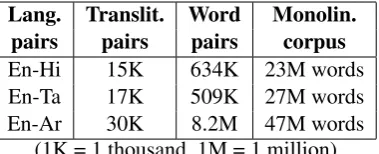
Models We need four models (translation, transliteration, language, and acronym) in order to run the proposed algorithm. For a language pair, we learnt these models using the following kinds of data, which was available to us:
• A set of pairs of NEs that are transliterations, to train the transliteration model
Lang. Translit. Word Monolin. pairs pairs pairs corpus En-Hi 15K 634K 23M words En-Ta 17K 509K 27M words En-Ar 30K 8.2M 47M words
[image:6.595.88.278.62.139.2](1K = 1 thousand, 1M = 1 million)
Table 1: Training data for the models.
• A monolingual corpus in the target language, to train a language model
• A dictionary mapping English alphabets to their transliterations in the target language.
One can get an idea of the scale of linguistic re-sources used by looking at Table 1.
Source language NER The Stanford NER tool (Finkel et al., 2005) was used for obtaining a list of English NEs from the source document.
6.2 Corpus for MWNE mining
For each language pair, a set of comparable article pairs is required. The article pairs each for En-Hi and En-Ta were obtained from news websites6, where the article correspondence was obtained us-ing a method described in (Udupa et al., 2009b). En-Ar article pairs were extracted from Wikipedia using inter-language links.
Preprocessing The Stanford NER tags each word in the source document as a person, location, organization or other. A continuous sequence of identical tags was treated as a single MWNE. Completely capitalized NEs were treated as acronyms. For each acronym (e.g. “FIFA”), both the acronym version (“FIFA”) as well as the abbreviation version (“F I F A”) were included in the list of source NEs. Each target document was sentence-separated and tokenized using simple rules based on the presence of newlines, punctuation, and blank spaces. If a word can be constructed by concatenating strings from the acronym model, it is treated as an acronym, and the acronym strings are separated out (e.g. ’O;;ma:ke’ emkeis changed to ’O;;ma :ke’ em ke).
6.3 Experimental Setup
Annotation Given an article pair, a human an-notator looks through the list of source NEs, and
6En-Hi fromWebdunia, En-Ta fromThe New Indian
Ex-press.
identifies transliterations in the target document. For MWNEs, the annotator also marks which word in the source corresponds to each word in the target MWNE. This constitutes gold standard data that can be used to measure performance. 120 article pairs were annotated for En-Hi, 120 for En-Ta, and 36 for En-Ar.
Evaluation The NEs mined from one article pair are compared with the gold standard for that pair, and one of three possible judgements is made:
• Fully matched (if it fully matches some an-notated NE (both source and target)).
• Partially matched (if source NEs match, and
the mined target NE is a subset of the gold target NE).
• Incorrect match (in all other cases).
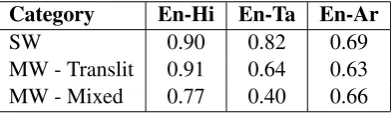
The algorithm is agnostic of the type of the NE (Person, Organization, etc.). So, reporting the precision and recall for each NE type does not provide much insight into the performance of the method. Instead, we report at different lev-els of match—full or partial, and for different categories of MWNEs—single word translitera-tion equivalents (SW), multi word transliteratranslitera-tion equivalents (including acronyms) (MW-Translit) and multi word NEs having at least one translation equivalent (MW-Mixed). We compute the num-bers for each article pair and then average over all pairs.
Parameter Tuning Parameter tuning was done following the procedure described in Section 5. For En-Hi and En-Ta, the following values were used:pN E= 1,mtlit = 100,rtlit = 7,mtlat= 1,
rtlat = 1. For En-Ar,mtlit = 1, rtlit = 14was used, the other parameters remaining the same. For the tuning exercise, 40 annotated article pairs were used for En-Hi, 40 pairs for En-Ta, and 26 pairs for En-Ar.
6.4 Results and Analysis
We evaluated the algorithm on 80 article pairs for En-Hi, 80 pairs for En-Ta, and 11 pairs for En-Ar. The results are given in Table 2.
Lang Prec. Prec. Recall Recall Pair (full) (part.) (full) (part.) En-Hi 0.84 0.86 0.89 0.89 En-Ta 0.78 0.80 0.61 0.63 En-Ar 0.42 0.44 0.63 0.66 En-Ar* 0.43 0.44 0.60 0.62
[image:7.595.75.286.63.156.2]* including the data used for tuning
Table 2: Precision and recall of the system
Category En-Hi En-Ta En-Ar
SW 0.90 0.82 0.69
MW - Translit 0.91 0.64 0.63 MW - Mixed 0.77 0.40 0.66
Table 3: Category-wise recall of the system
language models to disambiguate NE boundaries. (The false negatives are mostly due to limitations of transliteration model and the dictionary.) The precision is relatively low in Arabic, even when we include the tuning data. This suggests that the problem is not because of incorrect parameter val-ues. The error analysis for Arabic is discussed in Section 6.5.
We also report recall of the system for various categories of NEs in Table 3.7 Note that the MW cases and the SW case are mutually exclusive.
6.5 Error Analysis for Arabic
The system performed relatively poorly in Arabic than in the other languages. Detailed error analy-sis revealed the following sources of error. Source NER The text of the English articles au-tomatically extracted from Wikipedia was not very clean, as compared to the newswire text used for En-Hi and En-Ta. As a result, the source NER wrongly identified many words as NEs, which were mapped to words on the target side, affecting precision. E.g. words such as “best”, “foxe” were marked as NEs, and words with similar meaning or sound were found in the target. But since the annotator had ignored these words, the evaluation marked them as false positives.
Translation model Many words were ignored by the translation model because of the presence of diacritics, or affixes (e.g. ’لا’ al in Arabic is frequently prefixed to words; also, in Arabic, different sources of text may have different
7Since we cannot determine the category of false posi-tives, we do not report the precision here.
levels of diacritization for the same words). E.g. The target document contained ﻪﻳرﻮﻬﻤﺠﻟا
al-jamhooriyah “republic”; the dictionary contained تﺎﻳرﻮﻬﻤﺠﻟا al-jamhooriyat,
which has a different suffix, and hence was not found.
Transliteration model The non-uniform usage of diacritics and affixes (across training and test data) as mentioned above affected the perfor-mance of transliteration too. E.g. The model is trained on data where the ’لا’ prefix usually occurs
in the Arabic NE, but not in the English NE. As a result, it maps the ‘new’ in ‘new york’ toﻮﻴﻨﻟا
al-nyoo. The annotator had mapped ‘new’ to
ﻮﻴﻧ nyoo (i.e. without the prefix), causing the evaluation program to mark the system’s output as a false positive.
Generative Model Some errors occurred due to deficiencies in the generative model. The model requires every word in the source NE to be mapped to a unique word in the target NE. This causes problems when there are function words in the source NE, or when two source words are mapped to the same target word. E.g. ‘yale school of man-agement’ corresponds to the 3-word NE ‘هرادﻻا ﻞﻴﻳ ﻪﺳرﺪﻣ’ where ’of’ has no Arabic counterpart. ‘al azhar’ corresponds to the single word ﺮﻫزﻻا
al-azhar(which can be split as ﺮﻫزا لا al azhar, but is never done in practice).
7 Related work
Automatic learning of translation lexicons has been studied in many works. Pirkola et al. (Pirkola et al., 2003) suggest learning trans-formation rules from dictionaries and applying the rules to find cross lingual spelling variants. Several works (Fung, 1995; Al-Onaizan and Knight, 2001; Koehn and Knight, 2002; Rapp, 1999) suggest approaches to learn translation lexicons from monolingual corpora. Apart from single word approaches, some works (Munteanu and Marcu, 2006; Chris Quirk, 2007) focus on mining parallel sentences and fragments from ’near parallel’ corpora.
[image:7.595.84.280.191.249.2]from comparable corpora. Tao et al. (Tao et al., 2006) used phonetic mappings for mining NEs from comparable corpora, but their approach re-quires language specific knowledge which limits it to specific languages. Udupa et al. (Udupa et al., 2008; Udupa et al., 2009b) proposed a language-independent mining technique for mining single-word NE transliteration equivalents from compa-rable corpora. In this work, we extend this ap-proach for mining NE equivalents from compara-ble corpora.
8 Conclusion
Through an empirical study, we motivated the im-portance and non-triviality of mining multi-word NE equivalents in comparable corpora. We pro-posed a two-tier generative model for mining such equivalents, which is independent of the length of NE. We developed a variant of the Viterbi algo-rithm for finding the best alignment in our gener-ative model. We evaluated our approach for three language pairs, and discussed the error analysis for English-Arabic.
Currently, unigram approaches are popular for most tasks in NLP, CLIR, MT, topic modeling, etc. tasks. Phrase-based approaches are lim-ited by their efficiency and complexity, and also show limited improvement. We hope that this work will motivate researchers to explore princi-pled methods that make use of NE phrases to sig-nificantly improve the state-of-the-art in these ar-eas. The two-tier generative model is applicable to any problem where the context of an observed variable does not depend on a fixed number of past observed variables.
References
Yaser Al-Onaizan and Kevin Knight. 2001. Translat-ing named entities usTranslat-ing monolTranslat-ingual and bilTranslat-ingual resources. InACL ’02: Proceedings of the 40th An-nual Meeting on Association for Computational Lin-guistics, pages 400–408, Morristown, NJ, USA. As-sociation for Computational Linguistics.
Arul Menezes Chris Quirk, Raghavendra Udupa U. 2007. Generative models of noisy translations with applications to parallel fragments extraction. InMT Summit XI, pages 377–284. European Association for Machine Translation.
Jenny Rose Finkel, Trond Grenager, and Christopher Manning. 2005. Incorporating non-local informa-tion into informainforma-tion extracinforma-tion systems by gibbs sampling. In ACL ’05: Proceedings of the 43rd
Annual Meeting on Association for Computational Linguistics, pages 363–370, Morristown, NJ, USA. Association for Computational Linguistics.
Pascale Fung. 1995. A pattern matching method for finding noun and proper noun translations from noisy parallel corpora. InIN PROCEEDINGS OF THE 33RD ANNUAL CONFERENCE OF THE AS-SOCIATION FOR COMPUTATIONAL LINGUIS-TICS, pages 236–243.
Alexandre Klementiev and Dan Roth. 2006. Weakly supervised named entity transliteration and discov-ery from multilingual comparable corpora. In ACL-44: Proceedings of the 21st International Confer-ence on Computational Linguistics and the 44th an-nual meeting of the Association for Computational Linguistics, pages 817–824, Morristown, NJ, USA. Association for Computational Linguistics.
Philipp Koehn and Kevin Knight. 2002. Learning a translation lexicon from monolingual corpora. In
Proceedings of the ACL-02 workshop on Unsuper-vised lexical acquisition, pages 9–16, Morristown, NJ, USA. Association for Computational Linguis-tics.
Dragos Stefan Munteanu and Daniel Marcu. 2006. Extracting parallel sub-sentential fragments from non-parallel corpora. In ACL-44: Proceedings of the 21st International Conference on Computational Linguistics and the 44th annual meeting of the As-sociation for Computational Linguistics, pages 81– 88, Morristown, NJ, USA. Association for Compu-tational Linguistics.
Ari Pirkola, Jarmo Toivonen, Heikki Keskustalo, Kari Visala, and Kalervo J¨arvelin. 2003. Fuzzy transla-tion of cross-lingual spelling variants. InSIGIR ’03, pages 345–352, New York, NY, USA. ACM. Reinhard Rapp. 1999. Automatic identification of
word translations from unrelated english and german corpora. InACL, pages 519–526.
Tao Tao, Su youn Yoon, Andrew Fister, Richard Sproat, and Chengxiang Zhai. 2006. Unsupervised named entity transliteration using temporal and phonetic correlation.
Raghavendra Udupa, K. Saravanan, A. Kumaran, and Jagadeesh Jagarlamudi. 2008. Mining named entity transliteration equivalents from comparable corpora. InCIKM ’08, pages 1423–1424. ACM.
Raghavendra Udupa, K. Saravanan, Anton Bakalov, and Abhijit Bhole. 2009a. ”they are out there, if you know where to look”: Mining transliterations of oov query terms for cross-language information retrieval. In ECIR, volume 5478, pages 437–448. Springer.
Raghavendra Udupa, K. Saravanan, A. Kumaran, and Jagadeesh Jagarlamudi. 2009b. Mint: A method for effective and scalable mining of named entity transliterations from large comparable corpora. In