Dependency Parsing with Compression Rules
Pablo Gamallo
Centro Singular de Investigaci´on en Tecnolox´ıas da Informaci´on - CITIUS University of Santiago de Compostela, Galiza, Spain
Abstract
This article proposes a syntactic parsing strategy based on a dependency grammar containing both formal rules and a com-pression technique that reduces the com-plexity of those rules. Compression pars-ing is mainly driven by the spars-ingle-head constraint of Dependency Grammar, and can be seen as an alternative method to the well-knownconstructivestrategy. The compression algorithm simplifies the in-put sentence by progressively removing from it the dependent tokens as soon as binary syntactic dependencies are recog-nized. The performance of our system was compared to a deterministic parser based on supervised learning: MaltParser. Both systems were applied on several test sets of sentences in Spanish and Portuguese, from a variety of different domains and genres. Results showed that our pars-ing method keeps a similar performance through related languages and different domains, while MaltParser, as most super-vised methods, turns out to be very depen-dent on the text domain used to train the system.
1 Introduction
For large scale applications in Information Extrac-tion (IE), syntactic parsing should be robust, fast, and relatively accurate. Moreover, for specific IE applications such as semantic relation extraction, the output of parsing should be simple, easy to handle by the IE systems, and close to the seman-tic relationships to be extracted. For multilingual purposes, it is important to develop parsing tech-niques easily adapted to several languages. And finally, in order to be easily integrated in several NLP applications and tasks, the parsers should be
applied on different text domains and genres with similar accuracy.
There are two well known approaches that could be considered as good approximations to the ideal system filling all these parsing properties: both deterministic dependency parsing (Nivre, 2004) and partial parsing using rule-based finite-state techniques (Abney, 1996). However, these two parsing approaches have still some problems. Recent work on deterministic dependency pars-ing (called ‘transition based’) relies on supervised techniques requiring fully analyzed training cor-pora. Given that supervised techniques tend to have loss of precision when applied on texts of do-mains and genres different to those used for train-ing (Rimell et al., 2009; Gildea, 2001), they need too much manual effort to create, adapt, or modify the training corpus to the target domain.
Speed is not actually a problem for finite-state techniques, which can parse large text corpora in a very efficient way. However, as they rely on com-plex rule-based notations, their main drawback is the difficulty to adapt such a rule system to dif-ferent languages. Moreover, as most finite-state parsers are based on constituency grammars, their syntactic output cannot be easily integrated into IE applications. Unlike phrase constituents, depen-dencies are seen as simple and flat syntactic repre-sentations, very close to semantic relations which are the extraction target of many IE systems.
Many finite-state parsers are based on the con-structive strategy (Grefenstette, 1996; Abney, 1996; Ait-Mokhtar and Chanod, 1997). In con-structive parsing, an input sentence is manipulated by transducers that progressively transform the input with additional symbols encoding syntac-tic constituents or dependency relations (Oflazer, 2003). These transducers are pattern rules ar-ranged in cascades: the output of a transducer is the input of the next one, which contains new rules adapted to the symbols added to the input.
So, parsing consists in transforming a basic input string into a more complex one by incrementally adding new symbols, bracket delimiters, labels, or special markers. This strategy incrementally con-structs the linguistic representation within the in-put string, by making use of rules organized at dif-ferent levels of complexity.
In this article, we propose a new (rule-based) finite-state parsing strategy based on dependen-cies, which minimizes the complexity of rules by using a technique we callcompression. Compres-sion parsing is driven by the ”single-head” con-straint of Dependency Grammar, and can be seen as an alternative method to theconstructive strat-egy. It simplifies the input string by progressively removing thedependent tokens as binary syntac-tic dependencies are recognized. At the end of the compression process, if all the dependencies in the sentence were recognized, the input string should contain just one token representing the main head (i.e., the root) of the sentence. This strategy was inspired by the Right andLeft Reduce transitions used in deterministic dependency parsing. The input sentence is assumed to be tagged and dis-ambiguated with a Part-Of-Speech (PoS) tagger. Moreover, the cost of manually creating rules can also be reduced by providing a suitable rule nota-tion for linguists.
As in Ait-Mokhtar and Chanod (1997), we hold that the ordering of rules/transducers is in itself a genuine linguistic task, which must preserve the basic principle of doing the easiest task first (Ab-ney, 1996). If rules (and so the grammar) are written following this principle, it is possible to use finite-state automata to deal with embedding structures and long-distance dependencies. Note that this is a deterministic parsing strategy, since it cannot produce ambiguous structures. The use of grammars in recent dependency parsers is al-most non-existent. Our work propose to incor-porate more linguistic knowledge into the parsing systemsvialight-weight grammars.
Finally, a system based on the compression strategy was implemented and released under General Public License. In addition, we de-fined a high level grammar language to define dependency-based rules and developed a gram-mar compiler to generate compression parsers in several languages (Gamallo and Gonz´alez, 2011). The performance of this system was compared to MaltParser (Nivre et al., 2007b), a deterministic
parser based on supervised learning. Both systems were applied on several test sets of sentences of different domains and genres, in Spanish and Por-tuguese. One of the main motivations of the evalu-ation is to test whether the two systems are reliable to parse sentences of different domains and gen-res. It is generally accepted that supervised classi-fiers require some type of domain adaptation when both the training and test data sets belong to dif-ferent domains. In particular, the accuracy of sta-tistical parsers degrades when they are applied to different genres and domains (Rimell et al., 2009; Gildea, 2001). Results showed that our system keeps a similar performance through related lan-guages and different domains, while MaltParser, as most supervised methods, is very dependent on the text domain used to train the system.
The remainder of this article is organized as fol-lows. Section 2 introduces different approaches on both dependency and FST parsing. Then, Section 3 is focused on the description of our compres-sion strategy. Next, Section 4 provides a general view of the implemented system. Then Section 5 reports the diverse experiments performed over the Portuguese and Spanish data sets. And finally, some conclusions are addressed in Section 6.
2 Related Work
Our strategy is based on both dependencies and FST parsing.
2.1 Dependency-based Syntactic Parsing Following Nivre (2005), there are two tradi-tions in dependency parsing: grammar-driven and data-driven parsing. Within each tradition, it is also possible to distinguish between two differ-ent approaches: non-deterministic and determin-istic parsing. In the latest years, many works on dependency parsing have been developed within the approach to data-driven deterministic parsing, which is also known astransition-based parsing, in opposition to grammar-driven parsers. Other data-driven strategies are non-deterministic such as graph-based dependency parsing (McDonald and Pereira, 2006; Carreras, 2007; Martins et al., 2010) .
Nivre et al. (2004), the parsing strategy uses the arc-eager algorithm. In G´omez-Rodr´ıguez et al. (2014), this algorithm is simplified by just using two transitions on undirected dependencies (the head-dependent information is erased), so as to avoid error propagation.
As we will show later, the main problem of the supervised learning strategies arises when the test sentences belong to linguistic domains very dif-ferent from those found in the training corpus. We will show later the negative effect on system per-formance when the test and training data sets does not belong to the same domain and genre. As hand labeling data in new domains is a costly en-terprise, the domain adaptation problem is a fun-damental challenge in machine learning applica-tions. Note that many NLP annotated resources are based on text from the news domain (in most cases, the Wall Street Journal), which is a poor match to other domains such as biomedical texts, electronic mails, transcription of meetings, admin-istrative language, etc. (Daum´e-III and Marcu, 2007; Daum´e-III, 2006).
2.2 Finite-State Parsing Techniques
Finite-state technology has attractive properties for syntactic parsing, such as conceptual simplic-ity, flexibilsimplic-ity, and efficiency in terms of space and time. It allows to build robust and deterministic parsers. Most finite-state based parsing strategies use cascades of transducers and are known as con-structiveparsers.
Parsing based on cascades of finite-state ducers can be viewed as a sort of string trans-formation. Finite-state transducers introduce pro-gressively markings and labels within the input text. Transducers are arranged in cascades (or layers), where the subsequent transducer takes the output of the previous one as input. After a certain number of cascades, the initial input (which is a tagged sentence) is transformed into a structured text enriched with syntactic marks, such as chunk boundaries, labels for heads, spe-cial markers for functions or for relations between heads, etc. This strategy, known as constructive, progressively constructs the linguistic representa-tion within the input string, by making use of rules/transducers organized at different levels (or layers) of complexity.
Most of finite state strategies aim to construct, not dependency graphs, but phrase based
struc-tures (Ait-Mokhtar et al., 2002; Ciravegna and Lavelli, 2002; Kokkinakis and Kokkinakis, 1999; Ait-Mokhtar and Chanod, 1997; Abney, 1996; Joshi, 1996; Grefenstette, 1996). In general, the construction of these structures is performed with three main cascades/layer of rules: chunking, head recognition, and attachment. The first layers of rules transform the tagged input into sequences of symbols representing basic chunks. Then, further rules take those chunks as input to add new sym-bols marking the heads of each chunk and, finally, new rules are applied on the output of the previous ones to annotate the identified heads with labels of syntactic functions (attachment).
The number of finite-state approaches focused on constructive dependency parsing is much smaller. We can merely cite the work by Oflazer (2003), where the input string is progressively enriched by additional symbols encoding depen-dency relations between words.
The finite-state strategy often relies on one fun-damental property: easy-first parsing. Easy-first parsing means that the simplest tasks must be done first, leaving the harder decisions for the last steps of the parsing process. Parsing proceeds by grow-ingislands of certainty(Abney, 1996; Eisner and Smith, 2010; Goldberg and Elhadad, 2010; Tratz and Hovy, 2011; Versley, 2014).
Finite-state parsers are the fastest systems among those achieving linear time complexity. So, they are scalable as the input text increases in size and are easily integrated into IE applications ex-ploring the Web as corpus.
3 A Compression Parsing Strategy
We propose yet another FST based method, very similar to the constructive approaches, but by making use of a similar strategy to the shift-reduce algorithm as in incremental parsing. We call it
The input of our parsing method is a sequence of disambiguated tagged tokens, where each to-ken is associated with two pieces of information: a PoS tag representing the basic morpho-syntactic category of the token (NOUN, VERB, PRP, etc.) and a feature structure containing other relevant information of the token: morphological informa-tion (number, tense, person, etc.), lemma, token string, token position, etc. Tagged tokens are the elementary objects of the parsing process, while rules, which are implemented as finite state trans-ducers, operates on tagged tokens. More precisely, rules successively identify dependencies between tokens, remove the dependents (if required) from the input sequence, and update (if required) the feature structures of the heads.
3.1 Description of rules
A rule is a tuple< P, Arc,△, Reduce >, where:
• P is a pattern of tagged tokens, defined as a regular expression, whose general form is αXβY γ. X and Y are non-empty strings representing two tagged tokens, considered as thecore elementsof the pattern; whileα, β, andγ represent the left, middle, and right contexts, respectively, of the core elements; they may be empty.
• Arc is the action that creates a dependency link between the core elements (X and Y), when a subsequence of the tagged input is matched by the pattern; two types of arcs are distinguished: Left Arcadds a dependency link between X andY, being X the depen-dent and Y the head; Right Arc creates a dependency link betweenXandY, beingX the head and Y the dependent. This action also assigns a label (subject, modifier, ad-junct, etc) to the dependency.
• △ is a set of operations (Agreement, Add,
Correction, Inherit, etc.) that are applied on the feature structure of the core elements; they can be used to perform very different ac-tions: verifying if the two core elements (i.e., head-dependent) share a set of feature-values, adding new feature-values to the head, modi-fying some values of the head, correcting PoS tags, allowing the head to inherit selected val-ues from the dependent, etc. AddandInherit
can be seen as constructive operations.
• Reduceis the action that removes the depen-dentfrom the input string; this action can be suspended if the dependent token is likely to be the head in other dependencies that has not been recognized yet. So, the dependent will not be reduced until all its potential depen-dent tokens have been recognized.
Compressing rules, not only reduce the com-plexity of the search space (or input) of the re-maining rules to be applied, but also construct rel-evant information (by adding linguistic features) for the application of those rules. In particular, it may store in the head relevant information of the removed dependent (Inheritoperation), it per-mits to generate new attributes or modify values from existing attributes (Add operation), and also it can correct odd tagged PoS tags (Correction) (Garcia and Gamallo, 2010). In sum, the main contribution of our work is to define compressing rules as the integration of two parsing techniques: both transition-based and constructive parsing. On the one hand, the rules reduce the search space by removing the dependent tokens and, on the other hand, they can add relevant information to the head tokens by making use of operations such asAdd orInherit. Rules compresses the input se-quence of tokens so as to make it easier the identi-fication of more distant dependencies.
we know, no dependency grammar/parser has pro-posed this solution to the dependency-based anal-ysis of verbal periphrases and coordinations. 3.2 Rule Ordering: Easy First
As was mentioned above, the ordering of rules in a FST parser is a genuine linguistic task. Rules are ordered in such a way that the easiest tasks, for instance short dependencies, are performed first. As in (Eisner and Smith, 2010; Goldberg and Elhadad, 2010; Tratz and Hovy, 2011; Vers-ley, 2014), we assume that correct parsers exhibit a short-dependency preference: a word’s depen-dents tend to be close to it in the string. The fact of identifying first easy syntactic structures, such as those ruled by modifiers and specifiers, allows us to easily find later distant links, for instance those relating verbs with subordinate conjunctions. Let us take the expression: ‘if the former president of USA says ...’. There is here a long distance de-pendency between the verb ‘says’ and the condi-tional conjunction ‘if’. In most sentences, both words are not adjacent since a great variety of to-kens can be interposed. However, in a compres-sion approach, we can guess that dependency by making use of a very simple pattern consisting in a subordinate conjunction (type:S) appearing im-mediately to the left of a verb (last ruleT6below in
1). We just need the following sequence of trans-ductions/rules1:
T1: PRP←PRP NOUN
T2: NOUN←ADJ NOUN
T3: NOUN←DT NOUN
T4: NOUN←NOUN PRP
T5: VERB←NOUN VERB
T6: VERB←CONJ<type:S> VERB
(1)
In Figure 1, we show the application of the six rules on the input expression, as well as the effect of theReducetransition at each level (for the sake of simplicity, label assignment is not taken into ac-count).
Each rule processes the input from left to right repeatedly as long as new dependencies satisfying the pattern are found. Rules are checked top-down following the rank imposed by the linguist. When 1To simplify, rule notation is focused on just the final Re-duceoperation
T6: if says
T5: if president says
T4: if president of says
T3: if the president of says
T2: if the former president of says
[image:5.595.320.509.83.252.2]T1: if the former president of USA says
Figure 1: The six levels of analysis of ‘if the for-mer president of USA says...’
the parser reaches the last rule of the ranked list, if at least one dependency has been identified, the parser starts again from the beginning until no new dependency is found. So, the parser works itera-tively until no change is made.
4 The Implementation
4.1 The Modules
Our compression parsing strategy has been in-serted into a more generic natural language archi-tecture, which consists of the following modules:
A set of PoS tagging adapters that modify the output of two PoS taggers, namely FreeLing (Padr´o and Stanilovsky, 2012) and Tree-Tagger (Schimd, 1995), so as to generate an unified PoS tagged format. The result of this process is the in-put of compression parsers. A set of grammars written with a specific grammar notation. The grammar formalism was described in (Gamallo and Gonz´alez, 2011). A grammar compiler, writ-ten in Ruby, that takes a particular grammar as in-put and generates a compression parser, written in Perl. An a set of multilingual parsers, generated by the compiler from various grammars.
The whole system, called DepPattern, is re-leased under the GNU General Public License (GPL).2. Five parsers were generated for the fol-lowing languages: Spanish, Portuguese, English, French, and Galician. The parsers are robust and very efficient: they are able to parse about 3,000
2http://gramatica.usc.es/pln/tools/
words per second on a processor Core 2 Quad, 2.8 Ggz. The system can be run on any GNU/Linux distribution. DepPattern was used for several web-based IE applications, namely Open Information Extraction from Wikipedia (Gamallo et al., 2012), extraction of semantic relations with distant super-vision (Garcia and Gamallo, 2011), and extraction of bilingual terminologies from comparable cor-pora (Gamallo and Pichel, 2008). It has also been integrated into commercial tools, e.g. Linguakit3 and Avalingua4.
4.2 Multilingual Parsing
The parsers were developed for five languages: Spanish, Portuguese, Galician, French, and En-glish. However, we have just written two small, and not very different, grammars:
Romance Grammar A grammar with 96 rules that are all applied to four Latin languages, namely, Spanish, French, Galician, and Por-tuguese.
English Grammar A grammar with 104 rules for English.
The cost of writing these two grammars is quite low. They are small and almost identical, since they share most rules except a reduced group of them which is specific for English. The strategy we followed to write grammars is based on two methodological principles: to start with rules with high coverage, and to start with rules shared by as many languages as possible
The objective is to find a trade-off between high performance and low effort, i.e. we look for ef-ficiency. Most DepPattern rules of our gram-mars satisfy these two principles, giving rise to broad-coverage parsers. The quality of the French grammar is not good enough since this Latin lan-guage is quite different from Spanish, Portuguese, and Galician. There are important rules specific for French which have not been integrated in the shared grammar, for instance rules for dealing with partitives. Besides, we have not defined non-projective rules since, in general, they have low coverage and are language-dependent. Finally, the grammars also contain lexicalized rules for prepo-sitions, modal verbs, quantifiers, etc. However, as the sets of lexical units are declared in external
3https://linguakit.com/
4http://cilenis.com/en/avalingua/
configuration files, the grammars are not required to be modified.
5 Experiments
Our objective is to compare the performance of our FST-based strategy with that of a transition-based system. For this purpose, we compare Dep-Pattern with MaltParser5 (Nivre et al., 2007b), one of the top performing systems in the CoNLL shared tasks on multilingual dependency parsing in 2006 and 2007 (Hall and Nilsson, 2006; Nivre et al., 2007a). Experiments were performed on two languages: Portuguese and Spanish. The rea-son of making experiments on only two languages is the very high cost required to adapt the outputs of our system to the test data set.
5.1 Training and Test Corpora
The experiments were performed by making use of two dependency treebanks: Spanish Ancora 2.0 (Recasens and Mart´ı, 2010) and Portuguese Bosque 8.0 (Afonso et al., 2002), also used by par-ticipants at the CoNLL 2006 shared task. In order to have a similar experimental setup for the two languages, each corpus was divided in a training part containing115,000words and a test set with
100,000 words. The two training corpora were only used to build the statiscal model of Malt-Parser. DepPattern, which is a grammar-based system, does not require any training corpus. 5.1.1 MaltParser’s Optimization
We used MaltParser 1.7.1, equipped with nine dif-ferent transition-based parsing algorithms. To se-lect the best algorithm running in linear time (5 out 9: Nivre eager, Nivre standard, Stack proj, pla-nar, and 2-planar), we validated the target algo-rithms on the Portuguese test data set. The best performance was achieved by 2planar (G´omez-Rodr´ıguez and Nivre, 2010), based on arc-eager algorithm, even if the difference among the five tested algorithms was not statistically significant. So, the 2planar strategy was chosen to be com-pared with DepPattern.
All experiments were performed using a classi-fier based on support vector machines, as imple-mented in the LIBSVM package (Chang and Lin, 2001). Finally, we have reused the PoS tags and feature representation that produced the best re-sults on Portuguese and Spanish for the MaltParser
system at CoNLL shared task. 5.1.2 Test data sets
The two main data sets are the following:
bosque-test More than 3,000 sentences with 100M tokens taken from the Portuguese tree-bank.
ancora-test More than 3,000 sentences with 100M tokens taken from the Spanish tree-bank.
In order to compare MaltParser with Dep-Pattern, we must address three problems when preparing the test data set:
• The tagsets and feature structures required by DepPattern are not the same as those avail-able in the treebanks to train MaltParser. • Each treebank was annotated following
dif-ferent criteria regarding some linguistic phe-nomena. Besides, there are also differences of criteria between DepPattern and some de-pendency solutions found in the treebanks. • MaltParser can take advantage of the fact that
both training and test sets belong to the same domain.
DepPattern requires as input PoS tagged text with the format provided by Tree-Tagger or FreeL-ing. Ancora 2.0 was annotated with FreeLing tags, but it is not the case of Bosque 8.0. In or-der to permit DepPattern to have the same en-try as MaltParser for the Portuguese corpus, the PoS tags and features of Bosque 8.0 were con-verted into FreeLing-based PoS tags. Note that this PoS tag conversion allows us to apply Malt-Parser, in combination with FreeLing, to raw text. First, the PoS tags and feature representation of the two training sets were transformed into the FreeL-ing format. Then, the best MaltParser configura-tion was trained on these two sets and, finally, it was applied on text previously tagged with FreeL-ing. The results obtained were very similar (even slightly better) to those obtained with the PoS tags and features of the original treebanks. Conversion scripts are freely available.6
However, the main problem to evaluate DepPat-tern and to compare it with other systems is to
6http://gramatica.usc.es/˜gamallo/
resources/depcorpus-test.tgz
minimize the noise derived from the choice of dif-ferent linguistic criteria. In particular, we found in DepPattern grammars several linguistic decisions to define dependencies that are very different from those found in the exploited treebanks. For in-stance:
• All clause arguments (including the subject) are dependent on lexicalized verbs, and not on light or auxiliary verbs.
• All members of a coordination are dependent on the conjunction and not on the first coor-dinated member.
DepPattern grammars follow these two crite-ria. Bosque 8.0 follows neither of the two, and Ancora 2.0 just follows the first one. So, there are three different dependency criteria for dealing with these two linguistic phenomena, which have large coverage. In addition, there are many other conflicts to be considered: DepPattern analyzes the Portuguese possesive expressions in a differ-ent way as the treebank annotators: in ‘a sua mul-her’ (his wife), ‘sua’ is dependent of ‘mulher’ and ‘a’ of ‘sua’. However, in the Portuguese treebank, ‘a’ and ‘sua’ both depend of ‘mulher’. There are also different decisions for the internal dependen-cies of periphrastic verbal expressions: e.g. ‘tiene que ir’ (have to go). Particle ‘que’ (to) can be ei-ther dependent of ‘tiene’ or of ‘ir’. All these dif-ferences are a serious drawback for comparing our grammar-based parser against a corpus-driven sys-tem. To solve the problem, we adapted our generic Romance Grammar to each treebank. As a result, we generated both a Portuguese parser adapted to Bosque and a Spanish parser adapted to Ancora. Another solution would have been to create con-versor scripts to automatically modify the tree-banks. However, as the algorithms required are not trivial, in particular for complex phenomena such as coordination, this strategy was not considered.
The third problem is related to the content sim-ilarity between the training and the test corpora, which could benefit the data-driven system. Apart from the two data sets extracted from the tree-banks, we also built a small gold standard, called
open-test, by manually analyzing sentences ex-tracted from different sources. The description of this new test data set is the following:
Precision Recall F-score
ancora-test(es) 84.6 79.7 82
bosque-test(pt) 84.1 79.2 81.6
[image:8.595.85.278.62.106.2]open-test(pt) 86.2 76.6 81.1
Table 1: Evaluation of DepPattern (unlabeled de-pendencies)
variety of genres and domains: Wikipedia (scientific domain and encyclopedic genre), a Portuguese novel by Machado Assis (lit-erature genre), documents of the European Commission (economy domain).
Both bosque-test and ancora-test consist of sen-tences belonging to the same journalist genre as those found in the training corpus. By con-trast, open-test consists of miscellaneous sen-tences whose content is distributed through differ-ent genres and domains. So it can be considered as an open-content test set. The dataset is freely available7
5.2 Evaluation
To evaluate the performance of the two systems, it is necessary to take into account that DepPattern produces partial parses. This system assigns the dependency relation ‘0’ (or Root) to all unattached tokens. So, it is relevant to make use of preci-sion and recall, instead of accuracy, to measure the performance of the DepPattern parsers. For Malt-Parser, precision and recall are the same: these val-ues correspond to the unlabeled attachment score (UAS).
Furthermore, as the dependency labels of Dep-Pattern are very different from those found in the two treebanks, the evaluation was restricted to un-labeled dependencies. Parser evaluation is con-ducted by comparing the dependencies guessed by the system with manually revised dependencies. Given these two data sets, precision and recall are defined as in (Lin, 1998). As ‘0’ values, associated to unattached tokens, are considered as not found dependencies, they are relevant to measure recall in DepPattern. Punctuation marks are ignored in our evaluation.
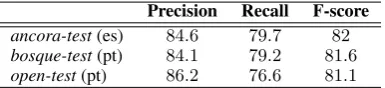
Tables 1 and 2 show the results obtained with DepPattern and MaltParser, respectively, when ap-plied on the different testing sets. The results ob-tained by MaltParser represent in fact the UAS
7http://gramatica.usc.es/˜gamallo/
resources/depcorpus-test.tgz
Precision Recall F-score
ancora-test(es) 85 85 85
bosque-test(pt) 88.2 88.2 88.2
[image:8.595.317.513.62.107.2]open-test(pt) 81.3 81.3 81.3
Table 2: Evaluation of MaltParser (unlabeled de-pendencies)
of the system, since precision and recall are the same. MaltParser outperforms DepPattern on both
bosque-testandancora-test.
The scores we obtained using MaltParser fol-low the same tendency (even if they are not iden-tical) of those obtained at the CoNLL 2006 shared task, where the system achieved91%accuracy on Portuguese and 85 on Spanish (for unlabeled at-tachment scores). In our experiments, MaltParser obtained 88.2%and85, respectively. The differ-ences between the Portuguese scores at CoNLL and those obtained in our experiment could derive from small changes in the optimization procedure, and from the size of the training corpus. Notice that the performance of MaltParser is quite differ-ent across our three data sets: 88.2%(bosque)85
(ancora), and81.3(open). By contrast, DepPattern achieves similar results in all the tests.
In the content-open test, we observe that whereas MaltParser gets down from88.2accuracy to 81.3, DepPattern keeps a similar score in the three datasets. It seems that the change of do-main affects the performance of the data-driven system. By contrast, the grammar-based parser keeps a similar performance across domains and genres. It seems to be also most stable across different languages: it achieves similar results in Spanish and Portuguese because, on the one hand, these languages are very close and, on the other, DepPattern only use those grammar rules shared by the two languages. However, it is not easy to explain why MaltParser behaves in a very differ-ent way on two languages which are very similar in terms of grammar.
means that the two systems are complementary since many of the correct dependencies they guess are not the same. In sum, they are good in differ-ent ways. This insight essdiffer-entially encourages to the pursuit of hybrid approaches and parser binations, since both strategies seem to be com-plementary and should work together to produce more efficient results.
6 Conclusions
The work described in the article can be seen as a contribution to improve old parsing strategies in-troduced at the end of the twentieth century, when most efficient techniques were based on rules/FST and constructive approaches. In particular, we de-scribed a grammar-driven parser based on FST, called compression parsing, which takes into ac-count some elements from deterministic and incre-mental dependency parsing, namely Arcand Re-duce transitions. This compression method, im-plemented in DepPattern, was compared with a data-driven, transition-based system: MaltParser.
The cost and effort of developing compression parsers for several languages is not very high, since they can achieve reasonable performance us-ing just very simple, multilus-ingual, and general-purpose grammars. In this article, we have also introduced a simple methodology to write multi-lingual and general-purpose grammars.
In future work, it would be interesting to com-pare a variety of grammar-driven systems by mea-suring, not only their performance, but also the complexity of the underlying grammar: number of rules, size (in bytes) of the source files, etc. It should also be important to quantify and com-pare the cost and effort of both writing grammars and building treebanks. Moreover, to comple-ment quantitative evaluation, it will be necessary to define objective protocols to compare parsers on the basis on qualitative evaluation (Lloberes et al., 2014).
Finally, we claim that FST-based parsing tech-niques simulate how we solve problems quickly, by taking first easy decisions which, in turn, make it easier to solve further complex tasks. How-ever, these parsing techniques are far from simu-lating two other interesting cognitive operations: first, how grammars are learnt and, second, how sentences are processed. Data-driven approaches can be seen as a good approximation to the way humans learn grammars, while incremental
left-to-right parsing can be seen as a simulation of how humans process and understand input sen-tences. Here, a question arises: would it be pos-sible to define a method taking advantage of all those parsing strategies? In other words, could be it possible to model a strategy that learns gram-mar rules from data, orders them as cascades of progressively more complex transducers, and ap-plies them to sentences in an incremental way? A method provided with these three ‘human prop-erties’ would be closer to the canonical systems in Artificial Intelligence, since the main objective would be, not only to produce parse trees, but also to simulate how humans understand sentences.
Acknowledgement
This work has been supported by RedPLIR, Xunta de Galicia, ref: CN2014/034.
References
Steven Abney. 1996. Partial parsing via finite-state cascades. InProceedings of the ESSLLI’96 Robust Parsing Workshop, pages 8–15.
Susana Afonso, Eckhard Bick, Renato Haber, and Di-ana Santos. 2002. Floresta sint´a(c)tica”: a treebank for portuguese. InLREC 2002, the Third Interna-tional Conference on Language Resources and Eval-uation, pages 1698–1703, Las Palmas de Gran Ca-naria, Spain.
Salah Ait-Mokhtar and Jean-Pierre Chanod. 1997. In-cremental finite-state parsing. InProceedings of the 5th Conference on Applied Natural Language Pro-cessing (ANLP-97), Washington, DC, USA.
Salah Ait-Mokhtar, Jean-Pierre Chanod, and Claude Roux. 2002. Robustness beyond shallowness: In-cremental deep parsing. Natural Language Engi-neering, 8(2/3):121–144.
Xavier Carreras. 2007. Experiments with a higher-order projective dependency parser. In
EMNLP/CoNLL.
Chih Chang and Chih J. Lin, 2001. LIBSVM: a library for support vector machines.
Fabio Ciravegna and Alberto Lavelli. 2002. Full pars-ing approximation for information extraction via finite-state cascades. Natural Language Engineer-ing, 8(2/3):145–165.
Hal Daum´e-III. 2006. Domain adaptation for statis-tical classifiers. Artificial Intelliegence Research, 26:101–126.
Jason Eisner and Noah A. Smith. 2010. Favor short dependencies: Parsing with soft and hard con-straints on dependency length. In Harry Bunt, Paola Merlo, and Joakim Nivre, editors,Trends in Parsing Technology: Dependency Parsing, Domain Adapta-tion, and Deep Parsing, chapter 8, pages 121–150. Springer.
Pablo Gamallo and Isaac Gonz´alez. 2011. A grammat-ical formalism based on patterns of part-of-speech tags. International Journal of Corpus Linguistics, 16(1):45–71.
Pablo Gamallo and Jos´e Ramom Pichel. 2008. Learn-ing Spanish-Galician Translation Equivalents UsLearn-ing a Comparable Corpus and a Bilingual Dictionary.
LNCS, 4919:413–423.
Pablo Gamallo, Marcos Garcia, and Santiago Fern´andez-Lanza. 2012. Dependency-based open information extraction. In ROBUS-UNSUP 2012: Joint Workshop on Unsupervised and Semi-Supervised Learning in NLP at the 13th Conference of the European Chapter of the Association for Computational Linguistics (EACL 2012), Avignon, France.
Marcos Garcia and Pablo Gamallo. 2010. Using morphosyntactic post-processing to improve pos-tagging accuracy. InPROPOR-2010, Porto-Alegre, Brasil.
Marcos Garcia and Pablo Gamallo. 2011. Dependency-based text compression for semantic relation extraction. In Workshop on Information Extraction and Knowledge Acquisition (IEKA 2011) at 8th International Conference on Recent Advances in Natural Language Processing (RANLP 2011), pages 21–28.
Daniel Gildea. 2001. Corpus variation and parser per-formance. In2001 EMNLP Conference, Pittsburgh, PA.
Yoav Goldberg and Michael Elhadad. 2010. An effi-cient algorithm for easy-first non-directional depen-dency parsing. InHuman Language Technologies: The 2010 Annual Conference of the North American Chapter of the Association for Computational Lin-guistics, pages 742–750, Stroudsburg, PA, USA. Carlos G´omez-Rodr´ıguez and Daniel
Fern´andez-Gonz´alez. 2012. Dependency parsing with undi-rected graphs. In13th Conference of the European Chapter of the Association for Computational Lin-guistics (EACL), pages 66–76, Avignon, France. Carlos G´omez-Rodr´ıguez and Joakim Nivre. 2010.
A transition-based parser for 2-planar dependency structures. InProceedings of the 48th Annual Meet-ing of the Association for Computational LMeet-inguis- Linguis-tics, ACL ’10, pages 1492–1501, Stroudsburg, PA, USA.
Carlos G´omez-Rodr´ıguez, D. Fern´andez-Gonz´alez, and V. Bilbao. 2014. Undirected dependency pars-ing. Computational Intelligence.
Gregory Grefenstette. 1996. Light parsing as finite-state filtering. InWorkshop on Extended Finite State Models of Language ECAI’96, Budapest, Hungary. Johan Hall and Jens Nilsson. 2006. CoNLL-X shared
task on multilingual dependency parsing. In The tenth CoNLL.
Aravind Joshi. 1996. A parser from antiquity: An early application of finite state transducers to natural language parsing. InECAI-96 Workshop on Exten-dend Finite State Models of Languages, Budapest, Hungary.
Dimitrios Kokkinakis and Sofie Johansson Kokkinakis. 1999. A cascaded finite-state parser for syntactic analysis of swedish. InThe 9th EACL, Bergen, Nor-way.
Dekang Lin. 1998. Dependency-Based Evaluation of MINIPAR. In Workshop on Evaluation of Parsing Systems, Granada, Spain.
Marina Lloberes, Irene Castell´on, Llu´ıs Padr´o, and Edgar Gonz´alez. 2014. Partes. test suite for pars-ing evaluation. Procesamiento del Lenguaje Natu-ral, 53:87–94.
Andr´e F. T. Martins, Noah A. Smith, Eric P. Xing, Pedro M. Q. Aguiar, and M´ario A. T. Figueiredo. 2010. Turboparsers: Dependency parsing by ap-proximate variational inference. InEmpirical Meth-ods in Natural Language Processing (EMNLP’10), Boston, USA.
Ryan McDonald and Fernando Pereira. 2006. Online learning of approximate dependency parsing algo-rithms. InEACL-2006, pages 81–88.
Joaquim Nivre, Johan Hall, and Jens Nilson. 2004. Memory-based dependency parsing. InProceedings of CoNLL, pages 49–56.
Joakim Nivre, Johan Hall, Sandra K¨ubler, Ryan Mc-Donald, Jens Nilson, Sebastian Riedel, and Deniz Yuret. 2007a. The CoNLL-2007 shared task on dependency parsing. InProceedings of the Shared Task Session of EMNLP-CoNLL 2007, pages 915– 932, Prague, Czech Republic.
Joakim Nivre, Johan Hall, Jens Nilsson, Atanas Chanev, G¨ulsen Eryigit, Sandra K¨ubler, Svetoslav Marinov, and Erwin Marsi. 2007b. Maltparser: A language-independent system for data-driven de-pendency parsing. Natural Language Engineering, 13(2):115–135.
Joaquim Nivre. 2005. Dependency grammar and de-pendency parsing. Technical Report MSI report 05133, V¨axj¨o University: School of Mathematics and Systems Engineering.
Kemal Oflazer. 2003. Dependency parsing with an extended finite-state approach. Computational Lin-guistics, 29(4):515–544.
Llu´ıs. Padr´o and Evgeny Stanilovsky. 2012. Freeling 3.0: Towards wider multilinguality. InConference on Language Resources and Evaluation (LREC’12), Istanbul, Turkey.
Marta Recasens and M. Ant`onia Mart´ı. 2010. AnCora-CO: Coreferentially annotated corpora for spanish and catalan. Language Resources and Evaluation, 315-345(4):315–345.
Laura Rimell, Stephen Clark, and Mark Steedman. 2009. Unbounded dependency recovery for parser evaluation. InConference on Empirical Methods in Natural Language Processing, pages 813–821, Sin-gapore.
Helmut Schimd. 1995. Improvements in part-of-speech tagging with an application to german. In
ACL SIGDAT Workshop, Dublin, Ireland.
Stephen Tratz and Eduard Hovy. 2011. A fast, effec-tive, non-projeceffec-tive, semantically-enriched parser. InIn Proceedings of EMNLP. Joseph Turian, Lev-Arie Ratinov, and Yoshua Bengio.
Yannick Versley. 2014. Experiments with easy-first nonprojective constituent parsing. In Proceedings of the First Joint Workshop on Statistical Parsing of Morphologically Rich Languages and Syntactic Analysis of Non-Canonical Languages, pages 39– 53, Dublin, Ireland.