Scoring Spoken Responses Based on Content Accuracy
Fei Huang
CS Dept. Temple Univ. Philadelphia, PA, 19122
Lei Chen
Educational Testing Service (ETS) Princeton, NJ, 08541
Jana Sukkarieh
ETS
Abstract
Accuracy of content have not been fully uti-lized in the previous studies on automated speaking assessment. Compared to writing tests, responses in speaking tests are noisy (due to recognition errors), full of incomplete sentences, and short. To handle these chal-lenges for doing content-scoring in speaking tests, we propose two new methods based on information extraction (IE) and machine learning. Compared to using an ordinary content-scoring method based on vector anal-ysis, which is widely used for scoring written essays, our proposed methods provided con-tent features with higher correlations to human holistic scores.
1 Introduction
In recent years, there is an increasing interest of using speech processing and natural language pro-cessing (NLP) technologies to automatically score speaking tests (Eskenazi, 2009). A set of features related to speech delivery, such as fluency, pronun-ciation, and intonation, has been utilized in these studies. However, accuracy of an answer’s content to the question being asked, important factors to be considered during the scoring process, have not been fully utilized. In this paper, we will report our ini-tial efforts exploring content scoring in an automated speaking assessment task. To start, we will briefly describe the speaking test questions in our research. In the test we used for evaluation, there were two types of questions. The first type, survey, requires a test-taker to provide answers specific to one or several key points in a survey ques-tion without any background reading/listening re-lated to the topic of the survey. Typical questions
could be “how frequently do you go shopping?” or “what kind of products did you purchase recently?” In contrast, the second type,opinion, requires a test-taker to speak as long as60 seconds to present his or her opinions about some topic. An example of such questions could be, “Do you agree with the statement that online shopping will be dominant in future or not?” Compared to the essays in writing tests, these spoken responses could just be incom-plete sentences. For example, for the survey ques-tions, test-takers could just say several words. For the questions described above, some test-takers may just use phrases like “once a week” or “books”. In addition, given short responding durations, the num-ber of words in test-takers’ responses is limited. Fur-thermore, since scoring speech responses requires speech recognition, more noisy inputs are expected. To tackle these challenges, we propose two novel content scoring methods in this paper.
The remainder of the paper is organized as fol-lows: Section 2 reviews the related previous re-search efforts; Section 3 proposes the two content-scoring methods we designed for two types of ques-tions described above; Section 4 reports the experi-mental results of applying the proposed methods; fi-nally, Section 5 concludes our reported research and describes our plans for future research.
2 Related Work
For writing tests, previous content scoring investiga-tions can be divided into the following three groups. The first group relies on obtaining and matching pat-terns associated with the correct answers (Leacock and Chodorow, 2003; Sukkarieh and Blackmore, 2009).
The second group of methods, also mostly used
for content-scoring, is to rely on a variety of text similarity measurements to compare a response with either pdefined correct answers or a group of re-sponses rated with a high score (Mohler and Mihal-cea, 2009). Compared to the first group, such meth-ods can bypass a labor intensive pattern-building step. A widely used approach to measuring text similarity between two text strings is to convert each text string into a word vector and then use the angle between these two vectors as a similar-ity metric. For example, Content Vector Analy-sis (CVA) has been successfully utilized to detect off-topic essays (Higgins et al., 2006) and to pro-vide content-related features for essay scoring (At-tali and Burstein, 2004). For this group of meth-ods, measuring the semantics similarity between two terms is a key question. A number of metrics have been proposed, including metrics (Courley and Mi-halcea, 2005) derived from WordNet, a semantics knowledge database (Fellbaum, 1998), and metrics related to terms’ co-occurrence in corpora or on the Web (Turney, 2001).
The third group of methods treats content scor-ing as a Text Categorization (TC) task, which treats the responses being scored on different score levels as different categories. Therefore, a large amount of previous TC research, such as the many machine learning approaches proposed for the TC task, can be utilized. For example, Furnkranz et al. (1998) compared the performance of applying two machine learning methods on a web-page categorization task and found that the Repeated Incremental Pruning to Produce Error Reduction algorithm (RIPPER) (Co-hen, 1995) shows an advantage concerning the fea-ture sparsity issue.
3 Methodology
As described in Section 1, for the two types of ques-tions considered, the number of words appearing in a response is quite limited given the short re-sponse time. Therefore, compared to written es-says, when applying the content-scoring methods based on vector analysis, e.g., CVA, feature sparsity becomes a major factor negatively influencing the performance of these methods. Furthermore, there are more challenges when applying vector analysis on survey questions because test-takers could just use words/phrases rather than completed sentences.
Also, somesurveyquestions could have a very large range of correct answers. For example, if a question is about the name of a book, millions of book ti-tles could be potential answers. Therefore, a simple phrase-matching solution cannot work.
3.1 Semi-Automatic Information Extraction Forsurveyresponses, the answers should be related to the key points mentioned in the questions. For example, for the question, “What kind of TV pro-grams do you like to watch?”, possible correct an-swers should be related to TV programs. Moreover, it should be the instances of specific TV programs, like news, comedy, talk shows, etc. Note that the ac-ceptable answers may be infinite, so it is not realis-tic to enumerate all possible answers. Therefore, we proposed a method to extract the potential answer candidates and then measure their semantic similar-ities to the answer keys that could be determined manually. In particular, the answer keys were deter-mined by the first author based on her analysis of the test prompts. For example, for the question “What kind of books do you like to read?”, two answer keys, “book” and “reading” were selected. After a fur-ther analysis of the questions, we found that most of thesurveyquestions are about “when” “where” and “what”, and the answers in the responses were usu-ally nouns or noun phrases. Therefore, we decided to extract the noun phrases from each response and use them as potential candidates.
We use two semantic similarity metrics (SSMs) to evaluate how each candidate relates to an answer key, including PMI-IR (Turney, 2001) and a word-to-word similarity metric from WordNet (Courley and Mihalcea, 2005). The PMI-IR is a measure based on web query analysis using Pointwise Mutual Information (PMI) and Information Retrieval (IR). For an answer candidate (c) and an answer key (k), their PMI-IR is computed as:
SSMPMI-IR(c, k) = hits(cNEARk)
hits(c)
where thehits(x)function obtains the count of term
we found that the Wu-Palmer metric proposed by Wu and Palmer (1994) worked the best in our pilot study. This metric is a score denoting how similar two word senses are, based on the depth of the two word senses in the taxonomy and their Least Com-mon Subsumer1(LCS):
SSMWN(c, k) =
2∗depth(LCS)
depth(c) +depth(k)
For each answer key, we calculated two sets of SSMs (SSMPMI-IR and SSMW N, respectively)
from all candidates. Then, we selected the largest
SSMPMI-IRandSSMW N as the final SSMs for this
particular answer key. For each test question, using the corresponding responses in the training set, we built a linear regression model between these SSMs for all answer keys and the human judged scores. The learned regression model was applied to the re-sponses to this particular testing question in the test-ing set to convert a set of SSMs to predictions of human scores. The predicted scores were then used as a content feature. Since answer keys were deter-mined manually, we refer to this method as semi-automatic information extraction (Semi-IE).
3.2 Machine Learning Using Smoothed Inputs For the opinion responses, inspired by Furnkranz et al. (1998), we decided to try sophisticated ma-chine learning methods instead of the simple vector-distance computation used in CVA. Due to short response-time in the speaking test being considered, the ordinary vector analysis may face a problem that the obtained vectors are too short to be reliably used. In addition, using other non-CVA machine learning methods can enable us to try other types of linguis-tic features. To address the feature sparsity issue, a smoothing method, which converts word-based text features into features based on other entities with a much smaller vocabulary size, is used. We use a Hidden Markov Model (HMM) based smooth-ing method (Huang and Yates, 2009), which in-duces classes, corresponding to hidden states in the HMM model, from the observed word strings. This smoothing method can use contextual information of the word sequences due to the nature of HMM.
Then, we convert word-entity vectors to the vec-tors based on the induced classes. TF-IDF (term
1Most specific ancestor node
frequency and inverse document frequency) weight-ing is applied on the new class vectors. Finally, the processed class vectors are used as input fea-tures (smoothed) to a machine learning method. In this research, after comparing several widely used machine learning approaches, such as Naive Bayes, CART, etc., we decided to use RIPPER proposed by Cohen (1995), a rule induction method, similar to Furnkranz et al. (1998).
4 Experiments
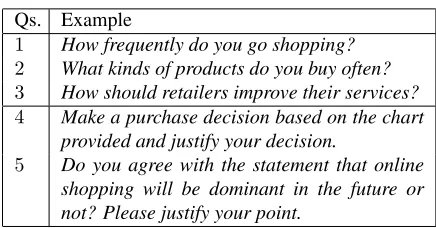
Our experimental data was from a test for interna-tional workplace English. Six testing papers were used in our study and each individual test contains threesurvey questions (1, 2, and 3) and two opin-ion questions (4 and 5). Table 1 lists examples for these question types. From the real test, we collected spoken responses from a total of 1,838
test-takers. 1,470test-takers were used for training and 368were used for testing. Following scoring rubrics developed for this test by considering speak-ers’ various language skill aspects, such as fluency, pronunciation, vocabulary, as well as content accu-racy, thesurveyandopinionresponses were scored by a group of experienced human raters by using a
3-point scale and a 5-point scale respectively. For thesurveyresponses, the human judged scores were centered on2; for theopinionresponses, the human judged scores were centered on3and4.
Qs. Example
1 How frequently do you go shopping?
2 What kinds of products do you buy often?
3 How should retailers improve their services?
4 Make a purchase decision based on the chart provided and justify your decision.
[image:3.612.317.535.451.565.2]5 Do you agree with the statement that online shopping will be dominant in the future or not? Please justify your point.
Table 1: Examples of the five kinds of questions investi-gated in the study
a word error rate around 30% to 40% could be achieved on the held-out speech data. In our exper-iments, we used speech transcriptions in the model training stage and used ASR outputs in the testing stage. Note that we decided to use speech transcrip-tions, instead of noisy ASR outputs that match to the testing condition, to make sure that the learned content-scoring model are based on correct word en-tities related to content accuracy.
For the survey responses, we manually selected the key points from the testing questions. Then, using a Part-Of-Speech (POS) tagger and a sen-tence chunker implemented by using the OpenNLP2 toolkit, we found all possible nouns and noun-phrases that could serve as answer candidates and applied the Semi-IE method described in Sec-tion 3.1. Foropinionquestions, based on Huang and Yates (2009), we used80hidden states and applied the method described in Section 3.2 for content scor-ing. We used JRip, a Java implementation of the RIPPER (Cohen, 1995) algorithm in the Weka (Hall et al., 2009) machine learning toolkit, in our experi-ments.
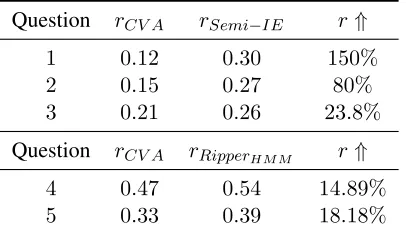
When measuring performance of content-related features, following many automated assessment studies (Attali and Burstein, 2004; Leacock and Chodorow, 2003; Sukkarieh and Blackmore, 2009), we used the Pearson correlationrbetween the con-tent features and human scores as an evaluation met-ric. We compared the proposed methods with a base-line method, CVA. It works as follows: it first groups all the training responses by scores, then it calculates a TF vector from all the responses under a score level. Also, an IDF matrix is generated from all the training responses. After that, for each testing response, CVA first converts it into a TF-IDF vec-tor and then calculates the cosine similarity between this vector with each score-level vector respectively and uses the largest cosine similarity as the content feature for that response. The experimental results, including content-features’ correlationsr to human scores from each proposed method and the correla-tion increases measured on CVA results, are shown in Table 2. First, we find that CVA, which is de-signed for scoring lengthy written essays, does not work well for the survey questions, especially on
2http://opennlp.sourceforge.net
Question rCV A rSemi−IE r⇑
1 0.12 0.30 150%
2 0.15 0.27 80%
3 0.21 0.26 23.8%
Question rCV A rRipperHM M r⇑
4 0.47 0.54 14.89%
[image:4.612.327.530.55.172.2]5 0.33 0.39 18.18%
Table 2: Comparisons of the proposed content-scoring methods with CVA onsurveyandopinionresponses
first two questions, which are mostly phrases (not completed sentences). By contrast, our proposed Semi-IE method can provide more informative con-tent measurements, indicated by substantially in-creased r. Second, CVA works better on opinion questions than onsurveyquestions. This is because thatopinion questions can be treated as short spo-ken essays and therefore are closer to the data on which the CVA method was originally designed to work. However, even on such a well-performing CVA baseline, the HMM smoothing method allows the Ripper algorithm to outperform the CVA method in content-features’ correlations to human scores. For example, on question4, on which either a table or a chart has been provided to test-takers, the CVA achieves ar of0.47. The proposed method can still improve therby about15%.
5 Conclusions and Future Works
In this paper, we proposed two content-scoring methods for the two types of test questions in an automated speaking assessment task. For particu-lar properties of these two question types, we uti-lized information extraction (IE) and machine learn-ing technologies to better score them on content accuracy. In our experiments, we compared these two methods, Semi-IE and machine learning us-ing smoothed inputs, with an ordinary word-based vector analysis method, CVA. The content features computed using the proposed methods show higher correlations to human scores than what was obtained by using the CVA method.
se-mantic similarly measurements (SSMs) into a single content feature. For the machine learning approach, inspired by Furnkranz et al. (1998), we will inves-tigate how to use some linguistic features related to response structures rather than just TF-IDF weights.
References
Y. Attali and J. Burstein. 2004. Automated essay scoring with e-rater v.2.0. InPresented at the Annual Meet-ing of the International Association for Educational Assessment.
W. Cohen. 1995. Text categorization and relational learning. InIn Proceedings of the 12th International Conference on Machine Learning.
C. Courley and R. Mihalcea. 2005. Measuring the se-mantic similarity of texts. InProceedings of the ACL Workshop on Empirical Modeling of Semantic Equiv-alence and Entailment, pages 13–18.
M. Eskenazi. 2009. An overview of spoken language technology for education. Speech Communication, 51(10):832–844.
C. Fellbaum. 1998. WordNet: An Electronic Lexical Database. Bradford Books.
J. Furnkranz, T. Mitchell, and E. Riloff. 1998. A case study in using linguistic phrases for text categorization on the WWW. In Proceedings from the AAAI/ICML Workshop on Learning for Text Categorization, page 512.
M. Hall, E. Frank, G. Holmes, B. Pfahringer, P. Reute-mann, and I. H Witten. 2009. The WEKA data min-ing software: An update. ACM SIGKDD Explorations Newsletter, 11(1):10–18.
D. Higgins, J. Burstein, and Y. Attali. 2006. Identifying off-topic student essays without topic-specific training data.Natural Language Engineering, 12.
F. Huang and A. Yates. 2009. Distributional represen-tations for handling sparsity in supervised sequence-labeling. InProceedings of ACL.
C. Leacock and M. Chodorow. 2003. C-rater: Auto-mated scoring of short-answer questions. Computers and the Humanities, 37(4):385–405.
M. Mohler and R. Mihalcea. 2009. Text-to-text seman-tic similarity for automaseman-tic short answer grading. In Proceedings of the 12th Conference of the European Chapter of the Association for Computational Linguis-tics, pages 567–575.
J. Z. Sukkarieh and J. Blackmore. 2009. c-rater: Auto-matic content scoring for short constructed responses. In Paper presented at the Florida Artificial Intelli-gence Research Society (FLAIRS) Conference, Sani-bel, FL.
P. D. Turney. 2001. Mining the Web for Synonyms: PMI-IR versus LSA on TOEFL. In Procs. of the Twelfth European Conference on Machine Learning (ECML), pages 491–502, Freiburg, Germany.