Effective Morphological Feature Selection
with MaltOptimizer at the SPMRL 2013 Shared Task
Miguel Ballesteros
Natural Language Processing Group Pompeu Fabra University.
Barcelona, Spain
Abstract
The inclusion of morphological features pro-vides very useful information that helps to en-hance the results when parsing morphologi-cally rich languages. MaltOptimizer is a tool, that given a data set, searches for the mal parameters, parsing algorithm and opti-mal feature set achieving the best results that it can find for parsers trained with MaltParser. In this paper, we present an extension of Mal-tOptimizer that explores, one by one and in combination, the features that are geared to-wards morphology. From our experiments in the context of the Shared Task on Parsing Morphologically Rich Languages, we extract an in-depth study that shows which features are actually useful for transition-based pars-ing and we provide competitive results, in a fast and simple way.
1 Introduction
Since the CoNLL Shared Tasks on Syntactic Depen-dency parsing (Buchholz and Marsi, 2006; Nivre et al., 2007), the number of treebanks and new pars-ing methods have considerably increased. Thanks to that, it has been observed that parsing morphologi-cally rich languages (henceforth, MRLs) is a chal-lenge because these languages include multiple lev-els of information that are difficult to classify and, therefore, to parse. This is why there has been recent research in this direction, with for instance a Special Issue in Computational Linguistics (Tsarfaty et al., 2012b).
MaltOptimizer (Ballesteros and Nivre, 2012b; Ballesteros and Nivre, 2012a) is a system that is
ca-pable of providing optimal settings for training mod-els with MaltParser (Nivre et al., 2006a), a freely available transition-based parser generator. MaltOp-timizer, among other things, performs an in-depth feature selection, selecting the attributes that help to achieve better parsing results. In this paper – and in this participation in the Shared Task on Pars-ing Morphologically Rich Languages (Seddah et al., 2013) – we present an extension of MaltOptimizer that performs a deeper search over the morpholog-ical features that are somewhat one of the keys to parsing MRLs. Instead of lumping all morphosyn-tactic features together, we define a different field for each individual feature (case, number, gender, etc.). Hence, we are able to extract a study that shows which features are actually useful for parsing MRLs with MaltParser.
The new SPMRL-MaltOptimizer
imple-mentation is available for download at
http://nil.fdi.ucm.es/maltoptimizer/spmrl.html. It is worth noting that it can be applied to any treebank in CoNLL data format.1
The rest of the paper is organized as follows. Sec-tion 2 describes MaltOptimizer. SecSec-tion 3 shows how we modified MaltOptimizer to make it able to perform a more complete morphological feature se-lection. Section 4 describes the experiments that we carried out with the data sets of the Shared Task on Parsing Morphologically Rich Languages. Section 5 reports the results of the experiments and the con-clusions that we can extract. Section 6 discusses re-lated work on MaltOptimizer and parsing morpho-logically rich languages. And finally, Section 7
con-1
http://ilk.uvt.nl/conll/#dataformat
cludes.
2 MaltOptimizer
MaltOptimizer is a system written in Java that im-plements a full optimization procedure for Malt-Parser based on the experience acquired from pre-vious experiments (Hall et al., 2007; Nivre and Hall, 2010). MaltOptimizer attempts to find the best model that it can find, but it does not guarantee that the outcome is the best model possible because of the difficulty of exploring all the possibilities that are provided by the parameters, parsing algorithms and different feature windows. The optimization proce-dure is divided in 3 different phases, as follows:
1. Data analysis and initial optimization.
2. Parsing algorithm selection.
3. Feature selection and LIBLINEAR optimiza-tion.
MaltOptimizer divides the treebank into a train-ing set and a held-out test set for evaluation. In the first phase, MaltOptimizer makes an analysis of the treebank in order to set up the rest of the optimiza-tion, and it attempts the optimization with some gen-eral parameters, such as the way of handling covered roots.2After that, it tests the parsing algorithms that are available in MaltParser by selecting the one that provides best results in default settings. In the third phase, it explores a wide range of features that are based on previous parsing steps and/or the informa-tion annotated in the treebanks. Finally, it also ex-plores the single hyper-parameter (c) of the LIBLIN-EAR classifier.
In the next Section, we present how we updated MaltOptimizer for our participation in the Shared Task of parsing MRLs.
3 Morphological Feature Exploration
The CoNLL data format contains several columns of information that help to perform the dependency parsing of a sentence. One of the columns is the FEATS column that normally contains a set of mor-phological features, which is normally of the format
a=x|b=y|c=z. At the time of writing, the available
2
A covered root is a root node covered by a dependency arc.
version of MaltOptimizer explores the features in-cluded in this column as a single feature, by lumping all morphosyntactic features in the MaltParser clas-sifier, and by splitting the information but including all of them at the same time without making any dis-tinctions. This is what MaltParser allows by using the standard CoNLL format, which contains the fol-lowing information per column.
1. ID: Identifier.
2. FORM: Word form.
3. LEMMA: Lemma or stemmed version of the word.
4. CPOSTAG: Coarse-grained part-of-speech tag.
5. POSTAG: Fine-grained part-of-speech tag.
6. FEATS: Morphosyntactic features (e.g., case, number, tense, etc.). It is normally of the for-mata=x|b=y|c=z.
7. HEAD: Head node.
8. DEPREL: Dependency relation to head.
9. PHEAD: Projective head node.
10. PDEPREL: Projective dependency relation to head.
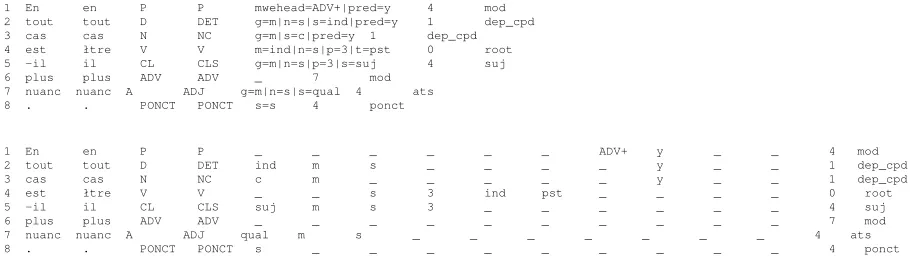
However, MaltParser also provides the option of parsing new data formats that are derived from the original CoNLL format. Therefore, there is the pos-sibility to add new columns that may contain use-ful information for parsing. The new MaltOptimizer implementation automatically generates a new data format and a new data set. It creates new columns that only contain the information of a single feature which is included in the FEATS column.
1 En en P P mwehead=ADV+|pred=y 4 mod 2 tout tout D DET g=m|n=s|s=ind|pred=y 1 dep_cpd 3 cas cas N NC g=m|s=c|pred=y 1 dep_cpd 4 est łtre V V m=ind|n=s|p=3|t=pst 0 root 5 -il il CL CLS g=m|n=s|p=3|s=suj 4 suj 6 plus plus ADV ADV _ 7 mod
7 nuanc nuanc A ADJ g=m|n=s|s=qual 4 ats 8 . . PONCT PONCT s=s 4 ponct
[image:3.612.70.525.63.194.2]1 En en P P _ _ _ _ _ _ ADV+ y _ _ 4 mod 2 tout tout D DET ind m s _ _ _ _ y _ _ 1 dep_cpd 3 cas cas N NC c m _ _ _ _ _ y _ _ 1 dep_cpd 4 est łtre V V _ _ s 3 ind pst _ _ _ _ 0 root 5 -il il CL CLS suj m s 3 _ _ _ _ _ _ 4 suj 6 plus plus ADV ADV _ _ _ _ _ _ _ _ _ _ 7 mod 7 nuanc nuanc A ADJ qual m s _ _ _ _ _ _ _ 4 ats 8 . . PONCT PONCT s _ _ _ _ _ _ _ _ _ 4 ponct
Figure 1: A sentence from the French treebank in the standard (above) and complex (below) formats. The projective columns have been removed for simplicity.
4 Experiments
With the intention of both assessing the usefulness of the new MaltOptimizer implementation and test-ing which features are useful for each targeted lan-guage, we carried out a series of experiments over the data sets from the Shared Task on Parsing MRLs (Seddah et al., 2013). We run the new MaltOpti-mizer implementation for all the data sets provided by the Shared Task organizers and we run Malt-Parser with the model suggested. Therefore, we had 36 different runs, 4 for each language (goldand pre-dicted scenarios with 5k treebanks, and gold and
predictedscenarios withfulltreebanks).
In order to have a comparable set of results, we performed all the optimization processes with the smaller versions of the treebanks (5k) and both op-timization and training steps with both the small and larger version for all languages. Each MaltOp-timizer run took approximately 3-4 hours for opti-mization (the running time also depends on the size of the set of morphological features, or other param-eters, such as the number of dependency relations) and it takes around 20 extra minutes to get the final model with MaltParser. These estimates are given with an Intel Xeon server with 8 cores, 2.8GHz and a heap space of, at least, 8GB.
5 Results and Discussion
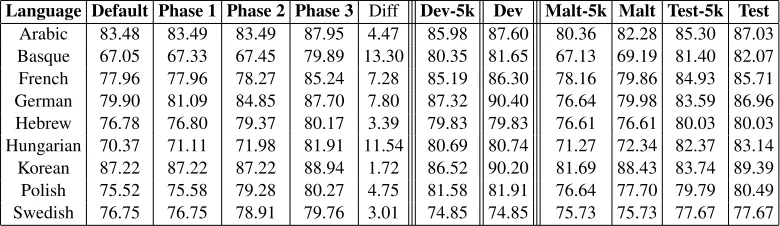
Table 1 shows the results for gold-standard input while Table 2 shows the results for the provided pre-dicted inputs for the best model that the new Mal-tOptimizer implementation can find (Dev-5k, Dev, Test-5k and Test) and a baseline, which is
Malt-Parser in default settings (Malt-5k and Malt) on the test sets. The first conclusion to draw is that the dif-ference between gold and predicted inputs is nor-mally of 2 points, however for some languages such as French the drop reaches 6 points. It is also ev-idenced that, as shown by Ballesteros and Nivre (2012a), some languages benefit more from the fea-ture selection phase, while others achieve higher im-provements by selecting a different parsing algo-rithm.
In general terms, almost all languages bene-fit from having an accurate stemmed version of the word in the LEMMA column, providing very substantial improvements when accurately selecting this feature. Another key feature, for almost all lan-guages, is the grammatical CASE that definitely en-hances the performance; we can therefore conclude that it is essential for MRLs. Both aspects evidence the lexical challenge of parsing MRLs without using this information.
There is a positive average difference comparing with the MaltParser baseline of 4.0 points training over the full treebanks and predicted scenario and 5.6 points training over the full treebanks and gold scenario. It is therefore evident how useful MaltOp-timizer is when it can perform an in-depth morpho-logical feature exploration. In the following subsec-tions we explain the results for each targeted lan-guage, giving special emphasis to the ones that turn out to be more meaningful.
5.1 Arabic
Language Default Phase 1 Phase 2 Phase 3 Diff Dev-5k Dev Malt-5k Malt Test-5k Test
Arabic 83.48 83.49 83.49 87.95 4.47 85.98 87.60 80.36 82.28 85.30 87.03 Basque 67.05 67.33 67.45 79.89 13.30 80.35 81.65 67.13 69.19 81.40 82.07 French 77.96 77.96 78.27 85.24 7.28 85.19 86.30 78.16 79.86 84.93 85.71 German 79.90 81.09 84.85 87.70 7.80 87.32 90.40 76.64 79.98 83.59 86.96 Hebrew 76.78 76.80 79.37 80.17 3.39 79.83 79.83 76.61 76.61 80.03 80.03 Hungarian 70.37 71.11 71.98 81.91 11.54 80.69 80.74 71.27 72.34 82.37 83.14 Korean 87.22 87.22 87.22 88.94 1.72 86.52 90.20 81.69 88.43 83.74 89.39 Polish 75.52 75.58 79.28 80.27 4.75 81.58 81.91 76.64 77.70 79.79 80.49 Swedish 76.75 76.75 78.91 79.76 3.01 74.85 74.85 75.73 75.73 77.67 77.67
Table 1: Labeled attachment score per phase compared to default settings for all training sets from the Shared Task on PMRLs in thegoldscenario on the held-out test set for optimization. The first columns shows results per phase (the procedure of each phase is briefly described in Section 2) on the held-out sets for evaluation. TheDev-5kand Devcolumns report labeled attachment score on the development sets. The columnsMaltandMalt-5kreport results of MaltParser in default settings on the test sets. And the columns,Test-5kandTestreport results for the best model found by SPMRL-MaltOptimizer on the test sets.
Language Default Phase 1 Phase 2 Phase 3 Diff Dev-5k Dev Malt-5k Malt Test-5k Test
[image:4.612.111.501.64.177.2]Arabic 83.20 83.21 83.21 85.68 2.48 80.35 82.28 78.30 80.36 79.64 81.90 Basque 68.80 69.33 69.89 77.24 8.44 78.12 79.46 68.12 70.11 77.59 78.58 French 77.43 77.43 77.63 79.42 1.99 77.65 79.33 76.54 77.98 77.56 79.00 German 78.69 79.87 82.58 83.97 5.28 83.39 86.63 74.81 77.81 79.22 82.75 Hebrew 76.29 76.31 79.01 79.67 3.38 73.40 73.40 69.97 69.97 73.01 73.01 Hungarian 68.26 69.12 69.96 78.71 10.45 76.82 77.62 69.08 70.15 79.00 79.63 Korean 80.08 80.08 80.08 81.63 1.55 77.96 83.02 74.87 82.06 75.90 82.65 Polish 74.43 74.49 76.93 78.41 3.98 80.61 80.83 75.29 75.63 79.50 80.49 Swedish 74.53 74.53 76.51 77.66 3.13 72.90 72.90 73.21 73.21 75.82 75.82
Table 2: Labeled attachment score per phase compared to default settings for all training sets from the Shared Task on PMRLs in thepredictedscenario on the held-out test set for optimization. The columns of this table report the results in the same way as Table 1 but using predicted inputs.
al., 2004), specifically its SPMRL 2013 dependency instance, derived from the Columbia Catib Tree-bank (Habash and Roth, 2009; Habash et al., 2009), extended according to the SPMRL 2013 extension scheme (Seddah et al., 2013).
For the goldinput, the most useful feature is, by far, DASHTAG3with an improvement of 2 points. CASE is also very useful, as it is for most of the languages, with 0.67 points. Moreover, SUBCAT (0.159) and CAT (0.129) provide improvements as well.
In thepred scenario, there is no DASHTAG, and this allows other features to rise, for instance, CASE (0.66), CPOSTAG (0.12), GENDER (0.08), SUB-CAT (0.07) and SUB-CAT (0.06) provide improvements. Finally it is worth noting that the TED accuracy
3
DASHTAG comes from the original constituent data, when a DASHTAG was present in a head node label, this feature was kept in the Catib corpus.
(Tsarfaty et al., 2011) for the lattices is 0.8674 with the full treebanks and 0.8563 with 5k treebanks, which overcomes the baseline in more than 0.06 points, this shows that MaltOptimizer is also useful under TED evaluation constraints.
5.2 Basque
The improvement provided by the feature selection for Basque (Aduriz et al., 2003) is really high. It achieves almost 13 points improvement with the
gold input and around 8 points with the predicted
MaltOp-timizer as default.
For thegold input, the CPOSTAG and LEMMA columns turn out to be very useful, providing an improvement of 2.5 points and slightly less than 1 point respectively, MaltOptimizer selects them all over the more central tokens over the stack and the buffer. The Basque treebank contains a very big set of possible features in the FEATS column, how-ever only some of them provide significant improve-ments, which evidences the usefulness of selecting them one by one. The most useful feature with a huge difference is KASE (or CASE) that provides 5.9 points by itself. MaltOptimizer fills out all the available positions of the stack and the buffer with this feature. Another useful feature is ERL [type of subordinated sentence], providing almost 0.8 points. Moreover, NUMBER (0.3), NORK2 (0.15), ASP [aspect] (0.09), NOR1 (0.08), and NMG (0.06) pro-vide slighter, but significant, improvements as well.4 Surprisingly, the predicted input provides bet-ter results in the first 2 phases, which means that for some reason MaltParser is able to parse better by using just the predicted POS column, however, the improvement achieved by MaltOptimizer dur-ing Phase 3 are (just) a bit more than 7 points. In this case, the CPOSTAG column is less useful, pro-viding only 0.13 points, while the LEMMA (1.2) is still very useful. CASE provides 4.5 points, while NUM (0.17), ASP (0.13) and ADM (0.11) provide improvements as well.
5.3 French
For French (Abeill´e et al., 2003) there is a huge dif-ference between the results withgoldinput and the results with predicted input. With gold input, the feature selection provides a bit less than 8 points while there is just an improvement of around 2 points with predicted input. In this case, the lack of quality in the predicted features is evident. It is also interesting that the lexical column, FORM, pro-vides a quite substantial improvement when Mal-tOptimizer attempts to modify it, which is some-thing that does not happen with the rest of lan-guages.
For thegoldinput, apart from LEMMA that pro-vides around 0.7 points, the most useful feature is
4
NORK2, NOR1 and NMG are auxiliaries case markers.
MWEHEAD [head of a multi word expression, if exists] that does not exist in thepredictedscenario. MWEHEAD provides more than 4 points; this fact invites us to think that a predicted version of this feature would be very useful for French, if possi-ble. PRED [automatically predicted] (0.8), G [gen-der] (0.6), N [number] (0.2) and S [subcat] (0.14) are also useful.
In thepredictedscenario, the CPOSTAG column provides some improvements (around 0.1) while the LEMMA is less useful than the one in the gold sce-nario (0.2). The morphological features that are use-ful are S [subcat] (0.3) and G [gender] (0.3).
5.4 German
For German (Brants et al., 2002) the results are more or less in the average. For thegoldinput, LEMMA is the best feature providing around 0.8 points; from the morphological features the most useful one is, as expected, CASE with 0.58 points. GENDER (0.16) and NUMBER (0.16) are also useful.
In thepredictedscenario, CASE is again very use-ful (0.67). Other features, such as, NUMBER (0.10) and PERSON (0.10) provide improvements, but as we can observe a little bit less than the improve-ments provided in thegoldscenario.
5.5 Hebrew
For the Hebrew (Sima’an et al., 2001; Tsarfaty, 2013) treebank, unfortunately we did not see a lot of improvements by adding the morphological fea-tures. For the gold input, only CPOSTAG (0.08) shows some improvements, while thepredicted sce-nario shows improvements for NUM (0.08) and PER (0.08). It is worth noting that the TED accuracy (Tsarfaty et al., 2011) for the lattices is 0.8305 which is ranked second.
5.6 Hungarian
The Hungarian (Vincze et al., 2010) results are also very consistent. During the feature selection phase, MaltOptimizer achieves an improvement of 10 points by the inclusion of morphological features. This also happens in the initial experiments per-formed with MaltOptimizer (Ballesteros and Nivre, 2012a), by using the Hungarian treebank of the CoNLL 2007 Shared Task. The current Hungarian treebank presents covered roots and multiple root la-bels and this is why we also get substantial improve-ments during Phase 1.
For thegoldinput, as expected the LEMMA col-umn is very useful, providing more than 1.4 points, while MaltOptimizer selects it all over the available feature windows. The best morphological feature is again CASE providing an improvement of 5.7 points just by itself, in a similar way as in the ex-periments with Basque. In this case, the SUBPOS [grammatical subcategory] feature that is included in the FEATS column is also very useful, provid-ing around 1.2 points. Other features that are useful are NUMP [number of the head] (0.2), NUM [num-ber of the current token] (0.16), DEF [definiteness] (0.11) and DEG [degree] (0.09).
In thepredicted scenario, we can observe a sim-ilar behavior for all features. MOOD provides 0.4 points while it does not provide improvements in the
gold scenario. The results of the SUBPOS feature are a bit lower in this case (0.5 points), which evi-dences the quality lost by usingpredictedinputs.
5.7 Korean
As Korean (Choi, 2013) is the language in which our submission provided the best results comparing to other submissions, it is interesting to dedicate a section by showing its results. For the5kinput, our model provides the best results of the Shared Task, while the results of the model trained over thefull
treebank qualified the second.
For the gold input, the most useful feature is CPOSTAG providing around 0.6 points. Looking into the morphological features, CASE, as usual, is the best feature with 0.24 points, AUX-Type (0.11), FNOUN-Type (0.08) are also useful.
In the predicted scenario, MaltOptimizer per-forms similarly, having CPOSTAG (0.35) and CASE
(0.32) as most useful features. ADJ-Type (0.11) and PUNCT-Type (0.06) are also useful. The results of the features are a bit lower with thepredictedinput, with the exception of CASE which is better.
5.8 Polish
Polish ( ´Swidzi´nski and Woli´nski, 2010) is one of the two languages (with Swedish) in which our model performs with the worst results.
In the gold scenario only the LEMMA (0.76) shows some substantial improvements during the optimization process; unfortunately, the morpholog-ical features that are extracted when MaltOptimizer generates the new complex data format did not fire.
For thepredicted input, LEMMA (0.66) is again the most useful feature, but as happened in thegold
scenario, the rest of the features did not fire during the feature selection.
5.9 Swedish
As happened with Polish, the results for Swedish (Nivre et al., 2006b) are not as good as we could ex-pect; however we believe that the information shown in this paper is useful because MaltOptimizer detects which features are able to outperform the best model found so far and the model trained with MaltParser in default settings by a bit less than 2 points in the predicted scenario and more than 2 points in the gold scenario.
For the gold scenario only two features are ac-tually useful according to MaltOptimizer, MaltOp-timizer shows improvements by adding GENDER (0.22) and PERFECTFORM (0.05).
For thepredictedinput, MaltOptimizer shows im-provements by adding DEGREE (0.09), GENDER (0.08) and ABBRV (0.06). However, as we can see the improvements for Swedish are actually lower compared to the rest of languages.
6 Related Work
Agirre et al. (2012), Padr´o et al. (2013) and Balles-teros et al. (2013) applied MaltOptimizer to test dif-ferent features of Ancient Greek, Basque and Span-ish (the last 2) respectively; however at that time MaltOptimizer did not allow the FEATS column to be divided. Finally, Ballesteros et al. (2012) applied MaltOptimizer for different parsing algorithms that are not included in the downloadable version show-ing that it is also possible to optimize different pars-ing algorithms.
7 Conclusions
This new MaltOptimizer implementation helps the developers to adapt MaltParser models to new lan-guages in which there is a rich set of features. It shows which features are able to make a change in the parsing results and which ones are not, in this way, it is possible to focus annotation effort for the purpose of parsing. We clearly observe that MaltOp-timizer outperforms very substantially the results shown in the baseline, which is MaltParser in default settings, and it is also nice to see that the improve-ments provided by MaltOptimizer for the morpho-logical features are actually very high, if we com-pare to the ones obtained by MaltOptimizer for the corpora of the CoNLL shared tasks (Ballesteros and Nivre, 2012a).
It is worth noting that the experiments with Mal-tOptimizer do not take so long. The time needed to perform the optimization is actually very short if we compare to the efforts needed to achieve results in the same range of accuracy by careful manual op-timization. The MaltOptimizer process was sped up following heuristics derived from deep proven experience (Nivre and Hall, 2010), which means that there are several combinations that are untested; however, it is worth noting that these heuristics re-sulted in similar performance to more exhaustive search for a big set of languages (Ballesteros, 2013).
From the feature study shown in Section 5, we ex-pect that it could be useful for people doing parsing research and interested in parsing MRLs. Finally, comparing our submission with the results of other teams, we believe that we provide a fast and effec-tive parser optimization for parsing MRLs, having competitive results for most of the languages.
Acknowledgments
I would like to thank Koldo Gojenola who initially gave me the idea presented in this paper. I am also very thankful to Joakim Nivre for his constant help and support. Finally, special thanks to the organizers Djam´e Seddah, Reut Tsarfaty and Sandra K¨ubler.
References
Anne Abeill´e, Lionel Cl´ement, and Franc¸ois Toussenel. 2003. Building a treebank for french. In Anne Abeill´e, editor,Treebanks. Kluwer, Dordrecht. I. Aduriz, M. J. Aranzabe, J. M. Arriola, A. Atutxa,
A. D´ıaz de Ilarraza, A. Garmendia, and M. Oronoz. 2003. Construction of a Basque dependency treebank. InProceedings of the 2nd Workshop on Treebanks and Linguistic Theories (TLT), pages 201–204.
Eneko Agirre, Aitziber Atutxa, and Kepa Sarasola. 2012. Contribution of complex lexical information to solve syntactic ambiguity in Basque. InProceedings of the 24th International Conference on Computational Lin-guistics (COLING 2012), Mumbai, India, 12/2012. Miguel Ballesteros and Joakim Nivre. 2012a.
MaltOp-timizer: A System for MaltParser Optimization. In
Proceedings of the Eighth International Conference on Language Resources and Evaluation (LREC 2012). Miguel Ballesteros and Joakim Nivre. 2012b.
Mal-tOptimizer: An Optimization Tool for MaltParser. In
Proceedings of the System Demonstration Session of the Thirteenth Conference of the European Chapter of the Association for Computational Linguistics (EACL 2012).
Miguel Ballesteros, Carlos G´omez-Rodr´ıguez, and Joakim Nivre. 2012. Optimizing Planar and 2-Planar Parsers with MaltOptimizer. Procesamiento del Lenguaje Natural, 49, 09/2012.
Miguel Ballesteros, Simon Mille, and Alicia Burga. 2013. Exploring Morphosyntactic Annotation Over a Spanish Corpus for Dependency Parsing . In Proceed-ings of the Second International Conference on De-pendency Linguistics (DEPLING 2013).
Miguel Ballesteros. 2013. Exploring Automatic Feature Selection for Transition-Based Dependency Parsing.
Procesamiento del Lenguaje Natural, 51.
Sabine Brants, Stefanie Dipper, Silvia Hansen, Wolf-gang Lezius, and George Smith. 2002. The TIGER treebank. In Erhard Hinrichs and Kiril Simov, edi-tors,Proceedings of the First Workshop on Treebanks and Linguistic Theories (TLT 2002), pages 24–41, So-zopol, Bulgaria.
Proceedings of the 10th Conference on Computational Natural Language Learning (CoNLL), pages 149–164.
Jinho D. Choi. 2013. Preparing Korean Data for the Shared Task on Parsing Morphologically Rich Lan-guages. ArXiv e-prints, September.
Yoav Goldberg and Michael Elhadad. 2010. Easy first dependency parsing of modern hebrew. In Proceed-ings of the NAACL HLT 2010 First Workshop on Sta-tistical Parsing of Morphologically-Rich Languages, SPMRL ’10, pages 103–107, Stroudsburg, PA, USA. Association for Computational Linguistics.
Nizar Habash and Ryan Roth. 2009. Catib: The columbia arabic treebank. InProceedings of the ACL-IJCNLP 2009 Conference Short Papers, pages 221– 224, Suntec, Singapore, August. Association for Com-putational Linguistics.
Nizar Habash, Reem Faraj, and Ryan Roth. 2009. Syn-tactic Annotation in the Columbia Arabic Treebank. In
Proceedings of MEDAR International Conference on Arabic Language Resources and Tools, Cairo, Egypt.
Johan Hall, Jens Nilsson, Joakim Nivre, G¨ulsen Eryi˘git, Be´ata Megyesi, Mattias Nilsson, and Markus Saers. 2007. Single malt or blended? A study in multilingual parser optimization. In Proceedings of the CoNLL Shared Task of EMNLP-CoNLL 2007, pages 933–939. Mohamed Maamouri, Ann Bies, Tim Buckwalter, and Wigdan Mekki. 2004. The Penn Arabic Treebank: Building a Large-Scale Annotated Arabic Corpus. In
NEMLAR Conference on Arabic Language Resources and Tools.
Francesco Mambrini and Marco Carlo Passarotti. 2012. Will a Parser Overtake Achilles? First experiments on parsing the Ancient Greek Dependency Treebank. In
Proceedings of the Eleventh International Workshop on Treebanks and Linguistic Theories (TLT11).
Joakim Nivre and Johan Hall. 2010. A quick guide to MaltParser optimization. Technical report, malt-parser.org.
Joakim Nivre, Johan Hall, and Jens Nilsson. 2006a. Maltparser: A data-driven parser-generator for depen-dency parsing. InProceedings of the 5th International Conference on Language Resources and Evaluation (LREC), pages 2216–2219.
Joakim Nivre, Jens Nilsson, and Johan Hall. 2006b. Tal-banken05: A Swedish treebank with phrase structure and dependency annotation. InProceedings of LREC, pages 1392–1395, Genoa, Italy.
Joakim Nivre, Johan Hall, Sandra K¨ubler, Ryan McDon-ald, Jens Nilsson, Sebastian Riedel, and Deniz Yuret. 2007. The CoNLL 2007 shared task on dependency parsing. InProceedings of the CoNLL Shared Task of EMNLP-CoNLL 2007, pages 915–932.
Muntsa Padr´o, Miguel Ballesteros, Hector Mart´ınez, and Bernd Bohnet. 2013. Finding dependency pars-ing limits over a large spanish corpus. In IJCNLP, Nagoya, Japan. Association for Computational Lin-guistics.
Djam´e Seddah, Reut Tsarfaty, Sandra K¨ubler, Marie Can-dito, Jinho Choi, Rich´ard Farkas, Jennifer Foster, Iakes Goenaga, Koldo Gojenola, Yoav Goldberg, Spence Green, Nizar Habash, Marco Kuhlmann, Wolfgang Maier, Joakim Nivre, Adam Przepiorkowski, Ryan Roth, Wolfgang Seeker, Yannick Versley, Veronika Vincze, Marcin Woli´nski, and Alina Wr´oblewska. 2013. Overview of the spmrl 2013 shared task: A cross-framework evaluation of parsing morphologi-cally rich languages. InProceedings of the 4th Work-shop on Statistical Parsing of Morphologically Rich Languages: Shared Task, Seattle, WA.
Mojgan Seraji, Be´ata Megyesi, and Joakim Nivre. 2012. Dependency parsers for persian. In Proceedings of 10th Workshop on Asian Language Resources, at 24th International Conference on Computational Linguis-tics (COLING 2012). ACL Anthology.
Khalil Sima’an, Alon Itai, Yoad Winter, Alon Altman, and Noa Nativ. 2001. Building a Tree-Bank for Modern Hebrew Text. InTraitement Automatique des Langues.
Marek ´Swidzi´nski and Marcin Woli´nski. 2010. Towards a bank of constituent parse trees for Polish. InText, Speech and Dialogue: 13th International Conference (TSD), Lecture Notes in Artificial Intelligence, pages 197—204, Brno, Czech Republic. Springer.
Reut Tsarfaty, Joakim Nivre, and Evelina Anders-son. 2011. Evaluating dependency parsing: Robust and heuristics-free cross-annotation evaluation. In
EMNLP, pages 385–396, Edinburgh, Scotland, UK., July. Association for Computational Linguistics. Reut Tsarfaty, Joakim Nivre, and Evelina Andersson.
2012a. Cross-framework evaluation for statistical parsing. InEACL, pages 44–54.
Reut Tsarfaty, Djam´e Seddah, Sandra Kuebler, and Joakim Nivre. 2012b. Parsing Morphologically Rich Languages: Introduction to the Special Issue. Compu-tational Linguistics, November.
Reut Tsarfaty. 2013. A Unified Morpho-Syntactic Scheme of Stanford Dependencies. Proceedings of ACL.
Veronika Vincze, D´ora Szauter, Attila Alm´asi, Gy¨orgy M´ora, Zolt´an Alexin, and J´anos Csirik. 2010. Hun-garian dependency treebank. InLREC.