Stochastic Parse Tree Selection for an Existing RBMT System
Christian Federmann DFKI GmbH Language Technology Lab
Saarbr¨ucken, Germany
Sabine Hunsicker DFKI GmbH Language Technology Lab
Saarbr¨ucken, Germany
Abstract
In this paper we describe our hybrid machine translation system with which we participated in the WMT11 shared translation task for the English→German language pair. Our system was able to outperform its RBMT baseline and turned out to be the best-scored participating system in the manual evaluation. To achieve this, we extended an existing, rule-based MT system with a module for stochastic selection of analysis parse trees that allowed to better cope with parsing errors during the system’s analysis phase. Due to the integration into the analysis phase of the RBMT engine, we are able to preserve the benefits of a rule-based translation system such as proper generation of target language text. Additionally, we used a statistical tool for terminology extraction to improve the lexicon of the RBMT system. We report results from both automated metrics and human evaluation efforts, including exam-ples which show how the proposed approach can improve machine translation quality.
1 Introduction
Rule-based machine translation (RBMT) systems that employ a transfer-based translation approach, highly depend on the quality of their analysis phase as it provides the basis for its later processing phases, namely transfer and generation. Any parse failures encountered in the initial analysis phase will proliferate and cause further errors in the following phases. Very often, bad translation results can be traced back to incorrect analysis trees that have been computed for the respective input sentences. Hence-forth, any improvements that can be achieved for
the analysis phase of a given RBMT system directly lead to improved translation output which makes this an interesting topic in the context of hybrid MT.
In this paper we present a study how the rule-based analysis phase of a commercial RBMT system can be supplemented by a stochastic parser. The system under investigation is the rule-based engine Lucy LT. This software uses a sophisticated RBMT transfer approach with a long research history; it is explained in more detail in (Alonso and Thurmair, 2003).
The output of its analysis phase is a parse forest containing a small number of tree structures. For our hybrid system we investigated if the existing rule base of the Lucy LT system chooses the best tree from the analysis forest and how the selection of this best tree out of the set of candidates can be improved by adding stochastic knowledge to the rule-based system.
The remainder of this paper is structured in the following way: in Section 2 we first describe the transfer-based architecture of the rule-based Lucy LT engine, giving special focus to its analysis phase which we are trying to optimize. Afterwards, we provide details on the implementation of the stochastic selection component, the so-called “tree selector” which allows to integrate knowledge from a stochastic parser into the analysis phase of the rule-based system. Section 3 reports on the results of both automated metrics and manual evaluation efforts, including examples which show how the proposed approach has improved or degraded MT quality. Finally, we conclude and provide an outlook on future work in this area.
S
$
$
CLS
CLS
NP
NO
PRN
They ADVP
ADVB
ADV
also
PRED
VB
VST
were
VB
VST
protesting
PP
PREPP
PREP
against
NP
AP
A
AST
bad
NO
NO
NST
pay
NO
NST
conditions CONJP
CONJ
and
CLS
NP
NO
PRN
They PRED
VB
VST
alleged
NP
NO
NST
persecution $
PNCT
[image:2.612.66.542.61.233.2].
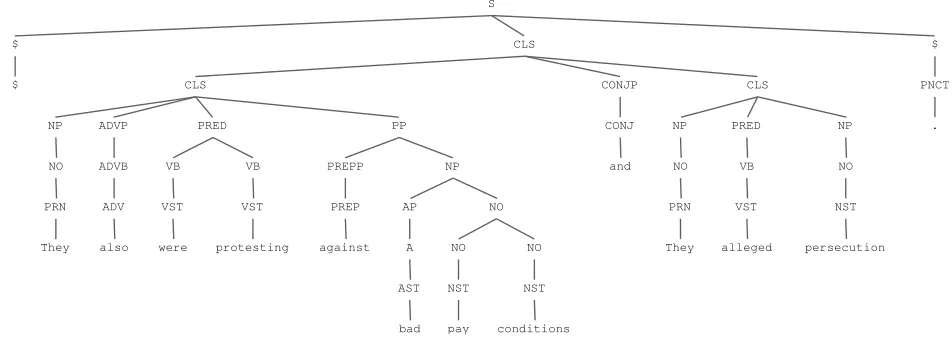
Figure 1: Original analysis tree from the rule-based MT system
2 System Architecture
2.1 Lucy LT Architecture
The Lucy LT engine is a renowned RMBT system which follows a “classical”, transfer-based machine translation approach. The system first analysesthe given source sentence creating a forest of several analysis parse trees. One of these parse trees is then selected (as “best” analysis) and transformed in the
transferphase into a tree structure from which the target text (i.e. the translation) can begenerated.
It is clear that any errors that occur during the initial analysis phase proliferate and cause negative side effects on the outcome of the final translation result. As the analysis phase is thus of very special importance, we have investigated it in more detail. The Lucy LT analysis consists of several phases:
1. The input is tokenised with regards to the system’s source language lexicon.
2. The resulting tokens undergo a morphological analysis, which is able to identify possible combinations of allomorphs for a token. 3. This leads to a chart which forms the basis for
the actual parsing, using a head-driven strat-egy1. Special handling is performed for the analysis ofmulti-word expressionsand also for
verbal framing.
At the end of the analysis, there is an extra phase named phrasal analysis which is called whenever
1
grammar formalism + number of rules
the grammar was not able to construct a legal con-stituent from all the elements of the input. This hap-pens in several different scenarios:
− The input is ungrammatical according to the LT analysis grammar.
− The category of the derived constituent is not one of the allowed categories.
− A grammatical phenomenon in the source sentence is not covered.
− There are missing lexical entries for the input sentence.
During the phrasal analysis, the LT engine collects all partial trees and greedily constructs an overall in-terpretation of the chart. Based on our findings from many experiments with the Lucy LT engine, phrasal analyses are performed for more than 40% of the sentences from our test sets and very often result in bad translations.
Each resulting analysis parse tree, independent of whether it is a grammatical or a result from the phrasal analysis, is also assigned an integer score by the grammar. The tree with the highest score is then handed over to the transfer phase, thus pre-defining the final translation output.
2.2 The “Tree Selector”
S
$
$
CLS
NP
NO
PRN
They ADVP
ADVB
ADV
also
PRED
VB
VST
were
VB
VST
protesting
PP
PREPP
PREP
against
NP
NP
AP
A
AST
bad
NO
NO
NST
pay
NO
NST
conditions
CONJP
CONJ
and
NP
AP
A
AST
alleged
NO
NST
persecution $
PNCT
[image:3.612.72.533.61.243.2].
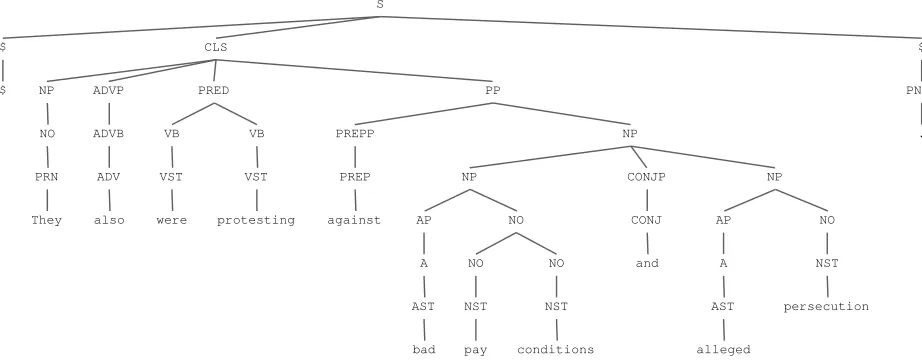
Figure 2: Improved analysis tree resulting from stochastic parse selection
good indication of which trees lead to good transla-tions, as is depicted in Table 1. Still, in many cases an alternative tree would have lead to a better trans-lation.
As additional feature, we chose to use the tree edit distance of each analysis candidate to a stochas-tic parse tree. An advantage of stochasstochas-tic parsing lies in the fact that parsers from this class can deal very well even with ungrammatical or unknown out-put, which we have seen is problematic for a rule-base parser. We decided to make use of the Stanford Parser as described in (Klein and Manning, 2003), which uses an unlexicalised probabilistic context-free grammar that was trained on the Penn Tree-bank2. We parse the original source sentence with this PCFG grammar to get a stochastic parse tree that can be compared to the trees from the Lucy analysis forest.
In our experiments, we compare the stochastic parse tree with the alternatives given by Lucy LT. Tree comparison is implemented based on theTree Edit Distance, as originally defined in (Zhang and Shasha, 1989). In analogy to theWord Editor
Lev-2Further experiments with different grammars are currently on-going.
Best Analysis Tree Percentage Default (id=1) 42 (61.76%) Alternative (id=2-7) 26 (38.24%)
Table 1: Evaluation of Analysis Forests
enshtein Distance, the distance between two trees is the number of editing actions that are required to transform the first tree into the second tree. The Tree Edit Distance knows three actions:
− Insertion − Deletion
− Renaming (substitution in Levenshtein Distance) Since the Lucy LT engine uses its own tag set, a mapping between this proprietary and the Penn Treebank tag set was created. Our implementation, called “Tree Selector” uses a normalised version of the Tree Edit Distance to estimate the quality of the trees from the Lucy analysis forest, possibly over-riding the analysis decision taken by the unmodified RBMT engine. The integration of the Tree Selector has been possible by using an adapted version of the rule-based MT system which allowed to communi-cate the selection result from our external process to the Lucy LT kernel which would then load the re-spective parse tree for all further processing steps.
2.3 LiSTEX Terminology Extraction
expres-sions and frequency. For English and German, about 26,000 terms were imported using this procedure.
2.4 Named Entity Handling
Named entities are often handled incorrectly and wrongly translated, such asGeorge Bush→George Busch. To reduce the frequency of such errors, we added a pre- and post-processing modules to deal with named entities. Before translation, the input text is scanned for named entities. We use both HeiNER (Wolodja Wentland and Hartung (2008)) and the OpenNLP toolkit3. HeiNER is a dictionary containing named entities extracted from Wikipedia. This provides us with a wide range of well-translated entities. To increase the coverage, we also use the named entity recogniser in OpenNLP. These entities have to be translated using the RBMT engine. We save the named entity translations and insert place-holders for all NEs. The modified text is translated using the hybrid set-up described above. After the translation is finished, the placeholders are replaced by their respective translations.
3 Evaluation
3.1 Shared Task Setup
For the WMT11 shared translation task, we submit-ted three different runs of our hybrid MT system:
1. Hybrid Transfer (without the Tree Selector, but with the extended lexicon)
2. Full Hybrid (with both the Tree Selector and the extended lexicon)
3. Full Hybrid+Named Entities (full hybrid and named entity handling)
Our primary submission was run #3. All three runs were evaluated using BLEU (Papineni et al. (2001)) and TER (Snover et al. (2006)). The results from these automated metrics are reported in Table 2.
Table 2: Automatic metric scores for WMT11
System BLEU TER
Hybrid Transfer 13.4 0.792
Full Hybrid 13.1 0.796
Full Hybrid+Named Entities 12.8 0.800
3
http://incubator.apache.org/opennlp/
Table 3 shows that we were able to outperform the original Lucy version. Furthermore, it turned out that our hybrid system was the best-scoring system from all shared task participants.
Table 3: Manual evaluation scores for WMT11
System Normalized Score
Full Hybrid+Named Entities 0.6805
Original Lucy 0.6599
3.2 Error Analysis
The selection process following the decision factors as explained in Section 2.2 may fail due to wrong assumptions in two areas:
1. The tree with the lowest distance does not result in the best translation.
2. There are several trees associated with the low-est distance, but the tree with the highlow-est score does not result in the best translation.
To calculate the error rate of the Tree Selector, we ran experiments on the test set of the WMT10 shared task and evaluated a sample of 100 sentences with regards to translation quality. To do so, we created all seven possible translations for each of the phrasal analyses and checked whether the Tree Selector re-turned a tree that led to exactly this translation. In case it did not, we investigated the reasons for this. Sentences for which all trees created the same trans-lation were skipped. This sample contains both examples in which the translation changed and in which the translation stayed the same.
Best Translation Returned 56% Other Translation Returned 44% Best Tree has Minimal Edit Distance 71% Best Tree has Higher Distance 29%
Table 4: Error Rate of the Tree Selector
at all (obviously the trees resulted in equal transla-tion output). In the remaining cases the translatransla-tions were divided evenly between slight degradations and and equal quality.
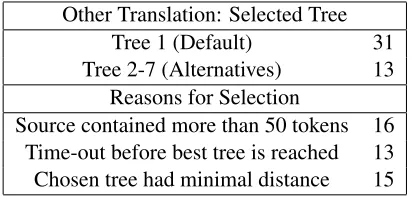
Other Translation: Selected Tree Tree 1 (Default) 31 Tree 2-7 (Alternatives) 13
Reasons for Selection
[image:5.612.83.289.224.323.2]Source contained more than 50 tokens 16 Time-out before best tree is reached 13 Chosen tree had minimal distance 15
Table 5: Evaluation of Tree Selector Errors
In the cases when the best tree was not chosen, the first tree (which is the default tree) was selected in 70.45% . This is due to a combinations of ro-bustness factors that are implemented in the RBMT system and have been beyond our control in the ex-periments. The LT engine has several different indi-cators which may throw a time-out exception, if, for example, the analysis phase takes too long to pro-duce a result. To avoid getting time-out errors, only sentences with up to 50 tokens are treated with the Tree Selector. Additionally the Tree Selector itself checks the processing time and returns intermediate results, if this limit is reached. This ensures that we receive a proper translation for all sentences.4
3.3 Examples
Using our stochastic selection component, we are able to fix errors which can be found in translation output generated by the original Lucy engine.
Table 6 shows several examples includingsource
text, reference text, andtranslations from both the original Lucy engine (A) and our hybrid system (B). We will briefly discuss our observations for these examples in the following section.
4We are currently working on eliminating this time-out issue as it prevents us from driving our approach to its full potential.
1. Translation A is the default translation. The parse tree for this translation can be seen in Figure 1. Here the adjectiveallegedis wrongly parsed as a verb. By contrast, Figure 2 shows the tree selected by our hybrid implementation, which contains the correct analysis of alleged
and results in a correct translation.
2. Word order is improved in the Example 2.
3. Lexical items are associated with a domain area in the lexicon of the rule-based system. Items that are contained within a different domain than the input text are still accessible, but items in the same domain are preferred. In Exam-ple 3, this may lead to the incorrect disam-biguation of multi-word expressions: the trans-lation ofto blow up asin die Luft fliegen was not preferred in Translation A due to the cho-sen domain and a more superficial translation was chosen. This problem is fixed in Transla-tion B. Our system chose a tree leading to the correct idiomatic translation.
4. Something similar happens in Example 4 where the choice of preposition is improved.
5. These changes remain at a rather local scope, but we also have instances where the sentence improves globally: Example 5 illustrates this well. In translation A, the name of the book,
“After the Ice”, has been moved to an entirely different place in the sentence, removing it from its original context.
6. The same process can be observed in Exam-ple 6, where the translation of device was moved from the main clause to the sub clause in Translation A.
7. An even more impressive example is Exam-ple 7. Here, translation A was not even a gram-matically correct sentence. This is due to the heuristics of the Lucy engine, although they could also create a correct translation B.
Table 6: Translation Examples for Original (A) and Improved (B) Lucy
1 Source: They were also protesting against bad pay conditions and alleged persecution.
Reference: Sie protestierten auch gegen die schlechten Zahlungsbedingungen und angebliche Schikanen.
Translation A: Sie protestierten auch gegen schlechte Soldbedingungen undbehaupteten Verfolgung.
Translation B: Sie protestierten auch gegen schlechte Soldbedingungen undangebliche Verfolgung. 2 Source: If the finance minister can’t find the money elsewhere, the project will have to be aborted and
sanctions will be imposed, warns Janota.
Reference: Sollte der Finanzminister das Geld nicht anderswo finden, m¨usste das Projekt gestoppt wer-den und in diesem Falle kommen Sanktionen, warnte Janota.
Translation A: Wenn der Finanzminister das Geld nicht anderswo finden kann, das Projekt abgebrochen
werden m¨ussen wirdund Sanktionen auferlegt werden werden, warnt Janota.
Translation B: Wenn der Finanzminister das Geld nicht anderswo finden kann,wirddas Projekt abgebrochen
werden m¨ussenund Sanktionen werden auferlegt werden, warnt Janota. 3 Source: Apparently the engine blew up in the rocket’s third phase.
Reference: Vermutlich explodierte der Motor in der dritten Raketenstufe.
Translation A: Offenbarbliesder Motorhinauf die dritte Phase der Rakete in.
Translation B: Offenbarflogder Motor in der dritten Phase der Raketein die Luft.
4 Source: As of January, they should be paid for by the insurance companies and not compulsory.
Reference: Ab Januar soll diese von den Versicherungen bezahlt und freiwillig sein.
Translation A: Ab Januar sollten sief¨ur vonden Versicherungsgesellschaften und nicht obligatorisch bezahlt werden.
Translation B: Ab Januar sollten sievonden Versicherungsgesellschaften und nicht obligatorisch gezahlt werden.
5 Source: In his new book, “After the Ice”, Alun Anderson, a former editor of New Scientist, offers a clear and chilling account of the science of the Arctic and a gripping glimpse of how the future may turn out there.
Reference: In seinem neuen Buch “Nach dem Eis” (Originaltitel “After the Ice”) bietet Alun Anderson, ein ehemaliger Herausgeber des Wissenschaftsmagazins “New Scientist”, eine klare und be-unruhigende Beschreibung der Wissenschaft der Arktis und einen packenden Einblick, wie die Zukunft sich entwickeln k¨onnte.
Translation A: In seinem neuen Buch bietet Alun Anderson, ein fr¨uherer Redakteur von Neuem Wis-senschaftler, “Nach dem Eis” einen klaren und kalten Bericht ¨uber die Wissenschaft der Arktis und einen spannenden Blick davon an, wie die Zukunft sich hinaus dort drehen kann.
Translation B: In seinem neuen Buch, “Nach dem Eis”, bietet Alun Anderson, ein fr¨uherer Redakteur von Neuem Wissenschaftler, einen klaren und kalten Bericht ¨uber die Wissenschaft der Arktis und einen spannenden Blick davon an, wie die Zukunft sich hinaus dort drehen kann. 6 Source: If he does not react, and even though the collision is unavoidable, the device exerts the
maxi-mum force to the brakes to minimize damage.
Reference: Falls der Fahrer nicht auf die Warnung reagiert und sogar wenn der Zusammenstoss schon unvermeidlich ist, ¨ubt der Bremsassistent den maximalen Druck auf die Bremsen aus, um auf diese Weise die Sch¨aden so gering wie m¨oglich zu halten.
Translation A: Wenn er nicht reagiert, unddas Ger¨atauch wenn der Zusammenstoß unvermeidlich ist, die gr¨oßtm¨ogliche Kraft zu den Bremsen aus¨ubt, um Schaden zu bagatellisieren.
Translation B: Wenn er nicht reagiert, und auch wenn der Zusammenstoß unvermeidlich ist, ¨ubtdas Ger¨at
die gr¨oßtm¨ogliche Kraft zu den Bremsen aus, um Schaden zu bagatellisieren.
7 Source: For the second year, the Walmart Foundation donated more than $150,000 to purchase, and transport the wreaths.
Reference: Die Walmart-Stiftung spendete zum zweiten Mal mehr als 150.000 Dollar f¨ur Kauf und Transport der Kr¨anze.
Translation A: F¨ur das zweite Jahr,die Walmart-Gr¨undung, mehr gespendetals $150,000, um die Kr¨anze zu kaufen, und zu transportieren.
4 Conclusion and Outlook
The analysis phase proves to be crucial for the over-all quality of the translation in rule-based machine translation systems. Our hybrid approach indicates that it is possible to improve the analysis results of such a rule-based engine by a better selection method of the trees created by the grammar. Our evaluation shows that the selection itself is no trivial task, as our initial experiments deliver results of varying quality. The degradations we have observed in our own manual evaluation can be fixed by a more fine-grained selection mechanism, as we al-ready know that better trees exist, i.e. the default translations.
While the work reported on in this paper is a dedicated extension of a specific rule-based machine translation system, the overall approach can be used with any transfer-based RBMT system. Future work will concentrate on the circumvention of e.g. the time-out errors that prevented a better performance of the stochastic selection module. Also, we will more closely investigate the issue of decreased trans-lation quality and experiment with other decision factors that may help to alleviate the negative effects. The LiSTEX module provides us with high qual-ity entries for the lexicon, increasing the coverage of the lexicon and fluency of the translation. As a side-effect, the new terms also help to reduce parsing errors, as formerly unknown multiword expressions are now properly recognised and treated. Further work is being carried out to increase the precision of the extracted terminology lists.
The addition of stochastic knowledge into an existing rule-based machine translation system is an example of a successful, hybrid combination of different MT paradigms into a joint system. Our system turned out to be the winning system for the English→German language pair of the WMT11 shared task.
Acknowledgements
The work described in this paper was supported by the EuroMatrixPlus project (IST-231720) which is funded by the European Community under the Seventh Framework Programme for Research and Technological Development.
References
Juan A. Alonso and Gregor Thurmair. 2003. The Com-prendium Translator system. In Proceedings of the Ninth Machine Translation Summit.
Christian Federmann, Sabine Hunsicker, Petra Wolf, and Ulrike Bernardi. 2011. From statistical term extrac-tion to hybrid machine translaextrac-tion. InProceedings of the 15th Annual Conference of the European Associa-tion for Machine TranslaAssocia-tion.
Dan Klein and Christopher D. Manning. 2003. Accu-rate unlexicalized parsing. InProceedings of the 41st Annual Meeting of the ACL, pages 423–430.
Kishore Papineni, Salim Roukos, Todd Ward, and Wei-Jing Zhu. 2001. Bleu: a method for automatic eval-uation of machine translation. IBM Research Report RC22176(W0109-022), IBM.
Matthew Snover, Bonnie Dorr, Richard Schwartz, Linnea Micciulla, and John Makhoul. 2006. A study of trans-lation edit rate with targeted human annotation. InIn Proceedings of Association for Machine Translation in the Americas, pages 223–231.
Carina Silberer Wolodja Wentland, Johannes Knopp and Matthias Hartung. 2008. Building a multilingual lexi-cal resource for named entity disambiguation, transla-tion and transliteratransla-tion. In European Language Re-sources Association (ELRA), editor, Proceedings of the Sixth International Language Resources and Eval-uation (LREC’08), Marrakech, Morocco, may. K. Zhang and D. Shasha. 1989. Simple fast algorithms