Distributed Parse Mining
Scott A. Waterman, PhD Microsoft Live Search/Powerset
475 Brannan St. San Francisco, USA
Abstract
We describe the design and implementation of a system for data exploration over dependency parses and derived semantic representations in a large-scale NLP-based search system at
powerset.com. Because of the distributed nature of the document repository and the pro-cessing infrastructure, and also the complex representations of the corpus data, standard text analysis tools such as grep or awk or language modeling toolkits are not applicable. This paper explores the challenges of extract-ing statistical information and of buildextract-ing lan-guage models in such a distributed NLP envi-ronment, and introduces a corpus analysis sys-tem, Oceanography, that simplifies the writ-ing of analysis code and transparently takes advantage of existing distributed processing infrastructure.
1 Introduction
In computational linguistics we deal with large cor-pora and vast amounts of data from which we would like to extract useful information. The size of the text resources, derived linguistic analyses, and the complexity of their representations is often a stum-bling block on the way to understanding the statisti-cal and linguistic behavior within the corpus. Sim-ple software tools suffice for small or simSim-ple anal-ysis problems, or for building models of easily rep-resented relations. However, as the size of data, the intricacy of relations to be analyzed, and the com-plexity of the representation grow, so too does the technical difficulty of conducting the analysis.
Software is our given means of escape from this escalation of complexity. However, as “computa-tional linguists,” we often find ourselves spending more time and attention building software to per-form the requiredcomputations than we do on un-derstanding the linguistics.
Even once a suitable set of NLP tools (e.g. tag-gers, chunkers, parsers, etc.) has been chosen, anal-ysis software, in the CL world, often consists of “throw away” scripts. Small,ad hocprograms are often the norm, often with no assurance (via strict design or testing) of correctness or completeness.
1.1 Oceanography
Our goal is to ensure that analysis is not so prob-lematic. Powerset is a group within the Microsoft Live Search team focused on using semantic NLP to improve web search. We face many problems with the scale and integration of our NLP compo-nents, and are approaching solving them by applying sound software design and abstraction principles to corpus processing. By generalizing tools to fit the processing environment, and the nature of the prob-lems at hand, we enable flexible processing which scales with the size of the platform and the data.
The Oceanography software environment is de-signed to address two important needs in large cor-pus analysis. The first is to simplify the actual pro-gramming of analysis code to reduce development time and increase reliability, and the second is to use the available distributed computing resources to re-duce running time and provide for rapid testing and experimental turnaraound.
1.2 Linguistic and Diagnostic data analysis There are two separate kinds of analysis we want to support over this processed corpus. The first is linguistic modeling. In order to achieve the best se-mantic interpretation of each source document, we seek to understand the linguistic behavior within the corpus. Probabilistic parsing, entity extraction, sense disambiguation, and argument role assign-ment are all informed by structured, statistical els of word behavior within the corpus. Some mod-els can be built from simple tokenized text, while other models need to incorporate parse dependen-cies or real-word knowledge of entities. Some of these tasks are exploratory and underspecified (e.g. selectional restrictions), while others, such as name tagging, have a well-developed literature and a num-ber of almost standard methodologies.
The second kind of analysis is aimed at character-izing and improving system behavior. For example, distributions of POS-tags or preposition attachments can serve as regression indicators for parser perfor-mance. In order to perform error analysis, we need to selectively sample various types of label assign-ments or parse structures. So summarization and sampling from the various intermediate NL analyses are very important processes to support.
2 Generalizing Text Mining
We have found that most of these analysis and data modeling tasks share certain higher order steps that allow us to generalize them all into a single pro-gramming framework. All involve identifying some phenomena in one of the NLP outputs, represent-ing it in some characteristic form, and then sum-ming or comparing distributions. These general steps apply to many corpus tasks, including building n-gram data, learning sentence breaks, identifying selectional preferences, or building role mappings for verb nominalizations.
The Oceanography system generalizes these steps into a declarative language for stating the selection of data, and the form of output, in a way that avoids repetitive and error prone boilerplate code for file traversal, regular expression matching, and statistics programming. By matching a declarative syntax to the general analysis steps, these common functions can be relegated to library code, or wrapped into the
executable in the compilation step. The less time spent in describing a task, or in coding and debug-ging the implementation, the more time and atten-tion can be spent in understanding the results and modeling the linguistic processes that underly the data.
This sort of abstraction away from the details of file representation, storage architecture, and pro-cessing model fits a general trend toward data min-ing, ortext mining(Feldman and Dagan, 1995). In data mining or KDD systems (Fayyad et al., 1996), the goal is to separate the tasks of creative anal-ysis and theorizing from the mundane aspects of traversing the data collection and computing statis-tics. These are much the same goals emphasized by Tukey (1977) – exploration of the data and in-teractions in order to understand which hypotheses, and which models of interaction, would be fruitful to explore. For our needs in analyzing collections of text, parses, and semantic representations, we have achieved a very practical step toward these goals.
2.1 Matching process to conception
We have found four steps that map very closely to our conception of the data analysis problem, which at the same time are easily translated to implemen-tations that can be run on both small local data sets and on very large distributed corpora.
1. Pattern matching – find the interesting phe-nomena among the mass of data, by declaring a set of desired properties to be met. In Oceanog-raphy, these are matched per-sentence.
2. Transformation – rewrite the raw occurrence data to identify the interesting part, and isolate it from the background
3. Aggregation – group together instances of the same kind
4. Statistics – compute statistics for counts, relative frequency, conditional distributions, distribu-tional comparisons, etc.
accomplished in an exploratory setting for NLP in-vestigations.
Later, in section 4, we describe how the steps are mapped to processing operations within the NLP pipeline architecture. Following that, we give exam-ples of how this framework maps to specific prob-lems, of both the exploratory and the diagnostic type.
2.2 Pattern Matching
The first step is to identify the specific phenomena of interest within the source data. If the data is a com-plex structure, it is helpful to express the patterns in a logical representation of the structure, rather than matching the representation directly.
Pattern matching in Oceanography for depen-dency parse structures is handled using a domain specific language (DSL) built explicitly for pattern-based manipulation of parse trees and semantic rep-resentations generated by the XLE linguistic compo-nents (Crouch et al., 2006). ThisTransferlanguage (Crouch, 2006) is normally used in the regular lin-guistic processing pipeline to incrementally rewrite LFG dependency parses into a role-labeled seman-tic representations (semreps) of entities, events, and relations in the text. Transfer matches pattern rules to a current set of parse dependencies or semantic facts, and writes alternate expressions derived from the matched components. Variables in these expres-sions are bound via Prolog-style unification (Huet, 1975).
For example, in figure 1, the first expression
word(· · ·) will match word forms in a parse that
are ‘verb’s, and bind %VerbSk variable to a
unique occurrence id and%VerbWord to the verb lemma. The second pattern finds the node in the dependency graph that fills theob(object) role for that verb, and extracts its lemmas. (The %%’s are placeholder variables in the pattern, needed to match the arity of the expression.) Below, in the same figure, is a representation of the verb and object from a parse of the phrase “determined the struc-ture”. On matching these facts, theVerbWordand
ObjLemmavariables would be bound to the strings
determineandstructure.
In a simpler environment, with more basic textual representations, this pattern matching step would be written with regular expressions, for example using
the familiargrepcommand. The balance provided by grep between the simplicity of its operational model (a transform from stdin to stdout) and the ex-pressiveness of the regular expressions allowsgrep to be a workhorse for data analysis over text.
However, except for simple cases such as word cooccurrence models, the typical need in deep lin-guistic analysis is not well served by regular expres-sions over strings. Anyone in the NLP field who has written regular expressions to match, say, part-of-speech labeled text knows the difficulties of hav-ing a pattern language which differs from the logical structures being matched. Another typical solution is to write a short program in a scripting language (e.g. perl, python, SNOBOL) which combines
regu-lar expressions to provide a simple structure parser. Tgrep (Pito, 1993) is a one such program which ex-tends this regular expression notion to patterns over trees, and can output subtrees matching those ex-pressions, but only provided they are represented as text in the LDC TreeBank format.
2.3 Transformation
Once the items of the pattern have been identified in their original context, it is often necessary to isolate them from that context, and remove the extraneous, irrelevant information. For instance, if one is do-ing a simple word count, the tokenized words of text must be separated from any annotation and counted independently. For more complicated tasks, such as finding a verb’s distribution of occurrence with di-rect objects, the verb and object need to be isolated from the remainder of the parse tree, perhaps as the simple tuple (verb, object), or in a more complex structure, with additional dependent information.
In our case, we express the transformed output of each pattern match with an expression built from the unification variables bound to the match. In figure 2, we construct avo pairof(verb, object).This new construct is simply added to the collection of facts and representations already present. All other pre-existing facts in the NL analysis of the sentence also remain in context, potentially available for aggrega-tion and counting.
==> vo_pair(%VerbWord, %ObjLemma).
word(%VerbSk, %VerbWord, verb, verb, %%, %%, %%, %% ), in_context(%%, role(hier(ob, %%), %VerbSk, %ObjLemma:%%))
word(determine:n(41,3),determine,verb,verb, ....) in_context(t,role(hier(ob,[[ob,root],..]),
determine:n(82,3),structure:n(91,3))))
Figure 1: Pattern matching using Transfer
In shallower text mining, this might be accom-plished using regex matching in a perl program. An-other common approach is to use command-line text tools such asawkorsed. Awk (Aho et al., 1977) is designed especially for text mining, but is limited to plain text files, on single machines, and doesn’t extend easily to structured graph representations or distributed processing. (But see, e.g. Sawzall (Pike et al., 2005) for a scalable awk-like language.)
2.4 Aggregation
The aggregation step collects the extracted instances and groups them by type and by key. Rather than have the matched, transformed results simply dumped out in some enormous file or database in their order of occurrence in the data set (as one would get e.g. fromgrep), it is quite useful even in the simplest of cases to aggregate all similar output items. This condenses the mass of data selected, and allows one to see the extent and diversity of the items that are found by the patterns. This simple counting is often enough for diagnostic tasks, and sometimes for exploratory tasks when a statistical judgement is not yet desired. The aggregation key might be, for various kinds of extraction: the head noun of an NN-compound, or the error type for parse errors, or the controlling verb of a relative clause.
In Oceanography, we require a declaration of the data that will be aggregated, in order to separate it from the remainder which will be discarded. These declarations take the form of familiar static type dec-larations, in the style of C++ or Java. Figure 3 shows the simple declaration for ourvo pairtype, where both fields are declared as strings. These named fields also provide a handle to refer to struc-ture members in later statements.
In the command line text world, aggregation might be accomplished by using the unix pipeline
vo_pair :: {
verb::String, object::String }
Figure 3: Declaring aggregation types
commandsort | uniq -c, to organize the out-put by the appropriate key. If using a small program to do this kind of analysis, one would use a dictio-nary or hash-table and sorting routines to organize the data before output.
2.5 Statistics
With the matched and extracted data, one can build up a statistical picture of the data and its interrela-tions. In our practice, and in the computational NLP literature, we have found a few fundamental statisti-cal operations that are frequently used to make sense of the corpus data. Primary among these are sim-ple class counts: the number of occurrences of a given phenomena. For instance, the count of part-of-speech tags, or of head nouns with adjective mod-ifiers, or the counts of (verb,object) pairs. These counts can be computed easily by summing the oc-currences in the aggregated groups.
Other statistics are more complicated, requiring combinations of the simple counts and sums — normalizing distributions by the total occurrence counts, for instance, as in the conditional occurrence of a part-of-speech label relative to the frequency of the token. Estimation of log-likelihood ratios or Pearson’s Chi-square test for pairwise correlation also falls in this category. These kinds of computa-tions are used heavily for building classifiers and for diagnostic purposes.
clustering over similarity, and building predictive or classification models for model corpus behavior.
3 Data Parallel Document Processing at Powerset
To simplify the processing of large web document collections, and flexibly include new processing modules, we have built a single consistent pro-cessing architecture for the natural language doc-ument pipeline, which allows us to process mil-lions of documents and handle terabytes of analy-sis data effectively. Coral is the name of the dis-tributed, document-parallel NLP pipeline at Power-set. Coral provides both a process and a data man-agement framework in order to smoothly execute the multi-step linguistic analysis of all content indexed for Powerset’s search.
Coral controls a multi-step pipeline for deep lin-guistic processing of documents indexed for search. A partial list of the steps every web document un-dergoes includes: HTML destructuring, sentence breaking, name tagging, parsing, semantic inter-pretation, anaphora resolution, and indexing. The pipeline is similar to the UIMA (Ferrucci and Lally, 2004) architecture in that each step adds interme-diate data — tagged spans, dependency trees, co-referent expressions — that can be used in subse-quent steps. Each step adds a different kind of data to the set, with its own labels and meanings. The output of all these steps is a daunting amount of in-formation, all of which is valuable for understanding the linguistic relations within the text, and also the behavior and effectiveness of the NLP pipeline.
Documents are processed in a data-parallel fash-ion. Multiple documents are processed indepen-dently, across multiple processes on multiple com-pute nodes within a clustered environment. The doc-ument processing model is sequential, with multi-ple steps run in a fixed sequence for each document in the index. All processing for a single document is typically performed on a single compute node. The steps of the pipeline communicate through in-termediate data writen to the local filesystem in be-tween steps, where each step is free to consume data produced earlier. Output from the stages is check-pointed to backing storage at various points along the way, and the final index fragments are merged at
the end.
This kind of data-parallel process lends itself well to a map/reduce programming infrastructure (Dean and Ghemawat, 2004). Map/reduce divides process-ing into two classes: data-parallel ‘map’ operations, and commutative ‘reduce’ operations, in which all map output aggregated under a particular key is pro-cessed together. In map/reduce terms, the entire linguistic processing runs as a sequence of ‘map’ steps (there is no inter-document communication), with a final ‘reduce’ step to collect index fragments and construct a unified search index. Coral uses the open-source hadoop implementation of map/reduce (Cutting, ) as the central task control and distribu-tion mechanism for assigning NLP pipeline jobs to documents in the input data, and it has full control of the map/reduce processing layer.
3.1 Difficulties for data mining in Coral
All of the intermediate processing output of the pipeline, the name tags, parses, semantic representa-tions, etc., are are retained by this complex process. Unfortunately, they are retained in an unfriendly format: small document-addressed chunks scattered across a large distributed filesystem, on hundreds of machines. There is no operational way to collect these chunks in any single file, or to traverse them efficiently from any single point. Traditional script-ing techniques, even if scalable to the terabytes of data, are not applicable to the distributed organiza-tion of the underlying data.
3.2 Re-using processing infrastructure for mining
patterns and relations to be investigated, rather than burdening them with complex yet necessary details.
4 Oceanography - a compiled data mining language
Oceanography has a compiler that transforms short analysis programs into multiple map/reduce steps that will operate over the corpus of text and deep lin-guistic analyses. These multiple sub-operations are then farmed out through the distributed cluster envi-ronment, managed by the Coral job controller. The data flow and dependencies between these jobs are compiled to a Coral-specific job control language.
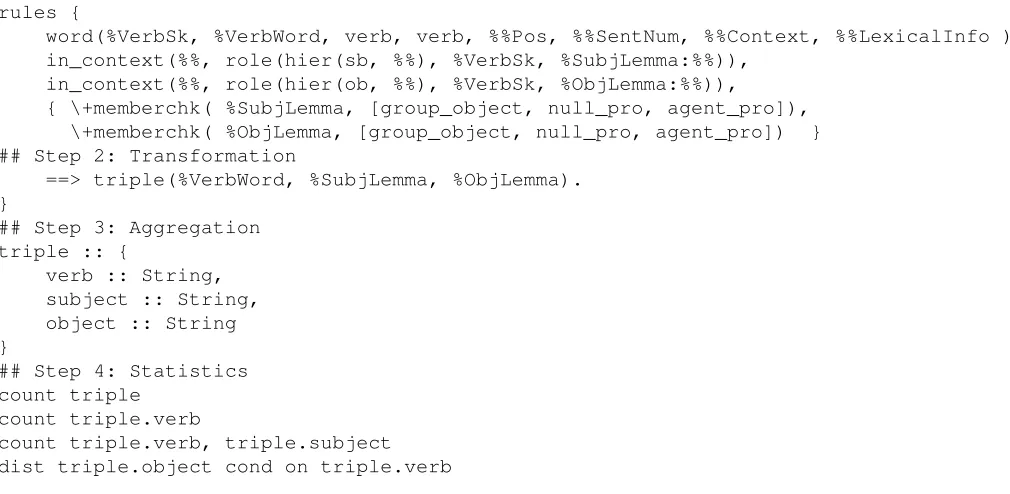
An oceanography program (cf. figure 4) is a single-file description of the data analysis task. It contains specifications for each of the four oper-ations: pattern matching, transformation, aggrega-tion, and statistics. The program style is declarative – there are no instructions for iterating over files, summing distributions, or parsing the dependency graph representations.
We find that this matches our intuitions and con-ception of the parse mining task. A statement of the end-product of the analysis is natural: e.g. find the conditional distribution of object head nouns for verbs, or symbolicallyp(obj|verb). The style of the oceanography program matches this well, where the statistics statement such as
dist triple.object cond on triple.verb states the desired output, and the preceding pat-tern match and type declarations serve as definitions to specify precisely what is meant by the variable names.
In the following sections, we will follow the steps of the Oceanography program in the listing in fig-ure 4. The example analysis presented is a simple one – to find all verbs with both subject and object roles, i.e. triples of(subject, object, verb), and re-port some counts and relative frequencies of verbs, subjects, and objects.
4.1 Step 1: Pattern Matching
The pattern matching rules are similar to those presented above in sec. 2.2. The first line matches a verb term, and the next two lines require the presence of terms in both the
sub-ject (role(hier(sb, %%))) and object
role(hier(ob, %%)) roles. Following the
explicit pattern expression, we add negative checks to ensure that neither the subject or object are PRO elements, which have no surface form.
4.2 Transformation
The transformation expressed in figure 4 is almost trivial. We capture the verb-subject-object triple in a simple three place predicate. Recall that the values of the triple:
(%VerbWord, %SubjLemma, %ObjLemma) are bound by unification to the terms matched in the pattern, above.
Although we have only one pattern and one matching transformation in this example, we are not in general limited in the number of patterns or out-put expressions we might use. Multiple transforms, from multiple patterns, can be used.
During compilation, these Transfer rules are com-piled into a binary object module, then distributed at runtime to the compute nodes where they will be executed in the proper sequence by the Coral job controller. Output from the transformation step, and between all the steps, is encoded as a set of hierar-chically structured objects using JSON (Crockford, 2006). Because JSON provides a simple structural encoding with named fields, and many programming environments can handle the JSON format, it pro-vides a flexible and self-describing interchange for-mat between steps in the Oceanography runtime. 4.3 Aggregation
The third section of the Oceanography program de-clares the types of objects to be aggregated follow-ing the transform step. The type declarations in this section serve two purposes. First, they spec-ify exactly what types of data from the match-ing/transformation phase should be carried forward. Recall that all of the source data is available for pro-cessing, but we are likely only interested in a small portion of it. Secondly, the declarations serve as type hints to the compiler so that operations and data stor-age are performed correctly in the later phases (e.g. adding strings vs. integers).
4.4 Statistics
## Step 1: pattern matching rules {
word(%VerbSk, %VerbWord, verb, verb, %%Pos, %%SentNum, %%Context, %%LexicalInfo ), in_context(%%, role(hier(sb, %%), %VerbSk, %SubjLemma:%%)),
in_context(%%, role(hier(ob, %%), %VerbSk, %ObjLemma:%%)),
{ \+memberchk( %SubjLemma, [group_object, null_pro, agent_pro]),
\+memberchk( %ObjLemma, [group_object, null_pro, agent_pro]) }
## Step 2: Transformation
==> triple(%VerbWord, %SubjLemma, %ObjLemma). }
## Step 3: Aggregation triple :: {
verb :: String, subject :: String, object :: String }
## Step 4: Statistics count triple
count triple.verb
[image:7.612.73.578.68.315.2]count triple.verb, triple.subject dist triple.object cond on triple.verb
Figure 4: A complete Oceanography program
count triple.verb
will result in occurrence counts of each verb seen in the parses. We can combine primitive types into tuples, in order to countn-grams (which are not nec-essarily adjacent), e.g.
count triple.verb, triple.subject
to give occurrence counts for all (verb,subject) pairs.
The dist X cond on Ystatement is used to
produce the conditional distribution p(x|y). The map/reduce framework collates all occurrences with a given valueyi to a single reduce function, which
sums the conditional counts ofx, and normalizes by the total.
Other statistics require multiple map/reduce op-erations. Computing the probability for the verb unigrams requires knowing the total number of oc-currences, which, in this kind of data-parallel pro-cessing architecture, is not available until the out-put of all occurrence counts is known. So, aprob
triple.verb statistic must implicitly compute
count triple.verb, sum all occurrences, and
normalize across the set. For a good type-driven analysis of information flow during various stages of a map/reduce computations, see L¨ammel (2008).
4.5 Output
Output is given two forms. For ease of interpreta-tions, human-readable tab delimited files are writ-ten, in which each record is preceded by the type, as given in the argument to the statistics declaration. To simplify later offline computation, the record can also be written out in a JSON encoded structure with named fields corresponding to the type.
5 Development and testing in Oceanography
The same source program is compiled for either single machine or cluster execution. The user must specify a different type of store location for input and output data, depending on environment. Compi-lation is done using a command line program, which takes as input the Oceanography program, and pro-duces a set of executable outputs, corresponding to the tasks in the map/reduce process. These can also be run immediately in the single machine setting, with results going to stdout.
5.1 Some sample tasks
Although these tools have been available at Power-set only a few months, we have already used them to great advantage in diagnostic and linguistic anal-ysis tasks. Diagnostically, it is important to un-derstand the failure modes of the various linguistic pipeline components. For instance, the morpholog-ical analysis component of the XLE parser will on occasion encounter tokens it cannot analyze. Hand-examining a few hundred parses (which starts to ex-ceed the mental fatigue threshold), one can find nu-merous examples. But one has no idea of the rel-ative frequency of any given type of error, or their combined effect on the parse output. Oceanography enables a very simple single pattern match rule to be used to find the frequency distribution of unknown tokens over 100M sentences as easily as 100, and the grammar engineers can use this information to pri-oritize their effort. Other diagnostics on the parse, such as the frequency of certain rare grammatical constructs (e.g. reduced relatives), or the prevalence of unparseable fragments, or relative frequencies of transitive v. intransitive use, are immensely impor-tant for understanding the nature of the corpus and the behavior of the parser.
The S-V-O triples used as an example also have practical import. By identifying the most common verb expressions, we can, just as in a keyword stop list, eliminate or downweight some of the less mean-ingful relations in our semantic index. For example, in the Wikipedia corpus, one of the most common S-V-O triples comes from the phrase “this article needs references.”
We are also beginning a series of lexical seman-tic studies, looking at selectional preferences and their dependence on surface form. Correspondence between prepositional adjunct roles and other
sur-face realizations is also an active area. Additionally, Oceanography is being used to analyze feature data from the parses in order to experiment with an unsu-pervised word sense disambiguation project.
6 Conclusion
We have presented a methodology for understanding a certain class of linguistic data analysis problems, which identifies the steps of pattern matching, data transformation, aggregation, and statistics. We have also presented a programming system, Oceanogra-phy, which by following this breakdown simplifies the programming of these tasks while at the same time enabling us to take advantage of existing large scale distributed processing infrastructure.
Acknowledgments
References
Alfred V. Aho, Peter J. Weinberger, and Brian W. Kernighan. 1977. awk.
D. Crockford. 2006. The application/json Media Type for JavaScript Object Notation (JSON). RFC 4627 (In-formational), July.
Richard S. Crouch, Mary Dalrymple, Ronald M. Kaplan, Tracy Holloway King, John Maxwell, and P. Newman. 2006. XLE documentation.
Richard S. Crouch. 2006. Packed rewriting for mapping text to semantics and KR.
Doug Cutting. Apache Hadoop Project. http://hadoop.apache.org/.
Jeffrey Dean and Sanjay Ghemawat. 2004. MapRe-duce: simplified data processing on large clusters. In
OSDI’04: Proceedings of the 6th conference on Sym-posium on Opearting Systems Design & Implementa-tion, Berkeley, CA, USA. USENIX Association. Usama M. Fayyad, David Haussler, and Paul E. Stolorz.
1996. KDD for Science Data Analysis: Issues and Examples. InKDD, pages 50–56.
Ronen Feldman and Ido Dagan. 1995. Knowledge Dis-covery in Textual Databases (KDT). In KDD, pages 112–117.
David Ferrucci and Adam Lally. 2004. UIMA: an archi-tectural approach to unstructured information process-ing in the corporate research environment. Nat. Lang. Eng., 10(3-4):327–348.
Grard P. Huet. 1975. A unification algorithm for typed lambda-calculus.Theor. Comput. Sci, 1:27.
Ralf L¨ammel. 2008. Google’s MapReduce programming model - Revisited. Sci. Comput. Program., 70(1):1– 30.
Rob Pike, Sean Dorward, Robert Griesemer, and Sean Quinlan. 2005. Interpreting the data: Parallel analy-sis with Sawzall. Scientific Programming, 13(4):277– 298.
Richard Pito. 1993. Tgrep.