Cologne: A Declarative Distributed Constraint
Optimization Platform
Changbin Liu
∗Lu Ren
∗Boon Thau Loo
∗Yun Mao
†Prithwish Basu
‡∗
University of Pennsylvania
†AT&T Labs - Research
‡Raytheon BBN Technologies
ABSTRACT
This paper presents Cologne, a declarative optimization platform that enables constraint optimization problems (COPs) to be declar-atively specified and incrementally executed in distributed systems. Cologne integrates adeclarative networkingengine with an off-the-shelf constraint solver. We have developed theCologlanguage that combines distributed Datalog used in declarative networking with language constructs for specifying goals and constraints used in COPs. Cologne uses novel query processing strategies for
process-ingCologprograms, by combining the use of bottom-up distributed
Datalog evaluation with top-down goal-oriented constraint solving. Using case studies based on cloud and wireless network optimiza-tions, we demonstrate that Cologne (1) can flexibly support a wide range of policy-based optimizations in distributed systems, (2) re-sults in orders of magnitude less code compared to imperative im-plementations, and (3) is highly efficient with low overhead and fast convergence times.
1.
INTRODUCTION
In distributed systems management, operators often have to con-figure system parameters that optimize performance objectives given constraints in the deployment environment. For instance, in dis-tributed data centers, cloud operators need to optimize placement of virtual machines (VMs) and storage resources to meet customer service level agreements (SLAs) while keeping operational costs low. In a completely different scenario of a wireless mesh net-work, each wireless device needs to configure its selected channel for communication in order to ensure good network throughput and minimize data losses.
This paper presents Cologne (COnstraint LOGic EngiNE), a declar-ative optimization platform that enablesconstraint optimization prob-lems(COPs) to be declaratively specified and incrementally exe-cuted in distributed systems. Traditional approaches in implement-ing COPs use imperative languages like C++ [2] or Java [1]. This often results in thousands lines of code, that are difficult to main-tain and customize. Moreover, due to scalability issues and man-agement requirements imposed across administrative domains, it is often necessary to execute a COP in adistributedsetting, where multiplelocalsolvers coordinate with each other and each one han-dles a portion of the whole problem to together achieve a global objective.
The paper makes the following contributions:
• Declarative platform. Central to our optimization platform is the integration of adeclarative networking[19] engine with an off-the-shelf constraint solver [2]. We have developed theColog
language that combines distributed Datalog used in declarative networking with language constructs for specifying goals and constraints used in COPs.
• Distributed constraint optimizations. To executeColog pro-grams in a distributed setting, Cologne integrates Gecode [2], an off-the-shelf constraint solver, and the RapidNet declarative net-working engine [5] for communicating policy decisions among different solver nodes. Supporting distributed COP operations requires novel extensions to state of the art in distributed Data-log processing, which is primarily designed for bottom-up evalu-ation. One of the interesting aspects ofColog, from a query pro-cessing standpoint, is the integration of RapidNet (an incremen-tal bottom-up distributed Daincremen-talog evaluation engine) and Gecode (a top-down gooriented constraint solver). This integration al-lows us to implement a distributed solver that can perform in-cremental and distributed constraint optimizations – achieved through the combination of bottom-up incremental evaluation and top-down constraint optimizations. Our integration is achieved without having to modify RapidNet or Gecode, hence making our techniques generic and applicable to any distributed Datalog engine and constraint solver.
• Use cases. We have applied our platform to two representative use cases that allow us to showcase key features of Cologne. First, inautomated cloud resource orchestration [16], we use our optimization framework to declaratively control the creation, management, manipulation and decommissioning of cloud re-sources, in order to realize customer requests, while conform-ing to operational objectives of the cloud service providers at the same time. Second, in mesh networks, policies onwireless
chan-nel selection[14] are declaratively specified and optimized, in
order to reduce network interference and maximize throughput, while not violating constraints such as refraining from channels owned exclusively by the primary users. Beyond these two use cases, we envision our platform has a wide-range of potential ap-plications, for example, optimizing distributed systems for load balancing, robust routing, scheduling, and security.
• Evaluation. We have developed a prototype of Cologne and have performed extensive evaluations of our above use cases. Our evaluation demonstrates that Cologne (1) can flexibly sup-port a wide range of policy-based optimizations in distributed systems, (2) results in orders of magnitude less code compared to imperative implementations, and (3) is highly efficient with low overhead and fast convergence times.
The rest of the paper is organized as follows. Section 2 presents an architecture overview of Cologne. Section 3 describes our two main use cases that are used as driving examples throughout the paper. Section 4 presents the Cologlanguage and its execution model. Section 5 next describes howCologprograms are compiled into distributed execution plans. Section 6 presents our evaluation results. We then discuss related work in Section 7 and conclude in Section 8.
2.
SYSTEM OVERVIEW
Node Configuration Layer Constraint Solver Optimization Commands Distributed Query Engine Node1 Node2 Node3 Colog Program
Node Configuration Layer
Cologne Constraint Solver Distributed Query Engine Colog Program Cologne Physical Operations Physical Operations System States Optimization Commands System States
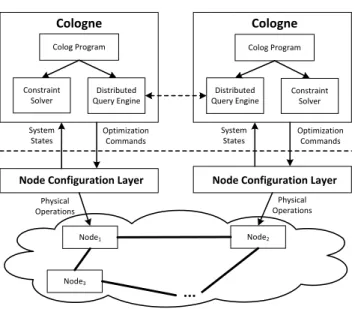
Figure 1: Cologne overview in distributed mode
Figure 1 presents a system overview of Cologne, which is de-signed for a distributed environment comprising of several net-worked nodes. Cologne can be deployed in acentralizedor
dis-tributed mode:
In the centralized deployment mode, the entire distributed sys-tem is configured by one centralized Cologne instance. It takes as input system states gathered from all nodes in the network, and a set of policy constraints and goals specified usingColog declara-tive language. These specifications are then used by aconstraint
solverto automatically generateoptimization commands. These
commands are then input into each node’sconfiguration layer, to generate physical operations to directly manipulate resources at each node.
In the distributed deployment mode, there are multiple Cologne instances, typically one for each node. In a general setting, each node has a set of neighbor nodes that it can directly communicate with (either via wireless communication links, dedicated backbone networks, or the Internet). Adistributed query engine[5] is used to coordinate the exchange of system states and optimization output amongst Cologne instances, in order to achieve a global objective (this typically results in an approximate solution).
A distributed deployment brings two advantages. First, distributed environments like federated cloud [9] may be administered by dif-ferent cloud providers. This necessitates each provider running its own Cologne instance for its internal configuration, but coordinat-ing with other Cologne instances for inter data center configura-tions. Second, even if the entire distributed system is entirely un-der one administrative domain, for scalability reasons of constraint optimization, each node may choose to configure a smaller set of resources using local optimization commands.
Theconfiguration layeris specific to individual use case
(Sec-tion 3). For instance, in a cloud environment, each node can rep-resent a data center’s resource controller. Hence, the configuration layer is a cloud orchestration engine [17]. On the other hand, in a wireless mesh network setting, each node denotes a wireless node, and the configuration layer may refer to a node’s routing [15] or channel configuration layer [14].
3.
USE CASE EXAMPLES
We present two use cases of Cologne, based on cloud resource orchestration [16, 17] and wireless network configuration [14]. The two cases are vastly different in their deployment scenarios – hence are useful at demonstrating the wide applicability of Cologne. We will primarily frame our discussions of the use cases in terms of COP expressed mathematically, and defer the declarative language specifications and runtime support for realizing these COP compu-tations to later sections.
3.1
Cloud Resource Orchestration
Our first use case is based oncloud resource orchestration[16], which involves the creation, management, manipulation and de-commissioning of cloud resources, including compute, storage and network devices, in order to realize customer SLAs, while con-forming to operational objectives of the cloud service providers at the same time.
Cologne allows cloud providers to formally model cloud resources and formulate orchestration decisions as a COP given goals and constraints. Based on Figure 1, the distributed system consists of a network of cloud controllers (nodes), each of which runs a cloud resource orchestration engine [17] as its configuration layer, co-ordinating resources across multiple distributed data centers. At each node, each Cologne engine utilizes a constraint solver for ef-ficiently generating the set of orchestration commands, and a dis-tributed query engine for communicating policy decisions among different Cologne instances.
Cologne provides a unified framework for mathematically mod-eling cloud resources orchestration as a COP. Operational objec-tives and customer SLAs are specified in terms of goals, which are subjected to a number of constraints specific to the cloud deploy-ment scenario. These specifications are then fed to Cologne, which automatically synthesizes orchestration commands.
We use the following two scenarios (ACloudand Follow-the-Sun) as our driving examples throughput the paper. Both examples are representative of cloud resource orchestration scenarios within and across data centers, respectively.
3.1.1
ACloud (Adaptive Cloud)
In ACloud, a customer may spawn new VMs from an existing disk image, and later start, shutdown, or delete the VMs. In today’s deployment, providers typically perform load balancing in an ad-hoc fashion. For instance, VM migrations can be triggered at an overloaded host machine, whose VMs are migrated to a randomly chosen machine currently with light load. While such ad-hoc ap-proaches may work for a specific scenario, they are unlikely to re-sult in configurations that can be easily customized upon chang-ing policy constraints and goals, whose optimality cannot be easily quantified.
As an alternative, Cologne takes as input real-time system states (e.g. CPU and memory load, migration feasibility), and a set of policies specified by the cloud provider. An example optimization goal is to reduce the cluster-wide CPU load variance across all host machines, so as to avoid hot-spots. Constraints can be tied to each machine’s resource availability (e.g. each machine can only run up to a fixed number of VMs, run certain classes of VMs, and not exceed its physical memory limit), or security concerns (VMs can only be migrated across certain types of hosts).
Another possible policy is to minimize the total number of VM migrations, as long as a load variance threshold is met across all hosts. Alternatively, to consolidate workloads one can minimize the number of machines that are hosting VMs, as long as each ap-plication receives sufficient resources to meet customer demands. Given these optimization goals and constraints, Cologne can be
ex-ecuted periodically, triggered whenever imbalance is observed, or whenever VM CPU and memory usage changes.
3.1.2
Follow-the-Sun
Our second motivating example is based on the Follow-the-Sun scenario [26], which aims to migrate VMs across geographical dis-tributed data centers based on customer dynamics. Here, the ge-ographic location of the primary workload (i.e. majority of cus-tomers using the cloud service) derives demand shifts during the course of a day, and it is beneficial for these workload drivers to be in close proximity to the resources they operate on. The migration decision process has to occur in real-time on a live deployment with minimal disruption to existing services.
In this scenario, the workload migration service aims to optimize for two parties: for providers, it enables service consolidation to reduce operating costs, and for customers, it improves application performance while ensuring that customer SLAs of web services (e.g. defined in terms of the average end-to-end experienced latency of user requests) are met. In addition, it may be performed to reduce inter-data center communication overhead [30, 7]. Since data cen-ters in this scenario may belong to cloud providers in different ad-ministrative domains (similar to federated cloud [9]), Follow-the-Sun may be best suited for a distributed deployment, where each Cologne instance is responsible for controlling resources within their data center.
We present a COP-based mathematical model of the Follow-the-Sun scenario. In this model, there arenautonomous geographically distributed data centersC1, ..., Cnat location1,2, ..., n. Each data
center is managed by one Cologne instance. Each siteCihas a
re-source capacity (set to the maximum number of VMs) denoted as
Ri. Each customer specifies the number of VMs to be instantiated,
as well as a preferred geographic location. We denote the aggre-gated resource demand at locationjasDj, which is the sum of
total number of VMs demanded by all customers at that location. Given the resource capacity and demand,Cicurrently allocatesAji
resources (VMs) to meet customer demandDjat locationj.
In the formulation,Mijkdenotes the number of VMs migrated
fromCitoCjto meetDk. Migration is feasible only if there is a
linkLijbetweenCiandCj. WhenMijk>0, the cloud
orchestra-tion layer will issue commands to migrate VMs accordingly. This can be periodically executed, or executed on demand whenever sys-tem parameters (e.g. demandDor resource availabilityR) change drastically.
A na¨ıve algorithm is to always migrate VMs to customers’ pre-ferred locations. However, it could be either impossible, when the aggregated resource demand exceeds resource capacity, or subop-timal, when the operating cost of a designated data center is much more expensive than neighboring ones, or when VM migrations incur enormous migration cost.
In contrast, Cologne’s COP approach attempts to optimize based on a number of factors captured in the cost function. In the model, we consider three main kinds of cost: (1) operating cost of data cen-terCjis defined asOCj, which includes typical recurring costs of
operating a VM atCj; (2) communication cost of meeting resource
demandDi from data centerCjis given asCCij; (3) migration
costM Cijis the communication overhead of moving a VM from
CitoCj. Given the above variables, the COP formulation is:
min (aggOC+aggCC+aggM C) (1)
aggOC= n X j=1 ( n X i=1 (Aij+ n X k=1 Mkji)∗OCj) (2) aggCC= n X j=1 n X i=1 ((Aij+ n X k=1 Mkji)∗CCij) (3) aggM C= n X i=1 n X j=1 (( n X k=1
max(Mijk,0))∗M Cij) (4)
subject to: ∀j:Rj≥ n X i=1 (Aij+ n X k=1 Mkji) (5)
∀i, j, k:Mijk+Mjik= 0 (6) Optimization goal. The COP aims to minimize the aggregate cost of cloud providers. In the above formulation, it is defined as the sum of the aggregate operating costaggOC in (2) across all data centers, the aggregate communication costaggCC in (3) to meet customer demands served at various data centers, and the ag-gregate VM migration costaggM Cin (4), all of which are com-puted by summing upOCj,CCij, andM Cijfor the entire system. Constraints. The COP is subjected to two representative con-straints. In Constraint (5), each data center cannot allocate more resources than it possesses. Constraint (6) ensures the zero-sum relation between migrated VMs betweenCiandCjfor demandk.
3.2
Wireless Network Configuration
Our second use case is based on optimizing wireless networks by adjusting the selected channels used by wireless nodes to commu-nicate with one another [14]. In wireless networks, communication between two adjacent nodes (within close radio range) would re-sult in possible interference. As a rere-sult, a popular optimization strategy performed is to carefully configure channel selection and routing policies in wireless mesh networks [11, 12]. These pro-posals aim to mitigate the impact of harmful interference and thus improve overall network performance. For reasonable operation of large wireless mesh networks with nodes strewn over a wide area with heterogeneous policy constraints and traffic characteristics, a
one-size-fits-allchannel selection and routing protocol may be
dif-ficult, if not impossible, to find.
To address the above needs, Cologne serves as a basis for de-veloping intelligent network protocols that simultaneously control parameters for dynamic (or agile) spectrum sensing and access, dy-namic channel selection and medium access, and data routing with a goal of optimizing overall network performance.
In Cologne, channel selection policies are formulated as COPs that are specified usingColog. The customizability ofColog al-lows providers a great degree of flexibility in the specification and enforcement of various local and global channel selection policies. These policy specifications are then compiled into efficient con-straint solver code for execution. Cologcan be used to express both centralized and distributed channel selection protocols.
Appendix A.1 gives examples of wireless channel selection ex-pressed as mathematical COP formulations.
4.
COLOG LANGUAGE
Cologne uses a declarative policy languageCologto concisely specify the COP formulation in the form of policy goals and con-straints. Using as examples ACloud and Follow-the-Sun from Sec-tion 3.1, we present theCologlanguage and briefly describe its execution model. Additional examples involving wireless network configurations are presented in Appendix A.2 and A.3.
Cologis based on Datalog, a recursive query language used in the database community for querying graphs. Our choice of Data-log as a basis forCologis driven by Datalog’s conciseness in speci-fying dependencies among system states, including distributed sys-tem states that exhibit recursive properties. Its root in logic pro-vides a convenient mechanism for expressing solver goals and con-straints. Moreover, there exists distributed Datalog engines [5] that will later facilitate distributed COP computations. In the rest of this section, we first introduce centralizedColog(without constructs for distribution), followed by distributedColog.
4.1
Datalog Conventions
In our paper, we use Datalog conventions in [22], in presenting
Colog. A Datalog program consists of a set of declarativerules.
Each rule has the formp <- q1, q2, ..., qn., which can be read
informally as “q1andq2and...andqnimpliesp”. Here,pis the
headof the rule, andq1,q2,...,qnis a list ofliteralsthat constitutes thebodyof the rule. Literals are eitherpredicateswithattributes, or boolean expressions that involve function symbols (including arith-metic) applied to attributes. The predicates in traditional Datalog rules are relations, and we will refer to them interchangeably as predicates, relations, or tables.
Datalog rules can refer to one another in a mutually recursive fashion. The order in which the rules are presented in a program is semantically immaterial; likewise, the order predicates appear in a rule is not semantically meaningful. Commas are interpreted as logical conjunctions (AND). Conventionally, the names of predi-cates, function symbols, and constants begin with a lowercase let-ter, while attribute names begin with an uppercase letter. Func-tion calls are addiFunc-tionally prepended byf. Aggregate constructs
(e.g. SUM, MIN, MAX) are represented as functions with attributes within angle brackets (<>).
4.2
Centralized Colog
Cologextends traditional Datalog with constructs for expressing
goals and constraints and also distributed computations. We defer the discussion of distribution to Section 4.3, and primarily focus on centralized Colog here.
Cologspecifications are compiled into execution plans executed
by a Datalog evaluation engine that includes modules for constraint solving. InCologprogram, two reserved keywordsgoalandvar
specify the goal and variables used by the constraint solver. The type of goal is eitherminimize,maximizeorsatisfy. As its name suggests, the first two minimizes or maximizes a given objective, and the third one means to find a solution that satisfies all given constraints.
Cologhas two types of table attributes –regularandsolver. A
regular attribute is a conventional Datalog table attribute, while a solver attribute is either a constraint solver variable or is derived from existing ones. The difference between the two is that the actual value of a regular attribute is determined by facts within a database, e.g. it could be an integer, a string, or an IP address. On the other hand, the value of a solver attribute is only determined by the constraint solver after executing its optimization modules.
We refer to tables that contain solver attributes assolver tables. Tables that contain only regular attributes are referred to asregular
tables, which are essentially traditional Datalog based and derived
tables.
Given the above table types,Cologincludes traditional Datalog rules that only contain regular tables, andsolver rulesthat contain one or more solver tables. These solver rules can further be catego-rized as derivation or constraint rules:
• Asolver derivation rulederives intermediate solver variables based on existing ones. Like Datalog rules, these rules have the
formp <- q1, q2, ..., qn., which results in the derivation of
pwhenever the rule body (q1andq2and ... andqn) is true.
Unlike regular Datalog rules, the rule headpis a solver table.
• Asolver constraint rulehas the formp -> q1, q2, ..., qn.,
denoting the logical meaning that whenever the rule headpis true, the rule body (q1andq2and...andqn) must also be true
to satisfy the constraint. In Cologne, all constraint rules involve one or more solver tables in either the rule body or head. Unlike a solver derivation rule, which derives new variables, a constraint
restrictsa solver attribute’s allowed values, hence representing
an invariant that must be maintained at all times. Constraints are used by the solver to limit the search space when computing the optimization goal.
A compiler can statically analyze aCologprogram to determine whether it is a Datalog rule, or a solver derivation/constraint rule. For ease of exposition in the paper, we add a rule label prefixr, d, andcto regular Datalog, solver derivation, and solver constraint
rules respectively.
As an example, the following program expresses a COP that aims to achieve load-balancing within a data center for the ACloud re-source orchestration scenario in Section 3.1. This example is cen-tralized, and we will revisit the distributed extensions in the next section.
goal minimize C in hostStdevCpu(C).
var assign(Vid,Hid,V) forall toAssign(Vid,Hid). r1 toAssign(Vid,Hid) <- vm(Vid,Cpu,Mem), host(Hid,Cpu2,Mem2). d1 hostCpu(Hid,SUM<C>) <- assign(Vid,Hid,V), vm(Vid,Cpu,Mem), C==V*Cpu. d2 hostStdevCpu(STDEV<C>) <- host(Hid,Cpu,Mem), hostCpu(Hid,Cpu2), C==Cpu+Cpu2. d3 assignCount(Vid,SUM<V>) <- assign(Vid,Hid,V). c1 assignCount(Vid,V) -> V==1. d4 hostMem(Hid,SUM<M>) <- assign(Vid,Hid,V), vm(Vid,Cpu,Mem), M==V*Mem.
c2 hostMem(Hid,Mem) -> hostMemThres(Hid,M), Mem<=M.
Program description. The above program takes as input
vm(Vid,Cpu,Mem) and host(Hid,Cpu,Mem)tables, which are
reg-ular tables. Eachvmentry stores information of a VM uniquely
identified byVid. Additional monitored information (i.e. its CPU utilizationCpuand memory usageMem) are also supplied in each
entry. This monitored information can be provided by the cloud in-frastructure, which regularly updates CPU and memory attributes in thevmtable. Thehosttable stores the hosts’ CPU utilization Cpuand memory usageMem. Given these input tables, the above
program expresses the following:
• Optimization goal: Minimize the CPU standard deviation at-tributeCinhostStdevCpu.
• Variables:As output, the solver generatesassign(Vid,Hid,V)
entries. Vare solver variables, where each entry indicates VM Vid is assigned to host Hid if V is 1 (otherwise 0).
assign(Vid,Hid,V) is bounded via the keyword forall to
toAssigntable, generated by joiningvmwithhostin ruler1. • Solver derivations: Rule d1aggregates the CPU of all VMs
running on each host. Ruled2takes the output fromd1and then
computes the system-wide standard deviation of the aggregate CPU load across all hosts. The output fromd2is later used by
the constraint solver for exploring the search space that meets the optimization goal. In most (if not all)Cologprograms, the
final optimization goal is derived from (or dependent on) solver variables.
• Solver constraints:Constraintc1expresses that each VM is
as-signed to one and only one host, via first aggregating the number of VM assignments in ruled3. Similarly, constraintc2ensures that no host can accommodate VMs whose aggregate memory exceeds its physical limit, as defined inhostMemThres.
To invoke actual constraint solving,Cologuses a reserved event
invokeSolverto trigger the optimization computation. This event can be generated either periodically, or triggered based on an event (local table updates or network messages). To restrict the maximum solving time for each COP execution, one can set the parameter
SOLVER MAX TIME.
UsingColog, it is easy to customize policies simply by modify-ing the goals, constraints, and addmodify-ing additional derivation rules. For instance, we can add a rule (continuous query) that triggers the COP program whenever load imbalance is observed (i.e.Cin hostStdevCpu exceeds a threshold). Alternatively, we can
opti-mize for the fewest number of unique hosts used for migration while meeting customer SLAs when consolidating workloads. If the overhead of VM migration is considered too high, we can limit the number of VM migrations, as demonstrated by the rules below.
d5 migrate(Vid,Hid1,Hid2,C) <- assign(Vid,Hid1,V), origin(Vid,Hid2), Hid1!=Hid2, (V==1)==(C==1). d6 migrateCount(SUM<C>) <- migrate(Vid,Hid1,Hid2,C). c3 migrateCount(C) -> C<=max_migrates.
In ruled5, theorigintable records the current VM-to-host
map-pings, i.e. VMVidis running on hostHid. Derivation rulesd5-6
counts how many VMs are to be migrated after optimization. In
d5,(V==1)==(C==1)means that ifVis 1 (i.e. VMVidis assigned to hostHid1), thenCis 1 (i.e. migrate VMVidfrom hostHid2to Hid1). Otherwise,Cis not 1. Constraint rulec3guarantees that the total number of migrations does not exceed a pre-defined threshold
max migrates.
4.3
Distributed Colog
Cologcan be used for distributed optimizations, and we
intro-duce additional language constructs to express distributed compu-tations.Cologuses thelocation specifier@construct used in declar-ative networking [19], to denote the source location of each corre-sponding tuple. This allows us to write rules where the input data spans across multiple nodes, a convenient language construct for formulating distributed optimizations.
To provide a concrete distributed example, we consider a dis-tributed implementation of the Follow-the-Sun cloud resource or-chestration model introduced in Section 3.1. At a high level, we utilize an iterative distributed graph-based computation strategy, in which all nodes execute alocalCOP, and then iteratively exchange COP results with neighboring nodes until a stopping condition is reached. In this execution model, data centers are represented as nodes in a graph, and a link exists between two nodes if resources can be migrated across them. The followingCologprogram imple-ments the local COP at each nodeX:
goal minimize C in aggCost(@X,C).
var migVm(@X,Y,D,R) forall toMigVm(@X,Y,D). r1 toMigVm(@X,Y,D) <- setLink(@X,Y), dc(@X,D). // next-step VM allocations after migration d1 nextVm(@X,D,R) <- curVm(@X,D,R1),
migVm(@X,Y,D,R2), R==R1-R2.
d2 nborNextVm(@X,Y,D,R) <- link(@Y,X), curVm(@Y,D,R1), migVm(@X,Y,D,R2), R==R1+R2. COP Colog symbolRi resource(I,R) symbolCi dc(I,C) symbolLij link(I,J) symbolAij curVm(I,J,R)
symbolMijk migVm(I,J,K,R)
equation (1) rulegoal, d8
equation (2) ruled4,d6
equation (3) ruled3,d5
equation (4) ruled7
equation (5) ruled9-10,c1-2
equation (6) ruler2
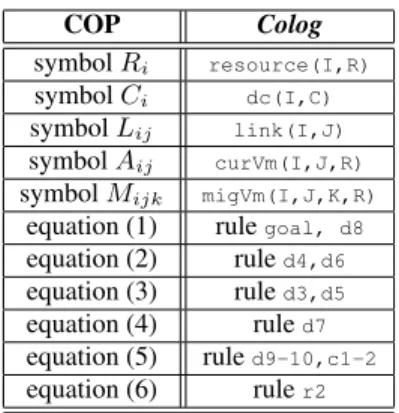
Table 1: Mappings from COP toColog.
// communication, operating and migration cost d3 aggCommCost(@X,SUM<Cost>) <- nextVm(@X,D,R),
commCost(@X,D,C), Cost==R*C.
d4 aggOpCost(@X,SUM<Cost>) <- nextVm(@X,D,R), opCost(@X,C), Cost==R*C.
d5 nborAggCommCost(@X,SUM<Cost>) <- link(@Y,X),
commCost(@Y,D,C), nborNextVm(@X,Y,D,R), Cost==R*C. d6 nborAggOpCost(@X,SUM<Cost>) <- link(@Y,X),
opCost(@Y,C), nborNextVm(@X,Y,D,R), Cost==R*C. d7 aggMigCost(@X,SUMABS<Cost>) <- migVm(@X,Y,D,R), migCost(@X,Y,C), Cost==R*C. // total cost d8 aggCost(@X,C) <- aggCommCost(@X,C1), aggOpCost(@X,C2), aggMigCost(@X,C3), nborAggCommCost(@X,C4), nborAggOpCost(@X,C5), C==C1+C2+C3+C4+C5.
// not exceeding resource capacity
d9 aggNextVm(@X,SUM<R>) <- nextVm(@X,D,R). c1 aggNextVm(@X,R1) -> resource(@X,R2), R1<=R2. d10 aggNborNextVm(@X,Y,SUM<R>) <- nborNextVm(@X,Y,D,R). c2 aggNborNextVm(@X,Y,R1) -> link(@Y,X),
resource(@Y,R2), R1<=R2.
// propagate to ensure symmetry and update allocations r2 migVm(@Y,X,D,R2) <- setLink(@X,Y),
migVm(@X,Y,D,R1), R2:=-R1. r3 curVm(@X,D,R) <- curVm(@X,D,R1),
migVm(@X,Y,D,R2), R:=R1-R2.
Program description.Table 1 summarizes the mapping from COP symbols toCologtables, and COP equations toCologrules identi-fied by the rule labels. For instance, each entry in tableRiis stored
as a resource(I,R) tuple. Likewise, the R attribute in migVm(I,J,K,R)stores the value of Mijk. The distributed COP
program works as follows.
• Optimization goal:Instead of minimizing the global total cost of all data centers, the optimization goal of this local COP is the total costCinaggCostwithin a local region, i.e. nodeXand one of its neighborsY.
• COP execution trigger: Periodically, each node Xrandomly selects one of its neighborsY(denoted as alink(@X,Y)entry)
to initiate aVM migrationprocess1setLink(@X,Y)contains the
pair of nodes participating in the VM migration process. This in essence results in the derivation oftoMigVmin ruler1, which
directly triggers the execution of the local COP (implemented by the rest of the rules). The output of thelocalCOP determines the quantity of resourcesmigVm(@X,Y,D,R)that are to be migrated betweenXandY forallentries intoMigVm.
1
To ensure that only one of two adjacent nodes initiates the VM mi-gration process, for any givenlink(X,Y), the protocol selects the
node with the larger identifier (or address) to carry out the subse-quent process. This distributed link negotiation can be specified in
• Solver derivations:During COP execution, ruled1andd2 com-pute the next-step VM allocations after migration for nodeXand Y, respectively. Ruled3-6derive the aggregate communication and operating cost for the two nodes. We note that ruled2and
d5-6aredistributedsolver derivation rules (i.e. not all rule
ta-bles are at the same location), and nodeXcollects its neighbor Y’s information (e.g.curVm, commCostandopCost) viaimplicit
distributed communications. Ruled7derives the migration cost
via aggregate keywordSUMABS, which sums the absolute values
of given variables. Ruled8derives the optimization objective
aggCostby summing all communication, operating and
migra-tion cost for both nodeXandY.
• Solver constraints:Constraintsc1andc2express that after mi-gration nodeXandYmust not have too many VMs which exceed their resource capacity given by tableresource. Rulec2is a
dis-tributed constraint rule, whereXretrieves neighborY’sresource
table over the network to impose the constraint.
• Stopping condition:At the end of each COP execution, the mi-gration resultmigVm is propagated to immediate neighborYto
ensure symmetry via ruler2. Then in ruler3both nodeXand
Yupdate theircurVmto reflect the changes incurred by VM
mi-gration. Above process is then iteratively repeated until all links have been assigned values, i.e. migration decisions between any two neighboring data centers have been made. In essence, one can view the distributed program as a series of per-node COPs carried out using each node’s constraint solver. The complexity of this program depends upon the maximum node degree, since each node at most needs to performmrounds of link negotia-tions, wheremis the node degree.
Our use ofCologdeclarative language provides ease in policy customizations. For example, we can impose restrictions on the maximum quantity of resources to be migrated due to factors like high CPU load or router traffic in data centers, or impose con-straints that the total cost after optimization should be smaller by a threshold than before optimization. These two policies can be defined as rules below.
d11 aggMigVm(@X,Y,SUMABS<R>) <- migVm(@X,Y,D,R). c3 aggMigVm(@X,Y,R) -> R<=max_migrates.
c4 aggCost(@X,C) -> originCost(@X,C2), C<=cost_thres*C2.
Rule d11derives total VM migrations betweenX and Y.
Con-straintc3ensures that total migrations do not exceed a pre-defined thresholdmax migrates. Rulec4guarantees thataggCostafter
mi-gration is below the product of the original costoriginCostand a
thresholdcost thres. originCostcan be derived by additional 5
Cologrules which are omitted here.
In distributed COP execution, each node only exposes limited information to their neighbors. These information includescurVm,
commCost,opCostandresource, as demonstrated in rulesd2,d5-6
andc2. This leads to better autonomy for each Cologne instance,
since there does not exist a centralized entity which collects the in-formation of all nodes. Via distributing its computation,Cologhas a second advantage: by decomposing a big problem (e.g. VM mi-grations between all data centers) into multiple sub-problems (e.g. VM migrations on a single link) and solving each sub-problem in a distributed fashion, it is able to achieve better scalability as the problem size grows via providing approximate solutions.
5.
EXECUTION PLAN GENERATION
This section describes the process of generating execution plans
fromCologprograms. Cologne’s compiler and runtime system are
implemented by integrating a distributed query processor (used in declarative networking) with an off-the-shelf constraint solver.
In our implementation, we use the RapidNet [5] declarative net-working engine together with the Gecode [2] high performance constraint solver. However, the techniques describe in this section is generic and can be applied to other distributed query engines and solvers as well.
5.1
General Rule Evaluation Strategy
Cologne uses a declarative networking engine for executing dis-tributed Datalog rules, and as we shall see later in the section, for implementing solver derivation and enforcing solver constraint rules. A declarative networking engine executes distributed Dat-alog programs using an asynchronous evaluation strategy known
aspipelined semi-na¨ıve(PSN) [18] evaluation strategy. The
high-level intuition here is that instead of evaluating Datalog programs in fixed rounds of iterations, one can pipeline and evaluate rules incrementally as tuples arrive at each node, until a global fixpoint is reached. To implement this evaluation strategy, Cologne adopts declarative networking’s execution model. Each node runs a set of local delta rules, which are implemented as a dataflow consist-ing of database operators for implementconsist-ing the Datalog rules, and additional network operators for handling incoming and outgoing messages. All rules are executed in a continuous, long-running fashion, where rule head tuples are continuously updated (inserted or deleted) via a technique known as incremental view
mainte-nance[20] as the body predicates are updated. This avoids having
to recompute a rule from scratch whenever the inputs to the rule change.
A key component of Cologne is the integration of a distributed query processor and a constraint solver running at each node. At a high level,Cologsolver rules are compiled into executable code in RapidNet and Gecode. Our compilation process mapsColog’s
goal,var, solver derivations and constraints into equivalent COP
primitives in Gecode. Whenever a solver derivation rule is exe-cuted (triggered by an update in the rule body predicates), Rapid-Net invokes Gecode’s high-performance constraint solving mod-ules, which adopts the standard branch-and-bound searching ap-proach to solve the optimization while exploring the space of vari-ables under constraints.
Gecode’s solving modules are invoked by first loading in appro-priate inputregular tablesfrom RapidNet. After executing its op-timization modules, the opop-timization output (i.e. opop-timization goal
goaland variablesvar) are materialized as RapidNet tables, which
may trigger reevaluation of other rules via incremental view main-tenance.
5.2
Solver Rules Identification
In order to process solver rules, Cologne combines the use of the basic PSN evaluation strategy with calls to the constraint solver at each node. Since these rules are treated differently from regular Datalog rules, the compiler needs to identify solver rules via a static analysis phase at compile time.
The analysis works by first identifying initial solver variables de-fined invar. Solver attributes are then identified by analyzing each
Cologrule, to identify attributes that are dependent on the initial
solver variables (either directly or transitively). Once an attribute is identified as a solver attribute, the predicates that refer to them are identified as solver tables. Rules that involve these solver tables are hence identified as solver rules. Solver derivation and constraint rules are differentiated trivially via rule syntax (<-vs->).
Example.To demonstrate this process, we consider the ACloud ex-ample in Section 4.2.assign,hostCpu,hostStdevCpu,assignCount, hostMemare identified as solver tables as follows:
• AttributeVinvaris a solver attribute of tableassign, sinceV
does not appear afterforall.
• In ruled1, given the boolean expressionC==V*Cpu,Cis identified
as a solver attribute of tablehostCpu. Hence, transitively,Cis a solver attribute ofhostStdevCpuin ruled2.
• In ruled3,Vis a known solver attribute ofassignand it appears
in rule head, soVis a solver attribute of tableassignCount.
• Finally, in ruled4, sinceMdepends onVdue to the assignment M==V*Mem, one can infer thatMis a solver attribute ofhostMem.
Once the solver tables are identified, rules d1-d4are trivially identified as solver derivation rules. Rulesc1andc2are legal solver constraint rules since their rule headsassignCountandhostMemare
solver tables.
In the rest of this section, we present the steps required for pro-cessing solver derivation and constraint rules. For ease of expo-sition, we first do not consider distributed evaluation, which we revisit in Section 5.5.
5.3
Solver Derivation Rules
To ensure maximum code reuse, solver derivation rules leverage the same query processing operators already in place for evaluat-ing Datalog rules. As a result, we focus only on the differences in evaluating these rules compared to regular Datalog rules. The main difference lies in the treatment of solver attributes in selection and aggregation expressions. Since solver attribute values are un-defined until the solver’s optimization modules are executed, they cannot be directly evaluated simply based on existing RapidNet ta-bles. Instead, constraints are generated from selection and aggrega-tion expressions in these rules, and then instantiated within Gecode as general constraints for reducing the search space. Cologne cur-rently does not allow joins to occur on solver attributes, since ac-cording to our experience, there is no such use cases in practice. Furthermore, joins on solver attributes are prohibitively expensive to implement and complicate our design unnecessarily, since they require enumerating all possible values of solver variables.
Example.We revisit ruled1in the ACloud example in Section 4.2.
The selection expressionC==V*Cpuinvolves an existing solver at-tributeV. Hence, a new solver variableCis created within Gecode,
and a binding betweenCandVis expressed as a Gecode constraint,
which expresses the invariant thatChas to be equal toV*Cpu. Likewise, in ruled4, the aggregateSUMis computed over a solver attributeM. This requires the generation of a Gecode constraint that
binds a new sum variable to the total of allMvalues.
5.4
Solver Constraint Rules
Unlike solver derivation rules, solver constraint rules simply im-pose constraints on existing solver variables, but do not derive new ones. However, the compilation process share similarities in the treatment of selection and aggregation expressions that involve solver attributes. The main difference lies in the fact that each solver con-straint rule itself results in the generation of a Gecode concon-straint.
Example. We use as example rulec2in Section 4.2 to illustrate.
Since the selection expressionMem<=Minvolves solver attributeM,
we impose a Gecode solver constraint expressing that host memory
Mshould be less than or equal to the memory capacityMem. This has
the effect of pruning the search space when the rule is evaluated.
5.5
Distributed Solving
Finally, we describe plan generation involvingCologrules with location specifiers to capture distributed computations. We focus on solver derivation and constraint rules that involve distribution,
and describe these modifications with respect to Sections 5.3 and 5.4.
At a high level, Cologne uses RapidNet for executing distributed rules whose predicates span across multiple nodes. The basic mech-anism is not unlike PSN evaluation for distributed Datalog pro-grams [18]. Each distributed solver derivation or constraint rule (with multiple distinct location specifiers) is rewritten using a
local-izationrewrite [19] step. This transformation results in rule bodies
that can be executed locally, and rule heads that can be derived and sent across nodes. The beauty of this rewrite is that even if the original program expresses distributed derivations and constraints, this rewrite process will realize multiple centralized local COP op-erations at different nodes, and have the output of COP opop-erations via derivations sent across nodes. This allows us to implement a distributed solver that can perform incremental and distributed con-straint optimization.
Example. We illustrate distributed solving using the Follow-the-Sun orchestration program in Section 4.3. Ruled2is a solver
deriva-tion rule that spans across two nodesXandY. During COP
execu-tion,d2retrieves rule body tableslinkandcurVmfrom nodeYto perform solver derivation. In Cologne,d2is internally rewritten as
following two rules via the localization rewrite:
d21 tmp(@X,Y,D,R1) <- link(@Y,X), curVm(@Y,D,R1). d22 nborNextVm(@X,Y,D,R) <- tmp(@X,Y,D,R1),
migVm(@X,Y,D,R2), R==R1+R2.
Ruled21is a regular distributed Datalog rule, whose rule body
is the tables with locationYind2. Its rule head is an intermediate regular tabletmp, which combines all the attributes from its rule
body. In essence, ruled21results in tabletmpgeneration at nodeY
and sent over the network toX. This rewrite is handled transparently by RapidNet’s distributed query engine. Ruled22is a centralized
solver derivation rule, which can be executed using the mechanism described in Section 5.3.
6.
EVALUATION
This section provides a performance evaluation of Cologne. Our prototype system is developed using the RapidNet declarative net-working engine [5] and the Gecode [2] constraint solver. Cologne takes as input policy goals and constraints written inColog, and then generates RapidNet and Gecode in C++, using the compila-tion process described in Seccompila-tion 5.
Our experiments are carried out using a combination of realis-tic network simulations, and actual distributed deployments, using production traces. In our simulation-basedexperiments, we use RapidNet’s built-in support for the ns-3 simulator [3], an emerging discrete event-driven simulator which emulates all layers of the net-work stack. This allows us to run Cologne instances in a simulated network environment and evaluate Cologne distributed capabilities. In addition, we can also run our experiments under an
implementa-tion mode, which enables users to run the same Cologne instances,
but uses actual sockets (instead of ns-3) to allow Cologne instances deployed on real physical nodes to communicate with each other.
Our evaluation aims to demonstrate the following. First, Cologne is a general platform that is capable of enabling a wide range of dis-tributed systems optimizations. Second, most of the policies spec-ified in Cologne result in orders of magnitude reduction in code size compared to imperative implementations. Third, Cologne in-curs low communication overhead and small memory footprint, re-quires low compilation time, and converges quickly at runtime for distributed executions.
Our evaluation section is organized around various use cases that we have presented in Section 3. These include: (1) ACloud
load balancing orchestration (Section 4.2); (2) Follow-the-Sun or-chestration (Section 4.3), and (3) wireless channel selection (Sec-tion 3.2). Our cloud orchestra(Sec-tion use cases derive their input data from actual data center traces obtained from a large hosting com-pany. In our evaluations, we use a combination of running Cologne over the ns-3 simulator, and deployment on an actual wireless testbed [4].
6.1
Compactness of Colog Programs
We first provide evidence to demonstrate the compactness of our
Cologimplementations, by comparing the number of rules inColog
and the generated C++ code.
Protocol Colog Imperative (C++)
ACloud (centralized) 10 935 Follow-the-Sun (centralized) 16 1487 Follow-the-Sun (distributed) 32 3112 Wireless (Centralized) 35 3229 Wireless (Distributed) 48 4445
Table 2:Cologand Compiled C++ comparison
Table 2 illustrates the compactness ofColog, by comparing the number ofCologrules (2nd column) for the five representative pro-grams we have implemented against the actual number of lines of code (LOC) in the generated RapidNet and Gecode C++ code (3rd column) usingsloccount. EachCologprogram includes all rules
required to implement Gecode solving and RapidNet distributed communications. The generated imperative code is approximately 100X the size of the equivalentCologprogram. The generated code is a good estimation on the LOC required by a programmer to implement these protocols in a traditional imperative language. In fact,Colog’s reduction in code size should be viewed as a lower bound. This is because the generated C++ code implements only the rule processing logic, and does not include various Cologne’s built-in libraries, e.g. Gecode’s constraint solving modules and the network layers provided by RapidNet. These built-in libraries need to be written only once, and are reused across all protocols written inColog.
While a detailed user study will allow us to comprehensively validate the usability ofColog, we note that the orders of magnitude reduction in code size makesCologprograms significantly easier to fast model complex problems, understand, debug and extend than multi-thousand-line imperative alternatives.
6.2
Use Case #1: ACloud
In our first set of experiments, we perform a trace-driven evalu-ation of the ACloud scenario. Here, we assume a single cloud con-troller deployed with Cologne, running the centralized ACloud pro-gram written inColog(Section 4.2). Benchmarking the centralized program first allows us to isolate the overhead of the solver, without adding communication overhead incurred by distributed solving.
Experimental workload. As input to the experiment, we use data center traces obtained from a large hosting company in the US. The data contains up to 248 customers hosted on a total of 1,740 statically allocated physical processors (PPs). Each customer application is deployed on a subset of the PPs. The entire trace is one-month in duration, and the trace primarily consists of sampling of CPU and memory utilization at each PP gathered at 300 seconds interval.
Based on the trace, we generate a workload in a hypothetical cloud environment similar to ACloud where there are 15 physical machines geographically dispersed across 3 data centers (5 hosts each). Each physical machine has 32GB memory. We preallocate 80 migratable VMs on each of 12 hosts, and the other 3 hosts serve as storage servers for each of the three data centers. This allows
us to simulate a deployment scenario involving about 1000 VMs. We next use the trace to derive the workload as a series of VM operations:
• VM spawn: CPU demand (% PP used) is aggregated over all PPs belonging to a customer at every time interval. We compute the average CPU load, assuming that load is equally distributed among the allocated VMs. Whenever a customer’s average CPU load per VM exceeds a predefined high threshold (80% in our experiment) and there are no free VMs available, one additional VM is spawned on a random host by cloning from an image tem-plate.
• VM stop and start:Whenever a customer’s average CPU load drops below a predefined low threshold (20% in our experiment), one of its VMs is powered off to save resources (e.g. energy and memory). We assume that powered-off VMs are not reclaimed by the cloud. Customers may bring their VMs back by powering them on when the CPU demands become high later.
Using the above workload, the ACloud program takes as input
vm(Vid,Cpu,Mem) and host(Hid,Cpu,Mem)tables, which are con-tinuously being updated by the workload generator as the trace is replayed.
Policy validation.We compare two ACloud policies against two strawman policies (default and heuristic):
• ACloud.This essentially corresponds to theCologprogram pre-sented in Section 4.2. We configure the ACloud program to pe-riodically execute every 10 minutes to perform a COP compu-tation for orchestrating load balancing via VM migration within each data center. To avoid migrating VMs with very low CPUs, thevmtable only includes VMs whose CPU utilization is larger than 20%.
• ACloud (M).To demonstrate the flexibility ofColog, we provide a slight variant of the above policy, that limits the number of VM migrations within each data center to be no larger than 3 for each interval. This requires only minor modifications to theColog
program, by adding rulesd5-6andc3as shown in Section 4.2. • Default.A na¨ıve strategy, which simply does no migration after
VMs are initially placed on random hosts.
• Heuristic. A threshold-based policy that migrates VMs from the most loaded host (i.e. with the highest aggregate CPU of the VMs running on it) to the least one, until the most-to-least load ratio is below a thresholdK(1.05in our experiment).Heuristic
emulates an ad-hoc strategy that a cloud operator may adopt in the absence of Cologne.
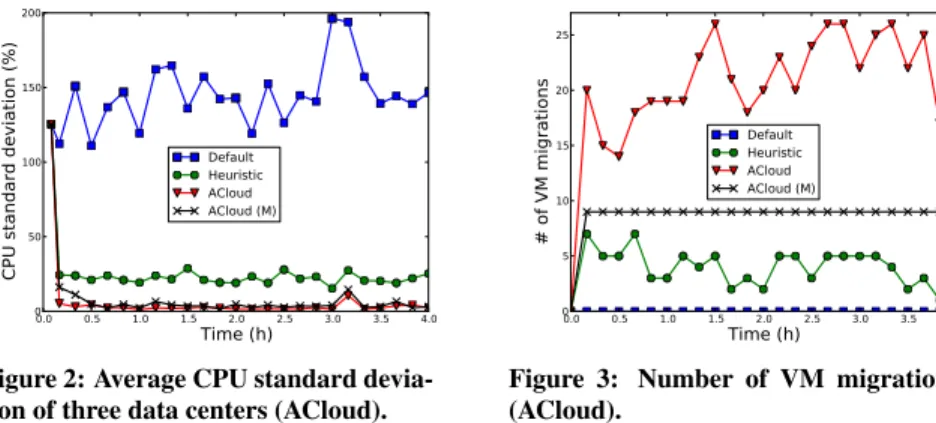
Figure 2 shows the average CPU standard deviation of three data centers achieved by theACloudprogram over a 4 hours period. We observe thatACloudis able to more effectively perform load bal-ancing, achieving a 98.1% and 87.8% reduction of the degree of CPU load imbalance as compared toDefaultandHeuristic, respec-tively. ACloud (M)also performs favorably compared toDefault
andHeuristic, resulting in a marginal increase in standard
devia-tion.
Figure 3 shows that on average,ACloudmigrates 20.3 VM mi-grations every interval. On the contrary,ACloud (M)(with migra-tion constraint) substantially reduces the number of VM migramigra-tions to 9 VMs per interval (3 per data center).
Compilation and runtime overhead. TheCologprogram is compiled and executed on an Intel Quad core 2.33GHz PC with
0.0 0.5 1.0 1.5 2.0 2.5 3.0 3.5 4.0 Time (h) 0 50 100 150 200
CPU standard deviation (%)
Default Heuristic ACloud ACloud (M)
Figure 2: Average CPU standard devia-tion of three data centers (ACloud).
0.0 0.5 1.0 1.5 2.0 2.5 3.0 3.5 4.0 Time (h) 0 5 10 15 20 25 # of VM migrations Default Heuristic ACloud ACloud (M)
Figure 3: Number of VM migrations (ACloud). 0 5 10 15 20 25 30 35 Time (s) 55 60 65 70 75 80 85 90 95 100
Normalized Total Cost (%)
10 Data Centers 8 Data Centers 6 Data Centers 4 Data Centers 2 Data Centers
Figure 4: Total cost as distributed solv-ing converges (Follow-the-Sun).
4GB RAM running Ubuntu 10.04. Compilation takes on average 0.5 seconds (averaged across 10 runs). For larger-scale data centers with more migratable VMs, the solver will require exponentially more time to terminate. This makes it hard to reach the optimal solution in reasonable time. As a result, we limit each solver’s COP execution time to 10 seconds. Nevertheless, we note from our results that the solver output still yields close-to-optimal solutions. The memory footprint is 9MB (on average), and 20MB (maximum) for the solver, and 12MB (relatively stable) for the base RapidNet program.
6.3
Use Case #2: Follow-the-Sun
Our second evaluation is based on the Follow-the-Sun scenario. We use the distributedCologprogram (Section 4.3) for implement-ing the Follow-the-Sun policies. The focus of our evaluation is to validate the effectiveness of the Follow-the-Sun program at re-ducing total cost for cloud providers, and to examine the scala-bility, convergence time and overhead of distributed solving using Cologne. Our evaluation is carried out by running Cologne in sim-ulation mode, with communication directed across all Cologne in-stances through the ns-3 simulator. We configure the underlying network to use ns-3’s built-in 10Mbps Ethernet, and all communi-cation is done via UDP messaging.
Experimental workload.Our experiment setup consists of mul-tiple data centers geographically distributed at different locations. We conducted 5 experimental runs, where we vary the number of data centers from 2 to 10. For each network size, we execute the distributedCologprogram once to determine the VM migrations that minimize the cloud providers’ total cost. Recall from Sec-tion 4.3 that this program executes in a distributed fashion, where each node runs a local COP, exchanges optimization outputs and reoptimizes, until a fixpoint is reached.
The data centers are connected via random links with an aver-age network degree of 3. In the absence of actual traces, our ex-perimental workload (in particular, operating and communication and migration costs) here are synthetically generated. However, the results still provide insight on the communication/computation overhead and effectiveness of the Follow-the-Sun program.
Each data center has a resource capacity of 60 units of migrat-able VMs (the unit here is by no means actual, e.g. one unit can denote 100 physical VMs). Data centers have a random placement of current VMs for demands at different locations, ranging from 0 to 10. Given that data centers may span across geographic regions, communication and migration costs between data centers may dif-fer. As a result, between any two neighboring data centers, we generate the communication cost randomly from 50 to 100, and the migration cost from 10 to 20. The operating cost is fixed at 10 for all data centers.
Policy validation.Figure 4 shows the total costs (migration, op-erating, and communication) over time, while the Follow-the-Sun program executes to a fixpoint in a distributed fashion. The total cost corresponds to theaggCost(optimization goal) in the program in Section 4.3. To make it comparable across experimental runs with different network sizes, we normalize the total cost so that its initial value is 100% when the COP execution starts. We observe that in all experiments, Follow-the-Sun achieves a cost reduction after each round of distributed COP execution. Overall the cost reduction ranges from 40.4% to 11.2%, as the number of data cen-ters increases from 2 to 10. As the network size gets larger, the cost reduction is less apparent. This is because distributed solving approximates the optimal solution. As the search space of COP execution grows exponentially with the problem size, it becomes harder for the solver to reach the optimal solution.
To demonstrate the flexibility ofColog in enabling different Follow-the-Sun policies, we modify the original Follow-the-Sun program slightly to limit the number of migrations between any two data centers to be less than or equal to 20, achieved with rulesd11
andc3as introduced in Section 4.3. This modified policy achieves comparable cost reduction ratios and convergence times as before, while reducing the number of VM migrations by 24% on average.
Compilation and runtime overhead.The compilation time of the program is 0.6 seconds on average for 10 runs. Figure 4 indi-cates that as the network size scales up, the program takes a longer time to converge to a fixpoint. This is due to more rounds of link negotiations. The periodic timers between each individual link ne-gotiation is 5 seconds in our experiment. Since the solver computa-tion only requires input informacomputa-tion within a node’s neighborhood, each per-link COP computation during negotiation is highly effi-cient and completes within 0.5 seconds on average. The memory footprint is tiny, with 172KB (average) and 410KB (maximum) for the solver, and 12MB for the RapidNet base program.
In terms of bandwidth utilization, we measure the communi-cation overhead during distributed COP execution. The per-node communication overhead is shown in Figure 5. We note that Cologne is highly bandwidth-efficient, with a linear growth as the number of data centers scales up. For10 data centers, the per-node communi-cation overhead is about3.5KBps.
6.4
Use Case #3: Wireless Channel Selection
In our final set of experiments, we perform evaluations of using Cologne to support declarative wireless channel selection policies (Section 3.2 and Appendix A).
Experimental setup. Our experimental setup consists of de-ploying Cologne instances on ORBIT [4], a popular wireless testbed that consist of machines arranged in a grid communicating with each other using 802.11. Each ORBIT node is equipped with 1 GHz VIA Nehemiah processors, 64KB cache and 512MB RAM.
0 2 4 6 8 10 # of data centers 0.0 0.5 1.0 1.5 2.0 2.5 3.0 3.5 4.0
Per-node communication overhead (KB/s)
Figure 5: Per-node communication overhead (Follow-the-Sun). 0 2 4 6 8 10 12 Data rate (Mbps) 0 1 2 3 4 5 6 7 8 9 Throughput (Mbps) Cross-layer Distributed Centralized Identical-Ch 1-Interface
Figure 6: Aggregate ORBIT through-put (30 nodes). 0 2 4 6 8 10 Data rate (Mbps) 0 1 2 3 4 5 6 Throughput (Mbps) 2-hop Interference Restricted Channels 1-hop Interference
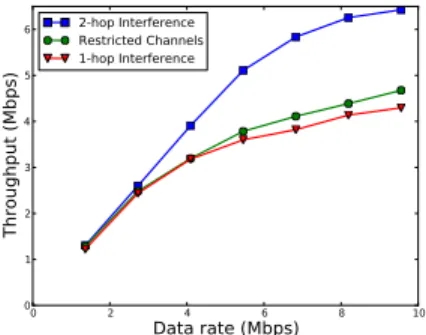
Figure 7: Aggregate network through-put (varying policies).
We selected 30 ORBIT nodes in a8m×5mgrid to execute one Cologne instance each. Each of these 30 nodes utilizes two Atheros AR5212-based 802.11 a/b/g cards as their data interfaces.
Policy validation. In our evaluation, we execute three channel selection protocolsCentralized(Appendix A.2),Distributed (Ap-pendix A.3) andCross-layer, a distributed cross-layer protocol [14] written inCologthat integrates and optimizes across channel selec-tion and routing policy decisions. We compare with two base line protocolsIdentical-Chand 1-Interface. In1-Interfaceall nodes communicate with each other using one interface and hence a com-mon channel. InIdentical-Ch[12], the same set of channels are as-signed to the interfaces of every node, and a centralized constraint solver then assigns each link to use one of these interfaces.
We injected packets into Cologne instances with increasing send-ing rate, and then measure theaggregate network throughput de-fined in terms of network-wide aggregate data packet transmissions that are successfully received by destination nodes. The result is depicted in Figure 6. We make the following observations. First,
centralizedanddistributedprotocols implemented in Cologne
sig-nificantly outperform single-interface and identical channel assign-ment solutions. The relative differences and scalability trends of these protocols are consistent with what one would expect in imper-ative implementations. Second,cross-layerprotocol outperforms other protocols and exhibits the best overall performance in terms of high throughput and low loss rate.
In our second experiment, we fix the channel selection proto-col to becross-layerand vary the channel selection policies. We use a simulated network setup with 30 nodes. Figure 7 highlights the capabilities of Cologne to handle policy variations with minor changes to the inputCologpolicy rules. Specifically, we vary the policies in two ways. First,Restricted Channelsreduces the num-ber of available channels for each node by an average of 20%. This emulates the situation where some channels are no longer available due to external factors, e.g. decreased signal strength, the presence of primary users, or geographical spectrum usage limits. Second,
1-hop Interferenceuses a different cost assignment function to
con-sider only one-hop interference [28]. As a basis of comparison,
2-hop Interferenceshows our original channel selection policy used
in prior experiments. We observe that forRestricted Channels, the throughput decreases by 35.9%. With the additional use of one-hop interference model, the throughput further reduces by an average of 6.9%, indicating that the two-hop interference model does a better job in ensuring channel diversity.
Compilation and runtime overhead.The compilation time of
CentralizedandDistributedis 1.2 seconds and 1.6 seconds
respec-tively. In terms of convergence time,Centralizedrequires less than 30 seconds to perform channel selection. The execution time is dominated by the computation overhead of the Gecode solver. The
distributed protocols converge quickly as well – at 40 seconds and 80 seconds respectively forDistributedandCross-layer. Since the solver computation only requires input channel information within a node’s neighborhood, each per-link COP computation during ne-gotiation is highly efficient and completes within 0.2 seconds. For bandwidth utilization,Distributed,Cross-layerare both bandwidth efficient, requiring only per-node average bandwidth utilization of 1.57KBps,1.58KBpsrespectively for computing channel selec-tion from scratch. In all cases, memory footprint is modest (about 12MB).
7.
RELATED WORK
In our prior work, we made initial attempts at developing special-ized optimization platforms tailored towards centralspecial-ized cloud re-source orchestration [16] and wireless network configuration [14]. This paper generalizes ideas from these early experiences, to de-velop a general framework, a declarative programming language, and corresponding compilation techniques. Consequently, Cologne is targeted as a general-purpose distributed constraint optimization platform that can support the original use cases and more. In doing so, we have also enhanced the ACloud and Follow-the-Sun policies through the use ofColog.
Prior to Cologne, there have been a variety of systems that use declarative logic-based policy languages to express constraint op-timization problems in resource management of distribute com-puting systems. [27] proposes continuous optimization based on declaratively specified policies for autonomic computing. [24] de-scribes a model for automated policy-based construction as a goal satisfaction problem in utility computing environments. The XSB engine [6] integrates a tabled Prolog engine with a constraint solver. Rhizoma [29] proposes using rule-based language and constraint solving programming to optimize resource allocation. [21] uses a logic-based interface to a SAT solver to automatically generate configuration solution for a single data center. [10] describes com-piling and executing centralized declarative modeling languages to Gecode programs.
Unlike the above systems, Cologne is designed to be a gen-eral declarative distributed platform for constraint optimizations. It first provides a general declarative policy language–Colog, which is user-friendly for constraint solving modeling and results in or-ders of magnitude code size reduction compared to imperative al-ternatives. Another unique feature of Cologne is its support for distributed optimizations, achieved by using theCologlanguage which supports distribution, and the integration of a distributed query engine with a constraint solver. Cologne platform supports both simulation and deployment modes. This enables one to first simulate distributed COP execution within a controllable network environment and then physically deploy the system on real devices.
8.
CONCLUSION
In this paper, we have presented the Cologne platform for declar-ative constraint optimizations in distributed systems. We argue that such a platform has tremendous practical value in facilitating ex-tensible distributed systems optimizations. We discuss two con-crete use cases based on cloud resource orchestration and wireless network configurations, and demonstrate how theCologlanguage enables a wide range of policies to be customized in support of these two scenarios. We have proposed novel query processing functionalities, that extend basic distributed Datalog’s PSN [18] evaluation strategies with solver modules, and compilation tech-niques that rewrite rule selection and aggregation expressions into solver constraints. We have implemented a complete prototype based on RapidNet declarative networking engine and Gecode con-straint solver. Our evaluation results demonstrate the feasibility of Cologne, both in terms of the wide range of policies supported, and the efficiency of the platform itself.
As future work, we plan to explore additional use cases in a wide range of emerging domains that involve distributed COPs, includ-ing decentralized data analysis and model fittinclud-ing, resource alloca-tions in other distributed systems, network design and optimiza-tions, etc.
9.
ACKNOWLEDGMENTS
This work is supported in part by NSF grants CCF-0820208, CNS-0845552, and CNS-1040672.
10.
REFERENCES
[1] Choco solver.http://www.emn.fr/z-info/choco-solver/. [2] Gecode constraint development environment.http://www.gecode.org/. [3] Network Simulator 3.http://www.nsnam.org/.
[4] ORBIT Wireless Network Testbed.http://www.orbit-lab.org/. [5] RapidNet.http://netdb.cis.upenn.edu/rapidnet/. [6] XSB Project.http://xsb.sourceforge.net/.
[7] M. Al-Fares, S. Radhakrishnan, B. Raghavan, N. Huang, and A. Vahdat. Hedera: Dynamic flow scheduling for data center networks. InNSDI, pages 281–296, 2010.
[8] V. Brik, E. Rozner, and S. Banerjee. Dsap: a protocol for coordinated spectrum access. InIn IEEE DySPAN, pages 611–614, 2005.
[9] R. Campbell, I. Gupta, M. Heath, S. Y. Ko, M. Kozuch, M. Kunze, T. Kwan, K. Lai, H. Y. Lee, M. Lyons, D. Milojicic, D. O’Hallaron, and Y. C. Soh. Open cirrus cloud computing testbed: federated data centers for open source systems and services research. InProc. of HotCloud Workshop, 2009.
[10] R. Cipriano, A. Dovier, and J. Mauro. Compiling and Executing Declarative Modeling Languages to Gecode. InProceedings of the 24th International Conference on Logic Programming, ICLP ’08, pages 744–748, 2008. [11] A. Dhananjay, H. Zhang, J. Li, and L. Subramanian. Practical, distributed
channel assignment and routing in dual-radio mesh networks. InProceedings of
the ACM SIGCOMM 2009 conference on Data communication, SIGCOMM
’09, pages 99–110, 2009.
[12] R. Draves, J. Padhye, and B. Zill. Routing in multi-radio, multi-hop wireless mesh networks. InMobiCom, pages 114–128, 2004.
[13] K. Jain, J. Padhye, V. N. Padmanabhan, and L. Qiu. Impact of interference on multi-hop wireless network performance. InMobiCom, pages 66–80, 2003. [14] C. Liu, R. Correa, H. Gill, T. Gill, X. Li, S. Muthukumar, T. Saeed, B. T. Loo,
and P. Basu. PUMA: Policy-based Unified Multi-radio Architecture for Agile Mesh Networking (full paper and demonstration). InThe Fourth International
Conference on COMmunication Systems and NETworkS (COMSNETS), pages
1–10, 2012.
[15] C. Liu, R. Correa, X. Li, P. Basu, B. T. Loo, and Y. Mao. Declarative policy-based adaptive mobile ad hoc networking.Networking, IEEE/ACM Transactions on, 2011.
[16] C. Liu, B. T. Loo, and Y. Mao. Declarative automated cloud resource orchestration. InProceedings of the 2nd ACM Symposium on Cloud Computing, SOCC ’11, pages 26:1–26:8, 2011.
[17] C. Liu, Y. Mao, J. Van der Merwe, and M. Fernandez. Cloud Resource Orchestration: A Data-Centric Approach. InProceedings of the biennial Conference on Innovative Data Systems Research (CIDR), 2011.
[18] B. T. Loo, T. Condie, M. Garofalakis, D. E. Gay, J. M. Hellerstein, P. Maniatis, R. Ramakrishnan, T. Roscoe, and I. Stoica. Declarative Networking: Language, Execution and Optimization. InSIGMOD, pages 97–108, June 2006.
[19] B. T. Loo, T. Condie, M. Garofalakis, D. E. Gay, J. M. Hellerstein, P. Maniatis, R. Ramakrishnan, T. Roscoe, and I. Stoica. Declarative Networking. In
Communications of the ACM (CACM), pages 87–95, 2009.
[20] Mengmeng Liu, Nicholas Taylor, Wenchao Zhou, Zachary Ives, and Boon Thau Loo. Recursive Computation of Regions and Connectivity in Networks. In ICDE, pages 1108–1119, 2009.
[21] S. Narain, G. Levin, S. Malik, and V. Kaul. Declarative infrastructure configuration synthesis and debugging.J. Netw. Syst. Manage., 16:235–258, September 2008.
[22] R. Ramakrishnan and J. D. Ullman. A Survey of Research on Deductive Database Systems.Journal of Logic Programming, 23(2):125–149, 1993. [23] A. Raniwala, K. Gopalan, and T.-c. Chiueh. Centralized channel assignment
and routing algorithms for multi-channel wireless mesh networks.SIGMOBILE Mob. Comput. Commun. Rev., pages 50–65, 2004.
[24] A. Sahai, S. Singhal, V. Machiraju, and R. Joshi. Automated policy-based resource construction in utility computing environments. InIEEE/IFIP Network
Operations and Management Symposium, pages 381–393, 2004.
[25] A. Subramanian, H. Gupta, and S. Das. Minimum Interference Channel Assignment in Multi-Radio Wireless Mesh Networks. InSECON, pages 481–490, 2007.
[26] J. Van der Merwe, K. Ramakrishnan, M. Fairchild, A. Flavel, J. Houle, H. A. Lagar-Cavilla, and J. Mulligan. Towards a ubiquitous cloud computing infrastructure. In”Proc. of the IEEE Workshop on Local and Metropolitan Area Networks”, pages 1–6, 2010.
[27] S. White, J. Hanson, I. Whalley, D. Chess, and J. Kephart. An architectural approach to autonomic computing. InAutonomic Computing, 2004. Proceedings. International Conference on, pages 2 – 9, may 2004.
[28] Y. Yi and M. Chiang. Wireless Scheduling Algorithms with O(1) Overhead for M-Hop Interference Model. InIEEE ICC, pages 3105–3109, 2008. [29] Q. Yin, A. Schuepbach, J. Cappos, A. Baumann, and T. Roscoe. Rhizoma: a
runtime for self-deploying, self-managing overlays. InProceedings of ACM Middleware, pages 10:1–10:20, 2009.
[30] Z. Zhang, M. Zhang, A. Greenberg, Y. C. Hu, R. Mahajan, and B. Christian. Optimizing cost and performance in online service provider networks. InNSDI, pages 33–48, 2010.
APPENDIX
A.
DECLARATIVE CHANNEL SELECTION
We first formulate wireless channel selection as a constraint op-timization problem (COP), followed by presenting its equivalent
Cologprograms (both centralized and distributed).
A.1
COP Formulation
In wireless channel selection, the optimization variables are the channels to be assigned to each communication link, while the val-ues are chosen from candidate channels available to each node. The goal in this case is to minimize the likelihood of interference among conflicting links, which maps into the well-knowngraph-coloring
problem [13].
We consider the following example that avoids interference based on theone-hop interferencemodel [28]. In this model, any two adjacent links are considered to interfere with each other if they both use channels whose frequency bands are closer than a certain threshold. The formulation is as follows:
Input domain and variables:Consider a networkG= (V, E), where there are nodesV ={1,2, . . . , N}and edgesE⊆V ×V. Each nodexhas a set of channelsPxcurrently occupied by primary
users within its vicinity. The number of interfaces of each node is
ix.
Optimization goal:For any two adjacent nodesx, y ∈V,lxy
denotes the link betweenxandy. Channel assignment selects a channelcxyfor each linklxyto meet the following optimization
goal:
min X
lxy,lxz∈E,y6=z
cost(cxy, cxz) (7)
wherecost(cxy, cxz)assigns a unit penalty if adjacent channel
assignmentscxyandcxzare separated by less than a specified