Using FB-LTAG Derivation Trees to Generate Transformation-Based
Grammar Exercises
Claire Gardent CNRS/LORIA
Nancy, France
Laura Perez-Beltrachini Universit´e de Lorraine/LORIA
Nancy, France
Abstract
Using a Feature-Based Lexicalised Tree Adjoining Grammar (FB-LTAG), we present an approach for generating pairs of sentences that are related by a syntactic transformation and we apply this approach to create language learning exercises. We argue that the derivation trees of an FB-LTAG provide a good level of representation for capturing syntactic transformations. We relate our approach to previous work on sentence reformulation, question generation and grammar exercise generation. We evaluate precision and linguistic coverage. And we demonstrate the genericity of the proposal by applying it to a range of transformations including the Passive/Active transformation, the pronominalisation of an NP, the assertion / yes-no question relation and the assertion / wh-question transformation.
1 Introduction
Textbooks for language learning generally in-clude grammar exercises. For instance, Tex’s
French Grammar 1 includes at the end of each
lecture, a set of grammar exercises which target a specific pedagogical goal such as the one shown in Figure 1 for learning to form questions. The aim of those exercises is to facilitate the acquisi-tion of a specific grammar point by presenting the
1
Tex’s French Grammar http://www.laits. utexas.edu/tex/ is an online pedagogical reference grammar which is arranged like many other traditional reference grammars with the parts of speech (nouns, verbs, etc.) used to categorize specific grammar items (gender of nouns, irregular verbs). Individual grammar items are explained in English, exemplified in a dialogue, and finally tested in self-correcting, fill-in-the-blank exercises.
learner with exercises made up of short sentences
involving a simple syntax and a restricted vocab-ulary.
As argued in (Perez-Beltrachini et al., 2012), most existing work on the generation of gram-mar exercises has concentrated on the automatic creation of exercises whose source sentences are “real life sentences” extracted from an existing corpus. In contrast, we aim at generating text-book style exercices i.e., exercices whose syntax and lexicon are controlled to match the linguistic content already acquired by the learner.
Moreover, in computer aided language learn-ing (CALL), much of the work towards gener-ating exercices has focused on so-called objec-tive test items i.e., test items such as multiple choice questions, fill in the blank and cloze exer-cise items, whose answer is strongly constrained and can therefore be predicted and checked with high accuracy. Thus, (Chen et al., 2006) describes a system called FAST which supports the semi-automatic generation of Multiple-Choice and Er-ror Detection exercises while (Aldabe et al., 2006) presents the ArikiTurri automatic question gener-ator for constructing Fill-in-the-Blank, Word For-mation, Multiple Choice and Error Detection ex-ercises.
Few studies, however, have been conducted on the generation of transformation based exercices such as illustrated in Figure 1.
In this paper, we present an approach for gener-ating transformation exercices such as (1), where the query (Q) is a sentence and the solution (S) is related to the query by a syntactic transformation.
(1) Instruction: Modify Q so that the underlined
verb is in passive.
Q: John hopes that Mary likes Peter.
Interrogative pronouns. Transform each sentence into the corresponding question. Example: Rita parle DE LA POLITIQUE. You write: De quoi est-ce que Rita parle? 1. Bette parle DE TAMMY.
2. Corey a besoin D’UNE BIERE. 3. Fiona t´el´ephone A RITA. 4. Joe-Bob sort AVEC TEX. 5. LE PROF d´erange Joe-Bob. 6. LES DEVOIRS d´erangent Joe-Bob. 7. Paw-Paw fait UNE SIESTE (nap). 8. Tammy cherche TEX.
9. TAMMY cherche Tex.
Figure 1: Grammar exercises from the Tex’s French Grammar textbook
S: John hopes that Peter is liked by Mary.
To control the syntax and the lexicon of the ex-ercices produced, we take a grammar based ap-proach and make use of generation techniques. More specifically, we generate sentences using a Feature-Based Lexicalised Tree Adjoining Gram-mar (FB-LTAG) for French (SemTAG). We show that the rich linguistic information associated with sentences by the generation process naturally sup-ports the identification of sentence pairs related by a syntactic transformation. In particular, we argue that the derivation trees of the FB-LTAG gram-mar provide a level of representation that captures both the formal and the content constraints gov-erning transformations. The content words and the grammatical functions labelling the tree nodes permit checking that the two sentences stand in the appropriate semantic relation (i.e., fully iden-tical content or ideniden-tical content modulo some lo-cal change). Further, the syntactic properties la-belling these nodes (names of FB-LTAG elemen-tary tree names but also some additional informa-tion provided by our generator) permits ensuring that they stand in the appropriate syntactic rela-tion.
The structure of the paper is the following. We start (Section 2) by discussing related work focus-ing on studies that target the production of syn-tactic reformulations. We then go on to present our approach and show that it permits generating different types of transformations (Section 3). In Section (4), we discuss results concerning linguis-tic coverage, precision and recall. Section (5) con-cludes with pointers for further research.
2 Related work
In linguistics, transformations (Harris, 1957; Chomsky, 1957) model recurrent linguistic rela-tions between sentence pairs. For instance, a transformation can be used to define the relation
between the active and the passive voice version of the same sentence. Formally, transformations were stated as tree-transducers on phrase structure trees and they defined either structure changing or structure building (generalised transformation) operations.
In computational linguistics, transformations and more generally, structure changing and struc-ture building rules have been used in such tasks as text simplification (Siddharthan, 2010), text sum-marising (Cohn and Lapata, 2009) and question generation (Piwek and Boyer, 2012). In these ap-proaches however, the transformation relation is not necessarily defined on phrase structure trees. For instance, for the question generation task, (Yao et al., 2012) has argued that Assertion/WH-Question transformations are best defined on se-mantic representations. Conversely, for text sim-plification, (Siddharthan, 2010) has convincingly shown that dependency trees are better suited as a representation on which to define text simplifi-cation rules than both phrase structure trees and semantic representations.
(Siddharthan, 2011) presents a user evaluation comparing different re-generation approaches for sentence simplification. He notes in particular that annotators preferred those transformations that are closer in syntax to the original sentence. To achieve this, rules for word ordering are ei-ther added to the transform rules or coded as con-straints within the input to a generator. In contrast, in our approach, syntactic similarity can be de-duced by tree comparison using the rich linguistic information associated by the generator with the FB-LTAG derivation trees.
(α1)
Nj
Tammy
l0:proper q(j hr hs) qeq(hr l1) l1:named(j tammy)
l1:indiv(j f sg)
(α2)
Se
VP N↓f Sed
Cl V N VPdc
Vcb N↓g
V Vba
ce ˆetre qui faire
lv:faire(a,f,g)
(β1)
Nx
D N*x
la
l2:le q(f dr ds)
qeq(hr, l3)
(α3)
Nt
tarte
l3:tarte(t)
α2-faire:{Active,CleftSubj,CanObj} (num:sg,tse:pst,mode:ind,pers:3)
α1-tammy:{ProperNoun} (fun:subj,gen:fem,num:sg,pers:3)
α3-tarte:{Noun}
(fun:obj,gen:fem,num:sg)
β1-la:{DefDet} (gen:fem,num:sg)
Derivation Tree
S
VP PP
Cl V Prep N↓
ce ˆetre par
[image:3.595.99.481.72.363.2]Tree Property CleftAgent
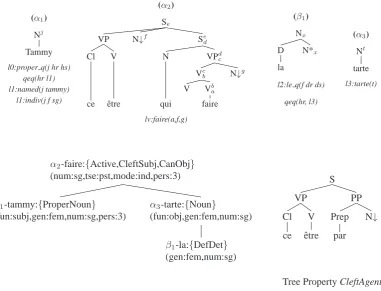
Figure 2: Grammar, Derivation Tree and Example Tree Property (Bottom right) for the sentence C’est Tammy qui fait la tarte (It is Tammy who bakes the pie)
base representation. Using a corpus of complex sentences parsed and aligned with the correspond-ing simplified sentences, the tree comparison al-gorithm they propose permit inducing simplifica-tion rules between dependency trees derived from TAG derivation trees. Although similar to our ap-proach, (Chandrasekar and Srinivas, 1997)’s pro-posal differs from ours in several ways. First, while we focus on transformations, they work on simplifications relating e.g., a sentence contain-ing a relative clause to two base clauses. Second, the trees on which they define their transforma-tions are reconstructed in a rather ad hoc man-ner from the TAG derivation trees and from in-formation extracted from the TAG derived trees. In contrast, we make use of the derivation trees produced by the GraDe algorithm. Third, while their work is limited to sentences containing rel-ative clauses, we consider a wider range of trans-formations. Fourth, their approach targets the au-tomatic acquisition of simplification rules while we manually define those.
3 Generating Transformation-related sentences
To generate pairs of sentences that are related by a transformation, we proceed in two main steps.
First, we construct a generation bank by gener-ating sentences from underspecified semantic rep-resentations using the GraDe algorithm (Gardent and Kruszewski, 2012). This generation bank stores sentences that have been generated using
GraDe together with the detailed linguistic
in-formation associated by this algorithm with each sentence in particular, its derivation tree.
Second, filters are used to retrieve from the gen-eration bank sentence pairs that provide the query and the solution to a given transformation type ex-ercise. These filters are defined on derivation trees and make use of the rich linguistic information associated by our generator with those derivation trees.
S
VP N S
Cl V N VP
V N
V V D N
c’ est Tex qui a fait la tarte
S
VP PP S
Cl V Prep N C VP
N V
D N V V
V V
c’ est par Tex que la tarte a ´et´e faite
α2-faire:{Active,CleftSubj,CanObj}
α1-tex:{...} α5-avoir:{TenseAux} α3-tarte:{...}
β1-la:{defDet}
α2-faire:{Passive,CleftAgent,CanSubj}
α1-tex:{...} α5-avoir:{TenseAux} α3-tarte:{...}
[image:4.595.51.499.74.330.2]β1-la:{defDet}
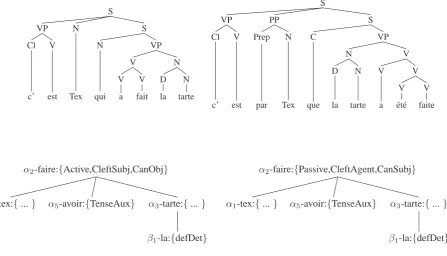
Figure 3: Derived (top) and Derivation (bottom) Trees for the active voiced sentence C’est Tex qui a fait la tarte (It is Tex who baked the pie) and its passive variant
transformationally related sentences. Finally, we present the derivation tree filters used to identify pairs of transformationally related sentences.
3.1 Grammar
The grammar used by the surface realiser is called SemTAG. It is a Feature-Based Lexicalised Tree Adjoining Grammar (FB-LTAG, (Vijay-Shanker and Joshi, 1988)) for French augmented with a unification-based compositional semantics as de-scribed in (Gardent and Kallmeyer, 2003).
Figure 2 shows an example FB-LTAG grammar and the derivation tree associated with the sen-tence C’est Tammy qui fait la tarte (It is Tammy who bakes a pie).
The basic elements of FB-LTAG are called el-ementary trees. Each elel-ementary tree is labelled with feature structures and is associated with at least one lexical item called the anchor of that tree. Elementary trees are of two types: auxiliary (to model recursion) and initial (to capture predi-cate/argument dependencies). They are combined using two operations, substitution andadjunction. The result of combining elementary trees together is both a derived tree (representing phrase struc-ture) and a derivation tree (describing the process by which a derived tree was produced). More
specifically, an FB-LTAG derivation tree indicates which FB-LTAG elementary trees were used to construct the parse tree and how they were com-bined: each node in a derivation tree is labelled with the name of an elementary trees used in the derivation and each edge indicates which oper-ation (substitution or adjunction) was applied to combine the two trees related by the edge.
As shown in Figure 2, the derivation trees pro-duced by GraDe contain additional information2.
Nodes are labelled not only with the name of an elementary tree but also with the lemma anchor-ing that tree, the feature structure associated with the anchor of that tree and the tree properties of that tree.
We use feature structure information to iden-tify the grammatical function of an argument and to verify that two transformationally related sen-tences are syntactically and morpho-syntactically identical up to the transformed part.
Tree properties are abstractions over tree de-scriptions. These properties are produced by the grammar compiler computing the grammar out of a more abstract grammar specification. They name the tree descriptions that were used to build
2
the FB-LTAG elementary trees. Thus, for in-stance, the tree propertyCleftAgentnames the tree description appearing at the bottom right of Fig-ure 2; and the elementary treeα2 in Figure 2 is
associated with the tree properties Active, Cleft-Subj,CanObjindicating that this tree was built by combining together the tree descriptions named Active, CleftSubjandCanObj.
3.2 Why Derivation Trees?
As discussed in Section 2, previous work on syn-tactic transformations has experimented with dif-ferent levels of representation on which to define transformations namely, dependency trees, phrase structure tree and semantic representations. While providing detailed information about the syntax and the informational content of a sentence, FB-LTAG derivation trees provide both a more ab-stract description of this information than derived trees and a richer representation than semantic formulae.
Figure 3 illustrates the difference between de-rived and derivation trees by showing those trees for the sentences C’est Tex qui a fait la tarte (It is Tex who baked the pie) and C’est par Tex que la tarte a ´et´e faite (It is by Tex that the pie was baked). While the derived trees of these two sentences differ in their overall structure (different struc-ture, different number of nodes), their derivation trees are identical up to the tree properties of the verb. Moreover, the tree properties of the active ({Active,CleftSubj,CanObj}) and of the pas-sive ({passive,cleftAgent,canSubj}) verb capture the changes in argument and verb realisation typi-cal of a passive transformation. In other words, derivation trees provide a level of description that is simpler (less nodes) and that better supports the identification of tranformationally related sen-tences (more similar configurations and explicit description of changes in argument and verb real-isation).
Derivation trees are also better suited than semantic formulae to capture transformations as, in some cases3, the semantic representa-tions of two transformationally related sentences
3Whether two syntactically distinct sentences share the
same semantics depends on the grammar. In the grammar we use, the semantic representations aims to capture the truth conditions of a sentence not their pragmatic or informational content. As a result, Passive/Active variations do share the same semantics.
may be identical. For instance, in our gram-mar, Active/Passive, canonical/inverted subject and cleft/non cleft argument variations are as-signed the same semantics. As shown above, for those cases, the tree properties labelling the derivation trees provide a direct handle for identi-fying sentences related by these transformations.
3.3 Derivation Tree Filters
•
• α{Ps}
v
• • •
•
• α{Pt}
v
• • •
a)
•
• α{Ps}
v
• αN P •
...
•
• α{Pt}
v
• αpron •
b)
•
• αv
• • •
•
• αv
• • • βqm
c)
αv
• αv
• • •
αv
• αv
• • • •
d)
•
• αv
• αn •
• •
βDet
•
• αv
• αn •
•
βwhDet
[image:5.595.314.512.213.621.2]e)
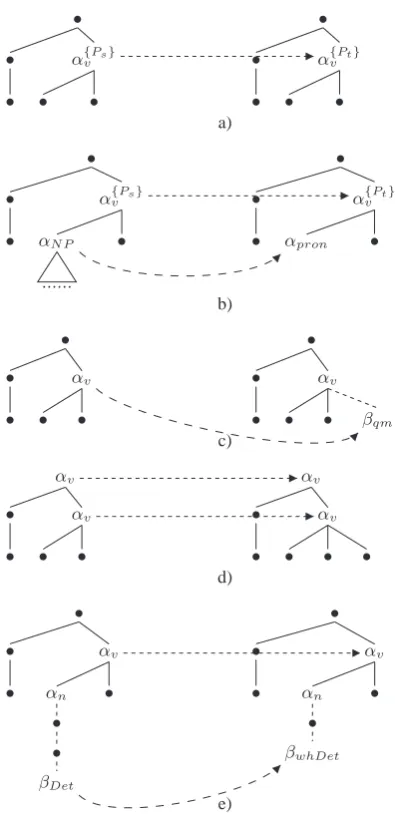
Figure 4: Tree filter types (tree schemas on the left de-pict source sentence derivation trees and those to their right their transform)
la-belling the nodes of these trees.
Figure 4 shows the general filtering patterns we used to handle four types of transformations used in language learning: Active/Passive, NP/pronoun (pronominalisation), NP/Wh-NP (WH-questions) and Assertion/Yes-No questions.
Filters (a) and (d) are used for the Ac-tive/Passive and for the canonical/inverted subject variations. Filter (a) relates two trees which are identical up to either one node differing in its tree properties. It applies for instance to the deriva-tion trees shown in Figure 3. Filter (d) is used for cases such asJohn wants Mary to like him / John wants to be liked by Marywhere the two derivation trees differ both in the tree properties assigned to want (CanSubj, CanObj, SentObj ↔ CanObj, Sen-tObj) and in the tree properties assigned tolike (In-fSubj, CanObj↔InfSubj, CanAgent); and where an additional node is present due to the presence of the pronounhimin the active sentence and its ab-sence in the passive variant.
Filter (b) is used for the NP/Pronoun transfor-mation and relates two trees which in addition to having one node with different tree properties also differ in that an NP node and its subtree maps to a pronoun node.
Filter (c) relates two trees which are identical up to the addition of an auxiliary tree of typeβqm.
As we shall see below, this is used to account for the relation between an assertion and a question including a question phrase (i.e.,n’est ce pas / Isn’t it,est ce que, invertedt’ilor question mark).
Finally, Filter (e) is used for the assertion/wh-question transformation and matches pairs of trees such that an NP containing n modifiers in one tree becomes a WH-NP with any number of thesenmodifiers in the other tree.
We now discuss in more detail the derivation tree filters specified for each type of transforma-tions.
3.4 Meaning Preserving Transformations
In SemTAG, semantic representations aim to cap-ture the truth conditions of a sentence not their pragmatic or informational content. As a result, some sentences with different syntax share the same semantics. For instance, all sentences in (2b) share the semantics in (2a).
(2) a. L0:proper q(C HR HS) L1:named(C tammy) L1:indiv(C f sg) qeq(HR L1) L3:love(EL TX C) L3:event(EL pst indet ind) L4:proper q(TX
HRX HSX) L5:named(TX tex) L5:indiv(TX m sg) qeq(HRX L5)
b. Tex loves Tammy, It is Tex who loves Tammy, It is Tammy whom Tex loves, Tammy is loved by Tex, It is Tammy who is loved by Tex, It is by Tex that Tammy is loved, etc.
The syntactic and pragmatic differences be-tween these semantically identical sentences is captured by their derivation trees and in partic-ular, by the tree properties labelling the nodes of these derivation trees. More generally, Ac-tive/Passive sentence pairs, canonical/cleft (e.g., Tex loves Tammy / It is Tex who loves Tammy and Canonical/Inverted Subject variations (e.g. C’est Tex que Tammy adore / C’est Tex qu’adore Tammy may lead to derivation trees of identical struc-ture but distinct tree properties. In such cases, the transformationally related sentence pairs can therefore be captured using the first type of deriva-tion filter i.e., filters which related derivaderiva-tion trees with identical structure but distinct tree proper-ties. Here, we focus on the Active/Passive vari-ation.
The differences between an active voice sen-tence and its passive counterpart include lexical, morphological and syntactic differences. Thus for instance, (3a) differs from (3b) in that the verb agrees with the proper name Tammy rather than the pronounil; the clitic is in the oblique case (lui) rather that the nominative (il); the subject NP Il has become a PP headed by the prepositionpar; the passive auxiliary ˆetre and the prepositionpar have been added to support the passive voice con-struction.
(3) a. Il regarde Tammy (He watches Tammy) b. Tammy est regard´ee par lui
(Tammy is watched by him)
In (Siddharthan, 2010), these variations are handled by complex node deletion, lexical substitution, insertion, and node ordering rules. By contrast, to identify Active / Passive
Active/Passive Tree Property Patterns
{Active, CanSubj, CanObj}
↔ {Passive, CanSubj, CanAgent}
{Active, CliticSubj, CanObj}
↔ {Passive, CanSubj, CanAgent}
{Active, WhSubj, CanObj}
↔ {Passive, InvertedSubj, WhAgent}
{Active, RelSubj, CanObj}
↔ {Passive, CanSubj, RelAgent}
{Active, CleftSubj, CanObj}
↔ {Passive, CanSubj, CleftAgent}
In sum, in our approach, the possible differ-ences in morphological agreement between ac-tive and passive sentences are accounted for by the grammar; differences in argument realisation (Object/Subject, Subject/Agent) are handled by the tree filters; and lexical differences due to ad-ditional function words fall out of the FB-LTAG coanchoring mechanism.
As should be clear from the derivation tree be-low, our approach supports transformations at any level of embedding. For instance, it permits iden-tifying the pair Tammy sait que Tex a fait la tarte / Tammy sait que la tarte a ´et´e faite par Tex (Tammy knows that Tex has baked the pie / Tammy knows that the pie has been baked by Tex).
α0-savoir:{...}
α2-faire
{Passive,CanAgent,CanSubj} α4-tammy:{...}
α1-tex:{...} α5-avoir:{...} α3-tarte:{...}
β1-la:{...}
It also supports a fine grained control of the Ac-tive/passive variants allowing both for cases with multiple variants (4a) and for transitive configura-tions with no passive counterpart (4b,d).
(4) a. C’est la tatou qu’il adore
C’est par lui que la tatou est ador´ee C’est lui par qui la tatou est ador´ee It is the tatoo that he loves / It is the tatoo that is loved by him
b. Tex veut faire une tarte
** Une tarte veut ˆetre faite par Tex Tex wants to bake a pie / ** A pie wants to be baked by Tex
c. Tex semble faire une tarte
Une tarte semble ˆetre faite par Tex Tex seems to bake a pie / A pie seems to be baked by Tex
d. Tex mesure 1.80m
** 1.80m est mesur´e par Tex
Tex measures 1.80m ** 1.80m is measured by Tex
(4a) is accounted for by specifying a tree filter including the tree property mapping CleftSubject
↔CleftAgent whereCleftAgentsubsumes the two types of clefts illustrated in (4a).
The lack of passive in (4b) and (4d) is ac-counted for by the grammar: since (4b) does not licence a passive, the starred sentence will not be generated. Similarly, because the verbmesurer / to be X tallis not passivable, the starred sentence in (4d) will not be produced.
3.5 Meaning Altering Transformations
When the content of two sentences differs, in par-ticular, when a content word is deleted or added, the derivation trees of these sentences may have a different structure. In those cases, we use fil-ters that relate derivation trees with distinct tree structures namely, filters (b), (c), (d) and (e) in Figure 4.
NP/Pronoun To handle the NP/Pronoun, we use the filter sketched in Figure (4b) which re-lates derivation trees that are identical up to an NP subtree replaced by a node labelled with a pronoun. In this way the difference between the derivation tree ofle tatou(two nodes) andqui(one node) does not prevent the identification of sen-tence pairs such as (5a).
(5) a. Le tatou chante
Il chante (Personal pronoun) The tatoo sings/He sings
b. Quel tatou chante ?
Qui chante ? (WH-Personal Pronoun) Which tatoo sings?/Who sings?
(b) in Figure 4 and matches NP/WH-Pronoun sen-tences (e.g., 6a-b where the NPLe grand tatou avec un chapeau qui dort sous le palmiermaps to a WH-Pronoun qui). The second tree filter is sketched in Figure (4e). It matches NP/Wh-NP sentences (e.g., 6a-c/f) where an NP matches to a WH-NP headed by a WH-Determiner, the head noun and any number of modifiers.
(6) a. Le grand tatou avec un chapeau qui dort sous le palmier ronfle.
Qui ronfle ? Quel tatou ronfle ? Quel grand tatou ronfle? Quel tatou avec un chapeau ronfle ? Quel tatou qui dort sous un palmier ronfle ? etc.
The big tatoo with a hat who sleeps under the palmtree snores/ Who snores? Which tatoo snores? Which tatoo with a hat snores? Which tatoo who sleeps snores? etc.
Yes-No Question. In French, yes/no questions can be formed in several ways:
(7) a. Le tatou chante
Le tatou chante t’il? (Inverted t’il) Est ce que le tatou chante ? (est ce que) Le tatou chante? (Intonation) Le tatou chante n’est ce pas? (n’est ce
pas (isn’t it))
The tatoo sings / Does the tatoo sing? The tatoo sings? The tatoo sings doesn’t it?
b. Vous chantez
Chantez vous? (Inverted Subject) You sing/Do you sing?
For cases such as (7b), we require the deriva-tion trees to be identical up to the tree property mapping CliticSubject ↔ InvertedCliticSubject.
For cases such as (7a) on the other hand, we use the filter sketched in Figure (4c) that is, a filter which requires that the derivation trees be iden-tical up to a single additional node licenced by a question phase (i.e.,t’il, est ce que, n’est ce pasor a question mark).
4 Evaluation
We carried out an experiment designed to assess the genericity, the correctness, the coverage and the recall of the approach. In what follows, we describe the grammar and lexicon used in that ex-periment; the sentence set used for testing; and the results obtained.
Grammar and Lexicons. The SemTAG gram-mar used contains around 1300 elementary trees and covers auxiliaries, copula, raising and small clause constructions, relative clauses, infinitives, gerunds, passives, adjuncts, wh-clefts, PRO con-structions, imperatives and 15 distinct subcate-gorisation frames. The syntactic and morpho-syntactic lexicons used for generating were tai-lored to cover basic vocabulary as defined by the lexicon used in Tex’s French Grammar. The syn-tactic lexicon contains 690 lemmas and the mor-phological lexicon 5294 forms.
Generated Sentences. To populate the gener-ation bank, we input GraDe with 52 semantic formulae corresponding to various syntactic and semantic configurations and their interactions4: including all types of realisations for verb argu-ments (cleft, pronominalisation, relative, question arguments); Intransitive, Transitive and ditransi-tive verbs; Control, raising and embedding verbs; Nouns, common nouns, personal strong and weak pronouns; standard and Wh- determiners.
From these 52 semantic formulae, GraDe pro-duced 5748 sentences which we stored in a database together with their full semantics and their derivation tree.
Results. Table 1 summarises the results of our experiment. It indicates the number of source sentences manually selected so as to test differ-ent syntactic configurations for each type of trans-formation considered (S), the number of transfor-mations found for these source sentences (T), the number of tree filters used for each type of trans-formation (TF) and the precision obtained (ratio of correct transformations).
The low number of tree filters relative to the number of syntactic configurations explored in-dicates a good level of genericity: with few fil-ters, a transformation can be captured in many distinct syntactic contexts. For instance, for the Active/passive transformation, 8 filters suffice to capture 43 distinct syntactic configurations.
As expected in an approach where the filters are defined manually, precision is high indicating that the filters are accurate. The generated pairs marked as incorrect by the annotator are all cases where the transformed sentence was ungrammat-ical; in other words, the filters were accurate.
4We restrict the tense of the verb of the main clause to
S T TF Precision Active/passive 43 38 8 88.5 Pronominalisation 36 33 7 73
Wh-Questions 25 20 7 88
[image:9.595.79.282.70.136.2]YN-Questions 24 20 5 90.5
Table 1: Source Sentences (S), Transformations of Source Sentences (T), Number of Filters (F) and Pre-cision (Ratio of correct transformations)
Finally, the relatively low number of transfor-mations found relative to the number of source sentences (e.g., 38 transforms for 43 source sen-tences in the Active/passive case) is mainly due to transformed sentences that are missing from the generation bank either because the corresponding input semantics is missing or because of gaps in the grammar or the lexicon. However, for few cases missing filters were identified as well.
5 Conclusion
We presented an approach which is, to the best of our knowledge, the first approach for generat-ing grammar exercices covergenerat-ing a wide range of structure changing transformations. And we ar-gued that FB-LTAG derivation trees naturally sup-port the identification of sentences that are related by a syntactic transformation.
In current work, we are pursuing two main di-rections. First, we are investigating how to ac-count for more complex transformations such as Tom ate because of his hungerandHis hunger caused Tom to eat. In particular, we plan to explore in how far the approach developed on dependency trees by (Siddharthan, 2010) can be ported to Sem-TAG derivation trees. Second, drawing on (Chan-drasekar and Srinivas, 1997)’s work, we are inves-tigating how to develop an algorithm that can in-duce derivation tree filters from FB-LTAG deriva-tion trees.
Acknowledgments
The research presented in this paper was partially supported by the European Fund for Regional De-velopment within the framework of the INTER-REG IV A Allegro Project. We would also like to thank German Kruszewski and Elise Fetet for their help in developing and annotating the test data.
References
I. Aldabe, M. Lopez de Lacalle, M. Maritxalar, E. Mar-tinez, and L. Uria. 2006. Arikiturri: an au-tomatic question generator based on corpora and nlp techniques. In Proceedings of the 8th inter-national conference on Intelligent Tutoring Sys-tems, ITS’06, pages 584–594, Berlin, Heidelberg. Springer-Verlag.
R. Chandrasekar and B. Srinivas. 1997. Automatic in-duction of rules for text simplification. Knowledge-Based Systems, pages 183–190.
C. Chen, H. Liou, and J. Chang. 2006. Fast: an au-tomatic generation system for grammar tests. In Proceedings of the COLING/ACL on Interactive presentation sessions, pages 1–4, Stroudsburg, PA, USA.
N. Chomsky. 1957. Syntactic Structures. Mouton. T. Cohn and M. Lapata. 2009. Sentence
compres-sion as tree transduction. Journal of Artificial Intel-ligence Research, 34:637–674.
C. Gardent and L. Kallmeyer. 2003. Semantic con-struction in FTAG. In 10th EACL, Budapest, Hun-gary.
C. Gardent and G. Kruszewski. 2012. Generation for grammar engineering. In INLG 2012, The seventh International Natural Language Generation Con-ference, Starved Rock, Illinois, USA.
Z.S. Harris. 1957. Co-occurrence and transformation in linguistic structure. Language, 33(3):283–340. L. Perez-Beltrachini, C. Gardent, and G. Kruszewski.
2012. Generating Grammar Exercises. In NAACL-HLT 7th Workshop on Innovative Use of NLP for Building Educational Applications, Montreal, Canada.
P. Piwek and K. E. Boyer. 2012. Varieties of ques-tion generaques-tion: introducques-tion to this special issue. Dialogue and Discourse, Special Issue on Question Generation.
A. Siddharthan. 2010. Complex lexico-syntactic re-formulation of sentences using typed dependency representations. In Proceedings of the 6th Inter-national Natural Language Generation Conference, INLG ’10, pages 125–133, Stroudsburg, PA, USA. A. Siddharthan. 2011. Text simplification using typed
dependencies: a comparison of the robustness of different generation strategies. In Proceedings of the 13th European Workshop on Natural Language Generation, ENLG ’11, pages 2–11, Stroudsburg, PA, USA.
K. Vijay-Shanker and AK Joshi. 1988. Feature Struc-tures Based Tree Adjoining Grammars. Proceed-ings of the 12th conference on Computational lin-guistics.