Condition Random Fields-based Grammatical Error Detection for
Chinese as Second Language
Jui-Feng Yeh, Chan-Kun Yeh, Kai-Hsiang Yu, Ya-Ting Li, Wan-Ling Tsai
Department of Computer Science and Information Engineering, National Chiayi University No.300 Syuefu Rd., Chiayi City 60004, Taiwan (R.O.C.)
{ralph, s1030484, s1030495, s1013037, s1013048 }@mail.ncyu.edu.tw
Abstract
The foreign learners are not easy to learn Chinese as a second language. Because there are many special rules different from other languages in Chinese. When the people learn Chinese as a foreign language usually make some grammatical errors, such as missing, re-dundant, selection and disorder. In this paper, we proposed the conditional random fields (CRFs) to detect the grammatical errors. The features based on statistical word and part-of-speech (POS) pattern were adopted here. The relationships between words by part-of-speech are helpful for Chinese grammatical error de-tection. Finally, we according to CRF deter-mined which error types in sentences. Accord-ing to the observation of experimental results, the performance of the proposed model is ac-ceptable in precision and recall rates.
1
Introduction
As the world globalize, travel around the world is quicker than before. With the growth of Chinese market and more and more china town. There are more than 1.3 billion people who speak Chinese. That means there is one speak Chinese out of every five people. Chinese is the most spoken lan-guage in the world. Sell products to the Chinese people, study and travel around Asia is much eas-ier than before. To speak with foreigners and trade with foreigners we have to understand their lan-guage first. So we believe that learning Chinese is important now.
To learn Chinese as second language we have to know not only pronunciations and glyph of the word, but also grammar and the part of speech of Chinese. For example, there are eight parts of speech (nouns, pronouns, adjectives, verbs, ad-verbs, prepositions, conjunctions, and interjec-tions) in English. But in Chinese there are ten parts of speech (nouns, adjectives, verbs, adverbs,
pronouns, interjections, prepositions, conjunc-tions, auxiliary words, and quantifiers). Nouns in-dicate the names of people or things, they can be further divided into four sub sorts, proper nouns, common nouns, abstract nouns, time nouns, place nouns. Adjective show the quality or forms of people or things, or the state of action or behavior. Verbs indicate the behaviors, actions or changes of people or things. They have several subsidiary categories: modal verbs, tendency verbs and de-ciding verb. Adverb is used in front of verbs or adjectives to show degree, extent, time or nega-tion. Pronoun is replace nouns or numerals. Prep-osition introduces nouns, pronouns or other lin-guistic units to verbs or adjectives and show the relationship between time, space, objects or meth-ods. Conjunction connects words, phrases or sen-tences.
Table 1. Example of error types.
Chinese grammar into three groups: morphology of content words, morphology of empty words and syntax. And each group is subdivided. Jiang et al. (2012) proposed the effectiveness of the XML and the goodness of XML structure these two parts compose XML syntax check. They im-proved local tree grammar of the XML document type definition, and then do XML validity check-ing in the grammatical structure based on the doc-ument type definition. Rozovskaya et al. (2012) presented a linguistically-motivated, holistic framework for correcting grammatical verb mis-takes. Describe and evaluate several methods of selecting verb candidates, an algorithm for deter-mining the verb type, and a type-driven verb error correction system. And they gloss a subset of the FCE dataset with gold verb candidates and gold verb type. Lee et al. (2014) develops a sentence judgment system using both rule-based and n-gram statistical methods to detect n-grammatical er-rors in sentences written by CFL learners. Users can input Chinese sentences into the proposed system to check for possible grammatical errors. Wu et al. (2012) through examining the collected English-to-Chinese corpus composed of error sen-tences, in contrast to the errors commonly made by learners of ESL such as the use of articles and prepositions, we found that learners of Chinese whose L1 is English tend to produce sentences with word order, lexical choice, redundancy, and omission errors. And they present an approach us-ing the proposed Relative Position Language Model (RP) and Parse Template Language Model (PT) to deal with the error correction problem, which is especially suitable for the correction of word order errors that comprise about one third of the errors made by learners of Chinese as a Sec-ond Language. The four error types considered for correction in their paper are errors of Lexical Choice, Redundancy, Omission, and Word Order.
In this paper, we show the four error types in Ta-ble 1. Islam et al. (2010) use the Google n-gram data set in a back-off fashion. And it increases the performance of the method. Their method can be applied to other languages for which Google n-grams are available. Sun, X., & Nan, X. (2010) defined the phrase’s format to “Modifier + head + complement”.
In our method, we tag some labels such as POS and binary variables in the sentences. In the sec-tion II, we described the models how to train the corpus by CRF. And show the experiment in the section III.
2
Method
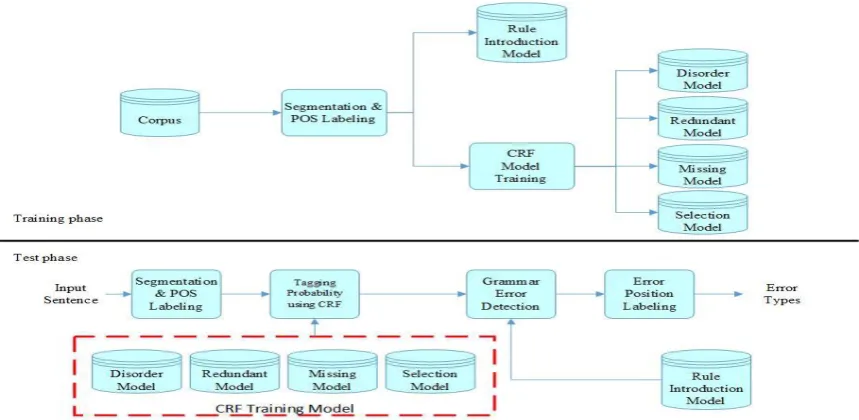
In this section, the architecture of our system is il-lustrated in Figure 1. Then we will describe the gram-matical error detection using CRF in the section 2.2. And the procedures distinguish into two parts: training phase and test phase.
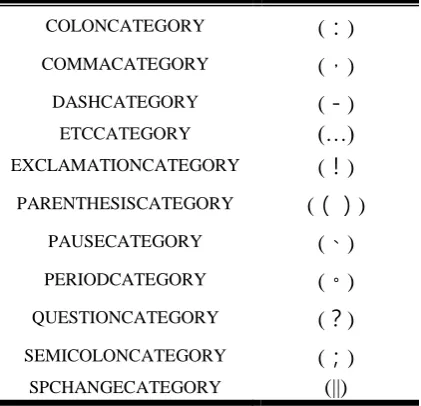
Table 2. Punctuation tagged by CKIP Autotag.
COLONCATEGORY (:)
COMMACATEGORY (,)
DASHCATEGORY (-)
ETCCATEGORY (…)
EXCLAMATIONCATEGORY (!)
PARENTHESISCATEGORY (())
PAUSECATEGORY (、)
PERIODCATEGORY (。)
QUESTIONCATEGORY (?)
SEMICOLONCATEGORY (;)
SPCHANGECATEGORY (||)
Error Types Error Sentence Correct Sentence
Missing Error 我(Nh) 送(VD) 你(Nh) 那裡(D) 我(Nh) 送(VD) 你(Nh) 到(VCL) 那裡(Ncd)
Redundant Error 他(Nh) 是(SHI) 我(Nh) 的(DE) 以前(Nd) 的(DE) 室友(Na)
他(Nh) 是(SHI) 我(Nh) 以前(Nd) 的(DE) 室友(Na)
Selection Error 吳(Nb) 先生(Na) 是(SHI) 修理(VC) 腳踏車(Na) 的(DE) 拿手(Nv)
吳(Nb) 先生(Na) 是(SHI) 修理(VC) 腳踏車(Na) 的(DE) 好手(Na)
[image:2.595.314.525.527.730.2]Figure 1. The Architecture of Our System
2.1 Data Preprocessing
CKIP Autotag is a word segment system which made by Taiwan Academia Sinica. CKIP Autotag can segment a long Chinese sentence into Chinese word. And then tag the punctuation (punctuation are listed in Table 2) and the POS to the word. This system classifies Chinese word into 47 dif-ferent POS.
We use this system to chunking words and tag-ging the POS on the sentence. We survey the grammar of Chinese sentence by CKIP Autotag. And observe the relation between the words by the POS.
2.2 Condition Random Fields
Conditional random fields (CRFs) is a class of statistical modelling method that is generally ap-plied in machine learning and pattern recognition, where they are used for structured prediction. It was an extension of both Maximum Entropy Model (MEMs) and Hidden Markov Models (HMMs) that was firstly introduced by Lafferty et al., 2001.Whereas an ordinary classifier predicts a label for a single sample without regard to adja-cent samples. A CRF can take context into ac-count. It’s a discriminative of undirected probabil-istic graphical model. It is used to encode known relationships between observations and construct consistent interpretations. Conditional random field defined conditional probability distribution P(Y|X) of given sequence given input sentence. Y is the “class label” sequence and X denotes as the observation word sequence.
A common used special case of CRFs is linear chain, which has a distribution of:
P
Λ(y|x) =
exp(∑t=1T ∑ λk kfk(yt−1,yt,x,t))Zx
( 1 )
Where 𝑓𝑘(𝑦𝑡−1, 𝑦𝑡, 𝑥, 𝑡) is usually an indicator
function. λ𝑘 is the learned weight of the feature
and Z𝑥 is the normalization factor that sum the
probability of all state sequences. The feature functions can measure any aspect of a state transi-tion,𝑦𝑡−1 𝑡𝑜 𝑦𝑡 and the entire observation se-quence, x, centered at the current time step, t.
Here we use three conditional random field models to calculate the conditional probability of the missing sentences, redundant sentences, disor-der sentences and error selection sentences.
In training phase, we give the matrix {Word, POS, TAG} to denote the sentence of the words in the train set. Such as {去, VCL, T} or {去, D, F}, the word “去(go)” has many part-of-speech in different sentences. The tag “T” means correct word in current sentence and tag “F” means error word in current sentence. Then we use this train-ing data to generate the model by Conditional ran-dom fields.
In testing phase, we segment and tag POS la-beling by CKIP Autotag. Then we also use the matrix {Word, POS} to denote the words. After preprocessing, we can get the tag’s probability of testing words by our training models using CRF++.
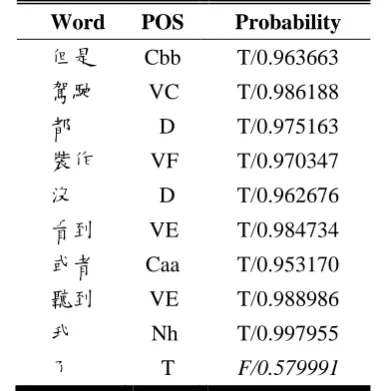
For example, input the sentence of “但是(but)
看 到(see) 或 者(or) 聽 到(hear) 我(me) 了
[image:4.595.83.276.203.399.2](interjection)”. There are some probabilities from different models, “Missing 0.872773, Redundant 0.465524, Selection 0.832839” and judge it is a redundant error. So we found every word’s prob-ability in this sentence. The probprob-ability of words are show in Table 3. And we found the error word is “了”.
Table 3. Probability of Words in the Sentence.
Word POS Probability
但是 Cbb T/0.963663
駕駛 VC T/0.986188
都 D T/0.975163
裝作 VF T/0.970347
沒 D T/0.962676
看到 VE T/0.984734
或者 Caa T/0.953170
聽到 VE T/0.988986
我 Nh T/0.997955
了 T F/0.579991
According the probability of tagging, we can determine what type’s error and speculate the po-sition in the sentence.
2.3 Rule Induction
There are many special cases of selection error types in Chinese. Such as quantifier is one case of all. In English, we usually use “a” or “an” to de-note quantifier.
But Chinese needs more different quantifiers then the other language. In many cases, Chinese use ‘個’ as a quantifier. There are more times we do not use ‘個’ as a quantifier. About quantifier of human we should use ‘位’ or ‘個’. About quanti-fier of animals we should use ‘隻’, ‘匹’, ‘頭’, or ‘條’. About quantifier of things we should use ‘件’. About quantifier of buildings we should use ‘座’ or ‘棟’. About quantifier of transportations we should use ‘臺’, ‘輛’, ‘架’ or ‘艘’ etc.
We also focused on finding the ordering type of the wrong words. There are some rules which we follow to finding ordering error.
Behind the words “把 (let)” is connected the POS ‘Nh’ or ‘Na’ or ‘Nep’.
Behind the POS ‘VA’ is connected the word “跟(with)”, and the POS ‘Nh’ or ‘Na’ also is connected behind the words “跟(with)”.
Behind the words “應該(maybe)” or “ 好 像(like)” or “到底(at last)” is connected the POS ‘Nh’ or ‘Na’.
Behind the word “已經(already)” is con-nected the POS ‘Neqa’ or ‘Neu’, and the POS ‘P’ or ‘Na’ or ‘VA’ is connected be-hind the POS ‘Neqa’ or ‘Neu’.
Above those rules, we can enhance our method during the detection grammatical errors.
3
Result
To evaluate the performance of our system, we used three parameters: precision, recall and f-score.
Precision is the fraction of retrieved documents that are relevant to the query.
Precision
=
𝑡𝑝
𝑡𝑝 + 𝑓𝑝
Recall is the fraction of the documents that are relevant to the query that are successfully re-trieved.
Recall
=
𝑡𝑝
𝑡𝑝 + 𝑓𝑛
F1-Score is a measure of a test's accuracy. It considers both the precision and the recall of the test to compute the score.
F1 − score
= 2 ∗
𝑃𝑟𝑒𝑠𝑖𝑠𝑖𝑜𝑛 ∗ 𝑅𝑒𝑐𝑎𝑙𝑙
𝑃𝑟𝑒𝑠𝑖𝑠𝑖𝑜𝑛 + 𝑅𝑒𝑐𝑎𝑙𝑙
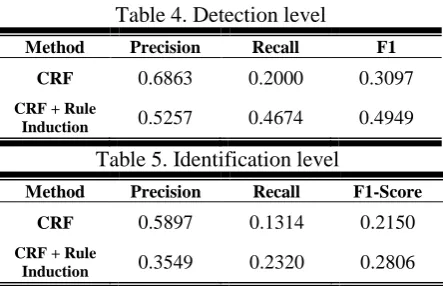
The comparative study of all the three cases has done. And a result of these cases are given in the Table 4 and Table 5 with the NLP-TEA 2014 da-taset.
In this paper, we collect 2,212 sentences in training dataset. And it contains 622 sentences of missing, 435 sentences of redundant, 849 sen-tences of selection and 306 sensen-tences of disorder. Then we use two dataset 1,750 sentences from TEA 2014 and 1,000 sentences from NLP-TEA 2015.
Table 4. Detection level
Method Precision Recall F1
CRF 0.6863 0.2000 0.3097
CRF + Rule
Induction 0.5257 0.4674 0.4949
Table 5. Identification level
Method Precision Recall F1-Score
CRF 0.5897 0.1314 0.2150
CRF + Rule
Induction 0.3549 0.2320 0.2806
[image:5.595.67.296.303.594.2]Table 6, Table 7, and Table 8 are the perfor-mance with the NLP-TEA 2015 dataset and com-pare the other team
Table 6. Detection level
Accuracy Precision Recall F1
NCYU 0.607 0.6112 0.588 0.5994
CYUT 0.579 0.7453 0.240 0.3631
NTOU 0.531 0.5164 0.976 0.6754
Table 7. Identification level
Accuracy Precision Recall F1
NCYU 0.463 0.4451 0.300 0.3584
CYUT 0.525 0.6168 0.132 0.2175
NTOU 0.225 0.2848 0.364 0.3196
Table 8. Position level
Accuracy Precision Recall F1
NCYU 0.374 0.2460 0.122 0.1631
CYUT 0.505 0.5287 0.092 0.1567
NTOU 0.123 0.1490 0.160 0.1543
In detection level (see the Table 6.), our recall is better than CYUT’s method. It means we can find more error in dataset. And our precision is better than NTOU’s method. It means our find correct error rate is better, although we find error quantity less than NTOU.
In identification level (Table 7.), it show who can find most error and error type is correct. In our method, our recall is nearly NTOU’s method, it means we find more correct error type than CYUT’s method. But our precision is better than
NTOU’s method. And our F1-Score is the best in this level.
In position level (Table 8.), our method‘s preci-sion and recall are between the CYUT’s method and NTOU’s method. It means our method is not illustrious in this level. We consider the reasons are our correction is not enough standard.
4
Conclusion
In this paper, we present a method using condi-tional random field model for predicting the gram-matical error diagnosis for learning Chinese.
After observe the experiment results, our method is acceptable in NLP-TEA 2015. We be-lieve this system is feasible. This system is useful for a foreign who learn Chinese as a second lan-guage. Even the people who use Chinese as a first language might use the wrong grammars.
There are some issues should be revise. First, the CRF models can be improved in some ways, such as words tagging or using the parsing tree. Second, increase the ranking mechanism to find the optimal words to correct the sentence.
In the future, we will pay attention to improve the precision and recall rates in this system. And let it can automatic correct the error if the people input the sen-tences.
Reference
Islam, A., & Inkpen, D. (2010, August). An unsuper-vised approach to preposition error correction. In Natural Language Processing and Knowledge Engi-neering (NLP-KE), 2010 International Conference on (pp. 1-4). IEEE.
Jiang, Y., Wang, T., Lin, T., Wang, F., Cheng, W., Liu, X., ... & Zhang, W. (2012, June). A rule based Chi-nese spelling and grammar detection system utility. In System Science and Engineering (ICSSE), 2012 International Conference on (pp. 437-440). IEEE.
Jiang, Y., Zhou, Z., Wan, L., Li, M., Zhao, W., Jing, M., & Liu, X. (2012, October). Cross sentence ori-ented complicated Chinese grammar proofreading method and practice. In Information Management, Innovation Management and Industrial Engineering (ICIII), 2012 International Conference on (Vol. 3, pp. 254-258). IEEE.
Lafferty, J., McCallum, A., and Pereira, F. 2001. Con-ditional Random Field: Probabilistic models for seg-menting and labeling sequence data. In Proceedings of the International Conference on Machine Learn-ing.
Corpora, pages 82-94. Nocedal, J., and Wright, S. 1999. Numerical optimization. Springer.
Lee, L. H., Yu, L. C., Lee, K. C., Tseng, Y. H., Chang, L. P., & Chen, H. H. (2014). A Sentence Judgment System for Grammatical Error Detection. COLING 2014, 67.
Liang-Chih Yu, Lung-Hao Lee, and Li-Ping Chang (2014). Overview of Grammatical Error Diagnosis for Learning Chinese as a Foreign Language. Pro-ceedings of the 1st Workshop on Natural Language Processing Techniques for Educational Applica-tions (NLPTEA'14), Nara, Japan, 30 November, 2014, pp. 42-47.
Li, P., Liao, L., & Li, X. (2012, July). A hierarchy-based constraint dependency grammar parsing for Chinese. In Audio, Language and Image Processing (ICALIP), 2012 International Conference on (pp. 328-332). IEEE.
Li, Z., Zhang, M., Che, W., Liu, T., & Chen, W. (2014). Joint Optimization for Chinese POS Tagging and Dependency Parsing. Audio, Speech, and Language Processing, IEEE/ACM Transactions on, 22(1), 274-286.
Rozovskaya, A., Roth, D., & Srikumar, V. (2014, April). Correcting grammatical verb errors. In Pro-ceedings of EACL.
Chang, R. Y., Wu, C. H., & Prasetyo, P. K. (2012). Er-ror diagnosis of Chinese sentences using inductive learning algorithm and decomposition-based testing mechanism. ACM Transactions on Asian Language Information Processing (TALIP), 11(1), 3.
Sun, X., & Nan, X. (2010, August). Chinese base phrases chunking based on latent semi-CRF model. In Natural Language Processing and Knowledge Engineering (NLP-KE), 2010 International Confer-ence on (pp. 1-7). IEEE.
Wu, C. H., Liu, C. H., Harris, M., & Yu, L. C. (2010). Sentence correction incorporating relative position and parse template language models. Audio, Speech, and Language Processing, IEEE Transactions on, 18(6), 1170-1181.
Yu, C. H., & Chen, H. H. (2012). Detecting Word Or-dering Errors in Chinese Sentences for Learning Chinese as a Foreign Language. In COLING (pp. 3003-3018).
Academia Sinica CKIP.
http://ckipsvr.iis.sinica.edu.tw/