© 2019, IRJET | Impact Factor value: 7.211 | ISO 9001:2008 Certified Journal | Page 2336
An Experimental Study of the Effect of Capillary tube in Different
Length and Different Configuration on the Performance of Simple
Vapour Compression Refrigeration System
Sunil M. Telang
1, Prof. Prashant Walke
21
Mtech Student (Heat Power Engineering) BIT Ballarpur, Maharashtra, India.
2
Assistant professor (Guide) Mechanical Engineering Department, BIT, Ballarpur, Maharashtra, India.
---***---Abstract - The design of capillary tube plays a very important role in the performance of a vapour compression refrigeration system. The study of the expansion device in simple vapor compression refrigeration system is necessary in order to understand the parameters which can enhance the overall performance of system. The experimental study was done on the capillary tubes of different length 3 feet, 3.5 feet, 4 feet each test section was studied with three distinct configurations i.e. helical coiled, straight coiled and serpentine coiled configuration. The diameter of each test section was kept constant to 0.036 inch. The effect of the configuration and the capillary tube different length on the overall performance of the system was studied. The findings of the experimental study revealed that the mass flow rate is maximum for the straight configuration and is least for the helical coiled configuration. The refrigeration effect was found to be maximum for the helical coiled configuration and was found to be least for straight coiled configuration. The compressor work was found to reduce as the load was increased on the system.
Key Words: Capillary tube, COP, Length,Refrigeration effect, configuration, refrigeration system, mass flow rate.
1. INTRODUCTION
A simple vapour compression refrigeration system consists of mainly five components namely compressor, condenser, expansion device, evaporator and a filter/drier. The following study is focused towards finding out the effect of the capillary tube on the performance of the refrigeration system .A capillary tube is a small diameter tube which is used for the expansion of the flowing fluid. The design of capillary tube plays a very important role in the performance of a vapour compression refrigeration system. The experimental study was done on the capillary tubes of different length 3feet ,3.5feet,4feet each test section was studied with three distinct configurations i.e. helical coiled, straight coiled and serpentine coiled configuration. The diameter of each test section was kept constant to 0.036 inch.The effect of the configuration and the capillary tube different length on the overall performance of the system was studied.
1.1 Vapour Compression Refrigeration System
The vapour compression system is the most widely used refrigeration system in practice. This refrigeration system adopts the vapour compression cycle. This cycle requires the addition of external work for its operation. Basically it consists of four processes namely:
Isentropic compression.
Constant pressure heat rejection. Throttling in an expansion valve. Constant pressure heat addition.
Fig.1. Schematic diagram of vapour compression refrigeration system.
© 2019, IRJET | Impact Factor value: 7.211 | ISO 9001:2008 Certified Journal | Page 2337 The condensed liquid refrigerant, in the thermodynamic
state known as a saturated liquid, is next routed through an expansion valve where it undergoes an abrupt reduction in pressure. That pressure reduction results in the adiabatic flash evaporation of a part of the liquid refrigerant. The auto-refrigeration effect of the adiabatic flash evaporation lowers the temperature of the liquid and vapor refrigerant mixture to where it is colder than the temperature of the enclosed space to be refrigerated.
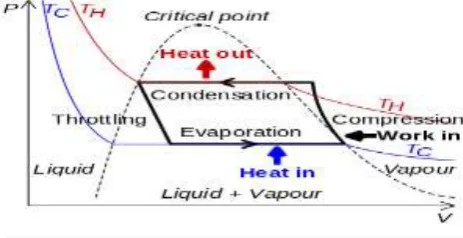
[image:2.595.44.276.382.501.2]The cold mixture is then routed through the coil or tubes in the evaporator. A fan circulates the warm air in the enclosed space across the coil or tubes carrying the cold refrigerant liquid and vapor mixture. That warm air evaporates the liquid part of the cold refrigerant mixture. At the same time, the circulating air is cooled and thus lowers the temperature of the enclosed space to the desired temperature. The evaporator is where the circulating refrigerant absorbs and removes heat which is subsequently rejected in the condenser and transferred elsewhere by the water or air used in the condenser. To complete the refrigeration cycle, the refrigerant vapor from the evaporator is again a saturated vapor and is routed back into the compressor.
Fig. A fictitious pressure-volume diagram for a typical refrigeration cycle
2. LITERATURE REVIEW
M.Y.Taib[2] et al. (2010) studied the performance of a domestic refrigerator and developed a test rig from refrigerator model NRB33TA. The main objective of the performance analysis was to obtain the performance of the system in terms of refrigeration capacity, coefficient of performance (cop), and compressor work by determining three important parameters which are temperature, pressure and refrigerant flow rate. The analysis of the collected data gave the cop of the system as 2.75 while the refrigeration capacity was ranging from 150 watt to 205 watt.
Sudharash Bhargava and Jagdev Singh[5] (2013) experimentally investigated the of pitch and length of the serpentine coiled adiabatic capillary tube on the flow of a eco friendly gas. The azeotropic blend ( 30% propane, 55% n-butane, 15% iso-butane) is used as refrigerant in
the experiment. Various capillary tubes with distinct lengths, pith and bore diameter were used as the test sections in the experiment. Inlet pressure of the capillary tubes was kept constant and then mass flow rates for different capillary tubes with different lengths and pitches were measured. Straight capillary tubes were also investigated. The data from the experiments showed that mass flow rate of the refrigerant in the system was less for serpentine coiled capillary tubes and was grater for straight capillary tubes.
Ankush Sharma and Jagdev Singh[4] (2013) experimentally investigated about the effects simple and twisted spirally coiled adiabatic capillary tubes on the refrigerant flow rate. Several capillary tubes with different bore diameters, lengths and pitches were taken as test sections. LPG was used as an alternative for R134a. mass flow rates for different capillary tubes were measured for different degrees of subcooling with constant inlet pressure of the capillary tube. Experiments were conducted on straight capillary tubes as well so as to facilitate proper comparison. The test results showed that mass flow rate is greater in straight capillary tube and least in twisted spirally coiled capillary tube.
Hirendra Kumar Paliwal and Keshav Kant[1] (2006) developed a flow model for designing and studying the performance of helical coiled capillary tubes and to mathematically simulate a situation closer to one existing in real practice. Homogeneous flow of two phase fluid was assumed through the adiabatic capillary tube. The model included the second law restrictions. The effect of the variation of different parameters like condenser and evaporator pressures, refrigerant flow rate, degree of sub cooling, tube diameter, internal roughness of the tube, pitch and the diameter of the helix and the length of the capillary tube were included in the model. Theoretically predicted lengths of helical coiled capillary tube for R-134a are compared with the length of the capillary tube actually required under similar experimental conditions and majority of predictions were found to be within around 10% of the experimental value.
3. Methodology
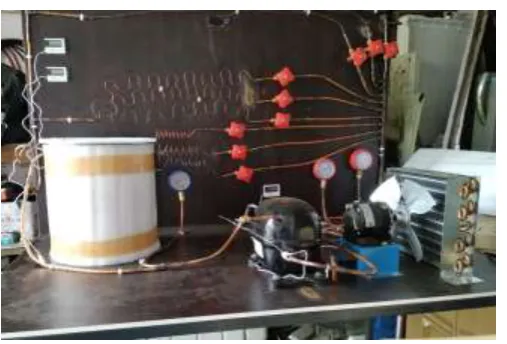
© 2019, IRJET | Impact Factor value: 7.211 | ISO 9001:2008 Certified Journal | Page 2338 The pressure gauge in the high pressure line was installed
just after the compressor and just before the condenser. Another pressure gauge was installed in the low pressure retun line to measure the pressure of the fluid returning back to the compressor. Another pressure gaguge is used in after condenser. A digital temperature meter was used to determine the temperatures that were to be used in the analysis of the system. In this system four temperature meter are used to measure the different temperature.
Fig. (a)Pictorial front view of the experimental setup.
4.EXPERIMENTAL OBSERVATION AND RESULT DISCUSSION
capillary tube in different length 3feet, 3.5feet, 4 feet each test section was studied with three distinct configurations i.e. helical coiled, straight coiled and serpentine coiled configuration. The diameter of each test section was kept constant to 0.036 inch.. Every set of readings consists of following readings, for no load condition and one each for loaded condition of 2000ml, 4000ml and 6000ml.
With the data collected in experiments, different performance parameters are calculated as follows
1) Net Refrigeration Effect (NRE) = H1– H3 kj/kg
Where
H1 = Enthalpy of Suction line H3 = Enthalpy of Liquid line.
2) Mass flow rate obtain, one TR, Kg/min = 210 / NRE
Kg/min
3) Work of compression (W) = H2 – H1 KJ/Kg
WhereH1 = Enthalpy of Suction line H2 = Enthalpy of Discharge line.
4) Co-efficient of performance (COP) = NRE / work of
compression Where
NRE = Net Refrigeration Effect.
Readings for 3 feet length – helical coiled capillary tube:
Sr.no Performance
parameter 2000ml 4000ml 6000ML
1 Compressor
suction pressure P1 (psi)
24 26 26
2 Compressor
discharge pressure P2 (psi)
130 131.5 132
3 Condenser
pressure Pc (psi) 124 124.5 124.5
4 Compressor
suction
temperature T1
27 29.6 29
5 Compressor
discharge temperature T2
49.7 52.1 50.5
6 Condenser
temperature T3 37.7 38 36.5
7 Evaporator
temperature T4 10.5 11.4 11.9
8 Refrigeration effect
Kj/kg 170 175 176.8
9 Work of
compression Kj/kg 9 7 6.2
10 Mass flow rate in
kg/min 1.235 1.200 1.187
11 Cop 18.89 25.00 28.51
Readings for 3 feet length –straight coiled capillary tube:
Sr.no Performance
parameter 2000ml 4000ml 6000ML
1 Compressor
suction pressure P1 (psi)
17 17.5 17.5
2 Compressor
discharge pressure P2 (psi)
126 126.5 127
3 Condenser
pressure Pc (psi) 123 123.5 124
4 Compressor
suction
temperature T1
28.9 30.1 30
5 Compressor
discharge temperature T2
51.3 51.5 51.7
6 Condenser
temperature T3 38.2 36.2 36.5
7 Evaporator
[image:3.595.37.291.200.372.2]© 2019, IRJET | Impact Factor value: 7.211 | ISO 9001:2008 Certified Journal | Page 2339 8 Refrigeration effect
Kj/kg 167 173 174
9 Work of
compression Kj/kg 10 7.5 7
10 Mass flow rate in
kg/min 1.257 1.214 1.210
11 Cop 16.7 23.07 24.85
Readings for 3 feet length serpentine coiled capillary tube:
Sr.no Performance
parameter 2000ml 4000ml 6000ML
1 Compressor
suction pressure P1 (psi)
20.5 19 18
2 Compressor
discharge pressure P2 (psi)
126.5 127 127
3 Condenser
pressure Pc (psi) 123 124 124
4 Compressor
suction
temperature T1
28.2 29.7 28.4
5 Compressor
discharge temperature T2
50.9 52.1 52.3
6 Condenser
temperature T3 37.3 37 34.7
7 Evaporator
temperature T4 14 17.9 19.4
8 Refrigeration effect
Kj/kg 168.5 174 175
9 Work of
compression Kj/kg 9.5 7.5 6.5
10 Mass flow rate in
kg/min 1.246 1.206 1.200
11 Cop 17.73 23.20 26.92
Readings for 3.5 feet length – helical coiled capillary tube:
Sr.no Performance
parameter 2000ml 4000ml 6000ML
1 Compressor
suction pressure P1 (psi)
20 18 18
2 Compressor
discharge pressure P2 (psi)
126 121 120
3 Condenser
pressure Pc(psi) 120 121 120
4 Compressor 24.4 25.6 26.1
suction
temperature T1
5 Compressor
discharge temperature T2
46.5 46.4 46.6
6 Condenser
temperature T3 34.4 32.2 32.1
7 Evaporator
temperature T4 10.3 15 17.1
8 Refrigeration effect
Kj/kg 174 177 178.2
9 Work of
compression Kj/kg 8 7 6
10 Mass flow rate in
kg/min 1.207 1.186 1.178
11 Cop 21.75 25.28 29.7
Readings for 3.5 feet length – straight coiled capillary tube:
Sr.no Performance
parameter 2000ml 4000ml 6000ML
1 Compressor
suction pressure P1 (psi)
11 9 9
2 Compressor
discharge pressure P2 (psi)
120 113 112
3 Condenser
pressure Pc (psi) 119 112 110
4 Compressor
suction
temperature T1
25.6 26.6 27.1
5 Compressor
discharge temperature T2
45.6 45.2 45.4
6 Condenser
temperature T3 32.3 30.5 30.3
7 Evaporator
temperature T4 24.4 25.6 25.8
8 Refrigeration effect
Kj/kg 171 175.5 176.5
9 Work of
compression Kj/kg 10.5 9.5 8.5 10 Mass flow rate in
kg/min 1.228 1.196 1.189
© 2019, IRJET | Impact Factor value: 7.211 | ISO 9001:2008 Certified Journal | Page 2340 Readings for 3.5 feet length serpentine coiled capillary
tube:
Sr.no Performance
parameter 2000ml 4000ml 6000ML
1 Compressor
suction pressure P1 (psi)
13 11 10
2 Compressor
discharge pressure P2 (psi)
120 113 110
3 Condenser
pressure Pc (psi) 119 113 109
4 Compressor
suction
temperature T1
24 27 27.3
5 Compressor
discharge temperature T2
45.9 47.1 48.1
6 Condenser
temperature T3 31.6 32.1 32.8
7 Evaporator
temperature T4 21.1 22.9 23.3
8 Refrigeration effect
Kj/kg 173 176.5 177.5
9 Work of
compression Kj/kg 10 8 7.5
10 Mass flow rate in
kg/min 1.213 1.189 1.183
11 Cop 17.3 22.06 23.67
Readings for 4 feet length – helical coiled capillary tube:
Sr.no Performance
parameter 2000ml 4000ml 6000ML
1 Compressor
suction pressure P1 (psi)
16 15 16
2 Compressor
discharge pressure P2 (psi)
120 121 121
3 Condenser
pressure P1 (psi) 119 120 119
4 Compressor
suction
temperature T1
26.1 28.5 30.3
5 Compressor
discharge temperature T2
48.3 49.6 50.1
6 Condenser
temperature T3 32.7 34.4 36.3
7 Evaporator
temperature T4 16.5 17.3 19.3
8 Refrigeration effect
Kj/kg 178 180 180.3
9 Work of
compression Kj/kg 7 6.5 6
10 Mass flow rate in
kg/min 1.179 1.166 1.164
11 Cop 25.42 27.69 30.05
Readings for 3 feet length – straight coiled capillary tube:
Sr.no Performance
parameter 2000ml 4000ml 6000ML
1 Compressor
suction pressure P1 (psi)
6 6 7
2 Compressor
discharge pressure P2 (psi)
115 110 110
3 Condenser
pressure P1 (psi) 115 110 109
4 Compressor
suction
temperature T1
28.9 29.9 30.3
5 Compressor
discharge temperature T2
46.5 48.2 49.6
6 Condenser
temperature T3 32 33 33.9
7 Evaporator
temperature T4 26.8 26.9 27.3
8 Refrigeration effect
Kj/kg 176 178 178
9 Work of
compression Kj/kg 9 8 7.5
10 Mass flow rate in
kg/min 1.193 1.180 1.179
11 Cop 19.55 22.25 23.73
Readings for 3 feet length – serpentine coiled capillary tube:
Sr.no Performance
parameter 2000ml 4000ml 6000ML
1 Compressor
suction pressure P1 (psi)
10 10 11
2 Compressor
discharge pressure P2 (psi)
© 2019, IRJET | Impact Factor value: 7.211 | ISO 9001:2008 Certified Journal | Page 2341 3 Condenser
pressure P1 (psi) 118 117 118
4 Compressor
suction
temperature T1
28.4 29.6 30.3
5 Compressor
discharge temperature T2
47.3 48.9 50.3
6 Condenser
temperature T3 33 34.8 36.3
7 Evaporator
temperature T4 24.3 24.4 25.3
8 Refrigeration effect
Kj/kg 177 178.5 179.5
9 Work of
compression Kj/kg 8 7 6.5
10 Mass flow rate in
kg/min 1.186 1.176 1.169
11 Cop 22.12 25.50 27.61
The above shown readings were used to plot bar graphs for comparing the system performance for different configurations for each capillary tube. The bar graphs were used to compare the effect of the capillary tube configuration and its length on the system performance. The bar graphs for the different test sections and their different configurations are drawn and shown below:-
Effect of configuration on the mass flow rate for 3 feet capillary tube.
Y axis in the following bar graph shows the mass flow rate in the system in kg/min.
Effect of configuration on the mass flow rate for 3.5 feet capillary tube.
Y axis in the following bar graph shows the mass flow rate in the system in kg/min.
Effect of configuration on the mass flow rate for 4feet capillary tube.
Y axis in the following bar graph shows the mass flow rate in the system in kg/min
Effect of configuration on the refrigeration effect for 3feet capillary tube.
Y axis in the following bar graph shows the refrigeration effect in the system in kj/kg
Effect of configuration on the refrigeration effect for 3.5feet capillary tube.
Y axis in the following bar graph shows the refrigeration effect in the system in kj/kg
Effect of configuration on the refrigeration effect for 4 feet capillary tube.
© 2019, IRJET | Impact Factor value: 7.211 | ISO 9001:2008 Certified Journal | Page 2342 Effect of configuration on the compression work for 3 feet
capillary tube.
Y axis in the following bar graph shows the compression work in the system in kj/kg
Effect of configuration on the compression work for 3.5 feet capillary tube.
Y axis in the following bar graph shows the compression work in the system in kj/kg
Effect of configuration on the compression work for 4 feet capillary tube.
Y axis in the following bar graph shows the compression work in the system in kj/kg
5. CONCLUSIONS
The above mentioned experimental study involved a thorough observation and analysis of the readings and values obtained. Every graph and observation table is self explanatory in itself and points out towards a specific outcome from the study.
1) The mass flow rate of the refrigerant is maximum in the
case of straight capillary tubes and is least for helical coiled capillary tubes for each test section.
2) The refrigeration effect produced is maximum for the helical coiled capillary tubes and is least for straight capillary tubes for each test section.
3) The compressor work was found to reduce as the load was increased on the system
4) The helical coiled capillary tubes take the least space and the straight coiled capillary tubes take the maximum space. This makes the helical coiled capillary tubes the best alternative for domestic refrigeration systems
5) The serpentine coiled capillary tubes do not have a very pronounced effect on the overall performance of the system and the performance in the case of serpentine coiled capillary tubes lies between to that with helical coiled capillary tube and straight coiled capillary tube.
6) The COP is increased when increased capillary length of the tube.
ACKNOWLEDGEMENT
With immense pleasure and great respect I take this opportunity to express my deep sense of gratitude toward my guide, Prof. Prashant Walke, Assistant Professor, BIT, Ballarpur for invaluable guidance, inspiration, constant encouragement and motivation throughout the project work.
I am grateful to Prof. Shailesh Khangar, Head of Department, and the faculty of department of Mechanical Engineering, B.I.T, Ballarpur for providing the amicable environment and allowing me to useful available facilities in this department during the course of this study.
We thank to Dr. Rajnikant our beloved principal, for his encouragement and providing all facilities needed in our project. I am very thankful to my friend and well-wisher who directly or indirectly helped me at every stage to complete this work.
Last but not least, I would like to thanks my family and almighty without their good wishes and blessing this dissertation work could not have been completed.
REFERENCES
1) Hirendra Kumar Paliwall, Keshav Kant2 , " A model for helical capillary tubes for refrigeration systems," International Refrigeration and Air Conditioning Conference Purdue University , 2006
2) M.Y.Taib, A.A.Aziz and A.B.S.Alias, “Performance analysis of a domestic refrigerator”, National Conference in Mechanical Engineering Research and Postgraduate Students, 2010.
3) J.K.Dabas, A.K.Dodeja, Sudhir Kumar and K.S.Kasana, “Performance characteristics of “vapour compression refrigeration system” under real transient conditions”, International Journal of Advancements in Technology, 2011.
© 2019, IRJET | Impact Factor value: 7.211 | ISO 9001:2008 Certified Journal | Page 2343 investigation of refrigerant flow rate with spirally coiled
adiabatic capillary tube in vapour compression refrigeration cycle using eco friendly refrigerant”, International Journal of Mechanical and Production Engineering Research and Development, 2013.
5) Sudharash Bhargava and Jagdev Singh, “Experimental study of azeotropic blend(30% propane, 55% n-butane, 15% iso-butane) refrigerant flow through the serpentine capillary tube in vapour compression refrigeration system”, International Journal of Mechanical and Production Engineering Research and Development, 2013.
6) Thamir K. Salim, “The effect of the capillary tube coil number on the refrigeration system performance”, Tikrit Journal of Engineering Sciences, 2012.
7) M.A. Akintunde, Ph.D. "Effect of Coiled Capillary Tube Pitch on Vapor Compression Refrigeration System Performance," The Pacific Journal of Science and Technology Volume 9. Number 2. November (2008), pp. 284-294.
8) K. NEELAKANTA1, V. ARUNDHATI2, N. VIKARAM MANOJ KUMAR: The Effect of Capillary Tube Length on the Performance of Vapour Compression Refrigeration System
9) Ali, M. E. (1998) Laminar natural convection from constant heat flux helicoidal tubes, International Journal of Heat and Mass Transfer, 41, 2175-2182.
10) Wong, T.N. and K. T. Ooi (1996) Evaluation of capillary tube performance for CFC- 12 and HFC 134a, International Communications in Heat and Mass Transfer, 23, 993-1001.
11) Sanzoo Fioreli, F.A. and Alex Alberto (2002) Experimental analysis of refrigerant mixtures flow through adiabatic capillary tubes, Experimental Thermal and Fluid Science, 26, 499-512.