Gender Recognition from Faces Using Fuzzy
Clustering and Nearest Neighbor Classifier
M. Mytri Madhurya, K.Vivek
M.Tech, Dept. of CSE., Vignan’s Lara Institute of Technology and science, Guntur, Andhra Pradesh, India
Assistant Professor, Dept. of CSE., Vignan’s Lara Institute of Technology and science, Guntur, Andhra Pradesh, India
ABSTRACT: Gender recognition is a standout amongst the most difficult issues in computer vision. Facial gender identification of neonates and children is also known as an extremely demanding issue for human spectators. This study propounds a novel gender grouping technique using frontal facial pictures of individuals. The proposed approach utilizes fuzzy clustering techniques and nearest neighbor, respectively, for feature extraction and classification steps. NN also applied to extract the most suitable features from images as well as reducing the dimensionality of data. The extracted components are then used to allocate the new pictures to proper classes male or female in view of fuzzy clustering. The computational time and exactness of the proposed method are examined together and the importance of the preferred approach estimated to most of the other known competing methods is proved, chiefly for younger faces. Experimental results indicate the significant classification accuracies which have been gathered from FERET databases. Meanwhile, the proposed algorithm is relatively easy, its computational time is viable and often less than the other state-of-art gender classification methods
KEYWORDS: gender recognition, face images, FERET, fuzzy clustering, NN classifier
I. INTRODUCTION
Face is known as one of the most compelling biometric features used to analyze different people. Identifying familiar faces, derive information such as gender, race and affecting state from a face are some detail of face problems in computer view. Some of the most crucial problems of face such as face detection, gender classification and face acceptance are discussed in [1-3]. Gender acceptance of facial images is a more ask for task in comparison with face recognition [2]. It can be treated as a binary classification problem, in which one has to remember whether a frontage face image is a male or a female. Successful genders remember/classification approach is able to enhance the achievement of some other applications such as face recognition and smart human-computer admix. As an example, search engines desire a pre-processing stage in order to complete the gender of people in images derive from the Internet [3]. In comparison with neonate and children facial gender classification, adult leading gender classification is a straightforward task for human [4]. Gender classification is extra problematic for function in which children’s faces are of activity rather than adults’ faces. Two key ingredient of gender classification are aspect extraction and pattern classification. Feature eradication in adult facial images is almost simpler than extraction of features from neonate and children images. Therefore, a more authentic technique is needed to absolutely indicate the gender of children and bundle. An important question is how the human age can change the features used for gender classification. The authors in [5] studied the aging chattels on gender classification and demonstrate that the gender classification certainty on young and senior faces can be much curtailed than the one on adults’ faces. This paper introduce a relatively straight-forward access which leads to an ample level of gender acceptance enhancement, exclusively in cases in which younger faces are of activity.
theoretically and practically that reducing the number of irrelevant features significantly increasing the learning efficiency of the classifier.
II. RELATED WORK
Many methods suggested in the literature for gender recognition from faces. In two databases namely FERET and collected set of faces from www, are used with hair for gender recognition. The FERET database has higher accuracy than www images. The most popular methods according to our review used to reduce the dimensionality in gender recognition are PCA [7], Linear Discriminant Analysis (LDA), LBP and WLD. PCA is mathematical procedure finds the orthogonal transformation to convert a set of values possibly correlated variables into set of values of linear uncorrelated variables and therefore reduces the noise in the data. LDA [8] is used to obtain a discriminative transformation which maximizes between-class scatter and minimizing within-class scatter.
Gender recognition based on Weber local descriptor (WLD) [9] is also one of the feature extraction technique, calculates the differential excitation and gradient orientation are integrated to form robust texture descriptor. In block-based WLD histograms are concatenated to yield the feature vector set and evaluated on the FERET database. The LBP [10] means local binary pattern which was put forward by Ojalai in 1994. Its basic idea is taking central pixel as a threshold and compare with surrounding pixels. LBP has low computational cost and effective texture descriptor. Moreover, features are extracted; some of them may become unwanted or irrelevant for classification. Several classifiers have been used in gender recognition after feature extraction and selection. The classifiers which have yielded highest gender classification exactness were multilayer neural network (NN), Adaboost, RBF networks, Support Vector Machines (SVM) [11] and PNN. Moghaddam and Yang first reported the SVM with the Radial Basis Function kernel (SVM+RBF) as the better gender classifier [12]. Most recently, Makinen and Raisamo compared the performance of SVM with other classifiers including NN and Adaboost [13]. According to the previous published results, SVM achieved the highest performance. The proposed method is evaluated on FERET gray scale face image database.
III. PROPOSED METHOD
In the proposed work, gender recognition method using frontage facial images of people. The expected approach employs adjacent neighbor classifier (NN) and fuzzy clustering technique, appropriately, for feature eradication and classification steps.
A. FUZZY CLUSTERING
The ‘clusters’ are functions that assign to every object, a number between zero and one, which is called membership of the object in the cluster. Objects which are identical to each other are identified having high membership value in the similar cluster. It is also assumed that the memberships are chosen that their sum for each object is equal to one. Clustering is of two types hard clustering and soft clustering (also known as fuzzy clustering). In hard clustering, data is distributed into distinct clusters, where each data element belongs to exactly one cluster.
The most broadly used algorithm is fuzzy clustering algorithms. Fuzzy set theory was proposed by Zadeh in 1965 and it gave an idea of uncertainty of belonging which was illustrated by a member function [11]. The use of fuzzy set produces imprecise class membership function. The central idea of “fuzzy clustering” [12] is the non-unique portioning of the data into a group of clusters. The data points are allotted membership values for each of the clusters and fuzzy clustering algorithm allow the clusters to produce into their natural shapes. Depending on the nature of the data and create for which clustering used in existence, different sizes of similarity may be used to place objects into classes, where the similarity measure controls how the classes are formed. Some examples of measures that can be used as in clustering include distance, intensity and connectivity.
The most widely used fuzzy clustering algorithm is “fuzzy c- means” (FCM) algorithm [14]. FCM is a data clustering algorithm in which each data point associated with cluster through a membership degree. This technique divides a group of N data points into r fuzzy groups and finds a cluster center in each group, such that a cost of function of a dissimilarity measure is minimized.
This FCM algorithm [15] employs fuzzy partitioning such that a given data point can belong to several groups with a degree stated by membership grades between 0 and 1.
B. K-NEAREST NEIGHBOR
KNN is a simpler algorithm that stores all available examples and classifies new variables of the example language based on similarity measure. It exploits lazy learning. For each test image (to be predicted), find the K closest members (the K nearest neighbors) of the training data set [16]. A Euclidean distance measure is used to compute how near each member of the training set is to the test set that is being analyzed.
From this K nearest neighbor, we find their class labels and apply majority suggested to determine the class label of test image. The best option of K depends upon the data; generally the larger values of K lessen the effect of noise on the classification, but make boundaries between classes less distinct.
Fig 1. GENDER RECOGNITION SYSTEM
IV. EXPERIMENTAL RESULTS
A. DATASET DESCRIPTION
The paper uses the gray images taken from FERET database [17] The FERET data set consists of 400 images representing male and female gender. This images contains variations in illumination, facial expressions, pose.
In the proposed work, we collected 100 face images of male and female gender. The working process of the project is done using matlab.
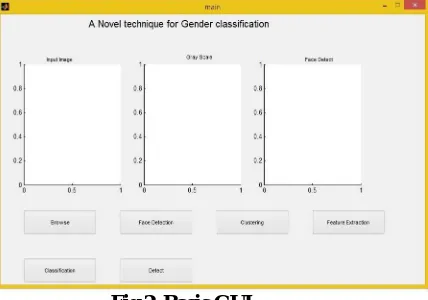
1. This is the first GUI that appears when we execute the project in Matlab. It consists of 3axes components in which input image, grayscale image, and facial part of input image are displayed simultaneously. It also consists of six push buttons Browse, Face Detection, Clustering Feature Extraction, Classified Image, Detect. On clicking each button performs corresponding action.
Fig 2. Basic GUI
Face Detection extraction, Feature Normalization
KNN classifier Decision
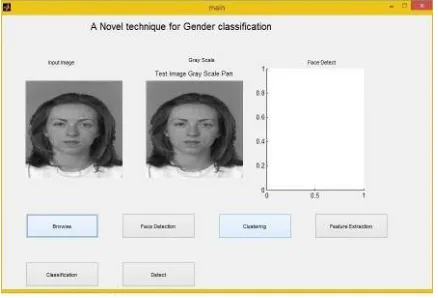
2. After browsing and selecting image program is written such that it automatically converts input image to scale 256*256 and converts to gray scale. It is displayed in second axis automatically.
Fig 3 Conversion of Input to Gray scale image
B. FACE DETECTION
It is a procedure to extract face part from input image which has normalized intensity and uniform size. The features are extracted from detected face part which illustrates changes of face such as folds in the face skin. We are going to use an executable .dll- dynamic link library file is utilized to remove face region.
Fig 4. Extraction of Facial Part From Input Image
4. Calculate the similar features of the given image by comparing the pixel values and group them to form a cluster.
Fig 6. Clusters Formed 5. Classification
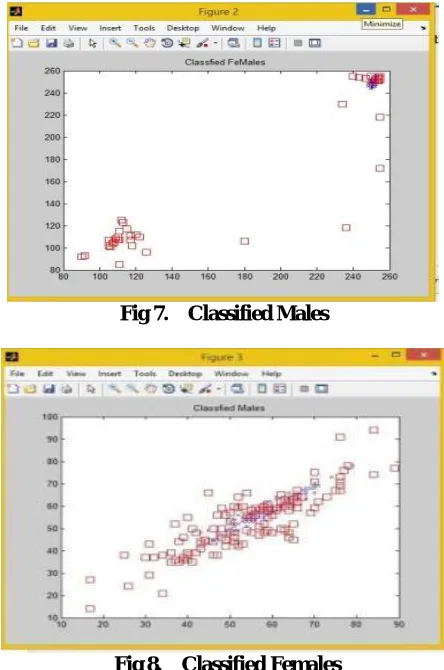
Using K-NN classifier, determine whether the given image is male or female. Determine K value using test set and report the performance on the test set.
Plot the performance on the test and train sets using K-NN algorithm.
Fig 7. Classified Males
6. Finally detect that the given input is male or female.
Fig 9. Output
IV. CONCLUSION
In this paper, we proposed a gender recognition system based Fuzzy C-means and NN classifier. These methods provide much improvement in recognition accuracy for gender recognition problem. Despite its simplicity, the proposed system can produce as good results as complicated systems.
REFERENCES
[1] Makinen, E., Raisamo, R.: ‘An experimental comparison of gender classification methods’, Journal of Pattern Recognition Letters, 2008, 29, pp. 1544-1556
[2] Daugman, J.: ‘Face and gesture recognition: overview’, IEEE Transactions on Pattern Analysis and Machine Intelligence, 1997, 19 (7), pp. 675– 676
[3] Baluja S., Rowley, H. A.: ‘Boosting sex identification performance’, International Journal of Computer Vision, 2007, 71 (1), pp. 111–119 [4] Hassanpour, H., Dehghan, H.: ‘Neonate Facial Gender Classification Using PCA and Fuzzy Clustering’, 17th Iranian Conference of Biomedical Engineering, Isfahan, Iran, Nov. 2010, pp. 1-5
[5] Guo, G.-D., Dyer, C., Fu, Y., Huang, T. S.: ‘Is gender recognition influenced by age? ’, IEEE International Workshop on Human-Computer Interaction (HCI’09), 2009, pp. 169-178
[6] Ozbudak, O., Tukel, M., Seker, S., “Fast Gender Classification”, IEEE International Conference on Computational Intelligence and Computing Research (ICCIC), pp. 1-5, Coimbatore, 2010
[7] Zheng W., ‘A novel improvement to PCA for image classification’, International Conference on Computer Science and Service System (CSSS) , 2011, pp. 1964 – 1967
[8] J. Bekios-Calfa, J. Buenaposada, and L. Baumela, “Revisiting linear discriminant techniques in gender recognition,” IEEE Trans. Pattern Anal. Mach. Intell., vol. 33, no. 4, pp. 858–864, Apr. 2011.
[9] Ullah, I., Hussain, M., Muhammad, G., Aboalsamh, H., Bebis, G., Mirza, A., “Gender recognition from face images with local WLDdescriptor”, 19th International Conference on Systems, Signals andImage Processing (IWSSIP), pp. 417-420, Vienna, 2012.
[10] Ahonen, T., Hadid, A., Pietikäinen, M., “Face Description with Local Binary Patterns: Application to Face Recognition”, IEEE T rans. Pattern Analysis and Machine Intelligence, 28 (12), pp. 2037-2041, 2006.
[11]B. Moghaddam, M.H.Yang. “Gender Classification with Support Vector Machines”, IEEE Trans. On PAMI, Vol. 24, No. 5, 2002, pp.707-711 [12] Gutta, S., Weschler, H., Phillips, P.J.: Gender and ethnic classificationof human faces using hybrid classifiers. In: Proceedingsof IEEE International Conference on Automatic Face and Gesture Recognition, pp. 194–199 (1998)
[13] Wu B., Ai H., Huang C.: LUT-based Adaboost for gender classification. AVBPA 2688, 104–110 (2003)
[14] Pal N.R, Pal K, Keller J.M. and Bezdek J.C, “A Possibilistic Fuzzy c-Means Clustering Algorithm”, IEEE Transactions on Fuzzy Systems, Vol. 13, No. 4, Pp. 517–530, 2005.
[15] ] Balafar, M.A., Ramli, A.R., Saripan, M.I., Mahmud, R., Mashohor, S. and Balafar, M. ‘New multi-scale medical image segmentation based on fuzzy C-mean (FCM)’, The 2008 IEEE Conference on Innovative Technologies in Intelligent Systems and Industrial Applications, 2008, pp. 66– 70
[16] Sudha L. R., Bhavani, R. ‘A combined classifier kNN-SVM in gait-based biometric authentication system’, International Journal of Computer Applications in Technology, 2014, 49 (2), pp. 113-121