Teacher Learning Based Optimized Load
Balancing Model for Public Cloud
Manoj Sakwar,
Gagan Vishwakarma, Yogendra Kumar JainResearch Scholar, Department of Computer Science & Engineering, Samrat Ashok Technological Institute, Vidisha, M.P, India
ABSTRACT: Load balancing of public cloud is core part of public cloud computing to increase the performance of cloud based services. Load balancing for busy and idle condition can be achieved either by traditional approaches such as Round Robin or Swarm Based approaches by utilizing particle of Swarm Optimization, ant colony optimization and glowworm swarm algorithm, such technique are called cloud partition based load balancing technique. This paper addressed load balancing policy based on teacher based learning optimization as a modification in conventional load balancing approach. The teacher based learning optimization well knows meta-heuristic function used for the purpose of optimization and searching process. Our modified load balancing policy simulated and compare with two different techniques one is round robin and other is glowworm algorithm. The result shows that our modified load balancing policy reduces load effect as compared to existing approaches.
KEYWORDS: Cloud computing, load balancing, TLBO, GSO, RR.
I. INTRODUCTION
Cloud computing is a representation for on-demand network access to a shared pool of configurable computing resources like storage, applications, networks, servers, and services that can be rapidly provisioned and released with minimal management effort or service provider interaction [1]. The public cloud computing infrastructure consists of hardware, software and platform for the execution of public demand and request. For the handling of multiple request of user cloud computing process used job scheduling and task scheduling process [2]. The job and task scheduling process perform by job scheduler, for the selection of resource and job scheduler used scheduling algorithm such as first come fist and round robin. But this algorithm is not sufficient for the process of large task on the demand of cloud infrastructure. So we are using GSO and TLBO algorithm. Rest of this paper is organized as follows: Section II discusses about load balancing maintenance in cloud computing environment description, Section III discusses about related work Section IV discusses about the proposed methodology. Section V discusses comparative result analysis. Finally, concluded in section VI.
II. RELATED WORK
Aarti Singh et.al in the year 2015 discuss on an Autonomous Agent Based Load Balancing (A2LB) Algorithm which provides dynamic load balancing for cloud environment. The proposed mechanism has been implemented and provides satisfactory results [8]. Subasish Mohapatra et.al in year 2013 analyzed different policies utilized with different algorithm for load balancing using a tool called cloud analyst. They compared different variants of RR for load balancing [9]. Kousik Dasgupta et.al in the year 2013 performed the proposed Genetic Algorithm (GA) and compared to existing approaches like First Come First Serve (FCFS), Round Robin (RR) and a local search algorithm Stochastic Hill Climbing (SHC) [10] .Suresh M.et.al in the year 2014 proposed approaches such as GSO based load balancing
Assistant Professor, Department of Computer Science & Engineering, Samrat Ashok Technological Institute, Vidisha, M.P, India
algorithm and ANFIS based load balancing algorithm [11].In the following section we discussed about various optimization techniques used in related areas are:
(a) Round Robin Optimization
It is one in all the best scheduling techniques that utilize the principle of your time slices. Here the time is split into multiple slices and every node is given a selected time slice or interval i.e. it utilizes the principle of your time scheduling [9]. Every node is given a quantum and during this quantum the node can perform its operations. The resources of the service provider are provided to the requesting client on the premise of this point slice. Figure 1 shows each user request is served by every processor at intervals time quantum. When the time slice is over, subsequent queued user request can come back for execution. If the user demand completes at intervals time quantum then user should not wait otherwise user have to be compelled to wait for its next slot.
Figure 1: Round Robin Processing Method
(b) Glow-worm Swarm Optimisation (GSO)
The GSO was first conferred by Krishnanand et.al (2005) as an application to collective artificial intelligence and robotics. During this algorithm, each glow-worm uses a probabilistic mechanism to decide on a neighbor that has a luciferin value or price related to him and moves towards it. Glow-worms are attracted to neighbors that glow brighter. The movement’s area unit based only on native information or data and selective neighbor interactions. This permits the swarm to divide into disjoint subgroups which will converge to multiple optima of a given multimodal function [12, 13]. Physical agents i (i =1,.., n) are initially at random deployed within the objective function area. Every agent within the swarm decides its direction of progress by the strength of the signal picked up from its neighbors. GSO algorithm to optimize the multi-modal function includes subsequent major steps:
1) Each glowworm iencodes the task value J ( (t)) at its existing location (t)into a luciferin value (t); 2) Constructing neighborhood set (t);
3) Glowworm i calculate moves toward j probability (t);
4) Select the moving objects j*and calculate the new location (t +1), s is the moving step; 5) Finally update the radius of the dynamic decision domain [14].
(c)Teaching-Learning Based Optimization (TLBO)
TLBO algorithm is proposed by Rao et.al. It inspired by teaching process in a classroom. A student takes n subjects is corresponding to a candidate solution with n dimension in the problem domain. In general, a student learns both from a teacher and classmates. Thus, the working process of TLBO is divided into two phases. The former is called teacher phase and the latter is referred to learner phase [15-16].
In teacher phase, learners initial get data from a teacher and then from different classmates in learner phase. The most effective solution is considered the teacher ( ) within the population. In the teacher phase, learners learn from the teacher and also the teacher tries to enhance the results of different individuals ( ) by increasing the mean results of the classroom ( ) towards his/her position . Two randomly generated parameters r within the very of zero and one and TF are applied in update formula for the solution Xi for random functions as follows:
= + . ( − . )
Where, and are the new and existing resolution of i, and TF could be a teaching issue which might be either one or two [14]. In second phase, i.e. the learner phase, the learners enhance their knowledge by Communicating with
PROCESS 1
PROCESS
PROCESS 5
different students within the classroom. Therefore, an individual can learn new data if the other individuals have a lot of knowledge than him/her. Throughout this stage, the student interacts at random with another (( ≠ )student in order to develop his/her knowledge. within the case that is best than (i.e. for minimization problems), is moved toward . Otherwise it's moved away from Xj:
= + . − ( ) > ( )
= + . − ( ) < ( )
If the new solution Xn is best, it's accepted within the population. The algorithm can continue till the termination condition is met. For additional details concerning the algorithm, the interested reader is observed relevant references [17-18].
III.PROPOSED ALGORITHM
This section discusses the proposed algorithm for load balancing utilizing the technique of TLBO. This algorithm process the task in two phases: first phase is job selection and second phase is job execution according to the predefined condition. The process of job allocation system define a new constraints set of resource allocation. We used optimization process of cloud task scheduling process for computational cloud systems it will give better solutions for the selection and allocation of resources to present tasks. The scheduling optimization is very significant because the scheduling is a main house block for making Cloud is more available to user communities. Performance prediction is also used in optimizing the scheduling algorithms. Accessible scheduling algorithms only consider an immediate value of the performance at the scheduling instance, and assume this value remains stable during the task execution. A more accurate model should consider that performance changes during the execution of the application. In proposed algorithm (depicted in figure 2) we are applying job selection with existing method to provide better results.
Proposed Algorithm:
• Let n is the no. of jobs (j1, j2, and j3… jn).
• Let m is the no. of virtual machine (v1,v2,……., vm)
• Compute the best teacher value according to the define constraints.
• For each resource obtain the information like bandwidth, computing capacity and current load from job scheduler.
• For each job obtain the job size and the time needed to complete the job. • Create job matrix for the process and apply teacher Factor.
• Generate the initial population of job and apply TLBO selection mechanism to select the optimal jobs from initial disturbed jobs. The selection of job is done using teacher function evaluation as follows.
( ) ×( ) ( )
ℎ + × ( − )
Here x is total number of job according to the selected considering their state. Here in the process of new teacher generation we used the teacher factor value=1 Then Calculate local jobs and set process priority order for completion of job. If selected job priority is high, then execute the job.
After execution of job, teacher factor value is updated.
Again select local job pool from scheduler process until all jobs are processed.
Figure 2: Process block diagram of TLBO based Job allocation technique in public cloud.
IV.SIMULATION RESULTS
In this section we perform experimental process of cloud computing techniques with cloud simulator. To interact with various services in the cloud and to maintain the resources in a balanced manner to fulfill the requirement of resources/infrastructure by those services, several techniques are required. Based on a core rest of features in the three common cloud services such as Infrastructure as a Service (IaaS), Platform as a Service (PaaS) and Software as a Service (SaaS), we evaluate the performance of cloud computing techniques in cloud computing environment for the load balance and resource management, Here we are using various numbers of techniques such as Round Robin, GSO and TLBO as a proposed method. For the further implementation and comparison for performance evaluation we use java programming languages through Net Beans IDE 8.0.1 tools for complete implementation/results process.
Figure 3: The configuration Simulation of User Database and Data center in Cloud Computing Environment.
Similarly figure 3 Main configuration, Data center configuration and advanced configuration are used. The Main configuration shows simulation duration, user bases, and application deployment configuration. The data center configuration shows data centers and advanced configuration we have used different parameters and load balancing policies such as round robin (RR), GSO, and TLBO.
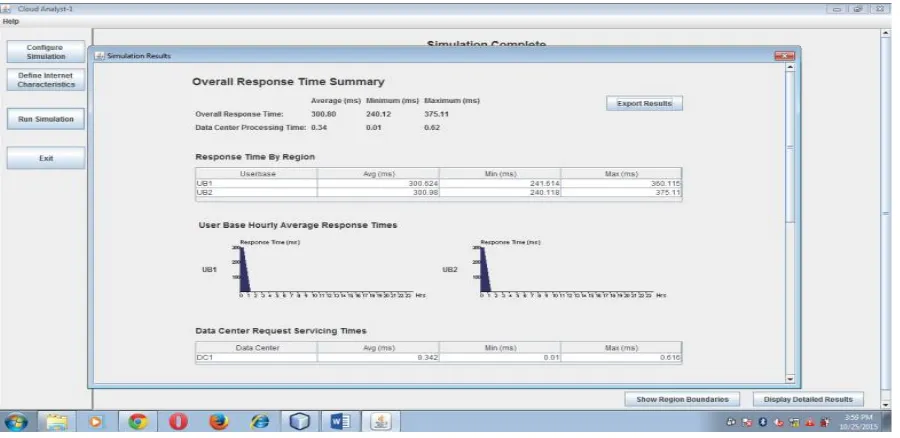
Figure 4: The response time and processing time for Round Robin Method in Cloud Computing Environment.
Table 1 & 2: Comparison among load balancing policies (Average response time) and Average data canter request servicing time among LB policies
UB(User Bases)
RR GSO TLBO
UB(1000) 50.422 50.394 50.357
UB(2000) 51.058 51.076 51.011
UB(3000) 51.626 51.658 51.638
UB(4000) 50.218 50.341 50.339
UB(5000) 301.906 301.559 301.832
UB(6000) 200.27 200.251 200.248
Table 1 Table 2
After these snapshots of implementation response and processing time analysis for RR, GSO, and TLBO respectively summarized in Table 1 and 2. In these tables we have used overall average response time and average data center processing time for the data set, user base (UB) and data center (DC).
Figure 5 Figure 6
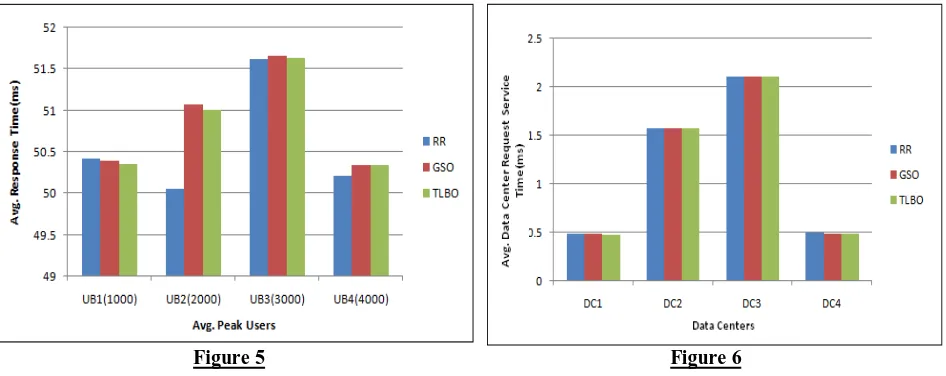
Figure 5 and 6: The comparative performance of ORT(Overall Response Time) for UB (User Bases) and comparative performance of DCPT(Data Center Processing Time) for DC (data centers) using RR, GSO and
TLBO Method in terms of Average values in milliseconds.
Figure 5 and 6 are bar charts depicting comparative performance of RR, GSO and TLBO method respectively. In which TLBO provide the better processing and response time as compared to round robin and GSO in terms of Average time in milliseconds.
V. CONCLUSION AND FUTURE WORK
In this paper teacher based learning optimization algorithm is proposed for job selection and resource allocation in public cloud computing. The TLBO function provides the higher performance rather than different swarm based algorithm like such as glowworm swarm algorithm. In the scenario of policy design inspired from two services one is glowworm optimization policy and another is TLBO based policy. The TLBO based policy reduces the load impact approx 10-12% in comparison of glowworm algorithm. Cloud Computing may be an immense concept and load balancing plays a really necessary role just in case of Clouds. There is a large scope of improvement during this space. We have mentioned only two divisible load scheduling algorithms that may be applied to clouds; however there are still
DC(Data Canters)
RR GSO TLBO
DC1 0.485 0.485 0.485
DC2 1.578 1.579 1.579
DC3 2.104 2.105 2.105
different approaches that may be applied to balance the load in clouds. The performance of the given algorithms also can be increased by varying completely different parameters.
REFERENCES
[ 1] Kundra, Vivek. "Federal cloud computing strategy." 2011.
[ 2] Liang, Po-Huei, and Jiann-Min Yang.” Evaluation of two level global load balancing framework in cloude environment”."International Journal of Computer Science & Information Technology Vol. 7.2, pp.1, 2015.
[ 3] Gupta, Ruhi, and Rekha Bhatia. "An Enhanced and Secure Approach of Load Balancing in Cloud Computing." Pp.112-116, 2014. [ 4] Rehman, M. Suhail, et al. "A Cloud Computing Course: From Systems to Services."Proceedings of the 46th ACM Technical Symposium
on Computer Science Education. ACM, 2015.
[ 5] Bhatia, Jitendra, and Malaram Kumhar. "Perspective Study on Load Balancing Paradigms in Cloud Computing." pp.112-120, 2015. [ 6] Katyal, Mayanka, and Atul Mishra. "A Comparative Study of Load Balancing Algorithms in Cloud Computing Environment." arXiv
preprint arXiv, Vol.1403.6918, 2014.
[ 7] Yuan, Hao, Changbing Li, and Maokang Du. "Cellular Particle Swarm Scheduling Algorithm for Virtual Resource Scheduling of Cloud Computing."International Journal of Grid and Distributed Computing Vol. 8.3, pp.299-308, 2015.
[ 8] Singh, Aarti, Dimple Juneja, and Manisha Malhotra. "Autonomous Agent Based Load Balancing Algorithm in Cloud Computing."Procedia Computer Science Vol. 45, pp. 832-841, 2015.
[ 9] Mohapatra, Subasish, K. Smruti Rekha, and Subhadarshini Mohanty. "A Comparison of Four Popular Heuristics for Load Balancing of Virtual Machines in Cloud Computing."International Journal of Computer Applications Vol.68.6, 2013.
[ 10] Dasgupta, Kousik, et al. "A genetic algorithm (GA) based load balancing strategy for cloud computing." Procedia Technology Vol.10, pp.340-347, 2013.
[ 11] Suresh, M., Kumar B. Santhosh, and S. Karthik. "A Load Balancing Model in Public Cloud Using ANFIS and GSO." Intelligent Computing Applications (ICICA), 2014 International Conference on. IEEE, 2014.
[ 12] Huang, Zhengxin, and Yongquan Zhou. "Using glowworm swarm optimization algorithm for clustering analysis." Journal of Convergence Information Technology Vol.6.2 pp.78-85, 2011.
[ 13] Krishnanand, K. N., and Debasish Ghose. "Glowworm swarm optimization for simultaneous capture of multiple local optima of multimodal functions."Swarm intelligence Vol. 3.2, pp87-124, 2009.
[ 14] Krishnanand, K. N., and Debasish Ghose. "Glowworm swarm based optimization algorithm for multimodal functions with collective robotics applications."Multiagent and Grid Systems Vol. 2.3 pp.209-222, 2006.
[ 15] Chen, Chang-Huang. "Group leader dominated teaching-learning based optimization."Parallel and Distributed Computing, Applications and Technologies (PDCAT), 2013 International Conference on IEEE, 2013.
[ 16] Rao, Ravipudi V., Vimal J. Savsani, and D. P. Vakharia."Teaching–learning-based optimization: a novel method for constrained mechanical design optimization problems." Computer-Aided Design Vol.43.3, pp. 303-315, 2011.
[ 17] Rao, R. Venkata, Vimal J. Savsani, and D. P. Vakharia."Teaching–learning-based optimization: an optimization method for continuous non-linear large scale problems." Information Sciences Vol.183.1, pp. 1-15, 2012.