Ber Performance Analysis of Coded OFDM-based
Systems over Various Channels
Md. Monirul Islam
Lecturer-CSE Atish Dipankar University of Science and Technology Plot# 209, Sector# 15, Khantek,
Dhaka-1230
Md. Ohidul Islam
Asst. Professor-CSE Atish Dipankar University of Science and Technology Plot# 209, Sector# 15, Khantek
Dhaka-1230
Md. Sorifujjaman
Dept. of EEE Atish Dipankar University of Science and Technology
Plot# 209, Sector# 15, Khantek, Dhaka-1230
ABSTRACT
The tremendous worldwide demand for high-speed mobile wireless communications is rapidly growing. OFDM technology promises to be a key technique for achieving the high data capacity and spectral efficiency requirements for wireless communication systems of the near future. The signal is offered to the receiver contains not only line of sight of radio wave, but also a large number of reflected radio waves that arrive at the receiver at different times. Delayed signals are a result of reflections from terrain features such as trees, hills, mountains, vehicles or building. These reflected delayed waves interfere with the direct wave and cause inter symbol interference (ISI), which causes significant degradation of the network performance. It is possible to use OFDM transmission scheme to overcome a multipath fading environment and a wireless broadband multimedia communication system (WBMCS). OFDM which is based on parallel data transmission scheme, reduces the effects of multipath fading. Usually OFDM has used in wireless LAN (WLAN) systems. In this paper, We are trying to investigate the OFDM-based BER performance over static and non-static or fading channel with a developed program written in MATLAB source code. We have also compared the performance between coherent and differential modulation scheme over static and fading channels. From our study, OFDM-based system performance depends severely on Doppler shift in turn depends on the velocity of user in the fading channels. In addition, BER performance degrades as Doppler shift increases. In this paper, We tried to highlight on a comparative study of OFDM-based system performance under different fading channels.
Keywords
Ber Performance, Ofdm- Based Systems, Modulation
1.
INTRODUCTION
Wireless communications is an emerging field, which has seen growing rapidly in the last several years. The large number of upgrade technology of mobile phone, Wireless Local Area Networks (WLAN) and the exponential growth of the Internet have resulted in an increased demand for new methods of obtaining high capacity wireless networks [1]. Most WLAN systems currently use the IEEE 802.11b standard, which provides a maximum data rate of 11 Mbps. Newer WLAN standards such as IEEE 802.11a and HiperLAN2 [2] are based on OFDM technology and provide a much higher data rate of 54 Mbps. However systems of the near future will require WLANs with data rates of greater than 100 Mbps, and so there is a need to further improve the spectral efficiency and data capacity of OFDM systems in WLAN applications.For cellular mobile applications, we will
see in the near future a complete convergence of mobile phone technology, computing, Internet access, and potentially many multimedia applications such as video and high quality audio. In fact, some may argue that this convergence has already largely occurred, with the advent of being able to send and receive data using a notebook computer and a mobile phone. Although this is possible with current 2G (2nd Generation) Mobile phones, the data rates provided are very low (9.6 kbps 14.4 kbps) and the cost is high (typically 0.20 1.30 AUD per minute) [3] limiting the usefulness of such a service.
The goal of third and fourth generation mobile networks is to provide users with a high data rate, and to provide a wider range of services, such as voice communications, videophones, and high speed Internet access. The higher data rate of future mobile networks will be achieved by increasing the amount of spectrum allocated to the service and by improvements in the spectral efficiency. OFDM is a potential candidate for the physical layer of fourth generation mobile systems [4].
2.
PRINCIPALS OF OFDM
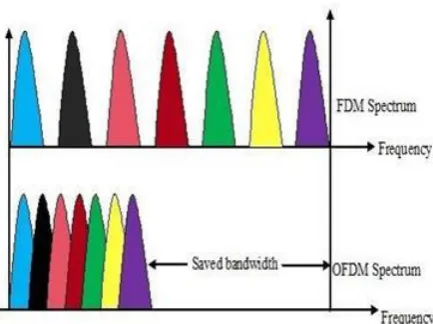
Fig. 1. Bandwidth comparison of OFDM and FDM
A. OFDM AS A MULTIPLEXING SCHEME
OFDM is similar to FDMA in that the multiple user access is achieved by subdividing the available bandwidth into multiple channels, which are then allocated to users. However, OFDM uses the spectrum much more efficiently by spacing the channels much closer together. This is achieved by making all the carriers orthogonal to one another, preventing interference between the closely spaced carriers. There are however, two main problems with TDMA. There is an overhead associated with the changeover between users due to time slotting on the channel. A change over time must be allocated to allow for any tolerance in the start time of each user, due to propagation delay variations and synchronization errors. This limits the number of users that can be sent efficiently in each channel. In addition, the symbol rate of each channel is high (as the channel handles the information from multiple users) resulting in problems with multipath delay spread [6].
B. OFDM AS A MULTIPLE ACCESS TECHNIQUE
OFDM can also be considered as a multiple-access technique, because an individual sub-carrier or groups of sub- carriers can be assigned to different users. Multiple users share a given bandwidth in this manner, yielding the system called OFDMA. Each user can be assigned a predetermined number of sub-carriers when they have information to send or alternatively, a user can be assigned a variable number of sub-carriers based on the amount of information that they have to send. The assignments are controlled by the media access control (MAC) layer, which schedules the resource assignments based on user demand [7].
C. ORTHOGONALITY
Signals are orthogonal if they are mutually independent of each other. Orthogonality is a property that allows multiple information signals to be transmitted perfectly over a common channel and detected, without interference. Loss of orthogonality results in blurring between these information signals and degradation in communications. Many common multiplexing schemes are inherently orthogonal. Time Di- vision Multiplexing (TDM) allows transmission of multiple information signals over a single channel by assigning unique time slots to each separate information signal. During each time slot only the signal from a single source is transmitted preventing any interference between the multiple information sources. Because of this TDM is orthogonal in nature. In the frequency domain most FDM systems are orthogonal as each of the separate transmission signals are well spaced out in frequency preventing interference. Although these methods are orthogonal the term OFDM has been reserved for a special form of FDM [8].
D. OFDM GENERATION AND RECEPTION
OFDM signals are typically generated digitally due to the difficulty in creating large banks of phase lock oscillators and receivers in the analog domain. Figure 2-5 shows the block diagram of a typical OFDM transceiver.
3.
DIGITAL MODULATION SCHEMES
In digital wireless communication systems, the modulating signal may be presented as a time sequence of symbols or pulses, where each symbol has in finite states. Each symbol represents n bits of information, where n=log2m bits/symbol. . Many linear and nonlinear digital modulation schemes are used in modern wireless communication systems. In linear modulation techniques, the amplitude of the transmitted signal, s(t), varies linearly with the modula6ng digital signal, m(t). Linear modulation techniques are bandwidth efficient and hence are very attractive for use in wireless communication systems where there is an increasing demand to accommodate more and more users within a limited spectrum. Many practical mobile radio communications systems use nonlinear modulation methods where, the amplitude of the carrier is constant regardless of the variation of the modulating signal [9].
Bandwidth efficiency describes the ability of a modulation scheme to accommodate data within a limited bandwidth. In general, increasing the data rates implies decreasing the pulse width of a digital symbol, which increases the bandwidth of the signal [10]. Thus, there is an unavoidable relationship between data rate and bandwidth occupancy. However, some modulation schemes perform better than the others in making this tradeoff. Bandwidth efficiency reflects how efficiently the allocated bandwidth is utilized and is defined as the ratio of the throughput data rates per Hertz in a given bandwidth. If R is the data rate in bits per second, and B is the bandwidth occupied by the modulated RF signal. Then bandwidth efficiency is expressed as:
The system capacity of a digital mobile communication system is directly related to the bandwidth efficiency of the modulation scheme, since a modulation with a greater value of will transmit more data in a given spectrum allocation.
4.
CHANNEL CODING AND
INTERLEAVING
Channel coding (Also called Error control coding) is concerned with methods of delivering information from a source to a destination with a minimum of errors. Error control coding is used to detect, and often correct, bits or symbols which are received in error. Error control generally fell into two categories, namely block codes and convolution codes [11].
A.
CONVOLUTION CODE
Fig. 2. A rated Convolution encoder
B.
THE VITERBI ALGORITHM
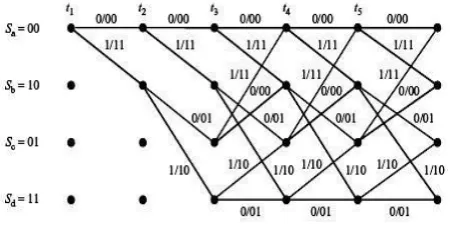
A Viterbi decoder uses the Viterbi algorithm for decoding a bit stream that has been encoded using Forward error correction based on a Convolution code. There are other algorithms for decoding a convolution ally encoded stream. The Viterbi algorithm (VA) is the most resource-consuming, but it does the maximum likelihood decoding. It is most often used for decoding convolution codes with constraint lengths k¡=10, but values up to k=15 are used in practice. The main problem that faces maximum likelihood decoding is the number of calculations that have to be done over all the possible code sequences. The VA reduces this complexity of calculation by avoiding having to take into account all the possible sequences. The decoding procedure consists of calculating the cumulative distance between the received sequence at an instant tia at given state of the trellis, and each of all the code sequences that arrive at that state at that instant ti . This calculation is done for all states of the trellis, and for successive time instants, in order to look for the sequence with the minimum cumulative distance [13]. The following example illustrates the application of the Viterbi decoding algorithm. The distance used as a measure of the decoding procedure is the Hamming distance; that is, the distance between any two sequences is defined as the number of differences between these two sequences.
Fig. 3. Trellis for -rated convolutional encoder
C.
INTERLEAVING
Interleaving is used to obtain time diversity in a digital communications system without adding any overhead. Inter- leavinghas become an extremely useful to transform analog voices into efficient digital messages that are transmitted over wireless links [14].
The function of the inter leaver is to spread the source bits out in time so that if there is a deep fade or noise burst, the important bits from a block of source data are not corrupted at the same time. By spreading the source bits over time, it becomes possible to make use of error control coding (called channel coding) which protects the source data from corruption by the channel. Since error control codes are designed to protect against channel errors that may occur randomly or in a bursty manner, inter leavers scramble the time order of source bits before they are channel coded [15].
5.
SIMULATION RESULTS AND
DISCUSSION
Matlab has been used to write a computer program designedfor simulation of an OFDM system to allow various parameters of the system to be varied and tested. The aim of doing the simulations is to measure the performance of OFDM under different channel conditions and to allow for different OFDM configurations to be tested. The effect of different modulation techniques and modulation level on OFDM has also been tested. Moreover, different error control coding has been employed to reduce BER rate.
To test the performance, a segment of recorded audio voice frequency data has been used. The number of bits chosen is 64000. Figure 6.1 shows the graphical representation of a recorded audio signal of data length 8000 samples in 1 second. It is PCM encoded at a data rate of 64Kbps with sampling frequency 8000Hz and 8 bit A/D conversion. Simulation tests have been run for different signal to noise ratio (1 through 20dB).
6.
PERFORMANCE OF OFDM OVER
FADING CHANNELS
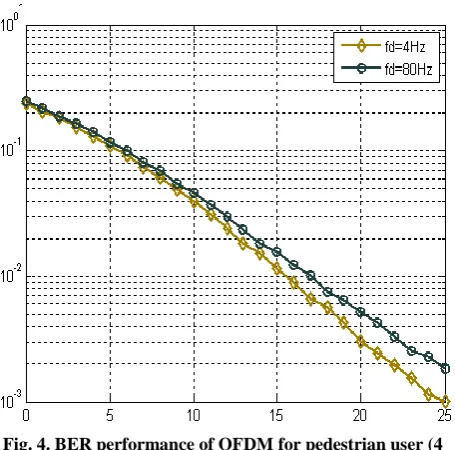
[image:3.595.56.282.540.653.2]Fig. 4. BER performance of OFDM for pedestrian user (4 Hz) and high speed user (80Hz) over Rayleigh channel
Now we shall compare the performance of OFDM in Rayleigh and Rician channel. Figure-5 shows such a simulation output. In this simulation D-2PSK was used as modulation scheme and Doppler shift and Rician factor were set at 40Hz and 5, respectively. From this figure it is seen that Bit Error Rate of OFDM over Rayleigh channel is far greater than that of Rician channel. The reason for this is very straightforward. From definition we know that this channel has no Line Of Sight (LOS) path and Rician channel has one LOS path or one major path. Since Rician channel has one LOS path so fading effect due to it must be lesser than that of Rayleigh channel. Thus Rayleigh channel produces greater BER than Rician channel. For a typical SNR value of 14 dB the BER for Rician channel is 0.0001328 and BER for Rayleigh channel is 0.0293. Hence the OFDM based system performance is 23.43dB better for Rician channel than Rayleigh channel.
Fig. 5. BER performance of OFDM over Rayleigh and Rician channel
7.
OFDM OVER DIFFERENT
CHANNEL WITH AND WITH- OUT
ERROR CONTROL CODING
[image:4.595.319.537.217.358.2]There are number of encoding techniques to reduce the Bit Error rate, that is, to improve system performance. Some examples of encoding techniques are Reed Solomon code, Convolution code, Gray code, Cyclic code, Interleaving in this thesis work Convolution code and block interleaving technique have been implemented to improve system performance. Let us first consider AWGN channel to show the effect of error control coding on OFDM performance. Figur-6 shows
Fig. 6. Performance of OFDM over AWGN channel with error control coding
It is seen that after using Convolution code and block Inter leaver the bit error probability for a given SNR is reduced considerably. For a typical SNR value of 6dB, the BER for uncoded AWGN channel is 0.0339 and BER by using Convolution code and block Interleaver is 0.0003203. Hence the system performance if improved by using error control coding is 20.24 dB.
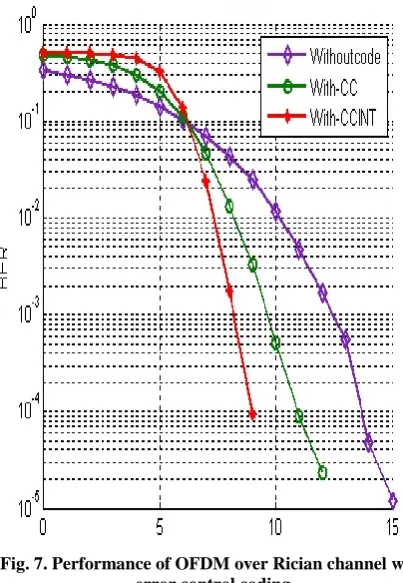
Now consider Rician channel to show the effect of error control coding on OFDM performance. It is seen form Figure- 7 that after using Convolution code and block Inter leaver the bit error probability for a given SNR is reduced considerably. It is seen from Figure-7 that for a typical SNR value of 9dB, the BER for uncoded Rician channel is 0.02444 and BER by using Convolution code and block Inter leaver is 9.375e- 05. Hence the system performance if improved by using error control coding is 34.16 dB.
[image:4.595.55.276.497.667.2]Fig. 7. Performance of OFDM over Rician channel with error control coding
Finally consider the Rayleigh channel to show the effect of error control coding on OFDM performance. It is seen form following Figure-8 that after using Convolution code and block Interleaver the bit error probability for a given SNR is reduced considerably. It is seen from Figure-8 that for a typical SNR value of 102dB, the BER for uncoded Rician channel is 0.01218 and BER by using Convolution code and block Inter leaver is 3.906e-006. Hence the system performance if improved by using error control coding is 44.93 dB.
To evaluate the OFDM performance over Rayleigh channel with error control coding, the input voice signal is shown and the corresponding output with and without error control coding is shown in Figure 8.
Fig. 8. Performance of OFDM over Rayleigh channel with error control coding
The current status of the research is that OFDM appears to be a suitable as a modulation technique for high performance wireless telecommunications. In this thesis work the performance of OFDM- based systems has been tested for various channels. BER Performance of the OFDM-based systems is found to be almost similar to theoretically calculated BER value. The BER simulation results are always in between 10- 1 to 10-5. The BER performance of coded OFDM is always better than uncoded OFDM. It is also observed form the simulation test that the coherent modulation is performed better in static channel and the differential modulation technique is performed better in Fading channel.
OFDM promises to be a suitable modulation technique for high capacity wireless communications and will become increasing important in the future as wireless networks become more relied on.
A. Future Works
Research can be done to illustrate the effect of the delay spread, peak power clipping etc, frequency offset estimation and channel estimation. One important major area which hasn’t been investigated is the problems that may be uncounted when OFDM is used in a multi- user environment. One possible problem which may be encountered is the receiver may require a very large dynamic range in order to handle the large signal strength variation between users. Another promising technique for 4G mobile communication is the combination of OFDM system with CDMA i.e multi-carrier CDMA (MC-CDMA).
8.
REFERENCES
[1] I. Y. Khan, S. U. Nyati, and S. B. Umesh, “To improve performance of ofdm system using optimize adaptive coding technique with con- volutional and bch coding,” International Journal of Application or Innovation in Engineering & Management (IJAIEM) Vol.
[2] E. N. Committee et al., “Broadband radio access networks (bran); hiper- lan type 2; physical (phy) layer,” Norme ETSI, document RTS0023003- R2, European Telecommunications Standards Institute, Sophia-Antipolis, Valbonne, France, 2001.
[3] B. Rowe, “Opening the airwaves: Accommodating third- generation wireless technologies,” 2001.
[4] J. Govil and J. Govil, “4g mobile communication systems: Turns, trends and transition,” in Convergence Information Technology, 2007. International Conference on. IEEE, 2007, pp. 13–18.
[5] N. Marchetti, M. I. Rahman, S. Kumar, and R. Prasad, “Ofdm: Principles and challenges,” New directions in wireless communications research, pp. 29–62, 2009. [6] R. Mosier and R. Clabaugh, “Kineplex, a
bandwidth-efficient binary transmission system,” Transactions of the American Institute of Electri- cal Engineers, Part I: Communication and Electronics, vol. 76, no. 6, pp. 723– 728, 1958.
[7] M. Rahman, S. Das, and F. Fitzek, “Ofdm based wlan systems,” Center for TeleInFrastruktur (CTiF), Technical report R-04- 1002, 2005.
[image:5.595.56.283.535.733.2][9] Z. Ghassemlooy, W. Popoola, and S. Rajbhandari, Optical wireless communications: system and channel modelling with Matlab R . CRC press, 2012.
[10]P Sweeney, Error control coding. Prentice Hall UK, 1991.approach. John Wiley & Sons, Inc., 2011.
[11]K. Pahlavan, Principles of wireless networks: A unified [12]N. T. Awon, M. Islam, M. Rahman, A. Islam et al.,
“Effect of awgn & fading (raleigh & rician) channels on ber performance of a wimax communication system,” arXiv preprint arXiv:1211.4294, 2012.
[13] S. Viraktamath, J. M. Kabbur, and G. V. Attimarad, “Implementation of viterbi algorithm on dsp,” International Journal of Engineering Science and Technology, vol. 4, no. 4, 2012.
[14] M. Kang and M.-S. Alouini, “Largest eigenvalue of complex wishart matrices and performance analysis of mimo mrc systems,” IEEE Journal on Selected Areas in Communications, vol. 21, no. 3, pp. 418–426, 2003. [15] B. Sklar, Digital communications. Prentice Hall Upper