Elder Care System – An Android Application
Abeywardhana D. S.
Faculty of Computing, Sri Lanka Institute of InformationTechnology Colombo, Sri Lanka
Shahid M. A.
Faculty of Computing, Sri Lanka Institute of InformationTechnology Colombo, Sri Lanka
Madushani W. N. R. B. C.
Faculty of Computing, Sri Lanka Institute of InformationTechnology Colombo, Sri Lanka
Vithana V. N.
Senior Lecture, Faculty of Computing, Sri Lanka Institute of Information Technology
Colombo, Sri Lanka
ABSTRACT
When we consider about elder people, due to their physical or mental condition they may not be able to perform their day to day task alone, always a supervision of a guardian will be needed. When considering the busy life style, guardians may not be able to track down their elder’s tasks all the time. Private nursing services could be a very expensive option. Elder will need help from someone to full fill their daily needs on the other hand guardian may not be able effort the cost. Due to lack of regular supervision, elders may find a hard time to take care of themselves. They might forget essential daily tasks like to take their medicines, doctors’ appointments etc. There are very few automated systems in the field of elder care. The elder care system explained in this research tends to provide an efficient automated system to help elders to live their life easily. This system will perform tasks such as automated medicine dispensing, search available doctors, panic button, wakeup time detection, sleeping time detection, also if patient unable to take their medicine in time send waring alerts to the guardian. This system will allow guardians to interact with elders if they busy, with the help of an android application.
Keywords
Panic button, Dispenser, Elder, Guardian, Doctor, Medicine schedule, Alerts, Android application
1.
INTRODUCTION
Nowadays elders are unable to perform their tasks alone. That make them hope free and uncomfortable. In the other hand guardians will be disappointed due to their lack of careens towards to their elderly members in the family because of today’s busy life style. According to the research study, System that develop, will be assist elder members to perform their task alone without any specific guardian supervision. So, tasks such as taking medicine on time, reminding doctors’ appointments, how to react to Emergency situations, introduction of Emergency Panic button will be performed by the developed System.
The Elder Care System is an automated System that is capable
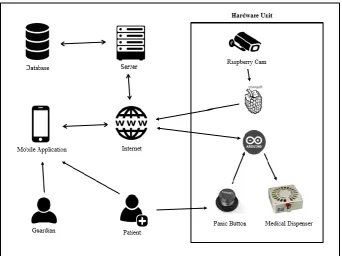
Furthermore, the system will alert the guardian if he/she misses to take their meds. According to the Figure there are mainly two users who are interacting with the system Guardian will interact with the android system and the patient will interact with the dispenser panic button and the android application the details are getting from the database where the details are being stored. All the above-mentioned data are taken from a hosted database and a server.
Throughout this project the project group hopes to find a,
Solution to remind the user when to take their medications.
And find a method to monitor the patient movements and alert the guardian in different situations.
Solution to alert the guardian in emergency situations. And a way to locate the users’ location and
recommend the guardian for available hospital and doctors in them.
2.
BACKGROUND STUDY
The research team studied numerous published research papers, articles and documents from various sources, and research team found some researches had advantages as well as the limitations. So, research team collected those limitations for build their system without limitations and user friendly.
Programmable Medicine Dispensing System, A new Programmable Medicine Dispenser and Storage Device for allowing for user or physician programming of a medication administration schedule, alerting the user, by means of an audible alarm, of a scheduled medication administration time, opening a corresponding medication compartment upon user acknowledgment of the alarm and instructing the user on the proper method of taking the medication. However, this system was very complex system & performs a single task (Dispensing Medicine) no way to find that person took the medicine [1].
systems in which software and robotic agents contribute to the common goal of generating active such as health care facilities. But the issue is, too expensive and not practical in real life [3].
In Home Patient Monitoring System, the system includes a plurality of remote monitoring units that each includes both a wireless transmission device and a conventional modem for communicating over voice telephone lines. The research team used Methodologies are Wireless transmitting device. Advantages are Proper connection between medical center and patient center, Proper database is used by the patient’s center to record patient data that access through the online methods. Their limitations are absence of proper way to track patient’s normal activities such as the time the patient is supposed to the medicines [4].
Panic Buttons for Seniors Must Go, an emergency use only panic button phone provides a low-cost comprehensive personal security device. Limitations are Only Sends a notification only if the patient is in a critical possession [5]. A Real-time System for In-home Activity Monitoring of Elders, real-time system for in-home activity monitoring and functional assessment for elder care. Limitations are the whole apartment should be equipped with the tool which is unaffordable to some people [6].
Semi-automatic Activity Summarization System for Elderly Care, the fast-growing mobile sensor technology makes sensor-based life logging system attractive to the remote elderly care. Limitations are If the phone is broken or disconnected from the network connection the sensors will not work properly [7].
An Android Application for Fall Monitoring and Response, they present an alert system for fall detection using common commercially available electronic devices to both detect the fall and alert authorities. They used an Android-based smart phone with an integrated tri-axial accelerometer. Their system advantages are Tracking patient movements through the acidometer and send appropriate messages in case if the patient gets any discomforts as well as their system limitations are Only concern about elders’ movement (false situations) absence of proper way to Dispense medicine [8].
Automated In-Home Fall Risk Assessment and Detection Sensor System for Elders, an unobtrusive, in-home sensor system that continuously monitors older adults for fall risk and detects falls could revolutionize fall prevention and care. Methodologies pulse-Doppler radar, Microsoft Kinect, web cameras. Advantage, Send alert to the guardian. Limitation, over budget and the device is too large [9].
B-Live - A Home Automation System for Disabled and Elderly People, system has been developed at Micro I/O for assisting elderly and disabled people in their homes. Limitations are Absence of proper method to dispense medicines, No emergency alerts [10].
These researches mostly consider about few components of elder care. “Elder Care System” covers all the parts. Such as automated medicine dispenser, monitor patient movements,
live screaming, panic alerts and search available doctors and take appointments. Therefore, it will be help and time saving for guardians and patients in their busy life style.
3.
METHODOLOGY
The prototype methodology was used to achieve the project goals. Planning, Analysis, Designing and Implementation phases were executed concurrently and iterated until the project reached all the objectives and the users were satisfied with a final prototype. First prototype was built with minimal number of features and the rest of the features were added to each prototype produced.
3.1
Planning
The planning phase is the most critical and essential step in the software development life cycle (SDLC). As a starting point to the SDLC research problem was found and as a solution for the problem an automatic dispenser with an android application was proposed. In the planning phase, the research team identified the project value and problems and divided the work among the members in the group. Technology was chosen in order to build the project and a budget was calculated.
3.2
Requirement Gathering and Analysis
Please After identifying the problem, the next phase is to analyze the problem. In this step, the research group analyzed the feasibility of the research, understand the stakeholder’s needs and defined the system that will be capable of detecting violations. Main stakeholders are guardian and patient who will use “Elder Care System” to ease their work.
After referring research papers related to the Elder care system to identify information which must be gathered and after identify requirements what must be included to the Elder care system, information must be gathered related to requirements.
3.3
Design
Designing phase was the place where the initial design of the project was planned. The sketch of the elder care system was designed, how the hardware components are placed and how it will be connected to software. All the main functionalities such as schedule dispenser, monitor patient, live streaming & panic button, search doctor and doctor appointments designs were planned and also the guardian android application and the patient android application designs were planned.
Fig 1: High Level Architecture Diagram
Fig 2: Hardware Circuit Diagram for Medicine Dispenser & Panic Button
3.4
Implementation
The goal was the implement a user-friendly system which works efficiently and effectively. Arduino IDE was used to implement the hardware programming of the system, Android Studio was used to implement the android application. Medical dispenser was implemented using Nodemcu and RTC module. Arduino mega and Bluetooth module were used to implement the panic button and research group used Raspberry to implement the live streaming and monitor the patient movements when needed. Furthermore, the research group developed android applications for the guardian and
[image:3.595.63.542.371.542.2]4.
RESULTS AND DISCUSSION
Nowadays almost everyone has a smartphone in their hands and the human computer interactions are very common in the modern era. The elder care system was developed to remind the user different tasks in different situations during the day. One of the tasks of the elder care system is to remind the user to take their medications during the day. This is done using an android application the user will schedule the times to take their pills and an alarm will ring when it’s time to take their medications which is attached to the Nodemcu and also indicate which pills to be taken in that particular time.
Another action of the elder care system is to alert related parties of the user in different situations this is done by using a panic button and a Bluetooth module which is connected to the Arduino mega board which is connected dispenser an SMS will be sent to the predefined numbers through the application when the users presses the panic button.
Another functionality of the system is the system is able to retrieve the user’s location and recommend doctors who suits the patient details which will be provided in the initial startup.
And also, the system has a raspberry pi microprocessor which helps the user to view the patient using the mobile application. A python code is written to upload the live feed to the server and to view the video in the elder care app.
The research group developed two different android mobile applications and one for the user and one to the guardian and a medical dispenser where the medicine, camera, panic button and the alarm is attached.
Android application was developed using Android Studio IDE and this application was developed for the use of the guardian and the patient. To develop the suggestions the research group used Business Intelligent Studio IDE and the algorithm used to develop the suggestions was Decision Tree. All the data is stored in a hosted database and it was taken to the android application. The application is capable to receive and playback videos via YouTube.
Interfaces related to the functionalities of elder care system, guardian android application, patient android application are described in this section.
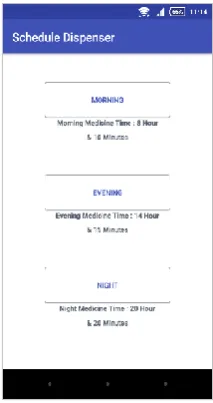
Fig 3: Guardian Android Application - Schedule Dispenser
Fig 3 represents the guardian android application Schedule Dispenser interface. Using this guardian can schedule time to indicate canisters medical in medical dispenser.
Fig 4: Guardian Android Application - Live Streaming
Fig 4 represents the guardian android application Live Streaming interface. Through this guardian can patient current situation lively.
Fig 5: Guardian Android Application - Search Available Doctors
[image:4.595.330.524.113.221.2]Fig 5 represents guardian android application Search Available Doctors interface. Pick the date and can see available doctors in the area.
[image:4.595.373.481.276.466.2] [image:4.595.113.220.531.733.2] [image:4.595.378.484.545.733.2]Fig 6 represent when guardian pick the date and choose the doctor and the hospital. Then popup create booking message box. After that input the patient name and create booking.
Fig 7: Patient Android Application – Setting Interface
Fig 7 represents patient android application Save Guardian Phone Number interface. Save the guardian phone number.
Fig 8: Guardian Android Application - View Hospitals
Fig 8 represents view of hospitals in Available doctor interface. Using this interface guardian can select the hospital.
5.
CONCLUSION AND FUTURE WORK
There are a very few number of dispensers and a very few number of multifunctional systems in the current market. Which is a sad thing because in the modern era it’s almost impossible to work and take care the elders in the same time and no one has taken any steps to create a solution.
After completing the research, the research group tested the
times which is 70% which concludes the system is practical in the real world.
The elder care system consists if some of multifunctional tasks the alarm and the panic alerts automatically reset itself after 5 minutes the application can monitor the patient movements and report the guardian if the patient misses any medications. An important part of the system is the mobile application will automatically retrieve the user location and create a list of hospitals and doctors around the user and it also automatically pair itself with Bluetooth module of the dispenser.
During the development of the project following are the limitations which were figured out:
The users should have a basic knowledge about how the handle an android application.
The user should have a steady internet connection. The user should be able to move around by himself. The location where the dispenser is placed should
have dc output.
The server should be available anytime.
The patients’ mobile application should be in a range of 50 meters.
Recommendations to those who are willing to develop this system further are as follows:
Add more canisters to store meds.
Add heart rate and blood pressure sensors to identify current health situation.
As the research was limited to a specific time period the group was able to focus only a limited number of components. In the future the group is willing to do more researches and develop more methods that will be included to the hardware device as well as to the android application.
6.
ACKNOWLEDGEMENTS
The research team take this opportunity to sincerely acknowledge the individuals and groups who have provided guidance and assistance throughout the project,
First and foremost, we would like to thank Dr. Yasas Jayaweera, the Academic Head of SLIIT Computing (Pvt). LTD. and Ms. Gayana Fernando, Senior lecturer and lecturer in-charge of the module for providing us with the opportunity to conduct the Research Project. We thank the other members of the academic staff of SLIIT Computing (Pvt.) LTD. We also thank the nonacademic staff who have provided support.
Finally, we would like to acknowledge with gratitude, the great amount of support and advice given by all our family members and friends as well as all the other individuals and groups that gave a helping hand whose names were not mentioned.
7.
REFERENCES
[image:5.595.116.219.113.305.2] [image:5.595.115.222.362.556.2]http://ro.uow.edu.au/cgi/viewcontent.cgi?article=1251&c ontext=buspaper.
[4] "The RoboCare Project Cognitive Systems for the Care of the Elderly", Webcache.googleusercontent.com, 2014. [Online].Available:http://webcache.googleusercontent.co m/search?q=cache:40PKpigIuj4J:citeseerx.ist.psu.edu/vi ewdoc/download%3Fdoi%3D10.1.1.100.4054%26rep%3 Drep1%26type%3Dpdf+&cd=1&hl=en&ct=clnk&gl=lk.
[5] "Panic buttons for seniors must go", MobiHealthNews, 2012.[Online].Available:http://webcache.googleusercont ent.com/search?q=cache:A2E_xo8FIHQJ:www.mobiheal thnews.com/19397/panic-buttons-for-seniors-must-go+&cd=1&hl=en&ct=clnk&gl=lk. [Accessed: 06- Dec- 2012].
[6] "A Real-time System for In-home Activity Monitoring of ElderS", 2017. [Online]. Available: http://ijssst.info/Vol-16/No-4/paper9.pdf.
[7] SQLAuthority[online]available:http://blog.sqlauthority.c om/2009/10/21/sql-serverintroduction-to-business-intelligence-important-terms-definitions/ October 2016
[8] "Wireless Health Care Service System for Elderly with
Dementia IEEE Journals &
Magazine", Ieeexplore.ieee.org,2017.[Online].Available: http://ieeexplore.ieee.org/document/1707682/...
[9] "Activity Recognition Using Wearable Sensors for Elder Care IEEE Conference Publication", Ieeexplore.ieee.org, 2017.[Online].Available:http://ieeexplore.ieee.org/docum ent/4734227/.
[10] "In-Home Fall Risk Assessment and Detection Sensor System", Webcache.googleusercontent.com, 2017.
[Online]. Available: