STUDY ON POSSIBISLITIC MULTIOBJECTIVE SOLID TRANSPORTATION PROBLEMS
1
Ammar
1
Department of Mathematics, Faculty of Science, Tanta University, Tanta, Egypt
2Department of Operations Research, Institute of Statistical Studies and
ARTICLE INFO ABSTRACT
The Solid
Usually, these properties are
In this paper, the efficient solutions and stability of multiobjective solid transportation problem (Poss MOSTP) with possibilitic coefficients
possibilistic demand quantities
the problem by incorporating possibilistic data into the objective functions coefficients, supplies, demands and conveyances. The concept of
efficient solution is extend
weighting problem of Poss MOSTP is deduced. A necessary and sufficient condition for such a solution is established. The basic notions like the solvability set and the stability set of t
are defined and characterized that's to characterize the parametric optimal solution for the auxiliary problem. An algorithm for the determination of the stability set is proposed. Finally, a numerical example is given to illustrate the aspec
Copyright © 2015 Ammar and Khalifa. This is an open access article distributed under the Creative Commons Att distribution, and reproduction in any medium, provided the original work is properly cited.
INTRODUCTION
The solid transportation problem (STP) is a generalization of the well
properties (supply, demand and conveyance) are taken into account in the constraint set instead of two (supply and demand), and its of great use in public distribution systems. The STP was first stated by Shell (1955). Although STP was forgotten for long because of the new existing solution methodologies, recently it is receiving the attention and the interest of the researcher
field (Ida et al. 1995; and Bit et al. 1993). Haley (1962) introduced the solution procedure of STP which is an extension of the modified distribution method. Patel and Tripathy (1989)developed a computationally superior method for a STP with mixe constraints. Vajda (1988) proposed an algorithm for a multi
distribution method. Basu et al. (1994) provided an algorithm for finding the optimum solution of solid fixed charge linear transportation problem. Li et al. (1997) designed a neural network approach for multicriteria STP. Jimenez and Verdegay (1996) developed a parametric approach for solving fuzzy STPs by an evolutionary algorithm (EA). Pandian and Natarajan (2010) are introduced the zeropoint method for finding an optimal solution to a classical TP. Pandian and Auradha
method using the principle of zero point method introduced by Pandian and Natarajan (2010) for finding an optimal solution of STP. Ojha et al. (2010) formulated a STP with discounted costs, fixed charges and vechicle costs as a linear programming problem. Qualitative analysis of some basic notions such as the set of feasible parameters, the solvability set and the stabi of the first kind and the stability set of the second kind are introduced by Osman (1977). Luhandjula (1987) deals with multi objective programming problems with possibilistic coefficients. Hussein (1998) introduced the complete solutions of multi objective transportation problems with possibilistic coefficients. Sakawa and Yano
optimality of fuzzy parametric programs. Kassem
possibilistic variables and without differentiability for the considered objective functions. Ammar and Youness (2005) introduced the solution of multi-objective TP with fuzzy objectives, fuzzy sources, and fuzzy destinations.
objective solid transportation problem (Poss MOSTP) with possibilistic coefficients, possibilistic supply values, possibilistic demand values, and possibilistic conveyances.
*Corresponding author: Ammar, E. E.
Department of Mathematics, Faculty of Science, Tanta University, Tanta, Egypt
ISSN: 0975-833X
Available online at http://www.journal
Article History: Received 05th October, 2014 Received in revised form 05th November, 2014 Accepted 27th December, 2014 Published online 31st January,2015
Key words: Multiobjective Solid Transportation Problems, Possibilistic Variables, α-Possibly Efficient solution, α-Possibly Optimal Solution, Stability Notions.
RESEARCH ARTICLE
POSSIBISLITIC MULTIOBJECTIVE SOLID TRANSPORTATION PROBLEMS
Ammar, E. E. and
2,*Khalifa, H. A
.
Department of Mathematics, Faculty of Science, Tanta University, Tanta, Egypt
Department of Operations Research, Institute of Statistical Studies and Research, Cairo University, Cairo, Egypt
ABSTRACT
Solid Transportation Problem (STP) arises when bounds are given on three item properties. Usually, these properties are supply, demand, and type of product or mode of transport (conveyance). In this paper, the efficient solutions and stability of multiobjective solid transportation problem (Poss MOSTP) with possibilitic coefficients r
i j k
c and / or possibilistic supply quantities
possibilistic demand quantities j
b and / or possibilistic conveyances
the problem by incorporating possibilistic data into the objective functions coefficients, supplies, demands and conveyances. The concept of α-possibly efficient is specified in which the ordinary efficient solution is extended based on the α-cut of a possibilistic variables. A solution of the weighting problem of Poss MOSTP is deduced. A necessary and sufficient condition for such a solution is established. The basic notions like the solvability set and the stability set of t
are defined and characterized that's to characterize the parametric optimal solution for the auxiliary problem. An algorithm for the determination of the stability set is proposed. Finally, a numerical example is given to illustrate the aspects of the developed results.
is an open access article distributed under the Creative Commons Attribution License, which distribution, and reproduction in any medium, provided the original work is properly cited.
The solid transportation problem (STP) is a generalization of the well-known transportation problem (TP) in which
demand and conveyance) are taken into account in the constraint set instead of two (supply and demand), and s of great use in public distribution systems. The STP was first stated by Shell (1955). Although STP was forgotten for long because of the new existing solution methodologies, recently it is receiving the attention and the interest of the researcher
. 1993). Haley (1962) introduced the solution procedure of STP which is an extension of the modified distribution method. Patel and Tripathy (1989)developed a computationally superior method for a STP with mixe constraints. Vajda (1988) proposed an algorithm for a multi-index transportation problem which is an extension of the modified
. (1994) provided an algorithm for finding the optimum solution of solid fixed charge linear . (1997) designed a neural network approach for multicriteria STP. Jimenez and Verdegay (1996) developed a parametric approach for solving fuzzy STPs by an evolutionary algorithm (EA). Pandian and Natarajan (2010) are
d the zeropoint method for finding an optimal solution to a classical TP. Pandian and Auradha
method using the principle of zero point method introduced by Pandian and Natarajan (2010) for finding an optimal solution of . (2010) formulated a STP with discounted costs, fixed charges and vechicle costs as a linear programming problem. Qualitative analysis of some basic notions such as the set of feasible parameters, the solvability set and the stabi
ind and the stability set of the second kind are introduced by Osman (1977). Luhandjula (1987) deals with multi objective programming problems with possibilistic coefficients. Hussein (1998) introduced the complete solutions of multi
on problems with possibilistic coefficients. Sakawa and Yano (1989) provided the concept of
optimality of fuzzy parametric programs. Kassem (1998) introduced the multiobjective nonlinear programming problems with differentiability for the considered objective functions. Ammar and Youness (2005) introduced objective TP with fuzzy objectives, fuzzy sources, and fuzzy destinations.In this paper, we deal with a multi
n problem (Poss MOSTP) with possibilistic coefficients, possibilistic supply values, possibilistic demand values, and possibilistic conveyances.
Mathematics, Faculty of Science, Tanta University, Tanta, Egypt.
Available online at http://www.journalcra.com
International Journal of Current Research
Vol. 7, Issue, 01, pp.11942-11953, January, 2015
INTERNATIONAL z
POSSIBISLITIC MULTIOBJECTIVE SOLID TRANSPORTATION PROBLEMS
Department of Mathematics, Faculty of Science, Tanta University, Tanta, Egypt
Research, Cairo University, Cairo, Egypt
(STP) arises when bounds are given on three item properties. supply, demand, and type of product or mode of transport (conveyance). In this paper, the efficient solutions and stability of multiobjective solid transportation problem (Poss
bilistic supply quantities i
a and / or and / or possibilistic conveyances
k
e are investigated. We consider the problem by incorporating possibilistic data into the objective functions coefficients, supplies, possibly efficient is specified in which the ordinary cut of a possibilistic variables. A solution of the weighting problem of Poss MOSTP is deduced. A necessary and sufficient condition for such a solution is established. The basic notions like the solvability set and the stability set of the first kind are defined and characterized that's to characterize the parametric optimal solution for the auxiliary problem. An algorithm for the determination of the stability set is proposed. Finally, a numerical
ribution License, which permits unrestricted use,
known transportation problem (TP) in which three item demand and conveyance) are taken into account in the constraint set instead of two (supply and demand), and s of great use in public distribution systems. The STP was first stated by Shell (1955). Although STP was forgotten for long time, because of the new existing solution methodologies, recently it is receiving the attention and the interest of the researchers in this . 1993). Haley (1962) introduced the solution procedure of STP which is an extension of the modified distribution method. Patel and Tripathy (1989)developed a computationally superior method for a STP with mixed index transportation problem which is an extension of the modified . (1994) provided an algorithm for finding the optimum solution of solid fixed charge linear . (1997) designed a neural network approach for multicriteria STP. Jimenez and Verdegay (1996) developed a parametric approach for solving fuzzy STPs by an evolutionary algorithm (EA). Pandian and Natarajan (2010) are d the zeropoint method for finding an optimal solution to a classical TP. Pandian and Auradha, (2010) proposed a new method using the principle of zero point method introduced by Pandian and Natarajan (2010) for finding an optimal solution of . (2010) formulated a STP with discounted costs, fixed charges and vechicle costs as a linear programming problem. Qualitative analysis of some basic notions such as the set of feasible parameters, the solvability set and the stability set ind and the stability set of the second kind are introduced by Osman (1977). Luhandjula (1987) deals with objective programming problems with possibilistic coefficients. Hussein (1998) introduced the complete solutions of multi-(1989) provided the concept of -Pareto objective nonlinear programming problems with differentiability for the considered objective functions. Ammar and Youness (2005) introduced n this paper, we deal with a multi-n problem (Poss MOSTP) with possibilistic coefficiemulti-nts, possibilistic supply values, possibilistic
Ammar and Khalifa (2014) studied the multiobjective solid transportation problem with fuzzy numbers.
The concept of
-possibly efficient and
-parametric efficient solution are introduced. The relation between the above two concept of solutions is established. A parametric analysis is introduced to characterize the set of all
-parametric efficient solutions. An algorithm to determine the stability set of the first kind corresponding to one parametric efficient solution of Poss MOSTP is presented. A numerical example is given to illustrate and clarify the obtained results.Preliminaries
In this section, we recall some definitions and lemma needed through the paper (Zadeh, (1970)).
Definition 1.A possibilistic variable y on
T
R
n is a variable characterized by a possibility distribution on
y( )
t
.This means that, if y is a variable taking values in T, then a possibility distribution
y associated with y may be viewed as a fuzzy constraint on the values that may be assigned to y. such a distribution is characterized by a possibility distribution function:
[ 0, 1]
y
T
which associated with eacht
T
the degree of compatibility of the variable y with the realizationt
T
. If T is a Cartesian product ofT T
1,
2, ...,
T
n, then
y( ,
t
1t
2, ...,
t
n)
is an n-array possibility distribution, i.e.,1 1 2 2
( )
(
( ),
(
), ...,
(
) )
n
y
t
yt
yt
yt
n
.Definition 2. The
-cut of a possibilistic variable y isy
{
t
T
:
y( )
t
}
.Definition 3.A possibility distribution
y on T is said to be convex if1 2 1 2 1 2
y
(
t
(1
)
t
)
min (
y(
t
),
y(
t
) ) ,
t
,
t
T
,
[ 0, 1]
.It is appropriate to define the support of a possibilistic variable y in the case of
T
R
n.Definition 4. The support of a possibilistic variable y is
y ( )
sup (
)
: sup (
( ) )
0 for all
0
u N t
y
t
T
u
,
where,
N
( )
t
{
u
T
: ||
u
t
||
}
.
Lemma 1.
Sup (
y
)
is a closed set in T.Proof. See, Hussein (1998).
Problem formulation
Consider the general possibilistic multiobjective solid transportation problem with possibilistic coefficients in the objective functions, possibilistic supplies, possibilistic demands, and possibilistic conveyances (Poss MOSTP)
(Poss MOSTP)
1 1 1
min
( ,
)
;
1, ...,
m n
r r
r i j k i j k
i j k
Z
x c
c
x
r
q
subject to
1 1
( , ,
)
:
;
1, ...,
;
n m n
i j k i
j k
x
G a b e
x
R
x
a
i
m
1 1 1 1
,
1, ..., ;
,
m m n
i j k j i j k k
i k i j
x
b
j
n
x
e
1 1 1
1, ..., ;
, and
m n
i j k
i j k
k
a
b
e
0,
1, ...,
;
1, ...,
;
i j k
x
i
m
j
n
1, ...,
k
,where,
c
i j kr(
r
1, ...,
q
),
a
i,
i
1, ...,
m b
;
j,
j
1, ...,
n e
;
k,
k
1, ...,
are possibilistic variables on R characterized by possibility distributions r,
i i j k a
c
,j
b
and
ek , respectively. For all outcomes it is assumed that allpossibility distributions involved in Poss MOSTP are convex ones with compact (i.e., bounded and closed) supports and 0
sup (
)
y
y
(see, Definitions 2-4).Efficiency aspects
Definition 5. (-possibly feasible actions):Let
1
(
11,
12, ...,
1m)
,B
1i
[ 0, 1]
,i
1, 2, ...,
m
;
2
(
21,
22, ...,
2n)
,
2j
[ 0, 1],
j
1, 2, ...,
n
; and
3
(
31,
32, ...,
3),
3k
[0, 1],
k
1, 2, ...,
. Thenx
G a b e
( , , ) {
x
R
m n :
x
i j k
0,
i
1, 2, ...,
m j
;
1, 2, ..., ;
n k
1, 2, ..., }
is said to be
-possibly feasibly actions for problem (Poss MOSTP) if:Poss 2
1 1 1 1
sup (
(
) )
,
j
m m
i j k j b j j i j k j
i k i k
x
b
b
x
b
,1, 2, ...,
j
n
; andPoss 3
1 1 1 1
sup (
(
) )
,
m n m n
i j k k e k k k i j k k
i j i j
x
e
e
x
e
,1, 2, ...,
k
,where Poss denotes possibility.
Definition 6. (-possibly efficient): A point
x
*( )
c
G a b e
( , ,
)
is said to be
-possibly efficient to Poss MOSTP if thereis no
x c
( )
G a b e
( , ,
)
such that:Poss
(
z
1( ,
x c
1)
z
1(
x
*,
c
1), ...,
z
r1( ,
x c
r1)
z
r1(
x
*,
c
r1)
,* 1 * 1
1 1
( ,
r)
(
,
r),
( ,
r)
(
,
r), ...,
r r r r
z
x c
z
x
c
z
x c
z
x
c
*
( ,
q)
(
,
q) )
q q
z
x c
z
x
c
, ………(1) On account of the extension principle,Poss
(
z
1( ,
x c
1)
z
1(
x
*,
c
1), ...,
z
r1( ,
x c
r1)
z
r1(
x
*,
c
r1)
,* 1 * 1
1 1
( ,
r)
(
,
r),
( ,
r)
(
,
r), ...,
( ,
q)
r r r r q
z
x c
z
x
c
z
x c
z
x
c
z
x c
1 2 1
1 2
* 1 2 1
( , , ..., )
(
,
) )
sup
min (
(
),
(
), ...,
r(
)
q
q r
q c c c
c c c C
z
x
c
c
c
c
,1
1
(
),
(
), ...,
(
) )
r r q
r r q
c
c
cc
cc
where,
1 2 ( ) 1 * 1 1
1 1 1
{(
,
, ...,
q)
q m n:
( ,
)
(
,
), ...,
r( ,
r)
C
c
c
c
R
z
x c
z
x
c
z
x c
* 1 * 1 * 1
1
(
,
),
( ,
)
(
,
),
1( ,
)
1(
,
),
r r r r r
r r r r r
z
x
c
z
x c
z
x
c
z
x c
z
x
c
*
...,
z
q( ,
x c
q)
z
q(
x
,
c
q)}
………..(3) For characterizing the
-possibly efficient solution for Poss MOSTP, let us consider the following
-parametric multi objective solid transportation problem (
-PMOSTP)(
-PMOSTP)1 1 1
min
( ,
)
,
1, ...,
m n
r r
r i j k i j k
i j k
z
x c
c
x
r
q
………..(4)
subject to
( , , ),
i j kr(
i j kr) ,
1, ...,
;
1, ..., ;
1, ..., ;
x
G a
e
c
c
i
m j
n k
1, ..., ;
i(
i) ,
1, ...,
;
j(
j) ,
1, ..., ;
r
q a
a
i
m b
b
j
n
1 1 1
(
) ,
1, ..., ,
(
)
(
)
(
)
m n
k k i j j
i j k
e
e
k
a
b
b
1
(
k)
k
e
, and0,
1, ...,
;
1, ..., ;
1, ..., ,
i j k
x
i
m j
n k
……….(5) where(
c
i j kr) , (
a
i) , (
b
j)
and(
e
k)
denote the
-cut of the possibilistic variablesc
i j kr,
a b
i,
j ande
k , respectively. By the convexity assumption, r(
),
1, 2, ..., ;
1, ...,
;
1, ..., ;
1, ..., ;
i j k
r i j k
c
c
r
q i
m
j
n k
( )i
a ai
,i
1, ...,
m
;
(
),
1, ..., ;
(
),
1, ...,
k
j j e k
b
b
j
n
e
k
are real intervals that will be denoted as[
c
i j kr( ),
c
i j kr( ) ], [
a
ir( ),
a
ir( ) ], [
b
jr( ),
b
jr( ) ], [
e
kr( ),
e
kr( ) ]
.Definition 7.A point
x
*( )
c
G a b e
( , , )
is said to be
-parametric efficient solution for
-PMOSTP found only if there( , , )
x
G a b e
andc
i j kr
(
c
i j kr)
such thatz
r( ,
x c
r)
z
r(
x
*,
c
r)
for allr
1, ...,
q
and strict inequality holds for at least one r.Theorem 1. A point
x
*( )
c
G a b e
( , , )
is an
-possibly efficient solution for Poss MOSTP if and only if*
( )
( , , )
x
c
G a b e
is an
-parametric efficient solution for
-PMOSTP.Proof: (Necessity). Let
x
*( )
c
G a b e
( , , )
be an
-possibly efficient solution for Poss MOSTP and*
( )
( , , )
x
c
G a b e
be not an
-parametric efficient solution for
-PMOSTP. Then there are1
( )
( , ,
),
r(
i j kr) ,
1, ...,
;
x
c
G a b e
t
c
r
q
i
1, ...,
m
;j
1, 1, ..., ;
n k
1, ...,
such that1 *
(
,
s)
(
,
s)
s s
z
x
t
z
x
t
, for alls
{1, ..., }
q
andr
{1, ..., }
q
, such that1 *
(
,
r)
(
,
r)
r r
z
x
t
z
x
t
.As
t
r
[
c
i j kr] ,
r
1, ...,
q
, we havePoss
(
z
1(
x
1,
c
1)
z
1(
x
*,
c
1), ...,
z
r1(
x
1,
c
r1)
z
r1(
x
*,
c
r1)
,1 * 1 1 * 1
1 1
(
,
r)
(
,
r),
(
,
r)
(
,
r), ...
r r r r
z
x
c
z
x
c
z
x
c
z
x
c
,1 *
(
,
q)
(
,
q)
,
[ 0, 1]
q q
z
x
c
z
x
c
.This contradicts the
-possibly efficient ofx
*( )
c
G a b e
( , , )
for Poss MOSTP and the necessity part is established. Sufficiency: Letx
*( )
c
G a b e
( , , )
be
-parametric efficient solution for
-PMOSTP andx
*( )
c
G a b e
( , , )
be not an
-possibly efficient solution for Poss MOSTP. Then there arex
2
G a b e
( , , )
andr
1, ...,
q
such thatPoss
(
z
1(
x
2,
c
1)
z
1(
x
*,
c
1), ...,
z
r1(
x
2,
c
r1)
z
r1(
x
*,
c
r1)
,2 * 2 1 * 1
1 1
(
,
r)
(
,
r),
(
,
r)
(
,
r), ...
r r r r
z
x
c
z
x
c
z
x
c
z
x
c
,2 *
(
,
q)
(
,
q)
q q
z
x
c
z
x
c
, i.e.,1 1 1
1
1 1 1
( , ..., )
sup
min (
(
), ...,
r(
),
r(
),
r(
), ...,
q
r r r
c c c c
c c C
c
c
c
c
(
) )
q
q
c
c
, ………...(6)where
Poss
C
{(
c
1, ...,
c
q)
R
q m n( ):
z
1(
x
2,
c
1)
z
1(
x
*,
c
1),
z
r1(
x
2,
c
r1)
,* 1 2 * 2 1
1
(
,
),
(
,
)
(
,
),
1(
,
)
r r r r
r r r r
z
x
c
z
x
c
z
x
c
z
x
c
,* 1 2 *
1
(
,
), ...,
(
,
)
(
,
)}
r q q
r q q
z
x
c
z
x
c
z
x
c
.For the supremum to be existed, there is
(
P
1,
P
2, ...,
P
q)
C
with1 2
1 2
min (
(
),
(
),
q(
) )
q
P
P
PP
PP
, then1 2
1 2
1 2
( , , ..., )
sup
min (
(
),
(
),
q(
) )
q
q
P P P
P P P C
P
P
P
.
This contradicts (8). Then there is
(
P
1,
P
2, ...,
P
q)
C
satisfying1 2
1 2
min (
(
),
(
),
q(
) )
q
P
P
PP
PP
(5)i.e.,
(
) ,
1, ..., ;
1, ...,
;
1, ...,
;
1, ...,
r r
i j k
P
c
r
q i
m
j
n
k
From (4) and (6) we arrive to the contradiction of the efficiency of
x
*( )
c
for
-PMOSTP at certain
[ 0, 1]
.Problem (
-PMOSTP) will be treated using the weighting approach (see, Chanas et al. (1984), i.e., defining the following problem (STP (w))1
1 1
1
(STP (
) )
min
( ,
)
subject to
( )
( , ,
),
(
) ,
1, ..., ;
1, ...,
;
1, ..., ;
1, ..., ;
(
) ,
1, ...,
;
(
) ,
1, ..., ;
(
) ,
1, ..., ,
(
)
(
)
(
) ,
q
r
r r
r
r r
i j k i j k
i i j j
m n
k k i j
i j
k k
w
w z
x c
x c
G a b e
c
c
r
q i
m
j
n k
a
a
i
m b
b
j
n e
e
k
a
b
e
w
1
:
1,
0 ,
1, ...,
;
1, ..., ;
1, ...,
q
r r
r
W
w
R
w
w
i
m
j
n k
It is clear that problem
STP (
w
)
is a single objective solid transportation problem which is considered as a parametric nonlinear programming problem since the possibilistic parameters will be treated as decision variables.Definition 7. The set of
-parametric optimal solutions ofSTP (
w
)
is defined as:* ( ) * * *
1 1
(
)
{
:
(
,
)
( ,
)
q q
q m n r r
r r r r
r r
E w
x
R
w z
x
c
w z
x c
, for each* * * * * * * *
(
)
(
,
,
),
( ) ,
( ) ,
( ) ,
( )
x c
G a
b
e
c
c
a
a
b
b
e
e
andw
r
0,
1
1, ..., , 1}
q
r r
r q w
.Remark 1.A point
x
* is said to be a proper
-parametric efficient solution of
-PMOSTP problem if and only if there exists*
0
w
such thatx
*
E w
(
*)
.Parametric analysis
Definition 8. The solvability set of
-PMOSTP problem is defined by:{
q:
B
w
R
there exists
-parametric efficient solutionx
* of
-PMOSTP problem,x
*
E w
(
)}
.Definition 9. Suppose that
w
*
B
with a corresponding
- parametric optimal solutionx
*
E w
(
*)
, then the stability setof the first kind of
-PMOSTP problem corresponding tox
*, denoted byS x
(
*)
and is defined by:* * *
(
)
{
:
(
)
S x
w
B
x
E w
is an
-parametric optimal solution ofSTP (
w
)
problem }..
For the sake of parametric analysis and for
0
, STP(
w
)
problem can be written as in the following form (Bazara et al. (1990) and Steuer (1986))(STP
(
w
) )
min1 1 1 1 1
( ,
)
min
(
( 0 )
( 0 ) )
q q m n
r L r u
r
r r r i j k i j k i j k
r r i m k
w z
x c
w
c
c
x
subject to
1 1
( ,
)
(
( 0 )
( 0 ) )
0,
1, ...,
;
n
L U
i i i j k i i
j k
g
x a
x
a
a
i
m
1 1
( ,
)
(
( 0 )
( 0 ) )
0,
1, ...,
;
m
L U
j j i j k j j
i k
h
x b
x
b
b
j
n
1 1
( ,
)
(
( 0 )
( 0 ) )
0,
1, ..., ;
m n
L U
k k i j k k k
i j
f
x e
x
e
e
k
0 0 0
1 1 1
(
)
(
)
(
)
m n
L u L u L u
i i j j k k
i j k
a
a
b
b
e
e
0,
1, ...,
;
1, ..., ;
1, ..., ;
i j k
x
i
m
j
n k
w
W
and
[ 0, 1]
.Let
w
*
B
withx
* is an
-parametric efficient solution of
-PMOSTP problem, then the Kuhn-Rucker necessary optimality conditions corresponding to (STPw
) )
problem will take the form:1 1 1 1
0
q m n
j u
r i
r i j k
r i j k
h
f
z
g
w
x
x
x
x
, ………(7)
1 1 1 1
0
m n
j u
r i
r i j k
r i j k
h
f
z
g
w
, ………...(8)
1 1
( 0 )
( 0 ),
1, ...,
n
L U
i j k i i
j k
x
a
a
i
m
, ………..………(9)
1 1
( 0 )
( 0 ),
1, ...,
m
L U
i j k j j
i k
x
b
b
j
n
, ………….……(10)
1 1
( 0 )
( 0 ),
1, ...,
m n
L U
i j k k k
i j
x
e
e
k
, ……… (11)0 0 0
1 1 1
(
)
(
)
(
)
m n
L U L U L U
i i j j k k
i j k
a
a
b
b
e
e
, ……….. (12)
( ,
)
0,
1, ...,
i
g
ix a
ii
m
, ……….. (13)( ,
)
0,
1, ...,
j
h
jx b
jj
n
, ……….(14)( ,
)
0,
1, ...,
k
f
kx e
kk
, ……… (15),
i j
and ,
k
0
,
(16)where
i(
i
1, ...,
m
),
j(
j
1, ...,
n
)
, and
k(
k
1, ..., )
are the Lagrange multipliers and the above expressions are evaluated atx
i j k*,
c
i j kr*,
a
i*,
b
*j ande
k*. According to whether any of the variables(
1, ...,
),
(
1, ...,
)
i
i
m
jj
n
, and
k(
k
1, ..., )
are zero or positive, the stability of the first kindS x
(
*)
of(STP (
w
) )
problem can be determined.Proposed algorithm
The steps of the proposed algorithm to determine the stability set of the first kind
S x
(
*)
can be summarized as in the following steps:Step 1: Start with an initial degree of
0
.Step 2: Constrict (STP
(
w
) )
problem.Step 3: Ask the DM to specify the initial value of
( 0
1)
.Step 4:Choose a certain
w
*
B
and solve (STP( ) )
w
problem using any available computer package (say, WINQSBPackage). Let
x
* be 0- parametric optimal solution of (STP( ) )
w
problem with the corresponding parameters* * * * * * * *
(
c
r L,
c
r u,
a
L,
a
U,
b
L,
b
U,
e
L,
e
U)
.Step 5: Substituting with
x
*,
c
r L*,
c
r u*,
a
L*,
a
U*,
b
L*,
b
U*,
e
L*,
e
U* into theKuhn-Tucker necessary optimality conditions
( 7 )
(16 )
, and solve the resulted system.Step 6: Determine the stability set of the first kind
S x
(
*)
according to the values of the Lagrange multipliers
i,
iandk
.Step 7: Set
(
*
)
[ 0, 1]
and go to step 2.Repeat the above procedure until the interval
[ 0, 1]
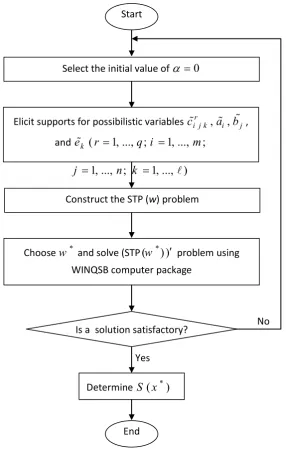
is fully exhausted. Then stop. The flow chart of the proposed algorithm can be characterized as in the following figure:Numerical example
Consider the following (Poss MOSTP)
2 3 2
1 1
1 1 1
min
i j k i j ki j k
z
c
x
[image:8.595.157.444.179.629.2]
,Fig. 1. Flowchart for proposed algorithm
Start
Select the initial value of
0
Elicit supports for possibilistic variables
c
i j kr,
a b
i,
j,
and
e
k(
r
1, ..., ;
q i
1, ...,
m
;
1, ..., ;
1, ..., )
j
n k
Construct the STP (
w
) problem
Choose
w
*and solve (STP
(
w
*) )
problem using
WINQSB computer package
Is a solution satisfactory?
Determine
S x
(
*)
End
No
Yes
2 3 2 2 2
1 1 1
min
i j k i j ki j k
z
c
x
subject to
3 2 3 2
12
1 1 2 2
1 1 1 1
,
:
j k,
j kj k j k
x
G
x
R
x
a
x
a
,2 2 2 2 2 2
1 1 2 2 3 3
1 1 1 1 1 1
,
,
i k i k i k
i k i k i k
x
b
x
b
x
b
,2 3 2 3
1 1 2 2
1 1 1 1
,
i j i j
i j i j
x
e
x
e
,0,
1, 2;
1, 2, 3;
1, 2
i j k
x
i
j
k
In this example, two objective are simultaneously satisfied: the first and second are the minimization of possibilistic transportation costs.
Also, the possibilistic variables
c
i j k1,
c
i j k2,
a
i,
b
j, ande
k are characterized by possibility distributions1
( ),
2( ),
( ),
( )
i j
i j k i j k a b
c c
and
ek( )
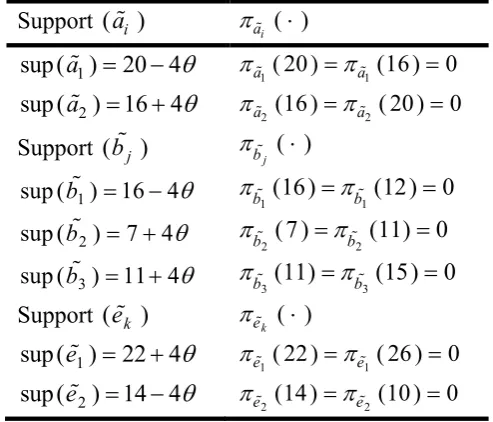
, respectively. [image:9.595.175.423.457.707.2]The supports of the possibilistic variables
c
i j k1,
c
i j k2,
a
i,
b
j, ande
k are[ 9, 13], [10, 14 ], [ 20, 24 ], [15, 19 ]
and[ 22, 29 ]
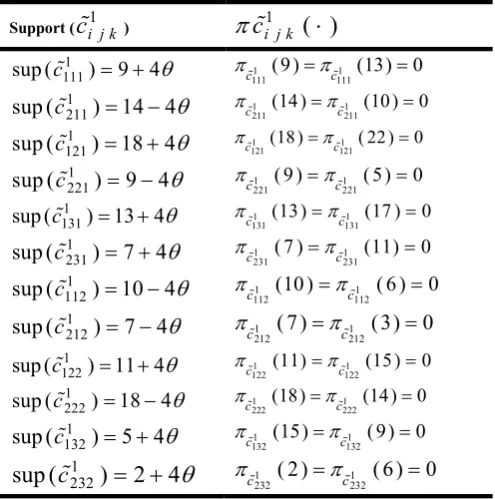
, respectively. it is appropriate to characterize these supports by parametric functions beginning by the points of maximum possibility ofc
i j k1 andc
i j k2 . Hence, the parametric functions of
to the supports for0
1
are:Table 1. The supports of
c
i j k1 and the corresponding possibly distributionsSupport (
c
i j k1 )
c
i j k1( )
1 111
sup (c )94
1 1111 111
( 9 ) (13) 0
c c
1 211
sup (
c
)
14
4
1 1 211 211(14 ) (10 ) 0
c c
1 121
sup (
c
)
18
4
1 1121(18 ) 121( 22 ) 0
c c
1 221
sup (
c
)
9
4
1 1 221 221( 9 ) ( 5 ) 0
c c
1 131
sup (c )134
1 1131(13 ) 131(17 ) 0
c c
1 231
sup (
c
)
7
4
1 1 231 231( 7 ) (11) 0
c c
1 112
sup (
c
)
10
4
1 1 112 112(10 ) ( 6 ) 0
c c
1 212
sup (
c
)
7
4
1 1212
( 7 )
212( 3)
0
c c
1 122
sup (c )11 4
1 1122 122
(11) (15 ) 0
c c
1 222
sup (c )184
1 1222 222
(18) (14 ) 0
c c
1 132
sup (
c
)
5
4
1 1132(15) 132( 9 ) 0
c c
1 232
sup (
c
)
2
4
1 1232
( 2 )
232( 6 )
0
c c