© 2019, IRJET | Impact Factor value: 7.211 | ISO 9001:2008 Certified Journal
| Page 35
An Android based Image Processing Application to Detect
Plant Disease
S. Sundara Lakshmi
1, P. Sundareshwaran
21
PG Student, Department of Computer Science and Engineering, Manonmaniam Sundaranar University,
Tirunelveli, Tami Nadu, India
2
Assistant Professor, Department of Computer Science and Engineering, Manonmaniam Sundaranar University,
Tirunelveli, Tamil Nadu, India
---***---Abstract -
Plant diseases have the tendency to diminishlife of plant. The plant is one of the available food sources necessary for every human being. The control of plant disease is always been an important practice for the survival of plant to produce large amount of yield. Hence, the identification of plant disease has become a major challenge for formers worldwide. Early detection and precise diagnosis is necessary for adequate management of plant disease. The initial detection is widely based on signs and symptoms of disease. Signs are the visible physical presence of the infected regions such as white, brown or black spots, spore masses which are found on the parts of plant. Although professionals are available for the recognition of diseases, Modern Smart phone applications can be used for the diagnosis in early stages. In this paper, an Android phone Image Processing Application is proposed detect plant diseases using android embedded vision platform, Android Studio. The Android application proposed here performs detection of infected spots using color transformation technique, edge detection by identifying the spots on the parts of the plant. This application can be extended for different plant diseases and different smart phone platforms.
Key Words: Android phone application, Plant Disease
Detection, Image processing technique, Android Studio.
1. INTRODUCTION
Plant disease is the part of nature. This plant disease will cause the drastic loss of crop yield. As plant is the major source of food for human race, there is always the need to control the disease in the early stage. India is well known for its diversity in everything, this case applies to plants also. As there are vast species of plant crops, there is also the vast variety of plant disease. Although the plant disease is infected in all parts of the plant, leaves are the most visible part of the plant and the disease symptoms are clearly seen from the leaf at the early stage. Although the formers have the professional experience to identify the plant disease, there is always some human error which is not always 100%. Also this analysis will be a time consuming process depending on the detecting ability of each formers. But after the development in the computer
vision technique, the use of software is also increased widely. Hence an Android application is developed in this paper to detect the plant disease at the early stage. This Android based application captures the disease infected leaf of the plant at the real-time and processed using the image processing technique to accurately detect the occurrence of the disease in the plant. This application detects the occurrence of plant disease and how much parentage the plant is infected by the disease. The Android phone has the application that contains the camera facility to capture the plant at real time or can use the mobile storage in which the images that should be processed to analyze the disease are stored. The image is processed using the image processing techniques like pre-processing, segmentation, feature extraction, and classification to detect whether the plant is infected by disease or the plant is healthy. This plant disease detection application is built in Android Studio using Java programming language. And the Android application package (APK) file generated by Android Studio is installed in user interfaces devices like Android Smartphone. This application requests the smart phone for the camera and storage accesses to detect the plant disease. Then the image processing phases begin when the user requests for the analysis of the real time captured image or stored image. As the result of analyzing the image the application informs the user about the state of the disease in the plant, whether the plant is healthy or infected by the disease. In case the plant is detected to have a disease, the percentage of damage is also informed to the user by analyzing the volume of area that is affected in the name of disease. Furthermore, this application can be extended to detect the disease by which the plant is infected, name of the pathogens it if infected by can also be detected using this extended Android phone application.
2. LITERATURE REVIEW
The development of the Android application for detection plant disease is initiated by the review of various methods used for detecting plant disease.
© 2019, IRJET | Impact Factor value: 7.211 | ISO 9001:2008 Certified Journal
| Page 36
proposed system is categorized into three bases:detection, classification, and quantification which recognize the pattern to detect the plant disease. Anand.H.Kulkarni et al [3] proposed the technique to detect plant disease by applying image processing. The captured image is filtered and segmented using Gabor filter. Texture and color features are extracted and plant disease is classified using Artificial Neural Networks (ANN) and showed about 91% accuracy. Jayme Garcia Arnal Barbedo proposed a computer based algorithm [4] to differentiate signs and symptoms of plant disease from asymptomatic tissues of plant leaf. This method segments the captured color image into various channels of color to detect the infected regions in the plant leaf. This semi-automated novel algorithm shows about 95% accuracy in differentiating the symptoms of plant. Samy Abu Naser et al [5] proposed the method for developing an expert system for plant disease diagnosis. In this proposed system the development of plant disease diagnosis with two methods: step by step description and Graphical representations are employed. Ashish Gupta et al [6] proposed an android phone platform for processing image recognition. Here the recognition of lottery ticket number using Tesseract OCR engine from mobile phones is developed by Ashish Gupta for identifying the number series in lottery ticket and knowing the winner of the lottery ticket online. K.Deepak et al [7] proposed an application using android operating system to detect the various types of leaf. This application classifies the leaf image by obtaining leaf contour and features of the leaf and compared with the dataset of obtained leaf images. Nickos Petrellis proposed a windows phone application [8] for diagnosis of plant disease. Here, the windows phone application is build using visual studio. The application detects the diseases in leaves and also describes the number of infected areas present in the leaf. Dixit Ekta Gajanan [9] developed an android based identification of plant fruit diseases using feature extraction technique. Here the fruit image is captured, segmented and various features such as color, texture, morphology and structure of fruit are extracted disease detection in fruit. Chaitra K M [10] presented a plant leaf disease identification system for android. Here, the system identifies the diseases by using Support Vector Machine (SVM) classifier. This system also describes the precaution action to be made for the identified disease.
3.
METHODS AND MATERIALS
In this paper the Android application is developed for detecting the plant disease. This application was developed in Android studio 3.0. The APK file developed from android studio is installed in user’s android phone. This installed APK file has accesses to mobile phone storage and camera application. The separate camera application was developed for this application. This application detects the disease from the image taken from the developed camera application or from the phone’s storage where the leaf images are saved.
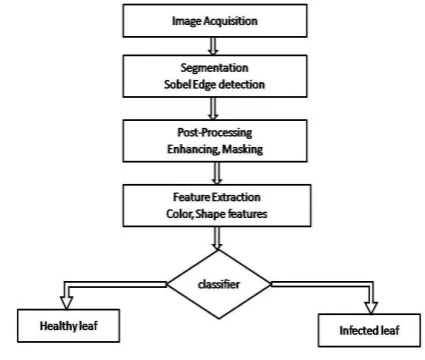
[image:2.595.320.533.325.505.2]The captured image or loaded image is first modified to Joint Photographic ExpertsGroup(JPEG) image format for the equal performance of the application. The application also crops the captured or loaded image into prescribed size without disturbing the actual information of the image for the processing in different mobile phones. Then the image processing technique is applied in the image to classify the occurrence of the disease. Post-processing technique is done after the segmentation operation is made on the image because the segmentation process only detects the edges of the leaf from the surrounding. The region of leaf in the image is detected by using edge detection algorithm Sobel operator which distinguishes the leaf image from the background. The post-processing techniques like enhancement and masking is done on the edge detected leaf image. Then the occurrence of the plant disease is classified using K-means clustering technique. The step by step implementation of this algorithm is shown in the Fig -1.
Fig -1: System Architecture for the Android Application.
3.1 Image Aquuisition
© 2019, IRJET | Impact Factor value: 7.211 | ISO 9001:2008 Certified Journal
| Page 37
[image:3.595.39.272.98.274.2]
(a) (b)
Fig -2: screenshot of Image acquisition phase (a) shows the Home page of the application with two acquisition methods ‘Open storage’ and ‘Take picture’ (b) shows the
real-time image taken by ‘Take picture’ option.
3.2 Segmentation using Edge detection technique
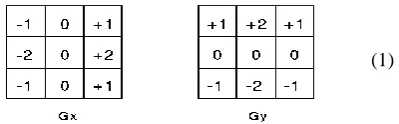
For segmentaion of leaf image the Sobel edge detection technique is used to detect the edges of the leaf from the real-time captured leaf image. This sobel operator computes the gradient variations of the image i.e, it detects and differentiates the foreground and background of the image. The mathematical model of this sobel operator is as follows:The sobel operator consists two 3×3 convolution kernels shown in the Eq.1.
[image:3.595.321.546.413.595.2] [image:3.595.50.250.485.547.2]
These two kernels represents the vertical and horizontal pixel values of the edges in the pixel grid. The gradient of the image is calculated using the Eq. 2 by the values of Gx and Gy.
| | √
Then the magnitude of the gradient is calculated using Eq.3.
| | | | | |
The angle of orientation of the edge for each pixel in pixel grid is calculated using the Eq.4.
= arc tan (Gy/Gx)
The Sobel edge detection technique used for detecting edge of leaf in an image is shown in the Fig -3.
(a) (b)
Fig -3: shows the Sobel Edge detection process (a) before and (b) after detecting edges.
3.3 Post-processing
The post-processing techniques like Enhancing and masking are done. The enhancement increases the contrast of the image and the masking process highlights the region of interest from the background. The post-processing of the leaf image is shown in Fig -4.
(a) (b)
Fig –4: Post-processing techniques (a) Enhanced image (b) masked image.
3.4 Feature extraction
The features such as color and shape features are extracted from the processed image. The RGB features are extracted from the original image and the shape features are extracted from the post-processed image. Before extracting RGB features the red, green, and blue pixels in the image is fragmented in separate channel. Then the Red, green and blue values of the image is extracted. And the shape features such as area, centroid, eccentricity, and perimeter are extracted from the post-processed image. (1)
(2)
(3)
© 2019, IRJET | Impact Factor value: 7.211 | ISO 9001:2008 Certified Journal
| Page 38
3.5. Classifier
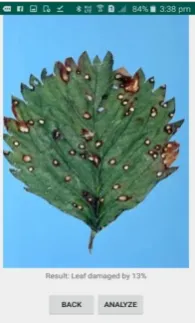
The plant disease occurrence is detected in this phase. The K-means clustering technique is used for detecting the occurrence of the disease in the plant. The k-means clustering is trained by dividing the data into k clusters based on the features extracted from the image. When a new image is processed the classification process searches for the matching cluster in the database of k clusters for the similarity and categorizes according to the feature sets of the cluster. The result of classification for the figure.1 is shown in the Fig -5.
Fig -5: Result of classifier showing percentage og region affected by disease.
4. RESULTS
[image:4.595.113.211.246.408.2]The result of the application is evaluated by processing about more than 50 images. The application detected the correct result for 45 out of 50 images. Hence the accuracy of this application for is calculated to be 90%. And the confusion matrix is constructed manually for just 10 images as shown below in the Table.1.
Table -1: Confusion matrix.
Accuracy
A
ctua
l
cl
as
s Diseased (TP) 25 (FP) 0 100%
Healthy (TN) 5 (FN) 20 80%
83.33 100 90 %
Predicted class
The accuracy is calculated using the Eq.5 shown below.
Accuracy
=
(5)
5. CONCLUSIONS
The main aim of this application is to detect the occurrence of the disease in the plant and displaying the percentage of the region infected by the disease. In this paper the Android studio 3.0 is used as the Android platform to implement the image processing techniques. The result of this application showed about 90% accuracy for correctly detecting the disease.
This proposed method can be extended by developing the android based application that detects and classifies the various plant diseases in all parts of the plant like stem, fruits, roots and flowers and can also provide some precautions to be taken for each disease.
REFERENCES
[1] Jayamala K. Patil and Raj Kumar,(2011),” Advances in Image Processing for Detection of Plant Diseases” Journal of Advanced Bioinformatics Applications and Research ISSN 0976-2604 Vol 2, Issue 2, June-2011, pp 135-141.
[2] Arnal Barbedo, J. G (2013). ”Digital image processing techniques for detecting, quantifying and classifying plant diseases”, SpringerPlus, 2(1). doi:10.1186/2193-1801-2-660.
[3]Anand.H.Kulkarni, Ashwin Patil R K, (2012),”
Applying image processing technique to detect plant diseases”,
International Journal of Modern Engineering Research (IJMER) ,Vol.2, Issue.5, Sep-Oct. 2012 pp-3661-3664. [4] Vijai Singh, & Misra, A. K. (2017) “Detection of plant leaf
diseases using image segmentation and soft computing techniques”, Elsevier, Information Processing in
Agriculture, 4(1), 41–49, doi:
10.1016/j.inpa.2016.10.005.
[5] Abu-Naser, S. S., Kashkash, K. A., & Fayyad, M. (2008). “Developing an Expert System for Plant Disease Diagnosis”, Journal of Artificial Intelligence, 1(2), 78– 85.doi:10.3923/jai.2008.78.85
[6] Ashish Gupta, Thomas Zou ,” Mobile Lottery Ticket Recognition Using Android Phone”, Department of Electrical Engineering, Stanford University, Stanford, CA
[7] Deepak, K., & Vinoth, A. N. (2014), “Leaf detection application for android operating system”. 2014 International Conference on Computation of Power, Energy, Information and Communication (ICCPEIC).
doi:10.1109/iccpeic.2014.6915417
[8] Petrellis, N. (2017). “A smart phone image processing application for plant disease diagnosis”. 2017 6th International Conference on Modern Circuits and Systems Technologies (MOCAST). doi:10.1109/ mocast. 2017.7937683.
© 2019, IRJET | Impact Factor value: 7.211 | ISO 9001:2008 Certified Journal
| Page 39
Identification System Using Feature Extraction Technique”, International Research Journal of Engineering and Technology (IRJET Volume: 05 Issue: 01 | Jan-2018.
[10] Chaitra K M, Faiza Anjum, Harshitha I P, Meghana D M, Rachitha M V,(2018) “Plant Leaf Disease Identification System for Android”, International Journal of Engineering Research in Computer Science and Engineering (IJERCSE) Vol 5, Issue 6, June 2018. [11] Khirade, S. D., & Patil, A. B (2015). “Plant Disease
Detection Using Image Processing”, 2015 International Conference on Computing Communication Control and Automation.doi:10.1109/iccubea.2015.153.
[12] Camargo, A., & Smith, J. S. (2009). “An image-processing based algorithm to automatically identify plant disease visual symptoms”,Elsevier, Biosystems Engineering, 102(1), 9–21.doi:10.1016/j.biosystem seng .2008.09.03
[13] Barbedo, J. G. A. (2014). “An Automatic Method to Detect and Measure Leaf Disease Symptoms Using Digital Image Processing”. Plant Disease, 98(12), 1709–1716.doi:10.1094/pdis-03-14-0290-re