Proceedings of the 2019 Conference on Empirical Methods in Natural Language Processing and the 9th International Joint Conference on Natural Language Processing, pages 4186–4196,
4186
Using Local Knowledge Graph Construction to
Scale Seq2Seq Models to Multi-Document Inputs
Angela Fan FAIR / LORIA
Claire Gardent CNRS / LORIA
Chlo´e Braud CNRS / LORIA
Antoine Bordes FAIR
angelafan,[email protected]
claire.gardent,[email protected]
Abstract
Query-based open-domain NLP tasks require information synthesis from long and diverse web results. Current approaches extrac-tively select portions of web text as input to Sequence-to-Sequence models using meth-ods such as TF-IDF ranking. We propose constructing a local graph structured knowl-edge base for each query, which compresses the web search information and reduces re-dundancy. We show that by linearizing the graph into a structured input sequence, models can encode the graph representations within a standard Sequence-to-Sequence setting. For two generative tasks with very long text in-put, long-form question answering and multi-document summarization, feeding graph rep-resentations as input can achieve better perfor-mance than using retrieved text portions.
1 Introduction
Effective information synthesis is at the core of many Natural Language Processing applica-tions, such as open-domain question answering and multi-document summarization. In such tasks, a fundamental challenge is the ability to distill rel-evant knowledge from hundreds of thousands of tokens of noisy and redundant input such as web-pages. Current approaches predominantly conduct TF-IDF-based information extraction to identify key portions of the information, and then provide this as sequential input to a Sequence-to-Sequence (Seq2Seq) model. The sub-selected portions are limited to a few thousand words, as models often struggle to encode much longer sequences.
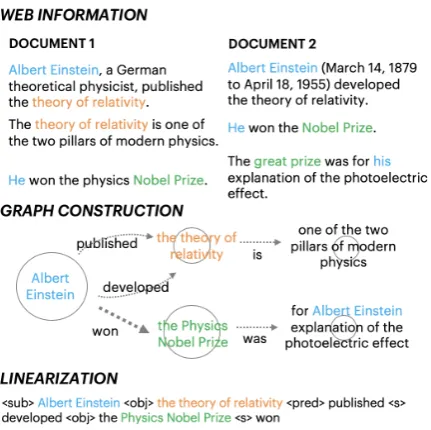
[image:1.595.309.525.234.449.2]In this work, we propose a mechanism to re-structure free text into local knowledge graphs that are then linearized into sequences, creating a canonical form in which information is presented to models. By constructing a graph intermedi-ary, redundant information can be merged or dis-carded, producing substantially compressed input
Figure 1: Multi-Document Input to Linearized Graph
Multi-document input resulting from web search queries are converted to a graph structured knowledge base using coref-erence resolution and information extraction, then linearized into a sequence for Seq2Seq models. Color indicates coref-erence resolution. Node weight is indicated by circle radius and edge weight by line thickness.
— small enough to be fully encoded by Seq2Seq models. Such a method can be seen as merging previous work on symbolic knowledge bases for information extraction with newer approaches us-ing deep neural networks to encode knowledge.
large-scale generative tasks with both long and noisy multi-document web input and paragraph length output: long-form question answering on the ELI5 dataset (Fan et al.,2019) and Wikipedia lead para-graph generation as a multi-document summariza-tion problem (Liu et al.,2018b).
2 Related Work
Interest in generative sequence modeling has in-tensified due to recent improvements (Peters et al., 2018;Devlin et al., 2018;Radford et al., 2019), making the challenge of information synthesis more relevant. In contrast to extractive tasks which only require models to identify spans and can do so effectively on long documents by look-ing at the paragraphs independently, generative se-quence models must combine multiple pieces of evidence from long and noisy multi-document in-put to generate correct and convincing responses.
2.1 Multi-Document Input
Previous work in multi-document summarization (Barzilay et al., 1999) applies various techniques to handle long input, including clustering to find similar information (Honarpisheh et al., 2008), extractive methods to select relevant sentences (Daum´e III and Marcu, 2002;Gillick and Favre, 2009;Berg-Kirkpatrick et al.,2011;Di Fabbrizio et al.,2014;Bing et al.,2015;Cao et al.,2017) in-cluding maximal marginal relevance (Fabbri et al., 2019), and incorporating queries (Baumel et al., 2018) and graphs (Ganesan et al.,2010;Yasunaga et al., 2017). However, there are few large scale multi-document summarization datasets and many approaches have focused on extractive selection or hybrid extractive-abstractive models. In this work, we use graph construction to re-structure multi-document input for abstractive generation.
Advancements in question answering have ex-amined performance on datasets with multi-document input, such as TriviaQA (Joshi et al., 2017). Various approaches have been proposed, including leveraging TF-IDF and bigram hash-ing with an RNN to find relevant information (Chen et al., 2017), models that score individual paragraphs for sub-selection (Clark and Gardner, 2017), and nearest neighbor search with paragraph re-ranking (Das et al., 2018a). However, these approaches have been applied to extractive ques-tion answering tasks that require span identifica-tion, rather than abstractive text generation in an
information synthesis setting.
2.2 Using Knowledge Bases
Previous work has explored various ways of rep-resenting information in knowledge bases (Bor-des et al., 2011) and improving these representa-tions (Chen et al., 2013). Knowledge bases have been leveraged to improve performance on various tasks, from coreference resolution (Ng and Cardie, 2002) and question answering (Zheng,2003;Bao et al.,2014;Cui et al., 2017;Sun et al.,2018) to signal processing (B¨uckner et al.,2002). Various works convert text into Abstract Meaning Repre-sentations (Liu et al.,2018a) for domains such as news (Vossen et al.,2015;Rospocher et al.,2016) and link nodes to large knowledge bases such as DBPedia (Auer et al.,2007). Wities et al.(2017) combine open information extraction with coref-erence and lexical infcoref-erence to build knowledge representations. They apply this to tweets and analyze the accuracy on various aspects of graph construction. Das et al. (2018b) construct graphs from procedural text to track entity position to an-swer when and if entities are created, destroyed, or moved. In contrast, we build graphs from substan-tially longer multi-document input and use them for multi-sentence text generation.
Recently, many have explored neural archi-tectures that can encode graph structured input (Bruna et al.,2013;Kipf and Welling,2016;Beck et al.,2018;Zhou et al.,2018;Xu et al.,2018;Lai et al.,2019). These models often represent graphs as adjacency matrices to generalize architectures such as convolutional networks to graph inputs. Rather than encoding a static knowledge graph or leveraging external knowledge graphs, we build a local graph for each query and model these using standard Seq2Seq models. We leave the incorpo-ration of graph networks for future work.
3 Graph Construction
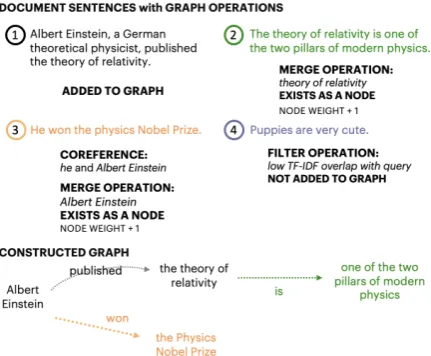
Figure 2: Steps ofGraph Construction. Color relates the document sentence used to produce the graph output.
Text to Triples to Graph Graph construction proceeds in several steps outlined in Figure 2. We applyCoreference Resolution(Clark and Man-ning,2016a,b)1andOpen Information Extraction
(Stanovsky et al.,2018)2to convert sentences into a Triple of the form (subject, predicate, object). The sentenceAlbert Einstein, a German theoreti-cal physicist, won the Nobel Prizewould become (Albert Einstein, won, the Nobel Prize).
A graph is constructed using the triples by rep-resenting subjects and objects as nodes connected by predicates as directed edges. For example, the triple would becomeAlbert Einstein−−→
won the
No-bel Prize. Nodes and edges have anameproperty that is the text they represent. They also have a
weightproperty that denotes the number of times that node or edge has appeared. For example, in Figure1, the node with nameAlbert Einstein has weight 4 and edge with namewonhas weight 2.
Merging Nodes and Edges When subsequent triples are added to the graph, they are merged with the existing graph if they already exist to re-duce information replication. To merge nodes, the TF-IDF overlap of the new node’s name is calcu-lated with the existing graph node names, and the new node is merged into an existing node if the TF-IDF is higher than some threshold (see Fig-ure 2, steps 2 and 3 for example merge
opera-1We use the implementation available here: https://
github.com/huggingface/neuralcoref
2We use the implementation available here:
https://github.com/gabrielStanovsky/ supervised-oie
tions). Edges are merged similarly with existing edges between the same two nodes. Such merge operations allow strings such as the Nobel Prize
and Nobel Prize to be represented as one node rather than separately. Similarly, coreference res-olution aids in merging — by identifying that Al-bert EinsteinandHerefer to the same entity and thus merging them, the construction of the graph reduces redundancy. The size of the graph can be modified by controlling which triples are added using TF-IDF overlap (see Figure2, step 4). TF-IDF overlap of the triple with the question can be used to determine if the triple contains relevant in-formation. This improves robustness to noisy web search input and helps filter entirely irrelevant por-tions, such as scraped HTML tags.
4 Modeling Graphs as Sequences
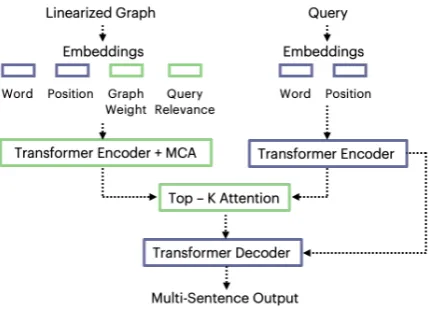
Current models for text generation often use Seq2Seq architectures such as the Transformer (Vaswani et al., 2017). These models are de-signed to encode sequences rather than graphs. We describe now how to convert a graph into a structured input sequence. Our complete model will take as input a linearized graph by en-coding graph attributes such as node and edge weight as embeddings. We add hierarchical and memory-compressed attention mechanisms to scale Seq2Seq models to encode the full graph and attend to the most relevant information within it (Figure4), and finally we integrate the benefits of language modeling using multi-task training.
4.1 Graph to Sequence
Figure 3: Graph Attribute Embeddings. In addition to word and position embeddings, models receive a Graph Weight embedding to encode node and edge weight and a Query Relevance embedding that encodes search result rank.
Figure 4: Model Architecture. Gray indicates standard Transformer elements, Green indicates modification.
Encoding Graph Information Transformer Seq2Seq models have two embeddings: a word embedding and a position embedding. Simply linearizing the graph, however, loses attribute information such as node and edge weight. Instead, we encode these attributes as embeddings in addition to the word and position embeddings.
To represent Graph Weight (GW), node and edge weight is provided as an embedding for each token. The node weight and edge weight are equivalent to the number of merge operations + 1. For example, ifAlbert Einsteinoccurred 4 times in the text, the GW embedding for the tokensAlbert
andEinsteinwould be 4, as shown in Figure3. We encode aQuery Relevance(QR) embedding to represent the relevance of the web search to the query as ranked by the information retrieval sys-tem (e.g. search engine). Information from the top web search results is likely more relevant than in-formation from the last web search results, so pro-viding this embedding allows the model to distin-guish between these different information sources. In Figure 3, tokens representing sentences from the first document have QR embedding 1, and to-kens from the second document have value 2.
Models now have access to several different types of embeddings, but all embedding infor-mation contributes equally as there is no mecha-nism to distinguish between them. We introduce a
mechanism for models to scale the graph embed-dings. We denote the embedding for positiontas
et, such thatewordt is the word embedding.
For the GW embedding, models learn a gating function g based on the word and GW embed-dings. Such a mechanism provides capacity for the model to decide when the additional embeddings are useful based on the words in the input. The gate is calculated by applying an MLP W to the concatenation of the word and GW embeddings. The learned gate is then applied to GW embed-dings to create the outputh:
gGWt =W[eGWt ;ewordt ]
hGWt =gGWt ◦eGWt
Models learn a gating mechanism for the QR embedding in a similar manner. The full embed-ding the model receives is as follows:
ewordt +epost + [hGWt ;hQRt ]
4.2 Hierarchical Attention
One challenge in modeling long sequences is that attention mechanisms struggle to make sharp se-lections when softmax-ing over long sequences (Fan et al.,2018). When attention is blurry, there lacks a strong distinction between noise and rele-vant information.
We assume that graphs are constructed from query-based web search input and thus leverage this query to learn a subselection operation using
operation limits the number of tokens, making the attention mechanism sharper.
4.3 Scaling to Encode the Graph
Recent progress has improved the ability of language models to process longer sequences (Sukhbaatar et al., 2019; Dai et al., 2019), but models remain limited in their capacity to en-code long documents. The multi-document re-sults of query-based web search have hundreds of thousands of tokens, beyond the limit of current Seq2Seq models to handle. For example, the ELI5 dataset provides an average of 200K tokens of web search input. However, by compressing the web search results into a knowledge graph, we signif-icantly reduce the number of tokens by an order of magnitude and make it possible for a model to access the entirety of the search information.
To represent the full graph, models must scale to encode around 10K input tokens. The attention mechanism in Transformer architectures becomes computationally expensive for sequences of this length. Instead, we experiment with the Memory-Compressed Attention (MCA) mechanism pro-posed for language models in (Liu et al.,2018b)3 and apply it to the encoder side of Seq2Seq mod-els. At each self-attention layer, MCA alternates between (1) local attention, computed between smaller chunks of tokens and (2) strided convolu-tions to reduce the number of keys and values used in attention computation. By adding the MCA mechanism to the encoder (E-MCA), we are able to encode the complete linearized graph.
4.4 Multi-tasking with KB Completion
Fan et al.(2019) used multi-task training on lan-guage modeling and various Seq2Seq tasks to in-corporate the benefits of language modeling in Seq2Seq models. We extend this by training ad-ditionally onknowledge graph completion. Mod-els receive at training time sequences of a lin-earized graph with nodes, edges, or both selec-tively masked and must predict the missing con-tent words. For example, models might receive as input <sub> Albert Einstein <obj> [mask] <pred>wonand need to predictthe Nobel Prize. This can be seen as both a multi-word extension of the masked language model training proposed in (Devlin et al.,2018) and as learning the task of
3In (Liu et al.,2018b), the mechanism is termed
DMCA as it is applied on the decoder side
knowledge base completion (Lacroix et al.,2018; Bordes et al.,2011). At training time, the tasks are distinguished using an indicator token in the input.
5 Experimental Setup
We evaluate our approach on two datasets with multi-document web input and multi-sentence ab-stractive output. We use Seq2Seq models that leverage a query concatenated with web search re-sults that have been processed into a supporting document — e.g. TF-IDF subselection, linearized graph, etc. — to generate long output.
5.1 Datasets and Evaluation
ELI5 First, we experiment with theExplain Like I’m Five(ELI5) (Fan et al.,2019) question answer-ing dataset of 270K complex questions paired with multi-sentence, explanatory answers (130 words on average). To facilitate question answering, the dataset provides the top 100 web search hits from querying the question, which results in 200K words on average. See Appendix for examples.
Previous work (Fan et al., 2019) used TF-IDF to find sentences in the web search that have the largest overlap with the question and created a TF-IDF extraction of about 850 words as input for Seq2Seq models. Instead, we construct a local knowledge graph for each question from the 100 web search hits. Following the average length of the TF-IDF support document constructed in (Fan et al., 2019), we experiment with modeling the firstN = 850tokens of the linearized graph, then scale to encode the entire graph using E-MCA.
WikiSum Second, we experiment on the Wik-iSum CommonCrawl (Liu et al., 2018b) summa-rization dataset4 with 1.5 million examples. This task formulates Wikipedia lead paragraph genera-tion as a multi-document summarizagenera-tion problem, where the paragraph must be generated using the cited article references and other queried content from web search. The query used is the title of the Wikipedia article. See Appendix for examples.
Previous work (Liu et al., 2018b) applied TF-IDF Ranking to order the paragraphs of web search given a query. Models receive the re-ordered paragraphs ranked by TF-IDF as input. Liu et al.(2018b) model the firstN = 500words of this re-ranking and then N = 11,000 using
4https://github.com/tensorflow/
MCA. We construct the knowledge graph for each Wikipedia article from the first 200K words of the ranked web search results5, and experiment with encoding500and11,000tokens.
Evaluation Both tasks evaluate the multi-sentence generation output against the gold output using F1 ROUGE. On WikiSum, we report only ROUGE-L following (Liu et al.,2018b).
We conduct a comparative human evaluation on the ELI5 dataset. We use crowdworkers to exam-ine the responses of two models on 300 different questions from the test set. For each question, 3 evaluators are shown two answers and asked to choose the one they prefer. To reduce variance, answers are standardized at 150 words each.
5.2 Training and Generation
To reduce the vocabulary size of varied web doc-ument content, we apply byte-pair encoding (Sen-nrich et al.,2016) to generate 40K codes for each dataset. We implement our models in fairseq-py (Ott et al., 2019) using the Transformer Big architecture and training schedule described in (Vaswani et al., 2017). Detailed parameters are listed in the Appendix. For generation, we use beam search with beam size 5 and tune a minimum and maximum length on the validation set.
5.3 Baselines
We compare our results to the Transformer se-quence models presented in (Fan et al.,2019) for ELI5 and (Liu et al.,2018b) for WikiSum.
We evaluate three additional baseline models:
• Sentence Selection with Maximal Marginal Relevance:(Fan et al.,2019) used TF-IDF to identify relevant sentences in the web docu-ments to form a support document of around 850 words. However, recent work (Fabbri et al., 2019) has shown that using maximal marginal relevance is an effective strategy for selecting relevant information while reducing redundancy. We explore using MMR to se-lect sentences from the web text to concate-nate to form a support document.
• Seq2Seq Multi-task Triples: To examine the impact of solely restructuring the input into Open IE Triples but not leveraging graph
5Average length of provided web input is around 50K
words, and maximum length is around 900K words
Model Input ROUGE
Length 1 2 L
Q + D to A*, TF-IDF avg 850 28.3 5.1 22.8
Q + D to A, MMR avg 850 28.1 5.0 22.9
Multi-task* avg 850 28.9 5.4 23.1
Multi-task Triples 850 29.0 5.2 23.2
Multi-task Top20 Trip. avg 570 28.8 5.3 23.2
Q + D to A Graph 850 28.8 5.3 23.3 Multi-task Graph 850 29.5 5.6 23.6
+ Top-100 Attention 850 29.7 5.7 23.8
[image:6.595.308.523.64.182.2]+ E-MCA 11K 30.0 5.8 24.0
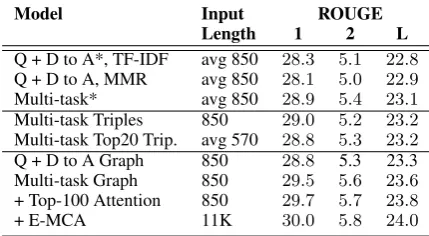
Table 1:Answer Generation on ELI5using Seq2Seq mod-els receiving the Question and a support Document (e.g. TF-IDF selection, Triples, Linearized Graph) to produce the
Answer. * denotes results from (Fan et al.,2019).
Model InputLen ROUGE-L
T + D to P* 500 34.2
LM + D-MCA* 11K 36.2
T + D to P 500 33.8
Multi-task 500 34.4
Multi-task Graph 500 34.9
+ Top-100 Attention 500 35.2
+ E-MCA 11K 36.5
LM + D-MCA + MoE-256* 7.5K 38.8
Table 2:Lead Paragraph Generation on WikiSum Com-monCrawlusing Seq2Seq models receiving theTitle and a supportDocument (e.g. TF-IDF ranking, Linearized Graph) to produce the LeadParagraph. * denotes results from (Liu et al., 2018b) that use data scraped from unrestricted web search, not the static CommonCrawl version.
construction to reduce redundancy, we ex-periment with a Triples Only baseline. The triples are concatenated to form the input.
• Seq2Seq Multi-task Top 20 Triples:As an al-ternative to using graph construction to com-press the full set of Open IE Triples, we ex-plore using TF-IDF overlap with the query to find the most relevant information. We select the top 20 triples to concatenate as input.
6 Results
We examine the performance of our proposed ap-proach and the choices made in graph construction and modeling. We analyze the quality of the com-pression created by graph construction and the ro-bustness and interpretability of this process.
6.1 Linearized Graph Improves Performance
The Seq2Seq Multi-task Triples baseline standard-izes the input by forming triples but does not re-move redundant triples. It produces marginally better results compared to the baseline Multi-Task model. Sub-selecting to the Top 20 Triples is harmful, as similar text has high TF-IDF over-lap with the query so redundant information is se-lected. Creating the graph structure brings an im-provement of around 0.6 ROUGE-1.
Similar trends are seen for the WikiSum dataset in Table2, where graph construction improves the Multi-task model by 0.5 ROUGE-1. These im-provements are statistically significant at the 95% confidence level.
For both datasets, a further improvement is seen by using the hierarchical attention mechanism to attend to only the most relevant information in the linearized graph input. For ELI5, it brings an ad-ditional 0.2 ROUGE-1 improvement and on Wik-iSum a 0.3 ROUGE-1 improvement.
By using MCA to scale Seq2Seq models to en-code the entire graph, further gains can be seen. Particularly in information synthesis tasks, prior work has shown the importance of reading more information. Liu et al.(2018b) achieved a 2-point ROUGE improvement by reading 11K tokens in-stead of 500. In our setting, E-MCA improves our results around 0.3 ROUGE on ELI5 and 1.3 ROUGE on WikiSum. We display random gener-ations from both datasets in the Appendix.
We use human evaluation to compare the Multi-task baseline to the Multi-Multi-task Graph + Top-k At-tention model. 57.4% of evaluations prefer the Multi-task Graph + Top-k Attention model. We conduct a two-tailed binomial test and find this re-sult is statistically significant withp= 0.003.
6.2 Analysis of Modeling Choices
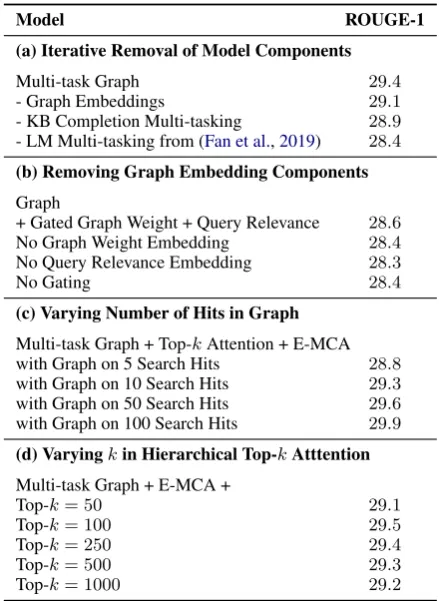
Ablation on Model Components Table3(a) se-quentially removes the graph embeddings, the knowledge-base completion multi-tasking, and the multi-tasking from (Fan et al., 2019) and reveals that each of these is important for performance.
Graph Attribute Embeddings Table 3(b) dis-plays the effect of removing the graph attribute embeddings and gating mechanism. Removing each is slightly harmful, and the combination of all three together provide the best performance.
More Web Search Documents Figure7(right) shows that graph construction with more web
Model ROUGE-1
(a) Iterative Removal of Model Components
Multi-task Graph 29.4
- Graph Embeddings 29.1
- KB Completion Multi-tasking 28.9
- LM Multi-tasking from (Fan et al.,2019) 28.4
(b) Removing Graph Embedding Components
Graph
+ Gated Graph Weight + Query Relevance 28.6
No Graph Weight Embedding 28.4
No Query Relevance Embedding 28.3
No Gating 28.4
(c) Varying Number of Hits in Graph
Multi-task Graph + Top-kAttention + E-MCA with Graph on 5 Search Hits 28.8
with Graph on 10 Search Hits 29.3
with Graph on 50 Search Hits 29.6
with Graph on 100 Search Hits 29.9
(d) Varyingkin Hierarchical Top-kAtttention
Multi-task Graph + E-MCA +
Top-k= 50 29.1
Top-k= 100 29.5
Top-k= 250 29.4
Top-k= 500 29.3
[image:7.595.306.526.61.362.2]Top-k= 1000 29.2
Table 3:Ablationson the ELI5 Validation Set
Model Input ROUGE-1
Seq2Seq Q + D to A TF-IDF 28.3 Seq2Seq Q + D to A Web 25.9 + Shuffle Web Shuffle 24.4 Seq2Seq Q + D to A Graph Web 28.5
[image:7.595.306.526.406.475.2]+ Shuffle Web Shuffle 28.2
Table 4: Importance ofWeb Search Relevanceon Valida-tion for ELI5, modeling 850 input words.
search information is important for answer token coverage. The graph on the top search hit alone is missing 64% of the answer tokens, but this de-creases as more search hits are used. Table 3(c) indicates that this lack of coverage of the answer tokens correlates with generation quality. Models receiving a graph built on the first 5 search hits alone are substantially worse than all 100 hits.
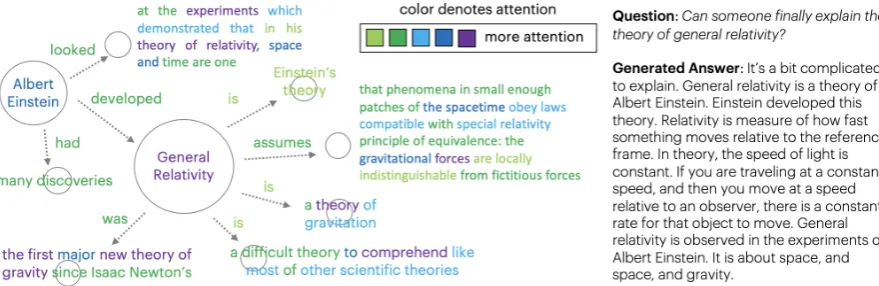
Figure 5:Interpretable Attentionof Seq2Seq models on a subgraph when answering a question in ELI5
[image:8.595.74.288.368.458.2]Figure 6: (Left) Distribution of Number ofNodes, (Middle) Number ofEdges, (Right)Weightof the Largest Node in graph construction on the ELI5 training set.
Figure 7: (Left) Graph construction drastically reduces input size by an order of magnitude. (Right) Graph construction encodes more tokens present in the answer compared to TF-IDF extraction and building the graph from more search hits increases answer token coverage. Analysis on ELI5 for both plots.
6.3 Graph Improves Answer Token Coverage Despite Compression
Figure 6 displays the distribution of the number of nodes, edges, and the largest node weight for each local graph built on the ELI5 dataset. The 100 web search results are compressed to a few hundred nodes. By merging redundancy and trim-ming irrelevant triples from the graph, the input is reduced by an order of magnitude (Figure7, left). Despite compression, the graph retains more answer tokens than TF-IDF subselection. Fig-ure7(right) displays the percentage of answer to-kens not present in the input. The TF-IDF Ex-traction from (Fan et al., 2019) is missing 38% of tokens. The graph constructed on all 100 web
search results is only missing 8.7% of tokens, but has around 10K words. When analyzing just the first 850 tokens to match the average length of the TF-IDF extraction, the graph is better (only miss-ing 35% of tokens). Further, the mergmiss-ing and dis-carding operations done during graph construction do not have a large effect on answer token cover-age — the full set of triples marginally reduces the percentage of answer tokens missing to 7.3% instead of 8.7%. This indicates that much of the information in the full set triples is redundant and unnecessary for good answer token coverage.
6.4 Graph Representation is More Robust to Poor Search Relevance Ordering
6.5 Interpretable Attention on Subgraphs
Figure5shows an example of the nodes and edges the model focuses upon most when answering a question on ELI5. To construct this visualiza-tion, we calculate the top nodes the model attends to and then their top edges. The model atten-tion on a sub-poratten-tion of the linearized input can be visualized as an interpretable graph that corre-sponds well to the model’s generated answer. For example, the relationship General Relativity −→
is
Einstein’s theorybecomes the generated sentence
General Relativity is a theory of Albert Einstein.
7 Conclusion
Many open-domain NLP tasks rely upon multi-document input from the web to facilitate tasks such as answering questions or writing summaries, but current approaches struggle to encode the en-tirely of this information. We propose construct-ing one knowledge graph per query and show that this method compresses information and reduces redundancy. We show on two abstractive genera-tion tasks that using the linearized graph achieves better performance than TF-IDF retrieval.
References
S¨oren Auer, Christian Bizer, Georgi Kobilarov, Jens Lehmann, Richard Cyganiak, and Zachary Ives. 2007. Dbpedia: A nucleus for a web of open data. InThe semantic web, pages 722–735. Springer.
Junwei Bao, Nan Duan, Ming Zhou, and Tiejun Zhao. 2014. Knowledge-based question answering as ma-chine translation. In Proceedings of the 52nd An-nual Meeting of the Association for Computational Linguistics (Volume 1: Long Papers), volume 1, pages 967–976.
Regina Barzilay, Kathleen R McKeown, and Michael Elhadad. 1999. Information fusion in the context of multi-document summarization. In Proceedings of the 37th annual meeting of the Association for Com-putational Linguistics.
Tal Baumel, Matan Eyal, and Michael Elhadad. 2018. Query focused abstractive summarization: Incorpo-rating query relevance, multi-document coverage, and summary length constraints into seq2seq mod-els. arXiv preprint arXiv:1801.07704.
Daniel Beck, Gholamreza Haffari, and Trevor Cohn. 2018. Graph-to-sequence learning using gated graph neural networks. arXiv preprint arXiv:1806.09835.
Taylor Berg-Kirkpatrick, Dan Gillick, and Dan Klein. 2011. Jointly learning to extract and compress. In Proceedings of the 49th Annual Meeting of the Asso-ciation for Computational Linguistics: Human Lan-guage Technologies-Volume 1, pages 481–490. As-sociation for Computational Linguistics.
Lidong Bing, Piji Li, Yi Liao, Wai Lam, Weiwei Guo, and Rebecca J Passonneau. 2015. Abstractive multi-document summarization via phrase selection and merging. arXiv preprint arXiv:1506.01597.
Antoine Bordes, Jason Weston, Ronan Collobert, and Yoshua Bengio. 2011. Learning structured embed-dings of knowledge bases. In Twenty-Fifth AAAI Conference on Artificial Intelligence.
Joan Bruna, Wojciech Zaremba, Arthur Szlam, and Yann LeCun. 2013. Spectral networks and lo-cally connected networks on graphs. arXiv preprint arXiv:1312.6203.
J¨urgen B¨uckner, Martin Pahl, O Stahlhut, and C-E Liedtke. 2002. A knowledge-based system for con-text dependent evaluation of remote sensing data. In Joint Pattern Recognition Symposium, pages 58–65. Springer.
Ziqiang Cao, Wenjie Li, Sujian Li, and Furu Wei. 2017. Improving multi-document summarization via text classification. InThirty-First AAAI Conference on Artificial Intelligence.
Danqi Chen, Adam Fisch, Jason Weston, and Antoine Bordes. 2017. Reading wikipedia to answer open-domain questions. InACL.
Danqi Chen, Richard Socher, Christopher D Man-ning, and Andrew Y Ng. 2013. Learning new facts from knowledge bases with neural tensor net-works and semantic word vectors. arXiv preprint arXiv:1301.3618.
Christopher Clark and Matt Gardner. 2017. Simple and effective multi-paragraph reading comprehen-sion.arXiv preprint arXiv:1710.10723.
Kevin Clark and Christopher D Manning. 2016a. Deep reinforcement learning for mention-ranking corefer-ence models. arXiv preprint arXiv:1609.08667.
Kevin Clark and Christopher D Manning. 2016b. Im-proving coreference resolution by learning entity-level distributed representations. arXiv preprint arXiv:1606.01323.
Wanyun Cui, Yanghua Xiao, Haixun Wang, Yangqiu Song, Seung-won Hwang, and Wei Wang. 2017. Kbqa: learning question answering over qa corpora and knowledge bases.Proceedings of the VLDB En-dowment, 10(5):565–576.
Rajarshi Das, Shehzaad Dhuliawala, Manzil Za-heer, and Andrew McCallum. 2018a. Multi-step retriever-reader interaction for scalable open-domain question answering.
Rajarshi Das, Tsendsuren Munkhdalai, Xingdi Yuan, Adam Trischler, and Andrew McCallum. 2018b. Building dynamic knowledge graphs from text us-ing machine readus-ing comprehension. arXiv preprint arXiv:1810.05682.
Hal Daum´e III and Daniel Marcu. 2002. A noisy-channel model for document compression. In Pro-ceedings of the 40th Annual Meeting on Association for Computational Linguistics, pages 449–456. As-sociation for Computational Linguistics.
Jacob Devlin, Ming-Wei Chang, Kenton Lee, and Kristina Toutanova. 2018. Bert: Pre-training of deep bidirectional transformers for language understand-ing. CoRR, abs/1810.04805.
Giuseppe Di Fabbrizio, Amanda Stent, and Robert Gaizauskas. 2014. A hybrid approach to multi-document summarization of opinions in reviews. In Proceedings of the 8th International Natural Lan-guage Generation Conference (INLG), pages 54–63.
Alexander R Fabbri, Irene Li, Tianwei She, Suyi Li, and Dragomir R Radev. 2019. Multi-news: a large-scale multi-document summarization dataset and abstractive hierarchical model. arXiv preprint arXiv:1906.01749.
Angela Fan, Yacine Jernite, Ethan Perez, David Grang-ier, Jason Weston, and Michael Auli. 2019. Eli5: Long form question answering. InProceedings of ACL 2019.
Angela Fan, Mike Lewis, and Yann Dauphin. 2018. Hi-erarchical neural story generation. arXiv preprint arXiv:1805.04833.
Kavita Ganesan, ChengXiang Zhai, and Jiawei Han. 2010. Opinosis: A graph based approach to abstrac-tive summarization of highly redundant opinions. In Proceedings of the 23rd International Conference on Computational Linguistics (Coling 2010), pages 340–348.
Dan Gillick and Benoit Favre. 2009. A scalable global model for summarization. In Proceedings of the Workshop on Integer Linear Programming for Natu-ral Langauge Processing, pages 10–18. Association for Computational Linguistics.
Mohamad Ali Honarpisheh, Gholamreza Ghassem-Sani, and Ghassem Mirroshandel. 2008. A multi-document multi-lingual automatic summarization system. In Proceedings of the Third International Joint Conference on Natural Language Processing: Volume-II.
Mandar Joshi, Eunsol Choi, Daniel Weld, and Luke Zettlemoyer. 2017. Triviaqa: A large scale distantly supervised challenge dataset for reading comprehen-sion. InACL.
Thomas N Kipf and Max Welling. 2016. Semi-supervised classification with graph convolutional networks. arXiv preprint arXiv:1609.02907.
Timoth´ee Lacroix, Nicolas Usunier, and Guillaume Obozinski. 2018. Canonical tensor decomposition for knowledge base completion. arXiv preprint arXiv:1806.07297.
Yuxuan Lai, Yansong Feng, Xiaohan Yu, Zheng Wang, Kun Xu, and Dongyan Zhao. 2019. Lattice cnns for matching based chinese question answering. arXiv preprint arXiv:1902.09087.
Fei Liu, Jeffrey Flanigan, Sam Thomson, Norman Sadeh, and Noah A Smith. 2018a. Toward abstrac-tive summarization using semantic representations. arXiv preprint arXiv:1805.10399.
Peter J. Liu, Mohammad Saleh, Etienne Pot, Ben Goodrich, Ryan Sepassi, Lukasz Kaiser, and Noam Shazeer. 2018b. Generating wikipedia by summa-rizing long sequences. InICLR.
Vincent Ng and Claire Cardie. 2002. Improving ma-chine learning approaches to coreference resolution. In Proceedings of the 40th annual meeting on as-sociation for computational linguistics, pages 104– 111. Association for Computational Linguistics.
Myle Ott, Sergey Edunov, Alexei Baevski, Angela Fan, Sam Gross, Nathan Ng, David Grangier, and Michael Auli. 2019. fairseq: A fast, extensible toolkit for sequence modeling. In Proceedings of NAACL-HLT 2019: Demonstrations.
Matthew E Peters, Mark Neumann, Mohit Iyyer, Matt Gardner, Christopher Clark, Kenton Lee, and Luke Zettlemoyer. 2018. Deep contextualized word rep-resentations. arXiv preprint arXiv:1802.05365.
Alec Radford, Jeffrey Wu, Rewon Child, David Luan, Dario Amodei, and Ilya Sutskever. 2019. Language models are unsupervised multitask learners.
Marco Rospocher, Marieke van Erp, Piek Vossen, Antske Fokkens, Itziar Aldabe, German Rigau, Aitor Soroa, Thomas Ploeger, and Tessel Bogaard. 2016. Building event-centric knowledge graphs from news. Journal of Web Semantics, 37:132–151.
Rico Sennrich, Barry Haddow, and Alexandra Birch. 2016. Neural machine translation of rare words with subword units. InACL.
Minjoon Seo, Aniruddha Kembhavi, Ali Farhadi, and Hannaneh Hajishirzi. 2017. Bidirectional attention flow for machine comprehension. InICLR.
Sainbayar Sukhbaatar, Edouard Grave, Piotr Bo-janowski, and Armand Joulin. 2019. Adaptive at-tention span in transformers.
Haitian Sun, Bhuwan Dhingra, Manzil Zaheer, Kathryn Mazaitis, Ruslan Salakhutdinov, and William W Co-hen. 2018. Open domain question answering us-ing early fusion of knowledge bases and text. arXiv preprint arXiv:1809.00782.
Ashish Vaswani, Noam Shazeer, Niki Parmar, Jakob Uszkoreit, Llion Jones, Aidan N Gomez, Łukasz Kaiser, and Illia Polosukhin. 2017. Attention is all you need.NIPS.
Piek Vossen, Tommaso Caselli, and Yiota Kont-zopoulou. 2015. Storylines for structuring massive streams of news. InProceedings of the First Work-shop on Computing News Storylines, pages 40–49.
Rachel Wities, Vered Shwartz, Gabriel Stanovsky, Meni Adler, Ori Shapira, Shyam Upadhyay, Dan Roth, Eugenio Mart´ınez-C´amara, Iryna Gurevych, and Ido Dagan. 2017. A consolidated open knowl-edge representation for multiple texts. In Proceed-ings of the 2nd Workshop on Linking Models of Lexi-cal, Sentential and Discourse-level Semantics, pages 12–24.
Kun Xu, Lingfei Wu, Zhiguo Wang, Yansong Feng, Michael Witbrock, and Vadim Sheinin. 2018. Graph2seq: Graph to sequence learning with attention-based neural networks. arXiv preprint arXiv:1804.00823.
Michihiro Yasunaga, Rui Zhang, Kshitijh Meelu, Ayush Pareek, Krishnan Srinivasan, and Dragomir Radev. 2017. Graph-based neural multi-document summarization.arXiv preprint arXiv:1706.06681.
Zhiping Zheng. 2003. Question answering using web news as knowledge base. In Proceedings of the tenth conference on European chapter of the As-sociation for Computational Linguistics-Volume 2, pages 251–254. Association for Computational Lin-guistics.