Proceedings of the 9th Workshop on Computational Approaches to Subjectivity, Sentiment and Social Media Analysis, pages 342–347 Brussels, Belgium, October 31, 2018. c2018 Association for Computational Linguistics
342
UBC-NLP at IEST 2018: Learning Implicit Emotion With an Ensemble of
Language Models
Hassan Alhuzali Mohamed Elaraby Muhammad Abdul-Mageed Natural Language Processing Lab
The University of British Columbia
{halhuzali,mohamed.elaraby}@alumni.ubc.ca,[email protected]
Abstract
We describe UBC-NLP contribution to IEST-2018, focused at learning implicit emotion in Twitter data. Among the 30participating teams, our system ranked the 4th (with69.3%
F-score). Post competition, we were able to score slightly higher than the 3rd ranking sys-tem (reaching70.7%). Our system is trained on top of a pre-trained language model (LM), fine-tuned on the data provided by the task or-ganizers. Our best results are acquired by an average of an ensemble of language models. We also offer an analysis of system perfor-mance and the impact of training data size on the task. For example, we show that training our best model for only one epoch with<40% of the data enables better performance than the baseline reported byKlinger et al.(2018) for the task.
1 Introduction
Emotion is essential in human experience and communication, lending special significance to natural language processing systems aimed at learning it. Emotion detection systems can be ap-plied in a host of domains, including health and well-being, user profiling, education, and mar-keting. There is a small, yet growing, body of NLP literature on emotion. Early works focused on creating and manually labeling datasets. The SemEval 2007 Affective Text task Strapparava and Mihalcea (2007) andAman and Szpakowicz (2007) are two examples that target the news and blog domains respectively. In these works, data were labeled for the 6 basic emotions of Ekman (Ekman, 1972). More recent works exploit dis-tant supervision (Mintz et al., 2009) to automat-ically acquire emotion data for training systems. More specifically, a number of works use hashtags like #happy and #sad, especially occurring fi-nally in Twitter data, as a proxy of emotion (Wang
et al., 2012;Mohammad and Kiritchenko, 2015; Volkova and Bachrach,2016).Abdul-Mageed and Ungar(2017) report state-of-the-art results using a large dataset acquired with hashtags. Other works exploit emojis to capture emotion carrying data (Felbo et al., 2017). Alhuzali et al.(2018) intro-duce a third effective approach that leverages first-person seed phrases like“I’m happy that”to col-lect emotion data.
Klinger et al. (2018) propose yet a fourth method for collecting emotion data that depends on the existence of the expression ”emotion-word + one of the following words (when, that or be-cause)” in a tweet, regardless of the position of the emotion word. In the “Implicit Emotion” shared task1, participants were provided data represent-ing the6emotions in the set (anger, disgust, fear, joy, sad, surprise). The trigger word was removed from each tweet. To illustrate, the task is to predict the emotion in a tweet like “Boys who like Star-bucks make me[#TRIGGERWORD#]because we can go on cute coffee dates” (with the triggered word labeled asjoy). In this paper, we describe our system submitted as part of the competition. Over-all, our submission ranked the 4th out of the 30
participating teams. With further experiments, we were able to acquire better results, which would rank our model at top3(70.7%F-score).
The rest of the paper is organized as follows: Section 2 describes the data. Section 3 offers a description of the methods employed in our work. Section3is where we present our results, and we perform an analysis of these results in Section5. We list negative experiments in Section6and con-clude in Section7.
2 Data
We use the Twitter dataset released by the organiz-ers of the “Implicit Emotion” task, as described in the previous section. The data are partitioned into
153,383tweets for training,9591tweets for val-idation, and28,757 data points for testing. The training and validation sets were provided early for system development, while the test set was released one week before the deadline of system submission. The full details of the dataset can be found in Klinger et al.(2018). We now describe our methods in the nesxt section.
3 Methods
3.1 Pre-processing
We adopt a simple pre-processing scheme, similar to most of the pre-trained models we employ. This involves lowercasing all text and filtering out urls and user mentions. We also split clusters of emojis into individual emojis, following Duppada et al. (2018). For our vocabulary V, we retain the top
100kwords and then remove all words occurring
<2times, which leaves|V|=23,656.
3.2 Models
We develop a host of models based on deep neural networks, using some of these models as our base-line models. As an additional basebase-line, we com-pare toKlinger et al.(2018) who propose a model based on Logistic Regression with a bag of word unigrams (BOW). All our deep learning models are based on variations of recurrent neural net-works (RNNs), which have proved useful for sev-eral NLP tasks. RNNs are able to capture sequen-tial dependencies especially in time series data, of which language can be seen as an example. One weakness of RNNs, however, lies in gradient ei-ther vanishing or exploding during training. Long-short term memory (LSTM) networks were devel-oped to target this problem, and hence we employ these in our work. We also use a bidirectional ver-sion (BiLSTM) where the vector of representation is built as a concatenation of two vectors, one that runs from left-to-right and another running from right-to-left. Ultimately, we generate a fixed-size representation for a given tweet using the last hid-den state for the Fwd and Bwd LSTM. Our sys-tems can be categorized as follows: (1) Syssys-tems tuning simple pre-trained embeddings, (2) Sys-tems tuning embeddings from language models,
and (3) Systems directly tuning language models. We treat #1 and #2 as baseline systems, while our best models are based on #3.
3.2.1 Systems With Simple Embeddings
Character and/or Word embeddings (Mikolov et al.,2013;Pennington et al.,2014;Bojanowski et al.,2016) have boosted performance on a host of NLP tasks. Most state of the art systems now fine-tune these embeddings as a simple transfer learn-ing technique targetlearn-ing the first layer of a network (McCann et al.,2017). We make use of one such pre-trained embeddings (fastText) to identify the utility of tuning its learned weights on the task.
FastText: The first embedding model is
fast-Text2(Bojanowski et al.,2016), which builds rep-resentations based on characters, rather than only words, thus alleviating issues of complex mor-phology characetrestic of many languages like Arabic, Hebrew, and Swedish, but also enhancing representations for languages of simpler morphol-ogy like English. Additionally, fastText partially solves issues with out-of-vocabulary words since it exploits character sequences. FastText is trained on the Common Crawl dataset, consisting of 600B tokens.
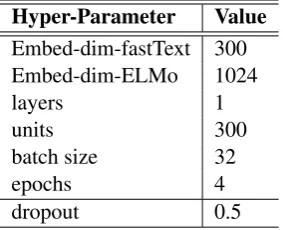
For this and the next set of experiments (i.e., ex-periments in 3.2.2), we train both an LSTM and BiLSTM. Since we treat these as baseline sys-tems, especially with our goal to report our ex-periments in available space for the competition, we try a small set of hyper-parameters, identifying best settings on our validation set. We train each network for4epochs each. For optimization, we useAdam(Kingma and Ba,2014). The model’s weights W are initialized from a normal distri-bution W ∼ N with a small standard deviation ofσ = 0.05. We apply two sources of regular-ization: dropout: we apply a dropout rate of 0.5 on the input embeddings to prevent co-adaptation of hidden units’ activation, and L2−norm: we also apply an L2-norm regularization with a small value (0.0001) on the hidden units layer to prevent the network from over-fitting on training set. Each of the networks has a single hidden layer. Net-work architectures and hyper-parameters are listed in Table1.
3.2.2 Embedding From LMs
Peters et al.(2018) build embeddings directly from
Hyper-Parameter Value
Embed-dim-fastText 300 Embed-dim-ELMo 1024
layers 1
units 300
batch size 32
epochs 4
[image:3.595.110.252.63.178.2]dropout 0.5
Table 1: Network architecture and hyper-parameters for experiments with simple pre-trained embeddings with fastText3.2.1and ELMo3.2.2across our LSTM and BiLSTM networks.
language models, which they refer to as ELMo. ELMo is shown to capture both complex char-acteristics of words (as syntax and semantics) as well as the usage of these words across various linguistic contexts, thanks to its language model-ing component. ELMo is trained on a dataset of Wikipedia and is publicly available 3, which we use as our input layer. More specifically, we ex-tract the weighted sum of the 3 layers (word em-bedding, Bi-lstm-outputs1, and Bi-lstm-outputs2) and follow the same network architectures and hyper-parameters employed with fastText as we explain before.
3.2.3 Fine-Tuning LMs: ULMFiT
Another recent improvement in training NLP sys-tems is related to the way these syssys-tems are fine-tuned, especially vis-a-vis how different layers in the network operate during training time.Howard and Ruder (2018) present ULMFiT4, an exam-ple such systems that is pre-trained on a language model exploiting Wikitext-103. Ultimately, ULM-FiT employs a number of techniques for train-ing. These include “gradual unfreezing”, which aims at fine-tuning each layer of the network in-dependently and then fine-tuning all layers to-gether. Gradual unfreezing proves useful for re-ducing the risk of overfitting as also found inFelbo et al. (2017). ULMFiT also uses “discriminative fine-tuning”, which tunes each layer with differ-ent learning rates, the idea being differdiffer-ent lay-ers capture different types of information (Howard and Ruder, 2018; Peters et al., 2018). Howard and Ruder(2018) also use different learning rates, which they refer to as “slanted triangular learning
3
https://github.com/allenai/bilm-tf 4http://nlp.fast.ai/category/ classification.html.
rates”, at different times of the training process. With ULMFiT, we experiment with different vari-ations of LMs5: forward (Fwd), backward (Bwd), and an average of these (BiLM (Fwd+Bwd)). We followHoward and Ruder(2018) in training each of the Fwd and Bwd models independently on the training data provided by the task organizers, and then combining their predictions using an ensem-ble averaging. This is the setting we refer to as BiLM. As we show in Section3, this is a benefi-cial measure (similar to what Howard and Ruder (2018) also found). For our hyper-parameters for this iteration of experiments, we identify them on our validation set. We list the network architec-tures and hyper-parameters for this set of experi-ments in Table2.
Hyper-Parameter Value
dim-size 400
vocab 23,656
batches 64
layers 3
units 1,150
[image:3.595.347.485.288.390.2]epochs 19
Table 2: Hyper-parameters for our submitted system exploiting fine-tuned language models from Howard and Ruder(2018).
4 Results
Table3shows results of all our models inF-score. As the Table shows, all our models achieve siz-able gains over the logistic regression model in-troduced by (Klinger et al.,2018) as a baseline for the competition (F-score = 60%). Even though our models trained based on fastText and ELMo each has a single hidden layer, which is not that deep, these at least 1.5% higher than the logistic regression model. We also observe that ELMo em-beddings, which are acquired from language mod-els rather than optimized from sequences of to-kens, achieves higher performance than FastText embeddings. This is not surprising, and aligns with the results reported byPeters et al.(2018).
For results with ULMFiT, as Table 3shows, it acquires gains over all the other models. As men-tioned earlier, we experiment with different vari-ations of LMs (Fwd, Bwd, and BiLM). Results in our submitted system are based on the Fwd model, and are at 69.4%. After system submission, we
5Fwd and Bwd LMs are offered by the authors of the
also experimented with the Bwd and BiLM mod-els and were able to acquire even higher gains, putting our best performance at 70.7% (which moves us to the top3position).
System Dev Test
Baseline(Klinger et al.,2018)
BOW Log-Reg 0.601 0.601 Embeddings
FastText(Bojanowski et al.,2016)
LSTM 0.629 0.629
Bi-LSTM 0.628 0.626
Embed. from LM (ELMo)(Peters et al.,2018)
LSTM 0.635 0.635
Bi-LSTM 0.615 0.614
Fine-Tuned LM(Howard and Ruder,2018) Fwd LM (submitted system) 0.694 0.693
Bwd LM 0.686 0.693
[image:4.595.71.285.131.334.2]BiLM 0.707 0.707
Table 3: Results: BiLM refers to an ensemble of both the Fwd and Bwd LMs.
5 Analysis
5.1 Error Analysis
Figure 1: Confusion matrix of errors inF-score across the different emotion classes.
Using predictions from our best model (as de-scribed in Table2), we investigate the extent with which each emotion is mislabeled and the cate-gories with which it is confused. Figure1shows the confusion matrix of this analysis. As the Fig-ure shows, anger is predicted with least F-score (% = 63), followed bysadness(% = 66). Figure
1also shows thatanger is most confused for sur-priseandsadnessis most confused foranger. Ad-ditionally,disgust is the third most confused cat-egory (% = 66), and is mislabeled as surprise 9%of the time. These results suggest overlap in the ways each of the emotions is expressed in the training data.
[image:4.595.309.523.376.543.2]To further investigate these observations, we measure the shared vocabulary between the differ-ent classes. Figure 2 shows percentages of lex-ical overlap in the data, and does confirm that some categories share unigram tokens to varying degrees. Lexical overlap between classes seem to align with the error matrix in Figure1. For exam-ple, anger overlaps most with surprise (% = 9) andsadnessoverlaps most withanger(% = 10). These findings are not surprising, since our mod-els are based on lexical input and do not involve other types of information (e.g., POS tags). Table 4 offers examples of overlap in the form of lexi-cal sequences between test data and training data across a number of classes.
Figure 2: Heat Map for percentages of shared vocabu-lary between emotion classes.
5.2 Size of Training Data
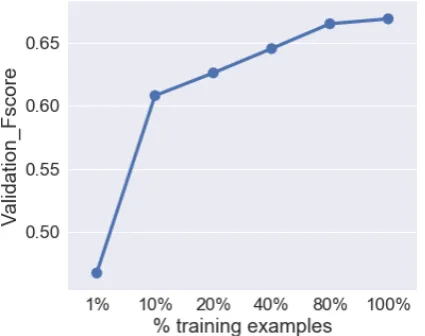
We also investigate the impact of training data size on model accuracy. For this purpose, we train models with different data sizes with the best pa-rameter settings shown in Table 2 6. Figure 3 shows the impact of different percentages of train-ing examples on model performance. We test
6Due to the high computational cost of training these
[image:4.595.74.287.397.605.2]Test Example True Predicted Train Example True I’m [#TRIGGERWORD#]
that like none of
my friends at school have seen national lamoon’s day
disgust sad
[#TRIGGERWORD#]
that like none of
my videos from last night ..
sad
hey luke! I’m so [#TRIGGERWORD#]
because you don’t follow me, not lies,
but please follow me
anger sad
i’m so
[#TRIGGERWORD#]
because you don’t follow me
[image:5.595.139.455.61.197.2]sad
Table 4: Examples overlapping lexical sequences in test and training data.
model performance for this analysis on our vali-dation data.
Interestingly, as Figure3shows, the model ex-ceeds the baseline model reported by the task or-ganizers (Klinger et al., 2018) when trained on only 10% of the training data. Additionally, the model outperforms the fastText and ELMo mod-els by only seeing40%of the training data. Once the model has access to80%of the training data, its gains start to increase relatively slowly. In ad-dition to the positive, yet unsurprising, impact that training data size has on performance, the results also reflect the utility of employing the pre-trained language model.
Figure 3: Impact of training data size on model per-formance, tested on our validation data. Results inF -score.
In order to further inspect this observation re-garding the impact of language modeling, we use the same architecture reported in Table2to train a classifier that does not have access to the pre-trained LM. We find the classifier to achieve only
63.8F-score. Again, this demonstrates the
advan-tage of using the pra-trained LM.
6 Negative Experiments
We performed a number of negative experiments that we report briefly here. Our intuition is that training our models with Twitter-specific data should help classification. For this reason, we trained ULMFiT with4.5million tweets with the same settings reported in Table2. We did not find this set of experiments to yield gains over the re-sults reported in Table 3, however. For example, an Fwd LM trained on Twitter domain data yields
67.9% F-score, which is 1.4% less than the F-score obtained by the Wikipedia-trained Fwd LM in3. The loss might be due to the smaller size of the Twitter data we train on, as compared to the Wikipedia data the ULMFiT is originally trained on (i.e.,>103million tokens).
7 Conclusion
[image:5.595.72.285.442.610.2]8 Acknowledgement
We acknowledge the support of the Natural Sciences and Engineering Research Council of Canada (NSERC). The research was enabled in part by support provided by WestGrid (https:
//www.westgrid.ca/) and Compute Canada
(www.computecanada.ca).
References
Muhammad Abdul-Mageed and Lyle Ungar. 2017. Emonet: Fine-grained emotion detection with gated recurrent neural networks. In Proceedings of the 55th Annual Meeting of the Association for Compu-tational Linguistics (Volume 1: Long Papers), vol-ume 1, pages 718–728.
Hassan Alhuzali, Muhammad Abdul-Mageed, and Lyle Ungar. 2018. Enabling deep learning of emo-tion with first-person seed expressions. In Pro-ceedings of the Second Workshop on Computational Modeling of Peoples Opinions, Personality, and Emotions in Social Media, pages 25–35.
Saima Aman and Stan Szpakowicz. 2007. Identifying expressions of emotion in text. InText, Speech and Dialogue, pages 196–205. Springer.
Piotr Bojanowski, Edouard Grave, Armand Joulin, and Tomas Mikolov. 2016. Enriching word vec-tors with subword information. arXiv preprint arXiv:1607.04606.
Venkatesh Duppada, Royal Jain, and Sushant Hiray. 2018. Seernet at semeval-2018 task 1: Domain adaptation for affect in tweets. arXiv preprint arXiv:1804.06137.
P. Ekman. 1972. Universal and cultural differences in facial expression of emotion. Nebraska Symposium on Motivation, pages 207–283.
Bjarke Felbo, Alan Mislove, Anders Søgaard, Iyad Rahwan, and Sune Lehmann. 2017. Using millions of emoji occurrences to learn any-domain represen-tations for detecting sentiment, emotion and sar-casm. InConference on Empirical Methods in Nat-ural Language Processing (EMNLP).
Jeremy Howard and Sebastian Ruder. 2018. Fine-tuned language models for text classification. arXiv preprint arXiv:1801.06146.
Diederik Kingma and Jimmy Ba. 2014. Adam: A method for stochastic optimization. arXiv preprint arXiv:1412.6980.
Roman Klinger, Orph´ee de Clercq, Saif M. Moham-mad, and Alexandra Balahur. 2018. Iest: Wassa-2018 implicit emotions shared task. InProceedings of the 9th Workshop on Computational Approaches to Subjectivity, Sentiment and Social Media Anal-ysis, Brussels, Belgium. Association for Computa-tional Linguistics.
Bryan McCann, James Bradbury, Caiming Xiong, and Richard Socher. 2017. Learned in translation: Con-textualized word vectors. InAdvances in Neural In-formation Processing Systems, pages 6297–6308.
Tomas Mikolov, Ilya Sutskever, Kai Chen, Greg S Cor-rado, and Jeff Dean. 2013. Distributed representa-tions of words and phrases and their compositional-ity. InAdvances in neural information processing systems, pages 3111–3119.
Mike Mintz, Steven Bills, Rion Snow, and Dan Juraf-sky. 2009. Distant supervision for relation extrac-tion without labeled data. In Proceedings of the Joint Conference of the 47th Annual Meeting of the ACL and the 4th International Joint Conference on Natural Language Processing of the AFNLP: Vol-ume 2-VolVol-ume 2, pages 1003–1011. Association for Computational Linguistics.
Saif M Mohammad and Svetlana Kiritchenko. 2015. Using hashtags to capture fine emotion cate-gories from tweets. Computational Intelligence, 31(2):301–326.
Jeffrey Pennington, Richard Socher, and Christopher D Manning. 2014. Glove: Global vectors for word representation. InEMNLP, volume 14, pages 1532– 1543.
Matthew E Peters, Mark Neumann, Mohit Iyyer, Matt Gardner, Christopher Clark, Kenton Lee, and Luke Zettlemoyer. 2018. Deep contextualized word rep-resentations. arXiv preprint arXiv:1802.05365.
Carlo Strapparava and Rada Mihalcea. 2007. Semeval-2007 task 14: Affective text. In Proceedings of the 4th International Workshop on Semantic Evalu-ations, pages 70–74. Association for Computational Linguistics.
Svitlana Volkova and Yoram Bachrach. 2016. Inferring perceived demographics from user emotional tone and user-environment emotional contrast. In Pro-ceedings of the 54th Annual Meeting of the Associa-tion for ComputaAssocia-tional Linguistics, ACL.
Wenbo Wang, Lu Chen, Krishnaprasad Thirunarayan, and Amit P Sheth. 2012. Harnessing twitter” big data” for automatic emotion identification. In